


EN 61051-1:2008
(Main)Varistors for use in electronic equipment - Part 1: Generic specification
General Information
- Abstract
It is applicable to varistors with symmetrical voltage current characteristics for use in electronic equipment. It establishes standard terms, inspection procedures and methods of test for use in sectional and detail specifications for Qualification Approval and for Quality Assessment Systems for electronic components.
- Status
- Withdrawn
- Publication Date
- 04-Nov-2008
- Withdrawal Date
- 30-Sep-2011
- Technical Committee
- CLC/SR 40 - Capacitors and resistors for electronic equipment
- Drafting Committee
- IEC/TC 40 - IEC_TC_40
- Parallel Committee
- IEC/TC 40 - IEC_TC_40
- Current Stage
- 9960 - Withdrawal effective - Withdrawal
- Start Date
- 03-Dec-2021
- Completion Date
- 03-Dec-2021



Relations
- Replaced By
EN IEC 61051-1:2018 - Varistors for use in electronic equipment - Part 1: Generic specification - Effective Date
- 23-Aug-2016
- Effective Date
- 10-Feb-2026
- Effective Date
- 10-Feb-2026
- Effective Date
- 09-Feb-2026
- Effective Date
- 09-Feb-2026
- Effective Date
- 09-Feb-2026
- Effective Date
- 09-Feb-2026
- Effective Date
- 09-Feb-2026
- Effective Date
- 09-Feb-2026
- Effective Date
- 03-Feb-2026
- Effective Date
- 03-Feb-2026
- Effective Date
- 03-Feb-2026
- Refers
EN 60068-2-78:2001 - Environmental testing - Part 2-78: Tests - Test Cab: Damp heat, steady state - Effective Date
- 03-Feb-2026
- Effective Date
- 03-Feb-2026
- Effective Date
- 03-Feb-2026
Frequently Asked Questions
EN 61051-1:2008 is a standard published by CLC. Its full title is "Varistors for use in electronic equipment - Part 1: Generic specification". This standard covers: It is applicable to varistors with symmetrical voltage current characteristics for use in electronic equipment. It establishes standard terms, inspection procedures and methods of test for use in sectional and detail specifications for Qualification Approval and for Quality Assessment Systems for electronic components.
It is applicable to varistors with symmetrical voltage current characteristics for use in electronic equipment. It establishes standard terms, inspection procedures and methods of test for use in sectional and detail specifications for Qualification Approval and for Quality Assessment Systems for electronic components.
EN 61051-1:2008 is classified under the following ICS (International Classification for Standards) categories: 31.040.99 - Other resistors. The ICS classification helps identify the subject area and facilitates finding related standards.
EN 61051-1:2008 has the following relationships with other standards: It is inter standard links to EN IEC 61051-1:2018, ISO 1000:1992, IEC 60027-1:1992, EN ISO 10077-1:2000, CEN/TS 13126-8:2004, EN 13059:2002, EN 1527:1998, EN 13523-23:2002, EN ISO 14272:2001, EN 60068-1:1994, EN 61249-2-7:2002, EN 60068-2-45:1992, EN 60068-2-78:2001, EN 60060-2:1994, EN 60068-2-6:1995. Understanding these relationships helps ensure you are using the most current and applicable version of the standard.
EN 61051-1:2008 is available in PDF format for immediate download after purchase. The document can be added to your cart and obtained through the secure checkout process. Digital delivery ensures instant access to the complete standard document.
Standards Content (Sample)
SLOVENSKI STANDARD
01-januar-2009
Varistorji za elektronsko opremo - 1. del: Rodovna specifikacija (IEC 61051-
1:2007)
Varistors for use in electronic equipement - Part 1: Generic specification (IEC 61051-
1:2007)
Varistoren zur Verwendung in Geräten der Elektronik - Teil 1: Fachgrundspezifikation
(IEC 61051-1:2007)
Varistances utilisées dans les équipements électroniques - Partie 1: Spécification
générique (CEI 61051-1:2007)
Ta slovenski standard je istoveten z: EN 61051-1:2008
ICS:
31.040.99 Drugi upori Other resistors
2003-01.Slovenski inštitut za standardizacijo. Razmnoževanje celote ali delov tega standarda ni dovoljeno.
EUROPEAN STANDARD
EN 61051-1
NORME EUROPÉENNE
November 2008
EUROPÄISCHE NORM
ICS 31.040.99 Supersedes CECC 42 000:1978
English version
Varistors for use in electronic equipement -
Part 1: Generic specification
(IEC 61051-1:2007)
Varistances utilisées Varistoren zur Verwendung
dans les équipements électroniques - in Geräten der Elektronik -
Partie 1: Spécification générique Teil 1: Fachgrundspezifikation
(CEI 61051-1:2007) (IEC 61051-1:2007)
This European Standard was approved by CENELEC on 2008-10-01. CENELEC members are bound to comply
with the CEN/CENELEC Internal Regulations which stipulate the conditions for giving this European Standard
the status of a national standard without any alteration.
Up-to-date lists and bibliographical references concerning such national standards may be obtained on
application to the Central Secretariat or to any CENELEC member.
This European Standard exists in three official versions (English, French, German). A version in any other
language made by translation under the responsibility of a CENELEC member into its own language and notified
to the Central Secretariat has the same status as the official versions.
CENELEC members are the national electrotechnical committees of Austria, Belgium, Bulgaria, Cyprus, the
Czech Republic, Denmark, Estonia, Finland, France, Germany, Greece, Hungary, Iceland, Ireland, Italy, Latvia,
Lithuania, Luxembourg, Malta, the Netherlands, Norway, Poland, Portugal, Romania, Slovakia, Slovenia, Spain,
Sweden, Switzerland and the United Kingdom.
CENELEC
European Committee for Electrotechnical Standardization
Comité Européen de Normalisation Electrotechnique
Europäisches Komitee für Elektrotechnische Normung
Central Secretariat: rue de Stassart 35, B - 1050 Brussels
© 2008 CENELEC - All rights of exploitation in any form and by any means reserved worldwide for CENELEC members.
Ref. No. EN 61051-1:2008 E
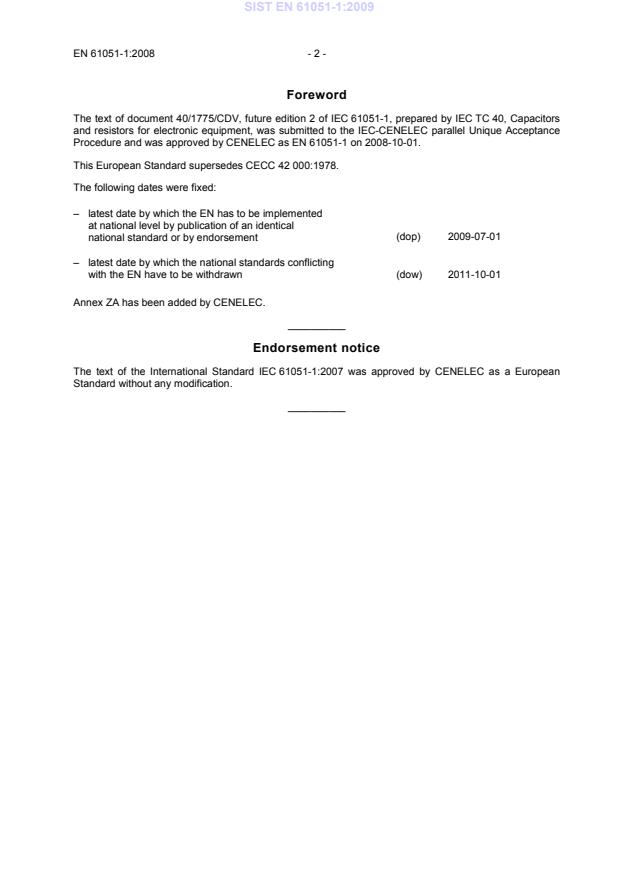
Foreword
The text of document 40/1775/CDV, future edition 2 of IEC 61051-1, prepared by IEC TC 40, Capacitors
and resistors for electronic equipment, was submitted to the IEC-CENELEC parallel Unique Acceptance
Procedure and was approved by CENELEC as EN 61051-1 on 2008-10-01.
This European Standard supersedes CECC 42 000:1978.
The following dates were fixed:
– latest date by which the EN has to be implemented
at national level by publication of an identical
national standard or by endorsement (dop) 2009-07-01
– latest date by which the national standards conflicting
(dow) 2011-10-01
with the EN have to be withdrawn
Annex ZA has been added by CENELEC.
__________
Endorsement notice
The text of the International Standard IEC 61051-1:2007 was approved by CENELEC as a European
Standard without any modification.
__________
- 3 - EN 61051-1:2008
Annex ZA
(normative)
Normative references to international publications
with their corresponding European publications
The following referenced documents are indispensable for the application of this document. For dated
references, only the edition cited applies. For undated references, the latest edition of the referenced
document (including any amendments) applies.
NOTE When an international publication has been modified by common modifications, indicated by (mod), the relevant EN/HD
applies.
Publication Year Title EN/HD Year
IEC 60027 Series Letter symbols to be used in electrical EN 60027 Series
technology
IEC 60050 Series International Electrotechnical Vocabulary - -
(IEV)
IEC 60060-2 1994 High-voltage test techniques - EN 60060-2 1994
Part 2: Measuring systems
IEC 60062 2004 Marking codes for resistors and capacitors EN 60062 2005
+ corr. January 2007
IEC 60068-1 1988 Environmental testing -
+ corr. October 1988 Part 1: General and guidance
+ A1 1992 EN 60068-1 1994
IEC 60068-2-1 2007 Environmental testing - EN 60068-2-1 2007
Part 2-1: Tests - Test A: Cold
1)
IEC 60068-2-2 1974 Environmental testing - EN 60068-2-2 1993
A1 1993 Part 2: Tests - Tests B: Dry heat A1 1993
A2 1994 A2 1994
2)
IEC 60068-2-6 1995 Environmental testing - EN 60068-2-6 1995
Part 2: Tests - Test Fc: Vibration (sinusoidal)
IEC 60068-2-13 1983 Environmental testing - EN 60068-2-13 1999
Part 2: Tests - Test M: Low air pressure
IEC 60068-2-14 1984 Environmental testing -
+ A1 1986 Part 2: Tests - Test N: Change of temperature EN 60068-2-14 1999
IEC 60068-2-20 1979 Environmental testing -
3)
+ A2 1987 Part 2: Tests - Test T: Soldering HD 323.2.20 S3 1988
IEC 60068-2-21 2006 Environmental testing - EN 60068-2-21 2006
Part 2-21: Tests - Test U: Robustness of
terminations and integral mounting devices
IEC 60068-2-27 1987 Environmental testing - EN 60068-2-27 1993
Part 2: Tests - Test Ea and guidance: Shock
IEC 60068-2-29 1987 Environmental testing - EN 60068-2-29 1993
Part 2: Tests - Test Eb and guidance: Bump
IEC 60068-2-30 2005 Environmental testing - EN 60068-2-30 2005
Part 2-30: Tests - Test Db: Damp heat, cyclic
(12 h + 12 h cycle)
1)
EN 60068-2-2, which includes supplement A:1976 to IEC 60068-2-2, and its amendments are superseded by EN 60068-2-2:2007,
which is based on IEC 60068-2-2:2007.
2)
EN 60068-2-6 is superseded by EN 60068-2-6:2008, which is based on IEC 60068-2-6:2007.
3)
HD 323.2.20 S3 is superseded by EN 60068-2-20:2008, which is based on IEC 60068-2-20:2008.
Publication Year Title EN/HD Year
IEC 60068-2-45 1980 Environmental testing - EN 60068-2-45 1992
Part 2: Tests - Test XA and guidance:
Immersion in cleaning solvents
IEC 60068-2-54 2006 Environmental testing - EN 60068-2-54 2006
Part 2-54: Tests - Test Ta: Solderability
testing of electronic components by the
wetting balance method
IEC 60068-2-58 2004 Environmental testing - EN 60068-2-58 2004
Part 2-58: Tests - Test Td: Test methods for + corr. December 2004
solderability, resistance to dissolution of
metallization and to soldering heat of surface
mounting devices (SMD)
4)
IEC 60068-2-69 1995 Environmental testing - EN 60068-2-69 1996
Part 2: Tests - Test Te: Solderability testing of
electronic components for surface mount
technology by the wetting balance method
IEC 60068-2-78 2001 Environmental testing - EN 60068-2-78 2001
Part 2-78: Tests - Test Cab: Damp heat,
steady state
IEC 60294 1969 Measurement of the dimensions of a - -
cylindrical component having two axial
terminations
IEC 60410 1973 Sampling plans and procedures for inspection - -
by attributes
IEC 60617 Data- Graphical symbols for diagrams - -
base
IEC 60695-11-5 2004 Fire hazard testing - EN 60695-11-5 2005
Part 11-5: Test flames - Needle-flame test
method - Apparatus, confirmatory test
arrangement and guidance
IEC 60717 1981 Method for the determination of the space - -
required by capacitors and resistors with
unidirectional terminations
IEC 61249-2-7 2002 Materials for printed boards and other EN 61249-2-7 2002
interconnecting structures - + corr. September 2005
Part 2-7: Reinforced base materials, clad and
unclad - Epoxide woven E-glass laminated
sheet of defined flammability (vertical burning
test), copper-clad
5)
IEC QC 001002-3 - IEC Quality Assessment System for Electronic - -
Components (IECQ) - Rules of Procedure -
Part 3: Approval procedures
ISO 1000 1992 SI units and recommendations for the use of - -
A1 1998 their multiples and of certain other units
4)
EN 60068-2-69 is superseded by EN 60068-2-69:2007, which is based on IEC 60068-2-69:2007.
5)
Undated reference.
INTERNATIONAL IEC
STANDARD 61051-1
QC 420000
Second edition
2007-04
Varistors for use in electronic equipment –
Part 1:
Generic specification
PRICE CODE
Commission Electrotechnique Internationale V
International Electrotechnical Commission
МеждународнаяЭлектротехническаяКомиссия
For price, see current catalogue
– 2 – 61051-1 © IEC:2007(E)
CONTENTS
FOREWORD.5
1 General .7
1.1 Scope.7
1.2 Object .7
1.3 Normative references .7
2 Technical data.8
2.1 Units, symbols and terminology .8
2.2 Terms and definitions .9
2.3 Preferred values and characteristics.13
2.4 Marking .13
2.4.1 General .13
2.4.2 Coding.14
3 Quality assessment procedures.14
3.1 Qualification approval/quality assessment systems .14
3.2 Primary stage of manufacture.14
3.3 Structurally similar components.14
3.4 Qualification approval procedures .15
3.5 Quality conformance inspection.15
3.5.1 Certified records of released lots .15
3.5.2 Delayed delivery.15
3.5.3 Release for delivery before the completion of Group B tests .16
3.6 Alternative test methods .16
3.7 Unchecked parameters.16
4 Test and measurement procedures.16
4.1 General .16
4.2 Standard atmospheric conditions.16
4.2.1 Standard atmospheric conditions for testing .16
4.2.2 Recovery conditions .17
4.2.3 Referee conditions .17
4.2.4 Reference conditions.17
4.3 Drying and recovery .17
4.4 Visual examination and check of dimensions.18
4.4.1 Visual examination .18
4.4.2 Marking .18
4.4.3 Dimensions (gauging).18
4.4.4 Dimensions (detail).18
4.5 Nominal varistor voltage or leakage current (not applicable to pulse
measurements) .
4.5.1 Test procedure .18
4.5.2 Measurement and requirements.18
4.6 Pulse current.18
4.6.1 Standard pulse currents.19
4.6.2 Tolerances .19
4.6.3 Measurement of the pulse current .19
4.7 Voltage under pulse condition .19
4.8 Capacitance .20
61051-1 © IEC:2007(E) – 3 –
4.9 Voltage proof (for insulated varistors only) .20
4.9.1 V-block method .20
4.9.2 Metal ball method .20
4.9.3 Foil method .21
4.10 Insulation resistance (for insulated varistors only) .21
4.10.1 Test procedure .21
4.10.2 Measurement and requirements.21
4.11 Robustness of terminations .22
4.11.1 General .22
4.11.2 Test Ua – Tensile .22
4.11.3 Test Ub – Bending (half of the number of terminations) .22
4.11.4 Test Uc – Torsion (other half of the number of terminations).22
4.11.5 Test Ud – Torque (for terminations with threaded studs or screws
and for integral mounting devices) .22
4.11.6 Visual examination .22
4.11.7 Final measurement .22
4.12 Resistance to soldering heat .23
4.12.1 Preconditioning.23
4.12.2 Test procedure .23
4.12.3 Recovery .23
4.12.4 Final inspection, measurement and requirements .23
4.13 Solderability .23
4.13.1 Test procedure .23
4.13.2 Final inspection, measurements and requirements .24
4.14 Rapid change of temperature .24
4.14.1 Initial measurement .24
4.14.2 Test procedure .24
4.14.3 Final inspection, measurement and requirements .24
4.15 Bump .25
4.15.1 Initial measurement .25
4.15.2 Test procedure .25
4.15.3 Final inspection, measurement and requirements .25
4.16 Shock.25
4.16.1 Initial measurement .25
4.16.2 Test procedure .25
4.16.3 Final inspection, measurement and requirements .25
4.17 Vibration.25
4.17.1 Initial measurement .25
4.17.2 Test procedure .26
4.17.3 Final inspection, measurement and requirements .26
4.18 Climatic sequence .26
4.18.1 Initial measurement .26
4.18.2 Dry heat .26
4.18.3 Damp heat, cyclic, Test Db, first cycle .26
4.18.4 Cold .26
4.18.5 Low air pressure.26
4.18.6 Damp heat, cyclic, Test Db, remaining cycles .26
4.18.7 Final inspection, measurement and requirements .27
4.19 Damp heat, steady state.27
– 4 – 61051-1 © IEC:2007(E)
4.19.1 Initial measurement .27
4.19.2 Test procedure .27
4.19.3 Final inspection, measurement and requirements .27
4.20 Fire hazard.28
4.21 Endurance at upper category temperature.28
4.22 Solvent resistance of marking.29
4.22.1 Test procedure .29
4.22.2 Requirements .29
4.23 Component solvent resistance.29
4.23.1 Initial measurements .29
4.23.2 Test procedure .29
4.23.3 Measurement and requirements.30
4.24 Mounting (for surface mount varistors only) .30
Annex A (normative) Mounting for measurements of varistors.32
Annex B (normative) Interpretation of sampling plans and procedures as described in
IEC 60410 for use within the IEC quality assessment system for electronic components.34
Annex C (normative) Rules for the preparation of detail specifications for capacitors
and resistors for electronic equipment .35
Figure 1 – Shape of pulse current type 1 .11
Figure 2 – Shape of pulse current type 2 .12
Figure A.1 – Mounting methods for measurements .32
Figure A.2 – Mounting method for measurements of surface mount varistors .33
Table 1 – Standard atmospheric conditions.17
Table 2 – Accepted differences between specified and recorded pulse current values .19
Table 3 – Force for wire terminations .22
Table 4 – Torque .22
Table 5 – Number of cycles .27
61051-1 © IEC:2007(E) – 5 –
INTERNATIONAL ELECTROTECHNICAL COMMISSION
____________
VARISTORS FOR USE IN ELECTRONIC EQUIPMENT –
Part 1: Generic specification
FOREWORD
1) The International Electrotechnical Commission (IEC) is a worldwide organization for standardization comprising
all national electrotechnical committees (IEC National Committees). The object of IEC is to promote
international co-operation on all questions concerning standardization in the electrical and electronic fields. To
this end and in addition to other activities, IEC publishes International Standards, Technical Specifications,
Technical Reports, Publicly Available Specifications (PAS) and Guides (hereafter referred to as “IEC
Publication(s)”). Their preparation is entrusted to technical committees; any IEC National Committee interested
in the subject dealt with may participate in this preparatory work. International, governmental and non-
governmental organizations liaising with the IEC also participate in this preparation. IEC collaborates closely
with the International Organization for Standardization (ISO) in accordance with conditions determined by
agreement between the two organizations.
2) The formal decisions or agreements of IEC on technical matters express, as nearly as possible, an international
consensus of opinion on the relevant subjects since each technical committee has representation from all
interested IEC National Committees.
3) IEC Publications have the form of recommendations for international use and are accepted by IEC National
Committees in that sense. While all reasonable efforts are made to ensure that the technical content of IEC
Publications is accurate, IEC cannot be held responsible for the way in which they are used or for any
misinterpretation by any end user.
4) In order to promote international uniformity, IEC National Committees undertake to apply IEC Publications
transparently to the maximum extent possible in their national and regional publications. Any divergence
between any IEC Publication and the corresponding national or regional publication shall be clearly indicated in
the latter.
5) IEC provides no marking procedure to indicate its approval and cannot be rendered responsible for any
equipment declared to be in conformity with an IEC Publication.
6) All users should ensure that they have the latest edition of this publication.
7) No liability shall attach to IEC or its directors, employees, servants or agents including individual experts and
members of its technical committees and IEC National Committees for any personal injury, property damage or
other damage of any nature whatsoever, whether direct or indirect, or for costs (including legal fees) and
expenses arising out of the publication, use of, or reliance upon, this IEC Publication or any other IEC
Publications.
8) Attention is drawn to the Normative references cited in this publication. Use of the referenced publications is
indispensable for the correct application of this publication.
9) Attention is drawn to the possibility that some of the elements of this IEC Publication may be the subject of
patent rights. IEC shall not be held responsible for identifying any or all such patent rights.
International Standard IEC 61051-1 has been prepared by IEC technical committee 40:
Capacitors and resistors for electronic equipment.
This second edition cancels and replaces the first edition published in 1991 and constitutes a
minor revision related to tables, figures and references.
The text of this standard is based on the following documents:
CDV Report on voting
40/1775/CDV 40/1841/RVC
Full information on the voting for the approval of this standard can be found in the report on
voting indicated in the above table.
The QC number that appears on the front cover of this publication is the specification number
in the IEC Quality Assessment System for Electronic Components (IECQ).
– 6 – 61051-1 © IEC:2007(E)
This publication has been drafted in accordance with the ISO/IEC Directives, Part 2.
The list of all the parts of the IEC 61051 series, under the general title Varistors for use in
electronic equipment, can be found on the IEC website.
The committee has decided that the contents of this publication will remain unchanged until
the maintenance result date indicated on the IEC web site under "http://webstore.iec.ch" in
the data related to the specific publication. At this date, the publication will be
• reconfirmed,
• withdrawn,
• replaced by a revised edition, or
• amended.
A bilingual version of this publication may be issued at a later date.
61051-1 © IEC:2007(E) – 7 –
VARISTORS FOR USE IN ELECTRONIC EQUIPMENT –
Part 1: Generic specification
1 General
1.1 Scope
This part of IEC 61051 is applicable to varistors with symmetrical voltage-current
characteristics for use in electronic equipment.
1.2 Object
The object of this standard is to establish standard terms, inspection procedures and methods
of test for use in sectional and detail specifications for Qualification Approval and for Quality
Assessment Systems for electronic components.
1.3 Normative references
The following referenced documents are indispensable for the application of this document.
For dated references, only the edition cited applies. For undated references, the latest edition
of the referenced document (including any amendments) applies.
IEC 60027 (all parts), Letter symbols to be used in electrical technology
IEC 60050 (all parts), International Electrotechnical Vocabulary (IEV)
IEC 60060-2:1994, High-voltage test techniques – Part 2: Measuring systems
IEC 60062:2004, Marking codes for resistors and capacitors.
IEC 60068-1:1988, Environmental testing – Part 1: General and guidance
Amendment 1 (1992)
IEC 60068-2-1:2007, Environmental testing – Part 2: Tests – Test A: Cold
IEC 60068-2-2:1974, Environmental testing – Part 2: Tests – Tests B: Dry heat
Amendment 1 (1993)
Amendment 2 (1994)
IEC 60068-2-6:1995, Environmental testing – Part 2: Tests – Test Fc and guidance: Vibration
(Sinusoidal)
IEC 60068-2-13:1983, Environmental testing – Part 2: Tests – Test M: Low air pressure
IEC 60068-2-14:1984, Environmental testing – Part 2: Tests – Test N: Change of temperature
Amendment 1 (1986)
IEC 60068-2-20:1979, Environmental testing – Part 2: Tests – Test T: Soldering
Amendment 2 (1987)
IEC 60068-2-21:2006, Environmental testing – Part 2-21: Tests – Test U: Robustness of
terminations and integral mounting devices
IEC 60068-2-27:1987, Environmental testing – Part 2: Tests – Test Ea and guidance: Shock
– 8 – 61051-1 © IEC:2007(E)
IEC 60068-2-29:1987, Environmental testing – Part 2: Tests – Test Eb and guidance: Bump
IEC 60068-2-30:2005, Environmental testing – Part 2-30: Tests – Test Db and guidance:
Damp heat, cyclic (12 h + 12-hour cycle)
IEC 60068-2-45:1980, Environmental testing – Part 2: Tests – Test XA and guidance –
Immersion in cleaning solvents
IEC 60068-2-54:2005, Environmental testing – Part 2-54: Tests – Test Ta: Solderability
testing of electronic components by the wetting balance method
IEC 60068-2-58:2004, Environmental testing – Part 2-58: Tests – Test Td: Test methods for
solderability, resistance to dissolution of metallization and to soldering heat of surface
mounting devices (SMD)
IEC 60068-2-69:1995, Environmental testing – Part 2: Tests – Test Te: Solderability testing of
electronic components for surface mount technology by the wetting balance method
IEC 60068-2-78:2001, Environmental testing – Part 2-78: Tests – Test Cab: Damp heat,
steady state
IEC 60294:1969, Measurement of the dimensions of a cylindrical component having two axial
terminations
IEC 60410:1973, Sampling plans and procedures for inspection by attributes
IEC 60617:2007, Graphical symbols for diagrams
IEC 60695-11-5:2004, Fire hazard testing – Part 11-5: Test flames – Needle-flame test
method – Apparatus, confirmatory test arrangement and guidance
IEC 60717:1981, Method for the determination of the space required by capacitors and
resistors with unidirectional terminations
IEC 61249-2-7:2002, Materials for printed boards and other interconnecting structures – Part
2-7: Reinforced base materials clad and unclad – Epoxide woven E-glass laminated sheet of
defined flammability (vertical burning test) copper-clad
IEC QC 001002-3, see http://www.iecq.org
ISO 1000:1992, SI units and recommendations for the use of their multiples and of certain
other units
Amendment 1 (1998)
2 Technical data
2.1 Units, symbols and terminology
Units, graphical symbols, letter symbols and terminology shall, whenever possible be taken
from the following publications:
IEC 60027
IEC 60050
IEC 60617
ISO 1000
61051-1 © IEC:2007(E) – 9 –
When further items are required they shall be derived in accordance with the principles of the
documents listed above.
2.2 Terms and definitions
For the purposes of this document, the following terms and definitions apply.
2.2.1
type
group of components having similar design features and the similarity of whose manufacturing
techniques enables them to be grouped together either for qualification approval or for quality
conformance inspection
They are generally covered by a single detail specification.
NOTE Components described in several detail specifications may, in some cases, be considered as belonging to
the same type and may therefore be grouped together for approval and quality conformance inspection.
2.2.2
style
subdivision of a type, generally based on dimensional factors which may include several
variants, generally of a mechanical order
2.2.3
varistor (voltage dependent resistor, VDR) (graphical symbol Z)
component, whose conductance, at a given temperature, increases rapidly with voltage. This
property is expressed by either of the following formulae:
β
U = CI (1)
or
γ
I = AU (2)
where
I is the current flowing through the varistor;
U is the voltage applied across the varistor;
β is the current index;
γ is the voltage index;
A and C are constants.
2.2.4
non-linearity current index β
starting from formula (1) of 1.5.3, it is defined by the formula:
I dU
β = × (3)
U d I
For the convenience of calculation, the following formula may be used:
Ig (U /U )
1 2
β = (4)
Ig (I /I )
1 2
β is always less than 1.
2.2.5
non-linearity voltage index γ
starting from formula (2) of 1.5.3, it is defined by the formula:
– 10 – 61051-1 © IEC:2007(E)
U d I
β = × (5)
I dU
For the convenience of calculation, the following formula may be used:
lg (I /I )
1 2
γ = (6)
lg (U /U )
1 2
γ is always greater than 1.
2.2.6
maximum continuous a.c. voltage
maximum a.c. r.m.s. voltage of a substantially sinusoidal waveform (less then 5 % total
harmonic distortion) which can be applied to the component under continuous operating
conditions at 25 °C. At temperatures greater than 25 °C the detail specification must give full
information on derating requirements.
Normally this voltage value shall be 1,1 times the supply voltage.
2.2.7
maximum continuous d.c. voltage
maximum d.c. voltage (with less than 5 % ripple) which can be applied to the component
under continuous operating conditions at an ambient temperature of 25 °C. At temperatures
greater than 25 °C the detail specification must give full information on derating requirements.
2.2.8
supply voltage
voltage by which the system is designated and to which certain operating characteristics of
the system are referred
2.2.9
nominal varistor voltage
voltage, at specified d.c. current, used as a reference point in the component characteristic
2.2.10
voltage-under-pulse conditions
peak value of the voltage, which appears at the terminations of the varistor, when a specified
current pulse is applied to it
2.2.11
clamping voltage
peak voltage developed across the varistor terminations under standard atmospheric
conditions, when passing an 8/20 class current pulse (see 1.5.15)
2.2.12
isolation voltage (applicable only to insulated varistors)
maximum peak voltage, which may be applied under continuous operating conditions between
the varistor terminations and any conducting mounting surface
2.2.13
leakage current
current passing through the varistor at the maximum d.c. voltage and at a temperature of
25 °C or at any other specified temperature
2.2.14
maximum peak current
maximum current per pulse, which may be passed by a varistor at an ambient temperature of
25 °C, for a given number of pulses
61051-1 © IEC:2007(E) – 11 –
2.2.15
class current
peak value of current, which is 1/10 of the maximum peak current for 100 pulses at two per
minute for the 8/20 pulse
2.2.16
pulse or impulse
unidirectional wave of voltage or current without appreciable oscillations
NOTE In IEC 60060-2, the word "impulse" is used; however, for this specification, only the word "pulse" is used.
2.2.17
pulse currents
two types of pulse currents are used:
1. The first type has a shape which increases from zero to a peak value in a short time,
and thereafter decreases to zero either approximately exponentially or in the manner
of a heavily damped sine curve. This type is defined by the virtual front time T and
the virtual time to half-value T ; see Figure 1. The pulse voltage of combination pulse
(see 2.2.29) has a similar shape.
% peak
current
O
T Time (linear
scale)
T
T
T
IEC 425/07
Figure 1 – Shape of pulse current type 1
2. The second type has an approximately rectangular shape and is defined by the virtual
duration of the peak and the virtual total duration; see Figure 2.
– 12 – 61051-1 © IEC:2007(E)
% peak
current
T
D
Possible polarity
T
reversal
T
IEC 426/07
T Virtual duration of peak current
D
T Virtual total duration
T
Figure 2 – Shape of pulse current type 2
2.2.18
value of the pulse current
pulse current is normally defined by its peak value. With some test circuits, overshoot or
oscillations may be present on the current. The pulse current shall be defined by a smooth
curve drawn through the oscillations provided the peaks of the oscillations comply with 4.6.2
2.2.19
virtual front time T
virtual front time T of a pulse current is 1,25 times the interval between the instants when the
pulse is 10 % and 90 % of its peak value. The virtual front time T of a pulse voltage is 1,67
times the interval between the instants when the pulse is 30 % and 90 % of its peak value
2.2.20
virtual origin O
virtual origin O of a pulse current is the instant preceding at which the current is 10 % of its
peak value by a time 0,1 × T . The virtual origin O of a pulse voltage is the instant preceding
1 1
that at which the voltage is 30 % of its peak value by a time 0,3 × T .
For oscillograms having linear time sweeps, this is the intersection with the X-axis of a
straight line drawn through the 10 % (30 %, in case of pulse voltage) and 90 % reference
points on the front.
2.2.21
virtual time to half-value T
virtual time to half-value T of a pulse current or pulse voltage is the time interval between the
virtual origin and the instant on the tail at which the current has first decreased to half its peak
value
2.2.22
virtual duration of peak of a rectangular pulse current t
d
time during which the current is greater than 90 % of its peak value
61051-1 © IEC:2007(E) – 13 –
2.2.23
virtual total duration t of a pulse current
t
time during which the amplitude of the pulse is greater than 10 % of its peak value. If
oscillations are present on the front, a mean curve should be drawn in order to determine the
time at which the 10 % value is reached
2.2.24
category temperature range
range of ambient temperatures for which the varistor is designed to operate continuously; this
is defined by the temperature limits of its appropriate climatic category
2.2.25
upper category temperature
maximum ambient temperature for which a varistor has been designed to operate
continuously:
– either, for varistors of metal oxide construction, at that portion of the maximum
continuous a.c. or d.c. voltage which is indicated in the derating curve given in the detail
specification;
– or, if appropriate, for varistors of silicon carbide construction, at that portion of the rated
dissipation which is indicated in the category dissipation
2.2.26
lower category temperature
minimum ambient temperature at which a varistor has been designed to operate continuously
2.2.27
thermal resistance
ratio between the temperature rise of the element of the varistor above the ambient
temperature and the applied power
2.2.28
rated dissipation
maximum allowable dissipation at an ambient temperature of 25 °C
2.2.29
combination pulse
pulse with voltage waveform of 1,2/50 (T /T ) and current waveform of 8/20 (T /T ), which is
1 2 1 2
expressed by “peak voltage/peak current”
2.3 Preferred values and characteristics
Each sectional specification shall prescribe the preferred values appropriate to the subfamily,
covered by that sectional specification.
2.4 Marking
2.4.1 General
The information given in the marking is normally selected from the following list; the relative
importance of each item being indicated by its position in the list:
a) maximum continuous a.c. voltage or nominal varistor voltage;
b) date of manufacture;
c) number of the detail specification and style reference;
d) manufacturer's name or trade mark.
– 14 – 61051-1 © IEC:2007(E)
The varistor shall be clearly marked with a) above and with as many of the remaining items as
is practicable. Any duplication of information in the marking on the varistor should be avoided.
In the case of extremely small components, the sectional specification shall prescribe the
requirements.
The package containing the varistor(s) shall be clearly marked with all the information listed
above.
Any additional marking shall be so applied that no confusion can arise.
2.4.2 Coding
When coding is used, the method shall be preferably selected from those given in IEC 60062.
3 Quality assessment procedures
3.1 Qualification approval/quality assessment systems
When these documents are being used for the purpose of a full quality assessment system
such as the IEC Quality Assessment System for Electronic Components (IECQ), with
Qualification Approval and Quality Conformance Inspection, the procedures of 3.4 and 3.5
shall be complied with.
When these documents are used outside such quality assessment systems as the IECQ
system for purposes such as design proving or type testing, the procedures and requirements
of 3.4.1 and 3.4.2 b) may be used, but the tests and parts of tests shall be applied in the order
given in the test schedules.
3.2 Primary stage of manufacture
For varistor specifications, the primary stage of manufacture is the mixing of ingredients.
3.3 Structurally similar components
Varistors within the scope of this specification may be grouped as structurally similar for the
purpose of forming inspection lots provided that the following requirements are met.
a) They shall be produced by one manufacturer on one site using essentially the same
design, materials, processes and methods
b) For electrical tests, devices having the same electrical characteristics may be grouped
provided that the element determining the characteristics is similar for all the devices
concerned
c) For environmental tests, devices having the same encapsulation, basic internal structure
and finishing processes may be grouped
d) For visual inspection (except marking) devices may be grouped if they have been made on
the same production line, have the same dimensions encapsulation and external finish.
The grouping may also be used for robustness of terminations and soldering tests where it
is convenient to group devices with different internal structures (see c) above).
e) For endurance tests, devices may be grouped if they have been made with the same
production process in the same location using the same design and differing only in
electrical characteristics. If it can be shown that one type from the group is more heavily
stressed than the others then tests on this type may be accepted for the remaining
members of the group.
61051-1 © IEC:2007(E) – 15 –
...