

EN 50065-4-3:2023
(Main)Signalling on low-voltage electrical installations in the frequency range 3 kHz to 148,5 kHz - Part 4-3: Low voltage decoupling filter - Incoming filter
General Information
- Abstract
This document applies to incoming filters used to control the coupling of signals between the utility area and the consumer area, as illustrated in Figure 1. This document defines: - the minimum impedance in the relevant frequency band(s) at both utility port and consumer port, - the minimum attenuation of unwanted signals transmitted from the utility side to the consumer side and vice versa. This document applies to incoming filters designed for single or multiphase installations. [Figure 1 - The application of incoming filter]
- Status
- Published
- Publication Date
- 23-Mar-2023
- Technical Committee
- CLC/TC 205A - Mains communicating systems
- Drafting Committee
- CLC/TC 205A/WG 12 - Filters
- Current Stage
- 6060 - Document made available - Publishing
- Start Date
- 24-Mar-2023
- Due Date
- 10-Sep-2022
- Completion Date
- 24-Mar-2023
- Directive
- 2004/22/EC - Measuring instruments


Overview
EN 50065-4-3:2023 is a European Standard developed by CLC (CENELEC) on signalling over low-voltage electrical installations in the frequency range 3 kHz to 148,5 kHz. This part, titled Low Voltage Decoupling Filter - Incoming Filter, specifies requirements for incoming filters that manage the coupling of signals between the utility network and the consumer area. The standard covers both single-phase and multiphase installations and plays a critical role in controlling the transmission of power line communication (PLC) signals, ensuring proper isolation and signal quality across boundaries.
Key Topics
Definition and Role of Incoming Filters
- Incoming filters act as boundary elements between utility and consumer circuits, controlling signal transfer while meeting strict impedance and attenuation requirements.
Electrical Characteristics
- The standard specifies minimum impedance requirements in relevant frequency bands: at least 5 Ohms on the consumer side and 20 Ohms on the utility side, depending on filter type.
- It defines the filter’s transfer function, ensuring sufficient attenuation of unwanted signals in both directions.
Filter Classifications
- Type 1: Meets both utility and consumer impedance requirements.
- Type 2: Meets only utility impedance requirements.
- Type 3: Meets only consumer impedance requirements.
Frequency Bands
- Utility side: 3 kHz to 95 kHz
- Consumer side: 95 kHz to 148,5 kHz
Electromagnetic Compatibility (EMC) and Safety
- Incoming filters are required to comply with relevant EMC immunity standards and safety specifications, referenced from the EN 50065 series.
Applications
Incoming filters standardized by EN 50065-4-3:2023 are essential for:
- Smart Metering and Smart Grids
- Ensuring reliable communication over power lines between utility companies and end-user premises, supporting advanced metering, grid monitoring, and automation.
- Residential, Commercial, and Industrial Installations
- Improving the quality of power line communication by blocking or attenuating noise and unwanted signals, protecting sensitive equipment, and maintaining compliance with EMC requirements.
- PLC Network Segmentation
- Preventing cross-talk and signal interference between adjacent network areas, enabling efficient segmentation and network design.
- Utility/Consumer Isolation
- Maintaining the integrity and security of signals within both the utility and consumer areas by ensuring proper boundary conditions.
Related Standards
EN 50065-4-3:2023 is part of a comprehensive suite of standards for power line signalling and electrical filter performance:
- EN 50065-1: General requirements, frequency bands, and electromagnetic disturbances for signalling on low-voltage installations.
- EN 50065-2-1: Immunity requirements for main communication equipment in residential, commercial, and light industrial environments.
- EN 50065-2-2: Immunity requirements in industrial environments.
- EN 50065-2-3: Immunity requirements for suppliers and distributors in the 3 kHz to 95 kHz frequency range.
- EN 50065-4-1: Generic specification for low voltage decoupling filters.
- EN 50065-4-2: Safety requirements for low voltage decoupling filters.
- EN 50065-4-7: Safety requirements for portable low voltage decoupling filters.
- EN 50065-4-4 / 4-5 / 4-6: Specifications for other types of decoupling and segmentation filters.
By adhering to EN 50065-4-3:2023, manufacturers and system integrators ensure that their incoming filters provide effective signal decoupling, impedance control, and signal isolation-critical factors in the safe and reliable operation of power line communication systems in Europe.
Relations
- Effective Date
- 14-May-2019
- Effective Date
- 03-Feb-2026
- Effective Date
- 03-Feb-2026
- Effective Date
- 03-Feb-2026
- Effective Date
- 03-Feb-2026
- Effective Date
- 03-Feb-2026
- Effective Date
- 03-Feb-2026
- Effective Date
- 03-Feb-2026
Get Certified
Connect with accredited certification bodies for this standard

ANCE
Mexican certification and testing association.

Intertek Slovenia
Intertek testing, inspection, and certification services in Slovenia.

LNE (Laboratoire National de Métrologie et d'Essais)
French national laboratory for metrology and testing.
Sponsored listings
Frequently Asked Questions
EN 50065-4-3:2023 is a standard published by CLC. Its full title is "Signalling on low-voltage electrical installations in the frequency range 3 kHz to 148,5 kHz - Part 4-3: Low voltage decoupling filter - Incoming filter". This standard covers: This document applies to incoming filters used to control the coupling of signals between the utility area and the consumer area, as illustrated in Figure 1. This document defines: - the minimum impedance in the relevant frequency band(s) at both utility port and consumer port, - the minimum attenuation of unwanted signals transmitted from the utility side to the consumer side and vice versa. This document applies to incoming filters designed for single or multiphase installations. [Figure 1 - The application of incoming filter]
This document applies to incoming filters used to control the coupling of signals between the utility area and the consumer area, as illustrated in Figure 1. This document defines: - the minimum impedance in the relevant frequency band(s) at both utility port and consumer port, - the minimum attenuation of unwanted signals transmitted from the utility side to the consumer side and vice versa. This document applies to incoming filters designed for single or multiphase installations. [Figure 1 - The application of incoming filter]
EN 50065-4-3:2023 is classified under the following ICS (International Classification for Standards) categories: 31.160 - Electric filters; 33.040.30 - Switching and signalling systems; 97.120 - Automatic controls for household use. The ICS classification helps identify the subject area and facilitates finding related standards.
EN 50065-4-3:2023 has the following relationships with other standards: It is inter standard links to EN 50065-4-3:2003, EN 50065-4-1:2001, EN 50065-4-2:2001, EN 50065-4-7:2005, EN 50065-2-2:2003, EN 50065-2-1:2003, EN 50065-2-3:2024, EN 50065-4-1:2023. Understanding these relationships helps ensure you are using the most current and applicable version of the standard.
EN 50065-4-3:2023 is associated with the following European legislation: EU Directives/Regulations: 2004/22/EC; Standardization Mandates: M/441, M/490. When a standard is cited in the Official Journal of the European Union, products manufactured in conformity with it benefit from a presumption of conformity with the essential requirements of the corresponding EU directive or regulation.
EN 50065-4-3:2023 is available in PDF format for immediate download after purchase. The document can be added to your cart and obtained through the secure checkout process. Digital delivery ensures instant access to the complete standard document.
Standards Content (Sample)
SLOVENSKI STANDARD
01-maj-2023
Signalizacija po nizkonapetostnih električnih napeljavah v frekvenčnem območju
od 3 kHz do 148,5 kHz - 4-3. del: Nizkonapetostni ločilni filtri - Vhodni filter
Signalling on low-voltage electrical installations in the frequency range 3 kHz to 148,5
kHz - Part 4-3: Low voltage decoupling filter - Incoming filter
Signalübertragung auf elektrischen Niederspannungsnetzen im Frenquenzbereich 3 kHz
bis 148,5 kHz - Teil 4-3: Niederspannungs-Entkopplungsfilter - Eingangsfilter
Transmission de signaux sur les réseaux électriques basse tension dans la bande de
fréquences de 3 kHz à 148,5 kHz - Partie 4-3: Filtres de découplage basse tension -
Filtre de branchement
Ta slovenski standard je istoveten z: EN 50065-4-3:2023
ICS:
31.160 Električni filtri Electric filters
33.040.30 Komutacijski in signalizacijski Switching and signalling
sistem systems
2003-01.Slovenski inštitut za standardizacijo. Razmnoževanje celote ali delov tega standarda ni dovoljeno.
EUROPEAN STANDARD EN 50065-4-3
NORME EUROPÉENNE
EUROPÄISCHE NORM March 2023
ICS 31.160; 33.040.30; 97.120 Supersedes EN 50065-4-3:2003
English Version
Signalling on low-voltage electrical installations in the frequency
range 3 kHz to 148,5 kHz - Part 4-3: Low voltage decoupling
filter - Incoming filter
Transmission de signaux sur les réseaux électriques basse Signalübertragung auf elektrischen Niederspannungsnetzen
tension dans la bande de fréquences de 3 kHz à 148,5 kHz im Frenquenzbereich 3 kHz bis 148,5 kHz - Teil 4-3:
- Partie 4-3: Filtre de découplage basse tension - Filtre de Niederspannungs-Entkopplungsfilter - Eingangsfilter
branchement
This European Standard was approved by CENELEC on 2022-10-03. CENELEC members are bound to comply with the CEN/CENELEC
Internal Regulations which stipulate the conditions for giving this European Standard the status of a national standard without any alteration.
Up-to-date lists and bibliographical references concerning such national standards may be obtained on application to the CEN-CENELEC
Management Centre or to any CENELEC member.
This European Standard exists in three official versions (English, French, German). A version in any other language made by translation
under the responsibility of a CENELEC member into its own language and notified to the CEN-CENELEC Management Centre has the
same status as the official versions.
CENELEC members are the national electrotechnical committees of Austria, Belgium, Bulgaria, Croatia, Cyprus, the Czech Republic,
Denmark, Estonia, Finland, France, Germany, Greece, Hungary, Iceland, Ireland, Italy, Latvia, Lithuania, Luxembourg, Malta, the
Netherlands, Norway, Poland, Portugal, Republic of North Macedonia, Romania, Serbia, Slovakia, Slovenia, Spain, Sweden, Switzerland,
Türkiye and the United Kingdom.
European Committee for Electrotechnical Standardization
Comité Européen de Normalisation Electrotechnique
Europäisches Komitee für Elektrotechnische Normung
CEN-CENELEC Management Centre: Rue de la Science 23, B-1040 Brussels
© 2023 CENELEC All rights of exploitation in any form and by any means reserved worldwide for CENELEC Members.
Ref. No. EN 50065-4-3:2023 E
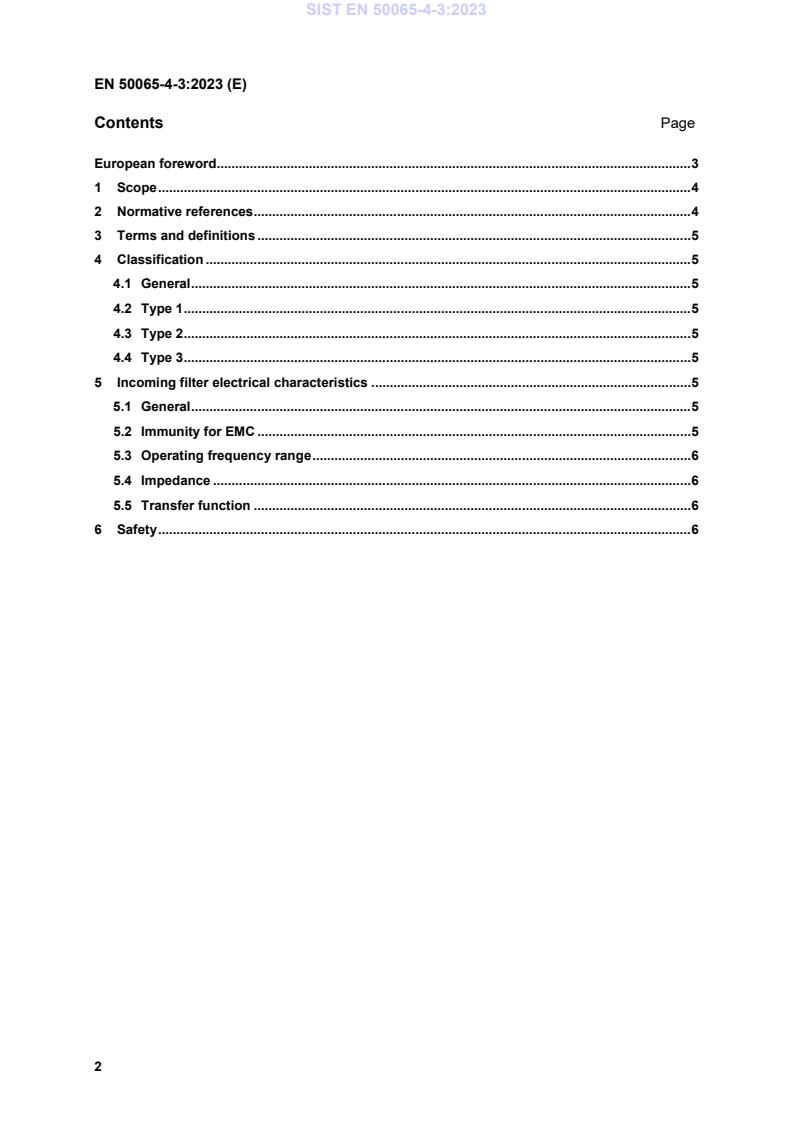
Contents Page
European foreword . 3
1 Scope . 4
2 Normative references . 4
3 Terms and definitions . 5
4 Classification . 5
4.1 General . 5
4.2 Type 1 . 5
4.3 Type 2 . 5
4.4 Type 3 . 5
5 Incoming filter electrical characteristics . 5
5.1 General . 5
5.2 Immunity for EMC . 5
5.3 Operating frequency range . 6
5.4 Impedance . 6
5.5 Transfer function . 6
6 Safety . 6
European foreword
This document (EN 50065-4-3:2023) has been prepared by WG 12 “Filters” of CLC/TC 219 “Mains
communicating systems”.
The following dates are fixed:
• latest date by which this document has to be (dop) 2023-09-24
implemented at national level by publication of
an identical national standard or by
endorsement
• latest date by which the national standards (dow) 2026-03-24
conflicting with this document have to be
withdrawn
This document supersedes EN 50065-4-3:2003 and all of its amendments and corrigenda (if any).
Attention is drawn to the possibility that some of the elements of this document may be the subject of
patent rights. CENELEC shall not be held responsible for identifying any or all such patent rights.
EN 50065 consists of the following parts, under
...