

FprEN 50065-4-2
(Main)Signalling on low voltage electrical installations in the frequency range 3 kHz to 148,5 kHz Part 4-2: Low voltage decoupling filters - Safety requirements
General Information
- Abstract
This product safety standard applies to decoupling filters in a mains communication system intended for utility networks or household and similar fixed-electrical installations including residential, commercial and light industrial buildings.
- Status
- Not Published
- Publication Date
- 21-Aug-2022
- Technical Committee
- CLC/TC 205A - Mains communicating systems
- Drafting Committee
- CLC/TC 205A/WG 12 - Filters
- Current Stage
- 4599 - Dispatch of FV draft to CMC - Finalization for Vote
- Start Date
- 14-Jan-2022
- Due Date
- 28-Dec-2021
- Completion Date
- 14-Jan-2022
- Directive
- 2004/22/EC - Measuring instruments

Overview
The FprEN 50065-4-2 standard, developed by CLC, establishes essential safety requirements for low voltage decoupling filters used in mains communication systems operating in the frequency range of 3 kHz to 148.5 kHz. This standard applies primarily to filters installed in utility networks as well as fixed electrical installations encompassing residential, commercial, and light industrial buildings. By ensuring product safety and reliability, FprEN 50065-4-2 supports secure and effective communication through low voltage electrical installations across Europe.
Key Topics
Scope and Applicability
Focus on decoupling filters designed for mains communication on low voltage networks in various fixed installations, including household and commercial premises.Safety Requirements
Defines construction and performance criteria to ensure protection against electric shock, abnormal heat, fire risk, and mechanical failures during normal and fault conditions.Testing and Classification
Comprehensive type testing procedures covering:- Electrical rating and impulse withstand voltage
- Resistance to aging, moisture ingress, and humidity
- Mechanical and thermal strength
- Resistance to fire, tracking, and environmental stress (humidity, temperature extremes)
Protection and Marking
Specifies protection levels against direct contact and water ingress (aligned with EN 60529 IP codes), and mandatory markings for clear identification of voltage ratings, current ratings, and compliance.Terminology and Definitions
Clarifies terms used within mains communication systems such as “decoupling filter,” “phase coupler,” “fault condition,” and “terminal types” (screw-type and screwless-type), ensuring consistent understanding and uniform application.
Applications
Utility Networks and Smart Grid Communication
Decoupling filters compliant with FprEN 50065-4-2 facilitate reliable data transmission through power lines, enabling smart metering, load management, and other utility services without compromising electrical safety.Residential Electrical Installations
Integration into household fixed electrical wiring to support home automation, energy monitoring, and remote control systems, ensuring minimal risk of electric shock or malfunction.Commercial and Light Industrial Settings
Used in office buildings, retail, and light industry environments where mains communication filters must withstand harsher environmental conditions while maintaining safety integrity.Low Voltage Mains Communication Systems
Designed to separate communication signals from power frequency components, decoupling filters enable effective signalling while protecting electrical equipment and users from faults and electrical hazards.
Related Standards
EN 50065 Series
This part 4-2 standard complements other parts including:- Part 1: General requirements and frequency bands
- Part 4-1: Generic specifications for low voltage decoupling filters
- Additional parts covering incoming filters, impedance filters, segmentation filters, phase couplers, and portable filters.
EN 60065
Safety requirements for audio, video, and similar electronic apparatus, relevant for components integrated into communication filters.EN 60529
Degrees of protection by enclosures (IP Code), used to define ingress protection for decoupling filters.IEC 60664-1
Insulation coordination principles applicable to low voltage systems.Electromagnetic Compatibility Standards
Including EN 61000-4-4 for immunity to transient electromagnetic disturbances impacting communication devices connected to power networks.
By adhering to FprEN 50065-4-2, manufacturers ensure their low voltage decoupling filters meet stringent safety criteria, enabling secure mains communication solutions that support modern electrical infrastructure with robust protection against electrical hazards.
Keywords: low voltage decoupling filters, mains communication system, safety requirements, power line communication, utility networks, residential electrical installations, EN 50065, CLC standards, electrical safety, low voltage electrical installations.
Relations
- Effective Date
- 24-Jan-2023
- Effective Date
- 14-May-2019
- Effective Date
- 14-May-2019
Get Certified
Connect with accredited certification bodies for this standard

ANCE
Mexican certification and testing association.

Intertek Slovenia
Intertek testing, inspection, and certification services in Slovenia.

LNE (Laboratoire National de Métrologie et d'Essais)
French national laboratory for metrology and testing.
Sponsored listings
Frequently Asked Questions
FprEN 50065-4-2 is a draft published by CLC. Its full title is "Signalling on low voltage electrical installations in the frequency range 3 kHz to 148,5 kHz Part 4-2: Low voltage decoupling filters - Safety requirements". This standard covers: This product safety standard applies to decoupling filters in a mains communication system intended for utility networks or household and similar fixed-electrical installations including residential, commercial and light industrial buildings.
This product safety standard applies to decoupling filters in a mains communication system intended for utility networks or household and similar fixed-electrical installations including residential, commercial and light industrial buildings.
FprEN 50065-4-2 is classified under the following ICS (International Classification for Standards) categories: 31.160 - Electric filters; 33.040.30 - Switching and signalling systems; 97.120 - Automatic controls for household use. The ICS classification helps identify the subject area and facilitates finding related standards.
FprEN 50065-4-2 has the following relationships with other standards: It is inter standard links to EN 50065-4-2:2001/A1:2003, EN 50065-4-2:2001, EN 50065-4-2:2001/A2:2005. Understanding these relationships helps ensure you are using the most current and applicable version of the standard.
FprEN 50065-4-2 is associated with the following European legislation: EU Directives/Regulations: 2004/22/EC, 2014/35/EU; Standardization Mandates: M/441, M/490, M/511. When a standard is cited in the Official Journal of the European Union, products manufactured in conformity with it benefit from a presumption of conformity with the essential requirements of the corresponding EU directive or regulation.
FprEN 50065-4-2 is available in PDF format for immediate download after purchase. The document can be added to your cart and obtained through the secure checkout process. Digital delivery ensures instant access to the complete standard document.
Standards Content (Sample)
SLOVENSKI STANDARD
01-julij-2021
Signalizacija po nizkonapetostnih električnih napeljavah v frekvenčnem območju
od 3 kHz do 148,5 kHz - 4-2. del: Nizkonapetostni ločilni filtri - Varnostne zahteve
Signalling on low voltage electrical installations in the frequency range 3 kHz to 148,5
kHz Part 4-2: Low voltage decoupling filters - Safety requirements
Signalübertragung auf elektrischen Niederspannungsnetzen im Frequenzbereich 3 kHz
bis 148,5 kHzTeil 4-2: Niederspannungs-Entkopplungsfilter - Sicherheitsanforderungen
Transmission de signaux sur les réseaux électriques basse tension dans la bande de
fréquences de 3 kHz à 148,5 kHz - Partie 4-2: Filtres de découplage basse tension -
Exigences de sécurité
Ta slovenski standard je istoveten z: prEN 50065-4-2
ICS:
31.160 Električni filtri Electric filters
33.040.30 Komutacijski in signalizacijski Switching and signalling
sistem systems
2003-01.Slovenski inštitut za standardizacijo. Razmnoževanje celote ali delov tega standarda ni dovoljeno.
EUROPEAN STANDARD DRAFT
prEN 50065-4-2
NORME EUROPÉENNE
EUROPÄISCHE NORM
April 2021
ICS Will supersede EN 50065-4-2:2001 and all of its
amendments and corrigenda (if any)
English Version
Signalling on low voltage electrical installations in the frequency
range 3 kHz to 148,5 kHz Part 4-2: Low voltage decoupling
filters - Safety requirements
Transmission de signaux sur les réseaux électriques basse Signalübertragung auf elektrischen Niederspannungsnetzen
tension dans la bande de fréquences de 3 kHz à 148,5 kHz im Frequenzbereich 3 kHz bis 148,5 kHzTeil 4-2:
- Partie 4-2: Filtres de découplage basse tension - Niederspannungs-Entkopplungsfilter -
Exigences de sécurité Sicherheitsanforderungen
This draft European Standard is submitted to CENELEC members for enquiry.
Deadline for CENELEC: 2021-07-16.
It has been drawn up by CLC/TC 219.
If this draft becomes a European Standard, CENELEC members are bound to comply with the CEN/CENELEC Internal Regulations which
stipulate the conditions for giving this European Standard the status of a national standard without any alteration.
This draft European Standard was established by CENELEC in three official versions (English, French, German).
A version in any other language made by translation under the responsibility of a CENELEC member into its own language and notified to
the CEN-CENELEC Management Centre has the same status as the official versions.
CENELEC members are the national electrotechnical committees of Austria, Belgium, Bulgaria, Croatia, Cyprus, the Czech Republic,
Denmark, Estonia, Finland, France, Germany, Greece, Hungary, Iceland, Ireland, Italy, Latvia, Lithuania, Luxembourg, Malta, the
Netherlands, Norway, Poland, Portugal, Republic of North Macedonia, Romania, Serbia, Slovakia, Slovenia, Spain, Sweden, Switzerland,
Turkey and the United Kingdom.
Recipients of this draft are invited to submit, with their comments, notification of any relevant patent rights of which they are aware and to
provide supporting documentation.
Warning : This document is not a European Standard. It is distributed for review and comments. It is subject to change without notice and
shall not be referred to as a European Standard.
European Committee for Electrotechnical Standardization
Comité Européen de Normalisation Electrotechnique
Europäisches Komitee für Elektrotechnische Normung
CEN-CENELEC Management Centre: Rue de la Science 23, B-1040 Brussels
© 2021 CENELEC All rights of exploitation in any form and by any means reserved worldwide for CENELEC Members.
Project: 69658 Ref. No. prEN 50065-4-2 E
prEN 50065-4-2:2021 (E)
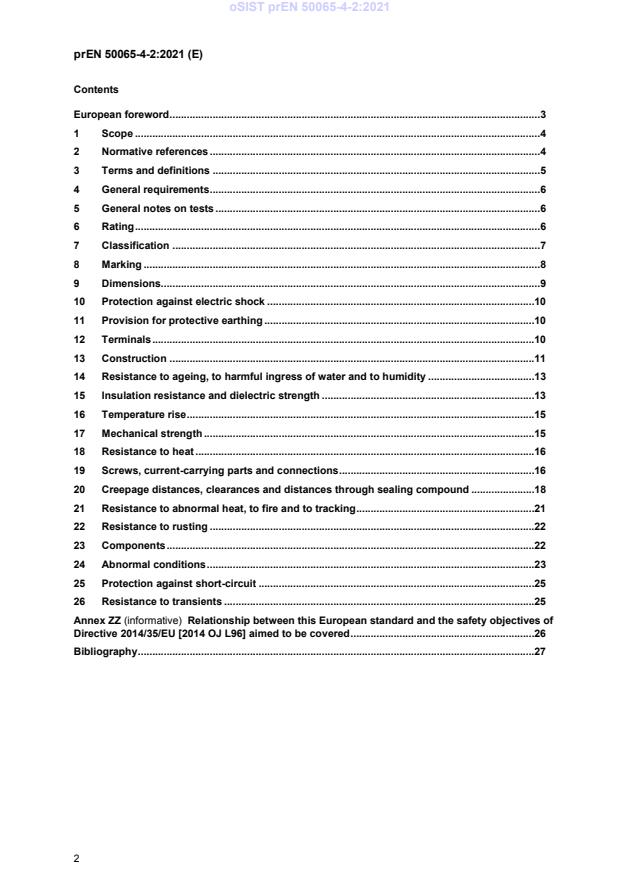
Contents
European foreword . 3
1 Scope . 4
2 Normative references . 4
3 Terms and definitions . 5
4 General requirements . 6
5 General notes on tests . 6
6 Rating . 6
7 Classification . 7
8 Marking . 8
9 Dimensions. 9
10 Protection against electric shock .10
11 Provision for protective earthing .10
12 Terminals .10
13 Construction .11
14 Resistance to ageing, to harmful ingress of water and to humidity .13
15 Insulation resistance and dielectric strength .13
16 Temperature rise .15
17 Mechanical strength .15
18 Resistance to heat .16
19 Screws, current-carrying parts and connections .16
20 Creepage distances, clearances and distances through sealing compound .18
21 Resistance to abnormal heat, to fire and to tracking .21
22 Resistance to rusting .22
23 Components .22
24 Abnormal conditions .23
25 Protection against short-circuit .25
26 Resistance to transients .25
Annex ZZ (informative) Relationship between this European standard and the safety objectives of
Directive 2014/35/EU [2014 OJ L96] aimed to be covered .26
Bibliography .27
prEN 50065-4-2:2021 (E)
European foreword
This document (prEN 50065-4-2:2021) has been prepared by WG 12 “Filters” of CLC/TC 205A “Mains
communicating systems”.
This document is currently submitted to the Enquiry.
The following dates are proposed:
• latest date by which the existence of this (doa) dor + 6 months
document has to be announced at national
level
• latest date by which this document has to be (dop) dor + 12 months
implemented at national level by publication of
an identical national standard or by
endorsement
• latest date by which the national standards (dow) dor + 36 months
conflicting with this document have to be (to be confirmed or
withdrawn modified when voting)
This document will supersede EN 50065-4-2:2001 and all of its amendments and corrigenda (if any).
This document has been prepared under a mandate given to CENELEC by the European Commission
and the European Free Trade Association, and supports essential requirements of EU Directive(s).
For the relationship with EU Directive(s) see informative Annex ZZ, which is an integral part of this
document.
EN 50065 consists of the following parts, under the general title: Signalling on low-voltage electrical
installations in the frequency range 3 kHz to 148,5 kHz
Part 1: General requirements, frequency bands and electromagnetic disturbances
Part 2-1: Immunity requirements for mains communications equipment and systems operating in the
range of frequencies 95 kHz to 148,5 kHz and intended for use in residential, commercial and light
industrial environments
Part 2-2: Immunity requirements for mains communications equipment and systems operating in the
range of frequencies 95 kHz to 148,5 kHz and intended for use in industrial environments
Part 2-3: Immunity requirements for mains communications equipment and systems operating in the
range of frequencies 3 kHz to 95 kHz and intended for use by electricity suppliers and distributors
Part 4-1: Low voltage decoupling filters – Generic specification
Part 4-2: Low voltage decoupling filters – Safety requirements
Part 4-3: Low voltage decoupling filters – Incoming filter
Part 4-4: Low voltage decoupling filters – Impedance filter
Part 4-5: Low voltage decoupling filters – Segmentation filter
Part 4-6: Low voltage decoupling filters – Phase coupler
Part 4-7: Portable low voltage decoupling filters – Safety requirements
Part 7: Equipment impedance
prEN 50065-4-2:2021 (E)
1 Scope
This document applies to decoupling filters in a low voltage mains communication system intended for
utility networks or household and similar fixed-electrical installations including residential, commercial and
light industrial buildings.
2 Normative references
The following documents are referred to in the text in such a way that some or all of their content
constitutes requirements of this document. For dated references, only the edition cited applies. For
undated references, the latest edition of the referenced document (including any amendments) applies.
HD 214 S2, Method for determining the comparative and the proof tracking indices of solid insulating
materials under moist conditions (IEC 60112)
HD 625.1, Insulation coordination for equipment within low-voltage systems - Part 1: Principles,
requirements and tests (IEC 60664-1)
EN 50065-4-1, Signalling on low-voltage electrical installations in the frequency range 3 kHz to 148,5 kHz
- Part 4-1: Low voltage decoupling filters - Generic specification
EN 60065, Audio, video and similar electronic apparatus - Safety requirements (IEC 60065)
EN 60068-2-30, Environmental testing - Part 2-30: Tests - Test Db: Damp heat, cyclic (12 h + 12 h cycle)
(IEC 60068-2-30)
EN 60068-2-75, Environmental testing - Part 2-75: Tests - Test Eh: Hammer tests (IEC 60068-2-75)
EN 60068-2-78, Environmental testing - Part 2-78: Tests - Test Cab: Damp heat, steady state
(IEC 60068-2-78)
EN 60127 (series), Miniature fuses (IEC 60127 series)
EN 60529, Degrees of protection provided by enclosures (IP Code) (IEC 60529)
EN 60695-2-1/X:1996, Fire hazard testing - Part 2: Test methods (IEC 60695-2-1/X:1994)
EN 60695-10-2, Fire hazard testing - Part 10-2: Abnormal heat - Ball pressure test method
(IEC 60695-10-2)
EN 60721-3-3, Classification of environmental conditions - Part 3: Classification of groups of
environmental parameters and their severities - Section 3: Stationary use at weatherprotected locations
(IEC 60721-3-3)
EN 60947-1:2007, Low-voltage switchgear and controlgear - Part 1: General rules (IEC 60947-1:2007)
EN 60999-1:2000, Connecting devices - Electrical copper conductors - Safety requirements for screw-
type and screwless-type clamping units - Part 1: General requirements and particular requirements for
2 2
clamping units for conductors from 0,2 mm up to 35 mm (included) (IEC 60999-1:1999)
EN 61000-4-4, Electromagnetic compatibility (EMC) - Part 4-4: Testing and measurement techniques -
Electrical fast transient/burst immunity test (IEC 61000-4-4)
EN 132400, Sectional Specification: Fixed capacitors for electromagnetic interference suppression and
connection to the supply mains (Assessment level D)
prEN 50065-4-2:2021 (E)
IEC 60999-2, Connecting devices - Electrical copper conductors - Safety requirements for screw-type and
screwless-type clamping units - Part 2: Particular requirements for clamping units for conductors above
35 mm2 up to 300 mm2 (included)
ISO 1456, Metallic and other inorganic coatings — Electrodeposited coatings of nickel, nickel plus
chromium, copper plus nickel and of copper plus nickel plus chromium
ISO 2081, Metallic and other inorganic coatings — Electroplated coatings of zinc with supplementary
treatments on iron or steel
ISO 2093, Electroplated coatings of tin — Specification and test methods
3 Terms and definitions
For the purposes of this document, the following terms and definitions apply.
ISO and IEC maintain terminological databases for use in standardization at the following addresses:
— ISO Online browsing platform: available at https://www.iso.org/obp
— IEC Electropedia: available at http://www.electropedia.org/
NOTE Where the term’s voltage and current are used, they imply r.m.s. values, unless otherwise specified.
3.1
decoupling filter
device installed in an electrical network or installation in order to make possible reliable data transmission
over the low voltage mains network
3.2
phase coupler
type of decoupling filter which transmits a signal within a specified frequency range from one phase to
another in a multi-phase installation
3.3
fault condition
abnormal condition which could occur during normal operation
3.4
enclosed equipment
equipment which is mounted and/or applied without an additional enclosure
3.5
unenclosed equipment
equipment intended to be built into an enclosure which completely covers the equipment
3.6
partly enclosed equipment
equipment intended to be built into an appropriate enclosure which only covers the unenclosed part of the
equipment
Note 1 to entry: Flush-mounted equipment intended to be located in a box is an example of such equipment.
3.7
terminal
conductive part of one pole, composed of one or more clamping unit(s) and insulation if necessary
prEN 50065-4-2:2021 (E)
3.8
screw-type terminal
clamping unit for the connection and subsequent disconnection of one conductor or the interconnection
and subsequent disconnection of two or more conductors, the connection being made, directly or
indirectly, by means of screws or nuts of any kind
3.9
screwless-type terminal
clamping unit for the connection and subsequent disconnection of one conductor or the interconnection
and subsequent disconnection of two or more conductors, the connection being made, directly or
indirectly, by means other than screws
3.10
nominal voltage
voltage assigned to the equipment by the manufacturer
3.11
nominal current
nominal maximum operating current assigned to the equipment by the manufacturer
3.12
conditional short-circuit current
value of the AC component of a prospective current, which the equipment protected by a suitable short-
circuit protective device (hereafter referred to as SCPD) in series can withstand under specified
conditions of use and behaviour
4 General requirements
Equipment and its enclosures shall be so designed and constructed that, in normal use, their
performance is reliable and without danger to the user or the surroundings.
In general, compliance is checked by carrying out all the tests specified, where applicable.
5 General notes on tests
5.1 General
Tests according to this document are type tests.
5.2 The samples are tested as delivered and under normal conditions of use, having regard to the
classification of the equipment and to the manufacturer's installation instructions.
5.3 Unless otherwise specified, the tests are carried out in the order of the clauses at an ambient
temperature of 20 °C ± 5 °C.
5.4 The required number of samples shall be 9.
Three samples are subjected to all the relevant tests, except the test of Clauses 23 and 24 where three
other samples are used, and the tests of Clauses 25 and 26 where another three samples are used.
5.5 Equipment is deemed not to comply with this document if any sample does not pass any of the
listed tests.
6 Rating
6.1 Standard values of nominal voltages are AC 230 V and AC 400 V.
prEN 50065-4-2:2021 (E)
If a different nominal voltage is applied this value shall not be less than 220 V.
6.2 Standard values of nominal currents are 10 A, 16 A, 20 A, 25 A, 32 A, 40 A, 50 A, 63 A, 80 A, 90A,
100 A and 125 A.
2 2 2 2 2
6.3 Standard cross-sectional areas of conductors are 1,5 mm , 2,5 mm , 4 mm , 6 mm , 10 mm ,
2 2 2 2
16 mm , 25 mm , 35 mm and 50 mm
Compliance with the requirements of 6.1 to 6.3 is checked by inspection of the marking.
7 Classification
7.1 Equipment is classified as follows:
7.1.1 According to protection against direct contact and external influences:
— enclosed equipment (minimum IP2X) for separate mounting;
— unenclosed equipment for mounting in an adequate enclosure.
NOTE 1 The degrees of protection are based on EN 60529.
NOTE 2 For unenclosed equipment, the protection against electric shock is given by the enclosure in which the
equipment is intended to be mounted. For enclosed equipment, the protection against electric shock is provided by
compliance with the requirements of Clause 10.
7.1.2 According to the degree of protection against ingress of water:
The degrees of protection are based on EN 60529.
7.1.3 According to the method of mounting
— surface-type equipment;
— flush-type equipment;
— panel board equipment.
7.1.4 According to environmental temperature conditions
The classifications are based on EN 60721-3-3.
— class 3K4 + 5 °C to + 40 °C for indoor locations
— class 3K5 - 5 °C to + 45 °C for unprotected indoor locations
— class 3K6 - 25 °C to + 55 °C for outdoor locations
— class 3K8H - 25 °C to + 70 °C for severe environments
7.1.5 According to the rated impulse withstand voltage
The rated impulse withstand voltages are based on HD 625.1.
— 4000 V according to overvoltage category III;
— 6000 V according to overvoltage category IV.
prEN 50065-4-2:2021 (E)
8 Marking
8.1 As a minimum the equipment shall be marked with:
a) nominal voltage(s) in volts ~;
b) nominal current in amperes;
c) manufacturer's or responsible vendor's name, trade mark or identification mark;
d) type of decoupling filter and reference or catalogue number;
e) symbol for temperature range, if different from class 3K4;
f) symbol for degree of protection;
g) symbol for degree of protection against ingress of water;
h) marking with conditional short-circuit current and suitable SCPD shall be given in the manufacturer’s
catalogues.
8.2 Symbols for marking shall be used as follows:
Amperes A
Volt V
Alternating current ~
Degree of protection against moisture IPX4 or IPX5
The letter “X” shall be replaced by the relevant number.
The figure for the current rating shall be placed before or above that for the nominal voltage and
separated from the latter by an oblique line or a dash.
NOTE The marking for current, voltage and nature of supply can be, for instance, as follows: 16 A 230 V~or
16/230~.
8.3 The manufacturer's or responsible vendor's name, trademark or identification mark, type reference
and nominal current shall be on the main part of the equipment.
Parts such as cover plates, which are necessary for safety purposes and are intended to be sold
separately, shall be marked with the manufacturer's or responsible vendor's name, trade mark or
identification mark and type reference.
The symbol for degree of protection, if applicable, shall be marked on the outside of its associated
enclosure so as to be easily discernible when the equipment is mounted and wired as in normal use.
Additional type references may be marked on the main part, or on the outside or the inside of the
associated enclosure.
NOTE The term “main” part means the part carrying the terminals and any part integral with them; it does not
include parts intended to be sold separately.
8.4 Terminals
The side name (Input side, output side) and the respective termination shall be marked, when
appropriate, in such a way that they are clearly distinguished (e.g. using a different colour for each side).
These indications shall not be placed on screws or any other easily removable parts.
NOTE “Easily removable parts” are those parts, which can be removed during the normal installation of the
equipment.
prEN 50065-4-2:2021 (E)
For example a typical marking scheme is given in Table 1.
Table 1 — Symbols for identification of the termination
Single phase Three phase
Point of connection Identification Point of connection Identification
Line L 1st Phase L1,
2nd Phase L2,
3rd Phase L3
Neutral N Neutral N
Earth EN 60417 series Earth EN 60417 series
Symbols 5019 Symbols 5019
Terminals associated with any one pole shall have similar identification differing from that of the terminals
associated with the other poles, unless the relationship is self-evident.
8.5 Terminals shall additionally be marked in accordance with EN 60999-1:2000, 7.4.
Compliance is checked by inspection.
8.6 Marking shall be durable and easily legible.
Compliance is checked by inspection and by the following test.
The test is made by rubbing the marking by hand for 15 s with a piece of cloth soaked with water and
again for 15 s with a piece of cloth soaked with petroleum spirit.
Marking made by impression, moulding, pressing or engraving is not subjected to this test.
The petroleum spirit used should consist of a solvent hexane with a content of aromatics of maximum
0,1 % by volume, a value of 29 % for kauri-butanol, an initial boiling-point of approximately 65 °C, a dry-
point of approximately 69 °C and a density of approximately 0,68 g/cm .
The type reference may be marked with paint or ink, protected, if necessary, by vanish.
8.7 The correct installation and use of the equipment shall be indicated in an installation instruction
delivered with the equipment. A phase coupler shall be delivered with a marking plate with the following
text:
Phase Coupler !
Must be disconnected while working on the installation.
The marking plate shall be fastened to the panel board in which the phase coupler is installed.
The installation instruction and the text of the marking plate shall be written in the official language(s) of
the country in which the equipment is to be sold.
Compliance is checked by inspection.
NOTE In the following country the marking plate is not necessary: Germany.
9 Dimensions
Equipment shall comply with the appropriate standard sheets.
Compliance is checked by inspection and by measurement.
prEN 50065-4-2:2021 (E)
10 Protection against electric shock
10.1 The test is carried out according to EN 60529, with the degree of protection IP2X.
During the test, live parts of the equipment shall not be accessible to the test finger.
11 Provision for protective earthing
11.1 Earthing terminals shall be terminals with screw clamping or with other means of comparable
effectiveness and shall comply with the appropriate requirements of Clause 12.
They shall be of the same size as the corresponding terminals for the supply conductors except that any
additional external earthing terminal shall be of a size suitable for conductors of at least 6 mm .
11.2 Decoupling filters having more than one cable inlet shall be provided with an internal earthing
terminal allowing the connection of an incoming and outgoing conductor for the continuity of the earthing
circuit.
Compliance with the requirements of 11.1and 11.2 are checked by inspection and the tests of Clause 12
11.3 The connection between the earthing terminal and accessible metal parts to be connected thereto
shall be of low resistance.
Compliance is checked by the following test:
A current derived from a.c. source having a no-load voltage not exceeding 12 V and equal to 1,5 times
rated current or 25 A, whichever is greater, is passed between the earthing terminal and each of the
accessible metal parts in turn
The voltage drop between the earthing terminal and the accessible metal part is measured, and the
resistance calculated from the current and this voltage drop.
In no case the resistance shall exceed 0,05 Ω.
12 Terminals
12.1 Introduction
The requirements in 12.2 and 12.3 are only for clamping units connected to power circuits.
12.2 General
12.2.1 Equipment shall be provided with terminals having screw-type or screwless-type clamping units.
12.2.2 Clamping units shall allow the conductor to be connected without special preparation.
12.2.3 The means for clamping the conductors in the clamping units shall not serve to fix any other
component, although they may hold the clamping units in place or prevent them from turning.
Compliance is checked by inspection and by the test of 12.3 as applicable.
12.3 Screw-type and screwless-type clamping units with clamping for external copper
conductors
12.3.1 Screw-type and screwless-type clamping units shall comply with EN 60999-1 or IEC 60999-2.
All the tests shall be with the clamping units mounted in the equipment.
The clamping units shall be tested with the cross-sectional area of conductors given in Table 2.
prEN 50065-4-2:2021 (E)
Table 2 — Connectable cross-sections of copper conductors
Ranges of nominal current In Type of conductor and cross-sectional area
(A) (mm )
Rigid Flexible
(solid or stranded)
In ≤ 10 1 to 2,5 1 to 1,5
10 < In ≤ 16 1,5 to 4 1 to 2,5
16 < In ≤ 25 2,5 to 6 1,5 to 4
25 < In ≤ 32 4 to 10 2,5 to 6
32 < In ≤ 40 6 to 16 -
40 < In ≤ 63 10 to 25 -
63 < In ≤ 80 16 to 35 -
80 < In ≤ 125 25 to 50 -
In addition to EN 60999-1:2000, 9.5 and 9.6: “During the test the clamping units shall not work loose from
their fixings to the equipment.”
EN 60999-1:2000, 8.16 and 9.9 are not applicable.
The test current in EN 60999-1:2000, 9.10 shall be according to Table 3.
Table 3 — Test current
Cross-sectional area of rigid Nominal current Test current
conductors
(A) (A)
(mm )
1,5 10–13 15
2,5 16 20
2,5 20 25
4 25 31,25
6 32 40
10 40 50
10 50 62,5
16 63 78,75
25 80 100
35 100 125
50 125 156
NOTE The test currents for equipment having other nominal currents are determined by interpolation between
the next lower and higher ratings.
13 Construction
13.1 Insulating linings and barriers shall have adequate mechanical strength and shall be secured in a
reliable manner.
prEN 50065-4-2:2021 (E)
Compliance is checked by inspection after the tests of Clause 17.
13.2 Equipment shall be constructed so as to permit:
— easy introduction and connection of the conductors in to the terminals;
— correct positioning of the conductors;
— easy fixing of the equipment;
— equipment intended for walls or boxes shall have adequate space between the underside of the base
and the enclosure (cover or box) so that, after installation of the equipment, the insulation of the
conductors is not pressed against live parts of different polarity.
Surface-type equipment shall be constructed so that the fixing means do not damage the insulation of the
cables during the installation.
NOTE 1 This requirement does not imply that the metal parts of the terminals are necessarily protected by
insulation barriers or insulating shoulders, to avoid contact, due to incorrect installation of the terminal metal parts,
with the insulation of the conductor.
NOTE 2 For surface-type equipment, mounted on a mounting plate, a wiring channel could be needed to comply
with this requirement.
Compliance is checked by inspection and by an installation test using conductors of the largest cross-
sectional area specified in Table 2 - Connectable cross-sections of copper conductors.
13.3 Covers and cover plates shall be held in place at two or more points by effective fixings such that
their removal requires the use of a tool.
It is recommended that the screws for fixing covers or cover plates be captive.
NOTE 1 The use of tight fitting washers of cardboard or the like is deemed to be an adequate method for securing
screws which have to be captive.
If the fixings of covers or cover plates serve also to fix the base, there shall be sufficient means to ensure
the correct position of the base after removal of the cover or cover plate.
Means for fixing covers or cover plates shall not serve to fix any other part.
NOTE 2 Decorative covers, cover plates or parts thereof, not providing protection against electric shock, are not
considered as covers or cover plates in the meaning of this subclause.
Compliance is checked by inspection and by an installation test.
13.4 Enclosed or partly enclosed equipment with the degree of protection IPX0 shall be so constructed
that, when the equipment is fixed and wired as in normal use, there are no free openings in the enclosure.
Compliance is checked by inspection and by an installation test with conductors of the smallest cross-
sectional area specified in Table 2.
NOTE Small gaps between enclosures and conduits or cables are neglected.
13.5 In equipment with a degree of protection higher than IPX0, membranes, screwed glands and
similar provisions shall be so designed that the part forming the tight inlet for the cable is replaceable.
Compliance is checked by inspection.
prEN 50065-4-2:2021 (E)
14 Resistance to ageing, to harmful ingress of water and to humidity
14.1 Resistance to ageing
The test is carried out over a bunch of devices and consists of the following steps:
1. damp heat test according to EN 60068-2-30 under the following conditions: 80 °C at 90 % of relative
humidity, during 6 days, the equipment being connected at nominal voltage and at nominal current
2. damp heat test according to EN 60068-2-30 under the following conditions: 80 °C at 90 % of relative
humidity, during 1 day, the equipment being connected at 1,1 times the nominal voltage and at the
nominal current
3. the equipment are removed from the cabinet. 24 h later, the following control is made
a. visual inspection to ensure that no mechanical degradation has occurred
b. impedance and transfer function measurements, according to EN 50065-4-1, to check
compliance with the requirements
Steps 1 to 3 are repeated four times in a row. For each of the four test sequences:
— no mechanical degradation shall be observed
— the filter shall satisfy the impedance and transfer function requirements in EN 50065-4-1.
14.2 Resistance to harmful ingress of water
The test is carried out according to EN 60529, with the degree of protection IPX1.
After the test, the equipment shall withstand the dielectric strength test as specified in subclause 15.2 of
this document, and shall operate properly.
14.3 Resistance to humidity
For this test, the filter is connected at nominal voltage and nominal current.
The test is carried out according to EN 60068-2-78, under the following conditions:
— the equipment, complete with enclosure, is mounted as in normal use as specified in the
manufacturer’s installation instructions
— temperature: + 55 ± 3°C
— relative humidity: 95 ± 3 %
— duration of the test: 4 days
During the whole test, the equipment shall not show any damage and shall be able to operate properly.
Two hours after the test, the insulation resistance measurement of the test specified in Clause 15 shall be
performed.
15 Insulation resistance and dielectric strength
15.1 The insulation resistance of the equipment shall be adequate.
Compliance is checked by the following tests which are made immediately after the test of 14.3, in the
humidity cabinet or in the room in which the samples were brought to the prescribed temperature, after
reassembly of those parts which have been removed without the aid of a tool.
prEN 50065-4-2:2021 (E)
The insulation resistance is measured with a voltage of approximately DC 500 V applied, the
measurement being made 1 min after application of the voltage.
The measured insulation resistance shall not be less than 5 MΩ:
— between all terminals connected together and metal foil in contact with the outer surface of
accessible parts;
— for equipment having a metal enclosure, between the outer surface and metal foil in contact with the
inner surface of the internal enclosure or the insulating lining;
— between live parts and terminals for looping-in of external conductors;
— between live parts and the mounting surface of the equipment, including the means for fixing and
parts of protective conductor circuit.
The measured insulation resistance shall not be less than 2 MΩ between live parts of different polarity.
NOTE While wrapping the metal foil around the outer surface or placing it in contact with the inner surface of
parts of insulating material, it is pressed against holes or grooves by means of a straight test finger of the same
dimensions as the standard test finger.
15.2 The dielectric strength of the equipment shall be adequate.
15.2.1 The insulation is subjected for 5 s to a sinusoidal voltage, having a frequency of 50 Hz or 60 Hz.
The value of the test voltage and the points of application are:
— 3 kV between all terminals and metal foil in contact with the outer surface of accessible parts;
— 1,5 kV between the outer metal surface and a metal foil in contact with the inner surface of the
internal enclosure or the insulated lining;
— 1,5 kV between live parts and terminals for looping-in of external conductors;
— 1,5 kV between live parts and the surface on which they are mounted, including the means for fixing
and parts of protective conductor circuit.
Initially, not more than half the prescribed voltage is applied; then it is raised in less than 1 s to the full
value.
No flashover or breakdown shall occur during the test.
NOTE 1 The values are based on HD 384.4.442 S1. The following formula is used: U0 + 1200 V and rounded,
where U0 is the voltage between line and neutral.
NOTE 2 While wrapping the metal foil around the outer surface or placing it in contact with the inner surface of
parts of insulating material, it is pressed against holes or grooves by means of a straight unjointed test finger of the
same dimensions as the standard test finger.
The high-voltage transformer used for the test shall be so designed that, when the output terminals are
short-circuited after the output voltage has been adjusted to the appropriate test voltage, the output
current is at least 200 mA.
The overcurrent relay should not trip when the output current is less than 100 mA.
NOTE 3 Care is taken that the r.m.s. value of the test voltage applied is measured within ± 3 %.
NOTE 4 Glow discharges without drop in voltage are neglected.
15.2.2 The insulation shall withstand an impulse voltage according to HD 625.1. The value of the test
voltage and the points of application are:
prEN 50065-4-2:2021 (E)
For overvoltage category III according to 7.1.5:
— 6 kV between all terminals and metal foil in contact with the outer surface of accessible parts;
— 4 kV between the outer metal surface and a metal foil in contact with the inner surface of the internal
enclosure or the insulated lining;
— 4 kV between live parts and the surface on which they are mounted, including the means for fixing
and parts of protective conductor circuit.
For overvoltage category IV according to 7.1.5:
— 8 kV between all terminals and metal foil in contact with the outer surface of accessible parts;
— 6 kV between the outer metal surface and a metal foil in contact with the inner surface of the internal
enclosure or the insulated lining;
— 6 kV between live parts and the surface on which they are mounted, including the means for fixing
and parts of protective conductor circuit.
No flashover or breakdown shall occur during the test.
The output impedance of the impulse generator shall not be higher than 2 Ω and the required impulse test
voltage shall be corrected for the altitude according to HD 625.1. The number of test pulses shall be 3
positive and 3 negative.
NOTE While wrapping the metal foil around the outer surface or placing it in contact with the inner surface of
parts of insulating material, it is pressed against holes or grooves by means of a straight unjointed test finger of the
same dimensions as the standard test finger.
16 Temperature rise
The test is performed according to EN 60947-1:2007, 8.3.3.3.
For the whole test, the equipment is supplied with a voltage level of 1,2 times the nominal voltage.
The equipment is loaded with alternating current of value 1,1 times the nominal current, for a duration
necessary for the steady-state temperature to be reached, without exceeding 8 h. The equipment is then
loaded with alternating current of value 1,4 times the nominal current for 15 min.
At the end of the test, and for a maximum ambient temperature of 40°C, the temperature rise for different
parts of the equipment should not exceed the values indicated in Table 4.
Table 4 — Maximum temperature rise
Parts of the equipment Maximum temperature rise (K)
Terminals and parts which may come into 60
contact with cable insulation when installed
Accessible metallic parts 15
Accessible non-metallic parts 25
17 Mechanical strength
17.1 Equipment shall have adequate mechanical strength so as to withstand the stresses imposed
during installation and use.
For enclosed and partly enclosed equipment compliance is checked by the tests 17.2 and 17.3.
17.2 Equipment shall have adequate impact resistance.
prEN 50065-4-2:2021 (E)
Compliance is checked by applying blows to the equipment by means of the spring-operated impact-test
apparatus or the pendulum hammer described in EN 60068-2-75.
The samples are mounted on a sheet of plywood, 8 mm nominal thickness and approximately 175 mm ,
secured at its top and bottom edges to a rigid bracket which is part of the mounting support.
The mounting support shall have a mass of 10 kg ± 1 kg and shall be mounted on a rigid frame by means
of pivots. The frame is fixed to a solid wall.
The equipment is mounted on the plywood as in normal use.
Before applying the blows, fixing screws of bases and covers are tightened with a torque equal to two-
thirds of that specified in EN 60999-1:2000, Table 4.
Three blows are applied to every point of the enclosure that is likely to be weak, with an impact energy of
0,5 J ± 0,04 J.
NOTE For partly enclosed equipment, the test is made only on the enclosed part of the equipment.
After the test, screwed glands and enclosures of the samples shall show no damage within the meaning
of this document.
17.3 Screwed glands are fitted with a cylindrical metal rod having a diameter, in millimetres, equal to the
nearest whole number below the internal diameter, in millimetres, of the packing.
The glands are then tightened by means of a suitable spanner, the torque shown in Table 5 being applied
to the spanner for 1 min.
Table 5 — Related torque
Diameter of test rod D Torque
(mm) (Nm)
Metal glands Glands of moulded material
D ≤ 14 6,25 3,75
14 < D ≤ 20 7,5 5,0
20 < D 10,0 7,5
After the test, the glands and the enclosures of the samples shall show no damage within the meaning of
this document.
18 Resistance to heat
Equipment shall be sufficiently resistant to heat.
The compliance is checked by carrying out the test according to EN 60695-10-2, with the temperature
being set at:
— 125°C for parts of insulating material necessary to retain current-carrying parts and earthing parts in
position
— 80°C for other parts of insulating material
19 Screws, current-carrying parts and connections
19.1 Connections, electrical or mechanical, shall withstand the mechanical stresses occurring in normal
use.
prEN 50065-4-2:2021 (E)
Screws or nuts which transmit contact pressure shall be in engagement with a metal thread.
Compliance is checked by inspection and for screws and nuts that are operated when connecting the
external conductors and mounting the equipment by the following test.
NOTE 1 The requirements for the verification of terminals are given in Clause 12.
The screws or nuts are tightened or loosened:
— 10 times for screws in engagement with a thread of insulating material;
— 5 times in all other cases.
Screws in engagement with a thread of insulating material are completely removed and reinserted each
time.
The test is made by means of a suitable screwdriver or a suitable tool, applying a torque as specified in
EN 60999-1:2000, Table 5.
The conductor is moved each time that the screw or nut is loosened.
During the test, no damage impairing the further use of the screwed connections shall occur, such as
breakage of screws or damage to the head slots, threads, washers or stirrups.
NOTE 2 Screws or nuts which are operated when assembling the equipment include screws for fixing covers or
cover plates, etc., but not connecting means for screwed conduits and screws for fixing the base of the equipment.
The shape of the blade of the test screwdriver is to fit the head of the screw to be tested. The screws and
nuts shall not be tightened in jerks. Damage to covers is neglected.
19.2 For screws in engagement with a thread of insulating material which are operated when mounting
the equipment during installation, their correct introduction into the screw hole or nut shall be ensured.
Compliance is checked by inspection.
NOTE The requirement with regard to correct introduction is met if introduction of the screw in a slanting manner
is prevented, for example by guiding the screw by the part to be fixed, by a recess in the female thread or by the use
of a screw with the leading thread removed.
19.3 Electrical connections shall be so designed that contact pressure is not transmitted through
insulating material other than ceramic, pure mica or other material with characteristics no less suitable,
unless there is sufficient resiliency in the metallic parts to compensate for any possible shrinkage or
yielding of the insulating material.
Compliance is checked by inspection.
NOTE The suitability of the material is considered in respect of the stability of the dimensions.
19.4 Screws and rivets, which serve as electrical as well as mechanical connections, sha
...