

EN 14735:2021
(Main)Characterization of waste - Preparation of waste samples for ecotoxicity tests
- Abstract
This document describes the necessary steps to be performed before carrying out ecotoxicity tests on wastes. The purpose of this document is to provide guidance on the taking of the sample, transport, storage of wastes and to define preparation, for the determination of ecotoxicological properties of wastes under the conditions specified in this document by biological testing either as raw wastes or water extracts from wastes. Sample preparation for other applications (e.g. assessment of waste effects on aquatic and terrestrial organisms in a disposal scenario) is not considered.
Specifying a test battery to characterize ecotoxicological properties of wastes is not in the scope of this document.
This document is applicable to solid and liquid wastes.
- Status
- Published
- Publication Date
- 23-Nov-2021
- Withdrawal Date
- 30-May-2022
- Technical Committee
- CEN/TC 444 - Environmental characterization
- Drafting Committee
- CEN/TC 444/WG 4 - Biological characterization
- Current Stage
- 6060 - Definitive text made available (DAV) - Publishing
- Start Date
- 24-Nov-2021
- Due Date
- 18-Jan-2022
- Completion Date
- 24-Nov-2021



Overview
EN 14735:2021 (CEN) - Characterization of waste - Preparation of waste samples for ecotoxicity tests - defines the procedures to prepare waste samples prior to biological ecotoxicity testing. The standard applies to solid and liquid wastes and covers sampling, transport, storage, pre-treatment and preparation of raw wastes or water extracts for the determination of ecotoxicological properties. It does not prescribe a specific test battery nor address sample preparation for disposal-scenario exposure assessments.
Key topics and technical requirements
- Scope & applicability: Applicable to both solid and liquid wastes; intended for ecotoxicity testing as described in the document.
- Sampling: Guidance on taking representative laboratory samples from waste materials.
- Transport and storage: Requirements to preserve sample integrity during transport and storage before testing.
- Waste characterization: Mandatory recording of physical/chemical properties relevant to ecotoxicity tests.
- Pre-treatment / particle size reduction: Procedures for granular, monolithic, paste-like wastes and sludges to obtain reproducible test material.
- Preparation of water extracts and leachates: Defined liquid/solid (L/S) ratios, leaching and separation procedures for aquatic tests and water extracts for terrestrial tests.
- Introduction to dilution media & pH considerations: Rules on dilution media selection and instructions for reporting and, where applicable, repeating tests with pH adjustment.
- Test-specific preparation: Separate provisions for tests on terrestrial organisms (soil-based introductions) and aquatic organisms (leachates, liquid wastes, miscibility considerations).
- Test reporting: Clear reporting requirements, including whether tests were repeated with pH adjustment and associated results (notable revision in Clause 12 from previous edition).
- Annexes: Normative guidance on test mixture preparation and an informative Annex listing ecotoxicity test methods considered in drafting the standard.
Practical applications and users
This CEN standard is used to ensure reproducible, comparable ecotoxicity data for:
- Environmental laboratories performing ecotoxicity tests and bioassays on wastes.
- Regulatory bodies and manufacturers preparing waste-related hazard assessments or classification dossiers.
- Waste management companies, site assessors and consultants conducting environmental characterization of waste streams.
- Research organisations developing or validating ecotoxicological methods using water extracts, leachates or whole-waste exposure.
Keywords: EN 14735:2021, ecotoxicity tests, waste characterization, preparation of waste samples, water extracts, terrestrial organisms, aquatic organisms, sample transport storage, CEN standard.
Related standards
- Supersedes EN 14735:2005 (and its amendment EN 14735:2005/AC:2007).
- Work prepared by CEN/TC 444 “Environmental characterization of solid matrices”; consult national CEN members for implementation and national adoptions.
Relations
- Effective Date
- 01-Dec-2021
- Replaces
EN 14735:2005 - Characterization of waste - Preparation of waste samples for ecotoxicity tests - Effective Date
- 01-Dec-2021
- Effective Date
- 25-Aug-2026
- Effective Date
- 28-Jan-2026
- Effective Date
- 28-Jan-2026
- Effective Date
- 28-Jan-2026
- Effective Date
- 28-Jan-2026
- Effective Date
- 28-Jan-2026
- Effective Date
- 28-Jan-2026
- Effective Date
- 28-Jan-2026
- Effective Date
- 28-Jan-2026
- Effective Date
- 28-Jan-2026
- Effective Date
- 28-Jan-2026
- Effective Date
- 28-Jan-2026
- Effective Date
- 28-Jan-2026
Get Certified
Connect with accredited certification bodies for this standard

CIS Institut d.o.o.
Personal Protective Equipment (PPE) certification body. Notified Body NB-2890 for EU Regulation 2016/425 PPE.

Kiwa BDA Testing
Building and construction product certification.
Kmetijski inštitut Slovenije
Agricultural Institute of Slovenia. Soil testing, plant health, agricultural product analysis.
Sponsored listings
Frequently Asked Questions
EN 14735:2021 is a standard published by the European Committee for Standardization (CEN). Its full title is "Characterization of waste - Preparation of waste samples for ecotoxicity tests". This standard covers: This document describes the necessary steps to be performed before carrying out ecotoxicity tests on wastes. The purpose of this document is to provide guidance on the taking of the sample, transport, storage of wastes and to define preparation, for the determination of ecotoxicological properties of wastes under the conditions specified in this document by biological testing either as raw wastes or water extracts from wastes. Sample preparation for other applications (e.g. assessment of waste effects on aquatic and terrestrial organisms in a disposal scenario) is not considered. Specifying a test battery to characterize ecotoxicological properties of wastes is not in the scope of this document. This document is applicable to solid and liquid wastes.
This document describes the necessary steps to be performed before carrying out ecotoxicity tests on wastes. The purpose of this document is to provide guidance on the taking of the sample, transport, storage of wastes and to define preparation, for the determination of ecotoxicological properties of wastes under the conditions specified in this document by biological testing either as raw wastes or water extracts from wastes. Sample preparation for other applications (e.g. assessment of waste effects on aquatic and terrestrial organisms in a disposal scenario) is not considered. Specifying a test battery to characterize ecotoxicological properties of wastes is not in the scope of this document. This document is applicable to solid and liquid wastes.
EN 14735:2021 is classified under the following ICS (International Classification for Standards) categories: 13.030.01 - Wastes in general. The ICS classification helps identify the subject area and facilitates finding related standards.
EN 14735:2021 has the following relationships with other standards: It is inter standard links to EN 14735:2005/AC:2006, EN 14735:2005, ISO 11465:1993, EN 14399-4:2005, EN ISO 14238:2013, EN 16720-1:2016, EN 12457-2:2002, EN 14899:2005, EN ISO 10390:2022, EN ISO 5667-3:2024, EN ISO 15685:2020, CEN/TS 17883:2024, EN ISO 29200:2020, EN 16457:2014, EN ISO 18187:2024. Understanding these relationships helps ensure you are using the most current and applicable version of the standard.
EN 14735:2021 is available in PDF format for immediate download after purchase. The document can be added to your cart and obtained through the secure checkout process. Digital delivery ensures instant access to the complete standard document.
Standards Content (Sample)
SLOVENSKI STANDARD
01-januar-2022
Nadomešča:
SIST EN 14735:2005
SIST EN 14735:2005/AC:2007
Karakterizacija odpadkov - Priprava vzorcev odpadka za ekotoksikološke preskuse
Characterization of waste - Preparation of waste samples for ecotoxicity tests
Charakterisierung von Abfällen - Herstellung von Abfallproben für ökotoxikologische
Untersuchungen
Caractérisation des déchets - Caractérisation des déchets - Préparation des échantillons
de déchets en vue d'essais écotoxicologiques
Ta slovenski standard je istoveten z: EN 14735:2021
ICS:
13.030.01 Odpadki na splošno Wastes in general
2003-01.Slovenski inštitut za standardizacijo. Razmnoževanje celote ali delov tega standarda ni dovoljeno.
EN 14735
EUROPEAN STANDARD
NORME EUROPÉENNE
November 2021
EUROPÄISCHE NORM
ICS 13.030.01 Supersedes EN 14735:2005
English Version
Characterization of waste - Preparation of waste samples
for ecotoxicity tests
Caractérisation des déchets - Préparation des Charakterisierung von Abfällen - Herstellung von
échantillons de déchets en vue d'essais Abfallproben für ökotoxikologische Untersuchungen
écotoxicologiques
This European Standard was approved by CEN on 3 October 2021.
CEN members are bound to comply with the CEN/CENELEC Internal Regulations which stipulate the conditions for giving this
European Standard the status of a national standard without any alteration. Up-to-date lists and bibliographical references
concerning such national standards may be obtained on application to the CEN-CENELEC Management Centre or to any CEN
member.
This European Standard exists in three official versions (English, French, German). A version in any other language made by
translation under the responsibility of a CEN member into its own language and notified to the CEN-CENELEC Management
Centre has the same status as the official versions.
CEN members are the national standards bodies of Austria, Belgium, Bulgaria, Croatia, Cyprus, Czech Republic, Denmark, Estonia,
Finland, France, Germany, Greece, Hungary, Iceland, Ireland, Italy, Latvia, Lithuania, Luxembourg, Malta, Netherlands, Norway,
Poland, Portugal, Republic of North Macedonia, Romania, Serbia, Slovakia, Slovenia, Spain, Sweden, Switzerland, Turkey and
United Kingdom.
EUROPEAN COMMITTEE FOR STANDARDIZATION
COMITÉ EUROPÉEN DE NORMALISATION
EUROPÄISCHES KOMITEE FÜR NORMUNG
CEN-CENELEC Management Centre: Rue de la Science 23, B-1040 Brussels
© 2021 CEN All rights of exploitation in any form and by any means reserved Ref. No. EN 14735:2021 E
worldwide for CEN national Members.
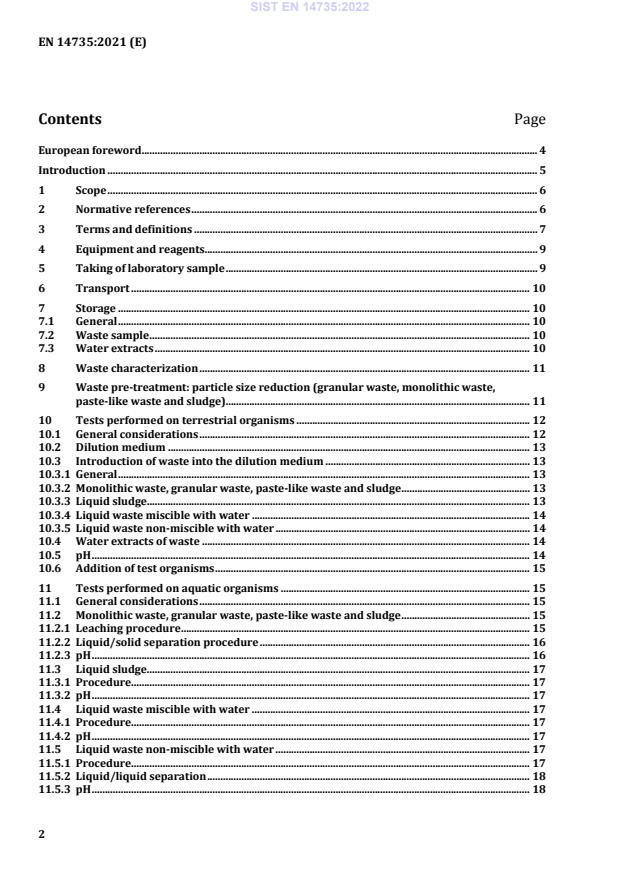
Contents Page
European foreword . 4
Introduction . 5
1 Scope . 6
2 Normative references . 6
3 Terms and definitions . 7
4 Equipment and reagents. 9
5 Taking of laboratory sample . 9
6 Transport . 10
7 Storage . 10
7.1 General . 10
7.2 Waste sample . 10
7.3 Water extracts . 10
8 Waste characterization . 11
9 Waste pre-treatment: particle size reduction (granular waste, monolithic waste,
paste-like waste and sludge) . 11
10 Tests performed on terrestrial organisms . 12
10.1 General considerations . 12
10.2 Dilution medium . 13
10.3 Introduction of waste into the dilution medium . 13
10.3.1 General . 13
10.3.2 Monolithic waste, granular waste, paste-like waste and sludge . 13
10.3.3 Liquid sludge . 13
10.3.4 Liquid waste miscible with water . 14
10.3.5 Liquid waste non-miscible with water . 14
10.4 Water extracts of waste . 14
10.5 pH . 14
10.6 Addition of test organisms . 15
11 Tests performed on aquatic organisms . 15
11.1 General considerations . 15
11.2 Monolithic waste, granular waste, paste-like waste and sludge . 15
11.2.1 Leaching procedure . 15
11.2.2 Liquid/solid separation procedure . 16
11.2.3 pH . 16
11.3 Liquid sludge . 17
11.3.1 Procedure. 17
11.3.2 pH . 17
11.4 Liquid waste miscible with water . 17
11.4.1 Procedure. 17
11.4.2 pH . 17
11.5 Liquid waste non-miscible with water . 17
11.5.1 Procedure. 17
11.5.2 Liquid/liquid separation . 18
11.5.3 pH . 18
11.6 Preparation of test mixtures . 18
12 Test report . 18
Annex A (normative) Preparation of test mixtures according to the ecotoxicity tests to be
performed . 19
Annex B (informative) Ecotoxicity tests considered to establish this document . 20
B.1 General . 20
B.2 Terrestrial tests methods . 21
B.2.1 Earthworms – Acute toxicity . 21
B.2.2 Earthworms – Effects on reproduction . 22
B.2.3 Earthworms – Avoidance . 23
B.2.4 Collembola – Effects on reproduction . 24
B.2.5 Coleoptera – Acute test . 25
B.2.6 Enchytraeid – Reproduction test . 26
B.2.7 Nematoda – Effects on growth, fertility and reproduction . 27
B.2.8 Juvenile land snails (Helix aspersa) . 28
B.2.9 Soil Flora – Inhibition of root growth . 29
B.2.10 Effects on emergence and growth . 31
B.2.11 Ammonium oxidation – Rapid test . 33
B.2.12 Mineralization and nitrification . 34
B.2.13 Dehydrogenase activity of Arthrobacter globiformis. 35
B.3 Aquatic tests methods . 37
B.3.1 Daphnia magna – Inhibition of mobility . 37
B.3.2 Daphnia magna – Inhibition of reproduction . 38
B.3.3 Ceriodaphnia dubia reproduction test . 39
B.3.4 Brachionus calyciflorus reproduction test . 40
B.3.5 Aliivibrio fischeri – Luminescent bacteria test . 41
B.3.6 Pseudomonas putida growth inhibition test . 42
B.3.7 Freshwater algal growth inhibition test . 43
B.3.8 Lemna minor – Growth inhibition test . 45
B.3.9 Fish egg test . 46
B.3.10 Freshwater fish acute toxicity test . 47
B.3.11 Marine copepods – Acute toxicity test . 48
B.3.12 Marine algal growth inhibition test . 49
B.3.13 Salmonella / Microsome test . 51
B.3.14 UMU test . 53
Bibliography . 54
European foreword
This document (EN 14735:2021) has been prepared by Technical Committee CEN/TC 444
“Environmental characterization of solid matrices”, the secretariat of which is held by NEN.
This European Standard shall be given the status of a national standard, either by publication of an
identical text or by endorsement, at the latest by May 2022, and conflicting national standards shall be
withdrawn at the latest by May 2022.
Attention is drawn to the possibility that some of the elements of this document may be the subject of
patent rights. CEN shall not be held responsible for identifying any or all such patent rights.
This document supersedes EN 14735:2005.
The main changes with respect to the previous edition are:
— the modification of Clause 12 “Test report” to specify whether ecotoxicity tests have been repeated
with pH adjustment of the test portion, allowing to clearly distinguish these results from those
obtained without pH adjustment;
— the clarification of the notes of 10.5 and 11.2.3 and associated notes regarding the repetition of the
tests with pH adjustment;
— the update of Annex B, describing the ecotoxicity tests considered to establish this document.
Any feedback and questions on this document should be directed to the users’ national standards body.
A complete listing of these bodies can be found on the CEN website.
According to the CEN-CENELEC Internal Regulations, the national standards organisations of the
following countries are bound to implement this European Standard: Austria, Belgium, Bulgaria, Croatia,
Cyprus, Czech Republic, Denmark, Estonia, Finland, France, Germany, Greece, Hungary, Iceland, Ireland,
Italy, Latvia, Lithuania, Luxembourg, Malta, Netherlands, Norway, Poland, Portugal, Republic of North
Macedonia, Romania, Serbia, Slovakia, Slovenia, Spain, Sweden, Switzerland, Turkey and the United
Kingdom.
Introduction
Ecotoxicity can be estimated using two approaches: a chemical-specific approach and a toxicity-based
approach. Chemical analyses are compared, in the first case, to quality criteria or threshold values to
estimate ecotoxicity. In the second one, ecotoxicity is measured directly using biological tests. These two
approaches complement each other; indeed, determination of pollutants in complex mixtures of
unknown composition, that is a characteristic of many wastes, does not allow a relevant estimation of
ecotoxicity. For such samples, the toxicity-based approach is usually recognized to be appropriate to
assess potential toxicity. Bioassays integrate, indeed, the effects of all contaminants including additive,
synergistic and antagonistic effects. They are sensitive to the bioavailable fraction of the contaminants
only. Finally, bioassays integrate the effects of all contaminants, including those, not considered or
detected by chemical analyses.
Ecotoxicity tests can be applied to wastes to identify their potential hazardous properties with respect to
the environment for classification purposes or to assess the risk related to a site-specific exposure
scenario.
Identification of properties potentially hazardous to the environment for classification purposes
A classification system, based on the assessment of intrinsic properties, should be independent of an
exposure scenario. The main requirement, in order to establish a relevant system for classifying wastes
and for assessment of hazard properties, is to obtain comparable test results. This can only be obtained
if the ecotoxicity tests on wastes are carried out according to a unique procedure describing more or less
conventional test conditions (an exclusive dilution medium for terrestrial tests, a unique L/S ratio for
preparation of water extracts, a unique liquid / solid separation step, etc.). This procedure should be
applicable to a very wide range of waste materials whatever their physical properties are.
Any strategy for the assessment of properties potentially hazardous to the environment used in a
classification system should include test organisms representing the terrestrial and the aquatic
compartment. Both types of tests should be considered because they expand the range of effect
expression due to differences in species sensitivity and exposure.
For this specific purpose, the water extracts preparations for toxicity testing do not simulate leaching
from wastes under environmental conditions but measure the water available fraction of the toxic
components of the wastes.
Site-specific exposure scenario
The second application of ecotoxicity tests to wastes refers to a risk assessment approach. In this
particular case, the test strategy should model site specific exposure conditions and should take into
account the transfer of contaminants via the food chain and to surface and ground water by run-off or
leaching. This application concerns firstly the definition of generic scenarios frequently encountered (e.g.
wastes deposit in stockpiles, re-use of wastes) and focus on the relevant way of exposure to terrestrial
and aquatic organisms.
This document describes the necessary steps to be performed before carrying out ecotoxicity tests on
wastes within the context of assessment of ecotoxic properties for classification purposes.
It should be kept in mind that the use of this standard is currently not mandatory for assessing the
hazardous property HP14.
1 Scope
This document describes the necessary steps to be performed before carrying out ecotoxicity tests on
wastes. The purpose of this document is to provide guidance on the taking of the sample, transport,
storage of wastes and to define preparation, for the determination of ecotoxicological properties of
wastes under the conditions specified in this document by biological testing either as raw wastes or water
extracts from wastes. Sample preparation for other applications (e.g. assessment of waste effects on
aquatic and terrestrial organisms in a disposal scenario) is not considered.
Specifying a test battery to characterize ecotoxicological properties of wastes is not in the scope of this
document.
This document is applicable to solid and liquid wastes.
2 Normative references
The following documents are referred to in the text in such a way that some or all of their content
constitutes requirements of this document. For dated references, only the edition cited applies. For
undated references, the latest edition of the referenced document (including any amendments) applies.
EN 12457-2:2002, Characterisation of waste - Leaching - Compliance test for leaching of granular waste
materials and sludges - Part 2: One stage batch test at a liquid to solid ratio of 10 l/kg for materials with
particle size below 4 mm (without or with size reduction)
EN 14899, Characterization of waste - Sampling of waste materials - Framework for the preparation and
application of a Sampling Plan)
EN 16720-1, Characterization of sludges - Physical consistency - Part 1: Determination of flowability -
Method by extrusion tube apparatus)
EN ISO 5667-3, Water quality - Sampling - Part 3: Preservation and handling of water samples (ISO 5667-
3)
EN ISO 14238:2012, Soil quality - Biological methods - Determination of nitrogen mineralization and
nitrification in soils and the influence of chemicals on these processes (ISO 14238: 2012)
ISO 11465, Soil quality - Determination of dry matter and water content on a mass basis - Gravimetric
method
EN ISO 10390, Soil, sludge and treated biowaste - Determination of pH (ISO/FDIS 10390)
3 Terms and definitions
For the purposes of this document, the following terms and definitions apply.
ISO and IEC maintain terminological databases for use in standardization at the following addresses:
— ISO Online browsing platform: available at https://www.iso.org/obp
— IEC Electropedia: available at https://www.electropedia.org/
3.1
dilution medium
liquid or solid used for the preparation of control vessels and the preparation of test mixtures
3.2
ecotoxicological properties
potential adverse effects to biological systems which a waste has an inherent capacity to cause
3.3
eluate
solution recovered from a leaching test
[SOURCE: EN 12457-2:2002, 3.3]
3.4
granular waste
waste not being monolithic, nor a liquid, a gas or a sludge
[SOURCE: adapted from EN 12457-2:2002, 3.10]
3.5
laboratory sample
sample or subsample(s) sent to or received by the laboratory (IUPAC definition)
Note 1 to entry: When the laboratory sample is further prepared (reduced) by subdividing, mixing, grinding or by
combinations of these operations, the result is the test sample. When no preparation of the laboratory sample is
required, the laboratory sample is the test sample. A test portion is removed from the test sample for the
performance of the test or for analysis. The laboratory sample is the final sample from the point of view of sample
collection, but it is the initial sample from the point of view of the laboratory.
Note 2 to entry: Several laboratory samples can be prepared and sent to different laboratories or to the same
laboratory for different purposes. When sent to the same laboratory, the set is generally considered as a single
laboratory sample and is documented as a single sample.
3.6
leachant
liquid used in a leaching test
Note 1 to entry: For the purpose of this document the leachant is water as specified in Clause 4.
3.7
leaching test
test during which a material is put into contact with a leachant and some constituents of the material are
extracted
3.8
liquid sludge
sludge in a liquid physical state, determined according to EN 16720-1
3.9
liquid waste
waste that completely flows out of a calibrated opening, down to the upper level of the opening within a
limited period of time (see Annex B of EN 12457-2:2002)
3.10
monolithic waste
waste prepared with a certain minimum dimensions and physical and mechanical properties that ensure
its integrity over a certain period of time in the considered scenario
[SOURCE: CEN/TS 16675:2018, 3.7]
3.11
paste-like material
material of soft plastic or wet cement consistency – usually smooth
3.12
sludge
mixture of liquid and solid separated from various types of liquid as a result of natural or artificial
processes
[SOURCE: adapted from EN 12457-2:2002, 3.8]
3.13
test mixture
mixture of the test portion (waste or water extract) with the dilution medium (3.1)
3.14
test portion
amount or volume of the test sample taken for measurement of ecotoxicological properties by biological
testing and/or other properties of interest, usually of known weight or volume (adapted from IUPAC
definition)
Note 1 to entry: The test portion can be taken from the laboratory sample directly if no preparation of sample
is required (e.g. with liquids), but usually it is taken from the prepared test sample.
Note 2 to entry: A unit or increment of proper homogeneity, size and fineness, needing no further preparation,
can be a test portion.
3.15
test sample
sample, prepared from the laboratory sample, from which test portions are removed for biological testing
or analysis (adapted from IUPAC definition)
Note 1 to entry: The preparation of the test sample can include particle size reduction, preparation of water
extract, etc.
3.16
water extract
solution obtained from a leaching test, a liquid/liquid extraction and a liquid/solid separation
(centrifugation)
4 Equipment and reagents
Usual laboratory equipment and the following.
4.1 Sieving equipment, e.g. with sieves of 4 mm square mesh.
NOTE Due to sieving, contamination of the sample can occur to an extent that affects the leaching of some
constituents of concern e.g. cobalt and tungsten from tungsten carbide equipment or chromium, nickel and
molybdenum from stainless steel equipment.
4.2 Crushing equipment: jaw crusher or cutting device.
NOTE Due to crushing, contamination of the sample can occur to an extent that affects the leaching of some
constituents of concern e.g. cobalt and tungsten from tungsten carbide equipment or chromium, nickel and
molybdenum from stainless steel equipment.
4.3 Balance of accuracy of at least 0,1 g.
4.4 End-over-end tumbler (5 rpm to 10 rpm) or rollertable rotating at about 10 rpm.
NOTE Other shaking or mixing devices can be used provided that they are proven to be equivalent.
4.5 Centrifuge that can attain a RCF between 2 000 g and 3 000 g.
4.6 Filtering apparatus, either a vacuum filtration device (between 30 kPa and 70 kPa) (300 mbars
to 700 mbars) or a high-pressure filtration apparatus (<0,5 MPa) (5 bars).
4.7 Large scale laboratory mixer.
4.8 pH meter.
4.9 Glass or high-density polyethylene (HDPE)/polypropylene (PP) bottles in accordance with
EN ISO 5667-3, glass bottles having caps of inert material, for example polytetrafluoroethylene. Rinsing
with sample material or water (4.10) is compulsory.
NOTE For inorganic constituents HDPE/PP bottles are preferred, except for samples containing mercury.
4.10 Water, distilled water, demineralized water or deionized water with a conductivity < 5 µS/cm.
5 Taking of laboratory sample
Obtain a representative laboratory sample of a quantity sufficient for the number of tests to be performed
and in accordance with the requirements of biological standardized methods to be used.
Special precautions should be taken to avoid any contamination of laboratory samples by material of
sampling devices and/or storage equipment, according to EN 14899.
NOTE Sampling devices are described in the technical report CEN/TR 15310-2.
Some wastes are subject to chemical, physical and biological changes as soon as they are collected (e.g.
wastes that are fermentable, subject to oxidation or carbonation and wastes that contain volatile
substances). Possible changes shall be considered and sampling conditions shall be designed accordingly
in order to limit the effects of such changes on the results of ecotoxicity tests.
However, addition of preservatives (e.g. acids, basic solutions, biocides) in order to reduce chemical and
biological activity is prohibited.
6 Transport
Transport of laboratory samples shall be performed in the dark, in tight containers fully filled with the
waste to be tested. However, special precautions should be taken for transport and storage of sludge or
other microbial active wastes. Containers can become pressurized due to gas production and explosions
may occur. For such laboratory samples, containers should not be completely filled. Nevertheless,
headspace shall not exceed 10 % of the total capacity of the container. Manual release of pressure during
and after transport may be necessary.
The container material shall be appropriate. The container, in which the waste laboratory sample is
transported, and the stopper shall not react with the constituents of the sample and shall not be a cause
of contamination. Wastes shall be stored in polyethylene, polypropylene, polytetrafluoroethene (PTFE)
or glass containers. However, security aspects shall be considered, including the risk of explosion due to
gas generation (for example, glass vessels are not suitable for sludge samples).
Transport of waste laboratory samples should be as short as possible. Possible changes shall be
considered and transport conditions shall be designed accordingly in order to limit the effects of such
changes on the results of ecotoxicity tests. Transport time shall be regarded as part of storage time.
A transport time of less than 48 h and/or a low temperature conditions (4 ± 2) °C are appropriate to
maintain the properties of laboratory samples.
7 Storage
7.1 General
Storage should be carried out in the containers defined in Clause 6. Possible changes shall be considered
and storage conditions shall be designed accordingly in order to limit the effects of such changes on the
results of ecotoxicity tests.
7.2 Waste sample
Storage time starting from reception of laboratory sample and ending with the start of definitive tests
should be as short as possible.
A storage time of less than two months and low temperature conditions (4 ± 2) °C are usually appropriate
to maintain the properties of waste samples (i.e. granular wastes (3.4), monolithic wastes (3.10), paste-
like materials (3.11)).
Liquid wastes should be stored under the conditions defined in 7.3.
NOTE Freezing can induce changes of characteristics of the waste sample.
7.3 Water extracts
Water extracts should be stored at (4 ± 2) °C in polyethylene, polypropylene, polytetrafluoroethene
(PTFE) or glass containers. Before testing, the containers shall be filled with a headspace less than 5 %.
NOTE 1 Freezing can induce changes of characteristics of water extracts.
It is recommended to minimize the time between the start of the different tests to be performed on the
same laboratory sample in order to minimize its changes.
Ecotoxicological tests shall start immediately after production of water extract as specified in the
applicable standard for the considered ecotoxicity test and in no case later than 72 h after production of
water extract. If a range-finding test and a definitive test are performed, the definitive test shall be
completed within 10 days after production of the water extract.
For longer tests (e.g. semi-static chronic tests), several water extracts shall be produced and used within
10 days after production.
If definitive test results are not in accordance with the range-finding test, water extraction shall be
repeated and the test shall be performed on the new water extract.
NOTE 2 It could be possible to extend the duration of storage if it has been proved that no modification of toxicity
occurred within the storage period (e.g. carry out the same ecotoxicity test immediately after extraction period and
at the end of storage period).
8 Waste characterization
The following characteristics shall be determined prior to the performance of ecotoxicity tests:
— For granular waste (3.4), monolithic waste (3.10), paste-like waste (3.11) and sludge (3.12):
• pH, according to EN ISO 10390;
• dry matter content, according to ISO 11465 (see Clause 9);
• water holding capacity, according to Annex A of EN ISO 14238:2012 (see note).
NOTE The method described in Annex A of EN ISO 14238:2012 has been found to be appropriate for most
kinds of waste.
— For liquid waste:
• pH;
• Dissolved oxygen concentration;
• Conductivity.
9 Waste pre-treatment: particle size reduction (granular waste, monolithic
waste, paste-like waste and sludge)
Both ecotoxicological and leaching tests are performed on material which originally and after
pretreatment has a particle size less than 4 mm.
The tests shall be made on material with a grain size of at least 95 % (mass) less than 4 mm. Therefore,
the laboratory sample shall be sieved (4.1). If oversized material exceeds 5 % (mass) the entire oversized
fraction shall be crushed with crushing equipment (4.2). On no account shall the material be finely
ground. Non-crushable material (e.g. metallic parts such as nuts, bolts, or scrap) in the sample shall be
separated and the weight and nature of the material shall be recorded. The method of size-reduction
applied shall be documented and recorded in the test report. Irrespective of any necessary size reduction,
the separate fractions with the exception of the non-crushable material shall be mixed to constitute the
test sample. If the laboratory sample cannot be crushed or sieved because of its moisture content, it is
allowed, only in this case, to dry the laboratory sample. The drying temperature shall not exceed 40 °C.
NOTE Fibrous materials, paste-like waste and plastics can often be size-reduced after cryogenic treatment. The
sample is usually plunged into liquid nitrogen (- 196 °C) just before crushing to make it fragile and brittle. It also
limits the overheating during crushing. As a result, the sample obtained is fine and perfectly homogeneous.
In order to minimize the possible contamination during the sieving, fragmentation and splitting, it is
recommended, before preparing the test sample, to process a portion of the laboratory sample through
the devices for sieving, fragmentation and splitting and to discard such material thereafter. This
recommendation does not cover the situation described in the notes under 4.1 and 4.2.
For this document, any other waste pre-treatment is excluded; especially, the test sample which shall not
be further dried. The determination of the dry matter content ratio and the moisture content ratio shall
be determined on a dedicated test portion. The moisture content of the test sample shall be determined
at (105 ± 5) °C. It shall be taken into account when adjusting the L/S ratio in leaching test. The dry mass
of the sample shall be determined at (105 ± 5) °C according to ISO 11465 and the dry matter content ratio
is calculated as follows:
M
D
DR=100×
(1)
M
W
where
DR is the dry matter content ratio (%);
M is the mass of the dried test portion (kg);
D
M is the mass of undried test portion (kg).
W
The moisture content ratio is calculated as follows:
(M − M )
W D
MC=100× (2)
M
D
where
MC is the moisture content ratio (%).
The basis for the calculation of the moisture content is the mass of the moisture content of the dry residue
in this document, as specified in ISO 11465 (for the determination of the water content of soil). It should
be noted that in EN 12880 (for the determination of water content of sludge), the water content is
calculated on the basis of the raw mass.
The above moisture content determination could be not accurate enough in some cases (e.g. large amount
of volatile or unstable compounds). In such cases a direct determination of the true water content should
be performed and the moisture content ratio calculated accordingly.
10 Tests performed on terrestrial organisms
10.1 General considerations
The determination of ecotoxicological properties of wastes under conventional conditions requires using
a dilution medium as inert as possible. This dilution medium shall allow the survival and the good
development of organisms during the test period. Both requirements may be difficult to reconcile
particularly considering plant growth inhibition tests and microbial tests (tests that required indigenous
population of microorganisms).
In order to fulfil these requirements, the dilution medium called “artificial soil” shall be used unless
otherwise specified in the standardized terrestrial test methods. The same medium shall be used for both
control and dilution.
Moreover, preparation of a medium should be reproducible to allow comparison of ecotoxicity tests
results.
Several standardized ecotoxicity tests were considered to establish the following conditions for testing
wastes on terrestrial organisms. This compilation of tests is given in Annex B.
Preparation of test mixtures may differ according to the type of waste and according to the ecotoxicity
tests to be performed. Preparation of the different test mixtures is summarized in Table A.1 of Annex A.
10.2 Dilution medium
The dilution medium shall have the following composition (such as defined in ISO 11268-1):
— sphagnum peat finely ground and with no visible plant remains: 10 % (percentage expressed on dry
mass basis);
— kaolinite clay containing not less than 30 % kaolinite: 20 % (percentage expressed on dry mass
basis);
— industrial quartz sand (more than 50 % of particle size from 0,05 mm to 0,20 mm): 70 % (percentage
expressed on dry mass basis).
Calcium carbonate (CaCO ), pulverised and of recognized analytical grade is added to bring the pH of the
wetted substrate to 6,0 ± 0,5 (generally between 0,5 % and 1 % of the mass of the dry ingredients).
Water (4.10) or mixture of water extract with water is added to the dilution medium to reach the
percentage of the total water holding capacity recommended for each test organism.
10.3 Introduction of waste into the dilution medium
10.3.1 General
Preparation of test mixtures differs according to the waste to be tested (see Annex A). The different
methods of preparation are described below.
10.3.2 Monolithic waste, granular waste, paste-like waste and sludge
Different methods can be applied to introduce the test portion into the dilution medium. Several
parameters influence the selection of introduction method such as physical properties of waste or
amounts to be tested. The following methods are recommended:
— for small amounts, introduce the test portion in the water (or in part of it) necessary to wet the
dilution medium, then mix this suspension thoroughly with the dilution medium;
— for large amounts, mix the test portion thoroughly with the already hydrated dilution medium;
— for hydrophobic waste, mix the test portion thoroughly with the dilution medium, then add the water
necessary to wet this mixture.
Test mixtures are expressed in percentages (dry mass of waste per total dry mass of test mixture).
10.3.3 Liquid sludge
Introduce the test portion in the water (or in part of it) necessary to wet the dilution medium, then mix
this suspension thoroughly with the dilution medium in order to obtain the test mixture to perform the
considered ecotoxicological test. Test mixtures are expressed in percentages (mass of waste per total dry
mass of test mixture).
The volume of the liquid sludge to be added is limited by the percentage of water holding capacity of the
test mixture recommended in the test methods.
10.3.4 Liquid waste miscible with water
Introduce the test portion in the water (or in part of it) necessary to wet the dilution medium, then mix
this suspension thoroughly with the dilution medium.
Some liquid waste may not contain any water and does not hydrate the test mixture, in which case it is
necessary to add water to allow survival of test organisms within the given test period.
The maximum quantity of liquid waste and water to be added shall correspond to the water holding
capacity of the dilution medium recommended for each test method (see Annex B). The structure
achieved after adding the liquid waste should meet the requirements of the test organisms.
10.3.5 Liquid waste non-miscible with water
The following methods are recommended.
a) For small amounts:
— introduce by ultrasonic dispersion the test portion in the water (or in part of it) necessary to wet
the dilution medium, then mix this suspension thoroughly with the dilution medium; or
— prepare a mixture of quartz sand (see 10.2) and the quantity of test portion required to obtain
the desired amount (a ratio of 10 g of sand per kilogram of soil is usually recommended). Mix
with the dilution medium thoroughly, then add the water necessary to wet this mixture.
b) For large amounts:
— mix the test portion thoroughly with the dilution medium already hydrated; or
— mix the test portion thoroughly with the dilution medium, then add the water necessary to wet
this mixture.
Test mixtures are expressed in percentages (mass of waste per total dry mass of test mixture).
10.4 Water extracts of waste
Introduce the water extract (see Clause 11) in the water (or in part of it) necessary to wet the dilution
medium, then mix this suspension thoroughly with the dilution medium.
The maximum quantity of water extract to be added shall correspond to the water holding capacity of the
dilution medium recommended for each test method.
Test mixtures are expressed in percentages (mass of water extract per total dry mass of test mixture).
10.5 pH
Tests shall be carried out without pH adjustment of the test portion. If toxic effects are observed in the
dilutions where pH is not compatible with the survival of the organisms, the test(s) can be repeated with
pH adjustment of the test portion. However, changes in pH can significantly modify the equilibrium
between the dissociated and non-dissociated forms of some chemicals and can lead to complexation or
precipitation reactions.
pH of all test mixtures is measured at the beginning and at the end of the test and reported.
NOTE 1 pH of test mixtures can significantly differ from pH of test portion according to the selected dilution
range and according to buffer capacity of test medium or test portion.
NOTE 2 According to the type of wastes, the preliminary assessment of available dat
...