

CEN/TR 16110:2024
(Main)Characterization of waste - Guidance on the use of ecotoxicity tests applied to waste
- Abstract
Ecotoxicity tests can be applied to wastes to identify their potential hazardous properties with respect to the environment or to assess the risk related to a site-specific exposure scenario. This document provides guidance for the selection and use of ecotoxicity tests for both applications.
This document focuses on the following selected field of applications:
a) Basic ecotoxicological characterization;
b) Site-specific exposure scenario;
c) Landfill management:
1) monitoring of leachates;
2) mineral waste going to non-controlled landfill sites.
d) Re-use of waste:
1) use of sludge in agriculture;
2) use of mineral waste in road construction.
The user should be aware that other fields of application can also be covered by ecotoxicological testing not being in the scope of the document. The ecotoxicological assessment of waste within other scenarios might need the development of other test strategies.
Depending on the waste type and the assessment goal, relevant criteria are described for the selection of a test strategy and the suitable ecotoxicity test(s).
This document also provides guidance for individual ecotoxicity test protocols to meet the specific demands of waste testing (e.g. limitations, test design, confounding factors).The tests recommended represent a minimum test battery that may be accomplished by additional tests or even be replaced by others according to the waste, the intended use or protection goal envisaged.
- Status
- Published
- Publication Date
- 06-Feb-2024
- Technical Committee
- CEN/TC 444 - Environmental characterization
- Drafting Committee
- CEN/TC 444/WG 4 - Biological characterization
- Current Stage
- 6060 - Definitive text made available (DAV) - Publishing
- Start Date
- 07-Feb-2024
- Due Date
- 28-Dec-2024
- Completion Date
- 07-Feb-2024

Overview
CEN/TR 16110:2024 - "Characterization of waste - Guidance on the use of ecotoxicity tests applied to waste" provides practical guidance for selecting and applying ecotoxicity tests to wastes. The Technical Report (approved January 2024) focuses on toxicity-based assessment where chemical analysis alone is insufficient, and addresses both hazard identification (HP 14 “Ecotoxic”) and site-specific exposure scenarios. It updates and supersedes earlier editions and includes national practice summaries to inform harmonized approaches.
Key Topics
- Scope and purpose: Guidance for basic ecotoxicological characterization, site-specific risk assessments, landfill management (leachate monitoring; mineral waste to non‑controlled landfills), and re‑use scenarios (sludge in agriculture; mineral waste in road construction).
- Test strategy and selection: Criteria to choose an appropriate test battery based on waste type, protection goals, sensitivity, practicability and cost. Recommends a minimum battery that can be extended or adapted.
- Leaching procedures and eluates: Overview of leaching tests, leachant selection (water-based eluates), and separation techniques tailored for ecotoxicological testing. Guidance on sample preparation, storage and transport.
- Ecotoxicity test protocols: Advice on adapting standardized biotests for wastes - limitations, confounding factors, test design (limit tests vs concentration–response, e.g., ECx), and reporting considerations (e.g., LID, ECx definitions).
- Decision‑making: Practical guidance for interpreting results in hazard classification and site‑specific contexts; includes examples and national practice annex summarizing approaches to HP 14.
- Quality and validation: Notes on international harmonization, known validation gaps for some methods, and outcomes from ring tests and studies used as background.
Applications
- Hazard classification of wastes with respect to HP 14 (Ecotoxic).
- Site‑specific risk assessment for contaminated sites and waste reuse projects.
- Landfill management: routine leachate monitoring and assessment of mineral wastes destined for non‑controlled disposal.
- Re‑use evaluation: assessing safety of sludge application in agriculture and mineral waste in road construction.
- Laboratory method adaptation: environmental labs and test facilities applying biotests to complex waste matrices.
Who should use this standard
- Environmental regulators and policy makers
- Waste managers and landfill operators
- Environmental and geotechnical consultants
- Accredited ecotoxicology laboratories
- Researchers and standardization bodies working on waste reuse and circular economy practices
Related standards and references
- References to regulatory context such as Council Regulation (EU) 2017/997 and Regulation (EC) No 1272/2008 are noted in the report.
- The report complements existing harmonized ecotoxicological test methods and provides waste‑specific adaptation guidance rather than replacing chemical threshold frameworks.
Keywords: CEN/TR 16110:2024, ecotoxicity tests, waste characterization, HP 14, leaching tests, leachate monitoring, sludge reuse, test battery, site-specific exposure.
Relations
- Effective Date
- 07-Jun-2023
Get Certified
Connect with accredited certification bodies for this standard

CIS Institut d.o.o.
Personal Protective Equipment (PPE) certification body. Notified Body NB-2890 for EU Regulation 2016/425 PPE.

Kiwa BDA Testing
Building and construction product certification.
Kmetijski inštitut Slovenije
Agricultural Institute of Slovenia. Soil testing, plant health, agricultural product analysis.
Sponsored listings
Frequently Asked Questions
CEN/TR 16110:2024 is a technical report published by the European Committee for Standardization (CEN). Its full title is "Characterization of waste - Guidance on the use of ecotoxicity tests applied to waste". This standard covers: Ecotoxicity tests can be applied to wastes to identify their potential hazardous properties with respect to the environment or to assess the risk related to a site-specific exposure scenario. This document provides guidance for the selection and use of ecotoxicity tests for both applications. This document focuses on the following selected field of applications: a) Basic ecotoxicological characterization; b) Site-specific exposure scenario; c) Landfill management: 1) monitoring of leachates; 2) mineral waste going to non-controlled landfill sites. d) Re-use of waste: 1) use of sludge in agriculture; 2) use of mineral waste in road construction. The user should be aware that other fields of application can also be covered by ecotoxicological testing not being in the scope of the document. The ecotoxicological assessment of waste within other scenarios might need the development of other test strategies. Depending on the waste type and the assessment goal, relevant criteria are described for the selection of a test strategy and the suitable ecotoxicity test(s). This document also provides guidance for individual ecotoxicity test protocols to meet the specific demands of waste testing (e.g. limitations, test design, confounding factors).The tests recommended represent a minimum test battery that may be accomplished by additional tests or even be replaced by others according to the waste, the intended use or protection goal envisaged.
Ecotoxicity tests can be applied to wastes to identify their potential hazardous properties with respect to the environment or to assess the risk related to a site-specific exposure scenario. This document provides guidance for the selection and use of ecotoxicity tests for both applications. This document focuses on the following selected field of applications: a) Basic ecotoxicological characterization; b) Site-specific exposure scenario; c) Landfill management: 1) monitoring of leachates; 2) mineral waste going to non-controlled landfill sites. d) Re-use of waste: 1) use of sludge in agriculture; 2) use of mineral waste in road construction. The user should be aware that other fields of application can also be covered by ecotoxicological testing not being in the scope of the document. The ecotoxicological assessment of waste within other scenarios might need the development of other test strategies. Depending on the waste type and the assessment goal, relevant criteria are described for the selection of a test strategy and the suitable ecotoxicity test(s). This document also provides guidance for individual ecotoxicity test protocols to meet the specific demands of waste testing (e.g. limitations, test design, confounding factors).The tests recommended represent a minimum test battery that may be accomplished by additional tests or even be replaced by others according to the waste, the intended use or protection goal envisaged.
CEN/TR 16110:2024 is classified under the following ICS (International Classification for Standards) categories: 13.030.01 - Wastes in general. The ICS classification helps identify the subject area and facilitates finding related standards.
CEN/TR 16110:2024 has the following relationships with other standards: It is inter standard links to CEN/TR 16110:2010. Understanding these relationships helps ensure you are using the most current and applicable version of the standard.
CEN/TR 16110:2024 is available in PDF format for immediate download after purchase. The document can be added to your cart and obtained through the secure checkout process. Digital delivery ensures instant access to the complete standard document.
Standards Content (Sample)
SLOVENSKI STANDARD
01-junij-2024
Nadomešča:
SIST-TP CEN/TR 16110:2011
Karakterizacija odpadkov - Navodilo za uporabo ekotoksikoloških preskusov za
odpadke
Characterization of waste - Guidance on the use of ecotoxicity tests applied to waste
Charakterisierung von Abfällen - Anleitung zur Anwendung von Ökotoxizitätsprüfungen
auf Abfälle
Caractérisation des déchets - Recommandations sur l'utilisation des essais d'écotoxicité
appliqués aux déchets
Ta slovenski standard je istoveten z: CEN/TR 16110:2024
ICS:
13.030.01 Odpadki na splošno Wastes in general
2003-01.Slovenski inštitut za standardizacijo. Razmnoževanje celote ali delov tega standarda ni dovoljeno.
CEN/TR 16110
TECHNICAL REPORT
RAPPORT TECHNIQUE
February 2024
TECHNISCHER REPORT
ICS 13.030.01 Supersedes CEN/TR 16110:2010
English Version
Characterization of waste - Guidance on the use of
ecotoxicity tests applied to waste
Caractérisation des déchets - Recommandations sur Charakterisierung von Abfällen - Anleitung zur
l'utilisation des essais d'écotoxicité appliqués aux Anwendung von Ökotoxizitätsprüfungen auf Abfälle
déchets
This Technical Report was approved by CEN on 1 January 2024. It has been drawn up by the Technical Committee CEN/TC 444.
CEN members are the national standards bodies of Austria, Belgium, Bulgaria, Croatia, Cyprus, Czech Republic, Denmark, Estonia,
Finland, France, Germany, Greece, Hungary, Iceland, Ireland, Italy, Latvia, Lithuania, Luxembourg, Malta, Netherlands, Norway,
Poland, Portugal, Republic of North Macedonia, Romania, Serbia, Slovakia, Slovenia, Spain, Sweden, Switzerland, Türkiye and
United Kingdom.
EUROPEAN COMMITTEE FOR STANDARDIZATION
COMITÉ EUROPÉEN DE NORMALISATION
EUROPÄISCHES KOMITEE FÜR NORMUNG
CEN-CENELEC Management Centre: Rue de la Science 23, B-1040 Brussels
© 2024 CEN All rights of exploitation in any form and by any means reserved Ref. No. CEN/TR 16110:2024 E
worldwide for CEN national Members.
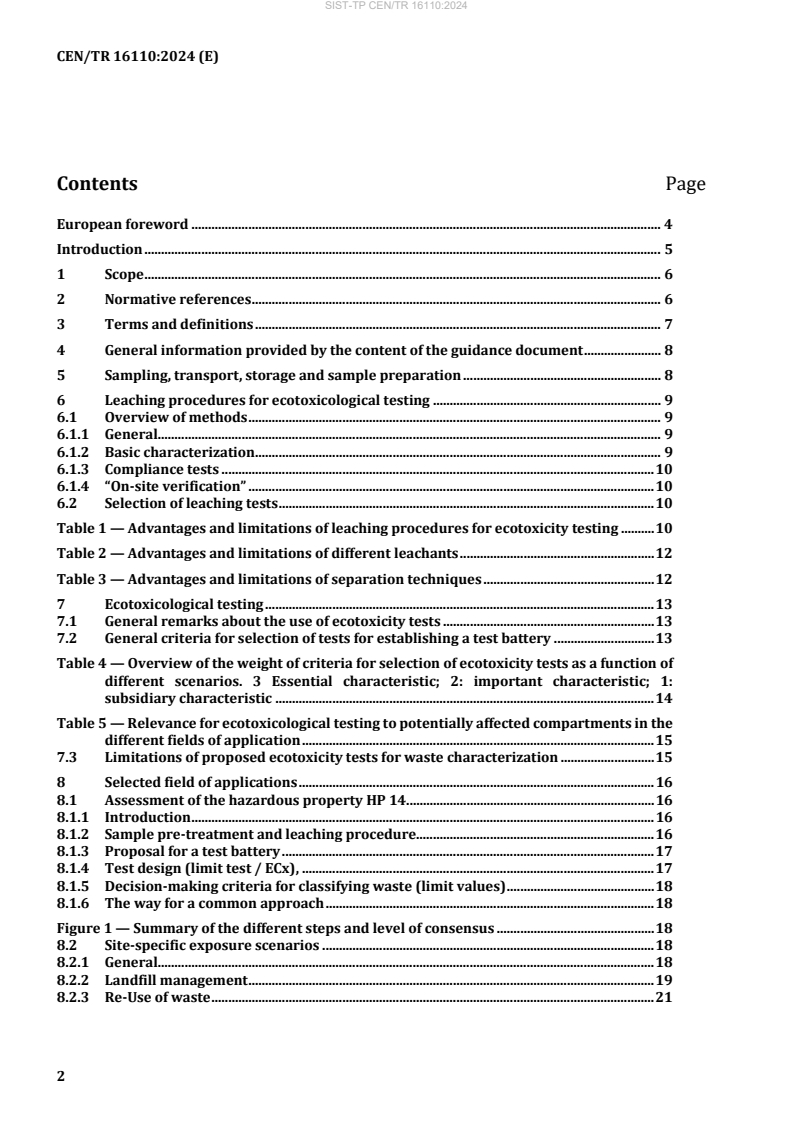
Contents Page
European foreword . 4
Introduction . 5
1 Scope . 6
2 Normative references . 6
3 Terms and definitions . 7
4 General information provided by the content of the guidance document . 8
5 Sampling, transport, storage and sample preparation . 8
6 Leaching procedures for ecotoxicological testing . 9
6.1 Overview of methods . 9
6.1.1 General. 9
6.1.2 Basic characterization . 9
6.1.3 Compliance tests . 10
6.1.4 “On-site verification” . 10
6.2 Selection of leaching tests . 10
Table 1 — Advantages and limitations of leaching procedures for ecotoxicity testing . 10
Table 2 — Advantages and limitations of different leachants . 12
Table 3 — Advantages and limitations of separation techniques . 12
7 Ecotoxicological testing . 13
7.1 General remarks about the use of ecotoxicity tests . 13
7.2 General criteria for selection of tests for establishing a test battery . 13
Table 4 — Overview of the weight of criteria for selection of ecotoxicity tests as a function of
different scenarios. 3 Essential characteristic; 2: important characteristic; 1:
subsidiary characteristic . 14
Table 5 — Relevance for ecotoxicological testing to potentially affected compartments in the
different fields of application . 15
7.3 Limitations of proposed ecotoxicity tests for waste characterization . 15
8 Selected field of applications . 16
8.1 Assessment of the hazardous property HP 14. 16
8.1.1 Introduction . 16
8.1.2 Sample pre-treatment and leaching procedure . 16
8.1.3 Proposal for a test battery . 17
8.1.4 Test design (limit test / ECx), . 17
8.1.5 Decision-making criteria for classifying waste (limit values) . 18
8.1.6 The way for a common approach . 18
Figure 1 — Summary of the different steps and level of consensus . 18
8.2 Site-specific exposure scenarios . 18
8.2.1 General. 18
8.2.2 Landfill management . 19
8.2.3 Re-Use of waste . 21
Figure 2 — Testing scheme for sludges and composts . 23
Annex A (informative) The national practices to assess the hazardous property HP 14
‘Ecotoxic’ Assessment of the Questionnaire . 25
A.1 Background . 25
A.2 Concerns / Limitations . 25
A.3 National approaches to assess HP 14 . 26
Table A.1 . 26
Table A.2 . 26
Table A.3 . 28
A.4 Types of wastes covered by the assessment . 29
Table A.4 . 29
Table A.5 . 30
A.5 Preparation of water extracts . 31
Table A.6 . 31
Table A.7 . 32
Table A.8 . 33
A.6 Battery of ecotoxicity tests . 34
Table A.9 . 34
A.7 Limit values, test design and decision-making criteria . 36
Table A.10 . 36
Bibliography . 38
European foreword
This document (CEN/TR 16110:2024) has been prepared by Technical Committee CEN/TC 444
“Environmental characterization of solid matrices”, the secretariat of which is held by NEN.
Attention is drawn to the possibility that some of the elements of this document may be the subject of
patent rights. CEN shall not be held responsible for identifying any or all such patent rights.
This document supersedes CEN/TR 16110:2010.
CEN/TR 16110:2010:
— The reference to the assessment of hazardous property HP 14 “Ecotoxic” in place of basic
ecotoxicological characterization
— The inclusion of an annex that summarizes the national practices to assess the hazardous property
HP 14 'Ecotoxic' and the addition of the main conclusions of this survey in subclause 8.1.
Any feedback and questions on this document should be directed to the users’ national standards body.
A complete listing of these bodies can be found on the CEN website.
Introduction
Ecotoxicity can be estimated using two approaches: a chemical-specific approach and a toxicity-based
approach. In the first situation, chemical analyses are compared to quality criteria or threshold values to
estimate toxicity. In the second case, toxicity is measured directly using toxicity tests. These two
approaches complement each other. However, determination of pollutants in complex mixtures of
unknown composition (a characteristic of many wastes) does not allow a relevant estimation of toxicity.
For such samples, the toxicity-based approach is usually recognized to be the best approach to assess
toxicity. Ecotoxicity tests integrate the effects of all contaminants including additive, synergistic and
antagonistic effects. They are sensitive to the bioavailable fraction of the contaminants only and integrate
the effects of all contaminants, including those, not considered or detected by chemical analyses.
Ecotoxicity tests can be applied to wastes to identify their hazardous properties (i.e. HP 14) in accordance
with Council Regulation (EU) 2017/997 [22] or to assess the risk related to a site-specific exposure
scenario. Determining the hazard classification of waste for hazardous property HP 14 “Ecotoxic” by
applying calculation formulae, generic cut-off values, as defined in Regulation (EC) No 1272/2008 [24] is
out of the scope of this document.
The majority of existing ecotoxicity tests being internationally harmonized were developed to describe
the ecotoxic potential of a test substance when added to water or to soil/soil material, of wastewater or
of eluates. These methods can be applied with some modifications for the ecotoxicological
characterization of wastes. Nevertheless, users of these methods should be aware that the validation of
the methods is not complete. Several studies as well as an International ring test have been conducted to
validate some test methods for waste samples and the results have been used as background information.
1 Scope
Ecotoxicity tests can be applied to wastes to identify their potential hazardous properties with respect to
the environment or to assess the risk related to a site-specific exposure scenario. This document provides
guidance for the selection and use of ecotoxicity tests for both applications.
This document focuses on the following selected field of applications:
a) hazardous properties (i.e. HP 14);
b) Site-specific exposure scenario;
c) Landfill management:
a. monitoring of leachates;
b. mineral waste going to non-controlled landfill sites.
d) Re-use of waste:
c. use of sludge in agriculture;
d. use of mineral waste in road construction.
Other fields of application can also be covered by ecotoxicological testing not being in the scope of the
document. The ecotoxicological assessment of waste within other scenarios might need the development
of other test strategies.
With regard, more specifically, to the assessment of hazardous properties, this document focuses on the
ecotoxicological characterization of waste using biotests.
Depending on the waste type and the assessment goal, relevant criteria are described for the selection of
a test strategy and the suitable ecotoxicity test(s).
This document also provides guidance for ecotoxicity test protocols to meet the specific demands of
waste testing (e.g., limitations, test design, confounding factors). The proposed tests represent a
minimum test battery that can be completed by additional tests or even be replaced by others according
to the waste, the intended use or protection goal envisaged.
2 Normative references
There are no normative references in this document.
3 Terms and definitions
For the purposes of this document, the following terms and definitions apply.
ISO and IEC maintain terminology databases for use in standardization at the following addresses:
— ISO Online browsing platform: available at https://www.iso.org/obp/
— IEC Electropedia: available at https://www.electropedia.org/
3.1
eluate
aqueous solution recovered from a leaching test
3.2
waste
any substance or object in the categories which the holder discards or intends or is required to discard
[SOURCE: Directive 2006/12/EC]
Note 1 to entry: See Annex I.
3.3
leachant
liquid used in a leaching test
Note 1 to entry: For the purpose of this Technical report the leachant is water
3.4
leaching test
test during which a waste is put into contact with a leachant and some constituents of the material are
extracted
3.5
leachate
any liquid percolating through the deposited waste and emitted from or contained within a landfill
3.6
inert waste
waste that does not undergo any significant physical, chemical or biological transformations
Note 1 to entry: Inert waste does not dissolve, burn or otherwise physically or chemically react, biodegrade, or
adversely affect other matter with which it comes into contact in a way likely to give rise to environmental pollution
or harm human health. The total leachability and pollutant content of the waste and the ecotoxicity of the leachate
must be insignificant, and in particular not endanger the quality of surface and/or groundwater. [adapted from
Directive 1993/31/EC].
3.7
ECx (effective concentration)
x % effect concentration of the test sample at which the measured effect (e.g., mobility, growth,
reproduction) is reduced by x % compared to the control
3.8
LID (lowest Ineffective Dilution (LID))
dilution expressed as the reciprocal value of the volume fraction of the test sample in the control and
dilution medium
Note 1 to entry: (e.g., if the waste eluate content is 1 in 4 (25 % volume fraction) the dilution level is D = 4)
4 General information provided by the content of the guidance document
This document gives guidance for the selection of a suitable test design e.g., determination of
concentration/effect relationship, single concentration test (limit test). Additionally, leaching tests are
suggested for each field of application and, for some ecotoxicity tests, information about confounding
factors or interactions with the test material is given.
Where test strategy and selection of test methods for basic characterization are favoured by
standardization and harmonization, a site-specific scenario might require a more tailor-made approach.
Comparisons with other locations and situations become less important, which open the way for the use
of less known organisms, specific exposure scenarios or non-standardized methods. Other criteria as
sensitivity, practicability and cost efficiency however still holds.
For some site-specific scenarios, choices regarding test strategy and test methods might strongly depend
on available information. For example, it is advised to consider the outcome of the assessment before
treatment in the re-assessment of treated waste. In other situations, emphasis should be paid to expected
changes in the waste material after application. For example, in the reuse of sludge as well as for the reuse
of mineral waste, changes in physico-chemical composition after application can be expected which
influence availability of toxicants and as a consequence possible ecological effects. It is important that the
overall strategy covers these aspects.
In most other cases of site-specific characterization of waste material, the principles for the definition of
test strategy and selection of test methods do not differ strongly from those proposed for the site-specific
assessment of contaminated soils in general. For guidance on these aspects, reference is therefore made
to general textbooks, reviews and guidelines (e.g., ISO 17616, ISO 18772).
5 Sampling, transport, storage and sample preparation
Before waste is assessed by any of the methods proposed, samples need to be collected from the site of
waste origin and, depending on the potential reuse scenario, from the site of future reapplication.
Sampling of waste is carried out by trained operators with sufficient knowledge of sampling, handling of
samples and safety measures at waste treatment plants, industrial sites or contaminated locations. The
sampling strategy and handling are linked to the waste or site to be investigated, the kind of
contamination and the aim of the biological tests.
Instructions on the design of sampling plan, transport, storage and sample preparation are given in the
documents EN 14899, CEN/TR 15310-1 to −5 and EN 14735.
Addition of preservatives (e.g., acids, basic solutions, biocides) in order to retard chemical and biological
activity is prohibited.
6 Leaching procedures for ecotoxicological testing
6.1 Overview of methods
6.1.1 General
For the selected fields of application, a key aspect regards the assessment of ecotoxic effects on organisms
exposed via the water phase. Indeed, the release of soluble constituents upon contact with water can be
regarded as a main mechanism of release which results in a potential risk to the environment during the
reuse or disposal of waste materials.
In order to generate a water extract from a solid material, several methods have been developed and a
wide variety of test protocols is available in literature. The following subclause does not intend to
describe all types of extraction methods but gives some relevant information on the selection of the
appropriate method according to the aim of the study.
The leaching of contaminants from waste is controlled by several parameters and external factors. These
factors include the physical/chemical nature of the waste especially in terms of pH, reducing properties
and degradable organic matter content, the nature of the leachant, the contact time of the leachant with
the waste, the particle size and the liquid to solid ratio (L/S). The outcome of which also influences the
ecotoxicological response of the waste leachate (see Van der Sloot and van Zomeren, 2009 [16]; Postma
et al., 2009 [17]).
European Standards have been developed to investigate mainly inorganic constituents from waste. They
do not take into account the particular characteristics of non-polar organic constituents nor the
consequences of microbiological processes in organic degradable wastes and need to be adapted in some
cases (e.g., Table 3). Some information is provided in EN ISO/TS 21268-3 and EN ISO/TS 21268-4 to
address organic contaminants.
Leaching tests, performed to characterize waste materials according to the Landfill Directive, can be
divided into three categories: basic characterization, compliance tests and on-site verification tests.
6.1.2 Basic characterization
Leaching tests belonging to this category are used to obtain information on the short- and long-term
leaching behaviour and characteristic properties of waste materials. They allow characterizing the source
term in accordance with a given scenario which can either be generic or site specific. Liquid/solid (L/S)
ratios, leachant composition, factors controlling leachability such as pH, redox potential, complexing
capacity and physical parameters are addressed in these tests. They can be subdivided as follows:
— Parametric tests. These tests are intended for measuring an intrinsic property of a material or the
effects (correlated) of specific parameters on release on the basis of a contaminated material in a
defined scenario. EN 14429 is a typical parametric test.
— Temperature, pH-value, liquid/solid ratio, redox potential, chemical properties or leaching agent
flow rate are examples of specific parameters which influence the behaviour towards leaching.
— Multiparametric tests. These tests are intended to measure the combined effect of different
parameters on release from a contaminated material in a relevant scenario. For a typical
multiparametric leaching test see EN 14405.
NOTE A methodology for the determination of the leaching behaviour of waste has been developed within TC
292 and formulated in EN 12920.
6.1.3 Compliance tests
Tests belonging to this category are used to determine whether the waste complies with specific
reference values. They also allow intercomparison and classification of different types of wastes. These
tests focus on key variables and leaching behaviour identified by basic characterization tests. In contrast
to characterization tests, this type of tests is relatively simple and quick. It is not designed to provide
information on leaching mechanisms and controlling factors. However, it is important to link the
information obtained with such tests to the more elaborated characterization tests.
Batch leaching tests developed originally by CEN/TC 292: EN 12457-1 to EN 12457-4 belong to this
category and are based on different liquid to solid (L/S) ratios (2 - 10) and different particle sizes (4 mm
– 10 mm).
6.1.4 “On-site verification”
Tests belonging to this category are used as a rapid check to confirm that the waste is the same as that
which has been subjected to the compliance test(s).
6.2 Selection of leaching tests
In addition to those mentioned above, it is important to consider some other parameters when selecting
leaching procedures for ecotoxicological testing such as duration of leaching test, amount of eluate
needed to perform ecotoxicological tests and separation of solid and liquid phases.
For example, for the leaching test procedure described in EN 14405, a linear leachant velocity of
15 cm/day has been fixed. This enables the test to be carried out to a final L/S = 10 l/kg in approximately
30 days and to reach L/S = 2 l/kg within approximately one week. This however leads to extended
storage period of eluate (for batch leaching tests, the contact time does not exceed 24 h) and possibly to
significant changes in its toxicity before performing ecotoxicity tests.
The advantages and limitations of the available techniques are given in Table 1, Table 2 and Table 3.
It is important to use the same leaching protocol for chemical analyses and for ecotoxicity tests in order
to facilitate the interpretation of the results.
For more information on the L/S ratio for batch tests and other leaching protocols refer also to ISO 18772.
Table 1 — Advantages and limitations of leaching procedures for ecotoxicity testing
Parameter Advantages Limitations
- Covering the water available - Separation could result in a loss of
fraction, simulation of leaching compounds
Static test (as
depending on L/S ratio. - Substantial higher release of organic
EN 12457-1
contaminants observed in batch L/S=10
- Quick, most experience,
to −4)
compared to cumulative release in
reproducible.
percolation test.
- Simulation of leaching, covering - The time required to obtain a sufficient
Type of
leaching in the field, risk assessment volume of eluate (depending on column
test
in terms of contact time. diameter and L / S ratio) can be long. It
could lead to changing characteristics of
Dynamic test - Separation of solid materials is not
the eluate during the storage period prior
needed (no turbidity).
(as
to ecotoxicity tests.
EN 14405)
- Contact time can be adapted to
scenario conditions.
- More realistic test conditions
possible.
Parameter Advantages Limitations
— Limits the dilution of the — The extraction method is not
extracted constituents which are applicable to waste with high water
therefore less likely to be present holding capacity. Such kind of wastes
in concentrations below the limit limits the recovery of the eluate or
of detection and/or toxicity. even makes it impossible.
— Close to pore water (first — The separation of the liquid
eluate of percolation test). phase could be more difficult.
Low L/S
Centrifugation methods might be
(e.g.,
required.
L/S = 2 l/kg
— Depending on the subsequent
as
characterization to be performed
EN 12457-1,
(especially if chronic tests are
first
included), the available volumes could
fractions of
be insufficient. It might be necessary to
EN 14405)
perform more than one test (e.g.,
parallel leachings) to produce the
needed volume of eluate.
— Negative effects of confounding
+
factors (e.g., extreme pH values, NH ,
conductivity) are more likely to occur
L/S at low L/S.
mass
— The method is applicable — The high volume of leaching
ratio
to most waste typologies. The solution generally produces a “diluted”
volume provided is considerably eluate compared to the one obtained at
greater than the maximum water low L/S ratio. For low-contaminated
holding capacity. waste, this can lead to a lack of effects
in the ecotoxicity tests.
— The extraction capacity is
high (saturation of the solution — Even for highly contaminated
being more difficult, taking into wastes the high L/S of the eluates
high L/S
account the volume). The transfer produced are unlikely to account for
is thus maximized. certain complexing effects which
(e.g.,
would occur under field conditions.
L/S = 10 l/kg
— The obtaining of eluate is
as
generally easier (less quantity of
EN 12457-2
solid particles to separate).
and −4)
— The obtained volumes of
eluate are likely to be sufficient
for the subsequent
ecotoxicological characterization
to be performed.
— Most of the available
ecotoxicological data were
obtained using this L/S ratio.
Table 2 — Advantages and limitations of different leachants
Parameter Advantages Limitations
— Provide comparable — In EN 12457-1 to −4, the pH conditions of
results by minimizing the tests are currently imposed by the material
interactions between itself. The sensitivity of leaching to relatively
Demineralized
leachant and waste. small changes in pH could be significant.
water
— The ionic composition of the eluate could
be a confounding factor.
- If toxic effects are observed in the dilutions where
Demineralized — Scenario covering
pH is not compatible with the tolerance of the
water adjusted acidic leaching in the field.
organisms, pH needs to be further adapted for
to a defined pH
— Information on
biotesting.
with acid or
contaminant composition
- The ionic composition of the eluate could be a
basic solutions
and for modelling.
confounding factor.
(as EN 14429)
Table 3 — Advantages and limitations of separation techniques
Parameter Advantages Limitations
— Technique simple to — Difficult to standardize (duration, bottle
implement. height, speed of decantation of the particles
variable).
— Allows the presence
in the eluate of more or less — Lack of settling of certain constituents
coarse particles. (e.g., colloids, organic or fine wastes).
— Depending on the — A too long decantation time can result in
duration of the decantation initial degradation or transformation of the
Decantation
and on the depth at which molecules.
the sampling from the vessel
— Toxicity of suspended particles (due to
is carried out, the maximum
physical action or to bounded chemicals) to be
size of the particles
considered.
recovered can be estimated.
— Simulation of
subsurface run off.
— Technique is simple — If the porosity is low (e.g., 0,45 µm), the
to use. obtained eluate contains only dissolved chemical
substances. The fine particles and the colloids on
— Depending on the
which contaminants can be trapped are
porosity of the filter,
eliminated.
particles can be present in
the eluate. — The clogging of the filter can result in an
overfiltration (the regular replacement of the
Filtration
— Facilitates the
filter when performing filtration allows limiting
standardization of the
this effect).
eluates.
— The filter type can interfere with the
— Sterilization is
recovery of certain contaminants (particularly
possible by 0,22 µm
organic contaminants).
filtration.
— The filter material could be ecotoxic.
Parameter Advantages Limitations
— Depending on time — Investment in equipment could be
and acceleration, it is necessary especially if a high volume of eluate is
Centrifugation possible to choose the size needed.
of particles still present in
the eluate.
7 Ecotoxicological testing
7.1 General remarks about the use of ecotoxicity tests
Sensitivity of animal and plant communities to toxicants can vary significantly from one species to
another. If testing is performed on one species or function only, the high diversity in the sensitivity
between species might result in a high level of uncertainty. It is therefore admitted that only a
combination of several ecotoxicity tests can give a clear view of the toxic effects of waste samples. The
ideal approach for the ecotoxicological characterization of the toxicity of waste is therefore to use a
battery of tests with several species belonging to different taxonomic groups and trophic levels.
In addition to scientific aspects, the minimum number of species to be tested can also depend on the
regulations to which the test strategy is intended to comply. This Technical Report only gives the basic
principles for their use. Further considerations to the selection of tests are given below.
7.2 General criteria for selection of tests for establishing a test battery
Two approaches can be considered for selecting ecotoxicological tests to establish a test battery: an “a
priori” method, in which the selection is made, independently of the results, according to decision criteria
such as standardization of the method, ecological relevance of test organisms and an “a posteriori”
method, in which the selection is made after analysing test results obtained on a large series of
ecotoxicological tests.
For the first approach, there is a good agreement on the criteria to be considered to establish a test
battery. These criteria are: robustness, relevance, reproducibility, sensitivity, end points (chronic, acute),
standardization status, discriminative power, cost, ease of use. The importance of each criterion is clearly
related to the aim of the ecotoxicological assessment:
a) to assess the intrinsic properties of the material (e.g., for classification / comparison of samples);
b) to identify the potential ecological risk as a function of the potential exposure pathways;
c) to measure the effective risk in the field (e.g., leachate monitoring of waste materials, re-use of sludge
in agriculture).
Table 4 gives an overview of the importance of criteria for the selection of ecotoxicity tests according to
the field of applications considered in this Technical Report.
Table 4 — Overview of the weight of criteria for selection of ecotoxicity tests as a function of
different scenarios. 3 Essential characteristic; 2: important characteristic; 1: subsidiary
characteristic
Landfill management Reuse of waste
Reuse of
Relevant characteristics for test Hazardous
Reuse of mineral
battery selection properties
Landfill of Monitoring sludge in waste in
waste of leachate agricultur road
e constructio
n
Good ratio cost – efficiency 3 3 3 2 2
Lack of test results redundancy 3 3 3 2 2
Ability of discrimination between
3 3 1 1 1
tested samples
Combination of
different trophic 3 3 3 3 3
levels
Combination of
Battery
assessment
structure 3 3 3 3 3
endpoints (acute,
chronic, genotox)
Way of exposure
2 3 3 3 3
(direct, indirect)
Rapidity of response 1 3 3 2 2
Easy to implement 3 3 3 2 2
Criteria for
selection of
Reproducibility 3 3 3 2 2
tests to be
Standardisation 3 3 3 2 2
included in the
test battery
Sensitivity 2 2 3 3 3
Ecological relevance 1 3 3 3 3
The selected field of application inherently implies the potentially affected environmental compartment
(soil, water) and exposure pathways. Therefore, according to the selected field of application, the applied
test battery can differ.
Table 5 summarizes the relevance of assessing effects towards aquatic or terrestrial organisms according
to the field of application considered in this document.
Table 5 — Relevance for ecotoxicological testing to potentially affected compartments in the
different fields of application
Relevance with respect to the effects
on
Fields of application Aquatic Terrestrial
Organisms Organisms
Hazardous properties high high
Site specific characterization
Re-Assessment of treated waste high No Consensus –
different
perception among
experts
Landfill management, e.g.
Assessment of ecotoxicity of mineral waste going to high high
non-controlled landfill sites
Monitoring of leachates high low
Reuse of waste
reuse of sludge in agriculture high high
reuse of mineral waste in road construction high low
7.3 Limitations of proposed ecotoxicity tests for waste characterization
The test methods described in this document were originally designed for hazard assessment of
chemicals and are internationally harmonized e.g., by OECD, EU or ISO. In most of them provisions have
been made to adapt the test design for the purposes of soil quality testing, but not for the purposes within
the scope of this document. However, applicability of some of them has been demonstrated (Pandard et
al. 2006 [27]; Moser and Roembke, 2009 [15]). In several cases, experience is still to be gained using the
test methods for characterizing waste. In addition, the selection of ecotoxicological test methods for the
assessment of wastes depends on their intended use/re-use and on the functions to be protected.
In this Technical Report, emphasis is paid to more specific aspects of waste characterization and
limitations of proposed ecotoxicity tests for waste characterization, such as:
— Waste material is often a mixture of many different constituents, among which a wide variety of
pollutants. Biological test systems are in principle suitable for detecting effects of those pollutants as
they react to the overall mixture. However, they also react to several other characteristics of the
waste material. Besides pollutants, physical characteristics (like grain size distributions, maximum
water holding capacity, sharp edges), overall parameters (such as pH, conductivity, and alkalinity) as
well as specific parameters (such as the concentrations of major ions or its ratio’s [e.g., Ca/Mg and
Na/K]), DOC (dissolved organic carbon) levels or nutrient or ammonium concentrations) might also
affect test organisms. These confounding factors intermingle with the effects of pollutants.
Depending on the aim of the characterization, toxic effects of these confounding factors might be
considered as important as effects caused by man-made pollutants. Moreover, these confounding
factors might also affect pollutants bioavailability. Differences in the composition of the major ions,
pH and DOC-content between eluates and the dilution media are known to both enhance or reduce
bioavailability over the concentration series and affect the outcome of the tests (Postma et al., 2009
[17]).
— Biological test systems are only to a limited extent suitable for volatile pollutants. Other methods
need to be developed for this purpose. Similarly, the impact of organic contaminants, which are easily
degradable under aerobic conditions, might be detected incompletely by the methods described. In
this case, it is advised to apply alternative methods for sampling and sample preparation.
— In this Technical Report only ecotoxicity tests, which are listed in EN 14735, are proposed.
Depending on the scenario as well as the type of waste and its contaminants, additional tests might
be relevant. These tests might focus on other chronic effects, bioaccumulation, biodegradation or
more specific effects such as genotoxicity or endocrine disruption.
8 Selected field of applications
8.1 Assessment of the hazardous property HP 14
8.1.1 Introduction
Generally speaking, the assessment of intrinsic hazardous properties is independent of exposure
scenarios and therefore is performed under conventional conditions. The main requirement is to obtain
comparable test results. For the assessment of the hazardous property HP 14 “Ecotoxic”, the Council
Regulation 2017/997 [22] recommends to align that assessment, to the extent possible, with the criteria
laid down in Regulation (EC) No 1272/2008 [24] for the assessment of ecotoxicity of chemicals (i.e.
application of calculation formulae using generic cut-off values). Nevertheless, the Council Regulation
states in Recital (8) that “When a test is performed to assess waste for the hazardous property HP 14
‘Ecotoxic’, it is appropriate to apply the relevant methods established in Commission Regulation (EC) No
440/2008 (2] or other internationally recognised test methods and guidelines. Decision 2000/532/EC
provides that, where a hazardous property of waste has been assessed by a test and by using the
concentrations of hazardous substances as indicated in Annex III to Directive 2008/98/EC, the results of the
test are to prevail.”
However, the Commission notice on technical guidance on the classification of waste 2018/C 124/01 [25]
declares that “Currently the Commission cannot provide specific recommendations regarding the approach
to be followed for the ecotoxicological characterisation of waste using biotests”. And “Until further EU
guidance is available, it is up to the Member States to decide, on a case-by-case basis, on the acceptability
and interpretation of results resulting from the ecotoxicological characterisation of waste using biotests”.
For that reason, a questionnaire has been prepared within CEN/TC 444/WG 4 to identify among the NSBs
and experts the use of ecotoxicity tests to assess HP 14 at national level. The main findings arising from
that questionnaire are presented in Annex A.
Thirteen countries replied to the questionnaire. Most countries who responded indicated that they
already used ecotoxicity tests in combination with the calculation method to assess HP 14. Nevertheless,
if there is an agreement on the use of ecotoxicity tests, no consensus has been reached on the testing
strategy to be applied. The following subclauses summarize the outcomes of the survey and intend to
make recommendations on the assessment of HP 14.
8.1.2 Sample pre-treatment and leaching procedure
The assessment of the hazardous property HP14 is performed under standardized conditions. Attention
is paid to storage time (
If there is an overall agreement on the use of a high L/S ratio (L/S = 10), no consensus has been reached
regarding the maximum particle size accepted for the leaching procedure which ranged from 1 to 10 mm
(1 mm: 2 countries, 4 mm: 6 countries, 10 mm: 2 countries). References were made to the following batch
leaching tests: EN 12457-2, EN 12457-4 and EN 14735. The OECD Guidance Document 23 [26] for the
preparation of WAFs for poor soluble metal compounds was also mentioned as water extraction
procedure.
For aquatic ecotoxicity tests a water extract procedure is chosen, which does not aim at simulating
leaching from wastes under environmental conditions but measures the water available fraction of the
toxic components of the wastes. For each material status a unique procedure is specified (EN 14735) in
order to obtain comparable ecotoxicity test results. For granular waste, paste-like waste and sludge a
leaching procedure is advised with a recommended L/S ratio of 10. This ratio is appli
...