


prEN 267
(Main)Automatic forced draught burners for liquid fuels
Automatic forced draught burners for liquid fuels
This revision should not include the MD- and PED-related amendments A1/A2 on EN 267:1999.
Automatische Brenner mit Gebläse für flüssige Brennstoffe
Brûleurs automatique à air soufflé pour cobustibles liquide
Ventilatorski gorilniki za tekoča goriva
General Information
- Status
- Not Published
- Current Stage
- 4060 - Closure of enquiry - Enquiry
- Start Date
- 01-May-2006
- Due Date
- 16-Mar-2007
- Completion Date
- 01-May-2006
- Directive
- 98/37/EC - Machinery
Relations
- Effective Date
- 07-Mar-2023
- Effective Date
- 18-Jan-2023
- Effective Date
- 22-Dec-2008
Overview
prEN 267 is a draft European Standard developed by the Technical Committee CEN/TC 47, focusing on automatic forced draught burners for liquid fuels. This standard supersedes EN 267:1999 with updated testing, construction, and operational requirements for burners using liquid fuels with specific viscosity characteristics. It is applicable primarily to single burners designed for use with petroleum-based fuels having viscosities between 1.6 mm²/s and 6 mm²/s at 20°C, often requiring fuel preheating for optimal atomisation.
The document supports manufacturers, testers, and regulatory bodies by defining terminology, testing methods, safety measures, and performance requirements for automatic and semi-automatic forced draught oil burners. These burners are commonly utilized in industrial settings but can also be found in commercial and household applications where safety and performance in various environments are paramount.
Key Topics
Scope and Applicability
The standard covers single combustion chamber burners capable of handling single-fuel or dual-fuel (liquid fuel function) operations. It specifically excludes certain amendments related to Machinery Directive (MD) and Pressure Equipment Directive (PED) from the 1999 edition.Construction and Operational Requirements
Key construction details include:- Atomisation types for liquid fuels
- Control methods for automatic and semi-automatic burners
- Ignition systems and safety devices
- Functional specifications such as combustion air delivery by fans, flame tubes, and combustion chamber design
- Weather and industrial environmental resistance, addressing exposure to moisture, temperature extremes, electromagnetic interference, and vibration
Testing Protocols
A comprehensive testing program is set out, detailing:- Laboratory conditions and test rigs
- Measurement equipment accuracy and calibrated assessments
- Smoke number determination and emission measurement (NOx and unburned hydrocarbons)
- Conformity evaluation procedures consistent with ISO/IEC 17025 requirements
Terms and Definitions
Precise definitions improve understanding and consistency, including distinctions between forced draught burners, automatic and semi-automatic burners, and dual-fuel burner functionalities.
Applications
Automatic forced draught burners compliant with prEN 267 are designed for reliable and efficient use in:
Industrial Heating Systems
Adapted to demanding environments, these burners provide consistent combustion performance despite challenging conditions such as high ambient temperatures, moisture, and mechanical stresses.Commercial and Residential Boilers and Heating Appliances
Safety and automatic control features facilitate their integration into heating systems with minimal operator intervention.Dual-Fuel Systems
Burners designed according to this standard support seamless switching or combined operation with gaseous fuels, enhancing fuel flexibility while meeting safety regulations (in conjunction with EN 676).Environmental Compliance
Emission monitoring and control protocols ensure that installations can meet European environmental directives on pollutants like NOx and unburned hydrocarbons.
Related Standards
prEN 267 references and complements several key standards to provide a comprehensive framework for burner safety and performance, including:
- EN 230 – Safety and control devices for monobloc oil burners
- EN 264 – Safety shut-off devices for liquid fuel combustion plants
- EN 676 – Forced draught burners for gaseous fuels (relevant for dual-fuel systems)
- EN 50156-1 – Electrical equipment for furnaces and ancillary equipment
- ISO/IEC 17025 – Requirements for testing and calibration laboratories
- EN 60730-1 – Automatic electrical controls for household and similar use
- EN 60529 – Degrees of protection provided by electrical enclosures (IP code)
This interconnected suite of standards ensures that prEN 267-compliant burners achieve high levels of safety, performance, and environmental responsibility, making them suitable for a wide range of modern heating and industrial applications.
By adhering to prEN 267, manufacturers and users of automatic forced draught burners for liquid fuels can ensure they meet up-to-date European safety and operational requirements while facilitating effective emission control and operational reliability in diverse environments.

Frequently Asked Questions
prEN 267 is a draft published by the European Committee for Standardization (CEN). Its full title is "Automatic forced draught burners for liquid fuels". This standard covers: This revision should not include the MD- and PED-related amendments A1/A2 on EN 267:1999.
This revision should not include the MD- and PED-related amendments A1/A2 on EN 267:1999.
prEN 267 has the following relationships with other standards: It is inter standard links to EN 267:2009, EN 267:1999; is excused to EN 267:2009. Understanding these relationships helps ensure you are using the most current and applicable version of the standard.
prEN 267 is associated with the following European legislation: EU Directives/Regulations: 98/37/EC; Standardization Mandates: M/079. When a standard is cited in the Official Journal of the European Union, products manufactured in conformity with it benefit from a presumption of conformity with the essential requirements of the corresponding EU directive or regulation.
You can purchase prEN 267 directly from iTeh Standards. The document is available in PDF format and is delivered instantly after payment. Add the standard to your cart and complete the secure checkout process. iTeh Standards is an authorized distributor of CEN standards.
Standards Content (Sample)
SLOVENSKI oSIST prEN 267:2006
PREDSTANDARD
februar 2006
Ventilatorski gorilniki za tekoča goriva
Automatic forced draught burners for liquid fuels
ICS 27.060.10 Referenčna številka
© Standard je založil in izdal Slovenski inštitut za standardizacijo. Razmnoževanje ali kopiranje celote ali delov tega dokumenta ni dovoljeno
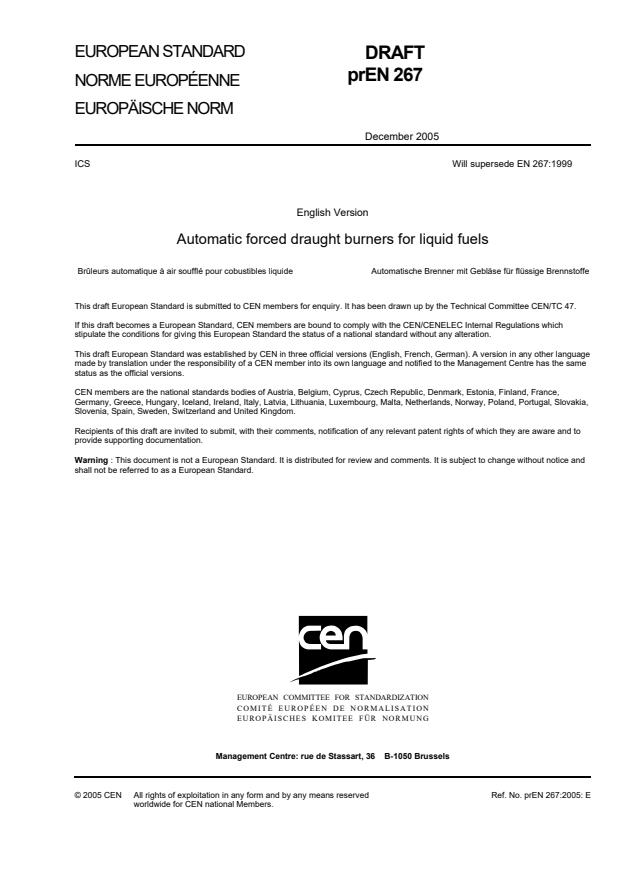
EUROPEAN STANDARD
DRAFT
NORME EUROPÉENNE
EUROPÄISCHE NORM
December 2005
ICS Will supersede EN 267:1999
English Version
Automatic forced draught burners for liquid fuels
Brûleurs automatique à air soufflé pour cobustibles liquide Automatische Brenner mit Gebläse für flüssige Brennstoffe
This draft European Standard is submitted to CEN members for enquiry. It has been drawn up by the Technical Committee CEN/TC 47.
If this draft becomes a European Standard, CEN members are bound to comply with the CEN/CENELEC Internal Regulations which
stipulate the conditions for giving this European Standard the status of a national standard without any alteration.
This draft European Standard was established by CEN in three official versions (English, French, German). A version in any other language
made by translation under the responsibility of a CEN member into its own language and notified to the Management Centre has the same
status as the official versions.
CEN members are the national standards bodies of Austria, Belgium, Cyprus, Czech Republic, Denmark, Estonia, Finland, France,
Germany, Greece, Hungary, Iceland, Ireland, Italy, Latvia, Lithuania, Luxembourg, Malta, Netherlands, Norway, Poland, Portugal, Slovakia,
Slovenia, Spain, Sweden, Switzerland and United Kingdom.
Recipients of this draft are invited to submit, with their comments, notification of any relevant patent rights of which they are aware and to
provide supporting documentation.
Warning : This document is not a European Standard. It is distributed for review and comments. It is subject to change without notice and
shall not be referred to as a European Standard.
EUROPEAN COMMITTEE FOR STANDARDIZATION
COMITÉ EUROPÉEN DE NORMALISATION
EUROPÄISCHES KOMITEE FÜR NORMUNG
Management Centre: rue de Stassart, 36 B-1050 Brussels
© 2005 CEN All rights of exploitation in any form and by any means reserved Ref. No. prEN 267:2005: E
worldwide for CEN national Members.
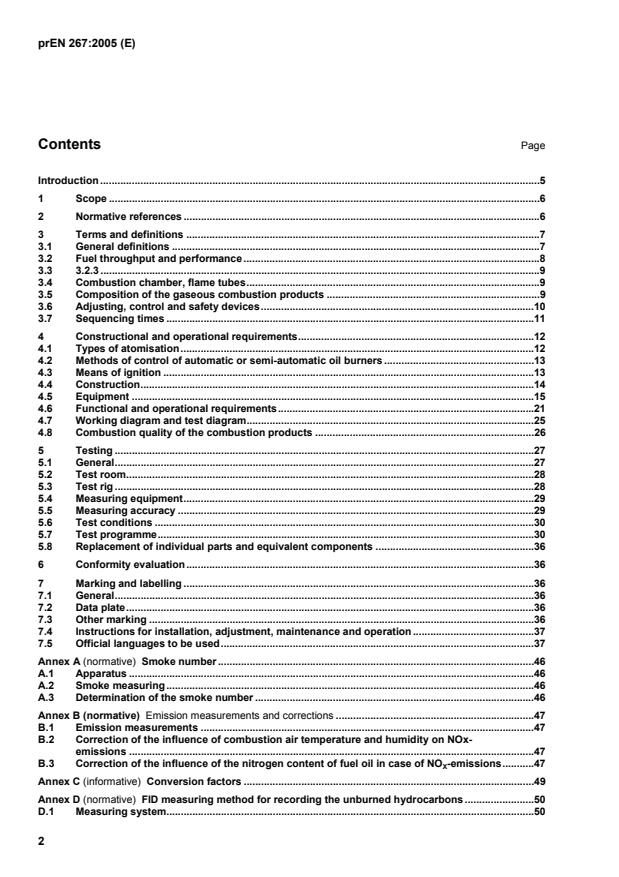
Contents Page
Introduction .5
1 Scope .6
2 Normative references .6
3 Terms and definitions .7
3.1 General definitions .7
3.2 Fuel throughput and performance.8
3.3 3.2.3 .9
3.4 Combustion chamber, flame tubes.9
3.5 Composition of the gaseous combustion products .9
3.6 Adjusting, control and safety devices.10
3.7 Sequencing times .11
4 Constructional and operational requirements.12
4.1 Types of atomisation.12
4.2 Methods of control of automatic or semi-automatic oil burners .13
4.3 Means of ignition .13
4.4 Construction.14
4.5 Equipment .15
4.6 Functional and operational requirements.21
4.7 Working diagram and test diagram.25
4.8 Combustion quality of the combustion products .26
5 Testing .27
5.1 General.27
5.2 Test room.28
5.3 Test rig .28
5.4 Measuring equipment.29
5.5 Measuring accuracy .29
5.6 Test conditions .30
5.7 Test programme.30
5.8 Replacement of individual parts and equivalent components .36
6 Conformity evaluation.36
7 Marking and labelling .36
7.1 General.36
7.2 Data plate.36
7.3 Other marking .36
7.4 Instructions for installation, adjustment, maintenance and operation.37
7.5 Official languages to be used.37
Annex A (normative) Smoke number .46
A.1 Apparatus .46
A.2 Smoke measuring.46
A.3 Determination of the smoke number .46
Annex B (normative) Emission measurements and corrections .47
B.1 Emission measurements .47
B.2 Correction of the influence of combustion air temperature and humidity on NOx-
emissions .47
B.3 Correction of the influence of the nitrogen content of fuel oil in case of NO -emissions.47
X
Annex C (informative) Conversion factors .49
Annex D (normative) FID measuring method for recording the unburned hydrocarbons .50
D.1 Measuring system.50
D.2 Starting .50
Annex E (informative) Conformity evaluation.51
E.1 Test laboratories and test samples, procedure .51
E.2 Types of test and test documents for oil burners.51
Annex F (informative) Examples for equipping of burners .54
F.1 Burners ≤≤≤≤ 100 kg/h .54
F.2 Burners > 100 kg/h .56
Annex G (informative) Other fuels.58
Annex H (Informative) Specific additional requirements and limitations for use of EN 267 burners
for industrial applications.59
H.1 Pre-heating of the combustion air .59
H.2 Continuous working of the forced draught fan.59
H.3 Electronic air/fuel ratio and O -controllers .59
H.4 Variable excess of combustion air .59
H.5 Burner with spark ignition.59
H.6 Air filtering .60
H. 7 Electrical equipment and EMC-compatibility.60
Annex I (informative) Check of the air proving device.61
Foreword
This document (prEN 267:2005) has been prepared by Technical Committee CEN/TC 47 “Atomizing oil
burners and their components - Function - Safety - Testing”, the secretariat of which is held by DIN.
This document is currently submitted to the parallel Enquiry.
This document will supersede EN 267:1999.
This document has been prepared under a mandate given to CEN by the European Commission and the
European Free Trade Association, and supports essential requirements of EU Directive(s).
Introduction
This European Standard is primarily intended for automatic forced draught oil burners having a combustion air
fan, operated with liquid fuels, and intended to be marketed as a complete assembly.
Forced draught oil burners according to this standard are often used in industrial applications. The safety
principles are the same as for forced draught oil burners used for household/commercial applications.
Industrial forced draught OIL burners however must operate safely in their industrial environment and the risks
involved may differ from those for household applications. These industrial forced draught oil burners can be
characterised by the ability to withstand industrial environmental influences, like moisture, high temperature,
electrical and magnetic phenomena, vibrations, etc.
Special requirements for forced draught burners for industrial premises will be given as a note with the
addition "Industrial application".
Further information and application limitations for forced draught burners, which are used for industrial
application, are given in informative annex H.
1 Scope
This European Standard specifies the test requirements for laboratory testing, the terminology, the general
requirements for the construction and operation of automatic forced draught oil burners supplied with:
a fuel having a viscosity at the burner inlet of 1,6 mm²/s (cSt) up to 6 mm²/s (cSt) at 20 °C, and
higher boiling petroleum based first raffinates. To achieve the viscosity required for proper atomisation
preheating is necessary.
The standard is applicable to:
single burners with a single combustion chamber, although such burners are fitted to a single appliance,
in which case the requirements of the relevant appliance standard shall additionally apply;
single-fuel and dual-fuel burners when operating on oil only;
the oil function of dual-fuel burners designed to operate independently on gaseous or liquid fuels. In
which case the requirements of EN 676 will also apply in respect of the gaseous fuel function.
2 Normative references
The following referenced documents are indispensable for the application of this document. For dated
references only the edition cited applies. For undated references the latest edition of the referenced document
(including any amendments) applies.
EN 230, Monobloc oil burners - Safety, control and regulation devices and safety times.
EN 264, Safety shut-off devices for combustion plants using liquid fuels; safety requirements and testing.
EN 676, Automatic forced draught burners for gaseous fuels.
EN 1044, Brazing - Filler metals.
EN 1057, Copper and copper alloys - Seamless, round copper tubes for water and gas in sanitary and heating
applications.
EN 1092-1, Flanges and their joints - Circular flanges for pipes, valves, fittings and accessories, PN
designated - Part 1: Steel flanges.
EN 1092-2, Flanges and their joints - Circular flanges for pipes, valves, fittings and accessories, PN
designated - Part 2: Cast iron flanges.
EN 1092-3, Flanges and their joints - Circular flanges for pipes, valves, fittings and accessories PN
designated - Part 3: Copper alloy flanges.
EN 1254-1, Copper and copper alloys - Plumbing fittings - Part 1: Fittings with ends for capillary soldering or
capillary brazing to copper tubes.
EN 1254-4, Copper and copper alloys - Plumbing fittings - Part 4: Fittings combining other end connections
with capillary or compression ends.
EN 12067-2, Gas/air ratio controls for gas burners and gas burning appliances - Part 2: Electronic types.
EN 50156-1, Electrical equipment for furnaces and ancillary equipment - Part 1: Requirements for application
design and installation.
EN 60204-1, Safety of machinery - Electrical equipment of machines - Part 1: General requirements (IEC
60204-1:1997).
EN 60335-1, Household and similar electrical appliances - Safety - Part 1: General requirements (IEC 60335-
1:2001, modified).
EN 60529, Degrees of protection provided by enclosures (IP code) (IEC 60529:1989).
EN 60730-1, Automatic electrical controls for household and similar use - Part 1: General requirements (IEC
60730-1:1999, modified).
EN 60947-5-1, Low-voltage switchgear and control gear - Part 5-1: Control circuit devices and switching
elements - Electromechanical control circuit devices (IEC 60947-5-1:2003).
EN ISO/IEC 17025, General requirements for the competence of esting and calibration laboratories (ISO/IEC
17025:1999).
ISO 7-1, Pipe threads where pressure-tight joints are made on the threads — Part 1: Dimensions, tolerances
and designation.
EN ISO 228-1, Pipe threads where pressure-tight joints are not made on the threads - Part 1: Dimensions,
tolerances and designation (ISO 228-1:2000).
ISO 1129, Steel tubes for boilers, super heaters and heat exchangers; Dimensions, tolerances and
conventional masses per unit length.
ISO 3183-1, Steel pipes for pipelines for combustible fluids — Technical delivery conditions — Part 1: Pipes of
requirement class A.
ISO 3183-2, Steel pipes for pipelines for combustible fluids — Technical delivery conditions- Part 2: Pipes of
requirement class B.
ISO 6806, Rubber hoses and hose assemblies for use in oil burners – Specification.
ISO 9329-1, Seamless steel tubes for pressure purposes — Technical delivery conditions — Part 1: Unalloyed
steels with specified room temperature properties.
ISO 9330, Welded steel tubes for pressure purposes — Technical delivery conditions — Part 1: Unalloyed
steel tubes with specified room temperature properties.
3 Terms and definitions
For the purposes of this standard the following terms and definitions apply:
3.1 General definitions
3.1.1
oil burner
means classified according to:
type of atomisation;
method of control;
means of ignition.
3.1.2
forced draught burner
burner in which the total air for combustion is supplied by means of a fan
3.1.2.1
automatic forced draught burner
oil burner that is fitted with an automatic ignition, flame monitoring and burner control devices. Ignition, flame
monitoring and the on/off switching of the burner occur automatically. The heat input of the burner can be
adjusted during operation either automatically or manually.
3.1.2.2
semi-automatic oil burner:
an oil burner, that differs from the fully automatic burner only in that start-up of the burner is initiated manually
by the operating personnel and there is no automatic re-start after switching off the burner
3.1.3
dual-fuel burner
burner in which both gaseous and liquid fuels can be burnt either simultaneously or in succession.
3.1.4
burners as a structural unit
burners as a structural unit are individually operating burners and comprise all the devices necessary for
operation such as oil atomising, air mixing and recirculating sections, where appropriate internal oil pre-
heating devices including oil pressure pump in the case of oil pressure atomisers, combustion air fan (in the
case of duo bloc-burners also the combustion air fan delivered separately) and flame supervision devices,
ignition device and the necessary valves for control and safety shut-down of the burner
3.1.5
multi-fuel burner
burner that is capable of burning different fuels simultaneously or as an alternative to liquid fuel
3.1.6
industrial applications
industrial applications means:
the extraction,
growth,
refining,
processing,
production,
manufacture or
preparation
of materials, plants, livestock, animal products, food or artefacts.
3.2 Fuel throughput and performance
3.2.1
throughput
constant mass of fuel consumed during one hour [Unit: kg/h]
3.2.1.1
maximum throughput
mass of fuel consumed during one hour at the highest throughput stated by the manufacturer [Unit: kg/h]
3.2.1.2
minimum throughput
mass of fuel consumed during one hour at the lowest throughput indicated by the manufacturer [Unit: kg/h]
3.2.2
heat input Q
F
amount of heat as a function of time released by the burner at a given throughput (oil flow rate x lower calorific
value H of the fuel) [Unit: Kilowatt (kW)]
i
3.2.2.1
maximum heat input Q
max
maximum heat input of the burner as indicated by the manufacturer [Unit: Kilowatt (kW)]
3.2.2.2
minimum heat input Q
Fmin
minimum heat input of the burner as indicated by the manufacturer [Unit: Kilowatt (kW)]
3.3 3.2.3
starting input Q
s
input of the burner during start-up position as a function of the maximum heat input [Unit: Per cent (%)]
3.3.1
test rig
combustion chamber nominated by the manufacturer. In the case where the manufacturer has not nominated
a combustion chamber, the test is carried out on test rigs with the flame tubes according to 6.3.
3.4 Combustion chamber, flame tubes
3.4.1
combustion chamber pressure p
F
effective positive pressure or negative pressure relative to the atmospheric pressure prevailing in the
combustion chamber [Unit: kilopascal (kPa)]
3.4.2
length of the combustion chamber l
distance between the face of the nozzle or the fuel outlet and the rear wall of the test flame tube or
combustion chamber [Unit: Millimetre (mm)]
3.5 Composition of the gaseous combustion products
3.5.1
CO content
quantity of carbon dioxide (CO ) in the dry gaseous products expressed as a proportion of the total volume, in
%
3.5.2
O content
quantity of oxygen (O ) contained in the dry gaseous products, expressed as a proportion of the total volume,
in %
3.5.3
CO content
quantity of carbon monoxide (CO) in the dry gaseous combustion products, measured as volumetric ppm
indicated as mg/kWh
3.5.4
content of nitrogen oxide
quantity of nitrogen oxide (NO and NO ) in the dry gaseous combustion products, measured as volumetric
ppm, calculated as NO , expressed in mg/kWh
3.5.5
content of unburned hydrocarbons
quantity of unburned hydrocarbons in the dry gaseous combustion products, measured as volumetric ppm,
calculated as C H
3 8
3.5.6
smoke number
sample reference, the shade of which is closest to that of the test mark [see annex A]
3.5.7
air figure λλλλ
ratio between the effectively introduced quantity of air and the theoretically required quantity of air
3.6 Adjusting, control and safety devices
3.6.1
flame detector device
device by which the presence of a flame is detected and signalled.
It can consist of a flame sensor, an amplifier and an element for signal transmission. These parts, with the
possible exception of the actual flame sensor, may be assembled in a single housing for use in conjunction
with a programming unit.
3.6.2
automatic burner control system
automatic burner control system comprises at least a programming unit and all the elements of a flame
detector device. The various functions of an automatic burner control system may be in one or more housings.
3.6.3
programming unit
programming unit reacts to signals from control and safety devices, gives control commands, controls the
start-up sequence, supervises the burner operation and causes controlled shut-down, and if necessary safety
shut-down and non-volatile lock-out. The programming unit follows a predetermined sequence of actions and
always operates in conjunction with a flame detector device.
3.6.4
safe start check
procedure employing a protection circuit or circuits, to establish whether or not a fault in a safety system or a
flame simulating condition exists prior to start-up
3.6.5
controlled shut-down
process by which the power to the fuel shut-off valve(s) is immediately removed before any other action takes
place, e. g. as a result of the action of a controlling function.
3.6.6
non-volatile lock-out
safety shut-down condition of the system, such that a re-start can only be accomplished by a manual reset of
the system and by no other means
3.6.8
safety shut-down
process which is effected immediately following the response of a safety limiter or the detection of a fault in
the automatic burner control system and which puts the burner out of operation by immediately removing the
power to the fuel shut-off valve(s) and the ignition device
NOTE Safety shut-down can also occur as a result of an interruption/decrease of the power supply.
3.6.9
safety shut-off device
device that automatically cuts off the fuel supply
3.6.10
ignition-restoration
operation by which the fuel is re-ignited after the extinction of the flame during operation without the fuel
supply being interrupted.
3.6.11
re-start
operation by which the starting process is repeated, after the extinction of the flame during operation. When
re-start takes place, the stipulated sequences of the control programme shall be adhered to
3.6.12
pressure switch
switch which compares the actual value of a pressure with the desired value, gives a signal when the actual
value exceeds or drops below the desired value and initiates the shut-off sequence.
3.6.13
ignition device
any means (flame, electrical ignition or other means) used to ignite the main burner, or the pilot burner if
applicable.
3.7 Sequencing times
3.7.1
total ignition time
period during which the ignition device is in operation. Pre-ignition, actual ignition and post-ignition times make
up the total ignition time [Unit: Seconds (s)]
3.7.1.1
pre-ignition time
period between the start of the ignition cycle and the release of the fuel [Unit: Seconds (s)]
3.7.1.2
ignition time
period between the release of the fuel and the first indication of the flame by the flame detector device [Unit:
Seconds (s)]
3.7.1.3
post-ignition time
period between the first indication of the flame by the flame detector device and the ignition device shut-off
[Unit: Seconds (s)]
3.7.2
safety time t
s
duration of the maximum permissible time during which the burner control unit allows the fuel to be released
without there being a flame [Unit: Seconds (s)]
3.7.2.1
ignition safety time
period starting from the signal for release of the fuel and terminating at the moment at which the signal for
interrupting the fuel supply is given [Unit: Seconds (s)]
3.7.2.2
safety time during operation
period starting at the moment the flame is extinguished and ending at the moment the signal for interrupting
the fuel supply is given [Unit: Seconds (s)]
3.7.3
purge time
period during which the combustion chamber is compulsorily ventilated without any fuel being supplied [Unit:
Seconds (s)]
3.7.3.1
pre-purge time
period during which purge takes place at the proven air rate prior to the energisation of the ignition device
[Unit: Seconds (s)]
3.7.3.2
post-purge time
period between any shut-down and the moment the fan is switched off. [Unit: Seconds (s)]
3.7.4
flame simulation
signal indicating the existence of a flame when no flame is present
3.7.5
operational state
state commencing with the presence of flame after the permissible ignition safety time has expired; it is the
end of the starting process. Starting can, however, be considered not to have taken place if the fuel release is
not authorized or if it is interrupted after expiry of the safety time by the lock-out of the burner control unit.
3.7.6
intermittent operation
state of operation the duration of which does not exceed 24 h
3.7.7
continuous operation
state of operation the duration of which exceeds 24 h
3.8
working field
admissible range of application of the burner (pressure in the combustion chamber as a function of fuel flow)
3.10
testing field
test range of the burner during the tests (pressure in the combustion chamber as a function of fuel flow
4 Constructional and operational requirements
4.1 Types of atomisation
4.1.1 Mechanical atomisation by pressurisation of the combustion liquid
Atomisation of the fuel by means of an atomising nozzle, through pressure release.
4.1.2 Atomisation by auxiliary fluid
Atomisation is obtained by the fuel flow meeting a flow of air, steam, other gases or any other liquid. These
types of burner include particularly:
emulsion burners, in which there is a prior mixing of the fuel with the atomising fluid;
rotary cup burners in which atomisation is obtained by the fuel, when leaving the edge of a rotating cup,
meets a flow of air, steam, other gases or any other fluid.
Burners having other means of preparation are allowed, if they comply in all other respects with the
requirements and test conditions of this Standard.
4.2 Methods of control of automatic or semi-automatic oil burners
4.2.1 On-off control (single stage burner)
Type of control where the oil burner is either in operation at constant throughput or switched off.
4.2.2 Multi-stage control (two and multi-stage burner)
Type of control where several firing stages (steps) can be utilised. Oil burners with only two firing rates are
included in this category.
4.2.3 Modulating control (modulating burner)
Type of control where the throughput may be infinitely varied between the lower and upper limits.
4.3 Means of ignition
4.3.1 Automatic electric ignition
4.3.1.1 General
These are systems in which the ignition of the fuel is brought about by means of electrical energy.
4.3.1.2 Ignition by controlled spark
System in which fuel is released when the presence of the ignition spark has been proven.
4.3.1.3 Ignition by non-controlled spark
System in which fuel may be released when the ignition spark is not controlled.
4.3.2 Automatic ignition with liquid or gaseous fuels
4.3.2.1 General
These are systems in which an ignition burner, which uses liquid or gaseous fuels, ignites the main fuel. The
operation of these ignition burners may be either permanent or intermittent. Permanent ignition burners may
be started manually. Intermittent ignition burners are started automatically.
4.3.2.2 Ignition by controlled ignition burner
System in which the main fuel supply may only be released when the controlled flame of the ignition burner
has been proven.
4.3.2.3 Ignition by non-controlled ignition burner
System in which the main fuel supply may be released when the ignition burner flame is not controlled.))
4.4 Construction
4.4.1 General design
The design and construction of the burner shall for its intended application be such that with the intended input
or input range and within the prescribed range of fuel pressure and fuel temperature, the fuel that is to be
used is burned completely and safely. Moving parts shall be shielded if the enclosure provided does not
ensure adequate protection.
The construction of the burner shall be in such a way that no instability, distortion or breakage likely to impair
its safety can occur.
Levers and similar devices which have to be operated by the installer or user shall be appropriately identified.
NOTE The burner head can be lengthened as long as the performance of the burner is not effected in an unsafe
manner. The geometry and the distance l (see figure 3) of the mixing device in the flame tube should remain unchanged.
4.4.2 Accessibility for maintenance and use
Constructional parts accessible during use and maintenance shall be free from sharp edges and corners that
might cause damage or personal injury during use or maintenance. Burners that can be withdrawn or
swivelled out of position without the use of tools shall be interlocked (for example, by means of limit switches)
in such a way that they cannot be operated in the withdrawn or swivelled position.
The interlock device shall be fail safe in design and, if it is a limit switch, shall comply with EN 60204-1 and
EN 60947-5-1.
4.4.3 Soundness
The oil carrying parts of the burner, up to atomising device, shall be sound.
The soundness of parts and assemblies making up the fuel circuit and likely to be dismantled during regular
maintenance in situ shall be achieved by means of mechanical joints, for example metal-to-metal joints,
gaskets, or 0-ring joints, but excluding the use of all sealing materials such as tape, paste or liquids. All
sealing materials shall remain effective under normal conditions of burner use.
4.4.4 Materials
The quality and thickness of the materials used in the construction of the burner shall be selected in such a
way that the constructional and performance characteristics of the system do not deteriorate during operation
and for suitable periods when they are installed correctly under the operating, maintenance and adjustment
conditions specified by the manufacturer. In particular, all the components of a burner shall withstand the
mechanical, chemical and thermal loads that may be encountered during operation. Under normal conditions
of use, maintenance and adjustment, they shall not show any changes that could affect their normal
functioning.
If the housing contains any metal parts not made of corrosion-resistant material, these shall be suitably
protected with an effective anti-corrosion coating.
Asbestos or asbestos-containing materials shall not be used.
Copper shall not be used for gas carrying parts where its temperature is likely to exceed 100 °C. Solder that
has a melting point below 450 °C after application shall not be used for gas carrying parts.
The pipe work material shall comply with:
EN 1057, EN 1044, EN 1254-1, EN 1254-4, ISO 6806, ISO 3183-1 and ISO 3183-2, ISO 9329-1, ISO
9330 series or ISO 1129 as appropriate,
or
other suitable approved materials.
4.4.5 Mounting
The burner shall be designed in such a way that it can be effectively mounted on the heat generator.
The burner components shall be arranged and secured in such a manner that their correct operating position,
and above all, the correct position of the burner orifices, cannot change during operation. The correct
operating position shall be maintained when accessories are dismantled and re-fitted.
Parts of the burner that are set or adjusted at the stage of manufacture and which should not be manipulated
by the user or installer shall be sealed.
Components requiring regular maintenance shall be arranged or designed that they are easily detachable.
Furthermore, they shall be designed or marked in such a way that if the manufacturer's instructions are
followed they cannot be replaced incorrectly.
4.4.6 Connections
Inlet connections with pressure-tight joints made on the threads, connections within the burner with
pressure-tight joints made on the threads that are not loosened for maintenance, and connections for parts
that are not frequently dismantled and re-fitted shall be designed in accordance with ISO 7-1.
Connections which have to be loosened for maintenance purposes shall be designed in accordance with prEN
ISO 228-1. Flange connections shall comply with EN 1092-1, EN 1092-2 and prEN 1092-3.
4.5 Equipment
4.5.1 Motors, fans and movable parts
Motors, fans and movable parts shall be so protected by suitable guards, shields or grilles of adequate size,
strength and durability that they are not liable to be touched accidentally. The degree of protection shall be at
least IP 20, according to EN 60529. Removal of such guards, shields or grilles shall be possible only with the
use of commonly available tools.
Belt drives, where used, shall be so designed or positioned as to afford protection to the operator.
Means shall be provided to facilitate adjustment of belt tension. Access to such means shall be possible only
with the use of commonly available tools.
Motors and fans shall be mounted in such a way as to minimise noise and vibration. Lubrication points, if
provided, shall be readily accessible.
4.5.2 Electrical safety
For the electrical equipment and connections of the burner the following requirements of EN 50156-1 or
EN 60335-1 shall apply, depending on the intended use:
a) rated value;
b) protection against accessibility to live parts;
leakage current and electric strength;
internal wiring;
components;
supply connection and external flexible cords;
connection terminals for external conductors;
provision for earthing;
creepage distances, clearances and distances through insulation;
c) radiation;
resistance to heat, fire and tracking.
The leakage current and electrical strength tests on the complete burner need not be performed if the
components and sub-assemblies have been separately tested and the interconnection is carried out in
accordance with the manufacturer's instructions.
If the measurements of the leakage current as required in EN 60335-1:1994, 13.2, are not possible, because
the circuits of protective impedance or radio interference filters cannot be disconnected, then the leakage limit
specified for leakage current is to be calculated taking into account the current through those circuits.
NOTE Industrial application: EN 60204-1 should apply.
In addition the documentation of the electrical connections for the individual components shall be provided by
means of an electrical wiring and connection diagram.
4.5.3 Air flow control device
Every burner shall be fitted with a device for controlling the air flow.
NOTE Air damper or fan-speed control; this device should be adjustable only by means of a tool. The adjusting
positions of the air damper should be visible, possibly after removal of a cap.
If the burner is provided with a manual means of adjusting the combustion air flow, this means shall be so
designed that, after adjustment according to the manufacturer's instructions, it is capable of being set and
sealed.
4.5.4 Fuel line components
4.5.4.1 General
All fuel line components shall be designed for the individual inlet pressure and temperature of the burner or be
protected against any excessive increase in pressure by means of relevant safety devices.
The used materials shall be designed and laid out to withstand the corrosive properties of the fuels to which
they are exposed in service.
4.5.4.2 Manually operated shut-off valve
A manually operated shut-off valve shall be provided upstream of all controls to isolate the burner. This valve
need not be supplied by the manufacturer, but it shall be specified in the manufacturer's installation
instructions. The manual fuel valve shall be readily accessible.
4.5.4.3 Filter and venting device
A filter shall be fitted at the inlet of the burner piping to prevent the ingress of foreign elements. Adequate
means to vent the fuel supply shall be installed. These devices need not be supplied by the manufacturer, but
they shall be specified in the manufacturer's installation instructions.
4.5.4.4 Fuel pressure adjustment device
A fuel pressure adjustment device shall be provided to allow the fuel rate to be achieved with the fuel
intended by the manufacturer and over the relevant range of pressures. Adjusters shall require a tool for
adjustment.
4.5.4.5 Safety shut-off devices
Safety shut-off devices shall be type-tested in accordance with EN 264.
4.5.4.5.1 Burners with a flow rate ≤≤≤≤ 100 kg/h
The safety shut-off devices for burners with a flow rate ≤ 100 kg/h shall be provided between pump and nozzle
corresponding to the burner system as shown in figures F.1 to F.4. It is permissible that the safety shut-off
device be integrated with the oil-pump:
a) single-stage burners shall be provided with one safety shut-off device in accordance with EN 264;
b) two-stage or multi-stage burners shall be fitted with one safety shut-off device for each nozzle (see
figure F.2);
c) burners with spill back nozzle shall be fitted with a safety shut-off device complying with EN 264 in the
feed line and in the return line. The nozzle shut-off valve may be fitted in lieu of one each of the safety
shut-off devices in the feed line and in the return line, on conditions that nozzle shut-off valve is tested
and approved as a safety shut-off device in accordance with EN 264. For atomizing oil burning with
spill back nozzle and an oil throughput > 30 kg/h a pressure switch in the return line shall be provided.
The pressure switch has to monitor the pressure in the return line (see Figures F.3 and F.4).
4.5.4.5.2 Burners with a flow rate > 100 kg/h
Two series-connected safety shut-off devices shall be provided in the flow of oil burners with a flow rate > 100
kg/h. One of the devices shall be of the fast closing type. The second device may also be used, as a final
controlling element for the combustion chamber input and the closing time shall not exceed 5 seconds. In the
case of burners with a return nozzle, two safety shut-off devices shall be provided in the return line and one
pressure switching device between the power regulator and the shut-off device (see figures F.6 and F.7). A
nozzle shut-off valve may replace a safety shut-off device in each line, one in the flow and one in the return
line, provided it has been tested and certified as a safety shut-off device in accordance with EN 264. The
safety shut-off devices shall be interlocked so that when the flow is open the return is not closed (does not
apply to the full-load stage in the case of step-regulated return burners). This can be done, for example, by
a mechanical connection between the safety shut-off devices in the flow and return by means of an
actuator;
or
electric or pneumatic interlocking of the safety shut-off devices in the flow and return.
It shall be ensured that no excessive pressure builds up between the two shut-off devices.
In the case of a burner with a nozzle head it may be necessary to enable oil flushing up to the nozzle head,
e.g. for preheating purposes. Since there is only one safety shut-off device in service, it shall be ensured by
an other second measure, that fuel discharge is prevented safely. As a possible measure the ignition device
may be connected and the burner shall be in the start position. It shall be ensured that the nozzle shut-off
valve could not be opened by the return pressure.
4.5.5 Fuel preheating
4.5.5.1 Heat sources
Any heat source that can be cut off immediately if required, and the rating of which can be automatically
controlled, can be used for oil preheating. Open flames shall not be permitted.
4.5.5.2 Value of preheating
In the unpressurised condition the fuel oil temperature shall not attain the fuel oil flash point and in any case
shall not exceed 90 ° C.
To attain the temperature for the required atomisation viscosity, pressure type preheaters shall be used. The
maximum temperature shall be at least 5 °C below the boiling temperature of water in the oil at the connected
pressure.
4.5.5.3 Temperature control of preheating
Each fuel oil preheating system shall be automatically controlled. A temperature indicator shall be fitted
downstream of the preheating system.
Shut down devices (e.g. thermostat) should prevent a temperature rise above 220 °C of the heat surface from
preheating systems within unpressurised oil fuel vessels, if they are not wetted by oil fuel in case of
troubleshooting.
4.5.5.4 Pressurised preheaters
For pressurised vessels and preheaters, the requirements for pressure vessels shall be applied
...
Questions, Comments and Discussion
Ask us and Technical Secretary will try to provide an answer. You can facilitate discussion about the standard in here.
Loading comments...