

EN 13284-1:2001
(Main)Stationary source emissions - Determination of low range mass concentration of dust - Part 1: Manual gravimetric method
- Abstract
This European Standard specifies a reference method for the measurement of low dust concentration in ducted gaseous streams in the concentrations below 50 mg/m3 standard conditions. This method has been validated with special emphasis around 5 mg/m3 on an average half hour sampling time.
This European Standard is primarily developed and validated for gaseous streams emitted by waste incinerators. More generally, it may be applied to gases emitted from stationary sources, and to higher concentrations.
If the gases contain unstable, reactive or semi-volatile substances, the measurement depend on the sampling and filter treatment conditions.
- Status
- Withdrawn
- Publication Date
- 20-Nov-2001
- Withdrawal Date
- 29-Sep-2026
- Technical Committee
- CEN/TC 264 - Air quality
- Drafting Committee
- CEN/TC 264/WG 5 - Total dust at low concentrations (emissions)
- Current Stage
- 9960 - Withdrawal effective - Withdrawal
- Start Date
- 01-Nov-2017
- Completion Date
- 30-Sep-2026

Relations
- Effective Date
- 08-Jun-2022
- Effective Date
- 03-Jun-2026
- Effective Date
- 03-Jun-2026
- Effective Date
- 28-Jan-2026
- Effective Date
- 28-Jan-2026
- Effective Date
- 28-Jan-2026
- Effective Date
- 28-Jan-2026
- Effective Date
- 28-Jan-2026
- Effective Date
- 28-Jan-2026
- Effective Date
- 28-Jan-2026
- Effective Date
- 28-Jan-2026
- Effective Date
- 28-Jan-2026
- Effective Date
- 28-Jan-2026
- Effective Date
- 28-Jan-2026
- Referred By
EN ISO 10683:2014 - Fasteners - Non-electrolytically applied zinc flake coatings (ISO 10683:2014) - Effective Date
- 28-Jan-2026
Get Certified
Connect with accredited certification bodies for this standard

CIS Institut d.o.o.
Personal Protective Equipment (PPE) certification body. Notified Body NB-2890 for EU Regulation 2016/425 PPE.

Kiwa BDA Testing
Building and construction product certification.
Kmetijski inštitut Slovenije
Agricultural Institute of Slovenia. Soil testing, plant health, agricultural product analysis.
Sponsored listings
Frequently Asked Questions
EN 13284-1:2001 is a standard published by the European Committee for Standardization (CEN). Its full title is "Stationary source emissions - Determination of low range mass concentration of dust - Part 1: Manual gravimetric method". This standard covers: This European Standard specifies a reference method for the measurement of low dust concentration in ducted gaseous streams in the concentrations below 50 mg/m3 standard conditions. This method has been validated with special emphasis around 5 mg/m3 on an average half hour sampling time. This European Standard is primarily developed and validated for gaseous streams emitted by waste incinerators. More generally, it may be applied to gases emitted from stationary sources, and to higher concentrations. If the gases contain unstable, reactive or semi-volatile substances, the measurement depend on the sampling and filter treatment conditions.
This European Standard specifies a reference method for the measurement of low dust concentration in ducted gaseous streams in the concentrations below 50 mg/m3 standard conditions. This method has been validated with special emphasis around 5 mg/m3 on an average half hour sampling time. This European Standard is primarily developed and validated for gaseous streams emitted by waste incinerators. More generally, it may be applied to gases emitted from stationary sources, and to higher concentrations. If the gases contain unstable, reactive or semi-volatile substances, the measurement depend on the sampling and filter treatment conditions.
EN 13284-1:2001 is classified under the following ICS (International Classification for Standards) categories: 13.040.40 - Stationary source emissions. The ICS classification helps identify the subject area and facilitates finding related standards.
EN 13284-1:2001 has the following relationships with other standards: It is inter standard links to EN 13284-1:2017, ISO 5725-2:1994, ISO 3966:1977, ENV 1178-2:1994, ENV 14237:2002, EN 14385:2004, EN 1911:2010, EN 1948-4:2010+A1:2013, EN 12779:2004+A1:2009, EN ISO 4042:2018, EN ISO 1891-2:2014, CEN/TS 1948-5:2015, EN ISO 10683:2018, EN ISO 2179:2016, EN ISO 10683:2014. Understanding these relationships helps ensure you are using the most current and applicable version of the standard.
EN 13284-1:2001 is associated with the following European legislation: EU Directives/Regulations: 94/67/EC; Standardization Mandates: M/002. When a standard is cited in the Official Journal of the European Union, products manufactured in conformity with it benefit from a presumption of conformity with the essential requirements of the corresponding EU directive or regulation.
EN 13284-1:2001 is available in PDF format for immediate download after purchase. The document can be added to your cart and obtained through the secure checkout process. Digital delivery ensures instant access to the complete standard document.
Standards Content (Sample)
2003-01.Slovenski inštitut za standardizacijo. Razmnoževanje celote ali delov tega standarda ni dovoljeno.Emissionen aus stationären Quellen - Ermittlung der Staubmassenkonzentration bei geringen Staubkonzentrationen - Teil 1: Manuelles gravimetrisches VerfahrenEmissions de sources fixes - Détermination de la faible concentration en masse de poussieres - Partie 1: Méthode gravimétrique manuelleStationary source emissions - Determination of low range mass concentration of dust - Part 1: Manual gravimetric method13.040.40Stationary source emissionsICS:Ta slovenski standard je istoveten z:EN 13284-1:2001SIST EN 13284-1:2002en,fr,de01-maj-2002SIST EN 13284-1:2002SLOVENSKI
STANDARD
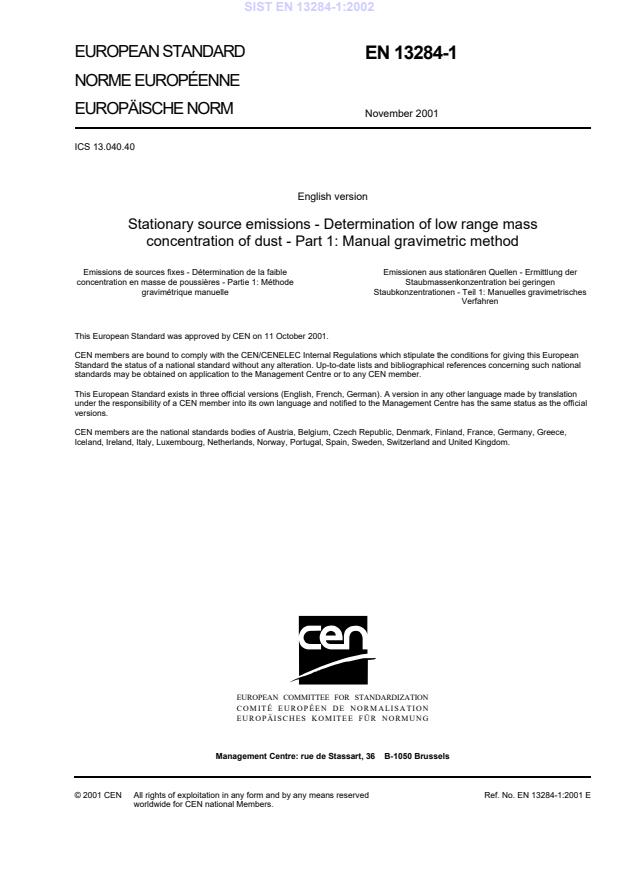
EUROPEAN STANDARDNORME EUROPÉENNEEUROPÄISCHE NORMEN 13284-1November 2001ICS 13.040.40English versionStationary source emissions - Determination of low range massconcentration of dust - Part 1: Manual gravimetric methodEmissions de sources fixes - Détermination de la faibleconcentration en masse de poussières - Partie 1: Méthodegravimétrique manuelleEmissionen aus stationären Quellen - Ermittlung derStaubmassenkonzentration bei geringenStaubkonzentrationen - Teil 1: Manuelles gravimetrischesVerfahrenThis European Standard was approved by CEN on 11 October 2001.CEN members are bound to comply with the CEN/CENELEC Internal Regulations which stipulate the conditions for giving this EuropeanStandard the status of a national standard without any alteration. Up-to-date lists and bibliographical references concerning such nationalstandards may be obtained on application to the Management Centre or to any CEN member.This European Standard exists in three official versions (English, French, German). A version in any other language made by translationunder the responsibility of a CEN member into its own language and notified to the Management Centre has the same status as the officialversions.CEN members are the national standards bodies of Austria, Belgium, Czech Republic, Denmark, Finland, France, Germany, Greece,Iceland, Ireland, Italy, Luxembourg, Netherlands, Norway, Portugal, Spain, Sweden, Switzerland and United Kingdom.EUROPEAN COMMITTEE FOR STANDARDIZATIONCOMITÉ EUROPÉEN DE NORMALISATIONEUROPÄISCHES KOMITEE FÜR NORMUNGManagement Centre: rue de Stassart, 36
B-1050 Brussels© 2001 CENAll rights of exploitation in any form and by any means reservedworldwide for CEN national Members.Ref. No. EN 13284-1:2001 ESIST EN 13284-1:2002
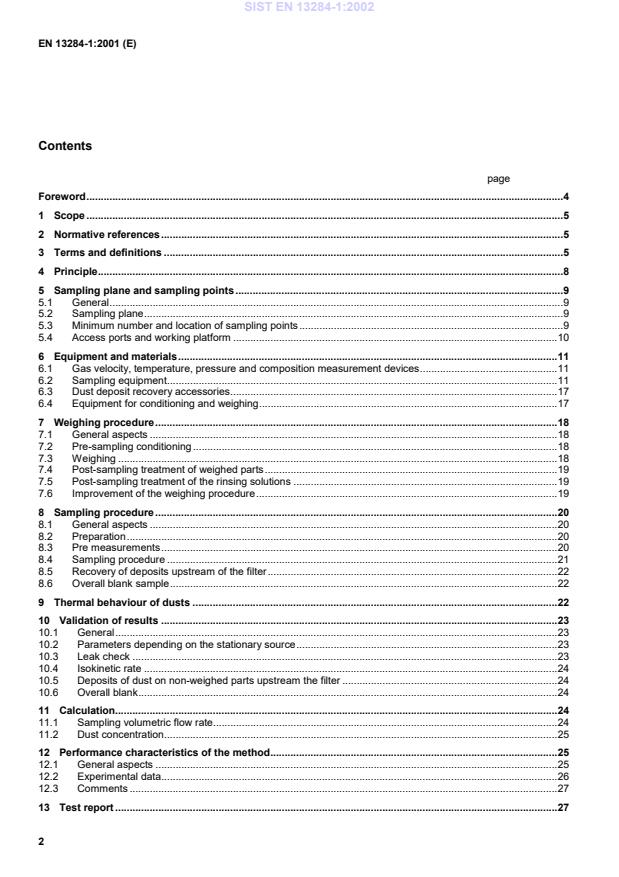
(normative)
Requirements related to the working platform.30Annex B
(normative)
Determination of flow direction with Pitot tubes.31B.1Type L Pitot tube.31B.2Type S Pitot tube.31Annex C
(normative)
Methods for determining the positions of sampling points in circular andrectangular ducts.32C.1Method for circular ducts.32C.1.1General.32C.1.2General method for circular ducts.32C.1.3Tangential method for circular ducts.34C.2Method for rectangular ducts.35Annex D
(informative)
Examples of suitable access ports for sampling equipment.37Annex E
(normative)
Proven design of the entry nozzles.39Annex F
(normative)
Summary of the requirements.42Annex G
(informative)
Sampling volume, flow rate and duration.43G.1General.43G.2Weighing uncertainties.43G.3Sampling volume.43G.4Sampling flow rate and duration.43Annex H
(informative)
Examples of weighing bias.44H.1General.44H.2Effect of insufficient temperature equilibrium.44H.3Effect of temperature variations.44H.4Effect of barometric pressure variations.44H.5Conclusions.44Bibliography.46SIST EN 13284-1:2002
The measured mass variation provides an estimation of the uncertainties. The overall blank value, divided by theaverage sampling volume of the measurement series, provides an estimation of the detection limit (in milligrams per cubicmetre) of the whole measurement process, as carried out by the operators. The overall blank includes possible deposits on thefilter and on all parts upstream.3.13weighing controlprocedure for the detection/correction of apparent weight variations due to possible changes between pre and postsampling weighing conditions3.14measurement seriessuccessive measurements carried out at the same sampling plane, and at the same process conditions3.15limit valuedust concentration which is permitted by authorities for the plant process (i.e. average limit value)Note
For purposes other than regulatory uses the measurement value should be compared to a stated reference value.4 PrincipleA sample stream of the gas is extracted from the main gas stream at representative sampling points for ameasured period of time, with an isokinetically controlled flow rate and a measured volume. The dust entrained inthe gas sample is separated by a pre-weighed plane filter, which is then dried and re-weighed. Deposits upstreamof the filter in the sampling equipment are also recovered and weighed. The increase of mass of the filter and thedeposited mass upstream the filter are attributed to dust collected from the sampled gas, which allows the dustconcentration to be calculated.Two different configurations of the sampling equipment may be used depending on the characteristics of gases tobe sampled (see 6.2.2).Valid measurements can be achieved only when:a) the gas stream in the duct at the sampling location has a sufficiently homogeneous and steady velocityprofile (see 5.2);b) sampling is carried out without disturbance of the gas stream with a sharp edged nozzle facing into the streamunder isokinetic conditions;c) samples are taken at a pre-selected number of stated positions in the sampling plane, to allow for a non uniformdistribution of dust in the duct;d) the sampling train is designed and operated to avoid condensation, chemical reactions and to minimise dustdeposits upstream of the filter and to be leak free;e) dust deposits upstream of the filter are taken into account;f) the overall blank value does not exceed 10 % of the daily limit value set for the process;SIST EN 13284-1:2002
The weighing uncertainty is not only related to the balance characteristics but to the whole procedure see annex G.e) thermometer and humidity meter near the balance;f) pressure gauge;g) depending on the evaporation procedure, an extraction hood and heating plate for the evaporation of rinsingsolution shall be provided.7 Weighing procedure7.1 General aspectsDepending on the kind of sampling device to be used, the parts to be weighed can be the filter with or without itssupport, or may also include all upstream parts from the filter.Depending on the procedure to be used the rinsing solutions can be evaporated and weighed in the same containeror transferred to a smaller container for weighing.7.2 Pre-sampling conditioningWeighed parts shall be dried in a drying oven for at least 1 h, at a minimum of 180 °C (see clause 9).The filters and/or the weighing containers are cooled down to ambient temperature in a desiccator located in theweighing room for at least 4 h. For larger parts e.g. weighing containers up to 12 h may be necessary. If thehumidity is controlled and dust is not hygroscopic the filters and/or the weighing containers may be equilibrated inthe weighing room.7.3 WeighingSince dust concentration is determined by difference between weights often obtained at one or two weeks interval,special care is required in order to avoid weighing errors related to balance drift, to insufficient temperatureequilibrium of parts to be weighed, and to climatic changes (see examples in annex H). Therefore, beforeperforming any measurement, the user shall validate their weighing procedure (see 7.6). It is stronglyrecommended to use the same balance for both pre-weighing and past weighing.Before each weighing series:a) the balance shall be checked against standard weights;b) additional check shall be carried out by weighing control parts, identical to the parts to be used in themeasurement, pre-treated in the same temperature and humidity control conditions and kept free fromcontamination;c) record the climatic conditions in the room.When weighing large volume parts (e.g. beakers), the temperature and barometric pressure may influence theapparent weight, this may be detected using the reference weight of the control parts. In these conditions, weighingcorrections shall be applied, based on the apparent weight modification of three identical control parts of each type(filter incl. support, container etc.).Attention has also to be drawn on an increase or decrease in weighing due to:a) electrostatic charges, which give erratic readings and which may have to be discharged/neutralised (metallicplate, ion gun);SIST EN 13284-1:2002
...