

EN 13674-4:2006+A1:2009
(Main + Amendment)Railway applications - Track - Rail - Part 4: Vignole railway rails from 27 kg/m to, but excluding 46 kg/m
- Abstract
This document specifies flat bottom Vignole railway rails from 27 kg/m to, but excluding 46 kg/m.
Eight pearlitic steel grades are specified covering a rail hardness range of 200 HBW to 440 HBW and include non-heat-treated non-alloy steels, non-heat-treated alloy steels, heat-treated non-alloy steels and heat-treated alloy steels.
There are 15 rail profiles specified in this document, but these may not be available in all steel grades.
- Status
- Withdrawn
- Publication Date
- 10-Nov-2009
- Withdrawal Date
- 06-Oct-2026
- Technical Committee
- CEN/TC 256 - Railway applications
- Drafting Committee
- CEN/TC 256/SC 1/WG 4 - Rails
- Current Stage
- 9960 - Withdrawal effective - Withdrawal
- Start Date
- 03-Apr-2019
- Completion Date
- 07-Oct-2026

Relations
- Effective Date
- 29-Aug-2009
- Effective Date
- 21-Dec-2011
- Effective Date
- 28-Jan-2026
- Effective Date
- 28-Jan-2026
- Effective Date
- 28-Jan-2026
- Effective Date
- 28-Jan-2026
- Effective Date
- 28-Jan-2026
Get Certified
Connect with accredited certification bodies for this standard

Zavod za gradbeništvo Slovenije (ZAG) - Inšpekcija
ZAG inspection body for construction products, structures, and materials.
Sponsored listings
Frequently Asked Questions
EN 13674-4:2006+A1:2009 is a standard published by the European Committee for Standardization (CEN). Its full title is "Railway applications - Track - Rail - Part 4: Vignole railway rails from 27 kg/m to, but excluding 46 kg/m". This standard covers: This document specifies flat bottom Vignole railway rails from 27 kg/m to, but excluding 46 kg/m. Eight pearlitic steel grades are specified covering a rail hardness range of 200 HBW to 440 HBW and include non-heat-treated non-alloy steels, non-heat-treated alloy steels, heat-treated non-alloy steels and heat-treated alloy steels. There are 15 rail profiles specified in this document, but these may not be available in all steel grades.
This document specifies flat bottom Vignole railway rails from 27 kg/m to, but excluding 46 kg/m. Eight pearlitic steel grades are specified covering a rail hardness range of 200 HBW to 440 HBW and include non-heat-treated non-alloy steels, non-heat-treated alloy steels, heat-treated non-alloy steels and heat-treated alloy steels. There are 15 rail profiles specified in this document, but these may not be available in all steel grades.
EN 13674-4:2006+A1:2009 is classified under the following ICS (International Classification for Standards) categories: 93.100 - Construction of railways. The ICS classification helps identify the subject area and facilitates finding related standards.
EN 13674-4:2006+A1:2009 has the following relationships with other standards: It is inter standard links to EN 13674-4:2006, EN 13674-4:2019, EN ISO 6892-1:2019, EN 10163-1:2004, EN 13674-1:2003, EN ISO 6506-1:2014, EN 13481-5:2012. Understanding these relationships helps ensure you are using the most current and applicable version of the standard.
EN 13674-4:2006+A1:2009 is associated with the following European legislation: EU Directives/Regulations: 2001/16/EC, 2008/57/EC, 93/38/EEC; Standardization Mandates: M/024, M/334. When a standard is cited in the Official Journal of the European Union, products manufactured in conformity with it benefit from a presumption of conformity with the essential requirements of the corresponding EU directive or regulation.
EN 13674-4:2006+A1:2009 is available in PDF format for immediate download after purchase. The document can be added to your cart and obtained through the secure checkout process. Digital delivery ensures instant access to the complete standard document.
Standards Content (Sample)
2003-01.Slovenski inštitut za standardizacijo. Razmnoževanje celote ali delov tega standarda ni dovoljeno.Železniške naprave - Zgornji ustroj - Tirnice - 4. del: Vignolove tirnice z maso v razponu od 27 kg/m do 46 kg/mBahnanwendungen - Oberbau - Schienen - Teil 4: Vignolschienen mit einer längenbezogenen Masse zwischen 27 kg/m und unter 46 kg/mApplications ferroviaires - Voie - Rail - Partie 4: Rails Vignole de masse comprise entre 27 kg/m et 46 kg/m, 46 kg/m non comprisRailway applications - Track - Rail - Part 4: Vignole railway rails from 27 kg/m to, but excluding 46 kg/m45.080Rails and railway componentsICS:Ta slovenski standard je istoveten z:EN 13674-4:2006+A1:2009SIST EN 13674-4:2006+A1:2010en,fr01-marec-2010SIST EN 13674-4:2006+A1:2010SLOVENSKI
STANDARD
EUROPEAN STANDARD NORME EUROPÉENNE EUROPÄISCHE NORM
EN 13674-4:2006+A1
November 2009 ICS 93.100 Supersedes EN 13674-4:2006English Version
Railway applications - Track - Rail - Part 4: Vignole railway rails from 27 kg/m to, but excluding 46 kg/m
Applications ferroviaires - Voie - Rail - Partie 4: Rails Vignole de masse comprise entre 27 kg/m et 46 kg/m, 46 kg/m non compris
Bahnanwendungen - Oberbau - Schienen - Teil 4: Vignolschienen mit einer längenbezogenen Masse zwischen 27 kg/m und unter 46 kg/m This European Standard was approved by CEN on 9 January 2006 and includes Amendment 1 approved by CEN on 22 September 2009.
CEN members are bound to comply with the CEN/CENELEC Internal Regulations which stipulate the conditions for giving this European Standard the status of a national standard without any alteration. Up-to-date lists and bibliographical references concerning such national standards may be obtained on application to the CEN Management Centre or to any CEN member.
This European Standard exists in three official versions (English, French, German). A version in any other language made by translation under the responsibility of a CEN member into its own language and notified to the CEN Management Centre has the same status as the official versions.
CEN members are the national standards bodies of Austria, Belgium, Bulgaria, Cyprus, Czech Republic, Denmark, Estonia, Finland, France, Germany, Greece, Hungary, Iceland, Ireland, Italy, Latvia, Lithuania, Luxembourg, Malta, Netherlands, Norway, Poland, Portugal, Romania, Slovakia, Slovenia, Spain, Sweden, Switzerland and United Kingdom.
EUROPEAN COMMITTEE FOR STANDARDIZATION
COMITÉ EUROPÉEN DE NORMALISATION EUROPÄISCHES KOMITEE FÜR NORMUNG
Management Centre:
Avenue Marnix 17,
B-1000 Brussels © 2009 CEN All rights of exploitation in any form and by any means reserved worldwide for CEN national Members. Ref. No. EN 13674-4:2006+A1:2009: ESIST EN 13674-4:2006+A1:2010
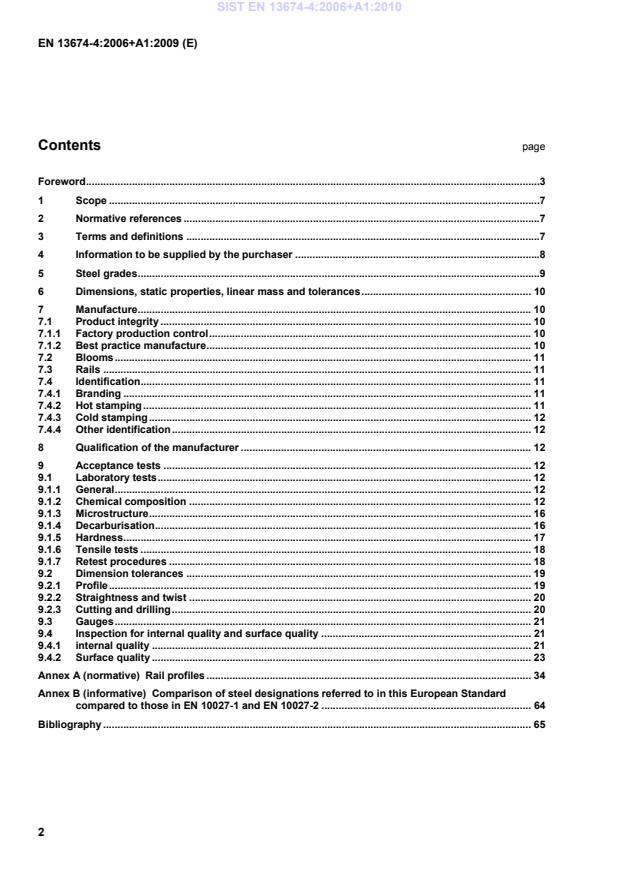
Rail profiles . 34 Annex B (informative)
Comparison of steel designations referred to in this European Standard compared to those in EN 10027-1 and EN 10027-2 . 64 Bibliography . 65
No branding lines R200 200 to 240 Non-alloy (C-Mn)
R220 220 to 260 Non-alloy (C-Mn) _______
____ R260 260 to 300 Non-alloy (C-Mn) _______
_______
R320Cr 320 to 360 Alloy (1 % Cr) _______
_______
______ R350HT 350 to 390 b Non-alloy (C-Mn), heat treated _______ ________
a See Table 3 for chemical composition/mechanical properties. b See Table 5 for hardness requirements. 6 Dimensions, static properties, linear mass and tolerances Rail profiles, dimensions, static properties and linear masses are given in Annex A. The tolerances of certain dimensions shall be as given in Table 6. All other quantities are informative only. NOTE Linear masses have been calculated based on the density of steel of 7,85 g/cm3. 7 Manufacture 7.1 Product integrity 7.1.1 Factory production control Rails shall be produced under a comprehensive system of factory production control, which shall ensure confidence in the conformity of the finished product. The system shall address this European Standard to ensure that the finished products consistently comply with requirements to achieve the product integrity necessary to provide assurance of product safety in track. Manufacturers shall demonstrate continuing compliance, including documented evidence, with the factory production control system required. Manufacturers having a factory production control system, which complies with EN ISO 9001 are recognised as satisfying the minimum requirements specified by this clause. 7.1.2 Best practice manufacture The product shall be manufactured to the best practices as defined in 7.1.1. NOTE This is to ensure that the rail attributes, described in the Introduction, which are not known in an exact manner or are not practically measurable, achieve the required high level of product integrity in track. SIST EN 13674-4:2006+A1:2010
___
ROLLING MILL _______ 98 40E1
(40E1 profile rail rolled 1998, non-alloy rail steel grade R260) 7.4.2 Hot stamping In addition to the branding requirements of 7.4.1 each rail shall be identified by a numerical and/or alphabetical code system, hot stamped on the non-branded side of the rail web by machine and each rail shall be hot stamped at least once every 5 m. NOTE Subsequent cutting could result in more than one rail length having the same identity. The figures and letters used shall be clearly legible and shall be 16 mm high. The stamped characters shall have a flat or radius face (1 mm to 1,5 mm wide) with bevels on each side. The letters and numbers shall be on a 10° angle from vertical and shall have rounded corners. The stamping shall be between 0,5 mm and 1,5 mm in depth along the centre of the web. The design shall be as shown in Figure 1. The identification system employed shall be such as to enable the hot stamped marking to be collated with: SIST EN 13674-4:2006+A1:2010
subclause R200, R220, R260, R320Cr R350HT Chemical composition 9.1.2 One per heat One per heat Hydrogen 9.1.2.2 One per heat (2 tests from first heat in sequence) One per heat (2 from first heat in sequence) Microstructure 9.1.3 Not required for grades R200, R220 and R260 One per 50 tonnes of re-heated a c
One per 1 000 t or part thereof for grade R320Cr One per 100 tonnes of mill heat treated a c Decarburisation 9.1.4 One per 1 000 t or part thereof a b One per 500 tonnes of re-heated and mill heat treated a c Hardness 9.1.5 One per heat a b One per 50 tonnes of re-heated a c
One per 100 tonnes of mill heat treated a c Tensile 9.1.6 One calculation per heat/one test per 2 000 t a b One per heat a c a Samples shall be taken at random but only rails from blooms outside the mixing zone between heats when continuously cast in sequence. b Samples shall be cut after rolling. c Samples shall be cut from heat-treated rails. SIST EN 13674-4:2006+A1:2010
% By mass 10-4 % (ppm) Max. H a Rm Min. elong !A" Min. Centre line running surface b
Steel name Sample C Si Mn P max S max Cr Al max. V max. N max.
MPa % hardness HBW R200 Liquid 0,40/0,60 0,15/0,58 0,70/1,20 0,035 0,035 0,15 max. 0,004 0,030 0,009 3,0
Solid 0,38/0,62 0,13/0,60 0,65/1,25 0,040 0,040 0,15 max. 0,004 0,030 0,010 3,0 680 14 200/240 R220 Liquid 0,50/0,60 0,20/0,60 1,00/1,25 0,025 0,025 0,15 max. 0,004 0.030 0,008 3,0
Solid 0,50/0,60 0,20/0,60 1,00/1,25
...