

EN 13094:2008
(Main)Tanks for the transport of dangerous goods - Metallic tanks with a working pressure not exceeding 0,5 bar - Design and construction
- Abstract
This European Standard specifies requirements for the design and construction of metallic tanks with a maximum working pressure not exceeding 50 kPa gauge used for the transport of dangerous goods by road and rail for which Tank Code with letter “G” is given in chapter 3.2 of ADR [2]. It also includes requirements for a system of identification of materials used in the construction of these tanks.
This European Standard specifies requirements for openings, closures and structural equipment.
NOTE 1 This document does not specify requirements for service equipment.
This European Standard is applicable to aircraft refuellers that are used on public roads. It is also applicable to inter-modal tanks (e.g. tank containers and tank swap bodies) for the transport of dangerous goods by road and rail.
NOTE 2 This document is not applicable to fixed rail tank wagons.
- Status
- Withdrawn
- Publication Date
- 08-Jul-2008
- Withdrawal Date
- 06-Oct-2026
- Technical Committee
- CEN/TC 296 - Tanks for transport of dangerous goods
- Drafting Committee
- CEN/TC 296/WG 2 - Low pressure metalic tanks - Design and construction
- Current Stage
- 9960 - Withdrawal effective - Withdrawal
- Start Date
- 06-May-2015
- Completion Date
- 07-Oct-2026

Relations
- Effective Date
- 22-Dec-2008
- Effective Date
- 21-May-2011
- Effective Date
- 25-Aug-2026
- Effective Date
- 28-Jan-2026
- Effective Date
- 28-Jan-2026
- Effective Date
- 28-Jan-2026
- Effective Date
- 28-Jan-2026
- Effective Date
- 28-Jan-2026
- Effective Date
- 28-Jan-2026
- Effective Date
- 28-Jan-2026
- Effective Date
- 28-Jan-2026
- Effective Date
- 28-Jan-2026
- Effective Date
- 28-Jan-2026
- Effective Date
- 28-Jan-2026
- Effective Date
- 28-Jan-2026
Get Certified
Connect with accredited certification bodies for this standard

CIS Institut d.o.o.
Personal Protective Equipment (PPE) certification body. Notified Body NB-2890 for EU Regulation 2016/425 PPE.
Institut za varilstvo d.o.o. (Welding Institute)
Slovenia's leading welding institute since 1952. ISO 3834, EN 1090, pressure equipment certification, NDT personnel, welder qualification. Only IIW Au

Kiwa BDA Testing
Building and construction product certification.
Sponsored listings
Frequently Asked Questions
EN 13094:2008 is a standard published by the European Committee for Standardization (CEN). Its full title is "Tanks for the transport of dangerous goods - Metallic tanks with a working pressure not exceeding 0,5 bar - Design and construction". This standard covers: This European Standard specifies requirements for the design and construction of metallic tanks with a maximum working pressure not exceeding 50 kPa gauge used for the transport of dangerous goods by road and rail for which Tank Code with letter “G” is given in chapter 3.2 of ADR [2]. It also includes requirements for a system of identification of materials used in the construction of these tanks. This European Standard specifies requirements for openings, closures and structural equipment. NOTE 1 This document does not specify requirements for service equipment. This European Standard is applicable to aircraft refuellers that are used on public roads. It is also applicable to inter-modal tanks (e.g. tank containers and tank swap bodies) for the transport of dangerous goods by road and rail. NOTE 2 This document is not applicable to fixed rail tank wagons.
This European Standard specifies requirements for the design and construction of metallic tanks with a maximum working pressure not exceeding 50 kPa gauge used for the transport of dangerous goods by road and rail for which Tank Code with letter “G” is given in chapter 3.2 of ADR [2]. It also includes requirements for a system of identification of materials used in the construction of these tanks. This European Standard specifies requirements for openings, closures and structural equipment. NOTE 1 This document does not specify requirements for service equipment. This European Standard is applicable to aircraft refuellers that are used on public roads. It is also applicable to inter-modal tanks (e.g. tank containers and tank swap bodies) for the transport of dangerous goods by road and rail. NOTE 2 This document is not applicable to fixed rail tank wagons.
EN 13094:2008 is classified under the following ICS (International Classification for Standards) categories: 13.300 - Protection against dangerous goods; 23.020.20 - Vessels and containers mounted on vehicles. The ICS classification helps identify the subject area and facilitates finding related standards.
EN 13094:2008 has the following relationships with other standards: It is inter standard links to EN 13094:2004, EN 13094:2015, ISO 1496-3:1995, EN ISO 15614-1:2017, EN ISO 9606-1:2017, EN 10204:2004, EN ISO 15614-2:2025, EN 910:1996, EN ISO 7500-1:2018, EN ISO 3834-1:2021, EN ISO 6892-1:2019, EN ISO 10042:2005, EN ISO 5817:2007, EN ISO 17637:2016, EN 12972:2007. Understanding these relationships helps ensure you are using the most current and applicable version of the standard.
EN 13094:2008 is associated with the following European legislation: EU Directives/Regulations: 94/55/EC, 96/49/EC, 96/86/EC, 96/87/EC; Standardization Mandates: M/086. When a standard is cited in the Official Journal of the European Union, products manufactured in conformity with it benefit from a presumption of conformity with the essential requirements of the corresponding EU directive or regulation.
EN 13094:2008 is available in PDF format for immediate download after purchase. The document can be added to your cart and obtained through the secure checkout process. Digital delivery ensures instant access to the complete standard document.
Standards Content (Sample)
2003-01.Slovenski inštitut za standardizacijo. Razmnoževanje celote ali delov tega standarda ni dovoljeno.Cisterne za prevoz nevarnega blaga - Kovinske cisterne z delovnim tlakom pod 0,5 bar - Konstruiranje in izdelavaTanks für die Beförderung gefährlicher Güter - Metalltanks mit einem Betriebsdruck von höchstens 0,5 bar - Auslegung und BauCiternes destinées au transport de matières dangereuses - Citernes métalliques ayant une pression de service inférieure ou égale à 0,5 bar - Conception et constructionTanks for the transport of dangerous goods - Metallic tanks with a working pressure not exceeding 0,5 bar - Design and construction23.020.20Posode in vsebniki, montirani na vozilaVessels and containers mounted on vehicles13.300Varstvo pred nevarnimi izdelkiProtection against dangerous goodsICS:Ta slovenski standard je istoveten z:EN 13094:2008SIST EN 13094:2008en,fr,de01-december-2008SIST EN 13094:2008SLOVENSKI
STANDARDSIST EN 13094:20041DGRPHãþD
EUROPEAN STANDARDNORME EUROPÉENNEEUROPÄISCHE NORMEN 13094July 2008ICS 13.300; 23.020.20Supersedes EN 13094:2004
English VersionTanks for the transport of dangerous goods - Metallic tanks witha working pressure not exceeding 0,5 bar - Design andconstructionCiternes destinées au transport de matières dangereuses -Citernes métalliques ayant une pression de serviceinférieure ou égale à 0,5 bar - Conception et constructionTanks für die Beförderung gefährlicher Güter - Metalltanksmit einem Betriebsdruck von höchstens 0,5 bar -Auslegung und BauThis European Standard was approved by CEN on 25 May 2008.CEN members are bound to comply with the CEN/CENELEC Internal Regulations which stipulate the conditions for giving this EuropeanStandard the status of a national standard without any alteration. Up-to-date lists and bibliographical references concerning such nationalstandards may be obtained on application to the CEN Management Centre or to any CEN member.This European Standard exists in three official versions (English, French, German). A version in any other language made by translationunder the responsibility of a CEN member into its own language and notified to the CEN Management Centre has the same status as theofficial versions.CEN members are the national standards bodies of Austria, Belgium, Bulgaria, Cyprus, Czech Republic, Denmark, Estonia, Finland,France, Germany, Greece, Hungary, Iceland, Ireland, Italy, Latvia, Lithuania, Luxembourg, Malta, Netherlands, Norway, Poland, Portugal,Romania, Slovakia, Slovenia, Spain, Sweden, Switzerland and United Kingdom.EUROPEAN COMMITTEE FOR STANDARDIZATIONCOMITÉ EUROPÉEN DE NORMALISATIONEUROPÄISCHES KOMITEE FÜR NORMUNGManagement Centre: rue de Stassart, 36
B-1050 Brussels© 2008 CENAll rights of exploitation in any form and by any means reservedworldwide for CEN national Members.Ref. No. EN 13094:2008: ESIST EN 13094:2008
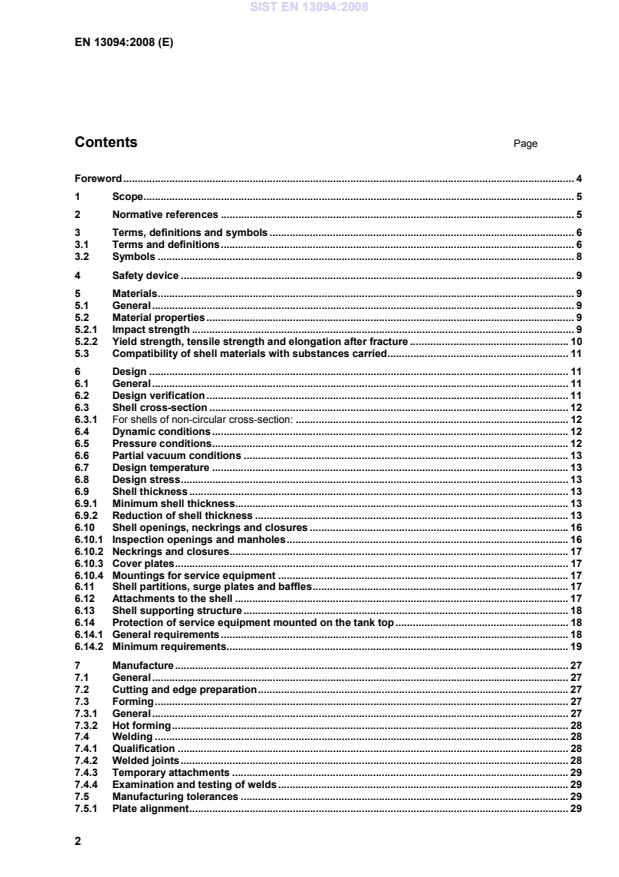
Rectification of defects.30 7.6.1 General requirements.30 7.6.2
Rectification of weld defects.31 Annex A (normative)
Methods of design verification.32 A.1 General.32 A.2 Dynamic testing.32 A.3 Finite element stress analysis.33 A.4 Reference design.35 A.5 Calculation method.35 Annex B (normative)
Method of measurement of specific resilience.55 B.1 Principle.55 B.2 Apparatus.55 B.3
Samples of materials to be tested.60 B.3 Procedure.62 B.4 Results.63 B.5 Global resilience (see 6.9.2.2 i)).63 Annex C (normative)
Design of neckrings, flanges and closures.65 Annex D (informative)
Examples of welding details.66 D.1 General.66 D.2 Tank construction.66 D.3 Attachment of reinforcements.82 D.4 Attachment of branches.84 D.5 Attachment of flanges, collars and reinforcing pads to the shell.88 D.6 Attachment of flanges onto branches.90 D.7 Attachment of heating channels to shells.92 Bibliography.94
NOTE 1 This document does not specify requirements for service equipment. This European Standard is applicable to aircraft refuellers that are used on public roads. It is also applicable to inter-modal tanks (e.g. tank containers and tank swap bodies) for the transport of dangerous goods by road and rail. NOTE 2 This document is not applicable to fixed rail tank wagons. 2 Normative references The following referenced documents are indispensable for the application of this document. For dated references, only the edition cited applies. For undated references, the latest edition of the referenced document (including any amendments) applies. EN 287-1, Qualification test of welders — Fusion welding — Part 1: Steels EN 473, Non destructive testing — Qualification and certification of NDT personnel — General principles EN 910:1996, Destructive tests on welds in metallic materials — Bend tests EN 970, Non-destructive examination of fusion welds — Visual examination EN 1435, Non-destructive examination of welds — Radiographic examination of welded joints EN 1714, Non-destructive examination of welds — Ultrasonic examination of welded joints EN 10002-1, Metallic materials — Tensile testing — Part 1: Method of test at ambient temperature EN 10045-1, Metallic materials — Charpy impact test — Part 1: Test method EN 10204, Metallic products — Types of inspection documents EN 12972:2007, Tanks for transport of dangerous goods — Testing, inspection and marking of metallic tanks EN 13317, Tanks for transport of dangerous goods — Service equipment for tanks — Manhole cover assembly EN 14025, Tanks for the transport of dangerous goods — Metallic pressure tanks — Design and construction EN ISO 3834-1, Quality requirements for fusion welding of metallic materials – Part 1: Criteria for the selection of the appropriate level of quality requirements (ISO 3834-1:2005) EN ISO 3834-2, Quality requirements for fusion welding of metallic materials – Part.2: Comprehensive quality requirements (ISO 3834-2:2005) SIST EN 13094:2008
Fusion welding — Part 2: Aluminium and aluminium alloys (ISO 9606-2:2004)
EN ISO 10042:2005, Welding – Arc-welded joints in aluminium and its alloys – Quality levels for imperfections (ISO 10042:2005)
EN ISO 15607, Specification and qualification of welding procedures for metallic materials — General rules (ISO 15607:2003)
EN ISO 15609-1, Specification and qualification of welding procedures for metallic materials — Welding procedure specification — Part 1: Arc welding (ISO 15609-1:2004) EN ISO 15609-2, Specification and qualification of welding procedures for metallic materials — Welding procedure specification — Part 2: Gas welding (ISO 15609-2:2001) EN ISO 15613, Specification and qualification of welding procedures for metallic materials — Qualification based on pre-production welding test (ISO 15613:2004) EN ISO 15614-1, Specification and qualification of welding procedures for metallic materials – Welding procedure test – Part 1: Arc and gas welding of steels and arc welding of nickel and nickel alloys (ISO 15614-1:2004) EN ISO 15614-2, Specification and qualification of welding procedures for metallic materials — Welding procedure test — Part 2: Arc welding of aluminium and its alloys (ISO 15614-2:2005) ISO 1496-3, Series 1 freight containers — Specification and testing — Part 3: Tank containers for liquids, gases and pressurized dry bulk
3 Terms, definitions and symbols 3.1 Terms and definitions For the purposes of this document, the following terms and definitions apply. 3.1.1 baffle any structure, other than a surge plate, intended to inhibit the movement of the shell contents 3.1.2 capacity total inner volume of shell or shell compartment NOTE When it is impossible to fill completely the shell or shell compartment because of its shape or construction, this reduced capacity should be used for the determination of the degree of filling and for the marking of the tank
NOTE 2 The value of g is 9,81 m/s2. L overlap of a lapped joint Lc length of reinforcing piece Lr length of reinforcing ring L0 initial gauge length of the test piece used in the tensile test, in millimetres (mm) l length of transition between plates of different thickness l1 length of overlap of swaged edge l2 length of weld at base of swaged joint N safety factor Pd highest effective pressure allowed in a shell during discharge (“maximum discharge pressure allowed”), in MegaPascals (MPa) Pr highest effective pressure allowed in a shell during filling (“maximum filling pressure allowed”), in MegaPascals (MPa) Pts opening pressure of the venting system, in MegaPascals (MPa) Pv effective pressure to which a shell is subjected by the substance carried (including such extraneous gases as it might contain) at the design temperature, in MegaPascals (MPa) Px design pressure of tank (MPa) R internal radius of a domed closure, in millimetres (mm) Rd determined tensile strength, in Newtons per square millimetre (N/mm2) Re apparent yield strength for steels having a clearly defined yield point or guaranteed 0,2 % proof strength for steels with no clearly defined yield point (1 % proof strength for austenitic steels) Ret apparent yield strength for steels having a clearly defined yield point or guaranteed 0,2 % SIST EN 13094:2008
(2) NOTE Elongations based on fixed lengths can be converted to proportional elongations using EN ISO 2566-1 or EN ISO 2566-2 as applicable. SIST EN 13094:2008
RID/ADR allows that the listing of approved substances may be dispensed with. In such cases, according to RID/ADR, groups of substances permitted on the basis of the tank code shown in the rationalised approach in RID/ADR 4.3.4.1.2 should be accepted for carriage taking into account any relevant special provision. 5.3.2 If contact between the substance carried and the material used for the construction of the shell is deemed likely to entail a progressive decrease in the thickness of the walls, this thickness shall be increased at manufacture by an appropriate amount. NOTE This additional thickness, to allow for corrosion, is not taken into consideration in determining the minimum shell thickness (see 6.9.1). 5.3.3 If the shell is fitted with a non-metallic protective lining, only materials and their means of bonding to the shell that are known to remain leakproof shall be used. 5.3.4 If shells intended for the carriage of liquids having a flash-point of not more than 60 °C are fitted with non-conductive protective linings, precautions shall be taken to prevent the accumulation of electrostatic charges that could present a danger of ignition. NOTE This requirement is also applicable to UN No. 1361 carbon and UN No. 1361 carbon black, packing group II. 6 Design 6.1 General A shell may have a circular or a non-circular cross-section. 6.2 Design verification The design of a tank shall be verified in accordance with one or a combination of the following methods: a) for shells with a circular cross-section, EN 14025 or any one of the methods specified in Annex A; b) for shells with non-circular cross-sections: 1) dynamic testing (A.2); 2) finite element stress analysis (A.3); 3) reference design based on experience of the Competent Authority with existing tank designs (A.4); 4) calculation method (A.5). Documentation shall be produced that gives evidence of the design verification. The design shall in any case conform to the minimum requirements of this European Standard. SIST EN 13094:2008
(3) If the shell thickness is increased to allow for corrosive substances, this additional thickness shall not be taken into consideration in calculating the minimum shell thickness. The actual minimum thickness shall not be below the absolute minimum shown in Table 1. 6.9.2 Reduction of shell thickness 6.9.2.1 Where protection against damage of the shell is provided in accordance with 6.9.2.2 to 6.9.2.3, the minimum thickness may be reduced by a maximum of 2 mm of reference steel (or equivalent thickness in another material, calculated using equation 3) from that specified in 6.9.1, but shall not be below the absolute minimum shown in Table 1.
Austenitic steels Other steels Pure aluminium Aluminium alloys m mm mm mm mm ≤ 1,80 2,5b 3 6 4 > 1,80 3 4 8 5 a For non-circular cross-sections, see 6.3.1. b For tank-containers and tank swap bodies not protected against damage, the shell thickness shall in no case be less than 3 mm whatever the material used.
6.9.2.2 Tank vehicles and demountable tanks shall be deemed to be protected against damage when one of the following measures given in a) to i) is adopted; dimensions that refer to distances between strengthening elements shall be taken between their attachment points on the tank shell: a) For shells with a circular or elliptical cross-section having a maximum radius of curvature of 2 m, the shell is equipped with strengthening elements comprising partitions or surge plates, or external or internal rings, so placed that at least one of the following conditions is met: the distance between two adjacent strengthening elements is less than or equal to 1,75 m; the volume contained between two partitions or surge plates is less than or equal to 7 500 l. A ring, and associated shell shall have a section modulus of at least 10 cm3 in reference steel, or an equivalent section modulus in another metal (see 6.14.2.5), when calculated around the neutral axis parallel to the shell. External strengthening elements shall not have projecting edges with a radius of less than 2,5 mm. b) For shells with double walls having an intermediate layer of rigid solid material (e.g. foam, at least 50 mm thick), the outer wall has a thickness of at least 0,5 mm of mild steel, 0,8 mm of aluminium or 2 mm of fibre reinforced
plastic material. For other insulating materials (e.g. mineral-wool, at least 100 mm thick), the outer wall has a thickness of at least 0,8 mm of austenitic steel, the outer wall of the ends
may be of a fibre reinforced plastic material with a thickness of at least 3 mm. Other combinations of materials used to provide protection against damage shall have specific resilience, as determined in accordance with Annex B, equivalent to that of the minimum thickness required by 6.9.1, and the thickness of the inner wall of the combination shall be not less than the minimum value specified in 6.9.2.1. c) For shells of forms other than in a), the shell is provided all around the mid-point of its vertical height and over at least 30 % of its height with additional protection designed in such a way as to offer specific resilience, as determined in accordance with Annex B, at least equal to that of a shell constructed in reference steel of a thickness of 5 mm for a shell diameter not exceeding 1,80 m or 6 mm for a shell diameter exceeding 1,80 m. The additional protection shall be applied in a durable manner to the outside of the shell. This requirement shall be deemed to have been met without further proof of the specific resilience when
the additional protection involves the welding of a plate of the same material as the shell to the area to be strengthened, such that the shell thickness is not less than the minimum specified in 6.9.1; and
flanged ends to the full thickness are used with the additional side protection extending to cover at least one third of the flange length. SIST EN 13094:2008
For shells of forms other than in a), when applying requirements of global resilience, the following conditions are all met: the volume contained between adjacent partitions or surge plates does not exceed 7 500 l; the volume of any compartment does not exceed 15 000 l except in the case of tanks dedicated to the carriage of liquids at or above 100 °C and below their flashpoint; the distance between adjacent partitions and surge plates does not exceed 1,75 m; the average distance between adjacent partitions or surge plates does not exceed 1,4 m; the corner radii connecting the side, top and bottom radii are not less than 250 mm; the thickness of the ends are conform to d) or e) as appropriate; for shells made with double ends with a separation exceeding 100 mm, the ends shall conform to the requirements specified in e); the weakest 4 m-shell segment has a global resilience of at least 100 kN
...