

EN 397:2025
(Main)Industrial protective helmets
- Abstract
This document specifies requirements for design, performance, test methods and markings for industrial protective helmets. The requirements apply to helmets for general use in industry.
Additional performance requirements for special applications are included to apply only when specifically claimed by the helmet manufacturer.
Industrial protective helmets are intended to reduce the risk of head injuries caused by impacts and therefore can reduce consequential effects.
- Status
- Published
- Publication Date
- 29-Apr-2025
- Technical Committee
- CEN/TC 158 - Head protection
- Drafting Committee
- CEN/TC 158/WG 1 - Industrial safety helmets
- Current Stage
- 6060 - Definitive text made available (DAV) - Publishing
- Start Date
- 30-Apr-2025
- Due Date
- 20-Oct-2023
- Completion Date
- 30-Apr-2025
- Directive
- 2016/425 - Regulation (EU) 2016/425 of the European Parliament and of the Council of 9 March 2016 on personal protective equipment and repealing Council Directive 89/686/EECOJ Ref: OJ L, 2026/1279 OJ Date: 16-Jun-2026

Overview
EN 397:2025 - Industrial protective helmets (CEN) is the updated European standard that specifies design, performance, test methods and marking requirements for industrial protective helmets intended for general use in industry. It replaces EN 397:2012+A1:2012 and was approved by CEN in 2025. The standard aims to reduce the risk and consequential effects of head injuries from impacts in workplaces such as construction, mining, manufacturing and shipping. Additional performance requirements for special applications apply only when explicitly claimed by the helmet manufacturer.
Key Topics
- Helmet types: Introduces two types - type 1 (on‑crown protection) and type 2 (on‑crown and off‑crown protection with higher energy testing).
- Physical and material requirements: Shell construction, ventilation considerations and sizing / ergonomics requirements.
- Shock absorption and impact testing: Defined test methods for crown and off‑crown impacts, including improved reproducibility through drop speed measurement.
- Resistance to penetration: Tests to confirm shell integrity against penetrating hazards.
- Retention system: Strength and effectiveness tests for chin straps and retention systems.
- Resistance to ignition and molten metal splash: Fire behaviour and molten metal splash procedures for helmets intended for specific environments.
- Electrostatic and enhanced visibility: New requirements and tests for electrostatic properties and retroreflective/enhanced visibility materials.
- Marking and manufacturer information: Required markings, instructions and annexes (including relation to Regulation (EU) 2016/425).
Applications
EN 397:2025 is used to:
- Certify and type‑test industrial protective helmets for general industry use.
- Guide PPE manufacturers in product design, testing and marking to meet European conformity.
- Inform safety managers, procurement officers and compliance teams when selecting head protection for construction, manufacturing, mining, transport and other industrial environments.
- Provide test houses and laboratories with standardized test methods and conditioning procedures (temperature, ageing, water immersion, etc.).
Practical benefits include clearer distinction between helmet performance levels (type 1 vs type 2), improved test reproducibility, and optional features (electrostatic control, enhanced visibility) for specific workplace hazards.
Related Standards (if applicable)
- EN 812 - Industrial bump caps (lighter head protection for superficial impacts)
- EN 14052 - High performance industrial helmets
- EN 50365:2023 - Reference for electrical insulation requirements (cited in EN 397:2025)
- Annex ZA in EN 397:2025 explains the standard’s relationship to EU PPE Regulation (EU) 2016/425
Keywords: EN 397:2025, industrial protective helmets, head protection, CEN standard, shock absorption, retention system, resistance to penetration, electrostatic properties, enhanced visibility, PPE.
Relations
- Effective Date
- 24-Oct-2018
- Effective Date
- 22-Jul-2026
- Effective Date
- 22-Jul-2026
- Effective Date
- 22-Jul-2026
- Effective Date
- 09-Feb-2026
- Effective Date
- 09-Feb-2026
- Effective Date
- 28-Jan-2026
- Refers
EN 13087-1:2000/A1:2001 - Protective helmets - Test methods - Part 1: Conditions and conditioning - Effective Date
- 28-Jan-2026
- Effective Date
- 28-Jan-2026
- Effective Date
- 28-Jan-2026
- Refers
EN ISO/CIE 11664-2:2022 - Colorimetry - Part 2: CIE standard illuminants (ISO/CIE 11664-2:2022) - Effective Date
- 28-Jan-2026
- Effective Date
- 28-Jan-2026
- Refers
EN 13087-3:2000/A1:2001 - Protective helmets - Test methods - Part 3: Resistance to penetration - Effective Date
- 28-Jan-2026
- Effective Date
- 28-Jan-2026
- Effective Date
- 28-Jan-2026
Get Certified
Connect with accredited certification bodies for this standard

CIS Institut d.o.o.
Personal Protective Equipment (PPE) certification body. Notified Body NB-2890 for EU Regulation 2016/425 PPE.

Kiwa BDA Testing
Building and construction product certification.
Kmetijski inštitut Slovenije
Agricultural Institute of Slovenia. Soil testing, plant health, agricultural product analysis.
Sponsored listings
Frequently Asked Questions
EN 397:2025 is a standard published by the European Committee for Standardization (CEN). Its full title is "Industrial protective helmets". This standard covers: This document specifies requirements for design, performance, test methods and markings for industrial protective helmets. The requirements apply to helmets for general use in industry. Additional performance requirements for special applications are included to apply only when specifically claimed by the helmet manufacturer. Industrial protective helmets are intended to reduce the risk of head injuries caused by impacts and therefore can reduce consequential effects.
This document specifies requirements for design, performance, test methods and markings for industrial protective helmets. The requirements apply to helmets for general use in industry. Additional performance requirements for special applications are included to apply only when specifically claimed by the helmet manufacturer. Industrial protective helmets are intended to reduce the risk of head injuries caused by impacts and therefore can reduce consequential effects.
EN 397:2025 is classified under the following ICS (International Classification for Standards) categories: 13.340.20 - Head protective equipment. The ICS classification helps identify the subject area and facilitates finding related standards.
EN 397:2025 has the following relationships with other standards: It is inter standard links to EN 397:2012+A1:2012, EN 13087-1:2000, EN 13087-3:2000, EN 960:2006, EN 60079-32-2:2015, EN 50365:2023, EN ISO 472:2013/A1:2018, EN 13087-1:2000/A1:2001, EN 13087-2:2012, EN 17353:2020, EN ISO/CIE 11664-2:2022, EN ISO 9185:2007, EN 13087-3:2000/A1:2001, EN 13087-5:2012, EN ISO 472:2013. Understanding these relationships helps ensure you are using the most current and applicable version of the standard.
EN 397:2025 is associated with the following European legislation: EU Directives/Regulations: 2016/425; Standardization Mandates: M/571, M/571 AMD 1. When a standard is cited in the Official Journal of the European Union, products manufactured in conformity with it benefit from a presumption of conformity with the essential requirements of the corresponding EU directive or regulation.
EN 397:2025 is available in PDF format for immediate download after purchase. The document can be added to your cart and obtained through the secure checkout process. Digital delivery ensures instant access to the complete standard document.
Standards Content (Sample)
SLOVENSKI STANDARD
01-julij-2025
Nadomešča:
SIST EN 397:2012+A1:2012
Industrijske zaščitne čelade
Industrial protective helmets
Industrieschutzhelme
Casques de protection pour l'industrie
Ta slovenski standard je istoveten z: EN 397:2025
ICS:
13.340.20 Varovalna oprema za glavo Head protective equipment
2003-01.Slovenski inštitut za standardizacijo. Razmnoževanje celote ali delov tega standarda ni dovoljeno.
EN 397
EUROPEAN STANDARD
NORME EUROPÉENNE
April 2025
EUROPÄISCHE NORM
ICS 13.340.20 Supersedes EN 397:2012+A1:2012
English Version
Industrial protective helmets
Casques de protection pour l'industrie Industrieschutzhelme
This European Standard was approved by CEN on 14 March 2025.
CEN members are bound to comply with the CEN/CENELEC Internal Regulations which stipulate the conditions for giving this
European Standard the status of a national standard without any alteration. Up-to-date lists and bibliographical references
concerning such national standards may be obtained on application to the CEN-CENELEC Management Centre or to any CEN
member.
This European Standard exists in three official versions (English, French, German). A version in any other language made by
translation under the responsibility of a CEN member into its own language and notified to the CEN-CENELEC Management
Centre has the same status as the official versions.
CEN members are the national standards bodies of Austria, Belgium, Bulgaria, Croatia, Cyprus, Czech Republic, Denmark, Estonia,
Finland, France, Germany, Greece, Hungary, Iceland, Ireland, Italy, Latvia, Lithuania, Luxembourg, Malta, Netherlands, Norway,
Poland, Portugal, Republic of North Macedonia, Romania, Serbia, Slovakia, Slovenia, Spain, Sweden, Switzerland, Türkiye and
United Kingdom.
EUROPEAN COMMITTEE FOR STANDARDIZATION
COMITÉ EUROPÉEN DE NORMALISATION
EUROPÄISCHES KOMITEE FÜR NORMUNG
CEN-CENELEC Management Centre: Rue de la Science 23, B-1040 Brussels
© 2025 CEN All rights of exploitation in any form and by any means reserved Ref. No. EN 397:2025 E
worldwide for CEN national Members.
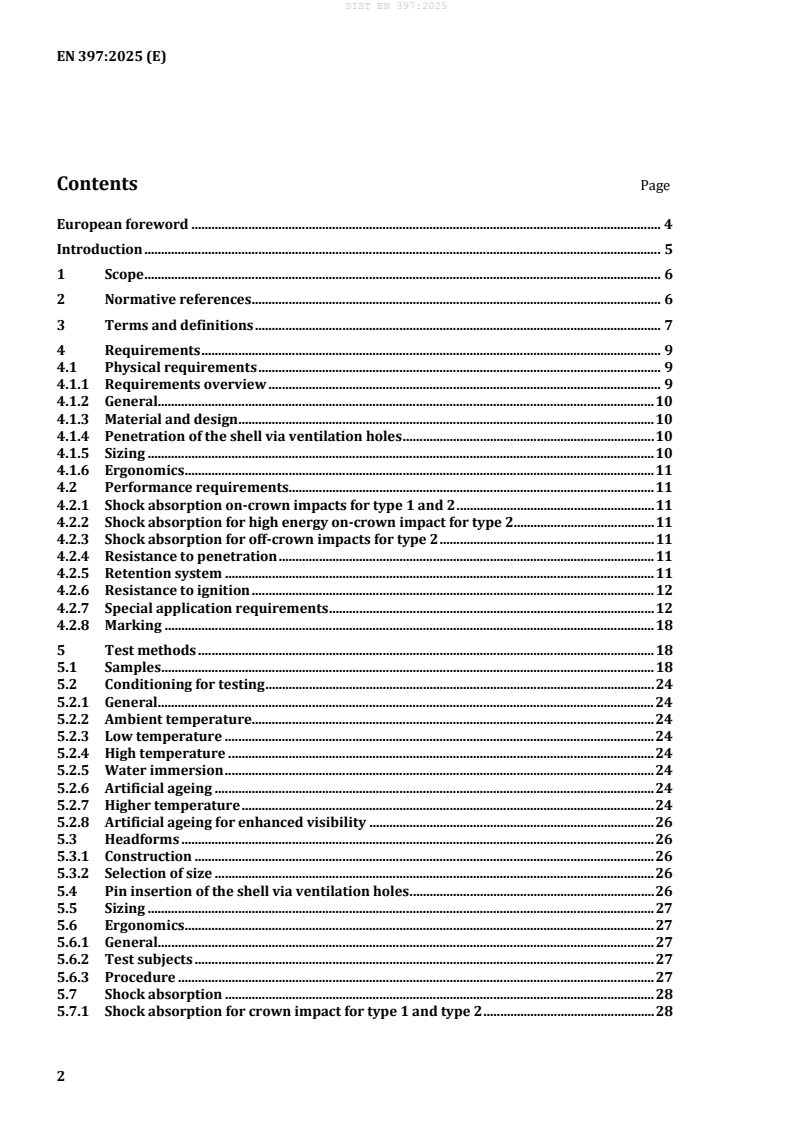
Contents Page
European foreword . 4
Introduction . 5
1 Scope . 6
2 Normative references . 6
3 Terms and definitions . 7
4 Requirements . 9
4.1 Physical requirements . 9
4.1.1 Requirements overview . 9
4.1.2 General. 10
4.1.3 Material and design . 10
4.1.4 Penetration of the shell via ventilation holes . 10
4.1.5 Sizing . 10
4.1.6 Ergonomics . 11
4.2 Performance requirements . 11
4.2.1 Shock absorption on-crown impacts for type 1 and 2 . 11
4.2.2 Shock absorption for high energy on-crown impact for type 2. 11
4.2.3 Shock absorption for off-crown impacts for type 2 . 11
4.2.4 Resistance to penetration . 11
4.2.5 Retention system . 11
4.2.6 Resistance to ignition . 12
4.2.7 Special application requirements . 12
4.2.8 Marking . 18
5 Test methods . 18
5.1 Samples . 18
5.2 Conditioning for testing . 24
5.2.1 General. 24
5.2.2 Ambient temperature. 24
5.2.3 Low temperature . 24
5.2.4 High temperature . 24
5.2.5 Water immersion . 24
5.2.6 Artificial ageing . 24
5.2.7 Higher temperature . 24
5.2.8 Artificial ageing for enhanced visibility . 26
5.3 Headforms . 26
5.3.1 Construction . 26
5.3.2 Selection of size . 26
5.4 Pin insertion of the shell via ventilation holes . 26
5.5 Sizing . 27
5.6 Ergonomics . 27
5.6.1 General. 27
5.6.2 Test subjects . 27
5.6.3 Procedure . 27
5.7 Shock absorption . 28
5.7.1 Shock absorption for crown impact for type 1 and type 2 . 28
5.7.2 Shock absorption for high energy on-crown impact for type 2 . 29
5.7.3 Shock absorption for off-crown for type 2 . 29
5.8 Resistance to penetration . 31
5.9 Retention system strength release . 31
5.10 Retention system effectiveness . 31
5.10.1 General . 31
5.10.2 Principle . 32
5.10.3 Apparatus . 32
5.11 Resistance to ignition of the shell . 34
5.11.1 Principle . 34
5.11.2 Apparatus . 34
5.11.3 Procedure . 34
5.11.4 Report . 34
5.12 Molten metal splash . 34
5.12.1 Principle . 34
5.12.2 Apparatus . 35
5.12.3 Procedure . 35
5.13 Electrostatic properties. 35
5.13.1 Atmosphere for conditioning and testing . 35
5.13.2 Surface resistance test for helmets comprising dissipative or conductive components
................................................................................................................................................................... 35
5.13.3 Leakage resistance test for helmets comprising dissipative or conductive components
................................................................................................................................................................... 35
5.13.4 Capacitance test for isolated conductive helmet components . 36
5.13.5 Transferred charge test for insulating and isolated dissipative helmet components
................................................................................................................................................................... 37
5.14 Enhanced visibility . 39
5.14.1 Background material. 39
5.14.2 Surface of retroreflective material . 39
5.14.3 Coefficient of retroreflection . 39
5.15 Determination of resistance to off-crown penetration . 39
5.15.1 Apparatus . 39
5.15.2 Procedure . 40
6 Marking . 40
6.1 General . 40
6.2 General markings . 40
7 Manufacturer’s instructions and information . 41
7.1 General . 41
7.2 For electrostatic properties . 42
7.3 For enhanced visibility properties . 43
Annex A (normative) Flowchart for testing electrostatic properties . 44
Annex ZA (informative) Relationship between this European Standard and the essential
Requirements of Regulation (EU) 2016/425 of the European Parliament and of the
Council of 9 March 2016 on personal protective equipment aimed to be covered . 53
Bibliography . 55
European foreword
This document (EN 397:2025) has been prepared by Technical Committee CEN/TC 158 “Head
protection”, the secretariat of which is held by SIS.
This European Standard shall be given the status of a national standard, either by publication of an
identical text or by endorsement, at the latest by October 2025, and conflicting national standards shall
be withdrawn at the latest by October 2025.
Attention is drawn to the possibility that some of the elements of this document may be the subject of
patent rights. CEN shall not be held responsible for identifying any or all such patent rights.
This document supersedes EN 397:2012+A1:2012.
In comparison with the previous version EN 397:2012+A1:2012 of edition EN 397:2012, the following
technical modifications have been made:
— the Introduction has been revised and modernized;
— two types of helmets have been introduced; with protection against impacts on-crown (type 1) or
on-crown and off-crown (type 2);
— measuring of drop speed has been defined for improved reproducibility;
— electrostatic and enhanced visibility requirements have been added;
— reference to EN 50365:2023, 4.3 for requirements on electrical insulation has been made.
This document has been prepared under a standardization request addressed to CEN by the European
Commission. The Standing Committee of the EFTA States subsequently approves these requests for its
Member States.
For the relationship with EU Legislation, see informative Annex ZA, which is an integral part of this
document.
Any feedback and questions on this document should be directed to the users’ national standards body.
A complete listing of these bodies can be found on the CEN website.
According to the CEN-CENELEC Internal Regulations, the national standards organisations of the
following countries are bound to implement this European Standard: Austria, Belgium, Bulgaria, Croatia,
Cyprus, Czech Republic, Denmark, Estonia, Finland, France, Germany, Greece, Hungary, Iceland, Ireland,
Italy, Latvia, Lithuania, Luxembourg, Malta, Netherlands, Norway, Poland, Portugal, Republic of North
Macedonia, Romania, Serbia, Slovakia, Slovenia, Spain, Sweden, Switzerland, Türkiye and the United
Kingdom.
Introduction
An industrial protective helmet is intended to be used in different work settings such as construction,
mining, shipping, manufacturing, etc. With this in mind the accidents that occur can therefore be different
depending on the workplace. Typical hazards include falling objects, slips, trips or falls of a person from
the same level or one above and loss of control of machinery. The intention with this document is to
reduce the potential injury to the head and risks associated with the hazards but will not eliminate them
completely.
Manufacturers complying with European Standards offer a suite of head protection devices for general
industrial use:
— the industrial bump cap meeting the requirements of EN 812;
— the industrial protective helmet meeting the requirements of type 1 and type 2 in this document;
— the high performance industrial helmet meeting the requirements of EN 14052.
EN 812, Industrial bump caps is intended to provide protection to the wearer against the effects of striking
their head against hard or stationary objects with sufficient severity to cause lacerations or other
superficial injuries. They are not intended to provide protection against the effects of impacts on the
crown area. In addition to the mandatory requirements the bump cap can have shock absorption
properties at low temperatures, be ignition resistant and have electrical insulation properties.
In this document type 1 industrial protective helmets are intended to reduce the possible consequential
effects of head injuries caused by impacts on the crown area. In this document type 2 industrial protective
helmets are tested using higher impact energy to the crown and require some additional testing for
impacts off-crown, front, rear, sides of the helmet. It also includes a retention system that meets
requirements for chin strap strength and effectiveness. In addition to the requirements for the type 1 and
type 2 helmets, this document includes requirements for special applications, for example low
temperature, high temperature, electrical insulation, electrostatic and enhanced visibility properties.
EN 14052, High performance industrial helmets offers even greater protection from falling objects,
protection from off-crown impacts and protection from penetration by a flat blade striker. It also includes
a retention system that meets requirements for chin strap strength and effectiveness.
Angled and tangential (rotational) impacts are one of the causes of head injuries. At the time of developing
this document, no rotational test method was available. Therefore, only linear impacts to a helmeted head
in the shock absorption test have been addressed. CEN/TC 158 will in the near future present a new test
method, which can be used in future revisions of this document.
The wearing of a helmet meeting the requirements in this document reduces, but not eliminates, the
consequences of head injury. A proportion of the energy of an impact is absorbed by the helmet, thereby
reducing the force of the blow sustained by the head.
There are limits to the amount of protection that can be provided and wearing a helmet cannot always
prevent death or long term disability.
1 Scope
This document specifies requirements for design, performance, test methods and markings for industrial
protective helmets. The requirements apply to helmets for general use in industry.
Additional performance requirements for special applications are included to apply only when
specifically claimed by the helmet manufacturer.
Industrial protective helmets are intended to reduce the risk of head injuries caused by impacts and
therefore can reduce consequential effects.
2 Normative references
The following documents are referred to in the text in such a way that some or all of their content
constitutes requirements of this document. For dated references, only the edition cited applies. For
undated references, the latest edition of the referenced document (including any amendments) applies.
EN 960:2006, Headforms for use in the testing of protective helmets
EN 13087-1:2000 , Protective helmets — Test methods — Part 1: Conditions and conditioning
EN 13087-2:2012, Protective helmets — Test methods — Part 2: Shock absorption
EN 13087-3:2000 , Protective helmets — Test methods — Part 3: Resistance to penetration
EN 13087-5:2012, Protective helmets — Test methods — Part 5: Retention system strength
EN 17353:2020, Protective clothing — Enhanced visibility equipment for medium risk situations — Test
methods and requirements
EN 50365:2023, Live Working — Electrically insulating helmets for use on low and medium voltage
installations
EN 60079-32-2:2015, Explosive atmospheres — Part 32-2: Electrostatics hazards — Tests (IEC 60079-32-
2:2015)
EN ISO 472:2013 , Plastics — Vocabulary (ISO 472:1999)
EN ISO 9185:2007, Protective clothing — Assessment of resistance of materials to molten metal splash
(ISO 9185:2007)
EN ISO/CIE 11664-2:2022, Colorimetry — Part 2: CIE standard illuminants (ISO/CIE 11664-2:2022)
As impacted by EN 13087-1:2000/A1:2001.
As impacted by EN 13087-3:2000/A1:2001.
As impacted by EN ISO 472:2013/A1:2018.
3 Terms and definitions
For the purposes of this document, the following terms and definitions apply.
ISO and IEC maintain terminology databases for use in standardization at the following addresses:
— ISO Online browsing platform: available at https://www.iso.org/obp
— IEC Electropedia: available at https://www.electropedia.org/
3.1
industrial protective helmet
head protector, hereinafter referred to as “helmet”, primarily intended to provide the wearer with
protection against impacts on-crown (type 1) or on-crown and off-crown (type 2)
Note 1 to entry: The helmet can incorporate additional protective functions.
3.2
shell
exterior part of the helmet which gives it its shape
3.3
retention system
complete assembly by means of which the helmet is maintained in position on the head, including any
devices for adjusting the system or enhancing the wearer’s comfort
Note 1 to entry: The retention system can include a chin strap.
[SOURCE: EN 14052:2012+A1:2012, 3.2]
3.4
crown
area on the upper outside surface of the helmet which lies within a 30° included solid angle from point G
(as defined in EN 960:2006, 2.12) on the central vertical axis through the head form to which the helmet
is fitted
[SOURCE: EN 14052:2012+A1:2012, 3.4]
3.5
integral additional protective function
part(s) of the helmet, intended by the helmet manufacturer not to be removed by the user, except for
maintenance purposes, and which provide protection to the wearer, other than as provided for by this
European Standard
[SOURCE: EN 14052:2012+A1:2012, 3.5]
3.6
non-integral additional protective function
additional protective device(s) attached to the helmet intended to be removable by the user, but are not
specifically required in order for the helmet to satisfy this document
EXAMPLE Non-integral additional function can be a visor, face shield or hearing protectors.
[SOURCE: EN 14052:2012+A1:2012, 3.6]
3.7
helmet accessory
additional device(s) attached to the helmet intended to be removable by the user, but which provide no
protective function to the wearer
EXAMPLE Helmet accessory can be a head lamp or a video camera.
[SOURCE: EN 14052:2012+A1:2012, 3.7]
3.8
HPI
Helmet Positioning Index
vertical distance measured on the longitudinal vertical plane, between the lowest point of the frontal
helmet shell and the reference plane (B), when the helmet is placed on the appropriate reference
headform
Note 1 to entry: The longitudinal vertical plane and the reference plane are defined in EN 960:2006.
Note 2 to entry: See Figure 1.
Key
B reference plane
1 helmet positioning index
Figure 1 — Helmet positioning index
3.9
test plaque
sample of the shell or representative shell material
[SOURCE: ANSI Z89.1-2014]
4 Requirements
4.1 Physical requirements
4.1.1 Requirements overview
Table 1 shows an overview for the requirements of type 1 and type 2 industrial protective helmets.
Table 1 — Overview for the requirements
Type 1 Type 2
Physical 4.1.2 General X X
requirements
4.1.3 Materials and design X X
4.1.4 Penetration of the shell via ventilation holes X X
4.1.5 Sizing X X
4.1.6 Ergonomics X X
Performance 4.2.1 Shock absorption on-crown impacts for type 1 X X
requirements and 2
4.2.2 Shock absorption for high energy on-crown - X
impact for type 2
4.2.3 Shock absorption for off-crown impacts for type 2 - X
4.2.4 Resistance to penetration X X
4.2.5 Retention system X X
(4.2.5.1) (4.2.5.2)
(4.2.5.3)
4.2.6 Resistance to ignition X X
4.2.7 Special application requirements O O
4.2.7.1 Performance at lower temperatures O 0
4.2.7.2 Performance at higher temperatures O O
4.2.7.3 Electrically insulating helmets for use on low O O
and medium voltage installations
4.2.7.4 Molten metal splash O O
4.2.7.5 Electrostatic properties O O
4.2.7.6 Enhanced visibility O O
4.2.7.7 Resistance to off-crown penetration O O
X Applicable for the specified type
O Applicable for special application
- Not applicable for the helmet type
4.1.2 General
Unless otherwise specified, the values stated in this document are expressed as nominal values. Except
for temperature limits, values that are not stated as maxima or minima shall be subject to a tolerance
of ±5 %. Unless otherwise specified, the temperature values shall be in accordance with
EN 13087-1:2000 .
Helmets shall be tested with all integral additional protective functions (3.5) fitted. When non-integral
additional protective functions (3.6) or helmet accessories (3.7) are submitted with the helmet for test,
the helmet shall satisfy the requirements of this document with and without these items fitted. Multiple
non-integral additional protective functions (3.6) or helmet accessories (3.7) may be tested
simultaneously.
If helmet accessories and/or non-integral additional protective functions are attached to a helmet, a list
of possible accessories that do not affect the conformity of the helmet with this document shall be
provided. See Table 7 for the identification of required tests, when helmet accessories are attached to the
helmet.
NOTE Accessories can be fixed on the helmet using fixing devices provided by the helmet manufacturer.
4.1.3 Material and design
4.1.3.1 Innocuousness
For those parts of the helmet that come into contact with the skin, materials shall not be used which are
known to be likely to cause skin irritation or any adverse effect on health.
Substances recommended for cleaning, maintenance or disinfection shall have no adverse effect on the
helmet and shall be known not to be likely to have any adverse effect upon the wearer, when applied in
accordance with the helmet manufacturer’s instructions.
Information claiming that the product is innocuous shall be checked.
4.1.3.2 Visual and tactile inspection
When tested according to 5.6.3.1, there shall be no sharp edges or projection on any parts of the helmet
which are in contact, or potential contact, with the wearer, when the helmet is worn, such as is likely to
cause injury to the wearer.
Any part of the helmet that can be adjusted or removed by the wearer for the purpose of replacement
when tested in accordance with 5.6.3.2, shall be so designed and manufactured as to facilitate adjustment,
removal and attachment without the use of tools.
4.1.4 Penetration of the shell via ventilation holes
If the helmet has ventilation holes, either adjustable or fixed, each ventilation hole shall be tested by pins
in accordance with 5.4. The test is considered as passed if both pins do not get in contact with the testing
head form during the tests.
NOTE 1 Requirements regarding ventilation design are not given because they depend on the use of the helmet
and the resulting risks as determined by a risk analysis.
NOTE 2 Holes intended for accessories (e.g. visor, ear muff) are not considered as ventilation holes.
NOTE 3 By assessment of the ventilation openings with a pin, means like meshes, etc. are not regarded as a
suitable limiting factor to avoid any penetration and avoid contact to the headform.
4.1.5 Sizing
The helmet shall be adjusted to fit to the headform as described in 5.5, when tested.
The size of the helmet shall be adjustable continuously or in steps of maximum 5 mm.
4.1.6 Ergonomics
Any adjustment system incorporated within the helmet shall be so designed and manufactured so that it
remains adjusted, when tested in accordance with 5.6.
When the helmet is assessed in accordance with 5.6.3 the following requirements shall be met:
a) it shall be possible for the helmet to be adjusted to give a snug secure fit to the head of the test subject;
b) the helmet shall always remain in place during the activities listed under 5.6.3.3;
c) there shall not be any “NO” answers from the test subject(s).
4.2 Performance requirements
4.2.1 Shock absorption on-crown impacts for type 1 and 2
When a helmet is tested in accordance with 5.7.1, the force transmitted to the headform shall not exceed
5,0 kN. This requirement shall be satisfied by helmets treated in accordance with the appropriate
conditioning processes given in 5.2 as specified by the list of mandatory tests given in Table 7.
4.2.2 Shock absorption for high energy on-crown impact for type 2
When a type 2 helmet is tested in accordance with 5.7.2, the force transmitted to the headform shall not
exceed 10,0 kN. This requirement shall be satisfied by helmets treated in accordance with the appropriate
conditioning processes given in 5.2 as specified by the list of mandatory tests given in Table 7.
4.2.3 Shock absorption for off-crown impacts for type 2
When a type 2 helmet is tested in accordance with 5.7.3, the force transmitted to the headform shall not
exceed 10,0 kN. This requirement shall be satisfied by helmets treated in accordance with the appropriate
conditioning processes given in 5.2 as specified by the list of mandatory tests given in Table 7.
4.2.4 Resistance to penetration
When a helmet is tested in accordance with 5.8, the striker shall not contact the headform. This
requirement shall be satisfied by helmets treated in accordance with the appropriate conditioning
processes given in 5.2, as specified by the list of mandatory tests given in Table 7.
4.2.5 Retention system
4.2.5.1 Chin strap strength release – type 1
If a chin strap is supplied with the helmet, it shall be no less than 10 mm wide when un-tensioned. When
a helmet is tested by the method described in 5.9, the chin strap shall not release at less than 150 N.
4.2.5.2 Chin strap strength release – type 2
A chin strap is mandatory for type 2 helmets, and it shall be no less than 10 mm wide when un-tensioned.
When a helmet is tested by the method described in 5.9, the chin strap shall not release at less than 500 N.
4.2.5.3 Retention system effectiveness – type 2
When a helmet is tested by the method described in 5.10, for the front way and rear way tests, the helmet
shall not come off the headform.
4.2.6 Resistance to ignition
When tested in accordance with 5.11, no part of the helmet shell shall ignite upon application of the
heated rod nor continue to glow after removal of the heated rod.
4.2.7 Special application requirements
4.2.7.1 Performance at lower temperatures
When tested for shock absorption in accordance with 5.7, the requirement given in 4.2 shall be satisfied
by one additional helmet which has been conditioned in accordance with 5.2.3.
When tested for penetration in accordance with 5.8, the requirement given in 4.2 shall be satisfied by one
additional helmet, which has been conditioned in accordance with 5.2.3.
Helmets claimed to meet this requirement shall state this fact on the marking of the helmet, in accordance
with 6.2.
4.2.7.2 Performance at higher temperatures
When tested for shock absorption by the method given in 5.7, the requirement of 4.2 shall be satisfied by
one helmet, which has been conditioned in accordance with 5.2.4.
When tested for resistance to penetration by the method given in 5.8, the requirement of 4.2 shall be
satisfied by a second helmet, which has been conditioned in accordance with 5.2.4.
Helmets claimed to meet this requirement shall state this fact on the marking of the helmet, in accordance
with 6.2.
4.2.7.3 Electrically insulating helmets for use on low and medium voltage installations
If the helmet also is designed to give electrically insulating protection it shall meet the requirements of
EN 50365:2023, 4.3.
4.2.7.4 Molten metal splash
When tested in accordance with 5.12, the shell material shall not:
a) be penetrated by the molten metal through the external shell;
b) burn with the emission of flame after a period of 5 s has elapsed after the pouring of molten metal has
ceased. Only the crown area of the helmet shall be assessed.
NOTE A helmet fitted with a grooved rim can comply with this requirement.
4.2.7.5 Electrostatic properties
4.2.7.5.1 General
To avoid the accumulation of harmful electrostatic charges, helmets shall be protected by one or more of
the following means:
— use of dissipative or conductive materials which are safely earthed, e.g. via contact to the wearer;
— restricting the size of chargeable insulating surfaces to within dimensions that cannot give rise to
incendiary electrostatic discharges;
— use of insulating materials and surfaces that do not tend to be highly charged by rubbing with
materials that can potentially contact the helmet in normal operation, or by exposure to charging
mechanisms such as corona discharge or aerosol sprays.
It is essential that dissipative or conductive helmet components are properly earthed to allow any charge
to be safely dissipated to earth, thereby avoiding hazardous electrostatic discharges. Refer to
CEN/CLC/TR 16832 for guidance on earthing.
Testing of insulating materials is not required in cases where the insulating materials are inside the
helmet in positions that are not accessible to rubbing or other charging mechanisms during normal
operation. The use of insulating materials shall not interfere with the contact to earth of dissipative or
conductive materials.
Helmets meeting the requirements for electrostatic properties specified in this document provide
protection against electrostatic hazards only in the following situations as described in
CEN/CLC/TR 16832:
a) personnel wearing helmets are properly earthed;
b) helmets are put on before entering hazardous areas;
c) helmets are not removed during operations in hazardous areas.
All requirements for electrostatic properties shall be tested after conditioning in accordance with 5.13.1.
A flowchart for testing electrostatic properties is shown in Figure 9 and Annex A.
4.2.7.5.2 Requirements
4.2.7.5.2.1 Surface resistance of dissipative helmet components
Surface resistance of dissipative helmet components shall be in the range 10 kΩ to 5 GΩ (1 × 10 Ω to
5 × 10 Ω) measured in accordance with 5.13.2.
4.2.7.5.2.2 Surface resistance of conductive helmet components
Ω) measured in
Surface resistance of conductive helmet components shall be less than 10 kΩ (1 × 10
accordance with 5.13.2.
4.2.7.5.2.3 Leakage resistance of helmets comprising dissipative or conductive components
The leakage resistance from dissipative or conductive helmet components shall be less than or equal to
5 GΩ (5 × 10 Ω) measured in accordance with 5.13.3.
4.2.7.5.2.4 Capacitance of isolated conductive helmet components
Conductive helmet components with a leakage resistance greater than 5 GΩ (5 × 10 Ω) are considered
to be isolated capacitances and shall meet the requirements specified in Table 2 when measured in
accordance with 5.13.4. Refer to Annex A flowcharts in this document and CLC/TR 60079-32-1:2018,
Clause 6.2.3 [6] for guidance on earthing of conductive components in zones with explosive atmosphere.
Table 2 — Maximum allowed isolated capacitance in zones with explosive atmosphere
Additional
Zone Group I Group IIA Group IIB Group IIC Group III
condition
a
0 3 pF 3 pF
1 6 pF 3 pF 3 pF
b
No high charging
20, 21
c
processes
10 pF
6 pF
MIE ≤ 10 mJ
20, 21
10 pF
MIE > 10 mJ
b
a
No isolated conductive objects allowed in Zone 0, Group IIC.
b
No requirements if charging processes capable of generating hazardous potentials are unlikely to occur
during normal operation including maintenance and cleaning.
c
Manual rubbing is usually not considered to be a high charging process.
4.2.7.5.2.5 Size of chargeable insulating helmet components
The maximum allowable size of chargeable insulating helmet components are specified in Table 3.
Insulating helmet components larger than these dimensions shall be measured in accordance with 5.13
and meet the requirements specified in 4.2.7.5.2.6. Refer to Annex A flowcharts in this document and
CLC/TR 60079-32-1:2018, Table 3 [6] for guidance on the size of insulating components.
Table 3 — Restriction on size of insulating solid materials in hazardous areas
Group 1 Group IIA Group IIB Group IIC Group III
Max. Max. Max. Max. Max. Max. Max. Max. Max. Max.
Zone
Area
Width Area Width Area Width Area Width Area Width
2 2 2 2 2
(mm) (mm) (mm) (mm) (mm)
(mm ) (mm ) (mm ) (mm ) (mm )
0 5 000 3 2 500 3 400 1
1 10 000 30 10 000 30 10 000 30 2 000 20
2 No size limit
20,
No size limit
21, 22
4.2.7.5.2.6 Transferred charge in electrostatic discharges from insulating and isolated
dissipative helmet components
For insulating helmet components exceeding the size limits specified in 4.2.7.5.2.5, or dissipative helmet
components with leakage resistance exceeding 5 GΩ (5 × 10 Ω), transferred charge in electrostatic
discharges from the insulating or isolated dissipative helmet components shall be measured in
accordance with 5.13.5 and meet the requirments specified in Table 4. Refer to Annex A flowcharts in this
document and CLC/TR 60079-32-1:2018, Table 4 [6], for guidance on discharges.
If results on corona charging and whipping with a leather glove have been discarded, it shall be stated in
the information for use that the helmet shall not be used in the presence of charge generating processes
stronger than manual rubbing.
Table 4 — Maximum acceptable transferred charge
Explosion EPL Ma
EPL Ga EPL Gb EPL Gc EPL Da EPL Db EPL Dc
Group
EPL Mb
Zone 0 Zone 1 Zone 2 Zone 20 Zone 21 Zone 22
Mining
I 60 nC
IIA 25 nC 60 nC 60 nC
IIB 10 nC 25 nC 25 nC
No
IIC measurable 10 nC 10 nC
discharge
a a a
III 60 nC 200 nC 200 nC
NOTE nC = Nanocoloumb, a measure of capacitance
a
Values only valid for spark discharges from isolated conductive or dissipative components.
4.2.7.6 Enhanced visibility
4.2.7.6.1 General
When tested in accordance with 5.14:
— helmets for enhanced visibility in daylight conditions shall meet the requirements as stated in
4.2.7.6.2;
— helmets for enhanced visibility in dark conditions shall meet the requirements as stated in 4.2.7.6.3
and 4.2.7.6.4;
— helmets for enhanced visibility in daylight and dark conditions shall meet the requirements as stated
in 4.2.7.6.2 to 4.2.7.6.4.
4.2.7.6.2 Chromaticity and luminance factor
The entire shell of the helmet shall be in fluorescent material.
When tested in accordance with 5.14.1, chromaticity and luminance factor for shell material shall comply
within the minimum requirements stated in Table 5:
Table 5 — Colour, enhanced visibility in daylight conditions
Colour Chromaticity coordinates Minimum luminance
factor (Y)
x y %
Fluorescent yellow-green 0,387 0,610 70
0,356 0,494
0,398 0,452
0,460 0,540
Fluorescent orange-red 0,610 0,390 40
0,535 0,375
0,570 0,340
0,655 0,344
Fluorescent red 0,655 0,344 25
0,570 0,340
0,595 0,315
0,690 0,310
4.2.7.6.3 Retroreflective performance surface
When tested according to 5.14.2, the total amount of retroreflective material shall be no less than 72 cm ,
and the surface area of each piece of retroreflective material shall be a minimum of 18 cm and it shall be
placed in each area (front, rear, left and right) as defined in Figure 2.
Key
1 front
2 rear
3 right
4 left
5 longitudinal vertical plane of symmetry
Figure 2 — Shell areas for retroreflective performance surface
The retroreflective material should not be placed in areas where they might be hidden by accessories in
working position (e.g. visor in low position).
4.2.7.6.4 Coefficient of retroreflection
When tested in accordance with 5.14.3, minimum coefficient of retroreflection (in cd/(lx x m )) for
retroreflective material shall comply within the minimum requirements stated in Table 6:
Table 6 — Minimum coefficient of retroreflection R in cd/(lx x m ) for separate performance
A
retroreflective material
Observation Entrance angle β1 (β1 = 0)
angle
5° 20° 30° 40°
α
12’ 330 290 180 65
20’ 250 200 170 60
1° 25 15 12 10
1°30′ 10 7 5 4
4.2.7.7 Resistance to off-crown penetration
When tested in accordance with 5.15 the striker shall not touch the headform.
4.2.8 Marking
The markings in the helmet shall be in accordance with Clause 6.
The marking of the number and year of this document, i.e. (EN 397:2025) followed by T1 or T2, for type
1 or type 2 helmet according to this standard, shall only be used if the requirements are fully met.
If appli
...