

CEN/TR 18249:2025
(Main)Head protection - Scientific background and rationale to EN 17950
- Abstract
This document describes the scientific background and rationale for the content of EN 17950, Protective helmets - Test methods - Shock absorption including measuring rotational kinematics.
- Status
- Published
- Publication Date
- 16-Dec-2025
- Technical Committee
- CEN/TC 158 - Head protection
- Drafting Committee
- CEN/TC 158/WG 11 - Headforms and test methods
- Current Stage
- 6060 - Definitive text made available (DAV) - Publishing
- Start Date
- 17-Dec-2025
- Due Date
- 09-Jun-2026
- Completion Date
- 17-Dec-2025

Overview
CEN/TR 18249:2025 - Head protection: Scientific background and rationale to EN 17950 (CEN/TC 158) documents the scientific rationale behind EN 17950:2024, the new European test methods for helmet shock absorption that include measurement of rotational kinematics. This Technical Report (draft submitted for vote) explains why a rotational test was needed, summarizes test-method options, and provides the technical basis for the headform and impact configurations specified in EN 17950.
Key topics
- Rationale for rotational testing: Oblique impacts are more common than purely linear impacts and can induce head rotation that contributes to brain injury. The report cites accident and biomechanical studies supporting inclusion of rotational kinematics in helmet testing.
- Chosen test method: Dropped helmeted headform impacting an oblique surface (45°) was selected for practicality, compatibility with existing vertical drop towers, and ability to generate tangential loading representative of real-world falls.
- Impact anvil: A hard steel anvil covered with #80 grinding paper is specified to provide a robust, repeatable, high-friction impacting surface for rotational energy transfer.
- Headform biofidelity: New headforms were developed because legacy forms (EN 960:2006, Hybrid III) lack correct inertial or frictional properties for rotational tests. Targeted properties include:
- Moment of inertia (MOI) around all three principal axes,
- Biofidelic mass and centre of gravity (CG),
- Realistic outer geometry (head shape),
- Coefficient of friction (COF) between headform surface and helmet comfort padding.
- Instrumentation: Six-degree-of-freedom kinematics (three linear + three rotational metrics) are recorded to evaluate rotational energy absorption; tangential plate-force alone is insufficient.
- Neck and body considerations: The report explains why a mechanical neckform was not adopted-short-duration impacts used in the method reduce the influence of neck dynamics-so the test is performed without a neckform.
- Repeatability & evaluation: Clause 6 summarizes multi-laboratory evaluations addressing repeatability and reproducibility of the method and headforms.
Applications
- Helmet design and development - optimize liners and shells for rotational as well as linear impact protection.
- Test laboratories - implement EN 17950 rotational test methods using compatible drop towers and instrumentation.
- Manufacturers and conformity assessment bodies - use the scientific basis when adopting EN 17950 for product evaluation, research, and internal QA.
- Regulators, consumer organizations, and researchers - assess helmet performance, injury risk metrics, and inform future standards.
Who should use this standard
- Helmet manufacturers (bicycle, equestrian, industrial, snow sports)
- Accredited testing laboratories and certification bodies
- Research institutes, universities, and biomechanics groups
- Standards committees, regulators, and consumer safety organizations
CEN/TR 18249:2025 supports EN 17950:2024 by explaining test choices and headform specifications, helping stakeholders implement robust rotational helmet testing that reflects real-world oblique impacts.
Get Certified
Connect with accredited certification bodies for this standard

CIS Institut d.o.o.
Personal Protective Equipment (PPE) certification body. Notified Body NB-2890 for EU Regulation 2016/425 PPE.

Kiwa BDA Testing
Building and construction product certification.
Kmetijski inštitut Slovenije
Agricultural Institute of Slovenia. Soil testing, plant health, agricultural product analysis.
Sponsored listings
Frequently Asked Questions
CEN/TR 18249:2025 is a technical report published by the European Committee for Standardization (CEN). Its full title is "Head protection - Scientific background and rationale to EN 17950". This standard covers: This document describes the scientific background and rationale for the content of EN 17950, Protective helmets - Test methods - Shock absorption including measuring rotational kinematics.
This document describes the scientific background and rationale for the content of EN 17950, Protective helmets - Test methods - Shock absorption including measuring rotational kinematics.
CEN/TR 18249:2025 is classified under the following ICS (International Classification for Standards) categories: 13.340.20 - Head protective equipment. The ICS classification helps identify the subject area and facilitates finding related standards.
CEN/TR 18249:2025 is available in PDF format for immediate download after purchase. The document can be added to your cart and obtained through the secure checkout process. Digital delivery ensures instant access to the complete standard document.
Standards Content (Sample)
SLOVENSKI STANDARD
01-marec-2026
Zaščita glave - Znanstveno ozadje in utemeljitev EN 17950
Head protection - Scientific background and rationale to EN 17950
Kopfschutz - Wissenschaftlicher Hintergrund und Begründung zu EN 17950
Casques de protection - Contexte scientifique et justification de l’EN 17950
Ta slovenski standard je istoveten z: CEN/TR 18249:2025
ICS:
13.340.20 Varovalna oprema za glavo Head protective equipment
2003-01.Slovenski inštitut za standardizacijo. Razmnoževanje celote ali delov tega standarda ni dovoljeno.
CEN/TR 18249
TECHNICAL REPORT
RAPPORT TECHNIQUE
December 2025
TECHNISCHER REPORT
ICS 13.340.20
English Version
Head protection - Scientific background and rationale to
EN 17950
Casques de protection - Contexte scientifique et Kopfschutz - Wissenschaftlicher Hintergrund und
justification de l'EN 17950 Begründung zu EN 17950
This Technical Report was approved by CEN on 7 December 2025. It has been drawn up by the Technical Committee CEN/TC
158.
CEN members are the national standards bodies of Austria, Belgium, Bulgaria, Croatia, Cyprus, Czech Republic, Denmark, Estonia,
Finland, France, Germany, Greece, Hungary, Iceland, Ireland, Italy, Latvia, Lithuania, Luxembourg, Malta, Netherlands, Norway,
Poland, Portugal, Republic of North Macedonia, Romania, Serbia, Slovakia, Slovenia, Spain, Sweden, Switzerland, Türkiye and
United Kingdom.
EUROPEAN COMMITTEE FOR STANDARDIZATION
COMITÉ EUROPÉEN DE NORMALISATION
EUROPÄISCHES KOMITEE FÜR NORMUNG
CEN-CENELEC Management Centre: Rue de la Science 23, B-1040 Brussels
© 2025 CEN All rights of exploitation in any form and by any means reserved Ref. No. CEN/TR 18249:2025 E
worldwide for CEN national Members.
Page
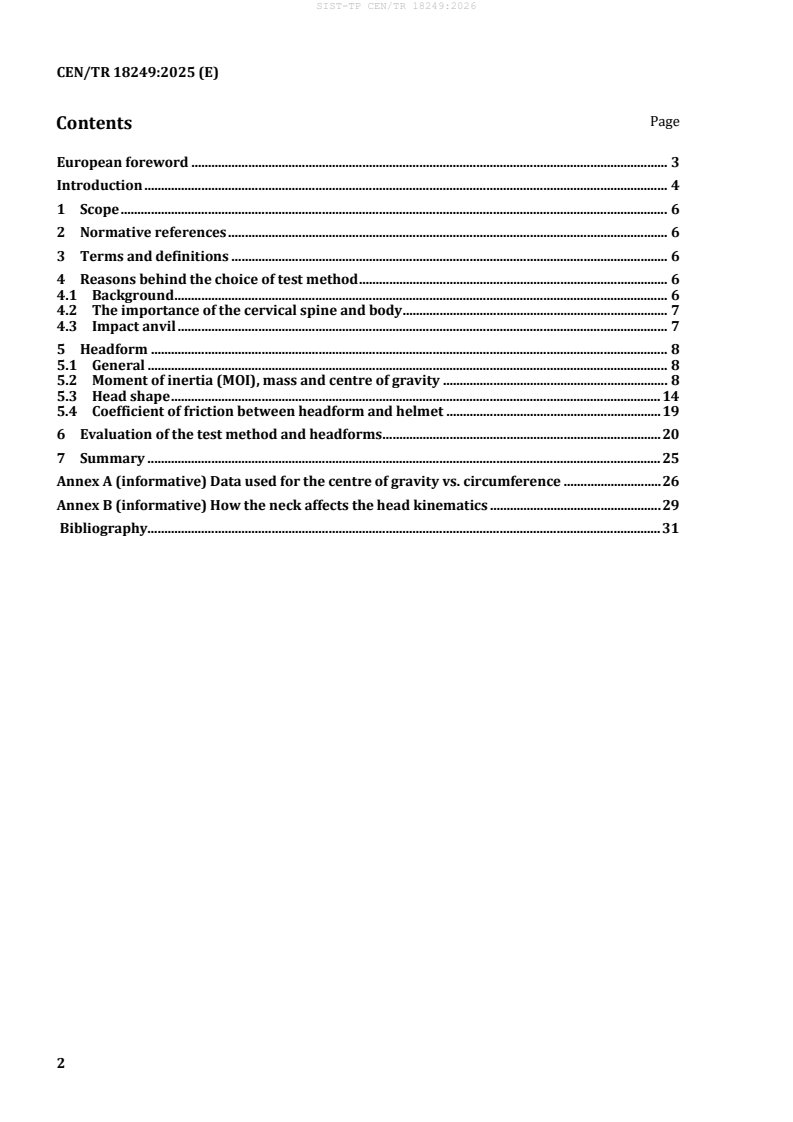
Contents
European foreword . 3
Introduction . 4
1 Scope . 6
2 Normative references . 6
3 Terms and definitions . 6
4 Reasons behind the choice of test method . 6
4.1 Background . 6
4.2 The importance of the cervical spine and body . 7
4.3 Impact anvil . 7
5 Headform . 8
5.1 General . 8
5.2 Moment of inertia (MOI), mass and centre of gravity . 8
5.3 Head shape . 14
5.4 Coefficient of friction between headform and helmet . 19
6 Evaluation of the test method and headforms . 20
7 Summary . 25
Annex A (informative) Data used for the centre of gravity vs. circumference . 26
Annex B (informative) How the neck affects the head kinematics . 29
Bibliography. 31
European foreword
This document (CEN/TR 18249:2025) has been prepared by Technical Committee CEN/TC 158 "Head
protection", the secretariat of which is held by SIS.
Attention is drawn to the possibility that some of the elements of this document may be the subject of
patent rights. CENELEC shall not be held responsible for identifying any or all such patent rights.
Any feedback and questions on this document should be directed to the users’ national committee. A
complete listing of these bodies can be found on the CENELEC website.
Introduction
The objective of this document is to provide the scientific background and rationale for the content of
EN 17950:2024 [1] Protective helmets — Test methods — Shock absorption including measuring
rotational kinematics. EN 17950:2024 [1] that was developed by Working group 11 (WG 11),
Headforms and test methods within the CEN, the European Committee for Standardization, Technical
Committee CEN/TC 158, Head protection.
The main reasons for developing a new rotational test method were:
— Oblique impacts are more frequent than pure linear impacts, see [2], [3], [4], [5] and [6]. In case
of an oblique impact and if the coefficient of friction is high enough, the tangential force could
result in an additional rotation of the head.
— Several studies show that the human head is sensitive to rotational motion, see [7], [8], [9], [10],
[11], [12], [13], [14], [15] and [16].
The first discussions within CEN/TC 158 to develop a standard with a rotational test method for helmets
was initiated 2006 and the new standard EN 17950:2024 [1] was published in July 2024. During the
development of EN 17950:2024 [1], WG 11 produced around 500 documents, performed numerous of
experimental tests, and held a large amount of meetings with its experts from a variety of CEN members.
These experts represented organizations from, among others, helmet manufacturers, universities, test
institutes, government authorities, consumer organizations, and research institutes.
In 2013, a project plan for the development of a new test method was created. The scope of the new test
method were in short:
a) measure head kinematics for impacts that induce rotational motion against a hard surface;
b) be simple, robust and cost effective,
c) use impact conditions based on real accident data,
d) be adjustable for several helmet categories.
Clause 4 presents potential test methods and the reason for the choice of test method used in EN
17950:2024 [1]. The reason for not using a mechanical neck is described in 4.2 and the motivation of
choice of impact anvil and impact angle is presented in 4.3.
WG 11 also reached consensus that the headform according to EN 960:2006 [17] was not suitable for a
rotational test method due to the fact that its inertial properties are not correct for rotational impacts
[18]. WG 11 was also discussing using the Hybrid III (HIII) headform. The main reasons for not adopting
the HIII headform were lack of sizes, specification of the moment of inertia (MOI), too high coefficient of
friction (COF) between the HIII rubber and comfort padding, and absence of a portion of the neck which
should constrain the chin strap, particularly under rotational impacts [19].
Therefore, WG 11 reached consensus to develop a new headform for inclusion in EN 17950:2024 [1]
with the following attributes to all head sizes defined by the circumference in cm:
e) a biofidelic MOI around all three principal axes;
f) a biofidelic mass;
g) a biofidelic outer geometry;
h) a biofidelic outer surface interface with the comfort padding in the helmet (coefficient of friction
between the head and the comfort padding in the helmet).
Clause 5 describes the background to the headform specification in EN 17950:2024 [1]. An evaluation
of the test method and the headform was performed to evaluate the repeatability and reproducibility
between individual tests and between different test laboratories. This evaluation is further described in
Clause 6.
Since the plan to develop EN 17950:2024 [1] was to make it adjustable for several different helmet
categories, the impact velocity and impact location are not specified within EN 17950:2024 [1]. A list of
examples of references to different studies, which WG 11 used as support material during the
development of EN 17950:2024 [1] regarding these factors, are listed in Table 1.
Table 1 — Example of publications concerning accident data
Helmet categories Reference
a
Bicycle [20] , [5], [3]
Horse riding [21], [22]
a
Industrial [23]
Snow [24], [25], [26]
a
This source was published after the development of EN 17950:2024 [1].
The pass/fail metric and threshold values have also been discussed in several meetings. It was however
decided to not include recommendations for the pass/fail criteria in EN 17950:2024 [1]. One item for
discussion was to record the three linear and three rotational metrics versus time to enable the
computing of advanced brain injury metrics in the future.
1 Scope
This document describes the scientific background and rationale for the content of EN 17950:2024
[1], Protective helmets — Test methods — Shock absorption including measuring rotational kinematics.
2 Normative references
There are no normative references in this document.
3 Terms and definitions
No terms and definitions are listed in this document.
4 Reasons behind the choice of test method
4.1 Background
WG 11 identified several different test methods to evaluate rotational impacts:
— Dropping the helmet positioned on an instrumented headform against an oblique surface and
measuring the tangential force between the helmet and the impacting surface, see [27].
— Dropping a helmet positioned on an instrumented headform against an oblique surface and
measuring the kinematics of the headform, see [19] and [28].
— Dropping a helmet positioned on an instrumented headform against a horizontal plate that is
moving at a controlled speed and measuring the kinematics of the headform, see [29] and [30].
— Dropping a mass onto a headform that is attached to a neckform, see [31].
— A pneumatic impactor that is impacting the helmet positioned on a headform that is connected to
a neckform and measuring the kinematics of the headform, see [32] and [33].
The method of dropping the helmet and headform against an oblique surface and measuring the
tangential force was proposed in ECE 22.05 [27] and referred to as method A. The test method was
designed to measure the tangential force between the helmet and the impacting plate that is angled 15°.
The advantage of dropping the helmet against an oblique surface is the simplicity of having just one part
moving, the helmeted headform. Another advantage is the simplicity of measuring the tangential and
the normal force in the plate as it is an inexpensive solution instead of having a number of
accelerometers and/or rotational transducers in the headform. However, it has been shown that the
tangential force in the plate cannot measure the energy absorption in the helmet as a six-degree of
freedom instrumentation in the headform can [34]. A possible improvement of the test used in ECE
22.05 [27] is to change headform specified and install sensors that can measure the six-degree of
freedom, for example using accelerometers or a combination of accelerometers and rotational rate
sensors. Further, the 15° inclined anvil leads mainly to sliding and does not permit an effective
tangential loading of the helmet structure.
The method of dropping the helmeted headform against an oblique surface was first presented by Deck
et al. [19]. They proposed to drop a helmeted headform against an 45° oblique surface relative to the
ground and measuring the six-degree of freedom kinematics of the headform. This test method has the
advantage of using a vertical drop tower, which is already used for shock absorption testing according
to EN 13087-2:2012 [35]. The changes required to perform the tests against an oblique surface are
minor.
The method of dropping the helmeted headform against a horizontally moving plate has been proposed
in several studies, see [36], [37] and [38]. One of the advantages with this method is that it is easy to set
different combinations of impact speeds and impact angles. One limitation is that the test is more
complex compared to dropping the helmeted headform against an oblique surface and therefore is more
expensive.
The method of dropping a mass vertically towards the helmeted headform attached to a neckform was
described by Siegkas et al. [31]. There are benefits with this test method as it is easy to control the initial
position of the head and helmet. However, as described in 4.2 the HIII neck has its limitations and also
that the test machine adds complexity and costs.
The method of using a pneumatic impactor has been used by National Operating Committee on
Standards for Athletic Equipment (NOCSAE) [32] and National Football League (NFL) [33]. In the
NOCSAE test setup, they are using a linear impactor (14 kg) that is accelerated by a pneumatic cylinder
to hit the NOCSAE headform, which is attached to the HIII neckform, see [32]. One limitation with this
test method is the use of the HIII neckform, which has shown to be relatively stiff compared to human
data, see [39]. Another limitation with this setup is that several of the impact points go through the
centre of gravity of the headform, which results in that the larger contribution of the rotational motion
is induced by the flexibility of the neckform and not the tangential force often seen in a fall to the ground.
As a consequence this test method cannot be seen as an oblique impact, resulting in rotational motion
of the head, since it does not properly load the helmet structure tangencially but mainly radially.
In 2014, WG 11 reached consensus to use the test method where the helmeted headform is dropped
against an oblique surface. An important factor for choosing this method was that the test machines
used in EN 13087-2:2012 [35] could be used with minor adjustments.
4.2 The importance of the cervical spine and body
The chosen test method could be performed with or without the neck and the rest of the body. The
inclusion of the neck in the test method was discussed within WG 11, see [40], [41], [5], [42] and [43].
Several studies have evaluated the influence of the neck in varying impact situations. The overall
conclusion within the WG 11 was that the neck effects the head kinematics, but the influence is smaller
during impacts with short durations which is the case for the test method used for. It was therefore
decided not to include a neckform in EN 17950:2024 [1]. More information regarding the discussion of
the importance of the neck and body is included in Annex B.
4.3 Impact anvil
The impact anvil arrangement was chosen based on accident reconstruction studies or to introduce as
much tangential force as possible. Here it was not meant that a test was designed with the goal of a high
tangential force in a sport where it is not evident. The test was intended to measure the rotational energy
absorption in the helmet. If the angle is too steep the helmet will just slide on the impact surface and
that will not evaluate the helmets possibility to absorb the rotational energy, see Mills [34]. The angle
needs to be between 30° to 45° in order to result in a normal force between the helmet and the ground
large enough to avoid slippage. As Mills [34] presents, the slippage is very much dependent on the
normal force component, the coefficient of friction between the head/helmet and helmet/plate and the
total inertia of the head and the helmet. If the angle is below 30°, the helmet structure is mainly loaded
radially (compression loading) and not tangeancially (shearing loading).
The 45° impact angle was selected based on two reasons:
— Accident reconstruction studies for bike and equestrian accidents showed that the mean impact
angle was between 30° to 60° against the ground or a car, see [5], [3], [44] and [45].
— The impact angle that challenges the helmet the most for rotational protection is 30° to 45°, see
[46].
The stiffness of the impacting surface can vary in different impact scenarios. For example it could be
either a hard asphalt surface or a softer dirt surface in bicycle accidents. However, an impacting surface
that is deformable might be more difficult to control or more expensive. To have a robust and controlled
impact it was concluded to use a hard steel surface covered with grinding paper of quality #80.
5 Headform
5.1 General
WG 11 decided to develop new headforms for helmet testing including both linear and oblique impacts.
Properties that were identified as important for the development of the headforms were moment of
inertia (MOI), mass and centre of gravity, head shape, and the coefficient of friction between the
headform and a typical helmet comfort padding material. Other aspects as the scalp, movable chin and
brain were also considered but excluded for simplicity reasons. The background to the choice of value
for the different properties are explained in Clause 5.
5.2 Moment of inertia (MOI), mass and centre of gravity
The specification developed for the headforms regarding the MOI, mass and centre of gravity was based
on data from the literature. Most of these studies are summarized in Yoganandan et al. [47] In addition
to Yoganandan paper are papers by Damon [48] and Connor et al. [18]. The inclusion criteria for the
experimental studies on human heads defined by WG 11 were:
— The human heads only included the head and no parts of the neck.
— Measurements of the mass and the MOI were performed around all three axis (X, Y and Z).
— The heads were not dehydrated before the measurements.
All required information was not available in all references. So, data were combined from difference
references. A summary of the different references is found in Table 2.
Table 2 — A summary of the reference used to determine the relation between MOI, mass,
centre of gravity, and circumference
Center of Mass versus
Number of MOI versus Mass versus
Reference gravity versus centre of
subject mass circumference
circumference gravity
Chandler et al.
6 x x
[49]
Plaga et al. [50] 15 x
Beier et al. [51] 21 x x x
Connor et al.
57 x x x
[18]
Hodgson &
38 x
Thomas [52]
Hodgson &
8 x
Thomas [53]
Hodgson &
29 x
Thomas [54]
Ching [55] 15 x x x
Walker et al.
20 x x
[56]
The results for the MOI is found in Figure 1. The values, see Annex A, were calculated by linear regression
analysis from the data reported in [50], [18], [51] and [49]. See Equation ((1)), Equation ((2)) and
Equation ((3)) where m is the head mass. The specific numbers for the MOI per headform size is
presented in Table 3.
𝐼𝐼 = 78.17 ∗ 𝑚𝑚 − 131.39
(1)
𝑥𝑥𝑥𝑥
𝐼𝐼 = 75.63 ∗ 𝑚𝑚 − 105.19
(2)
𝑦𝑦𝑦𝑦
𝐼𝐼 = 46.10 ∗ 𝑚𝑚 − 43.76
(3)
𝑦𝑦𝑦𝑦
Table 3 — Specific numbers for MOI per headform size
Values from literature
Circumference
Mass mod Loyd
at the 10° Plane Mass (kg) Ixx Iyy Izz
(kg)
(cm) (cm)
47 2,03 2,29 27,3 48,3 49,8
49 2,47 2,64 61,9 81,8 70,2
51 2,91 3,01 96,3 115,1 90,5
53 3,35 3,39 130,7 148,4 110,8
55 3,79 3,79 165,1 181,6 131,1
57 4,23 4,23 199,5 214,9 151,4
59 4,67 4,67 233,9 248,2 171,7
61 5,11 5,11 268,3 281,5 191,9
63 5,55 5,55 302,7 314,8 212,2
The MOI was then modified for two reasons.
a) WG 11 identified that the MOI and mass are not linear between the smallest headform sizes, more
relating to the child, compared to the larger headforms, when comparing the results presented by
Loyd [57]. However, the literature showed that a linear scaling is accepted for the larger
headforms, see [47]. Loyd [57] developed a relationship between the mass (m) and characteristic
length (l ) as well as the MOI (I , I , I ) and characteristic length. The characteristic
Characteristic xx yy zz
length is defined as the sum of the circumference, length and width of the head. Since different
datasets were used by Loyd [57] and WG 11 for the development of the adult headforms, a scale
factor was used to adjust the formulae. The modified formulae are presented in Equation ((4)),
Equation ((5)), Equation ((6)) and Equation ((7)).
b) The technical requirements for the headforms that were chosen forced a slight scaling of the MOI
values. The scaling was a few percent to meet the overall headform specification and to reduce
cost.
1) Ixx: unchanged
2) Iyy: +7.5 %
3) Izz: -12,5 % (47 cm), -10 % (51 cm), -7,5 % (51 cm) -5 % (53 cm), -2.5 % (55 cm), 0%
(57 cm), +2.5 % (59 cm), +5 % (61 cm), +7.5 % (63 cm)
For reason a), Equation ((4)), Equation ((5)), Equation ((6)) and Equation ((7)) were used to derive the
values shown in Table 4.
−5 2
𝑚𝑚 = [1.363∗ 10 ∗ (𝑙𝑙 − 0.01033∗𝑙𝑙 + 2.419]∗ 0.92 (4)
𝐶𝐶ℎ𝑎𝑎𝑎𝑎𝑎𝑎𝑎𝑎𝑎𝑎𝑎𝑎𝑎𝑎𝑎𝑎𝑎𝑎𝑎𝑎𝑎𝑎𝑎𝑎 𝐶𝐶ℎ𝑎𝑎𝑎𝑎𝑎𝑎𝑎𝑎𝑎𝑎𝑎𝑎𝑎𝑎𝑎𝑎𝑎𝑎𝑎𝑎𝑎𝑎𝑎𝑎
−7 −4
𝐼𝐼 = [1.364∗ 10 ∗ (𝑙𝑙 − 1.495∗ 10 ∗𝑙𝑙 + 0.04155]∗ 9736 (5)
𝑥𝑥𝑥𝑥
𝐶𝐶ℎ𝑎𝑎𝑎𝑎𝑎𝑎𝑎𝑎𝑎𝑎𝑎𝑎𝑎𝑎𝑎𝑎𝑎𝑎𝑎𝑎𝑎𝑎𝑎𝑎 𝐶𝐶ℎ𝑎𝑎𝑎𝑎𝑎𝑎𝑎𝑎𝑎𝑎𝑎𝑎𝑎𝑎𝑎𝑎𝑎𝑎𝑎𝑎𝑎𝑎𝑎𝑎
−7 2 −4
𝐼𝐼 = 1.538∗ 10 ∗ (𝑙𝑙 − 1.652∗ 10 ∗𝑙𝑙 + 0.04516 ∗ 8787
� � (6)
𝑦𝑦𝑦𝑦 𝐶𝐶ℎ𝑎𝑎𝑎𝑎𝑎𝑎𝑎𝑎𝑎𝑎𝑎𝑎𝑎𝑎𝑎𝑎𝑎𝑎𝑎𝑎𝑎𝑎𝑎𝑎 𝐶𝐶ℎ𝑎𝑎𝑎𝑎𝑎𝑎𝑎𝑎𝑎𝑎𝑎𝑎𝑎𝑎𝑎𝑎𝑎𝑎𝑎𝑎𝑎𝑎𝑎𝑎
−8 2 −5
𝐼𝐼 = �9.434∗ 10 ∗ (𝑙𝑙 − 9.652∗ 10 ∗𝑙𝑙 + 0.0254�∗ 8785
(7)
𝑧𝑧𝑧𝑧 𝐶𝐶ℎ𝑎𝑎𝑎𝑎𝑎𝑎𝑎𝑎𝑎𝑎𝑎𝑎𝑎𝑎𝑎𝑎𝑎𝑎𝑎𝑎𝑎𝑎𝑎𝑎 𝐶𝐶ℎ𝑎𝑎𝑎𝑎𝑎𝑎𝑎𝑎𝑎𝑎𝑎𝑎𝑎𝑎𝑎𝑎𝑎𝑎𝑎𝑎𝑎𝑎𝑎𝑎
Table 4 — Modified MOI values according to reason a)
Modified values for size 47-
55 (Loyd)
Head Head
Circumference Mass
width length Characteristic Mass Ixx mod Iyy mod Izz mod
at the 10° mod
from from Length (cm) (kg) Loyd Loyd Loyd
Plane (cm) Loyd
CAD CAD
47 13,7 15,8 76,5 2,03 2,29 68,2 76,7 59,5
49 14,2 16,7 79,9 2,47 2,64 89,4 99,2 74,7
51 14,7 17,6 83,3 2,91 3,01 113,6 124,8 91,9
53 15,1 18,4 86,5 3,35 3,39 139,1 151,7 109,8
55 15,5 19,2 89,7 3,79 3,79 167,4 181,4 129,4
57 16,0 20,0 93,0 4,23 4,23 199,5 214,9 151,4
59 16,4 20,8 96,2 4,67 4,67 233,9 248,2 171,7
61 16,8 21,6 99,4 5,11 5,11 268,3 281,5 191,9
63 17,3 22,5 102,8 5,55 5,55 302,7 314,8 212,2
For reason b), Table 5 shows the final values used for the new headform specification.
Table 5 — Final MOI values according to reason b)
Modified due to final scaling of Iyy and Izz
Circumference at
Mass (kg) Ixx Iyy Izz
the 10° Plane (cm)
47 2,29 68,2 82,5 52,1
49 2,64 89,4 106,6 67,3
51 3,01 113,6 134,1 85,0
53 3,39 139,1 163,1 104,3
55 3,79 167,4 195,0 126,2
57 4,23 199,5 231,0 151,4
59 4,67 233,9 266,8 175,9
61 5,11 268,3 302,6 201,5
63 5,55 302,7 338,4 228,1
The specification for the mass, center of gravity and MOI for the different headform sizes are presented
in EN 17950:2024 [1], Table 1. Values for MOI are relative to center of gravity. The relation between
MOI and mass for the headform and the experimental data are presented in 1 a), 1 b) and 1 c). The
relationship between mass and circumference for the new headforms and the experimental data are
presented in Figure 2. The relationship between the center of gravity and mass for both the headform
specification and the experimental data are presented in 3 a), 3 b) and 3 c). The location of the center of
gravity is specified as the distance from the Tragion point, which is the cephalometric point in the notch
just above the tragus of the ear.
a) MOI around X-axis as function of mass
b) MIO around Y-axis as function of mass
c) MOI around Z-axis as function of mass
Figure 1 — The relation between MOI and mass for the headform and the experimental data
Figure 2 — The relationship between mass and circumference for the new headforms and the
experimental data
a) Centre of gravity for x-coordinate versus mass based on literature data
b) Centre of gravity for y-coordinate versus mass based on literature data
c) Centre of gravity for z-coordinate versus mass based on literature data
Figure 3 — Centre of gravity versus mass based on literature data
5.3 Head shape
From the beginning of the project to develop EN 17950:2024 [1], it was agreed that EN 960 size J 575
mm has an outer shape that is acceptable but not optimal. The complete EN 960 family of sizes was
based on size J 575 mm and scaled to the other sizes. The experience in the WG 11 was that the smaller
and larger head forms were not representing the mean European population.
It was decided to use a research team at Delft University of Technology in The Netherlands to find a
more representative headform shape based on more than 4 000 scanned human heads from the
Netherlands, Italy and US with data from the DINED anthropometric database [58]. The team started to
investigate the head shape for different headform sizes. The work done by Delft University with the head
shape was presented in several WG 11 meetings.
Figure 4 shows a comparison between the scanned human head compared the EN 960 head shape. The
conclusions were:
— The shape of the headforms deviates considerably (> 5mm) from the 3D population manikins.
— The cheeks are too flat / underestimated.
— Top part is too flat.
— Sides are too pointy, especially for larger sizes.
— The back is too curved, especially for larger sizes.
Figure 4 — Comparison of the new head shape compared to the EN 960 head shape
The inclusion of facial features on the headforms was not a real need but as it would lead to more
advantages than disadvantages it was decided to keep it. One advantage being helmet positioning even
if the Frankfort plane and Tragion point are marked on the headform. It was however decided to remove
the ears, as the human ear is relatively soft compared to a normal headform material.
WG 11 decided to use scanned head shapes from children for sizes 47 cm and 49 cm. The reason can be
seen in Figure 5, where the CAD file from the scaled adult head is shown beside the CAD file from the
data base [58]. It was also concluded that sizes 47 cm and 49 cm are very rare in the adult population,
see Figure 6 and Figure 7. Anthropometric child data from the database [58]include 299 scanned
children in the age from 1 to 7 years old, see Figure 8.
Figure 5 — CAD files showing the different head shapes for head circumference 47 cm, using
the child database compared to the adult database
Figure 6 — Graph showing the distribution of the head circumference for 2 391 adults from the
US with very few below 515 mm [58]
Figure 7 — Graph showing the distribution of the head circumference for 1 140 adults from the
Netherlands with very few below 515 mm [58]
Figure 8 — Graph showing the distribution of the head circumference for 299 children 1 to 7
years from the Netherlands [58]
Size 51 cm is blended from the child shape and the adult shape. CAD files in STEP format of the outer
head shape are available for each head size 47 cm to 63 cm, see Figure 9. The headform coordinate
system is defined from the Tragion point. X forward, Y lateral and Z vertical axis. The centre of gravity
coordinates and the MOI values are defined relative to the Tragion point.
CAD files in STEP format of the outer head shape are available as supplementary files in EN 17950:2024
[1] for each head size 47 cm to 63 cm in steps of 2cm (head circumference measured around 10-degree
plane), see Figure 10.
Figure 9 — The geometry for the different headform sizes 47 cm to 63 cm
Figure 10 — Example of the CAD file in STEP format
5.4 Coefficient of friction between headform and helmet
When WG 11 in 2012 started to develop a new test method for rotational test, it was assumed to use the
HIII head. Then, for many reasons the HIII, EN 960 and the US NOCSAE headform were rejected since
they did not meet the set requirements. It was clear to WG 11 that the HIII and NOCSAE had a Coefficient
of Friction (COF) higher than the EN 960 headform.
In March 2017, a WG 11 expert from KU Leuven proposed a new test method using cadaver heads to
measure the COF against samples of polyester fabrics normally used in helmets [59]. Consensus was
reached to specify a COF of 0,3 between a polyester fabric and the headform. WG 11 had to define a test
method to measure the COF between a curved surface and a polyester strap. Also, WG 11 had to find
materials of the headform that could meet the COF specification.
A test method was then defined to measure the COF on a headform in the area where the headform
resembles a spherical surface. The test method uses a polyester strap that is wrapped around the
headform over an angle of 90° (φ). A 2 kg mass is fixed at one end of the strap and a force gauge is
attached on the other side. A test machine was developed for this purpose and can be seen in Figure 11.
Using the Capstan equation, see Equation ((8)) and Equation ((9)), the COF (μ) can be calculated from
the measured static force (F ) when a strap or a rope is moved around a curved surface with a defined
pull
weight at the other end, defined by the gravity force (F = 2 * 9,81).
mass
𝜇𝜇𝜇𝜇
𝐹𝐹 = 𝐹𝐹 ∗𝑒𝑒
𝑝𝑝𝑝𝑝𝑝𝑝𝑝𝑝 𝑚𝑚𝑎𝑎𝑎𝑎𝑎𝑎 (8)
𝐹𝐹
𝑝𝑝𝑝𝑝𝑝𝑝𝑝𝑝
𝜇𝜇 = ∗ ln� �
(9)
𝜋𝜋 𝐹𝐹
𝑚𝑚𝑎𝑎𝑎𝑎𝑎𝑎
Key
1 M5-50E Mark-10 Force gauge 250N
2 ESTFG2H Polygon test stand horizontal machine
3 polyester strap
4 headform
5 2 kg weight
Figure 11 — Test machine to measure the coefficient of
...