

EN 15936:2012
(Main)Sludge, treated biowaste, soil and waste - Determination of total organic carbon (TOC) by dry combustion
- Abstract
This European Standard specifies two methods for the determination of total organic carbon (TOC) in sludge, treated biowaste, soil, waste and sediment samples containing more than 1 g carbon per kg of dry matter (0,1 %).
When present, elementary carbon, carbides, cyanides, cyanates, isocyanates, isothiocyanates and thio-cyanates are determined as organic carbon using the methods described in this European Standard. An interpretation of the measured value may therefore be problematic in cases where the samples contain relevant levels of the above mentioned components. If necessary, these components should be determined separately by means of a suitable validated procedure and be recorded in the test report.
For sludge, treated biowaste and soil only Method A is validated.
- Status
- Withdrawn
- Publication Date
- 21-Aug-2012
- Withdrawal Date
- 13-Oct-2026
- Technical Committee
- CEN/TC 444 - Environmental characterization
- Drafting Committee
- CEN/TC 444/WG 3 - Inorganic analysis
- Current Stage
- 9960 - Withdrawal effective - Withdrawal
- Start Date
- 23-Feb-2022
- Completion Date
- 14-Oct-2026



Relations
- Effective Date
- 08-Jun-2022
- Effective Date
- 07-Aug-2019
- Refers
EN 15002:2015 - Characterization of waste - Preparation of test portions from the laboratory sample - Effective Date
- 28-Jan-2026
- Effective Date
- 28-Jan-2026
- Effective Date
- 28-Jan-2026
- Effective Date
- 28-Jan-2026
Get Certified
Connect with accredited certification bodies for this standard

CIS Institut d.o.o.
Personal Protective Equipment (PPE) certification body. Notified Body NB-2890 for EU Regulation 2016/425 PPE.

Kiwa BDA Testing
Building and construction product certification.
Kmetijski inštitut Slovenije
Agricultural Institute of Slovenia. Soil testing, plant health, agricultural product analysis.
Sponsored listings
Frequently Asked Questions
EN 15936:2012 is a standard published by the European Committee for Standardization (CEN). Its full title is "Sludge, treated biowaste, soil and waste - Determination of total organic carbon (TOC) by dry combustion". This standard covers: This European Standard specifies two methods for the determination of total organic carbon (TOC) in sludge, treated biowaste, soil, waste and sediment samples containing more than 1 g carbon per kg of dry matter (0,1 %). When present, elementary carbon, carbides, cyanides, cyanates, isocyanates, isothiocyanates and thio-cyanates are determined as organic carbon using the methods described in this European Standard. An interpretation of the measured value may therefore be problematic in cases where the samples contain relevant levels of the above mentioned components. If necessary, these components should be determined separately by means of a suitable validated procedure and be recorded in the test report. For sludge, treated biowaste and soil only Method A is validated.
This European Standard specifies two methods for the determination of total organic carbon (TOC) in sludge, treated biowaste, soil, waste and sediment samples containing more than 1 g carbon per kg of dry matter (0,1 %). When present, elementary carbon, carbides, cyanides, cyanates, isocyanates, isothiocyanates and thio-cyanates are determined as organic carbon using the methods described in this European Standard. An interpretation of the measured value may therefore be problematic in cases where the samples contain relevant levels of the above mentioned components. If necessary, these components should be determined separately by means of a suitable validated procedure and be recorded in the test report. For sludge, treated biowaste and soil only Method A is validated.
EN 15936:2012 is classified under the following ICS (International Classification for Standards) categories: 13.030.01 - Wastes in general. The ICS classification helps identify the subject area and facilitates finding related standards.
EN 15936:2012 has the following relationships with other standards: It is inter standard links to EN 13137:2001, EN 15936:2022, EN 15002:2015, EN ISO 11465:2025, EN 16179:2012, EN ISO 15004-1:2009. Understanding these relationships helps ensure you are using the most current and applicable version of the standard.
EN 15936:2012 is associated with the following European legislation: EU Directives/Regulations: 86/278/EEC; Standardization Mandates: M/330. When a standard is cited in the Official Journal of the European Union, products manufactured in conformity with it benefit from a presumption of conformity with the essential requirements of the corresponding EU directive or regulation.
EN 15936:2012 is available in PDF format for immediate download after purchase. The document can be added to your cart and obtained through the secure checkout process. Digital delivery ensures instant access to the complete standard document.
Standards Content (Sample)
2003-01.Slovenski inštitut za standardizacijo. Razmnoževanje celote ali delov tega standarda ni dovoljeno.ORWQHJDSchlamm, behandelter Bioabfall, Boden und Abfall - Bestimmung des gesamten organischen Kohlenstoffs (TOC) mittels trockener VerbrennungBoue, biodéchet traité, sol et déchets - Détermination de la teneur en carbone organique total (COT) par combustion sècheSludge, treated biowaste, soil and waste - Determination of total organic carbon (TOC) by dry combustion13.030.20Liquid wastes. SludgeICS:Ta slovenski standard je istoveten z:EN 15936:2012SIST EN 15936:2012en,fr,de01-december-2012SIST EN 15936:2012SLOVENSKI
STANDARD
EUROPEAN STANDARD NORME EUROPÉENNE EUROPÄISCHE NORM
EN 15936
August 2012 ICS 13.030.01 English Version
Sludge, treated biowaste, soil and waste - Determination of total organic carbon (TOC) by dry combustion
Boues, bio-déchets traités, sols et déchets - Détermination de la teneur en carbone organique total (COT) par combustion sèche
Schlamm, behandelter Bioabfall, Boden und Abfall - Bestimmung des gesamten organischen Kohlenstoffs (TOC) mittels trockener Verbrennung This European Standard was approved by CEN on 24 May 2012.
CEN members are bound to comply with the CEN/CENELEC Internal Regulations which stipulate the conditions for giving this European Standard the status of a national standard without any alteration. Up-to-date lists and bibliographical references concerning such national standards may be obtained on application to the CEN-CENELEC Management Centre or to any CEN member.
This European Standard exists in three official versions (English, French, German). A version in any other language made by translation under the responsibility of a CEN member into its own language and notified to the CEN-CENELEC Management Centre has the same status as the official versions.
CEN members are the national standards bodies of Austria, Belgium, Bulgaria, Croatia, Cyprus, Czech Republic, Denmark, Estonia, Finland, Former Yugoslav Republic of Macedonia, France, Germany, Greece, Hungary, Iceland, Ireland, Italy, Latvia, Lithuania, Luxembourg, Malta, Netherlands, Norway, Poland, Portugal, Romania, Slovakia, Slovenia, Spain, Sweden, Switzerland, Turkey and United Kingdom.
EUROPEAN COMMITTEE FOR STANDARDIZATION
COMITÉ EUROPÉEN DE NORMALISATION EUROPÄISCHES KOMITEE FÜR NORMUNG
Management Centre:
Avenue Marnix 17,
B-1000 Brussels © 2012 CEN All rights of exploitation in any form and by any means reserved worldwide for CEN national Members. Ref. No. EN 15936:2012: ESIST EN 15936:2012
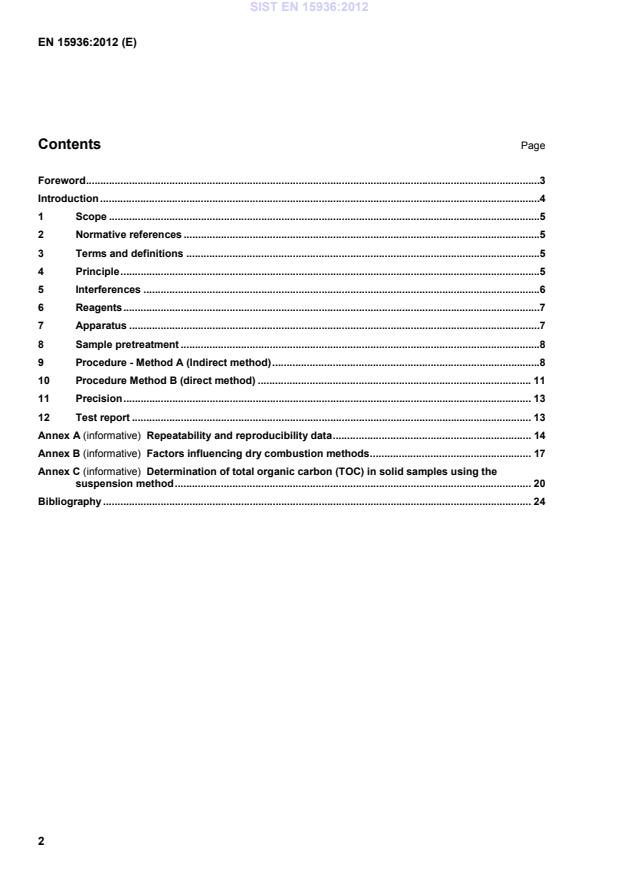
Repeatability and reproducibility data . 14Annex B (informative)
Factors influencing dry combustion methods . 17Annex C (informative)
Determination of total organic carbon (TOC) in solid samples using the suspension method . 20Bibliography . 24 SIST EN 15936:2012
According to the CEN/CENELEC Internal Regulations, the national standards organizations of the following countries are bound to implement this European Standard: Austria, Belgium, Bulgaria, Croatia, Cyprus, Czech Republic, Denmark, Estonia, Finland, Former Yugoslav Republic of Macedonia, France, Germany, Greece, Hungary, Iceland, Ireland, Italy, Latvia, Lithuania, Luxembourg, Malta, Netherlands, Norway, Poland, Portugal, Romania, Slovakia, Slovenia, Spain, Sweden, Switzerland, Turkey and the United Kingdom.
Agricultural soil Waste Filter cake, Bottom ash, Electro-plating sludge, Dredged sludge, Rubble
WARNING — Persons using this European Standard should be familiar with usual laboratory practice. This European Standard does not purport to address all of the safety problems, if any, associated with its use. It is the responsibility of the user to establish appropriate safety and health practices and to ensure compliance with any national regulatory conditions. IMPORTANT — It is absolutely essential that tests conducted according to this European Standard be carried out by suitably trained staff. SIST EN 15936:2012
3.2 total inorganic carbon TIC quantity of carbon that is liberated as carbon dioxide by acid treatment 3.3 total organic carbon TOC quantity of carbon that is converted into carbon dioxide by combustion and which is not liberated as carbon dioxide by acid treatment 4 Principle 4.1 Method A (indirect procedure) In this procedure, the TOC is obtained by the difference between the results of the measurements of TC and TIC. The total carbon (TC) present in the sample is converted to carbon dioxide by combustion in an oxygen-containing gas flow free of carbon dioxide. To ensure complete combustion, catalysts and/or modifiers can be used. The released amount of carbon dioxide is measured by infrared spectrometry, thermal conductivity detection, flame ionisation detection after reduction to methane, or by gravimetry, coulometry, conductometry after absorption. SIST EN 15936:2012
The carbon dioxide released during the analysis is measured using one of the detection methods infrared spectrometry, gravimetry, coulometry, conductometry, thermal conductivity detection, flame ionisation detection after reduction to methane, or other suitable techniques, and is expressed as carbon. 9.1.3 Determination of the TIC The sample prepared according to Clause 8 is weighed into the purging unit (7.3). The system is closed gas-tight and flushed with carrier gas until no more carbon dioxide from ambient air is present. Then acid (6.12) is added and the carbon dioxide is stripped by purging or stirring and/or heating. The released carbon dioxide is transferred to the detector by the carrier gas. SIST EN 15936:2012
Samples containing persistent carbonates (e.g. concrete, cement) require treatment with hot acid for complete release of carbon dioxide. 9.2 Calibration If a relative method is used for detection, e.g. infrared detection, calibration is necessary. Examples of calibration substances suitable for TC are calcium carbonate (6.1), potassium hydrogen phthalate (6.4), acetanilide (6.5), atropine (6.6), spectrographic graphite powder (6.7).
Sodium carbonate (6.2) and Na4-EDTA (6.3) as well as all compounds with EDTA-structure shall not be used for TC-calibration as they are used as control substances. Sodium carbonate (6.2) or calcium carbonate (6.1) are suitable for the calibration of TIC. Other calibration substances may be used provided their suitability is checked. The following procedure should be applied for calibration: Establish the preliminary working range. Measure a minimum of five standard samples. The concentration of these standard samples shall be distributed evenly over the working range. Calculate mean values for each concentration. Carry out a linear regression analysis with the mean values and test the linearity of the calibration function (see also ISO 8466-1). The function shall be linear. Otherwise the working range shall be restricted to the linear range. If an absolute method is used for detection, e.g. coulometry, only control measurements according to 9.3 shall be carried out. This calibration should be carried out for initial validation purposes or after major changes of the equipment. 9.3 Control measurements Control measurements should be carried out using control mixture A (6.10) for the procedures according to 9.1.2. (TC) and 9.1.3 (TIC). Analysis of one concentration from the middle of the respective working range, possibly repeated two or three times, is sufficient. For the TC and TIC the mean recovery shall be between 90 % and 110 % with a coefficient of variation ≤ 5 %. Blank values shall be taken into account if necessary. If the required recoveries are not achieved, the following measures may be helpful. For TC analysis: SIST EN 15936:2012
is the TOC content as carbon in the sample expressed in grams per kilogram (g/kg); w
is the water content of the sample as mass fraction expressed in percent (%). The TOC content is reported as carbon on a dry matter basis. According to Formula (3) results are obtained in grams per kilogram (g/kg), but other units may be used.
10 Procedure Method B (direct method) 10.1 Determination 10.1.1 General The mass of the test portion should be as large as possible and shall be chosen so that the liberated quantity of carbon dioxide lies within the working range of the equipment/calibration. 10.1.2 Removal of the inorganic carbon and determination of the TOC The sample prepared according to Clause 8 is weighed into a suitable vessel (7.4). The vessel may be prepared by thermal treatment (in a muffle furnace or the combustion apparatus itself) to minimize carbon blank values. In order to remove the inorganic carbon prior to the determination
...