


EN 15518-3:2023
(Main)Winter maintenance equipment - Road weather information systems - Part 3: Requirements on measured values of stationary equipment
Winter maintenance equipment - Road weather information systems - Part 3: Requirements on measured values of stationary equipment
This document specifies the terminology and performance requirements for all sensor components of stationary equipment within a Road Weather Information System (RWIS).
Winterdienstausrüstung - Straßenzustands- und Wetterinformationssysteme - Teil 3: Anforderungen an gemessene Werte der stationären Anlagen
Dieses Dokument legt die Terminologie und Leistungsanforderungen an alle Sensorkomponenten einer stationären Ausstattung innerhalb eines Straßenzustands- und Wetterinformationssystems (SWIS) fest.
Matériels de viabilité hivernale - Systèmes d'information météorologique routière - Partie 3 : Exigences relatives aux valeurs mesurées par des matériels fixes
Le présent document spécifie la terminologie et les exigences de performance de l’ensemble des composants de capteurs des matériels fixes des systèmes d’information météorologique routière (RWIS).
Oprema za zimska vzdrževalna dela - Cestni vremensko-informacijski sistemi - 3. del: Zahteve za merjene vrednosti pri stacionarni opremi
Ta dokument določa terminologijo in zahteve glede zmogljivosti za vse komponente senzorjev stacionarne opreme v cestno vremensko-informacijskem sistemu (RWIS).
General Information
- Status
- Published
- Publication Date
- 28-Nov-2023
- Technical Committee
- CEN/TC 337 - Winter maintenance and road service area maintenance equipment
- Drafting Committee
- CEN/TC 337/WG 1 - Winter maintenance equipment
- Current Stage
- 6060 - Definitive text made available (DAV) - Publishing
- Start Date
- 29-Nov-2023
- Due Date
- 08-Sep-2023
- Completion Date
- 29-Nov-2023
Relations
- Effective Date
- 19-Jan-2023
Overview - EN 15518-3:2023 (CEN)
EN 15518-3:2023 is the CEN European standard that specifies terminology and performance requirements for all sensor components of stationary Road Weather Information Systems (RWIS). Approved in November 2023 and replacing EN 15518-3:2011, this part focuses on the measured values produced by fixed (stationary) RWIS equipment used for winter maintenance decision support. It standardizes definitions for road and atmospheric parameters and sets laboratory and operational requirements for embedded and remote sensors.
Key topics and technical requirements
- Scope and terminology
- Defines road parameters (pavement surface temperature, road body temperature, water film thickness, ice, hoar frost, snow layer thickness, amount of de-icing agent, etc.) and atmospheric parameters (air temperature, relative humidity, precipitation, precipitation intensity, wind, visibility, global radiation).
- Sensor types
- Differentiates embedded (in-pavement) sensors and remote (non-contact) sensors and defines active vs passive measurement methods for freezing temperature.
- Performance and measurement requirements
- Example: pavement surface temperature (measuring range −30 °C to +60 °C; reporting range −30 °C to +70 °C; resolution 0.1 °C). Embedded sensor accuracy: ±0.2 °C (−15 to +10 °C) and ±0.8 °C outside that range; transient accuracy requirements also specified. Remote sensor accuracy is defined for isothermal laboratory conditions (±0.8 °C at 0 °C).
- Road surface condition and water film thickness thresholds are defined (e.g., “Not dry” from 0.015 mm water film thickness) and the standard introduces measurable metrics such as ice film thickness, snow layer thickness (remote sensors), and amount of de-icing agent (mass per m²).
- Environmental and mechanical requirements
- Operation temperature ranges for embedded (survive −40 °C to +70 °C) and atmospheric equipment (−40 °C to +60 °C), chemical resistance to road treatments, mechanical resistance to traffic and snow-clearing machines, and electromagnetic resistance.
- Test and reporting
- Accuracy statements apply under repeatable, reproducible laboratory conditions; CEN/TS 15518-4 provides related test methods.
Applications - who uses it and why
- Road authorities and highway agencies - procurement specifications, site siting and RWIS station configuration.
- Sensor and instrument manufacturers - design, calibration, and conformity to European RWIS performance benchmarks.
- Systems integrators and ITS providers - ensure interchangeability and consistent data feeds for winter maintenance decision support systems.
- Meteorological services and winter maintenance planners - improve de-icing timing, safety alerts, and operational efficiency by relying on standardized data quality.
Related standards
- EN 15518 series:
- Part 1: Global definitions and components
- Part 2: Road weather - Recommended observation and forecast
- Part 4 (CEN/TS 15518-4): Test methods for stationary equipment
- Normative reference: EN 15144 (terminology for winter maintenance)
Keywords: EN 15518-3:2023, RWIS, road weather information systems, stationary equipment, pavement surface temperature, embedded sensors, remote sensors, water film thickness, freezing temperature.

Frequently Asked Questions
EN 15518-3:2023 is a standard published by the European Committee for Standardization (CEN). Its full title is "Winter maintenance equipment - Road weather information systems - Part 3: Requirements on measured values of stationary equipment". This standard covers: This document specifies the terminology and performance requirements for all sensor components of stationary equipment within a Road Weather Information System (RWIS).
This document specifies the terminology and performance requirements for all sensor components of stationary equipment within a Road Weather Information System (RWIS).
EN 15518-3:2023 is classified under the following ICS (International Classification for Standards) categories: 07.060 - Geology. Meteorology. Hydrology; 13.030.40 - Installations and equipment for waste disposal and treatment; 35.240.99 - IT applications in other fields. The ICS classification helps identify the subject area and facilitates finding related standards.
EN 15518-3:2023 has the following relationships with other standards: It is inter standard links to EN 15518-3:2011. Understanding these relationships helps ensure you are using the most current and applicable version of the standard.
You can purchase EN 15518-3:2023 directly from iTeh Standards. The document is available in PDF format and is delivered instantly after payment. Add the standard to your cart and complete the secure checkout process. iTeh Standards is an authorized distributor of CEN standards.
Standards Content (Sample)
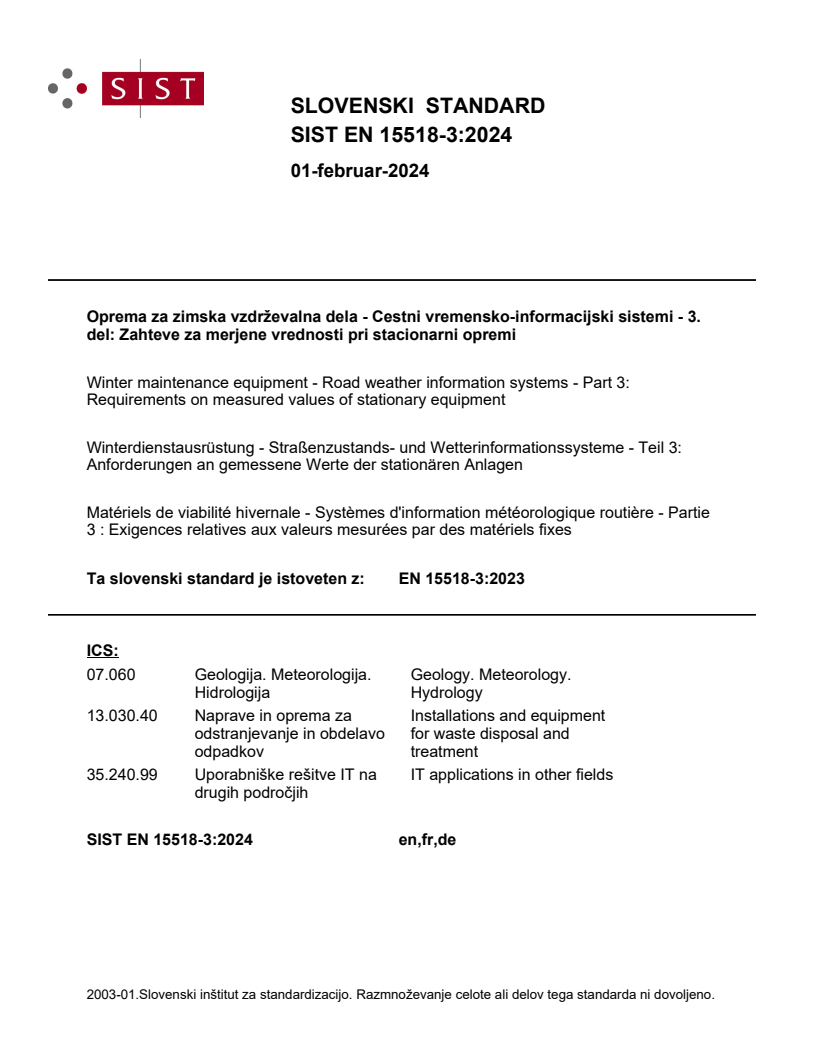
SLOVENSKI STANDARD
01-februar-2024
Oprema za zimska vzdrževalna dela - Cestni vremensko-informacijski sistemi - 3.
del: Zahteve za merjene vrednosti pri stacionarni opremi
Winter maintenance equipment - Road weather information systems - Part 3:
Requirements on measured values of stationary equipment
Winterdienstausrüstung - Straßenzustands- und Wetterinformationssysteme - Teil 3:
Anforderungen an gemessene Werte der stationären Anlagen
Matériels de viabilité hivernale - Systèmes d'information météorologique routière - Partie
3 : Exigences relatives aux valeurs mesurées par des matériels fixes
Ta slovenski standard je istoveten z: EN 15518-3:2023
ICS:
07.060 Geologija. Meteorologija. Geology. Meteorology.
Hidrologija Hydrology
13.030.40 Naprave in oprema za Installations and equipment
odstranjevanje in obdelavo for waste disposal and
odpadkov treatment
35.240.99 Uporabniške rešitve IT na IT applications in other fields
drugih področjih
2003-01.Slovenski inštitut za standardizacijo. Razmnoževanje celote ali delov tega standarda ni dovoljeno.
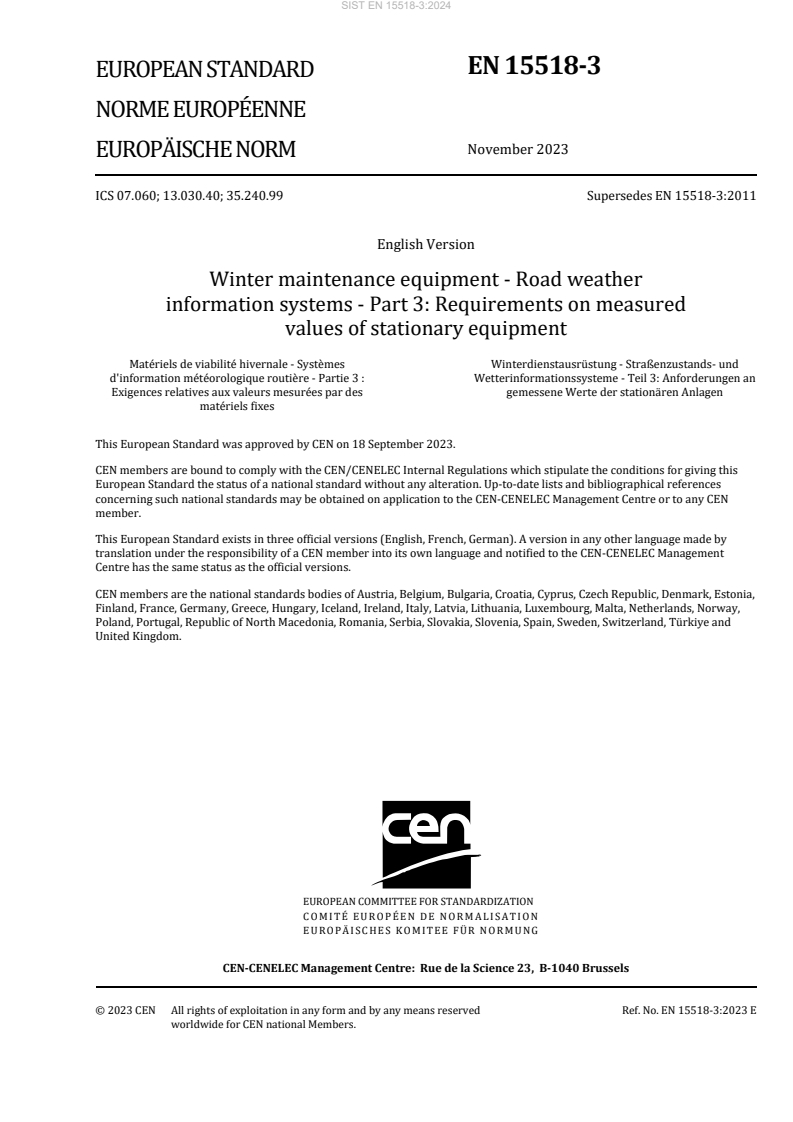
EN 15518-3
EUROPEAN STANDARD
NORME EUROPÉENNE
November 2023
EUROPÄISCHE NORM
ICS 07.060; 13.030.40; 35.240.99 Supersedes EN 15518-3:2011
English Version
Winter maintenance equipment - Road weather
information systems - Part 3: Requirements on measured
values of stationary equipment
Matériels de viabilité hivernale - Systèmes Winterdienstausrüstung - Straßenzustands- und
d'information météorologique routière - Partie 3 : Wetterinformationssysteme - Teil 3: Anforderungen an
Exigences relatives aux valeurs mesurées par des gemessene Werte der stationären Anlagen
matériels fixes
This European Standard was approved by CEN on 18 September 2023.
CEN members are bound to comply with the CEN/CENELEC Internal Regulations which stipulate the conditions for giving this
European Standard the status of a national standard without any alteration. Up-to-date lists and bibliographical references
concerning such national standards may be obtained on application to the CEN-CENELEC Management Centre or to any CEN
member.
This European Standard exists in three official versions (English, French, German). A version in any other language made by
translation under the responsibility of a CEN member into its own language and notified to the CEN-CENELEC Management
Centre has the same status as the official versions.
CEN members are the national standards bodies of Austria, Belgium, Bulgaria, Croatia, Cyprus, Czech Republic, Denmark, Estonia,
Finland, France, Germany, Greece, Hungary, Iceland, Ireland, Italy, Latvia, Lithuania, Luxembourg, Malta, Netherlands, Norway,
Poland, Portugal, Republic of North Macedonia, Romania, Serbia, Slovakia, Slovenia, Spain, Sweden, Switzerland, Türkiye and
United Kingdom.
EUROPEAN COMMITTEE FOR STANDARDIZATION
COMITÉ EUROPÉEN DE NORMALISATION
EUROPÄISCHES KOMITEE FÜR NORMUNG
CEN-CENELEC Management Centre: Rue de la Science 23, B-1040 Brussels
© 2023 CEN All rights of exploitation in any form and by any means reserved Ref. No. EN 15518-3:2023 E
worldwide for CEN national Members.
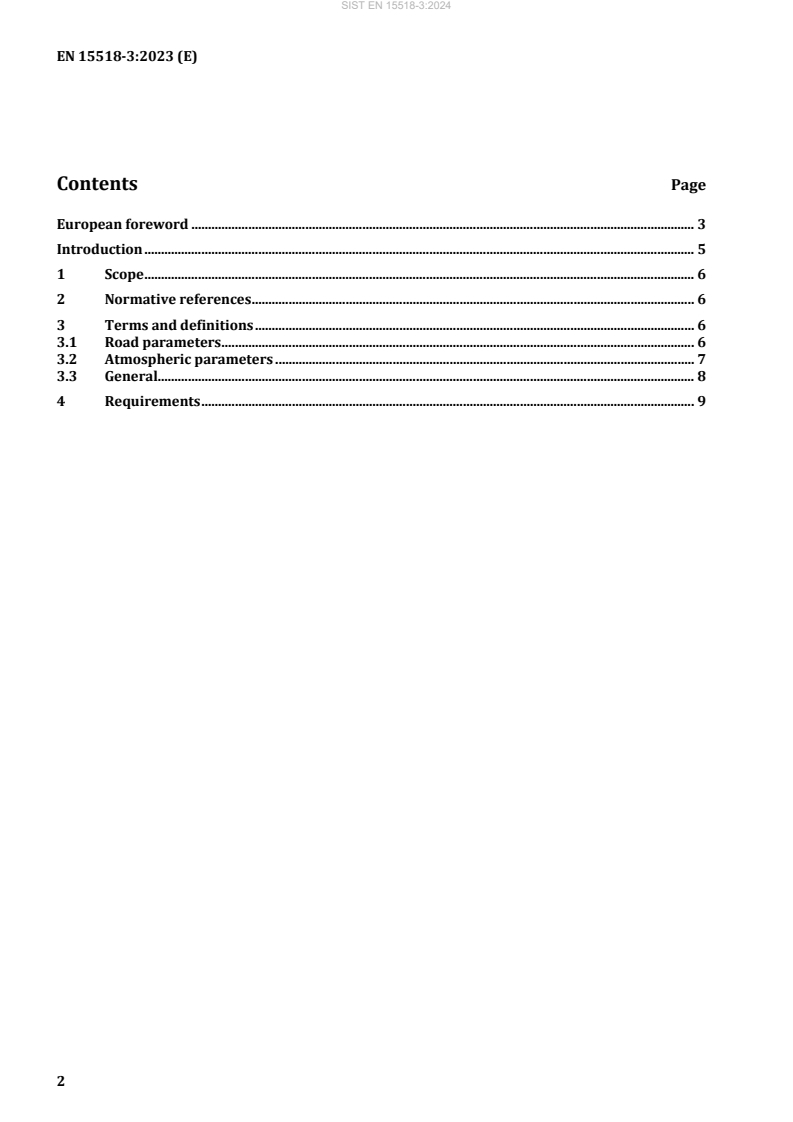
Contents Page
European foreword . 3
Introduction . 5
1 Scope . 6
2 Normative references . 6
3 Terms and definitions . 6
3.1 Road parameters . 6
3.2 Atmospheric parameters . 7
3.3 General. 8
4 Requirements . 9
European foreword
This document (EN 15518-3:2023) has been prepared by Technical Committee CEN/TC 337 “Road
operation equipment and products”, the secretariat of which is held by AFNOR.
This European Standard shall be given the status of a national standard, either by publication of an
identical text or by endorsement, at the latest by May 2024, and conflicting national standards shall be
withdrawn at the latest by May 2024.
Attention is drawn to the possibility that some of the elements of this document may be the subject of
patent rights. CEN shall not be held responsible for identifying any or all such patent rights.
This document supersedes EN 15518-3:2011.
— added definition and requirements for:
— freezing temperature;
— ice;
— hoar frost;
— ice film thickness;
— snow layer thickness;
— differentiation between embedded and remote (non-invasive) road sensors and specific
requirements for:
— road surface temperature;
— road surface condition;
— water film thickness;
— ice film thickness (only for remote sensors);
— snow layer thickness (only for remote sensors);
— adaptation of the definition and differentiation between active and passive measurement methods
in the requirements for freezing temperature;
— added requirements for:
— amount of de-icing agent;
— amount of precipitation;
— adaption of requirements for:
— road body temperature;
— air temperature;
— relative humidity;
— precipitation intensity;
— removed requirements for snow height (on and next to the road).
EN 15518, Winter maintenance equipment — Road weather information systems, is currently composed
with the following parts:
— Part 1: Global definitions and components;
— Part 2: Road weather — Recommended observation and forecast;
— Part 3: Requirements on measured values of stationary equipment;
— Part 4 (CEN/TS): Test methods for stationary equipment.
A list of all parts in a series can be found on the CEN website: https://www.cencenelec.eu/.
Any feedback and questions on this document should be directed to the users’ national standards body.
A complete listing of these bodies can be found on the CEN website.
According to the CEN-CENELEC Internal Regulations, the national standards organisations of the
following countries are bound to implement this European Standard: Austria, Belgium, Bulgaria, Croatia,
Cyprus, Czech Republic, Denmark, Estonia, Finland, France, Germany, Greece, Hungary, Iceland, Ireland,
Italy, Latvia, Lithuania, Luxembourg, Malta, Netherlands, Norway, Poland, Portugal, Republic of North
Macedonia, Romania, Serbia, Slovakia, Slovenia, Spain, Sweden, Switzerland, Türkiye and the United
Kingdom.
Introduction
Road Weather Information Systems (RWIS) are complex structures used for road maintenance decision
support, which feature as a rule the following components: meteorological sensors and instruments, road
condition sensors (embedded or remote), transmission technology, computer systems for processing,
representation and storing of information, road weather forecasts and alarms, in relation to traffic control
and traffic information systems and more.
A stationary road weather station performs the acquisition of road and meteorological information at a
fixed location.
This document lays down the requirements for the recommended sensor components of a road weather
station of a Road Weather Information System (RWIS). In the description of requirements, a distinction
is made between the sensor components forming a basis road weather station for winter use and the
recommended complementary optional sensor components.
Parameters which are not in the standard but offered on the market could be useful but are left out of this
minimum standard due to the fact that there are currently no professional methods available to verify
these parameters.
The aim is to ensure extensive combination and interchangeability within the systems.
With a set terminology for the components and the meteorological expressions an attempt is made to
counteract a diversity of terms and designations for identical phenomena.
1 Scope
This document specifies the terminology and performance requirements for all sensor components of
stationary equipment within a Road Weather Information System (RWIS).
2 Normative references
The following documents are referred to in the text in such a way that some or all of their content
constitutes requirements of this document. For dated references, only the edition cited applies. For
undated references, the latest edition of the referenced document (including any amendments) applies.
EN 15144, Winter maintenance equipment — Terminology — Terms for winter maintenance
CEN/TS 15518-4, Winter maintenance equipment — Road weather information systems — Part 4: Test
methods for stationary equipment
3 Terms and definitions
For the purposes of this document, the terms and definitions given in EN 15144 and the following apply.
ISO and IEC maintain terminology databases for use in standardization at the following addresses:
— ISO Online browsing platform: available at https://www.iso.org/obp
— IEC Electropedia: available at https://www.electropedia.org/
NOTE The following definitions have been established specifically for the RWIS domain.
3.1 Road parameters
3.1.1
pavement surface temperature
effective radiation temperature of a pavement surface and the contaminant
layer; conductive temperature on the pavement surface
3.1.2
road body temperature
temperature of the road in a specific depth in the construction layers
3.1.3
amount of de-icing agent
mass of de-icing agent on a road surface per square metre
3.1.4
freezing temperature
temperature at which a liquid begins to freeze on a road surface
Note 1 to entry: The requirement specifications for freeze temperature in this document are valid under well-
known and reproducible laboratory environment conditions. The real environment condition on a road under
traffic result in high variations due to the highly variable distribution of water film and de-icing agent concentration
over the pavement surface and a lot of other influences like traffic, solar radiation, surface slope, etc.
3.1.5
road surface condition
qualification of the status of road surface affected by road weather phenomenon
3.1.6
water film thickness
mean thickness of the film of water present on a flat surface, measured on a specific measurement area
observed by a sensor
Note 1 to entry: If a sensor provides also ice film and snow layer thickness, then this parameter means the liquid
portion. If a sensor doesn’t provide ice film and snow layer thickness, then water film thickness means all kind of
water content (water equivalent).
3.1.7
ice
water on a surface freeze from a liquid state to solid state, if surface temperature drops down below
freezing temperature (3.1.4) or if liquid precipitate falls on a surface whose temperature is below freezing
and immediately freezes into solid state
3.1.8
hoar frost
ice crystals deposit formed from contact of airborne moisture with a surface whose temperature is below
freezing
Note 1 to entry: Hoar frost differs from ice in that the frost crystals grow independently and, therefore, have a more
granular texture. Currently known surface sensor technologies are not able to detect Hoar Frost directly. The
condition can only be classified by the measuring station with the help of atmospheric sensors.
3.1.9
ice film thickness
mean thickness of the film (or layer) of ice (water equivalent of frozen water) present on a flat surface,
measured on a specific measurement area observed by a sensor
3.1.10
snow layer thickness
approximative layer of snow (water equivalent of snow) present on flat surface, measured on a specific
measurement area observed by a sensor
Note 1 to entry: Snow layer thickness gives an indication about the layer of snow, but accuracy cannot be defined
nor verified.
3.2 Atmospheric parameters
3.2.1
relative humidity
RH
measure of how much water vapor is in a water-air mixture compared to the maximum amount possible
3.2.2
precipitation
falling water
...
Die Norm EN 15518-3:2023 legt die Terminologie und Leistungsanforderungen für die Sensoren von stationären Geräten innerhalb eines Road Weather Information Systems (RWIS) fest. Durch die Fokussierung auf die gemessenen Werte von stationären Einrichtungen schafft das Dokument eine solide Grundlage für die Qualitätssicherung in der Winterdienstbranche. Ein zentrales Merkmal der Norm ist ihre umfassende Abdeckung aller relevanten Sensor Komponenten. Dies gewährleistet, dass die gemessenen Daten konsistent und zuverlässig sind, was für die effektive Implementierung von Winterwartungssystemen von entscheidender Bedeutung ist. Die Vorschriften zu den Leistungsanforderungen stellen sicher, dass die Geräte sowohl genau als auch für verschiedene Witterungsbedingungen optimiert sind. Dies verbessert nicht nur die Verkehrssicherheit, sondern erhöht auch die Effizienz der Winterdienstmaßnahmen. Die Norm ist besonders relevant im Kontext der zunehmenden Anforderungen an die Digitalisierung und Automatisierung im Verkehrssektor. Durch die Standardisierung der Messwerte trägt EN 15518-3:2023 dazu bei, dass verschiedene Systeme interoperabel werden, was sowohl für Betreiber als auch für die Nutzer von großem Vorteil ist. Diese interdisziplinäre Relevanz unterstreicht die Bedeutung von RWIS in der modernen Verkehrsinfrastruktur. Ein weiterer Stärke der Norm ist die klare Definition der Terminologie, die Missverständnisse minimiert und die Kommunikation zwischen Herstellern, Betreibern und weiteren Stakeholdern erleichtert. Die standardisierten Anforderungen fördern außerdem die Entwicklung innovativer Technologien, die sich an den festgelegten Maßstäben orientieren und so zu einer kontinuierlichen Verbesserung der Winterwartungssysteme beitragen. Insgesamt stellt die Norm EN 15518-3:2023 einen unverzichtbaren Beitrag zur Sicherstellung der Qualität und Zuverlässigkeit von Winterdienstgeräten dar, indem sie strenge Anforderungen an die Sensoren innerhalb eines Road Weather Information Systems definiert.
SIST EN 15518-3:2024は、冬季メンテナンス機器における路面気象情報システムに関する標準であり、特に常設機器のセンサーコンポーネントに対する用語や性能要件を定義しています。この文書は、路面気象情報システム(RWIS)のセンサー技術の一貫性と信頼性を高めるために重要な役割を果たします。 主な強みとしては、センサーから得られる測定値の明確な基準が設けられており、データの質を確保することで、冬季の道路管理や安全性向上に寄与する点が挙げられます。また、異なるメーカーの機器間での互換性を促進するための基準が明記されており、これにより現場での統合が容易になります。 この標準は、気象データの精度を向上させるため、包括的な言語と仕様を提供することで、過酷な冬季条件下でも適切な情報を提供できる能力を備えた機器の開発を促進します。従って、SIST EN 15518-3:2024は冬季道路管理に欠かせない基準であり、関係者が信頼性のある情報を基に行動をとるための強力なツールとなります。
The EN 15518-3:2023 standard provides comprehensive guidelines regarding winter maintenance equipment, specifically focusing on Road Weather Information Systems (RWIS). Its primary scope is to set forth the terminology and performance requirements for all sensor components of stationary equipment utilized within these systems. This specificity ensures that users can expect uniformity and reliability across various implementations of RWIS, which is crucial for effective winter maintenance operations. One of the standout strengths of this standard is its detailed articulation of the performance requirements for the sensor components. This ensures that the sensors used in the RWIS are accurate and capable of providing reliable data regarding road weather conditions. Such precision is vital for agencies responsible for road safety and maintenance, enabling them to respond appropriately to changing weather conditions. Furthermore, by establishing clear terminology, the standard aids in reducing ambiguities in communication and improves understanding among stakeholders involved in winter road maintenance. The relevance of EN 15518-3:2023 is underscored by the increasing importance of effective winter maintenance strategies, particularly in regions that experience severe weather conditions. With rising concerns over safety and efficiency in road management, the detailed framework provided by this standard significantly contributes to the optimization of road weather information systems. The implementation of harmonized sensor performance criteria will enhance the effectiveness of data collection and analysis, ultimately leading to better-informed decision-making processes regarding road treatments during winter weather scenarios. Overall, this standard is a pivotal resource for ensuring the consistency and quality of sensor components within RWIS, further establishing its critical role in supporting winter maintenance equipment operations. The clear focus on sensor measurement accuracy within the standard enhances its applicability and value for practitioners in the field.
La norme SIST EN 15518-3:2024 établit des exigences clairement définies concernant les valeurs mesurées des équipements stationnaires au sein des systèmes d'information sur les conditions routières (RWIS). Son champ d'application est particulièrement pertinent pour les organismes de maintenance hivernale, en garantissant que les capteurs intégrés dans les équipements stationnaires répondent à des critères de performance spécifiques. L'une des forces de cette norme réside dans sa terminologie précise, qui facilite la communication entre les divers acteurs du secteur. En standardisant les exigences de performance des capteurs, la norme assure non seulement une compréhension uniforme parmi les professionnels, mais également une amélioration de la fiabilité des données collectées par les systèmes RWIS. La pertinence de la norme SIST EN 15518-3:2024 se manifeste dans sa capacité à s'adapter aux besoins croissants de sécurité sur les routes durant l'hiver. En établissant des exigences claires sur les valeurs mesurées, cette norme contribue à une meilleure gestion de la circulation et à une réduction des accidents causés par des conditions météorologiques défavorables. De plus, la standardisation des équipements permet une harmonisation des pratiques en matière de maintenance hivernale à travers les différents territoires. En somme, la norme SIST EN 15518-3:2024 est essentielle pour garantir la qualité et la fiabilité des informations fournies par les systèmes d'information sur les conditions routières, ce qui en fait un outil indispensable pour les pouvoirs publics et les gestionnaires de trafic.
EN 15518-3:2023 표준은 도로 기상 정보 시스템(RWIS)의 고정 장비 센서 구성 요소에 대한 용어와 성능 요구 사항을 규정합니다. 이 문서는 도로의 겨울 유지 관리 장비의 효과적인 운영에 필수적인 정보를 제공하여, 겨울철 도로 안전성을 극대화하는 데 중점을 두고 있습니다. 이 표준의 강점은 특정 센서 요소에 대한 명확한 요구 사항을 제시함으로써, 다양한 기상 조건에서도 일관성 있게 데이터를 수집하고 처리할 수 있도록 지원한다는 점입니다. 또한, 성능 기준을 정의함으로써, 사용자는 도로 기상 정보 시스템의 신뢰성과 유효성을 보장받을 수 있습니다. EN 15518-3:2023의 범위는 센서의 신뢰성, 내구성 및 정확성에 대한 요구 사항을 포함하고 있어, 전체 시스템의 성능을 극대화합니다. 이는 도로 유지 관리에 참여하는 기관이나 기업에게 매우 중요한 기준이 되며, 겨울철 도로 관리의 전략적 계획 수립에 기여합니다. 따라서, EN 15518-3:2023 표준은 고정 장비의 센서 기술 및 성능 면에서 중대한 향상을 가져오며, 겨울철 도로 기상 관리에서의 중요성을 강조하는 유용한 자료로 자리잡고 있습니다.
Questions, Comments and Discussion
Ask us and Technical Secretary will try to provide an answer. You can facilitate discussion about the standard in here.
Loading comments...