

EN 1052-2:2016
(Main)Methods of test for masonry - Part 2: Determination of flexural strength
- Abstract
This European standard specifies a method for determining the flexural strength of small masonry specimens for the two principal axes of loading. Guidance is given on the preparation of the specimens, the conditioning required before testing, the testing machine, the method of test, the method of calculation and the contents of the test report.
- Status
- Published
- Publication Date
- 01-Mar-2016
- Technical Committee
- CEN/TC 125 - Masonry
- Drafting Committee
- CEN/TC 125/WG 4 - Test methods
- Current Stage
- 9093 - Decision to confirm - Review Enquiry
- Start Date
- 03-Sep-2021
- Completion Date
- 07-Oct-2026

Overview
EN 1052-2:2016 is a European standard published by CEN that defines the methods for determining the flexural strength of masonry. It applies specifically to small masonry specimens tested along the two principal axes of loading. This standard provides detailed guidance on specimen preparation, conditioning, testing procedures, calculation methods, and reporting requirements, ensuring consistent and reliable assessment of masonry flexural strength across industry laboratories.
Key objectives of this standard include establishing precise test conditions, ensuring reproducibility, and facilitating comparison of masonry performance. Flexural strength determination helps assess the ability of masonry to resist bending forces, a critical property for structural safety and durability.
Key Topics
Scope and Purpose
- Testing flexural strength of masonry using small specimens.
- Focus on two principal axes of loading for comprehensive evaluation.
Specimen Preparation and Conditioning
- Masonry units are conditioned according to specified moisture and curing parameters.
- Mortar mixing procedures and consistence tests ensure representative bonding conditions.
- Specimens built within strict timelines and cured under controlled environments for 28 days (or as alternative for lime-based mortar).
Testing Apparatus and Setup
- Use of a calibrated testing machine with defined error limits and load application rates.
- Four-point bending setup with precise bearing placements.
- Specimens tested vertically or horizontally with detailed guidance on positioning and support to avoid friction or handling damage.
Testing Procedure
- Load application rate between 0.03 and 0.3 N/mm² per minute until failure.
- Record maximum load, crack location, time to failure, and specimen dimensions.
- Repeat tests until at least five valid results per loading direction are obtained.
Calculations and Evaluation
- Flexural strength calculated using formulas accounting for specimen size and loading configuration.
- Mean and characteristic flexural strengths derived statistically, including consideration of standard deviations and sample size.
Reporting Requirements
- Comprehensive test report content including laboratory details, specimen description, curing, mortar and masonry properties, loading data, and test results.
Applications
EN 1052-2:2016 is instrumental in:
Structural Design and Safety Assessment
Engineers and designers use flexural strength data to evaluate masonry performance under bending stresses, guiding the design of safer masonry structures.Quality Control in Construction
Manufacturers and contractors apply these testing methods to verify compliance of masonry products with performance standards before and during construction.Material Development and Research
Researchers use the test protocols to compare new masonry materials and mortars, optimizing mixtures for enhanced flexural strength and durability.Regulatory Compliance
Ensures uniform assessment methods across European countries, facilitating trade and certification of masonry units and mortars.Failure Analysis and Diagnostics
Identifying weak points in masonry design or construction methods by examining flexural strength failure characteristics.
Related Standards
Compliance with EN 1052-2:2016 is typically supported by adherence to complementary European standards covering related properties of masonry units and mortar, including:
- EN 772-1 - Determination of compressive strength of masonry units
- EN 772-10 - Determination of moisture content in certain masonry units
- EN 998-2 - Specification for mortar for masonry
- EN 1015-3 - Determination of mortar consistence by flow table
- EN 1015-7 - Determination of air content of fresh mortar
- EN 1015-11 - Determination of flexural and compressive strength of hardened mortar
Integrating data from these standards provides a comprehensive evaluation of masonry materials, enhancing the accuracy and reliability of structural assessments.
Keywords: EN 1052-2:2016, masonry flexural strength, masonry test methods, masonry specimen preparation, four-point bending test, masonry mortar testing, masonry structural standards, European masonry testing, CEN masonry standards
Relations
- Effective Date
- 09-Mar-2016
- Effective Date
- 28-Jan-2026
- Effective Date
- 28-Jan-2026
- Effective Date
- 28-Jan-2026
- Effective Date
- 28-Jan-2026
- Effective Date
- 28-Jan-2026
- Effective Date
- 28-Jan-2026
- Referred By
EN 771-5:2011 - Specification for masonry units - Part 5: Manufactured stone masonry units - Effective Date
- 28-Jan-2026
- Effective Date
- 28-Jan-2026
- Effective Date
- 28-Jan-2026
- Referred By
EN 771-6:2011+A1:2015 - Specification for masonry units - Part 6: Natural stone masonry units - Effective Date
- 28-Jan-2026
- Effective Date
- 28-Jan-2026
- Effective Date
- 28-Jan-2026
- Effective Date
- 28-Jan-2026
- Referred By
EN 771-5:2011+A1:2015 - Specification for masonry units - Part 5: Manufactured stone masonry units - Effective Date
- 28-Jan-2026
Get Certified
Connect with accredited certification bodies for this standard

DIBt (Deutsches Institut für Bautechnik)
German Institute for Building Technology.
DIN CERTCO
DIN Group product certification.

Aboma Certification B.V.
Specialized in construction, metal, and transport sectors.
Sponsored listings
Frequently Asked Questions
EN 1052-2:2016 is a standard published by the European Committee for Standardization (CEN). Its full title is "Methods of test for masonry - Part 2: Determination of flexural strength". This standard covers: This European standard specifies a method for determining the flexural strength of small masonry specimens for the two principal axes of loading. Guidance is given on the preparation of the specimens, the conditioning required before testing, the testing machine, the method of test, the method of calculation and the contents of the test report.
This European standard specifies a method for determining the flexural strength of small masonry specimens for the two principal axes of loading. Guidance is given on the preparation of the specimens, the conditioning required before testing, the testing machine, the method of test, the method of calculation and the contents of the test report.
EN 1052-2:2016 is classified under the following ICS (International Classification for Standards) categories: 91.080.30 - Masonry. The ICS classification helps identify the subject area and facilitates finding related standards.
EN 1052-2:2016 has the following relationships with other standards: It is inter standard links to EN 1052-2:1999, EN 1015-3:1999, EN 998-2:2016, EN 1015-11:2019, EN 772-10:1999, EN 772-1:2011+A1:2015, EN 1015-7:1998, EN 771-5:2011, EN 13084-4:2005, EN 771-3:2011+A1:2015, EN 771-6:2011+A1:2015, EN 771-4:2011+A1:2015, EN 771-6:2011, EN 771-3:2011, EN 771-5:2011+A1:2015. Understanding these relationships helps ensure you are using the most current and applicable version of the standard.
EN 1052-2:2016 is associated with the following European legislation: EU Directives/Regulations: 305/2011; Standardization Mandates: M/116. When a standard is cited in the Official Journal of the European Union, products manufactured in conformity with it benefit from a presumption of conformity with the essential requirements of the corresponding EU directive or regulation.
EN 1052-2:2016 is available in PDF format for immediate download after purchase. The document can be added to your cart and obtained through the secure checkout process. Digital delivery ensures instant access to the complete standard document.
Standards Content (Sample)
2003-01.Slovenski inštitut za standardizacijo. Razmnoževanje celote ali delov tega standarda ni dovoljeno.Metode preskušanja za zidovje - 2. del: Ugotavljanje upogibne trdnostiPrüfverfahren für Mauerwerk - Teil 2: Bestimmung der BiegezugfestigkeitMéthodes d'essai de la maçonnerie - Partie 2: Détermination de la résistance à la flexionMethods of test for masonry - Part 2: Determination of flexural strength91.080.30Zidane konstrukcijeMasonryICS:Ta slovenski standard je istoveten z:EN 1052-2:2016SIST EN 1052-2:2016en,fr,de01-junij-2016SIST EN 1052-2:2016SLOVENSKI
STANDARDSIST EN 1052-2:20001DGRPHãþD
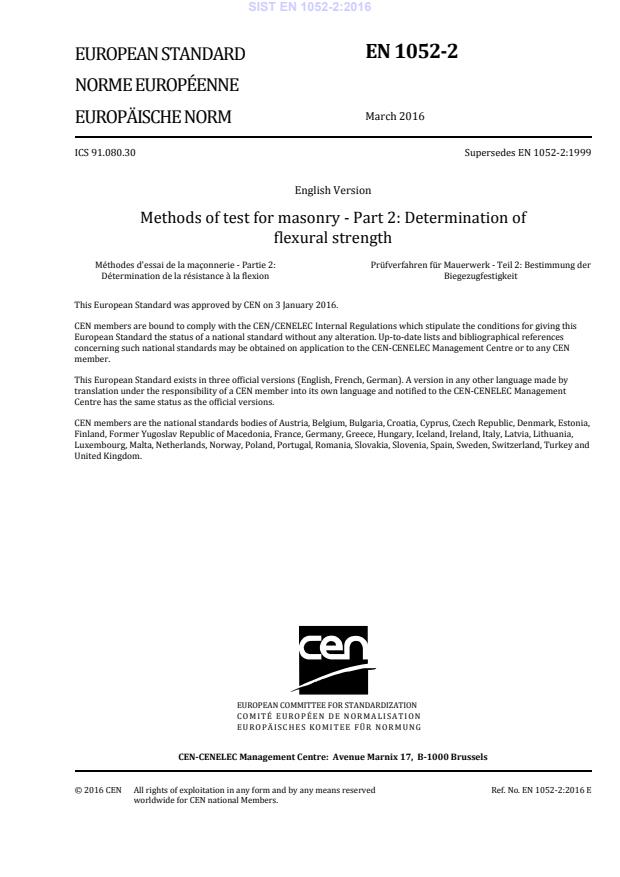
EUROPEAN STANDARD NORME EUROPÉENNE EUROPÄISCHE NORM
EN 1052-2
March
t r s x ICS
{ sä r z rä u r Supersedes EN
s r w tæ tã s { { {English Version
Methods of test for masonry æ Part
tã Determination of flexural strength Méthodes d 5essai de la maçonnerie æ Partie
tã Détermination de la résistance à la flexion
Prüfverfahren für Mauerwerk æ Teil
tã Bestimmung der Biegezugfestigkeit This European Standard was approved by CEN on
u January
t r s xä
egulations which stipulate the conditions for giving this European Standard the status of a national standard without any alterationä Upætoædate lists and bibliographical references concerning such national standards may be obtained on application to the CENæCENELEC Management Centre or to any CEN memberä
translation under the responsibility of a CEN member into its own language and notified to the CENæCENELEC Management Centre has the same status as the official versionsä
CEN members are the national standards bodies of Austriaá Belgiumá Bulgariaá Croatiaá Cyprusá Czech Republicá Denmarká Estoniaá Finlandá Former Yugoslav Republic of Macedoniaá Franceá Germanyá Greeceá Hungaryá Icelandá Irelandá Italyá Latviaá Lithuaniaá Luxembourgá Maltaá Netherlandsá Norwayá Polandá Portugalá Romaniaá Slovakiaá Sloveniaá Spainá Swedená Switzerlandá Turkey and United Kingdomä
EUROPEAN COMMITTEE FOR STANDARDIZATION COMITÉ EUROPÉEN DE NORMALISATION EUROPÄISCHES KOMITEE FÜR NORMUNG
CEN-CENELEC Management Centre:
Avenue Marnix 17,
B-1000 Brussels
t r s x CEN All rights of exploitation in any form and by any means reserved worldwide for CEN national Membersä Refä Noä EN
s r w tæ tã t r s x ESIST EN 1052-2:2016
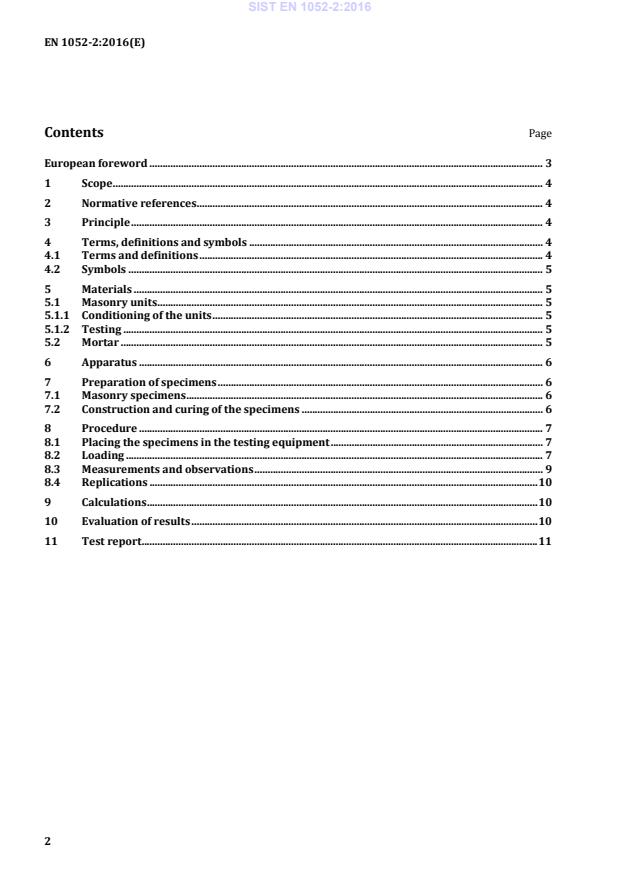
Page European foreword . 3 1 Scope . 4 2 Normative references . 4 3 Principle . 4 4 Terms, definitions and symbols . 4 4.1 Terms and definitions . 4 4.2 Symbols . 5 5 Materials . 5 5.1 Masonry units . 5 5.1.1 Conditioning of the units . 5 5.1.2 Testing . 5 5.2 Mortar . 5 6 Apparatus . 6 7 Preparation of specimens . 6 7.1 Masonry specimens . 6 7.2 Construction and curing of the specimens . 6 8 Procedure . 7 8.1 Placing the specimens in the testing equipment . 7 8.2 Loading . 7 8.3 Measurements and observations . 9 8.4 Replications . 10 9 Calculations . 10 10 Evaluation of results . 10 11 Test report . 11
...