

EN 17522:2023
(Main)Design and construction of backfilled and grouted borehole heat exchangers
- Abstract
This document covers standardization in the field of geological and environmental aspects, design, construction, operation, monitoring, maintenance and decommissioning of grouted borehole heat exchangers for uses in geothermal energy systems.
This document is only applicable for backfilled and grouted boreholes, it is not applicable for groundwater-filled boreholes.
Direct expansion and thermal syphon techniques are excluded from this document.
- Status
- Published
- Publication Date
- 04-Apr-2023
- Technical Committee
- CEN/TC 451 - Geothermal and water boreholes
- Drafting Committee
- CEN/TC 451/WG 2 - Borehole heat exchangers
- Current Stage
- 6060 - Definitive text made available (DAV) - Publishing
- Start Date
- 05-Apr-2023
- Due Date
- 21-Mar-2022
- Completion Date
- 05-Apr-2023


Overview
EN 17522:2023 is the European standard for the design and construction of backfilled and grouted borehole heat exchangers (BHEs) used in geothermal energy systems. It sets out requirements for geological and environmental assessment, system description, materials, design, construction, commissioning, operation, monitoring, maintenance and decommissioning. The standard applies only to backfilled and grouted boreholes (not groundwater‑filled boreholes) and excludes direct expansion and thermal syphon techniques.
Key topics and technical requirements
- Geological and environmental aspects
- Site investigation, hydrogeological risks (artesian and stacked aquifers), gas occurrence, karst, frost susceptibility and groundwater protection.
- Assessment of anthropogenic constraints and construction‑related environmental impacts.
- System description
- Components and layouts for vertical BHEs, horizontal piping and manifolds; interfaces with the thermal plant.
- Materials and components
- Requirements for polymeric and metallic materials, connection methods, heat transfer fluids and backfilling/grouting materials.
- Component selection criteria for loops, horizontal pipes, manifolds and fluids.
- Design and sizing
- Stepwise design methodology including ground thermal properties, Thermal Response Test (TRT) use, modelling/simulation and hydraulic design.
- Construction and installation
- Site preparation, drilling methods and monitoring, drilling fluids, loop installation, backfilling/grouting procedures and quality checks (leakage, flow, geophysical measurements).
- Commissioning, operation and monitoring
- Filling and start‑up procedures, commissioning checklists, ongoing monitoring (temperature, pressure, flow rate) and maintenance.
- Renovation and decommissioning
- Procedures for safe removal or permanent closure, handling of heat transfer fluids, and documentation requirements.
Practical applications and users
EN 17522:2023 is intended for professionals involved in geothermal ground‑source heat pump projects and district geothermal systems, including:
- Geothermal and civil engineers
- Drilling and installation contractors
- HVAC / building services designers and consultants
- Environmental and permitting authorities
- Facility managers, operators and maintenance teams
- Project owners and developers planning BHE fields
The standard helps ensure safe, durable and environmentally protective BHE installations, consistent sizing and reliable operation across residential, commercial and district heating/cooling applications.
Related standards
For integrated compliance, use SIST EN 17522 alongside other CEN/EN standards covering geothermal systems, drilling practices, materials and heat transfer fluids, local groundwater protection regulations and national drilling codes.
Relations
- Effective Date
- 28-Jan-2026
- Effective Date
- 28-Jan-2026
- Effective Date
- 28-Jan-2026
- Effective Date
- 28-Jan-2026
- Effective Date
- 28-Jan-2026
- Effective Date
- 28-Jan-2026
- Effective Date
- 28-Jan-2026
- Effective Date
- 28-Jan-2026
- Effective Date
- 28-Jan-2026
- Effective Date
- 28-Jan-2026
- Effective Date
- 28-Jan-2026
- Effective Date
- 28-Jan-2026
- Effective Date
- 28-Jan-2026
- Effective Date
- 28-Jan-2026
- Effective Date
- 28-Jan-2026
Get Certified
Connect with accredited certification bodies for this standard

DNV
DNV is an independent assurance and risk management provider.

Lloyd's Register
Lloyd's Register is a global professional services organisation specialising in engineering and technology.

DIBt (Deutsches Institut für Bautechnik)
German Institute for Building Technology.
Sponsored listings
Frequently Asked Questions
EN 17522:2023 is a standard published by the European Committee for Standardization (CEN). Its full title is "Design and construction of backfilled and grouted borehole heat exchangers". This standard covers: This document covers standardization in the field of geological and environmental aspects, design, construction, operation, monitoring, maintenance and decommissioning of grouted borehole heat exchangers for uses in geothermal energy systems. This document is only applicable for backfilled and grouted boreholes, it is not applicable for groundwater-filled boreholes. Direct expansion and thermal syphon techniques are excluded from this document.
This document covers standardization in the field of geological and environmental aspects, design, construction, operation, monitoring, maintenance and decommissioning of grouted borehole heat exchangers for uses in geothermal energy systems. This document is only applicable for backfilled and grouted boreholes, it is not applicable for groundwater-filled boreholes. Direct expansion and thermal syphon techniques are excluded from this document.
EN 17522:2023 is classified under the following ICS (International Classification for Standards) categories: 07.060 - Geology. Meteorology. Hydrology; 27.190 - Biological sources and alternative sources of energy; 91.140.10 - Central heating systems. The ICS classification helps identify the subject area and facilitates finding related standards.
EN 17522:2023 has the following relationships with other standards: It is inter standard links to EN 1254-3:2021+A1:2025, EN 1254-7:2021, EN 1254-8:2021+A1:2025, EN 1057:2006+A1:2010, EN 12201-1:2011, EN 12201-5:2024, EN ISO 15494:2018, EN 12449:2023, EN 10216-5:2021, EN 12168:2024, EN ISO 15875-1:2025, EN 12201-3:2024, EN 12201-2:2024, EN ISO 22391-1:2009, EN 1254-2:2021. Understanding these relationships helps ensure you are using the most current and applicable version of the standard.
EN 17522:2023 is available in PDF format for immediate download after purchase. The document can be added to your cart and obtained through the secure checkout process. Digital delivery ensures instant access to the complete standard document.
Standards Content (Sample)
SLOVENSKI STANDARD
01-junij-2023
Zasnova in zgradba zasutih in z malto zalitih vrtinskih toplotnih izmenjevalnikov
Design and construction of backfilled and grouted borehole heat exchangers
Planung und Bau von Erdwärmesonden
Conception et construction de sondes géothermiques verticales comblées et remplies de
coulis
Ta slovenski standard je istoveten z: EN 17522:2023
ICS:
07.060 Geologija. Meteorologija. Geology. Meteorology.
Hidrologija Hydrology
2003-01.Slovenski inštitut za standardizacijo. Razmnoževanje celote ali delov tega standarda ni dovoljeno.
EN 17522
EUROPEAN STANDARD
NORME EUROPÉENNE
April 2023
EUROPÄISCHE NORM
ICS 07.060; 27.190; 91.140.10
English Version
Design and construction of backfilled and grouted
borehole heat exchangers
Conception et construction de sondes géothermiques Planung und Bau von Erdwärmesonden
verticales comblées et remplies de coulis
This European Standard was approved by CEN on 23 January 2023.
CEN members are bound to comply with the CEN/CENELEC Internal Regulations which stipulate the conditions for giving this
European Standard the status of a national standard without any alteration. Up-to-date lists and bibliographical references
concerning such national standards may be obtained on application to the CEN-CENELEC Management Centre or to any CEN
member.
This European Standard exists in three official versions (English, French, German). A version in any other language made by
translation under the responsibility of a CEN member into its own language and notified to the CEN-CENELEC Management
Centre has the same status as the official versions.
CEN members are the national standards bodies of Austria, Belgium, Bulgaria, Croatia, Cyprus, Czech Republic, Denmark, Estonia,
Finland, France, Germany, Greece, Hungary, Iceland, Ireland, Italy, Latvia, Lithuania, Luxembourg, Malta, Netherlands, Norway,
Poland, Portugal, Republic of North Macedonia, Romania, Serbia, Slovakia, Slovenia, Spain, Sweden, Switzerland, Türkiye and
United Kingdom.
EUROPEAN COMMITTEE FOR STANDARDIZATION
COMITÉ EUROPÉEN DE NORMALISATION
EUROPÄISCHES KOMITEE FÜR NORMUNG
CEN-CENELEC Management Centre: Rue de la Science 23, B-1040 Brussels
© 2023 CEN All rights of exploitation in any form and by any means reserved Ref. No. EN 17522:2023 E
worldwide for CEN national Members.
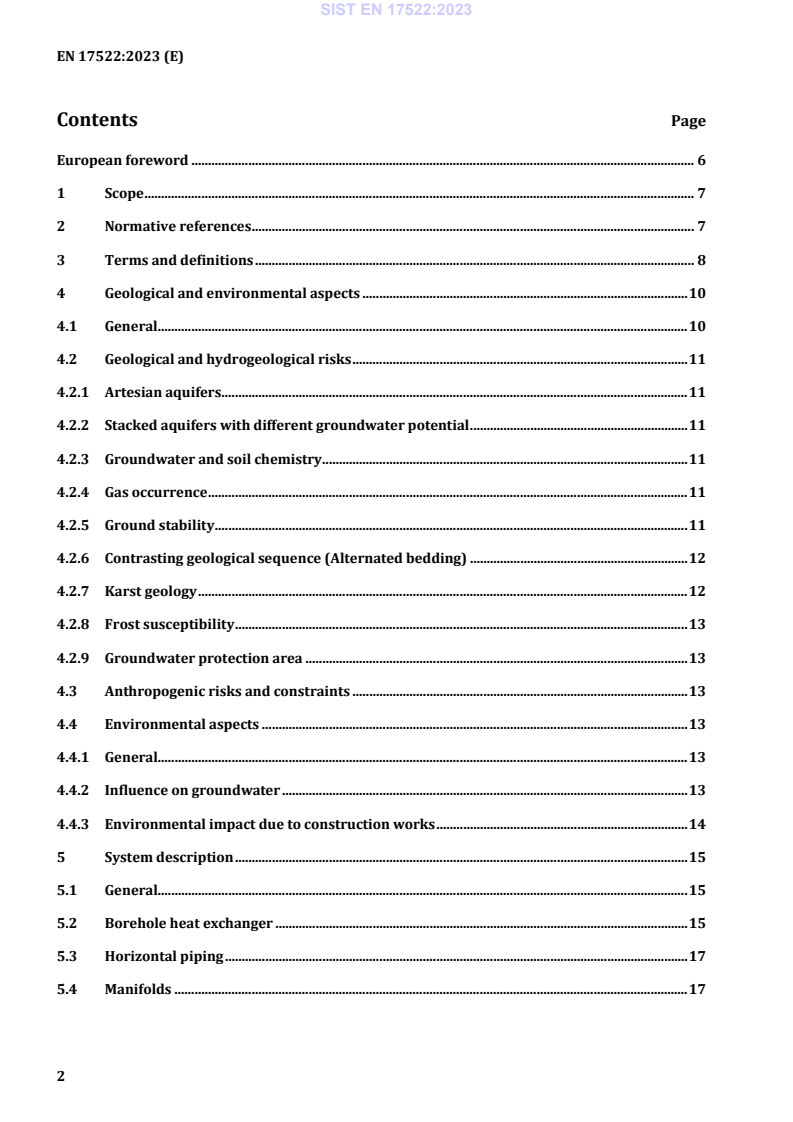
Contents Page
European foreword . 6
1 Scope . 7
2 Normative references . 7
3 Terms and definitions . 8
4 Geological and environmental aspects . 10
4.1 General. 10
4.2 Geological and hydrogeological risks . 11
4.2.1 Artesian aquifers . 11
4.2.2 Stacked aquifers with different groundwater potential . 11
4.2.3 Groundwater and soil chemistry . 11
4.2.4 Gas occurrence . 11
4.2.5 Ground stability . 11
4.2.6 Contrasting geological sequence (Alternated bedding) . 12
4.2.7 Karst geology . 12
4.2.8 Frost susceptibility . 13
4.2.9 Groundwater protection area . 13
4.3 Anthropogenic risks and constraints . 13
4.4 Environmental aspects . 13
4.4.1 General. 13
4.4.2 Influence on groundwater . 13
4.4.3 Environmental impact due to construction works . 14
5 System description . 15
5.1 General. 15
5.2 Borehole heat exchanger . 15
5.3 Horizontal piping . 17
5.4 Manifolds . 17
5.5 Thermal plant . 18
6 Materials . 18
6.1 General properties . 18
6.2 Materials . 18
6.2.1 Polymeric materials . 18
6.2.2 Connection methods . 20
6.2.3 Metallic materials . 21
6.3 Heat transfer fluid . 21
6.4 Backfilling materials . 22
6.4.1 General . 22
6.4.2 Grouting material . 22
6.4.3 Other backfilling materials requirements . 23
6.5 Component selection criteria . 23
6.5.1 General . 23
6.5.2 BHE loops . 23
6.5.3 Horizontal pipes . 24
6.5.4 Manifolds . 24
6.5.5 Heat transfer fluid . 24
7 Design . 24
7.1 Steps of design . 24
7.2 Sizing . 25
7.2.1 General . 25
7.2.2 General methodology . 26
7.2.3 Thermal properties of the ground . 29
7.2.4 Thermal Response Test (TRT) . 30
7.2.5 Calculation and modelling procedure . 37
7.2.6 Simulation . 38
7.2.7 Hydraulic design . 39
8 Construction . 40
8.1 General. 40
8.2 Site preparation and planning . 40
8.3 Drilling . 41
8.3.1 General. 41
8.3.2 Drilling diameter . 41
8.3.3 Drilling fluid . 41
8.3.4 Monitoring and documentation of the drilling process . 41
8.4 Borehole heat exchanger loop . 42
8.5 Borehole heat exchanger loop installation . 42
8.6 Backfilling and grouting procedure . 43
8.6.1 General. 43
8.6.2 Grouting procedure . 43
8.6.3 Other backfilling procedure. 44
8.7 Horizontal piping . 44
8.8 Testing and checking of BHE – Leakage, flow, grouting, geophysical measurements . 45
8.9 Manifolds . 45
9 Start-up . 46
9.1 General. 46
9.2 Heat transfer fluid . 46
9.3 Filling of the system . 46
9.4 Drying of new buildings . 46
9.5 Commissioning . 46
9.6 Documentation . 47
10 Operation, monitoring and maintenance . 47
10.1 Operation . 47
10.2 Monitoring . 47
10.2.1 General. 47
10.2.2 Temperature . 48
10.2.3 Pressure . 48
10.2.4 Flow rate . 48
10.3 Maintenance . 48
11 Renovation . 49
12 Decommissioning . 49
12.1 General . 49
12.2 Heat transfer fluid . 49
12.3 Borehole heat exchangers . 49
12.3.1 Backfilled boreholes . 49
12.4 Horizontal pipes . 50
12.5 Documentation . 50
Annex A (informative) Insulation of horizontal piping . 51
Annex B (informative) Example simulation time . 52
B.1 General . 52
B.2 Single house, unbalanced energy design. 52
B.3 Field of 30 houses with an unbalanced design . 53
B.4 Field with 400 houses with an unbalanced design . 54
B.5 Conclusion . 54
Annex C (informative) Commissioning checklist . 55
Annex D (informative) Examples of thermal conductivity and volumetric - heat capacity of the
underground . 57
Annex E (informative) Main drilling methods . 59
Bibliography . 61
European foreword
This document (EN 17522:2023) has been prepared by Technical Committee CEN/TC 451 “Water wells
and borehole heat exchangers”, the secretariat of which is held by AFNOR.
This European Standard shall be given the status of a national standard, either by publication of an
identical text or by endorsement, at the latest by October 2023, and conflicting national standards shall
be withdrawn at the latest by October 2023.
Attention is drawn to the possibility that some of the elements of this document may be the subject of
patent rights. CEN shall not be held responsible for identifying any or all such patent rights.
Any feedback and questions on this document should be directed to the users’ national standards body.
A complete listing of these bodies can be found on the CEN website.
According to the CEN-CENELEC Internal Regulations, the national standards organisations of the
following countries are bound to implement this European Standard: Austria, Belgium, Bulgaria, Croatia,
Cyprus, Czech Republic, Denmark, Estonia, Finland, France, Germany, Greece, Hungary, Iceland, Ireland,
Italy, Latvia, Lithuania, Luxembourg, Malta, Netherlands, Norway, Poland, Portugal, Republic of North
Macedonia, Romania, Serbia, Slovakia, Slovenia, Spain, Sweden, Switzerland, Türkiye and the United
Kingdom.
1 Scope
This document covers standardization in the field of geological and environmental aspects, design,
construction, operation, monitoring, maintenance and decommissioning of grouted borehole heat
exchangers for uses in geothermal energy systems.
This document is only applicable for backfilled and grouted boreholes, it is not applicable for
groundwater-filled boreholes.
Direct expansion and thermal syphon techniques are excluded from this document.
2 Normative references
The following documents are referred to in the text in such a way that some or all of their content
constitutes requirements of this document. For dated references, only the edition cited applies. For
undated references, the latest edition of the referenced document (including any amendments) applies.
EN 1057, Copper and copper alloys — Seamless, round copper tubes for water and gas in sanitary and
heating applications
EN 1254-2, Copper and copper alloys —Plumbing fittings — Part 2: Compression fittings for use with copper
tubes
EN 1254-3, Copper and copper alloys — Plumbing fittings — Part 3: Compression fittings for use with
plastics and multilayer pipes
EN 1254-7, Copper and copper alloys — Plumbing fittings — Part 7: Press fittings for use with metallic tubes
EN 1254-8, Copper and copper alloys — Plumbing fittings — Part 8: Press fittings for use with plastics and
multilayer pipes
EN 1965-2, Structural adhesives — Corrosion — Part 2: Determination and classification of corrosion to a
brass substrate
EN 10216-5, Seamless steel tubes for pressure purposes — Technical delivery conditions — Part 5: Stainless
steel tubes
EN 12201-1:2011, Plastics piping systems for water supply, and for drainage and sewerage under pressure
— Polyethylene (PE) — Part 1: General
EN 12201-2, Plastics piping systems for water supply, and for drainage and sewerage under pressure —
Polyethylene (PE) — Part 2: Pipes
EN 12201-3, Plastics piping systems for water supply, and for drainage and sewerage under pressure —
Polyethylene (PE) — Part 3: Fittings
EN 12201-5, Plastics piping systems for water supply, and for drainage and sewerage under pressure —
Polyethylene (PE) — Part 5: Fitness for purpose of the system
EN 12449, Copper and copper alloys — Seamless, round tubes for general purposes
EN ISO 15875-1, Plastics piping systems for hot and cold water installations — Crosslinked polyethylene
(PE-X) — Part 1: General (ISO 15875-1)
EN ISO 15494, Plastics piping systems for industrial applications — Polybutene (PB), polyethylene (PE),
polyethylene of raised temperature resistance (PE-RT), crosslinked polyethylene (PE-X), polypropylene (PP)
— Metric series for specifications for components and the system (ISO 15494)
EN ISO 22391-1, Plastics piping systems for hot and cold water installations — Polyethylene of raised
temperature resistance (PE-RT) — Part 1: General (ISO 22391-1)
EN 12168, Copper and copper alloys — Hollow rod for free machining purposes
EN ISO 1127, Stainless steel tubes — Dimensions, tolerances and conventional masses per unit length (ISO
1127)
3 Terms and definitions
For the purposes of this document, the following terms and definitions apply.
ISO and IEC maintain terminological databases for use in standardization at the following addresses:
— IEC Electropedia: available at https://www.electropedia.org/
— ISO Online browsing platform: available at https://www.iso.org/obp
3.1
aquifer
water-bearing geological layer comprising permeable rock, fractures or unconsolidated materials
(gravel, sand, or silt)
Note 1 to entry: an aquifer can be fully or partly saturated.
Note 2 to entry: its upper limit is called the “top of the aquifer” and its base is called the “bottom of the aquifer”
3.2
aquitard
body of rock or stratum of sediment that restricts but does not prevent the flow of groundwater from one
aquifer to another
3.3
backfill
material used for refilling any borehole or trench, except groundwater
3.4
borehole heat exchanger
BHE
consists of vertical or inclined boreholes with a loop, to circulate a heat transfer fluid and a borehole
backfill
3.5
borehole heat exchanger field
BHE field
area with several BHEs that are connected in the same hydraulic circulation system
3.6
borehole heat exchanger loop
BHE loop
pipe system in the borehole, which contains the fluid for heat transfer
3.7
borehole heat exchanger system
BHE system
the BHE system consists in four subsystems (Figure 1):
1) borehole heat exchanger;
2) horizontal piping;
3) manifold;
4) thermal plant (technical room) with all installation except heat pump
Note 1 to entry: the borehole heat exchanger system is considered as a unit including the entire borehole heat
exchanger field
3.8
effective borehole thermal resistance
effective thermal resistance between the mean temperature at the wall of the borehole and the mean fluid
temperature for thermally quasi-steady-state conditions in the borehole
Note 1 to entry: “borehole thermal resistance” always refers to the effective borehole thermal resistance
3.9
effective thermal conductivity
thermal conductivity determined by a thermal response test as effective value over the entire length of
the borehole heat exchanger
Note 1 to entry: implicit allowance also is made for unrecognized influencing factors, e.g. groundwater flow, as
long as the heat transport can still be regarded as heat conduction
3.10
fluid return
flow from the BHE
3.11
fluid supply
flow to the BHE
3.12
g-functions
the G-functions are dimensionless functions describing the relation between temperature change, load
and time for a specific BHE configuration, derived from more complex numerical or analytical solutions
3.13
ground source heat pump system with BHE
BHE GSHPS
BHE system including the horizontal piping, manifolds, the heat pump and circulation pump
3.14
grout
backfilling material for sealing of boreholes composed of clay and/or cement and additional components
(rock powder, etc.). Solid materials especially in case of cementous grouts shall be mixed with water
forming a pumpable slurry
3.15
heat transfer fluid
HTF
liquid fluid circulated through the BHE loop for the heat transport
3.16
injection pipe
tremie pipe or permanent grout injection pipe
3.17
shank spacing
distance between the centres of the U-pipes
3.18
slurry
liquid grout mixture at the time of mixing
3.19
thermal plant
heating/ including the heat pump installation
3.20
tremie pipe
grout injection pipe
3.21
COP
Coefficient Of Performance
ratio of the useful heating power to the electric power of a heat pump
3.22
EER
Energy Efficiency Ratio
ratio of the useful cooling power to the electric power of a chiller
4 Geological and environmental aspects
4.1 General
The designer shall check whether the location of the planned installation is situated in any areas defined
in spatial planning documents. These could be areas of special protection of natural resources (water
protection, nature protection) or areas of specific risks (endangered areas, landslides, contaminated sites,
etc.).
It shall be checked whether there are hydrogeological conditions (artesian aquifers, shallow groundwater
table, perched groundwater, etc.) that could require special consideration or even impact or risk
assessments.
The designer shall assess whether the available geological and hydrogeological information is sufficient
for the project in question.
4.2 Geological and hydrogeological risks
4.2.1 Artesian aquifers
When the drilling penetrates an artesian aquifer, the groundwater level rises above ground level and can
overflow uncontrollably at the wellhead. The use of improper drilling techniques or equipment selection
can result in uncontrolled upwelling and pressure loss. This represents the main risks when artesian
aquifers are penetrated.
Drilling in the artesian aquifer is a risk. Special specifications regarding drilling methods and BHE
construction shall be implemented.
4.2.2 Stacked aquifers with different groundwater potential
Drilling through sealing layers between aquifers could result in leakage from one aquifer to another and
result in impact on chemical characteristics of groundwater or hydraulic conditions. This could also cause
an undesired drop or increase of groundwater level in one or more aquifers. Consequences could be
decreased productivity of water sources or deteriorated formation conditions.
Groundwater flow conditions and qualities can also be affected adversely where drilling penetrates two
or more groundwater layers. In this case, the possibility of uncontrolled water exchange between the
individual aquifers via the borehole needs to be taken into account. A hydraulic short circuit shall be
avoided for groundwater protection reasons, especially where one of the penetrated layers contains
highly mineralized or contaminated groundwater.
If drilling would cross through several aquifers, at least the aquitards shall be sealed.
4.2.3 Groundwater and soil chemistry
The chemical composition of the groundwater (high sulphate concentration, low pH, high salinity, etc.)
could adversely affect the sealing properties and stability of the backfilling.
Drilling or excavating near springs or wells could adversely affect the mineralogical composition of
groundwater.
4.2.4 Gas occurrence
Under certain geological conditions, gas of geogenic origin can accumulate in cavities and trap structures
in the subsurface. When drilling in these areas, the gas could leak uncontrollably through the borehole
and pose a safety risk (toxic or explosive gases) or an environmental risk (greenhouse gases). Gas
deposits could occur in areas with volcanic activity or above geological layers containing coal, peat,
hydrocarbons, sulphides, etc. If the risk of drilling gas at the project site is known or can be predicted
based on geological research, appropriate safety measures (e.g. explosion protection and well control
measures such as an annular seal and diverter, special backfill material) are required or the drilling depth
should be limited or the drilling should be terminated.
Gas (e.g. CO ) can migrate by diffusion processes into the PE-HD BHE-loop. This can disrupt the operation
of the heat pump.
4.2.5 Ground stability
Unstable ground could be found especially in the following geological situations:
— intensively fissured, faulted and breccia zones, provoking formation of natural or anthropogenic
cavities (e.g. mine workings);
— soft fragile rocks representing unstable ground (e.g. volcanic or sedimentary rocks);
— solution or mining cavities or are extremely dangerous when the pressure or lubricant effect of the
drilling fluid mobilizes surface fill deposits into the cavity resulting in a sink hole. The drilling rig, site
equipment and shallow surface casing can be undermined often with fatal results and serious
contamination occurs when hydrocarbons in the fuel tanks are lost into the ground. The use of
augers, additional grouted surface casing or dual rotary drilling techniques (casing advance systems)
can help to alleviate these risks;
— swelling, dissolving and shrinking minerals or soils;
— presence of evaporites (especially anhydrite), potentially shrinking peat or swelling clays present a
risk of subsidence or swelling in the case of connection of shallow or deep aquifers with evaporitic
or clay layers resulting in unsuitable or difficult drillings.
4.2.6 Contrasting geological sequence (Alternated bedding)
Geology is highly diverse, and could range from structures represented by unconsolidated sand, clay and
gravel going to very complex situations including unconsolidated or consolidated sedimentary
(sandstone, limestone – fissured and frequently karstified) or crystalline (metamorphic and igneous)
rocks. An adequate knowledge of the geological conditions and associated hydrodynamic properties of
the selected site represents the base for any BHE drilling project. An appropriate site assessment raises
the probability of an efficient and long-lasting product. This also contributes to the management and
protection of groundwater resources (quantity and quality) to be exploited through future projects (e.g.
water wells of different purposes and configurations).
The lithological description of the geological sequence be drilled and the structural characterization of
the site area are both compulsory in order to provide sufficient information for the preparation of a BHE
design and provision of adequate drilling machineries and auxiliary equipment for efficient construction
works; whilst avoiding, minimizing and/or controlling the potential geologic risks during drilling.
Depending on the complexity of the project and of the geological conditions, the standard set of topics to
be described should refer to the following aspects (if appropriate):
— occurrence and description of the regional geologic structure(s) - sedimentary basin, folded
structures and/or faults;
— the lithological (specific) description (from bottom to top or reverse) of the litho-stratigraphic units
(formations, beds, layers, or horizons) to be drilled;
— occurrence and characterization of local tectonic (structural) discontinuities – faults, fissures,
fractures (particularly in case of hard rocks);
— occurrence and characterization of dissolution voids and channels (in case of carbonate and
evaporite rocks);
— hydrological aspects (groundwater chemistry, pH, redox potential, depth of sweet/salt level, level of
phreatic groundwater, regional groundwater flow for every aquifer, hydraulic conductivity, porosity
/ thermal parameters);
— inventory of other users in the vicinity (groundwater extraction wells, groundwater energy wells,
borehole heat exchangers).
4.2.7 Karst geology
Karstified zones can represent strong heterogeneity of the ground and risk of caverns and sink holes.
High probability of occurrence of caverns leads to several risks: collapsing of borehole, subsidence of the
ground, losses of drilling fluids, problems with backfilling, turbidity and solids in groundwater, unstable
temperature of groundwater (too low in winter, too high in summer), hardly predictable, unreliable
modelling.
Geological and hydrogeological conditions in the depth of karst area are often not sufficiently known to
make a reliable prediction without additional investigation.
4.2.8 Frost susceptibility
Because the temperature of the fluid in the BHE can be below 0 °C, there could be a risk of freezing the
soil causing upheaval of the horizontal pipe work and affect the sealing properties of the borehole filling
and the natural sealing layers around the borehole.
The sealing grout of the borehole heat exchanger should be adapted to the actual physiochemical
conditions, naturally occurring or due to operation of the system. It should not be negatively affected by
freezing and should withstand a negative temperature of the heat transfer fluid that returns to the
geothermal heat exchangers, keeping its physiochemical and mechanical properties intact.
4.2.9 Groundwater protection area
The risk of BHE in groundwater is the degradation of the groundwater quality.
Areas of interest to drinking water supply can be protected areas.
BHE installations in groundwater protection areas could require special authorizations. Local regulations
for protected areas shall be followed.
4.3 Anthropogenic risks and constraints
Interactions between the built environment and the subsoil could impose constraints on the construction
of borehole heat exchangers. Underground structures (e.g. basements, tunnels) can impact the
groundwater flow.
When planning a borehole heat exchanger, the potential risks and impacts of sites should be evaluated,
such as presence of:
— nature protection areas;
— unexploded ordnance;
— contaminated soil and groundwater;
— mining areas;
— areas of archaeological interest.
4.4 Environmental aspects
4.4.1 General
Environmental aspects shall be considered throughout the whole construction process.
4.4.2 Influence on groundwater
Regulations and the regional planning targets shall be complied with during planning, construction and
operation of ground source heat pump systems.
Within the scope of the applicable water law and – to the extent required – mining law procedures, the
desired uses should be harmonized with the water management targets with respect to the local situation
by imposing usage terms.
Groundwater should be managed in a way to avoid adverse changes to its quantity and chemical
composition. From this, it follows that:
— hazardous substances should not be allowed to enter the ground or penetrate into the groundwater
zone;
— in groundwater protection areas or other designated zones, the drinking water supply takes priority
over any thermal use of groundwater layers. This principle applies also for registered domestic wells
not covered by an official protection area. Exceptions shall be examined according to the local
regulations;
— the backfilling and sealing of the borehole should be carried out using suitable materials (in
accordance with local regulations). This can include sealing clays and/or grout depending on the risk
to the aquifer. Suitable materials are described in Clause 6.
4.4.3 Environmental impact due to construction works
4.4.3.1 General
Environmental aspects shall be considered throughout the entire design and construction process.
Systems for the thermal use of the underground should be constructed and operated without adverse
impact on the environment. For example, the use of unsuitable materials or circulation fluids in the
drilling process or the thermal impact on the ground and groundwater due to the operation of the heat
exchanger.
4.4.3.2 Materials
Materials installed underground shall be rated non-harmful to groundwater and environment and non-
corroding. Pipes, backfill materials, etc. shall be suitable for use in groundwater.
When using metal pipes in borehole heat exchangers in exceptional cases, attention should be paid to
sufficient wall thickness, metal quality and corrosion prevention, and the chemical composition of the
groundwater shall be considered. Attention should be paid to the consequences where heat transfer
media or working fluids could leak into the air, soil or groundwater.
If an antifreeze-based fluid is used as the heat transfer medium, it should be considered that, in case of
leakage, corrosion inhibitors or other additives can have negative impacts on the environment.
4.4.3.3 Drilling process
Drilling companies and consultants involved in BHE projects shall make sure that qualified staff are
employed to design, drill and operate the boreholes and warrant that equipment conforms to health and
safety standards and is regularly maintained and checked. This can be warranted through a recent
maintenance certificate. Drill rigs, drilling rods, accessories and materials shall not cause contaminants
to enter the ground and soil. Appropriate precautions shall be taken to prevent contamination and
similar. Pollution of surface water due to dumping of drilling fluid or highly mineralized groundwater
shall be avoided. The use of drilling fluid additives with clearance certificates is permitted in accordance
with any conditions imposed by the authorities. Only drilling fluid additives can be used that do not cause
chemical and biological changes in the ground. The quality of any fluid discharge shall comply with
national regulations.
Pollution of green spaces, roads, buildings or other infrastructure due to dirt, fluids, oil spill or
unnecessary noise and vibration of the drilling process should be avoided.
4.4.3.4 Waste management
Waste management plan should be implemented to cover the safe disposal of drilling fluids, slurry and
construction materials.
5 System description
5.1 General
A GSHPS with BHE can be divided into four subsystems (Figure 1):
Key
1 borehole heat exchanger
2 horizontal piping
3 manifold
4 thermal plant (technical room) with heat pump installation
NOTE The heating system, in the house including the heat pump, is not discussed in the text.
Figure 1 — Example of a GSHPS with BHE
The BHE represents the heat source (heating mode) or heat sink (cooling mode) for the system. BHE are
made in various versions (see Figure 2) each with different properties.
5.2 Borehole heat exchanger
There are several possible BHE configurations. The most common types of BHEs are the following three:
— single U-pipe (Figure 2 (1));
— double or multiple U-pipe (in Figure 2 (2) a double U-pipe is shown);
— coaxial pipe (Figure 2 (3)).
Key
a borehole
b backfilling
c distance between pipes (shank spacing)
d outer diameter of the pipe
e inner diameter of the pipe
Specifically for coaxial pipes (3)
f inner diameter of the inner pipe
g outer diameter of the inner pipe
h inner diameter of outer pipe
i outer diameter of outer pipe
Figure 2 — Types of typical BHE: single U-pipe (1), double U-pipe (2), coaxial pipe (3)
The BHE is characterized by the average borehole diameter and the depth.
The BHE pipes are characterized by their pipe material and their inner and outer diameters. For U-pipe
heat exchangers, the average distance between the pipe centres results from the geometries of the pipes,
their installation arrangement and the borehole. This is called shank spacing. The space between the pipe
and the borehole wall is filled with a backfill material (see 6.2).
Key
a fluid supply
b had of the BHE
c fluid return
d foot of the BHE
Figure 3 — Types of vertical BHE: single U-pipe (1), double U-pipe (2), coaxial with fluid supply
in the annular section (3), coaxial with fluid supply in the central pipe (4)
The design shall meet environmental (see Clause 4) and construction (see Clause 8) aspects of this
document.
The quality and operational life of the heat exchanger loop depends on the pressure class, the wall
thickness and operating temperature. The internal and/or external hydraulic pressure along the length
of the BHE shall be considered during all construction and operation phases.
5.3 Horizontal piping
The horizontal piping is the circuit connecting the BHEs, to
...