

EN 14462:2005+A1:2009
(Main + Amendment)Surface treatment equipment - Noise test code for surface treatment equipment including its ancillary handling equipment - Accuracy grades 2 and 3
- Abstract
This document specifies all the information necessary to carry out efficiently and under standardised conditions the determination, declaration and verification of the airborne noise emission of surface treatment machines as stated in Annex A. Surface treatment machines include but are not limited to
- machines for cleaning and pre-treatment of industrial item surfaces,
- machinery for coating and colour mixing,
- coating plants
and
- dryers, ovens and evaporating equipment.
This document describes the determination of emission sound pressure levels at work stations or other specified positions as well as the determination of sound power levels for surface treatment machines as stated in Annex A. This can be small single units (e.g. handheld atomising spraying equipment) and also complex machines with large dimensions (e.g. machines for cleaning and pre-treatment of industrial item surfaces, spray booths, dryers), which could also be linked.
In case of very large machines as defined in 3.10 the determination of sound power level may be very complicated or cannot be done with a reasonable amount of work. Therefore in this document, the measurement for very large machines is simplified by determining an averaged emission sound pressure level instead of the sound power level.
This document specifies noise measurement methods, installation/mounting and operation conditions that shall be used for the test. The use of this document ensures the reproducibility of the determination of the noise emission characteristics within specified limits determined by the grade of accuracy of the basic noise measurement method used (see 5.1 and 6.1). Noise measurement methods allowed by this document are engineering methods (grade 2) and survey methods (grade 3).
For continuous flow dryers for paper, board and foil (see EN 13023).
This document applies to surface treatment machines manufactured after the date of issue of this document.
- Status
- Withdrawn
- Publication Date
- 07-Apr-2009
- Withdrawal Date
- 06-Oct-2026
- Technical Committee
- CEN/TC 271 - Surface treatment equipment - Safety
- Drafting Committee
- CEN/TC 271/WG 5 - Noise test code
- Current Stage
- 9960 - Withdrawal effective - Withdrawal
- Start Date
- 25-Feb-2015
- Completion Date
- 07-Oct-2026
- Directive
- 2006/42/EC - Directive 2006/42/EC of the European Parliament and of the Council of 17 May 2006 on machinery, and amending Directive 95/16/EC (recast)OJ Ref: C, C 214 OJ Date: 08-Sep-2009

Relations
- Effective Date
- 17-Feb-2009
- Effective Date
- 04-Mar-2015
- Effective Date
- 18-Mar-2026
- Effective Date
- 09-Feb-2026
- Effective Date
- 28-Jan-2026
- Effective Date
- 28-Jan-2026
- Effective Date
- 28-Jan-2026
- Effective Date
- 28-Jan-2026
- Effective Date
- 28-Jan-2026
- Effective Date
- 28-Jan-2026
- Effective Date
- 28-Jan-2026
- Effective Date
- 28-Jan-2026
- Effective Date
- 28-Jan-2026
- Effective Date
- 28-Jan-2026
- Effective Date
- 28-Jan-2026
Get Certified
Connect with accredited certification bodies for this standard

DVS-ZERT GmbH
German welding certification society.
BSMI (Bureau of Standards, Metrology and Inspection)
Taiwan's standards and inspection authority.
CARES (UK Certification Authority for Reinforcing Steels)
UK certification for reinforcing steels and construction.
Sponsored listings
Frequently Asked Questions
EN 14462:2005+A1:2009 is a standard published by the European Committee for Standardization (CEN). Its full title is "Surface treatment equipment - Noise test code for surface treatment equipment including its ancillary handling equipment - Accuracy grades 2 and 3". This standard covers: This document specifies all the information necessary to carry out efficiently and under standardised conditions the determination, declaration and verification of the airborne noise emission of surface treatment machines as stated in Annex A. Surface treatment machines include but are not limited to - machines for cleaning and pre-treatment of industrial item surfaces, - machinery for coating and colour mixing, - coating plants and - dryers, ovens and evaporating equipment. This document describes the determination of emission sound pressure levels at work stations or other specified positions as well as the determination of sound power levels for surface treatment machines as stated in Annex A. This can be small single units (e.g. handheld atomising spraying equipment) and also complex machines with large dimensions (e.g. machines for cleaning and pre-treatment of industrial item surfaces, spray booths, dryers), which could also be linked. In case of very large machines as defined in 3.10 the determination of sound power level may be very complicated or cannot be done with a reasonable amount of work. Therefore in this document, the measurement for very large machines is simplified by determining an averaged emission sound pressure level instead of the sound power level. This document specifies noise measurement methods, installation/mounting and operation conditions that shall be used for the test. The use of this document ensures the reproducibility of the determination of the noise emission characteristics within specified limits determined by the grade of accuracy of the basic noise measurement method used (see 5.1 and 6.1). Noise measurement methods allowed by this document are engineering methods (grade 2) and survey methods (grade 3). For continuous flow dryers for paper, board and foil (see EN 13023). This document applies to surface treatment machines manufactured after the date of issue of this document.
This document specifies all the information necessary to carry out efficiently and under standardised conditions the determination, declaration and verification of the airborne noise emission of surface treatment machines as stated in Annex A. Surface treatment machines include but are not limited to - machines for cleaning and pre-treatment of industrial item surfaces, - machinery for coating and colour mixing, - coating plants and - dryers, ovens and evaporating equipment. This document describes the determination of emission sound pressure levels at work stations or other specified positions as well as the determination of sound power levels for surface treatment machines as stated in Annex A. This can be small single units (e.g. handheld atomising spraying equipment) and also complex machines with large dimensions (e.g. machines for cleaning and pre-treatment of industrial item surfaces, spray booths, dryers), which could also be linked. In case of very large machines as defined in 3.10 the determination of sound power level may be very complicated or cannot be done with a reasonable amount of work. Therefore in this document, the measurement for very large machines is simplified by determining an averaged emission sound pressure level instead of the sound power level. This document specifies noise measurement methods, installation/mounting and operation conditions that shall be used for the test. The use of this document ensures the reproducibility of the determination of the noise emission characteristics within specified limits determined by the grade of accuracy of the basic noise measurement method used (see 5.1 and 6.1). Noise measurement methods allowed by this document are engineering methods (grade 2) and survey methods (grade 3). For continuous flow dryers for paper, board and foil (see EN 13023). This document applies to surface treatment machines manufactured after the date of issue of this document.
EN 14462:2005+A1:2009 is classified under the following ICS (International Classification for Standards) categories: 17.140.20 - Noise emitted by machines and equipment; 25.220.01 - Surface treatment and coating in general. The ICS classification helps identify the subject area and facilitates finding related standards.
EN 14462:2005+A1:2009 has the following relationships with other standards: It is inter standard links to EN 14462:2005, EN 14462:2015, EN ISO 3744:2026, EN 61672-1:2013, EN ISO 11202:2010, EN 12921-4:2005+A1:2008, EN 16985:2018, EN 12757-1:2005+A1:2010, EN ISO 4871:1996, EN 12581:2005+A1:2010, EN ISO 9614-2:1996, EN ISO 3746:2010, EN 12921-2:2005+A1:2008, EN ISO 11201:2010, EN 12621:2025. Understanding these relationships helps ensure you are using the most current and applicable version of the standard.
EN 14462:2005+A1:2009 is associated with the following European legislation: EU Directives/Regulations: 2006/42/EC, 98/37/EC; Standardization Mandates: M/079, M/396. When a standard is cited in the Official Journal of the European Union, products manufactured in conformity with it benefit from a presumption of conformity with the essential requirements of the corresponding EU directive or regulation.
EN 14462:2005+A1:2009 is available in PDF format for immediate download after purchase. The document can be added to your cart and obtained through the secure checkout process. Digital delivery ensures instant access to the complete standard document.
Standards Content (Sample)
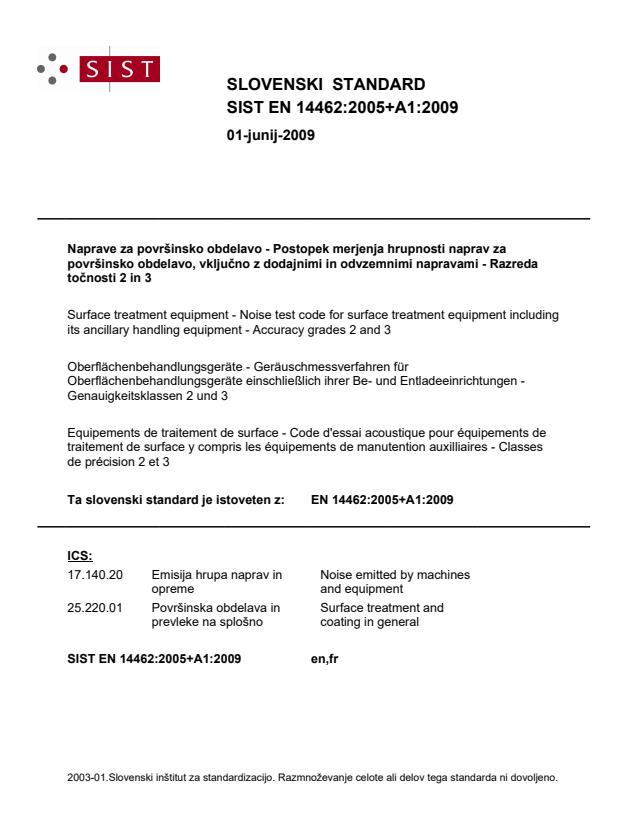
2003-01.Slovenski inštitut za standardizacijo. Razmnoževanje celote ali delov tega standarda ni dovoljeno.Oberflächenbehandlungsgeräte - Geräuschmessverfahren für Oberflächenbehandlungsgeräte einschließlich ihrer Be- und Entladeeinrichtungen - Genauigkeitsklassen 2 und 3Equipements de traitement de surface - Code d'essai acoustique pour équipements de traitement de surface y compris les équipements de manutention auxilliaires - Classes de précision 2 et 3Surface treatment equipment - Noise test code for surface treatment equipment including its ancillary handling equipment - Accuracy grades 2 and 325.220.01Površinska obdelava in prevleke na splošnoSurface treatment and coating in general17.140.20Emisija hrupa naprav in opremeNoise emitted by machines and equipmentICS:Ta slovenski standard je istoveten z:EN 14462:2005+A1:2009SIST EN 14462:2005+A1:2009en,fr01-junij-2009SIST EN 14462:2005+A1:2009SLOVENSKI
STANDARD
EUROPEAN STANDARD NORME EUROPÉENNE EUROPÄISCHE NORM
EN 14462:2005+A1
April 2009 ICS 17.140.20; 25.220.01 Supersedes EN 14462:2005English Version
Surface treatment equipment - Noise test code for surface treatment equipment including its ancillary handling equipment -Accuracy grades 2 and 3
Equipements de traitement de surface - Code d'essai acoustique pour équipements de traitement de surface y compris les équipements de manutention auxilliaires - Classes de précision 2 et 3
Oberflächenbehandlungsgeräte - Geräuschmessverfahren für Oberflächenbehandlungsgeräte einschließlich ihrer Be- und Entladeeinrichtungen - Genauigkeitsklassen 2 und 3 This European Standard was approved by CEN on 22 December 2004 and includes Amendment 1 approved by CEN on 7 March 2009.
CEN members are bound to comply with the CEN/CENELEC Internal Regulations which stipulate the conditions for giving this European Standard the status of a national standard without any alteration. Up-to-date lists and bibliographical references concerning such national standards may be obtained on application to the CEN Management Centre or to any CEN member.
This European Standard exists in three official versions (English, French, German). A version in any other language made by translation under the responsibility of a CEN member into its own language and notified to the CEN Management Centre has the same status as the official versions.
CEN members are the national standards bodies of Austria, Belgium, Bulgaria, Cyprus, Czech Republic, Denmark, Estonia, Finland, France, Germany, Greece, Hungary, Iceland, Ireland, Italy, Latvia, Lithuania, Luxembourg, Malta, Netherlands, Norway, Poland, Portugal, Romania, Slovakia, Slovenia, Spain, Sweden, Switzerland and United Kingdom.
EUROPEAN COMMITTEE FOR STANDARDIZATION
COMITÉ EUROPÉEN DE NORMALISATION EUROPÄISCHES KOMITEE FÜR NORMUNG
Management Centre:
Avenue Marnix 17,
B-1000 Brussels © 2009 CEN All rights of exploitation in any form and by any means reserved worldwide for CEN national Members. Ref. No. EN 14462:2005+A1:2009: ESIST EN 14462:2005+A1:2009
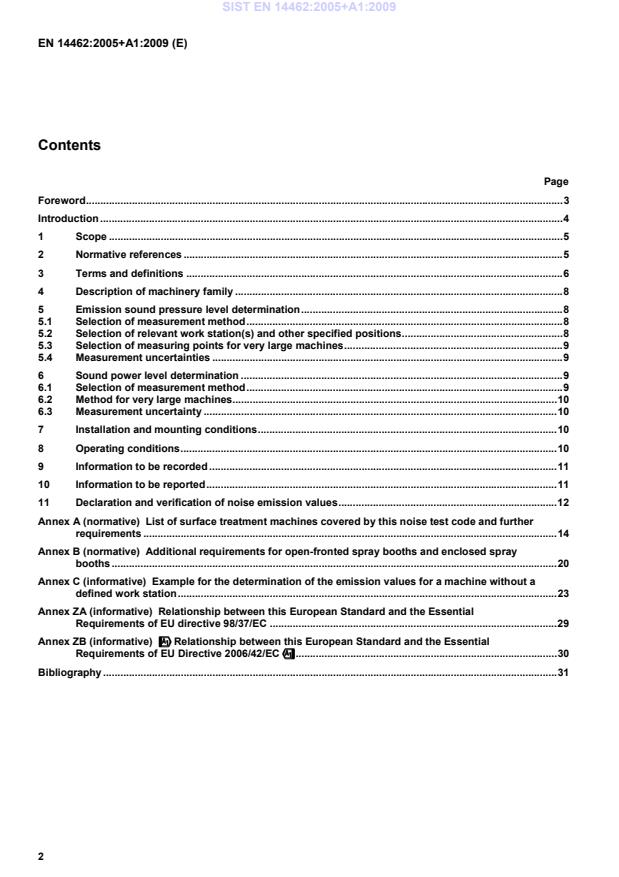
List of surface treatment machines covered by this noise test code and further requirements . 14Annex B (normative)
Additional requirements for open-fronted spray booths and enclosed spray booths . 20Annex C (informative)
Example for the determination of the emission values for a machine without a defined work station . 23Annex ZA (informative)
Relationship between this European Standard and the Essential Requirements of EU directive 98/37/EC . 29Annex ZB (informative)
!!!!Relationship between this European Standard and the Essential Requirements of EU Directive 2006/42/EC"""" . 30Bibliography . 31 SIST EN 14462:2005+A1:2009
Noise emission characteristics include both emission sound pressure levels at workstations and sound power levels. The determination of these characteristics is necessary for: manufacturers to declare the noise emitted; comparing the noise emitted by machines; purposes of noise control at the source during the design stage; estimation of noise emission (exposure) at the workplace or workstation. SIST EN 14462:2005+A1:2009
vehicle refinishing. !EN 12921-1", Machines for surface cleaning and pretreatment of industrial items using liquids or vapours — Part 1: Common safety requirements. !EN 12921-2", Machines for surface cleaning and pretreatment of industrial items using liquids or vapours — Part 2: Safety of machines using water based cleaning liquids. !EN 12921-3", Machines for surface cleaning and pretreatment of industrial items using liquids or vapours — Part 3: Safety of machines using flammable cleaning liquids. !EN 12921-4", Machines for surface cleaning and pretreatment of industrial items using liquids or vapours — Part 4: Safety of machines using halogenated solvents. !EN 12981", Coating plants — Spray booths for application of organic powder coating material — Safety requirements. EN 13355; Coating plants — Combined booths — Safety requirements. EN 61672-1, Electroacoustics - Sound level meters – Part 1: Specifications (IEC 61672-1:2002). EN ISO 3744, Acoustics — Determination of sound power levels of noise sources using sound pressure — Engineering method in an essentially free field over a reflecting plane (ISO 3744:1994). EN ISO 3746, Acoustics — Determination of sound power levels of noise sources using sound pressure — Survey method using an enveloping measurement surface over a reflecting plane (ISO 3746:1995). EN ISO 3747, Acoustics — Determination of sound power levels of noise sources using sound pressure — Comparison method for use in situ (ISO 3747:2000). EN ISO 4871:1996, Acoustics — Declaration and verification of noise emission values of machinery and equipment (ISO 4871:1996). EN ISO 9614-1, Acoustics — Determination of sound power levels of noise sources using sound intensity — Part 1: Measurement at discrete points (ISO 9614-1:1993). EN ISO 9614-2, Acoustics — Determination of sound power levels of noise sources using sound intensity — Part 2: Measurement by scanning (ISO 9614-2:1996). EN ISO 11201, Acoustics — Noise emitted by machinery and equipment — Measurement of emission sound pressure levels at a work station and at other specified positions — Engineering method in an essentially free field over a reflecting plane (ISO 11201:1995). EN ISO 11202, Acoustics — Noise emitted by machinery and equipment — Measurement of emission sound pressure levels at a work station and at other specified positions — Survey method in situ (ISO 11202:1995). EN ISO 11204, Acoustics — Noise emitted by machinery and equipment — Measurement of emission sound pressure levels at a work station and at other specified positions — Method requiring environmental corrections (ISO 11204:1995). 3 Terms and definitions For the purposes of this document, the following terms and definitions apply. 3.1 emission sound pressure, p sound pressure, at a specified position near a noise source, when the source is in operation under specified operating and mounting conditions on a reflecting plane surface excluding the effects of background noise as well SIST EN 14462:2005+A1:2009
[EN ISO 11200:1995] 3.2 emission sound pressure level, Lp ten times the logarithm to the base 10 of the ratio of the square of the emission sound pressure, p2(t), to the square of the reference sound pressure, p02, measured with a particular time weighting and a particular frequency weighting, selected from those defined in EN 61672-1. It is expressed in decibels. The reference sound pressure is 20 µPa
[EN ISO 11200:1995] The emission sound pressure level of surface treatment equipment is determined at specified positions in accordance with this document 3.3 average emission sound pressure level Lp energy-average of the emission sound pressure levels Lp at several microphone positions around the machine 3.4 sound power, W rate per unit time at which airborne sound energy is radiated by a source. It is expressed in watts
[EN ISO 3740:2000] 3.5 sound power level, LW ten times the logarithm to the base 10 of the ratio of the sound power radiated by the source under test to the reference sound power. It is expressed in decibels. The reference sound power is 1 pW (10-12 W). Frequency weighting or the width of the frequency band used shall be indicated, for example, A-weighted sound power level (LWA)
[EN ISO 3740:2000] 3.6 work station, operator’s position position in the vicinity of the machine under test which is intended for an operator
[EN ISO 11200:1995] 3.7 specified position position defined in relation to a machine including, but not limited to, an operator’s position. The position can be a single fixed point, or a combination of points along a path or on a surface located at a specified distance from the machine
[EN ISO 11200:1995] 3.8 reference box hypothetical surface which is the smallest rectangular parallelepiped that just encloses the source and terminates on the reflecting plane or planes
[EN ISO 3744:1995] SIST EN 14462:2005+A1:2009
When the application of the provisions of this clause leads to microphone positions that are not practical or may be dangerous, closest positions that are practical or not dangerous shall be chosen. An example for the arrangement of measuring points is shown in Annex C. The A-weighted emission sound pressure level LpA shall be determined at all defined measuring points in accordance with the relevant basic standard. The highest measured value on each floor and the position of the corresponding measuring point shall be reported. 5.3 Selection of measuring points for very large machines For very large machines (3.10), instead of the sound power level the emission sound pressure levels shall be determined at several positions in the following way: The measuring points shall be arranged on a measuring path as described in 5.2. For machines comprising several floors one measuring path is required for every floor. The measuring points shall be located according to the procedure described in 5.2. The A-weighted emission sound pressure level LpA shall be determined at all defined measuring points in accordance with the relevant basic standard. The energy-average of the emission sound pressure levels LpA at all microphone positions – average emission sound pressure level LpA – shall be the characteristic value for description of noise emission. 5.4 Measurement uncertainties The measurement uncertainties for the individual measurement method are those indicated in the corresponding basic standards (see 5.1) in terms of standard deviation of reproducibility. The resulting uncertainty KA for A-weighted levels which shall be considered for noise emission declaration is given in Clause 11. 6 Sound power level determination 6.1 Selection of measurement method A-weighted sound power levels LWA shall be determined in accordance with one of the basic noise emission standards: EN ISO 3744 (grade 2: engineering); EN ISO 3746 (grade 3: survey); SIST EN 14462:2005+A1:2009
In this case the average emission sound pressure levelLpA shall be determined and declared. 6.3 Measurement uncertainty The measurement uncertainties for the individual measurement method are those indicated in the corresponding basic standards (see 6.1) in terms of standard deviation of reproducibility. The resulting uncertainty KA for A-weighted levels which shall be considered for noise emission declaration is given in 11. 7 Installation and mounting conditions In general, complex machines for surface treatment consisting of the different components will be mounted at the destination; thus the installation conditions are given. If individual machines of smaller dimensions are measured in rooms, outside or within test rooms the machine shall be installed, mounted and linked in accordance with the manufacturer’s written instructions (to ensure the intended use). The installation chosen for noise measurement shall be indicated in the information to be recorded. The installation and mounting conditions shall be identical for the determination of both sound power level and emission sound pressure levels at specified positions, and for declaration purposes. 8 Operating conditions Since noise emissions depend on the corresponding operation mode of the machines, the operating conditions are specified in general in order to obtain comparable measuring results. The test shall be carried out under normal operating conditions including all sources of noise, normally present when the machine is under operation (e.g. pump, fan, conveyor). Therefore, Annex A of this document defines the operating conditions for the machines under test. When, for a particular machine listed in Annex A, operating conditions defined in Annex A cannot be used, the reason shall be given and the conditions actually used shall be recorded, reported and declared.
In case of multi-purpose machines, the operating conditions shall be those of the purpose which gives the highest noise emissions. In case of different working processes that together constitute a characteristic working cycle, it is this cycle that is defined as the operating conditions. SIST EN 14462:2005+A1:2009
A-weighted emission sound pressure level at workstations, where this exceeds 70 dB (A); where this level does not exceed 70 dB (A), this fact shall be indicated. A-weighted sound power level emitted by the machinery where the A-weighted emission sound pressure level at workstations exceeds !80 dB" (A). In the case of very large machines, instead of the sound power level, the A-weighted average emission sound pressure level.
For noise declaration of an individual machine an uncertainty KA of the A-weighted value of 2,5 dB (engineering, grade 2) or 5 dB (survey, grade 3) shall be used. For a production series of machines the arithmetic average of measured noise emission values and the uncertainty KA shall be declared (see Annex A of EN ISO 4871:1996). The noise declaration shall mention explicitly that the noise emission values have been obtained according to this noise test code, and indicate which basic noise measurement standards have been used. If this is not applicable, deviations from the basic noise measurement standard shall be indicated precisely. NOTE Additional noise emission quantities such as sound power levels in octave bands may also be given in the noise declaration. In this case, care shall be taken to present additional noise emission data in such form as to prevent confusion with the declared noise emission values. The method used and the grade of accuracy applied shall be stated.
...