

EN 12953-12:2003
(Main)Shell boilers - Part 12: Requirements for grate firing systems for solid fuels for the boiler
- Abstract
This part of this European Standard specifies the requirements for internal or external grate firing systems commencing at the fuel bunkers and ending at the ash extraction plant. For combination of various firing systems, the individual requirements of each system also apply.
If several fuels are burnt simultaneously or if a fuel quality varies considerably (e.g. moisture content), additional safety measures can be necessary, especially with respect to limitation of the fuel flow into the firing system and ensuring proper air supply to the individual fuels.
- Status
- Published
- Publication Date
- 16-Sep-2003
- Withdrawal Date
- 30-Mar-2004
- Technical Committee
- CEN/TC 269 - Shell and water tube boilers
- Drafting Committee
- CEN/TC 269/WG 3 - Equipment
- Current Stage
- 9092 - Decision on results of review/2YR ENQ - revise - Review Enquiry
- Start Date
- 04-Jun-2021
- Completion Date
- 07-Oct-2026
- Directive
- 2014/68/EU - Directive 2014/68/EU of the European Parliament and of the Council of 15 May 2014 on the harmonisation of the laws of the Member States relating to the making available on the market of pressure equipmentOJ Ref: C 293/01 OJ Date: 12-Aug-2016
97/23/EC - Pressure equipmentOJ Ref: C, C 118 OJ Date: 15-Apr-2011

Overview
EN 12953-12:2003 is a CEN (European Committee for Standardization) part of the EN 12953 series for shell boilers. It specifies requirements for grate firing systems for solid fuels, covering the installation from fuel bunkers and conveying plant through to the ash extraction system. The standard applies to internal and external grate systems and requires that, for combined firing systems, the individual requirements for each system are also satisfied. It highlights additional safety measures when multiple fuels are burned simultaneously or when fuel quality varies significantly (e.g., moisture content).
Key topics and technical requirements
The standard addresses practical and safety-critical elements of grate firing systems, including:
- Scope of fuels: coal grades, peat, oil shale, biomass (wood, straw, energy crops), municipal/industrial waste and fuel blends - and guidance when unconventional fuels are used.
- Fuel bunkers and conveying plant: design to prevent fuel accumulation, ensure reliable fuel flow, and minimize in-room fuel storage.
- Fuel treatment: sizing, drying and other preparation to ensure consistent combustion.
- Fuel feeding systems: feeders, chutes and bottom-grate feed arrangements.
- Explosion prevention and safety: measures for volatile or pyrolysing fuels and dust/explosion risks; references to dust explosion testing standards.
- Combustion air and flue gas handling: air supply, air/fuel ratio control and purging of flue gas passes.
- Firing system controls & electrical equipment: monitoring, control, purging, lighting-up, start-up, shutdown and master fuel trip arrangements.
- Ash handling and extraction: requirements for ash removal from grate systems.
- Operation and maintenance: training, operating instructions and supervised operation (Annex A contains operational requirements for permanently supervised systems).
- Safety & compliance: links to Pressure Equipment Directive (97/23/EC) via informative Annex ZA.
Applications - who uses this standard
EN 12953-12:2003 is intended for:
- Boiler manufacturers and OEMs designing shell boilers with grate firing systems
- Plant and mechanical engineers specifying fuel handling, feeding and ash extraction equipment
- Safety and process engineers implementing explosion prevention and combustion air control
- Power plants, biomass and waste-to-energy facilities that burn solid fuels on grates
- Inspection bodies, regulators and maintenance teams responsible for commissioning, operation and compliant documentation
Practical uses include designing or auditing fuel bunkers, specifying conveying and feeding systems, setting combustion air controls, and developing operating instructions and safety interlocks for mixed-fuel or variable-quality fuel operations.
Related standards
- EN 12953 (other parts) - Shell boilers series
- EN 12952-8 / EN 12952-9 - firing systems for water-tube boilers
- EN 26184-1 - dust explosion indices
- prEN 50156-1 - electrical equipment for furnaces
Keywords: EN 12953-12:2003, grate firing systems, shell boilers, solid fuels, fuel bunkers, ash extraction, combustion air, explosion prevention, CEN standard.
Relations
- Effective Date
- 09-Feb-2026
- Effective Date
- 28-Jan-2026
- Effective Date
- 28-Jan-2026
- Effective Date
- 28-Jan-2026
- Effective Date
- 28-Jan-2026
- Effective Date
- 28-Jan-2026
- Effective Date
- 28-Jan-2026
- Effective Date
- 28-Jan-2026
- Effective Date
- 22-Dec-2008
Get Certified
Connect with accredited certification bodies for this standard

DNV
DNV is an independent assurance and risk management provider.

Lloyd's Register
Lloyd's Register is a global professional services organisation specialising in engineering and technology.
DNV Energy Systems
Energy and renewable energy certification.
Sponsored listings
Frequently Asked Questions
EN 12953-12:2003 is a standard published by the European Committee for Standardization (CEN). Its full title is "Shell boilers - Part 12: Requirements for grate firing systems for solid fuels for the boiler". This standard covers: This part of this European Standard specifies the requirements for internal or external grate firing systems commencing at the fuel bunkers and ending at the ash extraction plant. For combination of various firing systems, the individual requirements of each system also apply. If several fuels are burnt simultaneously or if a fuel quality varies considerably (e.g. moisture content), additional safety measures can be necessary, especially with respect to limitation of the fuel flow into the firing system and ensuring proper air supply to the individual fuels.
This part of this European Standard specifies the requirements for internal or external grate firing systems commencing at the fuel bunkers and ending at the ash extraction plant. For combination of various firing systems, the individual requirements of each system also apply. If several fuels are burnt simultaneously or if a fuel quality varies considerably (e.g. moisture content), additional safety measures can be necessary, especially with respect to limitation of the fuel flow into the firing system and ensuring proper air supply to the individual fuels.
EN 12953-12:2003 is classified under the following ICS (International Classification for Standards) categories: 27.060.20 - Gas fuel burners; 27.100 - Power stations in general. The ICS classification helps identify the subject area and facilitates finding related standards.
EN 12953-12:2003 has the following relationships with other standards: It is inter standard links to EN 50156-1:2024, EN 12953-7:2002, EN 12952-9:2002, EN 12952-8:2002, EN 12953-6:2024, EN 12953-6:2011, EN 285:2006+A2:2009, EN 12953-1:2025; is excused to EN 12953-7:2002. Understanding these relationships helps ensure you are using the most current and applicable version of the standard.
EN 12953-12:2003 is associated with the following European legislation: EU Directives/Regulations: 2014/68/EU, 97/23/EC; Standardization Mandates: M/071. When a standard is cited in the Official Journal of the European Union, products manufactured in conformity with it benefit from a presumption of conformity with the essential requirements of the corresponding EU directive or regulation.
EN 12953-12:2003 is available in PDF format for immediate download after purchase. The document can be added to your cart and obtained through the secure checkout process. Digital delivery ensures instant access to the complete standard document.
Standards Content (Sample)
SLOVENSKI STANDARD
01-junij-2004
Mnogovodni kotli - 12. del: Zahteve za kurilne sisteme na trdna goriva z
zgorevalno rešetko
Shell boilers - Part 12: Requirements for grate firing systems for solid fuels for the boiler
Großwasserraumkessel - Teil 12: Anforderungen an Rostfeuerungsanlagen für feste
Brennstoffe für den Kessel
Chaudieres a tubes de fumée - Partie 12: Exigences pour les équipements de chauffe a
grille pour combustibles solides de la chaudiere
Ta slovenski standard je istoveten z: EN 12953-12:2003
ICS:
27.060.30 Grelniki vode in prenosniki Boilers and heat exchangers
toplote
2003-01.Slovenski inštitut za standardizacijo. Razmnoževanje celote ali delov tega standarda ni dovoljeno.
EUROPEAN STANDARD
EN 12953-12
NORME EUROPÉENNE
EUROPÄISCHE NORM
September 2003
ICS 27.060.30; 27.100
English version
Shell boilers - Part 12: Requirements for grate firing systems for
solid fuels for the boiler
Chaudières à tubes de fumée - Partie 12: Exigences pour Großwasserraumkessel - Teil 12: Anforderungen an
les équipements de chauffe à grille pour combustibles Rostfeuerungsanlagen für feste Brennstoffe für den Kessel
solides de la chaudière
This European Standard was approved by CEN on 12 June 2003.
CEN members are bound to comply with the CEN/CENELEC Internal Regulations which stipulate the conditions for giving this European
Standard the status of a national standard without any alteration. Up-to-date lists and bibliographical references concerning such national
standards may be obtained on application to the Management Centre or to any CEN member.
This European Standard exists in three official versions (English, French, German). A version in any other language made by translation
under the responsibility of a CEN member into its own language and notified to the Management Centre has the same status as the official
versions.
CEN members are the national standards bodies of Austria, Belgium, Czech Republic, Denmark, Finland, France, Germany, Greece,
Hungary, Iceland, Ireland, Italy, Luxembourg, Malta, Netherlands, Norway, Portugal, Slovakia, Spain, Sweden, Switzerland and United
Kingdom.
EUROPEAN COMMITTEE FOR STANDARDIZATION
COMITÉ EUROPÉEN DE NORMALISATION
EUROPÄISCHES KOMITEE FÜR NORMUNG
Management Centre: rue de Stassart, 36 B-1050 Brussels
© 2003 CEN All rights of exploitation in any form and by any means reserved Ref. No. EN 12953-12:2003 E
worldwide for CEN national Members.
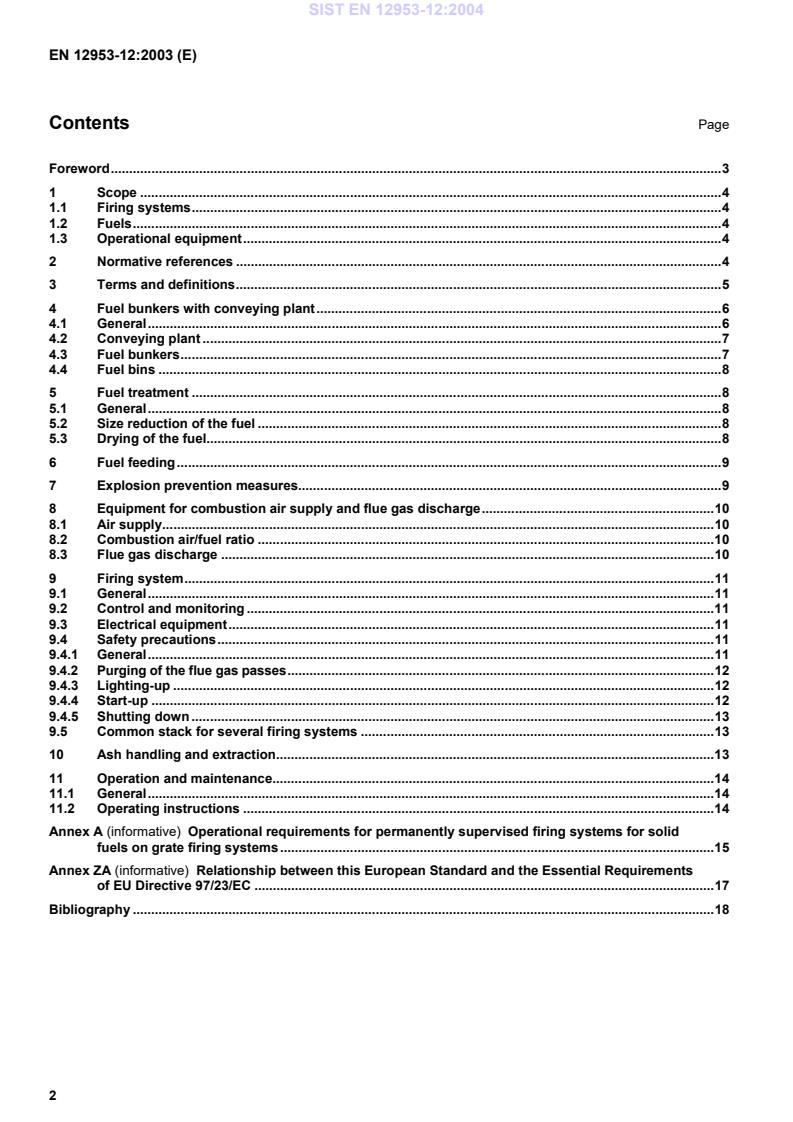
Contents Page
Foreword.3
1 Scope .4
1.1 Firing systems.4
1.2 Fuels.4
1.3 Operational equipment.4
2 Normative references .4
3 Terms and definitions.5
4 Fuel bunkers with conveying plant.6
4.1 General.6
4.2 Conveying plant .7
4.3 Fuel bunkers.7
4.4 Fuel bins .8
5 Fuel treatment .8
5.1 General.8
5.2 Size reduction of the fuel .8
5.3 Drying of the fuel.8
6 Fuel feeding.9
7 Explosion prevention measures.9
8 Equipment for combustion air supply and flue gas discharge.10
8.1 Air supply.10
8.2 Combustion air/fuel ratio .10
8.3 Flue gas discharge .10
9 Firing system.11
9.1 General.11
9.2 Control and monitoring .11
9.3 Electrical equipment.11
9.4 Safety precautions.11
9.4.1 General.11
9.4.2 Purging of the flue gas passes.12
9.4.3 Lighting-up .12
9.4.4 Start-up .12
9.4.5 Shutting down .13
9.5 Common stack for several firing systems .13
10 Ash handling and extraction.13
11 Operation and maintenance.14
11.1 General.14
11.2 Operating instructions .14
Annex A (informative) Operational requirements for permanently supervised firing systems for solid
fuels on grate firing systems.15
Annex ZA (informative) Relationship between this European Standard and the Essential Requirements
of EU Directive 97/23/EC .17
Bibliography .18
Foreword
This document EN 12953-12:2003 has been prepared by Technical Committee CEN/TC 269 “Shell and water-tube
boilers”, the secretariat of which is held by DIN.
This European Standard shall be given the status of a national standard, either by publication of an identical text or
by endorsement, at the latest by March 2004, and conflicting national standards shall be withdrawn at the latest by
March 2004.
This document has been prepared under a mandate given to CEN by the European Commission and the European
Free Trade Association, and supports essential requirements of EU Directive(s) (Pressure Equipment Directive
97/23/EC) [1].
For relationship with EU Directive(s), see informative annex ZA, which is an integral part of this document.
The European Standard EN 12953 concerning shell boilers consists of the following Parts:
� Part 1: General
� Part 2: Materials for pressure parts of boilers and accessories
� Part 3: Design and calculation for pressure parts
� Part 4: Workmanship and construction of pressure parts of the boiler
� Part 5: Inspection during construction, documentation and marking of pressure parts of the boiler
� Part 6: Requirements for equipment for the boiler
� Part 7: Requirements for firing systems for liquid and gaseous fuels for the boilers
� Part 8: Requirements for safeguards against excessive pressure
� Part 9: Requirements for limiting devices of the boiler and accessories
� Part 10: Requirements for feedwater and boiler water quality
� Part 11: Acceptance tests
� Part 12: Requirements for grate firing systems for solid fuels for the boiler
� Part 13: Operating instructions
CR 12953 Part 14: Guideline for the involvement of an inspection body independent of the manufacturer (TR)
Although these Parts may be obtained separately, it should be recognized that the Parts are interdependent. As such,
the design and manufacture of shell boilers requires the application of more than one Part in order for the
requirements of the European Standard to be satisfactorily fulfilled.
The annex A of this European Standard is informative.
This document includes a Bibliography.
According to the CEN/CENELEC Internal Regulations, the national standards organizations of the following
countries are bound to implement this European Standard: Austria, Belgium, Czech Republic, Denmark, Finland,
France, Germany, Greece, Hungary, Iceland, Ireland, Italy, Luxembourg, Malta, Netherlands, Norway, Portugal,
Slovakia, Spain, Sweden, Switzerland and the United Kingdom.
1 Scope
1.1 Firing systems
This part of this European Standard specifies the requirements for internal or external grate firing systems
commencing at the fuel bunkers and ending at the ash extraction plant. For combination of various firing systems,
the individual requirements of each system also apply.
If several fuels are burnt simultaneously or if a fuel quality varies considerably (e.g. moisture content), additional
safety measures can be necessary, especially with respect to limitation of the fuel flow into the firing system and
ensuring proper air supply to the individual fuels.
1.2 Fuels
The solid fuels covered are:
� all coal qualities, e.g. lignite or brown coal, sub-bituminous or hard brown coal, bituminous coal or hard coal,
pitch coal, anthracite, coke, coal culm, coal sludge;
� other fossil solid fuels (e.g. petrol coke peat, oil shale);
� biomass solid fuels (e.g. wood, wood wastes [bark], energy plants [miscanthus], harvest wastes [straw]);
� municipal waste solid fuels (e.g. garbage, sewage sludge, refuse derived fuels [RDF]);
� industrial waste solid fuels (e.g. petrol coke, soot, tyres, paper wastes, coated wood chips, spent wood, animal
product wastes).
Fuel blends from two or more of these groups (see 4.1.7), or fuels of unconventional or unknown quality can
require special safety measures which can be proved either by practical experience gained from comparable fuels,
or by suitable tests, e.g. in accordance with EN 26184-1. Such measures should be documented by the
manufacturer.
Fuels on which the design is based should be specified in the operating instructions (see 11.2). This should include
the fuel data for 100 % input of the basic fuel and the data for any supplementary fuels together with their maximum
thermal input percentage.
1.3 Operational equipment
The requirements for operational equipment in clauses 4 to 10 apply to steam boilers and hot water generators with
permanent supervision by properly trained personnel familiar with the special conditions of the firing systems and the
type of fuel.
Annex A contains the operational requirements for permanent supervision.
2 Normative references
This European Standard incorporates by dated or undated reference, provisions from other publications. These
normative references are cited at the appropriate places in the text, and the publications are listed hereafter. For
dated references, subsequent amendments to or revisions of any of these publications apply to this European
Standard only when incorporated in it by amendment or revision. For undated references the latest edition of the
publication referred to applies (including amendments).
EN 12952-8:2002, Water-tube boilers and auxiliary installations – Part 8: Requirements for firing systems for liquid
and gaseous fuels for the boiler.
EN 12952-9:2002, Water-tube boilers and auxiliary installations — Part 9: Requirements for firing systems for
pulverized solid fuels for the boiler.
EN 12953-7, Shell boilers — Part 7: Requirements for firing systems for liquid and gaseous fuels for the boiler.
EN 26184-1, Explosion protection systems — Part 1: Determination of explosion indices of combustible dusts in air
(ISO 6184-1:1985).
prEN 50156-1, Electrical equipment for furnaces and ancillary equipment — Part 1: Requirements for application
design and installation.
3 Terms and definitions
For the purposes of this European Standard, the following terms and definitions apply.
3.1
back-up firing system
separate firing system to maintain safe ignition and stable combustion. The lighting-up equipment can be used for
this purpose
3.2
basic fire
layer of glowing fuel, fire bed or flame of the fed fuel. The basic fire can also perform the duty of the lighting-up
equipment, or the back-up firing system (mostly air)
3.3
carrier gas
transport medium for pneumatic conveying
3.4
combustion air
total air supplied to the firing system for combustion
3.5
firing systems
can be distinguished in accordance with the type and structure of the fuel, the feeding procedure and the process
of combustion. Fuel and air can be introduced in the combustion chamber in different ways to establish and
maintain proper ignition and stable combustion. Combustion of the fuel is performed on grates
3.6
fuel bin
silo
dust-tight container for temporary storage of combustible solids in the boiler room
3.7
fuel bunker
open storage of solid fuel
3.8
fuel feeding system
device to transport fuel into the combustion chamber
NOTE This can be effected directly by feeders through ports in the furnace walls, by means of chutes or through the
bottom grate
3.9
fuel handling plant
installation for conveying, mixing and distributing solid fuels to the individual fuel bunkers or fuel bins
3.10
grate firing system
fuel is burnt in a layer supported by a system of firebars which may have a cooling system
NOTE The firebars should be so spaced as to admit the undergrate combustion air supply in proper distribution. Other
means of admitting and distributing the combustion air supply can be provided.
3.11
indicator
measuring instrument which indicates a variable value (e.g. pressure, temperature, flow, level). It can be equipped
with an annunciator
3.12
lighting-up equipment
facility to achieve safe ignition of the feed fuel
3.13
limiter
transducer, which, on reaching a fixed limit value (e.g. pressure, temperature, flow, level) is used to interrupt and
lockout the energy supply and It requires manual unlocking before restart
3.14
lockout
interruption of the energy supply. Manual unlocking is required before restart
3.15
master fuel trip
device located at a safe place for rapid automatic shutoff of all fuel supplies to the grate and electrical igniters in the
event of danger
3.16
maximum continuous rating (MCR)
allowable heat output
steam boiler or hot water heat output that can be generated during continuous operation and at which the steam or
hot water generator may be operated, taking the specified steam condition or hot water condition (water mass flow
times the difference between outlet and inlet enthalpy) into consideration
3.17
monitor
transducer that senses the reaching of a fixed limit value and initiates an alarm and/or a shut-down. The output signal
only reverses if the causing value has changed at a defined range
3.18
purging of the flue gas passes
flow of air through combustion chamber, flue gas passes, and associated ducts including flue-gas treatment systems,
which effectively removes any gaseous combustibles and replace them with air
3.19
start-up condition
the plant can be started
� cold (temperature of ceramic lining is at ambient value);
� hot (temperature of ceramic lining is above the minimum ignition temperature of the basic fuel); or
� warm (temperature of ceramic lining in between the ambient and minimum ignition temperature)
4 Fuel bunkers with conveying plant
4.1 General
4.1.1 All facilities shall be designed so as to withstand mechanical and thermal stresses. Fuel shall not be heated
to an unacceptable level. Sites where fuel may accumulate shall be avoided.
4.1.2 Conveyance, temporary storage, and extraction of the fuel shall be arranged such that sufficient flow of the
fuel and additives is ensured.
4.1.3 The fuel storage capacity shall be determined in accordance with the fuels used.
NOTE It is recommended that the storage of fuel within the boiler room itself is minimized.
4.1.4 Measures to prevent fire, explosion and injuries to personnel shall be provided for volatile fuels and those
capable of pyrolysis in the absence of external heating. As an example wet sludges can have an inherent explosion
risk due to the release of volatiles (e.g. methane)when stored. Dried sludges have a fire and dust explosion risk.
4.1.5 Sludge storage in bins shall be preferred to storage in bunkers (see 4.4.1).
4.1.6 The storage of fuels supplied in small grain sized particles or fibres which can be stirred up and become
airborne shall only be permitted in bins (silos).
4.1.7 If different types of fuels are used, dangerous operating conditions due to blending shall be excluded, e.g.
by the use of separate bunkers or bins and separate feeding systems.
4.1.8 If there is a risk of blockage of conveying systems or firing systems by coarse lumps of fuel, foreign matter
and tramp metal, then means for the removal of those objects shall be provided, preferably before entering the
bunker.
4.1.9 Dangerous areas accessible to personnel shall be marked with warning signs.
4.1.10 Outdoor storage facilities and fuel bearing components as well as buildings for indoor installation shall be
equipped with a lightning protective system in accordance with relevant European Standards.
4.2 Conveying plant
4.2.1 Several continuous conveyors arranged in series to form one conveying line shall be interlocked such that
the normal operation of any conveyor is possible only if the downstream conveyors are in normal operation and the
storage facility is ready to accept the fuel.
4.2.2 Precautions shall be taken for the protection of personnel against injury from moving components.
Sufficient time shall be provided between the warning signal and starting of the plant.
4.2.3 If the type and format of the fuel requires bins (silos) for temporary storage in accordance with 4.1.5 or
4.1.6, subsequent conveyance shall be performed in a closed system, which shall be gas-tight if operated under
internal pressure.
4.2.4 Piping used for conveyance shall be designed with a high resistance to wear.
4.2.5 For conveyance of fuel in closed pipes, deposition shall be prevented by sufficient velocity of the carrier
gas depending on the type and format of the fuel.
4.2.6 All piping system components of a conveying system shall be capable of being purged of fuel.
4.2.7 If multiple lines are installed, devices shall be provided to isolate idle conveying lines from the downstream
storage facility or the furnace.
4.3 Fuel bunkers
4.3.1 Fuel bunkers shall be built to achieve uniform discharge by the selection of proper shape and design, in
order to ensure a continuous fuel flow and to avoid segregation.
4.3.2 To avoid ingress of hot air/gas into the bunker, a minimum level of fuel shall be maintained and monitored
in the bunker, or other suitable measures shall be taken, see also 6.1 and 6.4.
4.3.3 The inner surface of the fuel bunker roof shall be designed so as to avoid the accumulation of dust and gas
in dead pockets.
4.3.4 Bunker charging openings shall be adequately guarded to prevent personnel from falling in.
4.3.5 Fuel bunkers shall be equipped with fire fighting or fire preventing equipment. Fire fighting by sprinkler
systems is allowed but the use of concentrated water jets is prohibited. Bunkers may be emptied by use of
emergency chutes.
4.4 Fuel bins
4.4.1 Some fuels according to their type and format shall be stored in dust-tight bins (silos). The requirements for
pulverized fuel bins specified in 5.4 and 6.2.2 of EN 12952-9:2002 apply accordingly.
4.4.2 The permissible maximum storage temperature shall be specified for each single fuel and fuel blends and
shall be monitored in the freeboard during the storage, if there is a risk of self-ignition
4.4.3 If combustible gas emanation from the fuel cannot be prevented, silos shall be equipped with suitable gas
monitoring and safe venting devices, otherwise an explosion-proof silo or inert gas protection shall be provided.
4.4.4 Fuels as specified in 4.1.4 require bins to be equipped with a stationary nonfreezing fire extinguishing
system to enable fire to be fought without opening access doors. The extinguishing comp
...