

EN 285:2006+A2:2009
(Main + Amendment)Sterilization - Steam sterilizers - Large sterilizers
- Abstract
1.1 This European Standard specifies requirements and the relevant tests for large steam sterilizers primarily used in health care for the sterilization of medical devices and their accessories contained in one or more sterilization modules. The test loads described in this European Standard are selected to represent the majority of loads (i.e. wrapped goods consisting of metal, rubber and porous materials) for the evaluation of general purpose steam sterilizer for medical devices. However, specific loads (e.g. heavy metal objects or long and/or narrow lumen) will require the use of other test loads.
Large steam sterilizers can also be used during the commercial production of medical devices.
1.2 This European Standard is not applicable to steam sterilizers designed to process a size of load less than one sterilization module or having a chamber volume less than 60 l.
1.3 This European Standard does not describe a quality assurance system for the control of all stages of the manufacture of the sterilizer.
NOTE Attention is drawn to the standards for quality management systems e.g. EN ISO 13485.
1.4 Planning and design of products applying to this European Standard should consider the environmental impact from the product during its life cycle. Environmental aspects are addressed in Annex A.
NOTE Additional aspects of environmental impact are addressed in EN ISO 14971.
- Status
- Withdrawn
- Publication Date
- 05-May-2009
- Withdrawal Date
- 06-Oct-2026
- Technical Committee
- CEN/TC 102 - Sterilizers for medical purposes
- Drafting Committee
- CEN/TC 102/WG 3 - Requirements
- Current Stage
- 9960 - Withdrawal effective - Withdrawal
- Start Date
- 23-Dec-2015
- Completion Date
- 07-Oct-2026
93/42/EEC - Medical devicesOJ Ref: C, C 293 OJ Date: 02-Dec-2009

Relations
- Effective Date
- 19-Jan-2023
- Effective Date
- 18-Jan-2023
- Effective Date
- 30-Dec-2015
- Effective Date
- 08-Jul-2026
- Effective Date
- 08-Jul-2026
- Effective Date
- 08-Jul-2026
- Effective Date
- 08-Jul-2026
- Effective Date
- 08-Jul-2026
- Effective Date
- 08-Jul-2026
- Effective Date
- 08-Jul-2026
- Effective Date
- 18-Feb-2026
- Effective Date
- 09-Feb-2026
- Refers
EN 61326:1997 - Electrical equipment for measurement, control and laboratory use - EMC requirements - Effective Date
- 09-Feb-2026
- Effective Date
- 09-Feb-2026
- Effective Date
- 09-Feb-2026
Get Certified
Connect with accredited certification bodies for this standard

BSI Group
BSI (British Standards Institution) is the business standards company that helps organizations make excellence a habit.

TÜV Rheinland
TÜV Rheinland is a leading international provider of technical services.

TÜV SÜD
TÜV SÜD is a trusted partner of choice for safety, security and sustainability solutions.
Sponsored listings
Frequently Asked Questions
EN 285:2006+A2:2009 is a standard published by the European Committee for Standardization (CEN). Its full title is "Sterilization - Steam sterilizers - Large sterilizers". This standard covers: 1.1 This European Standard specifies requirements and the relevant tests for large steam sterilizers primarily used in health care for the sterilization of medical devices and their accessories contained in one or more sterilization modules. The test loads described in this European Standard are selected to represent the majority of loads (i.e. wrapped goods consisting of metal, rubber and porous materials) for the evaluation of general purpose steam sterilizer for medical devices. However, specific loads (e.g. heavy metal objects or long and/or narrow lumen) will require the use of other test loads. Large steam sterilizers can also be used during the commercial production of medical devices. 1.2 This European Standard is not applicable to steam sterilizers designed to process a size of load less than one sterilization module or having a chamber volume less than 60 l. 1.3 This European Standard does not describe a quality assurance system for the control of all stages of the manufacture of the sterilizer. NOTE Attention is drawn to the standards for quality management systems e.g. EN ISO 13485. 1.4 Planning and design of products applying to this European Standard should consider the environmental impact from the product during its life cycle. Environmental aspects are addressed in Annex A. NOTE Additional aspects of environmental impact are addressed in EN ISO 14971.
1.1 This European Standard specifies requirements and the relevant tests for large steam sterilizers primarily used in health care for the sterilization of medical devices and their accessories contained in one or more sterilization modules. The test loads described in this European Standard are selected to represent the majority of loads (i.e. wrapped goods consisting of metal, rubber and porous materials) for the evaluation of general purpose steam sterilizer for medical devices. However, specific loads (e.g. heavy metal objects or long and/or narrow lumen) will require the use of other test loads. Large steam sterilizers can also be used during the commercial production of medical devices. 1.2 This European Standard is not applicable to steam sterilizers designed to process a size of load less than one sterilization module or having a chamber volume less than 60 l. 1.3 This European Standard does not describe a quality assurance system for the control of all stages of the manufacture of the sterilizer. NOTE Attention is drawn to the standards for quality management systems e.g. EN ISO 13485. 1.4 Planning and design of products applying to this European Standard should consider the environmental impact from the product during its life cycle. Environmental aspects are addressed in Annex A. NOTE Additional aspects of environmental impact are addressed in EN ISO 14971.
EN 285:2006+A2:2009 is classified under the following ICS (International Classification for Standards) categories: 11.080.10 - Sterilizing equipment. The ICS classification helps identify the subject area and facilitates finding related standards.
EN 285:2006+A2:2009 has the following relationships with other standards: It is inter standard links to EN 285:2006/prA2, EN 285:2006+A1:2008, EN 285:2015, EN 13445-6:2026, EN 13445-8:2026, EN 13445-2:2026, EN 13445-3:2026, EN 13445-4:2026, EN 13445-1:2026, EN 13445-5:2026, EN 13445-3:2021+A1:2026, EN 61672-1:2003, EN 61326:1997, EN 60751:1995, EN 60584-2:1993. Understanding these relationships helps ensure you are using the most current and applicable version of the standard.
EN 285:2006+A2:2009 is associated with the following European legislation: EU Directives/Regulations: 2007/47/EC, 93/42/EEC; Standardization Mandates: M/023. When a standard is cited in the Official Journal of the European Union, products manufactured in conformity with it benefit from a presumption of conformity with the essential requirements of the corresponding EU directive or regulation.
EN 285:2006+A2:2009 is available in PDF format for immediate download after purchase. The document can be added to your cart and obtained through the secure checkout process. Digital delivery ensures instant access to the complete standard document.
Standards Content (Sample)
2003-01.Slovenski inštitut za standardizacijo. Razmnoževanje celote ali delov tega standarda ni dovoljeno.Sterilizacija - Parni sterilizatorji - Veliki sterilizatorjiSterilisation - Dampf-Sterilisatoren - Groß-SterilisatorenStérilisation - Stérilisateurs à la vapeur d'eau - Grands stérilisateursSterilization - Steam sterilizers - Large sterilizers11.080.10Sterilizacijska opremaSterilizing equipmentICS:Ta slovenski standard je istoveten z:EN 285:2006+A2:2009SIST EN 285:2006+A2:2009en,fr,de01-julij-2009SIST EN 285:2006+A2:2009SLOVENSKI
STANDARD
EUROPEAN STANDARD NORME EUROPÉENNE EUROPÄISCHE NORM
EN 285:2006+A2
May 2009 ICS 11.080.10 Supersedes EN 285:2006+A1:2008English Version
Sterilization - Steam sterilizers - Large sterilizers
Stérilisation - Stérilisateurs à la vapeur d'eau - Grands stérilisateurs
Sterilisation - Dampf-Sterilisatoren - Groß-Sterilisatoren This European Standard was approved by CEN on 27 April 2006 and includes Amendment 1 approved by CEN on 4 February 2008 and Amendment 2 approved by CEN on 5 April 2009.
CEN members are bound to comply with the CEN/CENELEC Internal Regulations which stipulate the conditions for giving this European Standard the status of a national standard without any alteration. Up-to-date lists and bibliographical references concerning such national standards may be obtained on application to the CEN Management Centre or to any CEN member.
This European Standard exists in three official versions (English, French, German). A version in any other language made by translation under the responsibility of a CEN member into its own language and notified to the CEN Management Centre has the same status as the official versions.
CEN members are the national standards bodies of Austria, Belgium, Bulgaria, Cyprus, Czech Republic, Denmark, Estonia, Finland, France, Germany, Greece, Hungary, Iceland, Ireland, Italy, Latvia, Lithuania, Luxembourg, Malta, Netherlands, Norway, Poland, Portugal, Romania, Slovakia, Slovenia, Spain, Sweden, Switzerland and United Kingdom.
EUROPEAN COMMITTEE FOR STANDARDIZATION
COMITÉ EUROPÉEN DE NORMALISATION EUROPÄISCHES KOMITEE FÜR NORMUNG
Management Centre:
Avenue Marnix 17,
B-1000 Brussels © 2009 CEN All rights of exploitation in any form and by any means reserved worldwide for CEN national Members. Ref. No. EN 285:2006+A2:2009: ESIST EN 285:2006+A2:2009
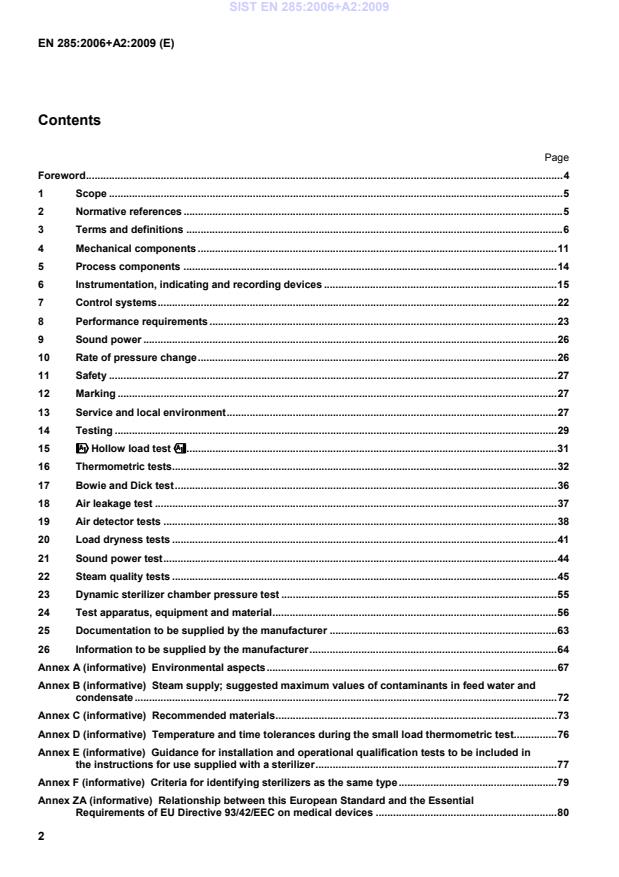
Environmental aspects . 67Annex B (informative)
Steam supply; suggested maximum values of contaminants in feed water and condensate . 72Annex C (informative)
Recommended materials . 73Annex D (informative)
Temperature and time tolerances during the small load thermometric test. 76Annex E (informative)
Guidance for installation and operational qualification tests to be included in the instructions for use supplied with a sterilizer . 77Annex F (informative)
Criteria for identifying sterilizers as the same type . 79Annex ZA (informative)
Relationship between this European Standard and the Essential Requirements of EU Directive 93/42/EEC on medical devices . 80SIST EN 285:2006+A2:2009
process challenge devices for use in performance testing for small sterilizers Type B and Type S" EN 868-5, Packaging materials and systems for medical devices which are to be sterilized — Part 5: Heat and self-sealable pouches and reels of paper and plastic film construction — Requirements and test methods EN 1822 (all parts), High efficiency air filters (HEPA and ULPA) EN 10088-1, Stainless steels — Part 1: List of stainless steels EN 10088-3, Stainless steels — Part 3: Technical delivery conditions for semi-finished products, bars, rods, wire, sections and bright products of corrosion resistant steels for general purposes EN 12953 (all parts), Shell boilers EN 13445 (all parts), Unfired pressure vessels EN 14222, Stainless steel shell boilers EN 60584-2:1993, Thermocouples — Part 2: tolerances (IEC 60584-2:1982 + A1:1989) SIST EN 285:2006+A2:2009
for measurement, control and laboratory use —
Part 2-040: Particular requirements for
sterilizers and washer-disinfectors used to
treat medical materials (IEC 61010-2- 040:2005) EN 61326:1997, Electrical equipment for measurement, control and laboratory use — EMC requirements (IEC 61326:1997) EN 61672-1:2003, Electroacoustics — Sound level meters — Part 1: Specifications (IEC 61672-1:2002) EN 61672-2:2003, Electroacoustics — Sound level meters — Part 2: Pattern evaluation tests (IEC 61672-2:2003) EN ISO 3746:1995, Acoustics — Determination of sound power levels of noise sources using sound pressure — Survey method using an enveloping measurement surface over a reflecting plane (ISO 3746:1995) EN ISO 4017, Hexagon head screws — Product grades A and B (ISO 4017:1999) 3 Terms and definitions For the purposes of this document, the terms and definitions given in EN 764-1:2004 and the following apply. NOTE Other definitions relevant to validation are given in EN 554. 3.1 access device means used to permit access to restricted parts of the equipment NOTE This may be by dedicated key, code or tool. 3.2 air removal removal of air from the sterilizer chamber and sterilizer load to facilitate steam penetration 3.3 automatic controller device that, in response to pre-determined cycle variables, operates the sterilizer sequentially through the required stages of the cycle(s) 3.4 biological indicator microbiological test system providing a defined resistance to a specified sterilization process [ISO/TS 11139:2001, definition 2.4] SIST EN 285:2006+A2:2009
Key a Pipe thread EN ISO 228-G 1/2 A Figure 1 — Connection for test instrument 4.3.3.3 A straight connecting sleeve, in accordance with Figure 2, shall be provided at a point of easy access in order to pass flexible cords to the temperature sensors. Dimensions in millimetres
Key a Pipe thread EN ISO 228-G 1 A Figure 2 — Connection sleeve for thermoelements The connecting sleeve with its O-ring-seal or flat seal shall be closed with a cap, and a temperature proof and mechanically resistant soft packing. The cap shall be marked with the letters TT (temperature test). 4.3.3.4 Test tee(s) and valve cock(s) with sealing plug(s) shall be fitted to permit connection of reference instruments for the calibration of all pressure instruments, connected to the sterilizer chamber and jacket (see 6.1.2 and 6.1.4). SIST EN 285:2006+A2:2009
1 500 mm high, and the access shall not be obstructed. NOTE 1 If the pressure equipment is housed in a frame, this frame should not promote corrosion of the equipment. NOTE 2 The access for maintenance should be positioned so that it will not compromise the safety of either the product or persons. NOTE 3 Requirements for access are specified in EN 61010-2-040. 4.4.3 The panelling shall be designed to provide a continuous contact with the surfaces of the building in which it is installed when these surfaces are within the tolerances given in Tables 1 and 2. Sterilizers designed for incorporation into existing buildings, or purpose built rooms shall provide a continuous joint with adjacent surfaces when these are within the limits given in Tables 1 and 2. Table 1 — Tolerances for the aperture into which the sterilizer is installed Dimension
m Tolerance
mm Horizontal plane Vertical plane up to 3 ± 12 ± 16 above 3 to 6 ± 16 ± 16 above 6 to 15 ± 24 ± 20 above 15 to 30 ± 24 ± 20 above 30 ± 30 ± 30
m Deviation
mm Finished surfaces of walls and ceilings Finished floor (bearing surface)
0,1
4 10 10 10 20 12 15 25 15
5 Process components 5.1 Pipework and fittings 5.1.1 Pipe joints and fittings shall be both pressure-tight and vacuum-tight. 5.1.2 Except where this will interfere with the function of the sterilizer the pipework for steam or water at a temperature greater than 60 °C shall be thermally insulated to reduce heat transmission to the environment [see also 26.2 g) and h)]. NOTE To reduce the formation of condensation cold water pipework should be insulated. 5.1.3 Means shall be provided to prevent the ingress of particulates of a size and quantity which could affect the performance of a sterilizer. NOTE Strainers of a relevant pore size may be used. 5.1.4 All control valves in the pipework shall be marked with permanent identification in relation to their functions (see 12.2). NOTE Reference numbers or written descriptions can be used. 5.2 Steam source 5.2.1 General A sterilizer can be operated with steam from an external supply, or generated solely for the sterilizer or a group of sterilizers, or generated from within the sterilizer chamber. 5.2.2 Steam supply from a dedicated steam generator 5.2.2.1 Shell boilers shall comply with EN 14222 or EN 12953 as applicable. 5.2.2.2 The feed water inlet shall be designed to prevent back-syphoning into the feed water system. NOTE This may require the use of a break tank which should be made from material resistant to water at 100 °C. 5.2.2.3 The power requirements and the capacity of the steam generator shall be sufficient to ensure that the steam demand specified for the sterilizer can be met. SIST EN 285:2006+A2:2009
Sterilizer chamber temperature
indicating instrument Temperature recorder Control and/or monitoring of
plateau period by temperature Key 1 sterilizer chamber Figure 3 — Possible arrangement of temperature sensors The sensor used for the control of the sterilization cycle and for the indication and also the sensor used to record the sterilization cycle shall be located at the point identified by the manufacturer as the reference measurement point (see 7.1.4). SIST EN 285:2006+A2:2009
Pressure Sterilization a
Date a and sterilizer identification (measured value) Cycle identification Counter No ON X
X START X
X X X t1 X
X b
t2 X
X b
t3 X X X
t4 X X X
t5 X
X
t6 X
X
END X
OFF X
a Optional for analogue records b For each change: t1 time at the start of the first steam injection; t2 time at the start of the second vacuum pulse; t3 time at the start of the plateau period; t4 time at the end of the holding time; t5 time at the start of the drying period; t6 time at the end of the drying period.
Key 1
start 2
end Figure 4 — Diagram of a specimen sterilization cycle given as an example only SIST EN 285:2006+A2:2009
...