

EN 285:2006+A1:2008
(Main + Amendment)Sterilization - Steam sterilizers - Large sterilizers
- Abstract
1.1 This European Standard specifies requirements and the relevant tests for large steam sterilizers primarily used in health care for the sterilization of medical devices and their accessories contained in one or more sterilization modules. The test loads described in this European Standard are selected to represent the majority of loads (i.e. wrapped goods consisting of metal, rubber and porous materials) for the evaluation of general purpose steam sterilizer for medical devices. However, specific loads (e.g. heavy metal objects or long and/or narrow lumen) will require the use of other test loads.
Large steam sterilizers can also be used during the commercial production of medical devices.
1.2 This European Standard is not applicable to steam sterilizers designed to process a size of load less than one sterilization module or having a chamber volume less than 60 l.
1.3 This European Standard does not describe a quality assurance system for the control of all stages of the manufacture of the sterilizer.
NOTE Attention is drawn to the standards for quality management systems e.g. EN ISO 13485.
1.4 Planning and design of products applying to this European Standard should consider the environmental impact from the product during its life cycle. Environmental aspects are addressed in Annex A.
NOTE Additional aspects of environmental impact are addressed in EN ISO 14971.
- Status
- Withdrawn
- Publication Date
- 11-Mar-2008
- Withdrawal Date
- 05-May-2009
- Technical Committee
- CEN/TC 102 - Sterilizers for medical purposes
- Drafting Committee
- CEN/TC 102/WG 3 - Requirements
- Current Stage
- 9960 - Withdrawal effective - Withdrawal
- Start Date
- 06-May-2009
- Completion Date
- 06-May-2009
- Directive
- 93/42/EEC - Medical devicesOJ Ref: C, C 163 OJ Date: 15-Jul-2009

Relations
- Effective Date
- 18-Jan-2023
- Effective Date
- 19-Jan-2023
- Effective Date
- 18-Jan-2023
Get Certified
Connect with accredited certification bodies for this standard

BSI Group
BSI (British Standards Institution) is the business standards company that helps organizations make excellence a habit.

TÜV Rheinland
TÜV Rheinland is a leading international provider of technical services.

TÜV SÜD
TÜV SÜD is a trusted partner of choice for safety, security and sustainability solutions.
Sponsored listings
Frequently Asked Questions
EN 285:2006+A1:2008 is a standard published by the European Committee for Standardization (CEN). Its full title is "Sterilization - Steam sterilizers - Large sterilizers". This standard covers: 1.1 This European Standard specifies requirements and the relevant tests for large steam sterilizers primarily used in health care for the sterilization of medical devices and their accessories contained in one or more sterilization modules. The test loads described in this European Standard are selected to represent the majority of loads (i.e. wrapped goods consisting of metal, rubber and porous materials) for the evaluation of general purpose steam sterilizer for medical devices. However, specific loads (e.g. heavy metal objects or long and/or narrow lumen) will require the use of other test loads. Large steam sterilizers can also be used during the commercial production of medical devices. 1.2 This European Standard is not applicable to steam sterilizers designed to process a size of load less than one sterilization module or having a chamber volume less than 60 l. 1.3 This European Standard does not describe a quality assurance system for the control of all stages of the manufacture of the sterilizer. NOTE Attention is drawn to the standards for quality management systems e.g. EN ISO 13485. 1.4 Planning and design of products applying to this European Standard should consider the environmental impact from the product during its life cycle. Environmental aspects are addressed in Annex A. NOTE Additional aspects of environmental impact are addressed in EN ISO 14971.
1.1 This European Standard specifies requirements and the relevant tests for large steam sterilizers primarily used in health care for the sterilization of medical devices and their accessories contained in one or more sterilization modules. The test loads described in this European Standard are selected to represent the majority of loads (i.e. wrapped goods consisting of metal, rubber and porous materials) for the evaluation of general purpose steam sterilizer for medical devices. However, specific loads (e.g. heavy metal objects or long and/or narrow lumen) will require the use of other test loads. Large steam sterilizers can also be used during the commercial production of medical devices. 1.2 This European Standard is not applicable to steam sterilizers designed to process a size of load less than one sterilization module or having a chamber volume less than 60 l. 1.3 This European Standard does not describe a quality assurance system for the control of all stages of the manufacture of the sterilizer. NOTE Attention is drawn to the standards for quality management systems e.g. EN ISO 13485. 1.4 Planning and design of products applying to this European Standard should consider the environmental impact from the product during its life cycle. Environmental aspects are addressed in Annex A. NOTE Additional aspects of environmental impact are addressed in EN ISO 14971.
EN 285:2006+A1:2008 is classified under the following ICS (International Classification for Standards) categories: 11.080.10 - Sterilizing equipment. The ICS classification helps identify the subject area and facilitates finding related standards.
EN 285:2006+A1:2008 has the following relationships with other standards: It is inter standard links to EN 285:2006+A2:2009, EN 285:2006, EN 285:2006/prA1. Understanding these relationships helps ensure you are using the most current and applicable version of the standard.
EN 285:2006+A1:2008 is associated with the following European legislation: EU Directives/Regulations: 93/42/EEC. When a standard is cited in the Official Journal of the European Union, products manufactured in conformity with it benefit from a presumption of conformity with the essential requirements of the corresponding EU directive or regulation.
EN 285:2006+A1:2008 is available in PDF format for immediate download after purchase. The document can be added to your cart and obtained through the secure checkout process. Digital delivery ensures instant access to the complete standard document.
Standards Content (Sample)
SLOVENSKI STANDARD
01-julij-2008
Sterilizacija - Parni sterilizatorji - Veliki sterilizatorji
Sterilization - Steam sterilizers - Large sterilizers
Sterilisation - Dampf-Sterilisatoren - Groß-Sterilisatoren
Stérilisation - Stérilisateurs à la vapeur d'eau - Grands stérilisateurs
Ta slovenski standard je istoveten z: EN 285:2006+A1:2008
ICS:
11.080.10 Sterilizacijska oprema Sterilizing equipment
2003-01.Slovenski inštitut za standardizacijo. Razmnoževanje celote ali delov tega standarda ni dovoljeno.
EUROPEAN STANDARD
EN 285:2006+A1
NORME EUROPÉENNE
EUROPÄISCHE NORM
March 2008
ICS 11.080.10 Supersedes EN 285:2006
English Version
Sterilization - Steam sterilizers - Large sterilizers
Stérilisation - Stérilisateurs à la vapeur d'eau - Grands Sterilisation - Dampf-Sterilisatoren - Groß-Sterilisatoren
stérilisateurs
This European Standard was approved by CEN on 27 April 2006 and includes Amendment 1 approved by CEN on 4 February 2008.
CEN members are bound to comply with the CEN/CENELEC Internal Regulations which stipulate the conditions for giving this European
Standard the status of a national standard without any alteration. Up-to-date lists and bibliographical references concerning such national
standards may be obtained on application to the CEN Management Centre or to any CEN member.
This European Standard exists in three official versions (English, French, German). A version in any other language made by translation
under the responsibility of a CEN member into its own language and notified to the CEN Management Centre has the same status as the
official versions.
CEN members are the national standards bodies of Austria, Belgium, Bulgaria, Cyprus, Czech Republic, Denmark, Estonia, Finland,
France, Germany, Greece, Hungary, Iceland, Ireland, Italy, Latvia, Lithuania, Luxembourg, Malta, Netherlands, Norway, Poland, Portugal,
Romania, Slovakia, Slovenia, Spain, Sweden, Switzerland and United Kingdom.
EUROPEAN COMMITTEE FOR STANDARDIZATION
COMITÉ EUROPÉEN DE NORMALISATION
EUROPÄISCHES KOMITEE FÜR NORMUNG
Management Centre: rue de Stassart, 36 B-1050 Brussels
© 2008 CEN All rights of exploitation in any form and by any means reserved Ref. No. EN 285:2006+A1:2008: E
worldwide for CEN national Members.
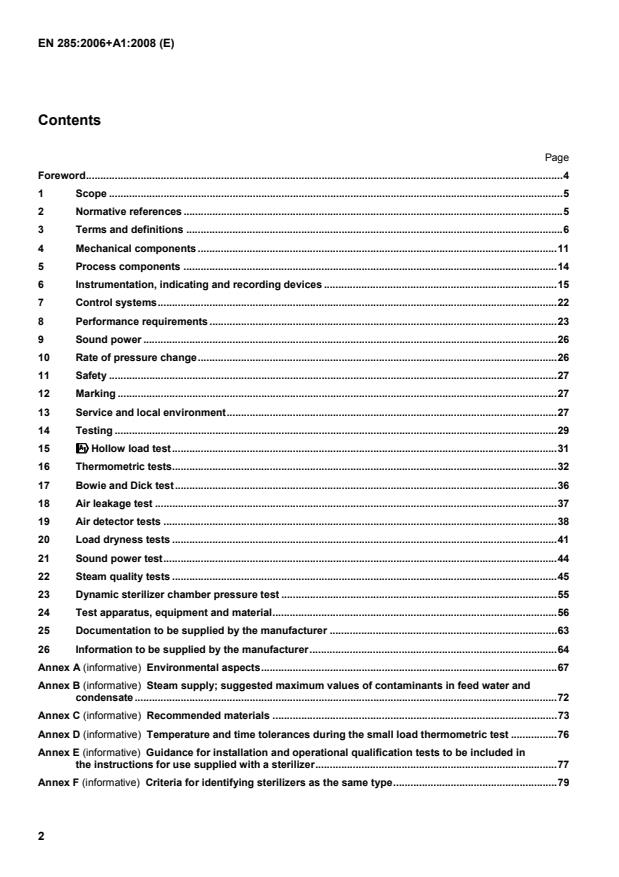
Contents
Page
Foreword.4
1 Scope .5
2 Normative references .5
3 Terms and definitions .6
4 Mechanical components .11
5 Process components .14
6 Instrumentation, indicating and recording devices .15
7 Control systems.22
8 Performance requirements .23
9 Sound power .26
10 Rate of pressure change.26
11 Safety .27
12 Marking .27
13 Service and local environment.27
14 Testing .29
15 !!!!Hollow load test.31
16 Thermometric tests.32
17 Bowie and Dick test.36
18 Air leakage test .37
19 Air detector tests .38
20 Load dryness tests .41
21 Sound power test.44
22 Steam quality tests .45
23 Dynamic sterilizer chamber pressure test .55
24 Test apparatus, equipment and material.56
25 Documentation to be supplied by the manufacturer .63
26 Information to be supplied by the manufacturer.64
Annex A (informative) Environmental aspects.67
Annex B (informative) Steam supply; suggested maximum values of contaminants in feed water and
condensate .72
Annex C (informative) Recommended materials .73
Annex D (informative) Temperature and time tolerances during the small load thermometric test .76
Annex E (informative) Guidance for installation and operational qualification tests to be included in
the instructions for use supplied with a sterilizer.77
Annex F (informative) Criteria for identifying sterilizers as the same type.79
Annex ZA (informative) Relationship between this European Standard and the Essential Requirements
of EU Directive 93/42/EEC on medical devices .80
Bibliography.81
Foreword
This document (EN 285:2006+A1:2008) has been prepared by Technical Committee CEN/TC 102 “Sterilizers for
medical purposes”, the secretariat of which is held by DIN.
This European Standard shall be given the status of a national standard, either by publication of an identical text or
by endorsement, at the latest by September 2008 and conflicting national standards shall be withdrawn at the latest
by November 2008.
This document includes Amendment 1, approved by CEN on 2008-02-04.
This document supersedes !EN 285:2006".
The start and finish of text introduced or altered by amendment is indicated in the text by tags ! ".
This document has been prepared under a mandate given to CEN by the European Commission and the European
Free Trade Association, and supports essential requirements of EU Directive(s).
For relationship with EU Directive(s), see informative Annex ZA, which is an integral part of this document.
This document does not specify requirements for the validation and routine control of sterilization by moist heat. A
European Standard specifying requirements for the validation and routine control of sterilization by moist heat was
prepared by CEN/TC 204 "Sterilization of medical devices", see EN 554 (currently under revision, see
prEN ISO 17665).
The performance requirements specified in this document are not intended for the process to be effective in
inactivating the causative agents of spongiform encephalopathies such as scrapie, bovine spongiform
encephalopathy and Creutzfeld-Jakob disease. However, some national regulations require the use of modified
steam processes as part of a general prion decontamination programme.
According to the CEN/CENELEC Internal Regulations, the national standards organizations of the following
countries are bound to implement this European Standard: Austria, Belgium, Bulgaria, Cyprus, Czech Republic,
Denmark, Estonia, Finland, France, Germany, Greece, Hungary, Iceland, Ireland, Italy, Latvia, Lithuania,
Luxembourg, Malta, Netherlands, Norway, Poland, Portugal, Romania, Slovakia, Slovenia, Spain, Sweden,
Switzerland and United Kingdom.
1 Scope
1.1 This European Standard specifies requirements and the relevant tests for large steam sterilizers primarily
used in health care for the sterilization of medical devices and their accessories contained in one or more
sterilization modules. The test loads described in this European Standard are selected to represent the majority of
loads (i.e. wrapped goods consisting of metal, rubber and porous materials) for the evaluation of general purpose
steam sterilizer for medical devices. However, specific loads (e.g. heavy metal objects or long and/or narrow
lumen) will require the use of other test loads.
Large steam sterilizers can also be used during the commercial production of medical devices.
1.2 This European Standard is not applicable to steam sterilizers designed to process a size of load less than
one sterilization module or having a chamber volume less than 60 l.
1.3 This European Standard does not describe a quality assurance system for the control of all stages of the
manufacture of the sterilizer.
NOTE Attention is drawn to the standards for quality management systems e.g. EN ISO 13485.
1.4 Planning and design of products applying to this European Standard should consider the environmental
impact from the product during its life cycle. Environmental aspects are addressed in Annex A.
NOTE Additional aspects of environmental impact are addressed in EN ISO 14971.
2 Normative references
The following referenced documents are indispensable for the application of this document. For dated references,
only the edition cited applies. For undated references, the latest edition of the referenced document (including any
amendments) applies.
EN 764-1:2004, Pressure equipment — Part 1: Terminology — Pressure, temperature, volume, nominal size
!deleted text"
EN 867-3, Non-biological systems for use in sterilizers — Part 3: Specification for Class B indicators for use in the
Bowie and Dick test
!EN 867-5, Non-biological systems for use in sterilizers — Part 5: Specification for indicator systems and
process challenge devices for use in performance testing for small sterilizers Type B and Type S"
EN 868-5, Packaging materials and systems for medical devices which are to be sterilized — Part 5: Heat and self-
sealable pouches and reels of paper and plastic film construction — Requirements and test methods
EN 1822 (all parts), High efficiency air filters (HEPA and ULPA)
EN 10088-1, Stainless steels — Part 1: List of stainless steels
EN 10088-3, Stainless steels — Part 3: Technical delivery conditions for semi-finished products, bars, rods, wire,
sections and bright products of corrosion resistant steels for general purposes
EN 12953 (all parts), Shell boilers
EN 13445 (all parts), Unfired pressure vessels
EN 14222, Stainless steel shell boilers
EN 60584-2:1993, Thermocouples — Part 2: tolerances (IEC 60584-2:1982 + A1:1989)
EN 60751:1995, Industrial platinum resistance thermometer sensors (IEC 60751:1983 + A1:1986)
EN 61010-1, Safety requirements for electrical equipment for measurement, control and laboratory use — Part 1:
General requirements (IEC 61010-1:2001)
EN 61010-2-040, Safety requirements for electrical equipment for measurement, control and laboratory use —
Part 2-040: Particular requirements for sterilizers and washer-disinfectors used to treat medical materials (IEC
61010-2- 040:2005)
EN 61326:1997, Electrical equipment for measurement, control and laboratory use — EMC requirements
(IEC 61326:1997)
EN 61672-1:2003, Electroacoustics — Sound level meters — Part 1: Specifications (IEC 61672-1:2002)
EN 61672-2:2003, Electroacoustics — Sound level meters — Part 2: Pattern evaluation tests (IEC 61672-2:2003)
EN ISO 3746:1995, Acoustics — Determination of sound power levels of noise sources using sound pressure —
Survey method using an enveloping measurement surface over a reflecting plane (ISO 3746:1995)
EN ISO 4017, Hexagon head screws — Product grades A and B (ISO 4017:1999)
3 Terms and definitions
For the purposes of this document, the terms and definitions given in EN 764-1:2004 and the following apply.
NOTE Other definitions relevant to validation are given in EN 554.
3.1
access device
means used to permit access to restricted parts of the equipment
NOTE This may be by dedicated key, code or tool.
3.2
air removal
removal of air from the sterilizer chamber and sterilizer load to facilitate steam penetration
3.3
automatic controller
device that, in response to pre-determined cycle variables, operates the sterilizer sequentially through the required
stages of the cycle(s)
3.4
biological indicator
microbiological test system providing a defined resistance to a specified sterilization process
[ISO/TS 11139:2001, definition 2.4]
3.5
calibration
set of operations that establish, under specified conditions, the relationship between values of a quantity indicated
by a measuring instrument or measuring system, or values represented by a material measure or a reference
material, and the corresponding values realized by standards
[IVM:1994, definition 6.11]
3.6
chamber depth
depth of the sterilizer chamber which is available for the sterilizer load
3.7
chamber height
height of the sterilizer chamber which is available for the sterilizer load
3.8
chamber width
width of the sterilizer chamber which is available for the sterilizer load
3.9
cycle complete
indication that the sterilization cycle has been completed according to programme and that the sterilized load is
ready for removal from the sterilizer chamber
3.10
door
lid or similar device provided as a means of closing and sealing the sterilizer chamber
3.11
double ended sterilizer
sterilizer in which there is a door at each end of the sterilizer chamber
!3.12
endpoint
point of the observed change as defined by the manufacturer occurring after the indicator has been exposed to
specified stated values
[EN ISO 11140-1:2005]"
3.13
equilibration time
period which elapses between the attainment of the sterilization temperature at the reference measurement point
and the attainment of the sterilization temperature at all points within the load
3.14
holding time
period for which the temperatures at the reference measurement point and at all points within the load are
continuously within the sterilization temperature band
NOTE The holding time follows immediately after the equilibration time. The extent of the holding time is related to the
sterilization temperature.
3.15
inoculated carrier
carrier on which a defined number of test organisms has been deposited
[EN 866-1:1997, definition 3.8]
3.16
installation qualification
IQ
process of obtaining and documenting evidence that equipment has been provided and installed in accordance
with its specification
[ISO/TS 11139:2001, definition 2.20]
3.17
loading door
door in a double ended sterilizer through which the sterilizer load is put into the sterilizer chamber prior to
sterilization
3.18
medical device
instrument, apparatus, implement, machine, appliance, implant, in vitro reagent or calibrator, software, material or
other similar or related article, intended by the manufacturer to be used, alone or in combination, for human beings
for one or more of the specific purpose(s) of
diagnosis, prevention, monitoring, treatment or alleviation of disease,
diagnosis, monitoring, treatment, alleviation of or compensation for an injury,
investigation, replacement, modification or support of the anatomy or of a physiological process,
supporting or sustaining life,
control of conception
disinfection of medical devices,
providing information for medical purposes by means of in vitro examination of specimens derived from the
human body,
and which does not achieve its primary intended action in or on the human body by pharmacological,
immunological or metabolic means, but which may be assisted in its function by such means
[EN ISO 13485:2003, definition 3.7]
3.19
non-condensable gas
air and other gas which will not condense under the conditions of steam sterilization
3.20
operating cycle
sequence of operating stages which is performed automatically by a sterilizer
3.21
operational qualification
OQ
process of obtaining and documenting evidence that installed equipment operates within predetermined limits when
used in accordance with its operational procedures
[ISO/TS 11139:2001, definition 2.24]
3.22
operator
person operating equipment for its intended purpose
3.23
plateau period
equilibration time plus the holding time
3.24
pressure vessel
vessel comprising the sterilizer chamber, jacket (if fitted), door(s) and components that are in permanent
connection with the sterilizer chamber
!3.25
process challenge device
PCD
item designed to constitute a defined resistance to a sterilization process and used to assess performance of the
process"
3.26
reference measurement point
point where the temperature sensor for the sterilization cycle control is located
3.27
reference standard
standard, generally having the highest metrological quality available at a given location or in a given organization,
from which measurements made there are derived
[IVM:1994, definition 6.6]
3.28
saturated steam
water vapour in a state of equilibrium between condensation and evaporation
[ISO 13683:1997, definition 3.18]
3.29
sterile
condition of a medical device that is free from viable microorganisms
[EN 556-1:2001, definition 3.4]
3.30
sterilization
validated process used to render a product free from viable microorganisms
[ISO/TS 11139:2001, definition 2.42]
NOTE In a sterilization process, the nature of microbial inactivation is described by an exponential function. Therefore the
presence of a viable microorganism on any individual item can be expressed in terms of probability. This probability can be
reduced to a very low number, it can never be reduced to zero.
3.31
sterilization cycle
operating cycle performed by a sterilizer for the purpose of sterilization
3.32
sterilization module
rectangular parallelepiped of dimensions 300 mm (height) × 600 mm (length) x 300 mm (width)
3.33
sterilization temperature
minimum temperature on which the evaluation of the sterilization efficacy is based
3.34
sterilization temperature band
temperature tolerance range for the load and the reference measurement point, the minimum of which is the
sterilization temperature
NOTE These temperatures are usually stated in whole degrees Celsius.
3.35
sterilizer
apparatus designed to achieve sterilization
3.36
sterilizer chamber
part of the sterilizer which receives the sterilizer load
[EN 554:1994, definition 3.27]
3.37
sterilizer load
items that are to be sterilized simultaneously in the same sterilizer chamber
3.38
superheated steam
water vapour whose temperature is higher than the boiling point of water at the corresponding pressure
3.39
test organism
microorganisms used for the manufacture of inoculated carriers
[EN 866-1:1997, definition 3.16]
3.40
type test
series of checks and tests for a particular design of sterilizer to demonstrate compliance with the requirements of
this European Standard
3.41
unloading door
door in a double ended sterilizer through which the sterilizer load is removed from the sterilizer chamber after a
sterilization cycle
3.42
usable space
space inside the sterilizer chamber which is not restricted by fixed parts and which is available to accept the
sterilizer load
3.43
works test
series of tests performed at the manufacturer´s works to demonstrate that each sterilizer will comply with its
specification
4 Mechanical components
4.1 Dimensions
The usable space within the sterilizer chamber shall accommodate one or more sterilization modules.
4.2 Materials
Materials in contact with steam shall:
resist attack from steam and condensate;
not cause deterioration of the quality of the steam;
not release any substances known to be toxic in such quantities that could create a health or
environmental hazard.
NOTE 1 Guidance on steam contaminants is given in Table B.2.
NOTE 2 Because of the different types of sterilizers and the large number of uses, it is not possible to specify detailed
requirements for materials for specific applications. The purchaser should provide the manufacturer with information about the
goods to be sterilized.
NOTE 3 Advice on the various combinations of materials is given in Annex C. However, for some applications, a combination
of materials selected from more than one group may be appropriate.
4.3 Pressure vessel
4.3.1 General
4.3.1.1 The pressure vessel shall comply with EN 13445.
4.3.1.2 The door seal shall be a replaceable component.
It shall be possible to inspect and clean the surface of the door seal which comes into contact with the sealing
faces without the need to dismantle the door assembly.
4.3.1.3 After closing the sterilizer door, it shall be possible to open it before a cycle has been started.
4.3.1.4 It shall not be possible to open a sterilizer door(s) during a cycle.
4.3.2 Double ended sterilizers
4.3.2.1 Except for maintenance purposes it shall not be possible for more than one door to be open at one
time.
4.3.2.2 It shall not be possible to open the unloading door until a cycle complete indication is obtained.
4.3.2.3 It shall not be possible to open the unloading door if a Bowie and Dick cycle or an air leakage test has
been carried out (see 7.1.14 and 7.1.15).
4.3.2.4 The control used to start the sterilization cycle shall be located at the loading side of the sterilizer.
4.3.3 Test connections
4.3.3.1 The connections as required by 4.3.3.2 and 4.3.3.3 shall be provided.
NOTE The test connection for pressure test and temperature test as shown in Figure 1 and Figure 2 may be provided as a
combined detachable adapter.
4.3.3.2 A test connection in accordance with Figure 1 shall be fitted to the sterilizer chamber or in a pipe which
is in direct connection with the sterilizer chamber providing it causes no adverse effect on the measurement of the
pressure in the sterilizer chamber. The test connection which is used for the connection of a test instrument shall
be provided with a cap, marked PT (pressure test) and sealed with either an O-ring-seal or a flat seal.
Dimensions in millimetres
Key
a
Pipe thread EN ISO 228-G 1/2 A
Figure 1 — Connection for test instrument
4.3.3.3 A straight connecting sleeve, in accordance with Figure 2, shall be provided at a point of easy access
in order to pass flexible cords to the temperature sensors.
Dimensions in millimetres
Key
a
Pipe thread EN ISO 228-G 1 A
Figure 2 — Connection sleeve for thermoelements
The connecting sleeve with its O-ring-seal or flat seal shall be closed with a cap, and a temperature proof and
mechanically resistant soft packing. The cap shall be marked with the letters TT (temperature test).
4.3.3.4 Test tee(s) and valve cock(s) with sealing plug(s) shall be fitted to permit connection of reference
instruments for the calibration of all pressure instruments, connected to the sterilizer chamber and jacket (see 6.1.2
and 6.1.4).
4.3.4 Insulating material
Except where insulation would interfere with the function and operation of the sterilizer, external surfaces of the
pressure vessel shall be insulated to reduce heat transmission to the environment [see also 26.2 g) and h)].
4.4 Framework and panelling
4.4.1 Where the sides of the sterilizer are visible from the operator area, they shall be enclosed with panelling.
The manufacturer shall provide instructions for the cleaning of the panelling.
NOTE The panelling should have a corrosion-resistant finish to the cleaning agents specified by the manufacturer.
4.4.2 The panelling of the sterilizer shall allow access for maintenance work. Such panelling shall be
demountable or the dimensions of any personal access shall be not less than 500 mm wide and not less than
1 500 mm high, and the access shall not be obstructed.
NOTE 1 If the pressure equipment is housed in a frame, this frame should not promote corrosion of the equipment.
NOTE 2 The access for maintenance should be positioned so that it will not compromise the safety of either the product or
persons.
NOTE 3 Requirements for access are specified in EN 61010-2-040.
4.4.3 The panelling shall be designed to provide a continuous contact with the surfaces of the building in which it
is installed when these surfaces are within the tolerances given in Tables 1 and 2.
Sterilizers designed for incorporation into existing buildings, or purpose built rooms shall provide a continuous joint
with adjacent surfaces when these are within the limits given in Tables 1 and 2.
Table 1 — Tolerances for the aperture into which the sterilizer is installed
Dimension Tolerance
m mm
Horizontal plane Vertical plane
up to 3 ± 12 ± 16
above 3 to 6 ± 16 ± 16
above 6 to 15 ± 24 ± 20
above 15 to 30 ± 24 ± 20
above 30 ± 30 ± 30
Table 2 — Deviation from vertical and horizontal flatness and alignment
Distance between Deviation
checkpoints
m mm
Finished surfaces of walls Finished floor
and ceilings (bearing surface)
0,1 3 2
1 5 4
4 10 10
10 20 12
15 25 15
5 Process components
5.1 Pipework and fittings
5.1.1 Pipe joints and fittings shall be both pressure-tight and vacuum-tight.
5.1.2 Except where this will interfere with the function of the sterilizer the pipework for steam or water at a
temperature greater than 60 °C shall be thermally insulated to reduce heat transmission to the environment [see
also 26.2 g) and h)].
NOTE To reduce the formation of condensation cold water pipework should be insulated.
5.1.3 Means shall be provided to prevent the ingress of particulates of a size and quantity which could affect the
performance of a sterilizer.
NOTE Strainers of a relevant pore size may be used.
5.1.4 All control valves in the pipework shall be marked with permanent identification in relation to their functions
(see 12.2).
NOTE Reference numbers or written descriptions can be used.
5.2 Steam source
5.2.1 General
A sterilizer can be operated with steam from an external supply, or generated solely for the sterilizer or a group of
sterilizers, or generated from within the sterilizer chamber.
5.2.2 Steam supply from a dedicated steam generator
5.2.2.1 Shell boilers shall comply with EN 14222 or EN 12953 as applicable.
5.2.2.2 The feed water inlet shall be designed to prevent back-syphoning into the feed water system.
NOTE This may require the use of a break tank which should be made from material resistant to water at 100 °C.
5.2.2.3 The power requirements and the capacity of the steam generator shall be sufficient to ensure that the
steam demand specified for the sterilizer can be met.
5.2.2.4 The manufacturer shall specify the quality and quantity of feed water (see 13.3.7, 26.2 e) and m) and
Table B.1).
5.2.3 Steam supply from a central source
The manufacturer shall specify the quality and quantity of the steam to be supplied for use with the sterilizer [see
26.2 d)].
NOTE See Table B.2 for guidance on condensate derived from the steam.
5.3 Air filter
5.3.1 Where the sterilization cycle requires the admission of air into the sterilizer chamber, the air shall be
admitted through a filter.
NOTE Air filters should be constructed from material resistant to corrosion and biodegradation. The filter material should be
supported in a manner which prevents damage to the filter medium.
5.3.2 The filter shall comply with class H 14 in accordance with EN 1822 or better and the most penetrating
particle size shall be 0,3 µm or smaller when tested in accordance with EN 1822.
5.3.3 The filter unit shall be accessible, replaceable and mounted externally to the sterilizer chamber in such a
manner that the filter material is kept dry.
5.3.4 Means shall be provided to prevent the penetration of steam, water and/or condensate from the sterilizer
chamber into the filter.
5.4 Vacuum system
A vacuum system shall be used for air removal and drying. The manufacturer shall specify the depth of vacuum
needed to comply with the requirements for the tests specified in this European Standard [see 26.2 r)].
6 Instrumentation, indicating and recording devices
6.1 Equipment
6.1.1 General
6.1.1.1 All instruments and indicating devices specified in Clause 6 shall be located in a position where they
can be readily viewed by the operator under normal operation of the sterilizer and their function shall be identified.
6.1.1.2 Unless otherwise specified instruments and gauges shall be readable by normal or corrected vision
from a distance of (1,00 ± 0,15) m and with a minimum external illumination of (215 ± 15) lx.
6.1.1.3 Each instrument and gauge shall be located in a manner that ensures that the maximum and minimum
values of temperature and humidity specified by the instrument and gauge manufacturers are not exceeded during
normal operation.
NOTE Normally the temperature and relative humidity in the vicinity of instruments and gauges should not exceed 50 °C
and 85 % respectively.
6.1.2 Instruments
Sterilizers shall be provided with at least the following instruments:
a) sterilizer chamber temperature indicating instrument;
b) sterilizer chamber temperature recorder;
c) sterilizer chamber pressure indicating instrument;
d) sterilizer chamber pressure recorder;
e) jacket pressure indicating instrument (if the sterilizer is fitted with a jacket intended to be pressurized);
f) steam pressure gauge (if a steam generator is incorporated within the sterilizer panelling).
NOTE 1 Items b) and d) may be incorporated into a single recording system.
NOTE 2 Except where required in EN 61010-2-040 the instruments a), c), e) and f) may be incorporated into a system
whereby the display of any measurement may be selected by the user.
6.1.3 Indicating devices
6.1.3.1 Sterilizers shall be provided with at least the following indicating devices:
a) visual display indicating "door(s) locked";
b) visual display indicating "in progress";
c) visual display indicating "cycle complete";
d) visual display indicating "fault" (see 7.2);
e) indication of the operating cycle selected;
f) operating cycle counter;
g) operating cycle stage indication.
NOTE The operating cycle stage indication may incorporate items a), b) and c).
6.1.3.2 The cycle complete indication shall be cancelled when the door opening has been initiated.
6.1.4 Double ended sterilizer
Both ends of the sterilizer shall be provided with at least:
a) sterilizer chamber pressure indicating instrument;
b) visual display indicating "doors locked";
c) visual display indicating "in progress";
d) visual display indicating "cycle complete";
e) visual display indicating "fault" (see 7.2).
6.2 Sensors, indicating instruments and time equipment
6.2.1 Temperature
6.2.1.1 Temperature sensors
Temperature sensors shall be either platinum resistance types complying with Class A of EN 60751:1995 or
thermocouples complying with one of the tables specified in Tolerance Class 1 of EN 60584-2:1993.
NOTE Other sensors of demonstrated equivalence can be used.
The temperature sensor shall have a response time τ ≤ 5 s when tested in water.
At least two independent temperature sensors shall be provided. These sensors shall be connected to the sterilizer
chamber temperature indicating instrument, temperature recorder and temperature controller as indicated in
Figure 3 a) or b). The arrangement illustrated in Figure 3 c) and d) shall not be permitted.
Sterilizer chamber temperature Temperature recorder Control and/or monitoring of
indicating instrument plateau period by temperature
Key
1 sterilizer chamber
Figure 3 — Possible arrangement of temperature sensors
The sensor used for the control of the sterilization cycle and for the indication and also the sensor used to record
the sterilization cycle shall be located at the point identified by the manufacturer as the reference measurement
point (see 7.1.4).
6.2.1.2 Moveable temperature sensors inside sterilizers
Where a moveable temperature sensor and its wiring is located inside the sterilizer chamber, it shall be
manufactured in such a way as to be temperature resistant as well as pressure-tight, vacuum-tight and steam-tight.
6.2.1.3 Sterilizer chamber temperature indicating instrument
The sterilizer chamber temperature indicating instrument shall:
a) be either digital or analogue;
b) be graduated in degrees Celsius;
c) have a scale which includes the range 50 °C to 150 °C;
d) have an accuracy of ± 1 % or better over the scale range 50 °C to 150 °C;
e) for analogue instruments be graduated in divisions not greater than 2 °C;
f) for digital instruments have a resolution of 0,1 °C or better;
g) be adjusted to an accuracy of ± 0,5 °C or better at the sterilization temperature;
h) have an ambient temperature error compensation not exceeding 0,04 K/K;
i) have means to adjust in situ by the use of an access device without dismantling the instrument.
6.2.2 Pressure
The sterilizer chamber pressure indicating instrument shall:
a) be either digital or analogue;
b) be graduated in kilopascals or bars;
c) have a scale which includes the range 0 kPa to 400 kPa or - 1 bar to 3 bar with a zero reading at absolute
vacuum or ambient pressure respectively;
d) have an accuracy of ± 1,6 % or better over the scale range 0 kPa to 400 kPa (- 1 bar to 3 bar);
e) for analogue instruments be graduated in divisions not greater than 20 kPa (0,2 bar);
f) for digital instruments have a resolution of 1 kPa (0,01 bar) or better;
g) be adjusted to an accuracy of ± 5 kPa (± 0,05 bar) or better at the operating pressure;
h) have an ambient temperature error compensation not exceeding 0,04 %/K over the scale range 0 kPa to
400 kPa (- 1 bar to 3 bar);
i) have means to adjust in situ by the use of an access device without dismantling the instrument.
NOTE Where digital pressure indicators are used, an additional mechanically actuated indicator can be required to comply
with national pressure vessel regulations. Where an analogue instrument is provided only for this purpose, the requirement for
adjustment in situ is waived.
6.2.3 Time indicating equipment
If time indicators are fitted they shall:
a) be graduated in hours, minutes and seconds as applicable;
b) have an error not exceeding 1 %.
6.3 Recorders and records
6.3.1 General
6.3.1.1 The recorder shall be either analogue or digital.
6.3.1.2 The recorder shall be independent such that the measuring chain as well as value data processing and
printed values are separate from the automatic controller.
NOTE This does not exclude the transfer of informative data from the automatic controller to the recorder and vice versa,
via a combined system for data transfer.
6.3.1.3 Records shall include the values for the pressure transition points throughout the operating cycle. The
printing of data shall be sufficient to confirm that the cycle parameters have been attained and maintained within
the permitted tolerances throughout the operating cycle (see also Clause 8).
NOTE Figure 4 and Table 3 illustrate the points where cycle variables should be recorded for a specimen sterilization
cycle.
6.3.1.4 The recorder shall produce a record which shall be readable as defined in 6.3.1.5 when stored in
defined conditions for a period of not less than 11 years.
6.3.1.5 Records shall be readable when viewed at a distance of (250 ± 25) mm with normal or corrected vision
in an illumination of (215 ± 15) lx.
6.3.1.6 If times are marked, units shall be either in seconds or minutes or multiples thereof.
Time periods up to 5 min shall have an accuracy of ± 2,5 % or better and for periods above 5 min of ± 1 % or
better.
6.3.1.7 Means shall be provided to adjust the recorder in situ by the use of an access device.
6.3.2 Recorders producing analogue records
6.3.2.1 Chart speed
Recorders producing analogue records shall have a chart speed of not less than 4 mm/min.
6.3.2.2 Temperature
Temperature recorders producing analogue records shall:
a) have a chart graduated in degrees Celsius;
b) have a scale which includes the range 50 °C to 150 °C;
c) have an accuracy of ± 1 % or better over the scale range 50 °C to 150 °C;
d) have a chart with graduated divisions not greater than 2 °C;
e) have a resolution of 1 °C or better;
f) be adjusted to an accuracy of ± 1 °C or better at the sterilization temperature;
g) have a sampling rate for each channel of 2,5 s or better.
6.3.2.3 Pressure
Pressure recorders producing analogue records shall:
a) have a chart graduated in kilopascals or bars;
b) have a scale which includes the range 0 kPa to 400 kPa or - 1 bar to 3 bar with a zero reading at absolute
vacuum or ambient pressure respectively;
c) have an accuracy of ± 1,6 % or better over the scale range 0 kPa to 400 kPa (- 1 bar to 3 bar);
d) have a chart graduated in divisions not greater than 20 kPa (0,2 bar);
e) have a resolution of 5 kPa (0,05 bar) or better;
f) be adjusted to an accuracy of ± 5 kPa (± 0,05 bar) or better at the operating pressure;
g) have a sampling rate for each channel of 1 s or better.
6.3.3 Recorders producing digital records
6.3.3.1 Temperature
Temperature recorders producing digital records shall:
a) have alphanumeric characters;
b) have data defined by text;
c) have a range which includes 50 °C to 150 °C;
d) have a resolution of 0,1 °C or better;
e) have an accuracy of ± 1 % or better over the range 50 °C to 150 °C;
f) have a paper width which has a space for a minimum of 15 characters/line;
g) have a sampling rate for each channel of 2,5 s or better.
6.3.3.2 Pressure
Pressure recorders producing digital records shall:
a) have alphanumeric characters;
b) have data defined by text;
c) have a range which includes 0 kPa to 400 kPa (- 1 bar to 3 bar);
d) have a resolution of 1 kPa (0,01 bar) or better;
e) have an accuracy of ± 1,6 % or better over the range 0 kPa to 400 kPa (- 1 bar to 3 bar);
f) have a paper width which has a space for a minimum of 15 characters/line;
g) have a sampling rate for each channel of 1 s or better.
Table 3 — Examples of values to be recorded
a
a
Programme Time Temperature Pressure Sterilization Date and sterilizer
step identification
(measured value) Cycle Counter No
identification
ON X X
START X X X X
b
t
X X
b
t X X
t X X X
t
X X X
t X X
t X X
END X
OFF X
a
Optional for analogue records
b
For each change:
t time at the start of the first steam injection;
t time at the start of the second vacuum pulse;
t time at the start of the plateau period;
t time at the end of the holding time;
t time at the start of the drying period;
t time at the end of the drying period.
Key
1 start 2 end
Figure 4 — Diagram of a specimen sterilization cycle given as an example only
7 Control systems
7.1 General
7.1.1 The sterilizer shall be operated by an automatic controller which has one or more pre-set operating cycles.
NOTE 1 The user may specify the use of an access device for the selection and/or starting of the cycle(s) used for
production or test.
NOTE 2 Automatic loading and unloading can be performed before the sterilization cycle start and after a cycle complete.
7.1.2 The parameters identified by the manufacturer as critical to the sterilization process shall be reproducible
within the limits identified in 7.1.3. This shall be demonstrated by the tests specified in this European Standard.
7.1.3 The manufacturer shall specify the parameters programmed into the automatic controller and the
tolerances that will ensure the performance requirements in !8.2" to be met.
NOTE See Figure 4 and Table 3.
7.1.4 The reference measurement point shall be selected in such a way that throughout the plateau period the
temperature at this point correlates with the temperature in the usable space.
The temperature relationship between the reference measurement point selected and the location identified as the
coolest part of the usable space shall be determined.
7.1.5 A device shall be fitted such that if a failure of the automatic controller occurs, the pressure within the
sterilizer chamber can be returned to atmospheric pressure to allow the loading door to be safely opened.
7.1.6 Measurement systems for sterilizer chamber temperature and pressure shall be fitted with broken sensor
monitoring (see 7.2.4) which will cause a fault to be indicated.
7.1.7 The error of any controlled time period shall not
...