

EN 12953-6:2011
(Main)Shell Boilers - Part 6: Requirements for equipment for the boiler
- Abstract
This part of this European Standard specifies the minimum requirements for safety related equipment for shell boilers as defined in EN 12953-1, to ensure the boiler operates within the allowable limits (pressure, temperature, etc.) and if the limits are exceeded the energy supply shall be interrupted and locked out without manual (human) intervention at the boiler.
NOTE 1 The maximum time of operation without manual (human) intervention should be defined for each boiler system.
NOTE 2 Annex C (informative) gives recommendations of operation and testing of the boiler system with a maximum time of operation without manual (human) intervention of 72 hours.
- Status
- Withdrawn
- Publication Date
- 15-Feb-2011
- Withdrawal Date
- 06-Oct-2026
- Technical Committee
- CEN/TC 269 - Shell and water tube boilers
- Drafting Committee
- CEN/TC 269/WG 3 - Equipment
- Current Stage
- 9960 - Withdrawal effective - Withdrawal
- Start Date
- 18-Dec-2024
- Completion Date
- 07-Oct-2026
- Directive
- 2014/68/EU - Directive 2014/68/EU of the European Parliament and of the Council of 15 May 2014 on the harmonisation of the laws of the Member States relating to the making available on the market of pressure equipmentOJ Ref: C 293/01 OJ Date: 12-Aug-2016
97/23/EC - Pressure equipmentOJ Ref: C, C 104 OJ Date: 11-Apr-2012

Relations
- Effective Date
- 22-Dec-2008
- Effective Date
- 19-Jan-2023
- Effective Date
- 09-Feb-2026
- Effective Date
- 28-Jan-2026
- Refers
EN 12953-2:2002 - Shell boilers - Part 2: Materials for pressure parts of boilers and accessories - Effective Date
- 28-Jan-2026
- Effective Date
- 28-Jan-2026
- Refers
EN 12953-8:2001 - Shell boilers - Part 8: Requirements for safeguards against excessive pressure - Effective Date
- 28-Jan-2026
- Effective Date
- 28-Jan-2026
- Effective Date
- 28-Jan-2026
- Refers
EN 12953-10:2003 - Shell boilers - Part 10 : Requirements for feedwater and boiler water quality - Effective Date
- 28-Jan-2026
- Effective Date
- 28-Jan-2026
- Effective Date
- 28-Jan-2026
- Effective Date
- 28-Jan-2026
Get Certified
Connect with accredited certification bodies for this standard

DNV
DNV is an independent assurance and risk management provider.

Lloyd's Register
Lloyd's Register is a global professional services organisation specialising in engineering and technology.
DNV Energy Systems
Energy and renewable energy certification.
Sponsored listings
Frequently Asked Questions
EN 12953-6:2011 is a standard published by the European Committee for Standardization (CEN). Its full title is "Shell Boilers - Part 6: Requirements for equipment for the boiler". This standard covers: This part of this European Standard specifies the minimum requirements for safety related equipment for shell boilers as defined in EN 12953-1, to ensure the boiler operates within the allowable limits (pressure, temperature, etc.) and if the limits are exceeded the energy supply shall be interrupted and locked out without manual (human) intervention at the boiler. NOTE 1 The maximum time of operation without manual (human) intervention should be defined for each boiler system. NOTE 2 Annex C (informative) gives recommendations of operation and testing of the boiler system with a maximum time of operation without manual (human) intervention of 72 hours.
This part of this European Standard specifies the minimum requirements for safety related equipment for shell boilers as defined in EN 12953-1, to ensure the boiler operates within the allowable limits (pressure, temperature, etc.) and if the limits are exceeded the energy supply shall be interrupted and locked out without manual (human) intervention at the boiler. NOTE 1 The maximum time of operation without manual (human) intervention should be defined for each boiler system. NOTE 2 Annex C (informative) gives recommendations of operation and testing of the boiler system with a maximum time of operation without manual (human) intervention of 72 hours.
EN 12953-6:2011 is classified under the following ICS (International Classification for Standards) categories: 27.060.30 - Boilers and heat exchangers; 27.100 - Power stations in general. The ICS classification helps identify the subject area and facilitates finding related standards.
EN 12953-6:2011 has the following relationships with other standards: It is inter standard links to EN 12953-6:2002, EN 12953-6:2024, EN 50156-1:2004, EN 12953-9:2007, EN 12953-2:2002, EN 12953-12:2003, EN 12953-8:2001, EN 12953-7:2002, EN 12953-1:2002, EN 12953-10:2003, EN 12953-13:2012, EN 14222:2021, EN 12953-3:2016. Understanding these relationships helps ensure you are using the most current and applicable version of the standard.
EN 12953-6:2011 is associated with the following European legislation: EU Directives/Regulations: 2014/68/EU, 97/23/EC; Standardization Mandates: M/071. When a standard is cited in the Official Journal of the European Union, products manufactured in conformity with it benefit from a presumption of conformity with the essential requirements of the corresponding EU directive or regulation.
EN 12953-6:2011 is available in PDF format for immediate download after purchase. The document can be added to your cart and obtained through the secure checkout process. Digital delivery ensures instant access to the complete standard document.
Standards Content (Sample)
2003-01.Slovenski inštitut za standardizacijo. Razmnoževanje celote ali delov tega standarda ni dovoljeno.Mnogovodni kotli - 6. del: Zahteve za opremo kotlaGroßwasserraumkessel - Teil 6: Anforderungen an die Ausrüstung für den KesselChaudières à tube de fumée - Partie 6: Exigences pour l'équipement de la chaudièreShell Boilers - Part 6: Requirements for equipment for the boiler27.060.30Grelniki vode in prenosniki toploteBoilers and heat exchangersICS:Ta slovenski standard je istoveten z:EN 12953-6:2011SIST EN 12953-6:2011en,fr,de01-november-2011SIST EN 12953-6:2011SLOVENSKI
STANDARDSIST EN 12953-6:20021DGRPHãþD
EUROPEAN STANDARD NORME EUROPÉENNE EUROPÄISCHE NORM
EN 12953-6
February 2011 ICS 27.060.30 Supersedes EN 12953-6:2002English Version
Shell Boilers - Part 6: Requirements for equipment for the boiler Chaudières à tube de fumée - Partie 6: Exigences pour l'équipement de la chaudière
Großwasserraumkessel - Teil 6: Anforderungen an die Ausrüstung für den Kessel This European Standard was approved by CEN on 1 January 2011.
CEN members are bound to comply with the CEN/CENELEC Internal Regulations which stipulate the conditions for giving this European Standard the status of a national standard without any alteration. Up-to-date lists and bibliographical references concerning such national standards may be obtained on application to the CEN-CENELEC Management Centre or to any CEN member.
This European Standard exists in three official versions (English, French, German). A version in any other language made by translation under the responsibility of a CEN member into its own language and notified to the CEN-CENELEC Management Centre has the same status as the official versions.
CEN members are the national standards bodies of Austria, Belgium, Bulgaria, Croatia, Cyprus, Czech Republic, Denmark, Estonia, Finland, France, Germany, Greece, Hungary, Iceland, Ireland, Italy, Latvia, Lithuania, Luxembourg, Malta, Netherlands, Norway, Poland, Portugal, Romania, Slovakia, Slovenia, Spain, Sweden, Switzerland and United Kingdom.
EUROPEAN COMMITTEE FOR STANDARDIZATION
COMITÉ EUROPÉEN DE NORMALISATION EUROPÄISCHES KOMITEE FÜR NORMUNG
Management Centre:
Avenue Marnix 17,
B-1000 Brussels © 2011 CEN All rights of exploitation in any form and by any means reserved worldwide for CEN national Members. Ref. No. EN 12953-6:2011: ESIST EN 12953-6:2011
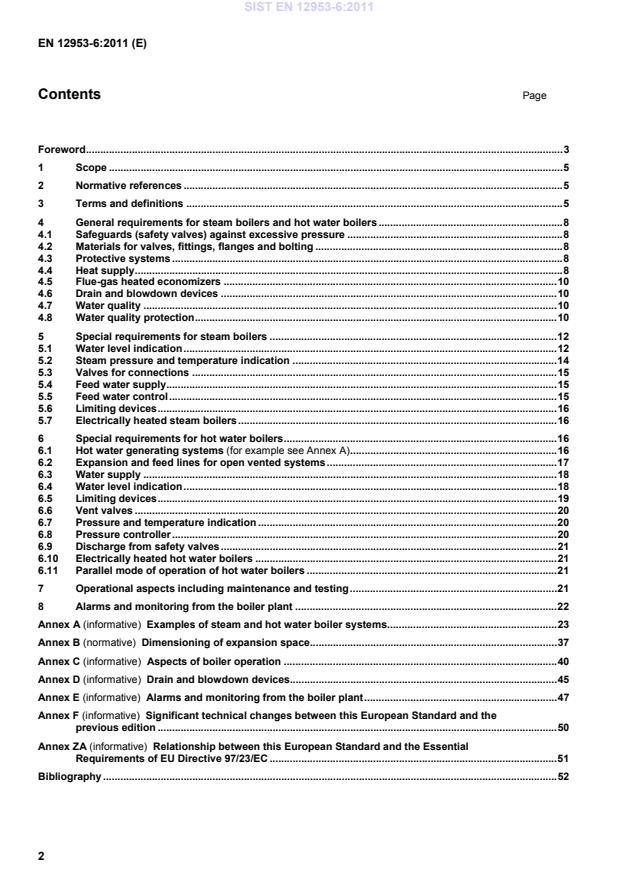
Foreword . 31Scope . 52Normative references . 53Terms and definitions . 54General requirements for steam boilers and hot water boilers . 84.1Safeguards (safety valves) against excessive pressure . 84.2Materials for valves, fittings, flanges and bolting . 84.3Protective systems . 84.4Heat supply . 84.5Flue-gas heated economizers . 104.6Drain and blowdown devices . 104.7Water quality . 104.8Water quality protection . 105Special requirements for steam boilers . 125.1Water level indication . 125.2Steam pressure and temperature indication . 145.3Valves for connections . 155.4Feed water supply. 155.5Feed water control . 155.6Limiting devices . 165.7Electrically heated steam boilers . 166Special requirements for hot water boilers . 166.1Hot water generating systems (for example see Annex A) . 166.2Expansion and feed lines for open vented systems . 176.3Water supply . 186.4Water level indication . 186.5Limiting devices . 196.6Vent valves . 206.7Pressure and temperature indication . 206.8Pressure controller . 206.9Discharge from safety valves . 216.10Electrically heated hot water boilers . 216.11Parallel mode of operation of hot water boilers . 217Operational aspects including maintenance and testing . 218Alarms and monitoring from the boiler plant . 22Annex A (informative)
Examples of steam and hot water boiler systems. 23Annex B (normative)
Dimensioning of expansion space . 37Annex C (informative)
Aspects of boiler operation . 40Annex D (informative)
Drain and blowdown devices . 45Annex E (informative)
Alarms and monitoring from the boiler plant . 47Annex F (informative)
Significant technical changes between this European Standard and the
previous edition . 50Annex ZA (informative)
Relationship between this European Standard and the Essential
Requirements of EU Directive 97/23/EC . 51Bibliography . 52 SIST EN 12953-6:2011
NOTE 1 The maximum time of operation without manual (human) intervention should be defined for each boiler system. NOTE 2 Annex C (informative) gives recommendations of operation and testing of the boiler system with a maximum time of operation without manual (human) intervention of 72 hours. 2 Normative references The following referenced documents are indispensable for the application of this European Standard. For dated references, only the edition cited applies. For undated references, the latest edition of the referenced document (including any amendments) applies. EN 12953-1:2002, Shell boilers — Part 1: General EN 12953-2:2002, Shell boilers — Part 2: Materials for pressure parts of boilers and accessories EN 12953-7:2002, Shell boilers — Part 7: Requirements for firing systems for liquid and gaseous fuels for the boilers EN 12953-8:2001, Shell boilers — Part 8: Requirements for safeguards against excessive pressure EN 12953-9:2007, Shell boilers — Part 9: Requirements for limiting devices of the boiler and accessories EN 12953-10:2003, Shell boilers — Part 10: Requirements for feedwater and boiler water quality EN 12953-12:2003, Shell boilers — Part 12: Requirements for grate firing systems for solid fuels for the boiler EN 50156-1:2004, Electrical equipment for furnaces and ancillary equipment — Part 1: Requirements for application design and installation 3 Terms and definitions For the purposes of this document, the terms and definitions given in EN 12953-1:2002 and the following apply. 3.1 controls devices used for maintaining the variable to be controlled (pressure, temperature, etc.) at a specific value (set point) 3.2 limiter limiting device that, on reaching a fixed value (pressure, temperature, etc.) is used to interrupt and lock-out the energy supply and requires manual unlocking before restart limiting device requires: measuring or detection function, and SIST EN 12953-6:2011
Figure 1 — Protective devices and safety accessories according to PED 97/23/EC 3.3 independent ability to function as required without dependence upon other equipment 3.4 lock-out safety shut-down condition of the protective system, such that a restart can only be accomplished by a manual reset of the limiter or by a manual reset of the safety logic and by no other means 3.5 functional check testing of the safety device to ensure it performs its intended function 3.6 electrically heated steam boilers steam boilers in which water is heated by an electric current flowing between electrodes or by immersion heaters 3.7 electrically heated hot water boilers hot water boilers in which water is heated by an electric current flowing between electrodes or by immersion heaters 3.8 expansion vessels
containers to compensate for temperature dependent changes in water volume
closed expansion vessels are pressurised open expansion vessels are vented to atmospheric pressure and are not pressurised SIST EN 12953-6:2011
maximum heat output (water mass flow times the difference between outlet and inlet enthalpy) that can be generated during continuous operation and at which hot water boilers can be operated 3.10 allowable flow temperature highest temperature, measured at the outlet branch at which the hot water boiler can be operated (see 6.5.2.3) 3.11 maximum continuous rating (MCR) maximum continuous steam output that can be generated during continuous operation taking the specified steam condition into consideration 3.12 internal steam cushion steam filled space located within the steam boiler to accommodate changes in volume 3.13 external steam cushion steam filled space located outside the steam boiler to accommodate changes in volume 3.14 gas cushion gas-filled space to accommodate changes in volume 3.15 effective heat transfer
3.15.1 for a hot water boiler, the heat supply is on and flow of water is greater than or equal to a specified minimum value 3.15.2 for a steam boiler, the heat supply is on, the start-up or steam valve is open and the temperature is greater than the saturation temperature at ambient pressure 3.16 normal operation automatic operation, with all regulating circuits and controls (open loops/closed loops) in automatic mode and with the set points and parameters valid for normal operation NOTE Normal operation also includes the automatic switching on and off of the assigned actuators (e.g. burner). 3.17 normal shut down controlled switch off of the boiler either operated manually or automatically
3.18 make-up water water which compensates for losses of water and steam from the system 3.19 feedwater mixture of returned condensate and/or make up water supplied to the boiler inlet SIST EN 12953-6:2011
external system for keeping the hot water system pressure within the required pressure limits NOTE In order to prevent corrosion caused by oxygen infiltration, systems that prevent the system water being in direct contact with air should be preferred. 3.21 boiler attendant boiler operator
skilled person appointed for operating the boiler plant
4 General requirements for steam boilers and hot water boilers
4.1 Safeguards (safety valves) against excessive pressure Each steam boiler and hot water boiler, except open vented hot water boiler, shall be equipped with safeguards (safety valves) against excessive pressure in accordance with EN 12953-8. Superheaters and economizers shall be protected in accordance with EN 12953-8. Where a superheater or an economizer can be isolated a pressure gauge connection shall be provided. 4.2 Materials for valves, fittings, flanges and bolting The conditions and requirements to select the material shall be in accordance with EN 12953-2. 4.3 Protective systems
4.3.1 All limiters and their installation shall be designed in accordance with EN 12953-9. The protective systems shall be in accordance with EN 50156-1. 4.3.2 The application design and installation of the electrical safety circuit as well as the electrical and control equipment for the heat supply and its auxiliary equipment shall be in accordance with EN 50156-1. A hazard analysis shall be carried out for each limiting device function and appropriate levels of functional safety implemented. NOTE 1 Typical Safety Integrity Level (SIL) requirements for boiler protective systems are not less than 2. NOTE 2
It should be possible to stop the boiler by additional devices outside the boiler such as shut-off valve, emergency shut-off, fire detectors, etc. 4.3.3 Functional check of all limiters shall be possible at any time during operation e.g. by simulation where appropriate in accordance with manufacturer's operating instructions (see Clause 7). 4.3.4 When a limiter activates, information shall be given to indicate which limiter has activated.
4.3.5 After lock out, the steam boiler/hot water boiler shall be physically checked by the boiler attendant (operator), before start-up (see 4.4.2).
4.4 Heat supply
4.4.1 General The requirements for heat supply to steam boilers and hot water boilers shall be in accordance with either EN 12953-7 or EN 12953-12 depending on fuel type.
The start-up sequence shall consider as a minimum the following points which are to be defined by the manufacturer: lock out by i.e. limiters;
minimum flow of water for hot water boilers to avoid over heating and to reach effective heat transfer; minimum temperature of water for hot water boilers to avoid corrosion; minimum temperature of critical parts of boilers to avoid unacceptable thermal stresses; steam output as a function of pressure of steam boilers to improve internal mixing (flow) and to avoid thermal stresses (effective heat transfer); sequence shall contain times (or pressures) and burner loads for a gentle start-up to avoid thermal stresses; additional heat supply requirements like i.e. maximum permitted low loads, minimum number of burner steps for stepped burner or minimum burner adjustment time between low and high load for infinitely variable burners. 4.4.3 Normal shut down The control sequence designed for normal shutdown shall involve the low load position of heat supply before switching off the boiler. SIST EN 12953-6:2011
The boiler water conductivity shall be continuously monitored to ensure the water quality remains within the allowable limits prescribed by the manufacturer's operating instructions and EN 12953-10.
If the limit values prescribed by the manufacturer can be exceeded, an adequate suitable device shall automatically cut off and lock out the heat supply.
NOTE The device should comply with the general requirements for limiting devices in EN 12953-9:2007, Clause 4. In addition, the suitability of the device should be verified by type testing. 4.8.2 Condensate in steam boiler plants A hazard analysis shall be carried out to identify if there is a risk that harmful matter (e.g. oil, grease, organic material, acid, lye, seawater, hardness etc.) can enter with the condensate into the feed water system and/or into the boiler that will compromise the safety of the boiler or the operation of the limiters within the period of operation without manual intervention. SIST EN 12953-6:2011
4.8.3 Water circulating system in hot water boiler plants A hazard analysis shall be carried out to identify if there is a risk that harmful matter (e.g. oil, grease, organic material, acid, lye, seawater, hardness etc.) can enter the water circulating system that will compromise the safety of the boiler or the operation of the limiters within the period of operation without manual intervention. NOTE If the intermediate circuit of a double circuit system is filled with softened water, it is not considered that there is a hazard of harmful matter entering the system. If it is assessed in the hazard analysis that harmful matter can enter the water circulating system, adequate monitoring shall be installed which is able to detect the contamination. If the maximum concentrations of the harmful matter as set out by the hazard analysis can be exceeded, a suitable protection method shall be used. If the method of protection is a device, which automatically interrupts the supply of, or diverts, the contaminated water from the system, or ultimately cuts off and locks-out the heat supply to the boiler, then the device shall comply with the general requirements for limiting devices in EN 12953-9:2007, Clause 4. The monitoring shall be continuous unless justified by hazard analysis. 4.8.4 Make-up water
4.8.4.1 If it is assessed that a significant change of the total hardness value in the make-up water downstream of the make-up water treatment plant or storage tanks can occur, the total hardness value of the make-up water shall be monitored automatically. In the case of demineralised make-up water the conductivity value can be monitored instead of the total hardness. If the limit values prescribed by the manufacturer are exceeded, an adequate suitable device shall automatically interrupts the supply of, or diverts, the make-up water downstream, or ultimately cuts off and locks-out the heat supply. NOTE A significant change of the total hardness value are not necessarily the same as the limit value as stated in EN 12953-10 (total hardness < 0,01 mmol/l alt. 0,05 mmol/l). The monitoring shall be continuous unless justified by hazard analysis. 4.8.4.2 If it is assessed that there is a risk that other harmful matter (e.g. oil, grease, organic material, acid, lye, seawater etc.) can enter the make-up water that will compromise the safety of the boiler or the operation of the limiters within the period of operation without manual intervention then a suitable monitoring system shall be installed. If the limit values prescribed by the manufacturer are exceeded, an adequate suitable device shall automatically interrupt the supply of, or diverts, the make-up water downstream, or ultimately cuts off and locks-out the heat supply. The monitoring shall be continuous unless justified by hazard analysis. SIST EN 12953-6:2011
5.1.2 The gauge(s) shall be mounted so that the lowest water level (LWL) and the maximum water level is visible in the gauge glass. The lowest permissible water level (LWL) shall be additionally marked on the gauge glass. The maximum water level shall be specified by the boiler manufacturer but need not be marked on the gauge glass. The water level indicating device shall be so arranged that the value "50 mm above HHS” is visible if there is a risk from accumulated heat in the furnace or in the flue gas passes. 5.1.3 The (LWL) of the steam boiler (see Figure 2), which shall be permanently and legibly marked on the steam boiler, visible at all times, and identified by the letters "LWL", shall be the greater of: a) 100 mm above the highest point of the heated surface "HHS"; or b) if the flue gas temperature exceeds 400 °C, and the steam boiler has slow acting combustion (e.g. combustion of wood or other solid fuels), a height above "HHS" shall be fixed to allow for a sinking time of not less than 7 min. The sinking time t is the time taken for the water level to sink from the lowest permissible water level to the highest point of the heated surface in the case of complete loss of feedwater supply and at maximum continuous rating, i.e. t = V/(Qst v) (1) where
Qst is the maximum continuous rating, in kg/min; V is the water volume of the steam boiler between LWL and HHS, in m3;
v is the specific volume of water, in m3/kg. SIST EN 12953-6:2011
Key 1 controlled water level 2 LWL 3 HHS Figure 2 — Water level indication 5.1.4 All tubes and fittings connecting a water level gauge directly to a steam boiler or via an external chamber shall be as short as possible and constructed so that no undrained pocket is formed between the steam boiler and the gauge. There shall be no other outlet from this connection except for regulators, steam pressure gauges and drains or other similar apparatus which does not permit the escape of a significant amount of steam (see Figure 3). SIST EN 12953-6:2011
Key 1 steam boiler 2 tube internal diameter ≥ 20mm 3 tube internal diameter ≥ 40mm 4 external chamber 5 water level gauge
Figure 3 — Example of water level gauge connections 5.1.5 Tubes connecting a water level gauge to the steam boiler shall be not less than 20 mm internal diameter.
Where the water gauge is fitted to an external chamber, the tubes connecting the external chamber to the steam boiler shall not be less than 40 mm internal diameter (see Figure 3). If the external chamber contains additionally a limiter, then the requirements of EN 12953-9 shall also be considered. 5.1.6 The water level gauge shall be designed to prevent an excessive discharge of steam and water should breakage of the transparent glass occur during operation. When leaving the boiler house, the operator shall close the valves isolating the water level gauge from the steam boiler.
5.1.7 Water level gauges shall be capable of being isolated from the steam boiler and blowdown system.
The normal working position of the valve shall be indicated. Water level gauges shall be capable of being blown down. 5.2 Steam pressure and temperature indication 5.2.1 Each steam boiler shall have a steam pressure gauge, with a minimum dial diameter of 100 mm, connected to the steam space either directly or through the water level gauge column or its steam connection. 5.2.2 The steam pressure gauge shall be connected to a siphon or similar device of sufficient capacity to keep the gauge tube filled with water. The pipe shall be of sufficient size and should have provision for blowing through, if possible. SIST EN 12953-6:2011
5.3 Valves for connections 5.3.1 Steam outlets The stop valve connecting the boiler to the steam pipe shall be attached to the steam boiler. In the case of a steam boiler with a superheater, the stop valve shall be located at the outlet from the superheater header.
NOTE 1 The valve should preferably be of a type which positively indicates whether it is open or closed. Where more than one steam boiler is connected to a common header or steam manifold, the steam connections for each steam boiler shall be provided with two stop valves, one of which shall be of the non-return type, with a free blowing drain valve between them. NOTE 2 It is preferable that the valve nearest the steam boiler be a non-return type. 5.3.2 Feed pipe connections Each feed pipe to any steam boiler shall be provided with a stop valve and a non-return valve. The stop valve shall be nearest the steam boiler. Where there is an integral economiser, the foregoing valves shall be placed at the inlet to the economiser. If the stop valve and non-return valve are not installed in direct connection to each other, it shall be possible to vent the pressure in the interconnecting piping. In the event of backflow through a feed pump, where the suction pipework may be of a lower pressure rating than the discharge line provisions shall be made to avoid dangerous overpressure in the suction pipe. 5.4 Feed water supply The steam boiler shall be provided with an adequate supply of feed water.
5.5 Feed water control 5.5.1 The water level shall be controlled automatically. 5.5.2 One automatic device shall be provided to prevent the maximum water level from being exceeded. This device does not have to be an additional device.
5.5.3 Where the feedwater supply is interrupted, the heat supply shall be cut off simultaneously if there is a risk of the economisers overheating due to the interrupted feed. SIST EN 12953-6:2011
the superheated steam temperature shall be controlled automatically; a temperature limiter shall be provided to cut-off and lock out the heat supply. 5.7 Electrically heated steam boilers NOTE Electrical safety matters require consideration. 5.7.1 Steam boilers heated by electric current flowing between electrodes All the requirements of Clause 5 shall apply except 5.4 and 5.6.1. 5.7.2 Steam boilers heated by immersion heaters 5.7.2.1 All the requirements of Clause 5 shall apply except for 5.1.3 a), 5.1.3 b) and 5.6.1. 5.7.2.2 The lowest water level (LWL) as defined in 5.1.3 a) shall be 30 mm above the uppermost surface of the immersion heaters. For low water protection, each boiler shall be equipped with one water level limiter to cut off and lock out the heat supply when the water level falls to the "LWL" position. 6 Special requirements for hot water boilers 6.1 Hot water generating systems (for example see Annex A) 6.1.1 Open vented systems shall be directly connected to the atmosphere (see Figure A.1). 6.1.2 Closed systems shall not be connected to the atmosphere (see Figures A.2 and A.3). They are subdivided into: SIST EN 12953-6:2011
expansion line: hi397,115Qd+= (2)
feed line: hi9273,015Qd+= (3) where
Qh
is the heat output from the hot water boiler, in kW
In the case of a combined feed/expansion line the following formula shall be used: combined: )397,115(25,1hiQd+= (4) In no case shall the internal diameter di be less than 25 mm. SIST EN 12953-6:2011
Key 1 expansion line 2 make-up water-line 3 combined feed and expansion line 4 flow-line 5 return-line 6 feed line 7 vent line 8 over-flow line 9 expansion vessel 10 boiler Figure 4 — Open vented system 6.3 Water supply The hot water boiler system shall be provided with an adequate supply of water.
6.4 Water level indication 6.4.1 For hot water boilers operating with an internal steam cushion, the requirements for the water level indicators shall be the same as for steam boilers and the requirements of Clause 5 shall also apply. 6.4.2 Water level indicators shall be fitted to all expansion tanks associated with pump pressurization units which are open to the atmosphere or which are operating with a steam or gas cushion in direct contact with the system water or the expansion water. In the case where the expansion vessel is provided with a membrane which is keeping the water compartment separated from the atmosphere or a gas cushion, a permanent indication of the water content of the vessel is achieved by transmitting the weight of the vessel to a controller or a similar method.
Qst,equiv is the equivalent steam generation calculated according to the allowable heat output, in kg/min; t
is the sinking time, in min;
V
is the water volume of the boiler between LWL and HHS, in m3;
v
is the specific volume of water, in m3/kg. 6.5 Limiting devices 6.5.1 Low water protection 6.5.1.1 All types of hot water generating systems shall be provided with water level limiters, to cut off and lock out the heat supply in the event of loss of water. For open vented systems, instead of the water level limiter, a low pressure limiter shall be sufficient when the allowable heat output is less or equal to 1,5 MW. 6.5.1.2 For hot water systems operating with an internal steam cushion, the requirements for water level limiters shall be the same as for steam boilers and the requirements of 5.6.1 shall apply. 6.5.1.3 In the case of expansion tanks which are open to the atmosphere or are operating with a steam or gas cushion in direct contact with the system water or the expansion water, a water level limiter LZA- shall be installed (see Figures A.8 and A.11). A water level limiter LZA- is not required if the expansion vessel is with a gas and a water compartment which are separated by a membrane protecting the hot water system from gas or air penetration (see Figures A.9 and A.10). 6.5.1.4 In all other cases, one low-water limiter shall be fitted either in, or adjacent to, the top of the hot water boiler. 6.5.2 Pressure and temperature limitation 6.5.2.1
...