

prEN 15221-10
(Main)Facility Management - Part 10: Digital Transformation of Facility Management (FM)
- Abstract
This document specifies requirements and provides a framework for the digital transformation of Facility Management (FM). It defines the principles, processes and supporting elements for organizations to apply when planning, implementing and improving digitalization within FM. The purpose of this standard is to ensure that FM organizations can adopt digital practices in a consistent and effective manner that improves operational efficiency, enhances decision-making and strengthens resilience.
The standard is written as a companion to EN ISO 41001 [5] Facility management — Management systems — Requirements with guidance for use and EN 15221-8 [2] Facility management — Principles and processes. Its role is not to duplicate the management system requirements of EN ISO 41001 [5] or the principles and processes of EN 15221-8 [2], but to provide the digitalization dimension that complements both.
NOTE Annex B describes the relationship between this document and other standards.
This standard applies broadly. It is relevant to:
— organizations of any type, size, or sector engaged in FM;
— both in-house FM functions and outsourced FM service providers;
— all phases of FM service delivery and the asset life cycle.
Certain elements are outside the scope of this document. General FM principles and processes are covered in EN 15221-8 [2], while the management system requirements for FM are addressed by EN ISO 41001 [5]. These exclusions ensure that this document remains focused on digital transformation as a distinct, yet integrated, component of FM.
- Status
- Not Published
- Publication Date
- 30-Jan-2028
- Technical Committee
- CEN/TC 348 - Facility Management
- Drafting Committee
- CEN/TC 348/WG 10 - FM digital transformation
- Current Stage
- 4020 - Submission to enquiry - Enquiry
- Start Date
- 01-Oct-2026
- Due Date
- 16-Oct-2026
- Completion Date
- 16-Oct-2026

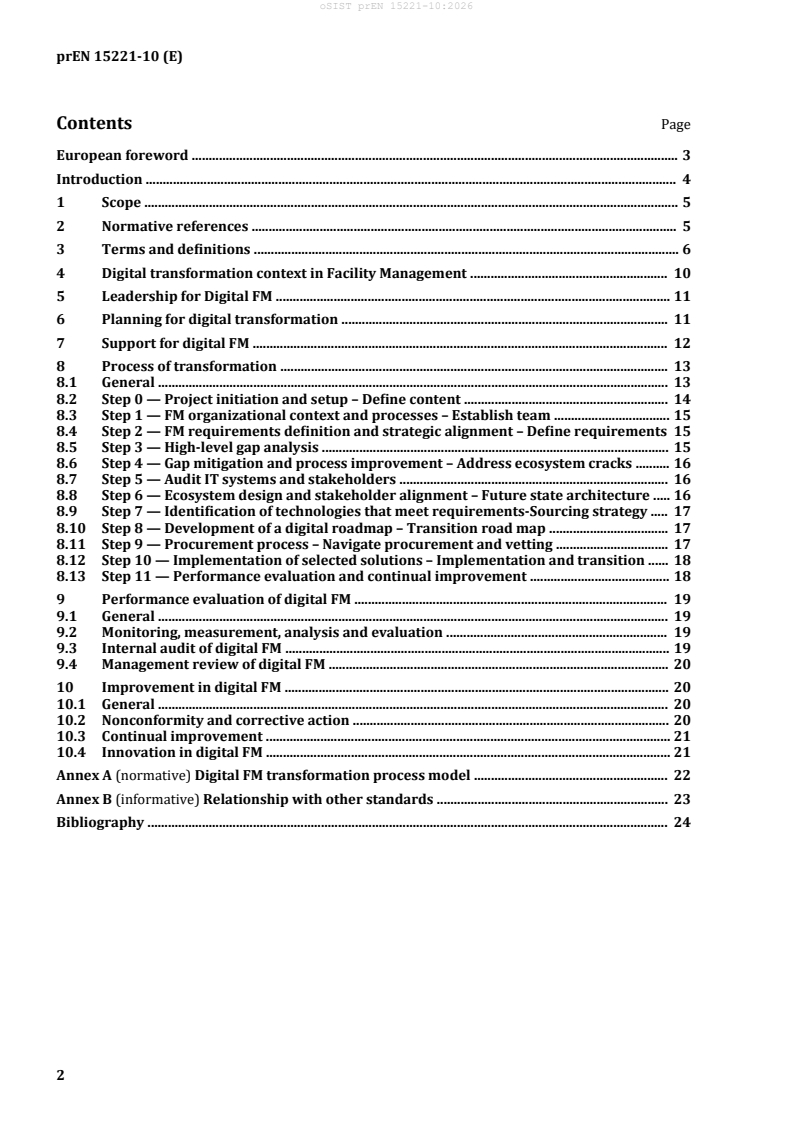
prEN 15221-10 is a CEN draft European Standard for Facility Management - Part 10: Digital Transformation of Facility Management (FM). It specifies requirements and a framework for planning, implementing and improving digitalization in FM for organizations of any type, size or sector, including in-house FM functions and outsourced service providers. It is written as a companion to EN ISO 41001 and EN 15221-8, so it adds the digitalization dimension to existing FM management and process standards.
What does prEN 15221-10 specify?
prEN 15221-10 specifies how an organization should structure digital transformation in FM, from context and leadership through planning, support, implementation, evaluation and improvement. The standard applies across the FM service delivery chain and the asset life cycle, and it is intended to be used broadly by organizations working in FM.
The document is organized into:
- Clause 1 Scope
- Clause 2 Normative references
- Clause 3 Terms and definitions
- Clause 4 Digital transformation context in Facility Management
- Clause 5 Leadership for Digital FM
- Clause 6 Planning for digital transformation
- Clause 7 Support for digital FM
- Clause 8 Process of transformation
- Clause 9 Performance evaluation of digital FM
- Clause 10 Improvement in digital FM
- Annex A and Annex B
The annexes are split by purpose:
| Annex | What it covers |
|---|---|
| Annex A | The normative digital FM transformation process model with the twelve-step sequence |
| Annex B | The informative relationship between this document and other standards |
In practice, this means the standard is not just about tools or software. It sets out how to manage digitalization as part of FM governance, FM processes and FM decision-making.
What are the key requirements of prEN 15221-10?
prEN 15221-10 treats digital FM as a managed organizational change, not a series of isolated IT projects. The main requirements are spread across Clauses 4 to 10 and are reinforced by the mandatory process model in Annex A.
Clause 4 requires context analysis, stakeholder review and a clear digitalization scope. The organization has to look at external issues such as technology trends, regulation and sustainability pressures, and internal issues such as culture, governance, skills and existing systems. In practice, this keeps digital FM aligned with business reality and avoids deploying tools without a defined purpose.
Clause 5 requires leadership commitment, a digital FM policy and defined responsibilities. Top management has to align digital FM with strategy, provide resources and monitor progress. The policy has to cover interoperability, data governance, cybersecurity, sustainability, resilience and continual improvement. A Digital FM Lead is to be appointed, so accountability is clear and digital work does not remain fragmented.
Clause 6 requires measurable objectives and a digital roadmap. The organization has to identify risks and opportunities, set objectives, define priorities, assign resources and plan timelines and evaluation methods. The roadmap should sequence short-, medium- and long-term initiatives. In practice, this gives buyers and FM teams a structured basis for investment and sequencing.
Clause 7 requires resources, competence, communication and data governance. The document expects enough financial, human, technical and infrastructure support, along with competence in digital literacy, FM processes, cybersecurity, data governance, interoperability and AI awareness. It also points to FAIR principles, EN ISO/IEC 27001 and EN ISO 19650, which matters because FM digitalization depends on trusted data and secure information handling.
Clause 8 and Annex A define a twelve-step transformation process. The steps run from project initiation and baseline assessment through gap analysis, ecosystem design, technology identification, procurement, implementation and performance evaluation. Annex A makes this process model normative, so users of the standard need to follow the sequence and preserve its intent.
Clause 9 requires monitoring, internal audit and management review. The organization has to measure technical and organizational performance, including availability, reliability, data quality, adoption, process efficiency, sustainability and resilience outcomes. This matters because digital FM has to be evidenced, not just described.
Clause 10 requires corrective action, continual improvement and innovation. When nonconformities occur, the organization has to control them, analyse causes and prevent recurrence. It also has to learn from audits, reviews, benchmarking and pilots. In practice, the standard expects digital FM to improve over time and to use innovation in a controlled way.
What terms does prEN 15221-10 define?
prEN 15221-10 relies on FM vocabulary from EN ISO 41011 and EN 15221-8, and it adds digital FM terms that are central to the document.
- Facilities Management (FM) - the organizational function that integrates people, place and process in the built environment to improve quality of life and core business productivity.
- Digitalization - the integration of digital technologies into FM processes to improve efficiency, effectiveness, resilience and decision-making.
- Digital transformation - a profound change driven by digital technologies that moves the organization in a new direction and creates new value.
- Information Management (IM) - coordinated activities to direct and control information across the life cycle of FM assets and services.
- Building Information Modelling (BIM) - use of a shared digital representation of a built asset to support design, construction and operation decisions.
- Digital Twin (DTw) - a digital representation connected to a target entity so the physical and digital states stay synchronized at an appropriate rate.
- Interoperability - the ability of systems to interact effectively through information exchange.
- Key Performance Indicator (KPI) - a quantifiable measure used to evaluate whether digital FM is meeting its objectives.
Who uses prEN 15221-10?
prEN 15221-10 is for people responsible for FM strategy, operations and transformation. That includes FM managers, FM directors, Digital FM Leads, asset owners, in-house FM teams and outsourced FM service providers.
It is also relevant to IT, OT, cybersecurity, procurement, sustainability and governance roles because the standard links digital FM to data, systems, security, sourcing and organizational control. Buyers and contract managers can use it when defining requirements for FM services or digital FM platforms. It applies across sectors and across all phases of FM service delivery and the asset life cycle.
What standards are used with prEN 15221-10?
prEN 15221-10 is designed to work with several companion standards named in Clause 2 and Annex B.
- EN 15221-8 - provides FM principles and processes, which form the operational base for digitalization.
- EN ISO 41001 - provides the FM management system requirements into which digital FM is integrated.
- EN ISO 41011:2024 - provides the FM vocabulary used for consistent terminology.
- EN ISO 19650-1 to EN ISO 19650-6 - provide the information management framework for BIM, covering concepts and principles, delivery phase, operational phase, information exchange, security-minded information management, and health and safety information.
- EN ISO/IEC 27001 - provides the information security, cybersecurity and privacy protection framework.
- ISO 55000 - is referenced in Annex B as an asset management principle set that aligns with FM digitalization.
- EN 18162:2026 and ISO/TS 15926-11:2023 - are used in the definitions for Digital Twin and interoperability, respectively.
These references matter because the standard does not stand alone. It assumes that FM process management, information management and security management are already being handled through recognized standards.
What does the prEN 15221-10 document contain?
prEN 15221-10 contains a full transformation framework, not just a list of policy statements. Clause 4 sets the FM digitalization context, Clause 5 covers leadership and policy, Clause 6 covers planning, and Clause 7 covers support and governance.
Clause 8 is the operational core of the document and presents the twelve-step digital FM transformation process, supported by Figure 1. Clause 9 covers monitoring, analysis, internal audit and management review, while Clause 10 covers corrective action, continual improvement and innovation. Annex A turns the process model into a normative sequence, and Annex B explains how the document relates to EN ISO 41001, EN 15221-8, EN ISO 41011, EN ISO 19650, EN ISO/IEC 27001 and ISO 55000.
Get Certified
Connect with accredited certification bodies for this standard

BSI Group
BSI (British Standards Institution) is the business standards company that helps organizations make excellence a habit.

Great Wall Tianjin Quality Assurance Center
Established 1993, first batch to receive national accreditation with IAF recognition.

Hong Kong Quality Assurance Agency (HKQAA)
Hong Kong's leading certification body.
Sponsored listings
Frequently Asked Questions
prEN 15221-10 is a draft published by the European Committee for Standardization (CEN). Its full title is "Facility Management - Part 10: Digital Transformation of Facility Management (FM)". This standard covers: This document specifies requirements and provides a framework for the digital transformation of Facility Management (FM). It defines the principles, processes and supporting elements for organizations to apply when planning, implementing and improving digitalization within FM. The purpose of this standard is to ensure that FM organizations can adopt digital practices in a consistent and effective manner that improves operational efficiency, enhances decision-making and strengthens resilience. The standard is written as a companion to EN ISO 41001 [5] Facility management — Management systems — Requirements with guidance for use and EN 15221-8 [2] Facility management — Principles and processes. Its role is not to duplicate the management system requirements of EN ISO 41001 [5] or the principles and processes of EN 15221-8 [2], but to provide the digitalization dimension that complements both. NOTE Annex B describes the relationship between this document and other standards. This standard applies broadly. It is relevant to: — organizations of any type, size, or sector engaged in FM; — both in-house FM functions and outsourced FM service providers; — all phases of FM service delivery and the asset life cycle. Certain elements are outside the scope of this document. General FM principles and processes are covered in EN 15221-8 [2], while the management system requirements for FM are addressed by EN ISO 41001 [5]. These exclusions ensure that this document remains focused on digital transformation as a distinct, yet integrated, component of FM.
This document specifies requirements and provides a framework for the digital transformation of Facility Management (FM). It defines the principles, processes and supporting elements for organizations to apply when planning, implementing and improving digitalization within FM. The purpose of this standard is to ensure that FM organizations can adopt digital practices in a consistent and effective manner that improves operational efficiency, enhances decision-making and strengthens resilience. The standard is written as a companion to EN ISO 41001 [5] Facility management — Management systems — Requirements with guidance for use and EN 15221-8 [2] Facility management — Principles and processes. Its role is not to duplicate the management system requirements of EN ISO 41001 [5] or the principles and processes of EN 15221-8 [2], but to provide the digitalization dimension that complements both. NOTE Annex B describes the relationship between this document and other standards. This standard applies broadly. It is relevant to: — organizations of any type, size, or sector engaged in FM; — both in-house FM functions and outsourced FM service providers; — all phases of FM service delivery and the asset life cycle. Certain elements are outside the scope of this document. General FM principles and processes are covered in EN 15221-8 [2], while the management system requirements for FM are addressed by EN ISO 41001 [5]. These exclusions ensure that this document remains focused on digital transformation as a distinct, yet integrated, component of FM.
prEN 15221-10 is classified under the following ICS (International Classification for Standards) categories: 03.080.10 - Maintenance services. Facilities management; 35.240.01 - Application of information technology in general; 35.240.67 - IT applications in building and construction industry. The ICS classification helps identify the subject area and facilitates finding related standards.
prEN 15221-10 is available in PDF format for immediate download after purchase. The document can be added to your cart and obtained through the secure checkout process. Digital delivery ensures instant access to the complete standard document.
Standards Content (Sample)
Contents
- Introduction
- 1 Scope
- 2 Normative references
- 3 Terms and definitions
- 3.1 Facilities Management
- 3.2 digitalization
- 3.3 digital transformation
- 3.4 Information Management
- 3.5 Building Information Modelling
- 3.6 Digital Twin
- 3.7 interoperability
- 3.8 maturity model
- 3.9 governance
- 3.10 data governance
- 3.11 resilience
- 3.12 sustainability
- 3.13 Computerized Maintenance Management System
- 3.14 Computer-Aided Facility Management System
- 3.15 Integrated Workplace Management System
- 3.16 Key Performance Indicator
- 3.17 Information Technology
- 3.18 Operational Technology
- 3.19 Internet of Things
- 4 Digital transformation context in Facility Management
- 5 Leadership for Digital FM
- 6 Planning for digital transformation
- 7 Support for digital FM
- 8 Process of transformation
- 8.1 General
- 8.2 Step 0 — Project initiation and setup – Define content
- 8.3 Step 1 — FM organizational context and processes – Establish team
- 8.4 Step 2 — FM requirements definition and strategic alignment – Define
- 8.5 Step 3 — High-level gap analysis
- 8.6 Step 4 — Gap mitigation and process improvement – Address ecosystem cracks
- 8.7 Step 5 — Audit IT systems and stakeholders
- 8.8 Step 6 — Ecosystem design and stakeholder alignment – Future state architecture
- 8.9 Step 7 — Identification of technologies that meet requirements-Sourcing strategy
- 8.10 Step 8 — Development of a digital roadmap – Transition road map
- 8.11 Step 9 — Procurement process – Navigate procurement and vetting
- 8.12 Step 10 — Implementation of selected solutions – Implementation and transition
- 8.13 Step 11 — Performance evaluation and continual improvement
- 9 Performance evaluation of digital FM
- 9.1 General
- 9.2 Monitoring, measurement, analysis and evaluation
- 9.3 Internal audit of digital FM
- 9.4 Management review of digital FM
- 10 Improvement in digital FM
- 10.1 General
- 10.2 Nonconformity and corrective action
- 10.3 Continual improvement
- 10.4 Innovation in digital FM
- Annex A
- Annex B
- Bibliography
Introduction
Facility Management (FM) ensures the functionality, comfort, safety, performance and efficiency of the built environment by integrating people, place, process, and technology. The European Standards provide a coherent framework for defining, implementing, and improving FM practices across various organizational contexts, aligning with international best practices and evolving organizational or core business needs.
Developed by the European Committee for Standardization (CEN), the EN 15221 series aligns closely with the EN ISO 41000 family of standards, ensuring consistency in terminology, processes, and methodologies. They are designed to support organizations in optimizing resource use, enhancing support service quality, and delivering value through effective FM. They reflect the collective expertise of professionals, industry stakeholders, and national standardization bodies, ensuring that it is both practical and adaptable to the dynamic nature of the FM sector. The European standards on Facility Management (FM) consist of two series/families:
- EN 15221;
- EN ISO 41000.
For an overview of published standards and ongoing work, see CEN Website: www.cen.eu These standards address a wide range of FM topics, including terminology, management system, service procurement, quality management, space planning and more.
Their purpose is to standardize practices and provide organizations with tools to align FM strategies with their broader business objectives. By offering a structured approach, the standards serve as a foundation for organizations of all sizes to develop sustainable, resilient, and future-ready facilities that contribute to organizational success, and thus achieve greater performance, efficiency, sustainability, and stakeholder satisfaction.
oSIST prEN 15221-10:2026 prEN 15221-10 (E)
1 Scope
This document specifies requirements and provides a framework for the digital transformation of Facility Management (FM). It defines the principles, processes and supporting elements for organizations to apply when planning, implementing and improving digitalization within FM. The purpose of this standard is to ensure that FM organizations can adopt digital practices in a consistent and effective manner that improves operational efficiency, enhances decision-making and strengthens resilience.
The standard is written as a companion to EN ISO 41001 [5] Facility management — Management systems — Requirements with guidance for use and EN 15221-8 [2] Facility management — Principles and processes. Its role is not to duplicate the management system requirements of EN ISO 41001 [5] or the principles and processes of EN 15221-8 [2], but to provide the digitalization dimension that complements both.
NOTE Annex B describes the relationship between this document and other standards. This standard applies broadly. It is relevant to:
- organizations of any type, size, or sector engaged in FM;
- both in-house FM functions and outsourced FM service providers;
- all phases of FM service delivery and the asset life cycle.
Certain elements are outside the scope of this document. General FM principles and processes are covered in EN 15221-8 [2], while the management system requirements for FM are addressed by EN ISO 41001 [5]. These exclusions ensure that this document remains focused on digital transformation as a distinct, yet integrated, component of FM.
2 Normative references
The following documents are referred to in the text in such a way that some or all of their content constitutes requirements of this document. For dated references, only the edition cited applies. For undated references, the latest edition of the referenced document (including any amendments) applies. EN 15221-8, Facility Management - Part 8: Principles and processes EN ISO 19650-1, Organization and digitization of information about buildings and civil engineering works, including building information modelling (BIM) - Information management using building information modelling - Part 1: Concepts and principles (ISO 19650-1:2018) EN ISO 19650-2, Organization and digitization of information about buildings and civil engineering works, including building information modelling (BIM) - Information management using building information modelling - Part 2: Delivery phase of the assets (ISO 19650-2:2018) EN ISO 19650-3, Organization and digitization of information about buildings and civil engineering works, including building information modelling (BIM) - Information management using building information modelling - Part 3: Operational phase of the assets (ISO 19650-3:2020) EN ISO 19650-4, Organization and digitization of information about buildings and civil engineering works, including building information modelling (BIM) - Information management using building information modelling - Part 4: Information exchange (ISO 19650-4:2022) EN ISO 19650-5, Organization and digitization of information about buildings and civil engineering works, including building information modelling (BIM) - Information management using building information modelling - Part 5: Security-minded approach to information management (ISO 19650-5:2020)
oSIST prEN 15221-10:2026 prEN 15221-10 (E) EN ISO 19650-6, Organization and digitization of information about buildings and civil engineering works, including building information modelling (BIM) - Information management using building information modelling - Part 6: Health and safety information (ISO 19650-6:2025) EN ISO/IEC 27001, Information security, cybersecurity and privacy protection - Information security management systems - Requirements (ISO/IEC 27001:2022) EN ISO 41001, Facility management - Management systems - Requirements with guidance for use (ISO 41001:2018) EN ISO 41011:2024, Facility management - Vocabulary (ISO 41011:2024) EN ISO 19650 (all parts), Organization and digitization of information about buildings and civil engineering works, including building information modelling (BIM) - Information management using building information modelling
3 Terms and definitions
For the purposes of this document, the terms and definitions given in EN ISO 41011:2024 and EN 15221-8, and the following apply.
ISO and IEC maintain terminology databases for use in standardization at the following addresses:
- ISO Online browsing platform: available at http://www.iso.org/obp
- IEC Electropedia: available at http://www.electropedia.org/
3.1 Facilities Management
FM organizational function which integrates people, place and process within the built environment with the purpose of improving the quality of life of people and the productivity of the core business Note 1 to entry: The terms “facility management” and “facilities management” can be used interchangeably. Note 2 to entry: FM provides the management system context in which digitalization takes place. [SOURCE: EN ISO 41011:2024 [6], 3.1.1, modified — Note 2 to entry is added.]
3.2 digitalization
integration of digital technologies into facility management (FM) processes to improve efficiency, effectiveness, resilience and decision-making, by embedding technology into FM practices in a way that delivers measurable outcomes Note 1 to entry: Digitalization goes beyond basic information technology (IT) adoption.
3.3 digital transformation
process of profound and radical change through digital technologies (including big data, blockchain, cloud computing, internet of things, artificial intelligence, analytics, cognitive solutions, etc.) that orients an organization in a new direction and takes it to an entirely different level of effectiveness, which is based on analytics of data Note 1 to entry: Digital transformation denotes the fundamental change in FM processes, culture and service delivery brought about by digital technologies, leading to new business models and enhanced value creation. [SOURCE: ISO/IEC TS 30105-9:2023 [7], 3.4, modified — Note 1 to entry is added.]
oSIST prEN 15221-10:2026 prEN 15221-10 (E)
3.4 Information Management
IM coordinated activities to direct and control the management of information across the life cycle of FM assets and services Note 1 to entry: In line with EN ISO 19650 (all parts) [8] (see Clause 2), information management underpins all aspects of FM digitalization.
3.5 Building Information Modelling
BIM use of a shared digital representation of a built asset to facilitate design, construction and operation processes to form a reliable basis for decisions Note 1 to entry: Built assets include, but are not limited to, buildings, bridges, roads, process plants. Note 2 to entry: In FM, BIM ensures continuity of asset data and forms a reliable basis for decision-making. [SOURCE: EN ISO 19650-1:2018 [9], 3.3.14.]
3.6 Digital Twin
DTw digital representation of a target entity with data connections that enable convergence between the physical and digital states at an appropriate rate of synchronization EXAMPLE - static digital twins, which capture a snapshot of the asset; - dynamic twins, which update in real time; - predictive twins, which integrate analytics and AI.
Note 1 to entry: Digital twin has some or all the capabilities of visualization, simulation, surveying, monitoring, forecasting, control, etc.
Note 2 to entry: Digital Twin refers to a digital representation of a physical asset, system or process that is synchronized at a frequency and level of detail sufficient to support decision-making. [SOURCE: EN 18162:2026 [10], 3.5, modified — Note 2 to entry is added.]
3.7 interoperability
ability of effective interaction between systems based on the exchange of information Note 1 to entry: Systems can be computerized systems or enterprises. Note 2 to entry: In digital FM, interoperability prevents fragmentation and reduces the risk of vendor lock-in. [SOURCE: ISO/TS 15926-11:2023 [11], 3.1.16, modified — Note 2 to entry is added.]
oSIST prEN 15221-10:2026 prEN 15221-10 (E)
3.8 maturity model
structured way of describing the stages of growth in FM digitalization capability Note 1 to entry: Maturity models often distinguish levels such as:
- initial and ad hoc;
- managed and repeatable;
- defined and standardized;
- optimized and continually improving.
3.9 governance
framework of rules, practices and processes through which FM digitalization is directed and controlled Note 1 to entry: It includes alignment with organizational strategy, accountability and transparency and ethical oversight of emerging technologies.
3.10 data governance
exercise of authority over data assets Note 1 to entry: In FM, this includes ensuring that data follows the FAIR principles, meaning it is Findable, Accessible, Interoperable and Reusable.
3.11 resilience
ability of FM digital systems and processes to anticipate, prepare for, respond to and recover from disruptions Note 1 to entry: It applies both to IT systems, such as cybersecurity and continuity and to FM service delivery.
3.12 sustainability
state of the global system including environmental, social and economic aspects, in which the needs of the present are met without compromising the ability of future generations to meet their own needs Note 1 to entry: The environmental, social and economic aspects interact, are interdependent and are often referred to as the triple bottom line, also known as the three dimensions of sustainability. Note 2 to entry: Sustainability is the goal of sustainable development. Note 3 to entry: Digital FM contributes to broader environmental, social and governance (ESG) objectives when sustainability is prioritized.
[SOURCE: ISO Guide 82:2019 [12], 3.1, modified — “the triple bottom line, also known as” has been added to Note 1 to entry. Note 3 to entry is added.]
3.13 Computerized Maintenance Management System
CMMS platform supporting maintenance operations by managing work orders, preventive schedules and asset tracking Note 1 to entry: Computerized Maintenance Management Systems often serve as an entry point to digitalization in FM.
oSIST prEN 15221-10:2026 prEN 15221-10 (E)
3.14 Computer-Aided Facility Management System
CAFM management of large amounts of facility-related information using computer-assisted methodologies Note 1 to entry: Extended digital support to multiple FM functions, including space management, asset information, maintenance and service request handling.
[SOURCE: EN ISO 41011:2024 [6], 3.9.1, modified — Note 1 to entry is added.]
3.15 Integrated Workplace Management System
IWMS management of large amounts of facility-related information using computer-assisted methodologies Note 1 to entry: Enterprise platforms that bring together real estate, space, operations and sustainability management. Many IWMS solutions integrate Internet of Things data, dashboards and advanced analytics. [SOURCE: EN ISO 41011:2024 [6], 3.9.1, modified — Note 1 to entry is added.]
3.16 Key Performance Indicator
KPI quantifiable measure used to evaluate the success of digital FM in meeting objectives EXAMPLE - data quality scores; - system uptime and reliability; - user adoption rates; - success rates for interoperability and data exchange.
3.17 Information Technology
IT application software that manages data and business information related to FM and includes:
- CMMS (3.13) Computerized Maintenance Management Systems;
- CAFM (3.14) Computer Aided Facility Management;
- IWMS (3.15) Integrated Workplace Management Systems;
- CPIP - Connected Portfolio Intelligence Platform;
- ERP – Enterprise Resource Planning;
- CTI – Computer Telephony Interface
3.18 Operational Technology
OT building infrastructure hardware and software that detect or cause changes in physical processes in a building / facility through direct monitoring and control of industrial devices
oSIST prEN 15221-10:2026 prEN 15221-10 (E)
3.19 Internet of Things
IoT interrelated computing devices, mechanical and digital machines that are provided with unique identifiers and the ability to transfer data over a network without requiring human-to-human or humanto-computer interaction Note 1 to entry: These includes sensors to measure:
- temperature;
- energy;
- motion detection;
- water detect;
- light meter and detection; and
- heating, ventilation, and air conditioning (HVAC) monitoring.
4 Digital transformation context in Facility Management
Organizations undertaking digital transformation in FM shall begin by analysing both their external and internal context. This analysis ensures that digitalization initiatives are grounded in the realities of the operating environment and aligned with organizational priorities. External issues may include:
- technology trends, such as the Internet of Things, artificial intelligence, robotics and Digital Twin (3.6);
- national and international related regulatory requirements, including the EU Artificial Intelligence (AI) Policy, Corporate Sustainability Reporting Directive (CSRD), Renewable Energy Directive (RED) and General Data Protection Regulation (GDPR);
- industry benchmarks, competitive pressures and market innovations;
- societal expectations relating to sustainability (3.12), resilience (3.11) and Environmental, Social, Governance (ESG) reporting.
Internal issues may include:
- organizational culture and readiness for change;
- governance (3.9) and decision-making structures;
- the current digital maturity level of FM processes;
- the availability of skills, resources and capabilities;
- existing IT infrastructure and FM systems.
...