

EN ISO/IEC 27018:2026
(Main)Information security, cybersecurity and privacy protection - Guidelines for protection of personally identifiable information (PII) in public clouds acting as PII processors (ISO/IEC 27018:2025)
- Abstract
This document establishes commonly accepted control objectives, controls and guidelines for implementing measures to protect personally identifiable information (PII) in line with the privacy principles in ISO/IEC 29100 for the public cloud computing environment.
In particular, this document specifies guidelines based on ISO/IEC 27002:2022, taking into consideration the regulatory requirements for the protection of PII which can be applicable within the context of the information security risk environment(s) of a provider of public cloud services. This document is applicable to all types and sizes of organizations, including public and private companies, government entities and not-for-profit organizations, which provide information processing services as PII processors via cloud computing under contract to other organizations.
The guidelines in this document can also be relevant to organizations acting as PII controllers.
- Status
- Published
- Publication Date
- 31-Aug-2028
- Technical Committee
- CEN/CLC/JTC 13 - Cybersecurity and Data Protection
- Drafting Committee
- CEN/CLC/JTC 13/WG 5 - Data Protection, Privacy and Identity Management
- Current Stage
- 6060 - Definitive text made available (DAV) - Publishing
- Start Date
- 28-Oct-2026
- Due Date
- 01-Sep-2028
- Completion Date
- 01-Sep-2028
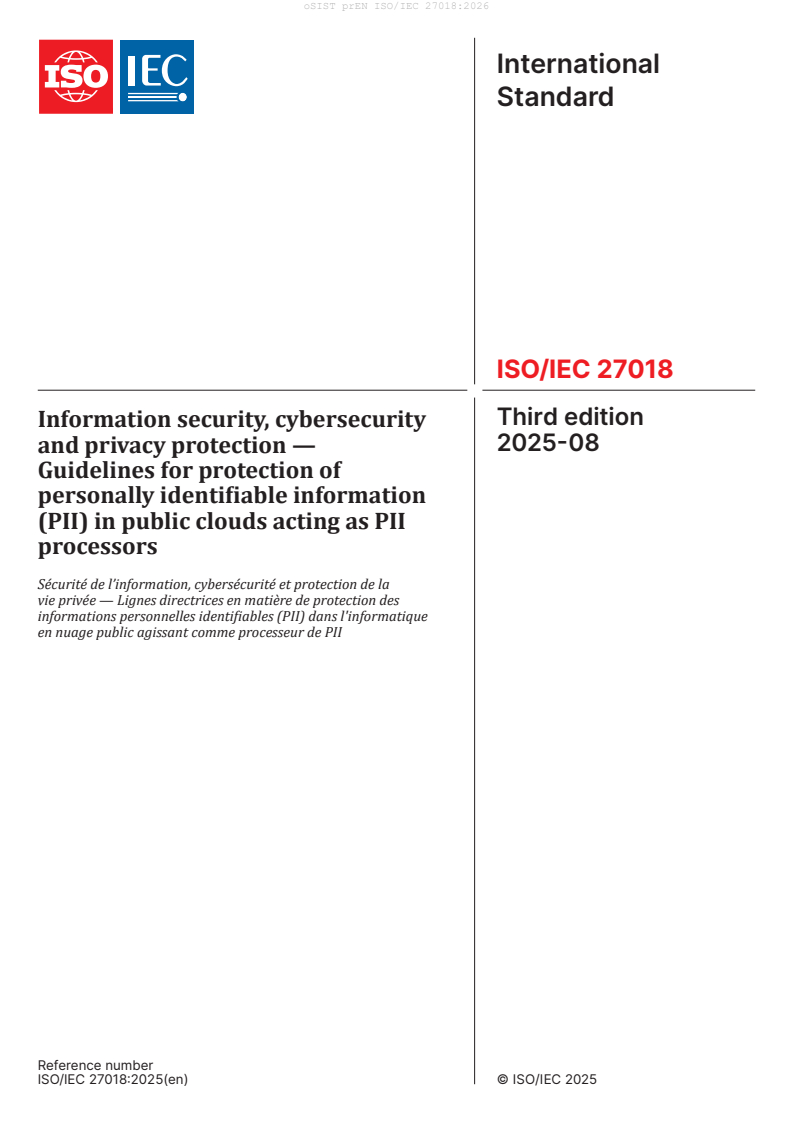

EN ISO/IEC 27018:2026 is the CEN adoption of ISO/IEC 27018 for public cloud services that act as PII processors. It gives control objectives, controls and implementation guidance for protecting personally identifiable information (PII) in line with ISO/IEC 29100 privacy principles and ISO/IEC 27002:2022 controls. It is written for organizations that provide cloud processing of PII under contract, and it can also help PII controllers.
What does EN ISO/IEC 27018:2026 specify?
EN ISO/IEC 27018:2026 specifies commonly accepted controls and guidance for protecting PII in the public cloud computing environment. Its focus is on public cloud providers that process PII on behalf of customers, under contract, and on the responsibilities that need to be shared or allocated between provider, subcontractors and customer.
The document is organized into the usual front matter, then Clauses 1 to 8, followed by two informative annexes. Clauses 5 to 8 cover organizational, people, physical and technological controls, using the same control layout as ISO/IEC 27002:2022.
| Annex | What it covers |
|---|---|
| Annex A | Public cloud PII processor extended control set for PII protection, with additional controls and guidance grouped by ISO/IEC 29100 privacy principles |
| Annex B | Correspondence between this document and the first edition ISO/IEC 27018:2019 |
The scope also makes clear that the guidance can be relevant to PII controllers, not only to PII processors.
What are the key requirements of EN ISO/IEC 27018:2026?
EN ISO/IEC 27018:2026 is mainly a guidance standard, but it is very specific about the controls a public cloud PII processor should implement and how responsibilities should be handled in practice. The most important points are the contract, the handling of rights and disclosures, incident handling, and the technical controls around access, logging, backup and encryption.
Contracts, roles and transparency
Clause 5.1 expects contractual agreements to allocate responsibilities between the public cloud PII processor, subcontractors and the cloud service customer. In practice, that means the contract has to say who does what for the service model in use, such as IaaS, PaaS or SaaS.
Clause 5.2 adds that the public cloud PII processor should have a PII specialist to advise cloud service customers. Clause A.11.11 and A.11.12 reinforce this by requiring minimum technical and organizational measures in contracts with customers and subcontractors. This matters because cloud customers need contractual proof that their PII is handled only for agreed purposes.
Purpose limitation, customer rights and disclosure
Annex A.3.1 says PII processed under contract should not be used for purposes independent of the customer’s instructions. Annex A.3.2 adds that the processor should not use PII for marketing or advertising without express consent, and that consent cannot be a condition of service. Clause A.2.1 requires the processor to help the customer enable PII principals to exercise rights such as access, correction and erasure.
Clause A.6.1 and A.6.2 deal with disclosure to third parties and law enforcement. The processor should notify the customer of legally binding disclosure requests when allowed, and keep records of disclosures. In practice, this supports customer oversight and gives an audit trail for legal requests.
Incident handling, breach notification and review
Clause 5.26 requires an incident response process that can distinguish between ordinary information security events and events that may involve a PII data breach. Annex A.10.1 requires prompt notification to the cloud service customer when unauthorized access leads to loss, disclosure or alteration of PII, together with records of the incident and the steps taken.
Clause 5.35 requires independent review of information security. Where individual customer audits are impractical or risky, the public cloud PII processor should provide independent evidence of how it operates. In practice, this helps customers review compliance without forcing intrusive audits into a multi-tenant cloud environment.
Access, identity, logging and authentication
Clause 5.16 says identity management should support the cloud service customer’s control over its users where appropriate. Clause 8.5 requires secure authentication, including secure log-on procedures for accounts requested by the customer. Annex A.11.8, A.11.9 and A.11.10 add distinct user IDs, careful user ID management and records of authorized users. This matters because shared or reused identities make it harder to trace actions on PII.
Clause 8.15 requires logging, periodic log review and rules for customer access to logs. It also says logs should be limited to intended purposes and deleted within a documented period. For a cloud operator, that means logs must support investigations without exposing one customer’s records to another customer.
Backup, cryptography and system separation
Clause 8.13 covers information backup. The document expects multiple copies in physically or logically diverse locations, documented restoration periods and review of backup and recovery procedures. It also says the provider should explain backup and restore capabilities when it offers those services.
Clause 8.24 covers use of cryptography. The processor should inform the customer about available key management capabilities, such as KMS or HSM-backed services, so the customer can manage its own cryptographic protection. Clause 8.31 adds that if PII has to be used for testing, a risk assessment should be done and technical and organizational measures should reduce the risk.
Storage, transfer and disposal
Clause 5.14 covers information transfer, including recording the movement of physical media containing PII and using additional measures such as encryption where appropriate. Clause 7.14 says equipment that may contain PII should be treated as if it does when it is disposed of or reused.
Annex A.10.3 requires policies for return, transfer and disposal of PII, including erasure from backup and subcontractor storage when the data are no longer needed. Annex A.12.1 and A.12.2 add control over the countries where PII may be stored and over the intended destination of transmitted PII. In practice, this is the part that supports cross-border cloud arrangements and exit from a cloud service.
What terms does EN ISO/IEC 27018:2026 define?
- Data breach - a security compromise that leads to accidental or unlawful destruction, loss, alteration, unauthorized disclosure of, or access to protected data.
- Personally identifiable information (PII) - information that can be linked directly or indirectly to a natural person.
- PII controller - the privacy stakeholder that determines the purposes and means for processing PII.
- PII principal - the natural person to whom the PII relates.
- PII processor - the privacy stakeholder that processes PII on behalf of, and under the instructions of, a PII controller.
- PII processing - any operation performed on PII, such as collection, storage, use, disclosure, deletion or destruction.
- Public cloud service provider - the party that makes cloud services available according to the public cloud model.
Who uses EN ISO/IEC 27018:2026?
EN ISO/IEC 27018:2026 is used by organizations of all sizes that provide cloud processing services as PII processors, including public and private companies, government entities and not-for-profit organizations. It is also relevant to cloud service customers, especially when they need to assess a provider’s controls before signing a contract or during supplier review.
In practice, the document is used by information security teams, privacy teams, legal and procurement staff, quality managers and auditors. They use it to set contract terms, choose controls, review subcontractors, plan incident handling, and check whether the cloud service provider can protect PII in a multi-tenant environment.
What changed in EN ISO/IEC 27018:2026 from the previous edition?
EN ISO/IEC 27018:2026 is the third edition and it cancels and replaces ISO/IEC 27018:2019. The stated main changes are alignment with ISO/IEC 27002:2022 and the addition of Annex B.
Which standards are used with EN ISO/IEC 27018:2026?
- ISO/IEC 27000 - provides the information security management systems vocabulary used with this document.
- ISO/IEC 27002:2022 - supplies the base control set that this document mirrors and extends for public cloud PII protection.
- ISO/IEC 22123-1 - provides cloud computing vocabulary used for the public cloud context.
- ISO/IEC 29100 - supplies the privacy principles used to organize Annex A.
- ISO/IEC 27005 - gives guidance on information security risk management, which supports control selection and risk treatment.
- ISO/IEC 29134 - gives guidance on privacy impact assessment, which supports PII risk assessment.
- ISO/IEC 22123-3 - provides the cloud computing reference architecture used when assigning roles and responsibilities.
What does the EN ISO/IEC 27018:2026 document contain?
EN ISO/IEC 27018:2026 contains a clause-by-clause control framework aligned with ISO/IEC 27002:2022. Each control includes a title, attribute table, purpose, guidance and, where relevant, additional public cloud PII protection guidance and other information.
Clauses 5 to 8 cover organizational, people, physical and technological controls. Annex A adds further controls for public cloud PII processors and organizes them under the privacy principles of ISO/IEC 29100. Annex B gives a correspondence table to ISO/IEC 27018:2019, which is useful for transition planning and for mapping old control sets to the current edition.
Relations
- Effective Date
- 22-Apr-2026
Get Certified
Connect with accredited certification bodies for this standard

BSI Group
BSI (British Standards Institution) is the business standards company that helps organizations make excellence a habit.

Bureau Veritas
Bureau Veritas is a world leader in laboratory testing, inspection and certification services.

DNV
DNV is an independent assurance and risk management provider.
Sponsored listings
Frequently Asked Questions
EN ISO/IEC 27018:2026 is a draft published by the European Committee for Standardization (CEN). Its full title is "Information security, cybersecurity and privacy protection - Guidelines for protection of personally identifiable information (PII) in public clouds acting as PII processors (ISO/IEC 27018:2025)". This standard covers: This document establishes commonly accepted control objectives, controls and guidelines for implementing measures to protect personally identifiable information (PII) in line with the privacy principles in ISO/IEC 29100 for the public cloud computing environment. In particular, this document specifies guidelines based on ISO/IEC 27002:2022, taking into consideration the regulatory requirements for the protection of PII which can be applicable within the context of the information security risk environment(s) of a provider of public cloud services. This document is applicable to all types and sizes of organizations, including public and private companies, government entities and not-for-profit organizations, which provide information processing services as PII processors via cloud computing under contract to other organizations. The guidelines in this document can also be relevant to organizations acting as PII controllers.
This document establishes commonly accepted control objectives, controls and guidelines for implementing measures to protect personally identifiable information (PII) in line with the privacy principles in ISO/IEC 29100 for the public cloud computing environment. In particular, this document specifies guidelines based on ISO/IEC 27002:2022, taking into consideration the regulatory requirements for the protection of PII which can be applicable within the context of the information security risk environment(s) of a provider of public cloud services. This document is applicable to all types and sizes of organizations, including public and private companies, government entities and not-for-profit organizations, which provide information processing services as PII processors via cloud computing under contract to other organizations. The guidelines in this document can also be relevant to organizations acting as PII controllers.
EN ISO/IEC 27018:2026 is classified under the following ICS (International Classification for Standards) categories: 35.030 - IT Security. The ICS classification helps identify the subject area and facilitates finding related standards.
EN ISO/IEC 27018:2026 has the following relationships with other standards: It is inter standard links to EN ISO/IEC 27018:2020. Understanding these relationships helps ensure you are using the most current and applicable version of the standard.
EN ISO/IEC 27018:2026 is available in PDF format for immediate download after purchase. The document can be added to your cart and obtained through the secure checkout process. Digital delivery ensures instant access to the complete standard document.
Standards Content (Sample)
Contents
- Introduction
- 0.1 Background and context
- 0.2 PII protection controls for public cloud computing services
- 0.3 PII protection requirements
- 0.4 Selecting and implementing controls in a cloud computing environment
- 0.5 Developing additional guidelines
- 0.6 Lifecycle considerations
- 1 Scope
- 2 Normative references
- 3 Terms and definitions
- 3.1 data breach
- 3.2 personally identifiable information
- 3.3 PII controller
- 3.4 PII principal
- 3.5 PII processor
- 3.6 PII processing
- 3.7 public cloud service provider
- 4 Overview
- 4.1 Structure of this document
- 5.1 Policies for information security Public cloud service provider-specific
- 5.2 Information security roles and responsibilities Public cloud service provider-specific
- 5.3 Segregation of duties No additional public cloud service
- 5.4 Management responsibilities No additional public cloud service
- 5.5 Contact with authorities No additional public cloud service
- 5.6 Contact with special interest groups No additional public cloud service
- 5.7 Threat intelligence No additional public cloud service
- 5.8 Information security in project management No additional public cloud service
- 5.9 Inventory of information and other associated No additional public cloud service
- 5.10 Acceptable use of information and other associat- No additional public cloud service
- 5.11 Return of assets No additional public cloud service
- 5.12 Classification of information No additional public cloud service
- 5.13 Labelling of information No additional public cloud service
- 5.14 Information transfer Public cloud service provider-specific
- 5.15 Access control No additional public cloud service
- 5.16 Identity management Public cloud service provider-specific
- 5.17 Authentication information No additional public cloud service
- 5.18 Access rights No additional public cloud service
- 5.19 Information security in supplier relationships No additional public cloud service
- 5.20 Addressing information security within supplier No additional public cloud service
- 5.21 Managing information security in the ICT supply No additional public cloud service
- 5.22 Monitoring, review and change management of No additional public cloud service
- 5.23 Information security for use of cloud services No additional public cloud service
- 5.24 Information security incident management plan- No additional public cloud service
- 5.25 Assessment and decision on information security No additional public cloud service
- 5.26 Response to information security incidents Public cloud service provider-specific
- 5.27 Learning from information security incidents No additional public cloud service
- 5.28 Collection of evidence No additional public cloud service
- 5.29 Information security during disruption No additional public cloud service
- 5.30 ICT readiness for business continuity No additional public cloud service
- 5.31 Legal, statutory, regulatory and contractual re- No additional public cloud service
- 5.32 Intellectual property rights No additional public cloud service
- 5.33 Protection of records No additional public cloud service
- 5.34 Privacy and protection of PII No additional public cloud service
- 5.35 Independent review of information security Public cloud service provider-specific
- 5.36 Compliance with policies, rules and standards for No additional public cloud service
- 5.37 Documented operating procedures No additional public cloud service
- 6.1 Screening No additional public cloud service
- 6.2 Terms and conditions of employment No additional public cloud service
- 6.3 Information security awareness, education and Public cloud service provider-specific
- 6.4 Disciplinary process No additional public cloud service
- 6.5 Responsibilities after termination or change of No additional public cloud service
- 6.6 Confidentiality or non-disclosure agreements Public cloud service provider-specific
- 6.7 Remote working No additional public cloud service
- 6.8 Information security event reporting No additional public cloud service
- 7.1 Physical security perimeters No additional public cloud service
- 7.2 Physical entry No additional public cloud service
- 7.3 Securing offices, rooms and facilities No additional public cloud service
- 7.4 Physical security monitoring No additional public cloud service
- 7.5 Protecting against physical and environmental No additional public cloud service
- 7.6 Working in secure areas No additional public cloud service
- 7.7 Clear desk and clear screen No additional public cloud service
- 7.8 Equipment siting and protection No additional public cloud service
- 7.9 Security of assets off-premises No additional public cloud service
- 7.10 Storage media No additional public cloud service
- 7.11 Supporting utilities No additional public cloud service
- 7.12 Cabling security No additional public cloud service
- 7.13 Equipment maintenance No additional public cloud service
- 7.14 Secure disposal or re-use of equipment Public cloud service provider-specific
- 8.1 User endpoint devices No additional public cloud service
- 8.2 Privileged access rights No additional public cloud service
Introduction
0.1 Background and context
Cloud service providers who process personally identifiable information (PII) under contract to their customers are expected to operate their services in ways that allow both parties to meet the requirements of applicable legislation and regulations covering the protection of PII. The requirements and the way in which the requirements are divided between the cloud service provider and its customers vary according to legal jurisdiction, and according to the terms of the contract between the cloud service provider and the customer. Legislation which governs how PII is allowed to be processed (i.e. collected, used, transferred and disposed of) is sometimes referred to as data protection legislation; PII is sometimes referred to as personal data or personal information. The obligations falling on a PII processor vary from jurisdiction to jurisdiction, which makes it challenging for businesses providing cloud computing services to operate in a multinational environment.
A public cloud service provider is a “PII processor” when it processes PII for and according to the instructions of a cloud service customer. The cloud service customer, who has the contractual relationship with the public cloud PII processor, can range from a natural person (i.e. a “PII principal”, processing his or her own PII in the cloud) to an organization (i.e. a “PII controller”, processing PII relating to many PII principals). The cloud service customer can authorize one or more cloud service users associated with it to use the services made available to the customer under its contract with the public cloud PII processor. The cloud service customer has authority over the processing and use of the data. A cloud service customer who is also a PII controller can be subject to a wider set of obligations governing the protection of PII than the public cloud PII processor. Maintaining the distinction between PII controller and PII processor relies on the public cloud PII processor having no data processing objectives other than those set by the cloud service customer with respect to the PII it processes and the operations necessary to achieve the cloud service customer's objectives. NOTE 1 Where the public cloud PII processor is processing cloud service customer account data, it can be acting as a PII controller for this purpose. This document does not cover such activity. The intention of this document, when used in conjunction with the information security objectives and controls in ISO/IEC 27002, is to create a common set of security categories and controls that can be implemented by a public cloud computing service provider acting as a PII processor. This document has the following objectives:
- to enable the public cloud PII processor to be transparent in relevant matters so that cloud service customers can select well-governed cloud-based PII processing services; - to assist the cloud service customer and the public cloud PII processor in entering into a contractual agreement; - to provide cloud service customers with a mechanism for exercising audit and compliance rights and responsibilities in cases where the individual cloud service customer data, which are hosted in a multiparty, virtualized server (cloud) environment, can be technically impractical to audit and can potentially increase risks to those physical and logical network security controls in place. NOTE 2 It is expected that public cloud service providers comply with applicable obligations when acting as a PII processor.
This document can assist by providing a common compliance framework for public cloud service providers, in particular those that operate in a multinational market.
0.2 PII protection controls for public cloud computing services
This document is designed for organizations to use as a reference for selecting PII protection controls within the process of implementing a cloud computing information security management system based on ISO/IEC 27001, or as a guidance document for implementing commonly accepted PII protection controls for organizations acting as public cloud PII processors. In particular, this document has been based on ISO/IEC 27002, taking into consideration the specific risk environment(s) arising from those PII protection requirements which can apply to public cloud computing service providers acting as PII processors.
oSIST prEN ISO/IEC 27018:2026 ISO/IEC 27018:2025(en) In the context of PII protection requirements for a public cloud service provider acting as a PII processor, the organization is protecting the information assets entrusted to it by its customers. Implementation of the controls of ISO/IEC 27002 by the public cloud PII processor is both suitable for this purpose and necessary. This document extends the ISO/IEC 27002 controls to accommodate the distributed nature of the risk and the existence of a contractual relationship between the cloud service customer and the public cloud PII processor. This document extends ISO/IEC 27002 in two ways, by providing:
- implementation guidance applicable to public cloud PII protection for some of the existing ISO/IEC 27002 controls, and
- a set of additional controls and associated guidance in Annex A intended to address public cloud PII protection requirements not addressed by the existing ISO/IEC 27002 control set, organized in line with the privacy principles of ISO/IEC 29100.
Most of the controls and guidelines in this document also apply to a PII controller. However, the PII controller is, in most cases, subject to additional obligations not specified here.
0.3 PII protection requirements
It is essential that an organization identifies its requirements for the protection of PII. There are three main sources of requirement, as given below.
a) Legal and contractual requirements: One source is the legal and contractual requirements to which an organization, its trading partners, contractors and service providers are bound, as well as responsibilities concerning their socio-cultural and operating environment. It should be noted that legislation, regulations and contractual commitments made by the PII processor can mandate the selection of particular controls and can also necessitate specific criteria for implementing those controls. These requirements can vary from one jurisdiction to another. b) Risks: Another source is derived from assessing risks to the organization associated with PII, taking into account the organization’s overall business strategy and objectives. Through a risk assessment, risks are identified, their consequence and likelihood are assessed and risks are evaluated. ISO/IEC 27005 provides information security risk management guidance, including advice on risk assessment, risk acceptance, risk communication, risk monitoring and risk review. ISO/IEC 29134 provides guidelines on privacy impact assessment.
c) Corporate policies: While many aspects covered by a corporate policy are derived from legal and sociocultural requirements, an organization can also choose voluntarily to go beyond the criteria that are derived from the requirements of a).
0.4 Selecting and implementing controls in a cloud computing environment
Controls can be selected from this document (which includes by reference the controls from ISO/IEC 27002, creating a combined reference control set for the sector or application defined by the relevant sector). If required, controls can also be selected from other control sets, or new controls can be designed to meet specific needs as appropriate.
NOTE A PII processing service provided by a public cloud PII processor can be considered as an application of cloud computing rather than as a sector in itself. Nevertheless, the term “public cloud service provider-specific” is used in this document, as this is the conventional term used within other Information Security Management systems standards developed by ISO/IEC JTC 1/SC 27.
The selection of controls is dependent on organizational decisions based on the criteria for risk acceptance, risk treatment options, and the general risk management approach applied to the organization and, through contractual agreements, its customers and suppliers. It is also subject to relevant national and international legislation. Where organizations/public cloud providers do not select the controls specified in this document, a justification should be provided.
Further, the selection and implementation of controls is dependent on the public cloud provider’s actual role in the context of the whole cloud computing reference architecture (see ISO/IEC 22123-3). Many different organizations can be involved in providing infrastructure and application services in a cloud computing environment. In some circumstances, selected controls can be unique to a particular service category of
oSIST prEN ISO/IEC 27018:2026 ISO/IEC 27018:2025(en) the cloud computing reference architecture. In other instances, there can be shared roles in implementing security controls. Contractual agreements are expected to specify the PII protection responsibilities of all organizations involved in providing or using the cloud services, including the public cloud PII processor, its sub-contractors and the cloud service customer.
The controls in this document can be considered as guiding principles and applicable for most organizations. They are explained in more detail in this document along with implementation guidance. Implementation can be made simpler if requirements for the protection of PII have been considered in the design of the public cloud PII processor’s information system, services and operations. Such consideration is an element of the concept that is often called “privacy by design” (see References [64] and [65]).
0.5 Developing additional guidelines
This document can be regarded as a starting point for developing PII protection guidelines. It is possible that not all of the controls and guidance in this code of practice are applicable. Furthermore, additional controls and guidelines not included in this document can be required. When documents are developed containing additional guidelines or controls, it can be useful to include cross-references to clauses in this document where applicable to facilitate compliance checking by auditors and business partners.
0.6 Lifecycle considerations
PII has a natural lifecycle, from creation and origination, through to storage, processing, use and transmission, to its eventual destruction or disuse. The risks to PII can vary during its lifetime but protection of PII remains important at all stages.
PII protection requirements are expected to be taken into account as existing and new information systems are managed through their lifecycle.
oSIST prEN ISO/IEC 27018:2026 International Standard ISO/IEC 27018:2025(en) Information security, cybersecurity and privacy protection — Guidelines for protection of personally identifiable information (PII) in public clouds acting as PII processors
1 Scope
This document establishes commonly accepted control objectives, controls and guidelines for implementing measures to protect personally identifiable information (PII) in line with the privacy principles in ISO/IEC 29100 for the public cloud computing environment.
In particular, this document specifies guidelines based on ISO/IEC 27002:2022, taking into consideration the regulatory requirements for the protection of PII which can be applicable within the context of the information security risk environment(s) of a provider of public cloud services. This document is applicable to all types and sizes of organizations, including public and private companies, government entities and not-for-profit organizations, which provide information processing services as PII processors via cloud computing under contract to other organizations. The guidelines in this document can also be relevant to organizations acting as PII controllers.
2 Normative references
The following documents are referred to in the text in such a way that some or all of their content constitutes requirements of this document. For dated references, only the edition cited applies. For undated references, the latest edition of the referenced document (including any amendments) applies. ISO/IEC 27000, Information technology — Security techniques — Information security management systems — Overview and vocabulary ISO/IEC 27002:2022, Information security, cybersecurity and privacy protection — Information security controls ISO/IEC 22123-1, Information technology — Cloud computing — Part 1: Vocabulary
3 Terms and definitions
For the purposes of this document, the terms and definitions given in ISO/IEC 22123-1, ISO/IEC 27000, ISO/IEC 27002 and the following apply.
ISO and IEC maintain terminology databases for use in standardization at the following addresses:
- ISO Online browsing platform: available at https:// www .iso .org/ obp
- IEC Electropedia: available at https:// www .electropedia .org/
3.1 data breach
compromise of security that leads to the accidental or unlawful destruction, loss, alteration, unauthorized disclosure of, or access to, protected data transmitted, stored or otherwise processed [SOURCE: ISO/IEC 27040:2024, 3.5.2]
oSIST prEN ISO/IEC 27018:2026 ISO/IEC 27018:2025(en)
3.2 personally identifiable information
PII information that a) can be used to establish a link between the information and the natural person to whom such information relates, or b) is or can be directly or indirectly linked to a natural person Note 1 to entry: The “natural person” in the definition is the PII principal (3.4). To determine whether a PII principal is identifiable, account should be taken of all the means which can reasonably be used by the privacy stakeholder holding the data, or by any other party, to establish the link between the set of PII and the natural person. Note 2 to entry: This definition is included to define the term PII as used in this document. A public cloud PII processor (3.5) is typically not in a position to know explicitly whether information it processes falls into any specified category unless this is made transparent by the cloud service customer. [SOURCE: ISO/IEC 29100:2024, 3.7, modified — Note 2 to entry has been added.]
3.3 PII controller
privacy stakeholder (or privacy stakeholders) that determines the purposes and means for processing personally identifiable information (PII) (3.2) other than natural persons who use data for personal purposes Note 1 to entry: A PII controller sometimes instructs others [e.g. PII processors (3.5)] to process PII on its behalf while the responsibility for the processing remains with the PII controller. [SOURCE: ISO/IEC 29100:2024, 3.8]
3.4 PII principal
natural person to whom the personally identifiable information (PII) (3.2) relates Note 1 to entry: Depending on the jurisdiction and the particular PII protection and privacy legislation, the synonym “data subject” can also be used instead of the term “PII principal”. [SOURCE: ISO/IEC 29100:2024, 3.9, modified — Note 1 to entry has been added.]
3.5 PII processor
privacy stakeholder that processes personally identifiable information (PII) (3.2) on behalf of and in accordance with the instructions of a PII controller (3.3) [SOURCE: ISO/IEC 29100:2024, 3.10]
3.6 PII processing
processing of PII operation or set of operations performed on personally identifiable information (PII) (3.2) Note 1 to entry: Examples of processing operations of PII include, but are not limited to, the collection, storage, alteration, retrieval, consultation, disclosure, anonymization, pseudonymization, dissemination or otherwise making available, deletion or destruction of PII.
[SOURCE: ISO/IEC 29100:2024, 3.21, modified — "PII processing" has been added as the preferred term.]
3.7 public cloud service provider
party which makes cloud services available according to the public cloud model
oSIST prEN ISO/IEC 27018:2026 ISO/IEC 27018:2025(en)
4 Overview
4.1 Structure of this document
This document follows the structure used in ISO/IEC 27002:2022 for the description of controls. In this aspect, the same strategy that was adopted in the earlier version of this document (ISO/IEC 27018:2019), in
mirroring the controls in ISO/IEC 27002:2013, has been repeated here. Annex B provides a comparison of the two control layouts in this document and the previous edition (ISO/IEC 27018:2019).
Specifically, the following rules have been used in mirroring the controls in ISO/IEC 27002:2022 in this document. In cases where the various elements of the control layout (described in 4.2) for a control are identical, only a reference is provided to the corresponding control in ISO/IEC 27002:2022. For those controls that require additional guidance and related information in the context of public cloud PII protection, additional guidance is provided under the headings “Public cloud PII protection implementation guidance” and “Other information for public cloud PII protection” respectively. This type of guidance is also referred to using the term “Public cloud service provider-specific implementation guidance”. Besides these, additional controls and associated implementation guidance applicable to PII protection for cloud computing service providers are described in Annex A. Finally, the clause numbers in this document are aligned with the corresponding clause numbers in ISO/IEC 27002:2022.
The controls in Table 1 are organized into four themes, which correspond to the controls listed in Clauses 5 to 8 as follows:
- the theme "Public cloud service provider-specific implementation guidance is provided" corresponds to the control "Public cloud PII protection implementation guidance";
- the theme "Public cloud service provider-specific implementation guidance and other information is provided" corresponds to the control "Public cloud PII protection implementation guidance and other information for Public cloud PII protection";
- the theme "No additional public cloud service provider-specific implementation guidance or other information is provided" corresponds to the control "no specific Guidance or other information for Public cloud PII protection";
- the theme "Public cloud service provider-specific implementation guidance is provided, together with a cross-reference to control(s) in Annex A" corresponds to the control "Public cloud PII protection implementation guidance and cross-reference to control(s) in Annex A".
oSIST prEN ISO/IEC 27018:2026 ISO/IEC 27018:2025(en) Table 1 — Location of public cloud service provider-specific guidance and other information for implementing controls in ISO/IEC 27002:2022 ISO/IEC ISO/IEC 27002:2022 Control name Theme 27002:2022 Control identifier Clause 5 – Organizational controls
5.1 Policies for information security Public cloud service provider-specific
implementation guidance and other
information is provided.
5.2 Information security roles and responsibilities Public cloud service provider-specific
b implementation guidance is provided.
5.3 Segregation of duties No additional public cloud service
provider-specific implementation guidance d or other information is provided.
5.4 Management responsibilities No additional public cloud service
provider-specific implementation guidance d or other information is provided.
5.5 Contact with authorities No additional public cloud service
provider-specific implementation guidance d or other information is provided.
5.6 Contact with special interest groups No additional public cloud service
provider-specific implementation guidance d or other information is provided.
a
5.7 Threat intelligence No additional public cloud service
provider-specific implementation guidance d or other information is provided.
...