


EN 27779:1991
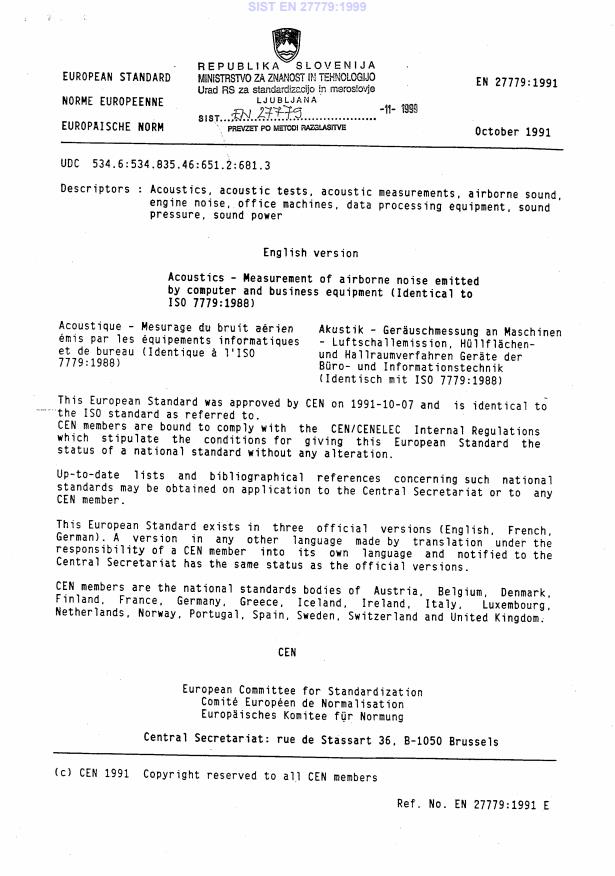
(Main)Acoustics - Measurement of airborne noise emitted by computer and business equipment (ISO 7779:1988)
Acoustics - Measurement of airborne noise emitted by computer and business equipment (ISO 7779:1988)
Specification of procedures for measuring and reporting the noise emitted by computer and business equipment
Akustik - Geräuschmessung an Maschinen - Luftschallemission, Hüllflächen- und Hallraumverfahren-Geräte der Büro- und Informationstechnik (ISO 7779:1988)
Acoustique - Mesurage du bruit aérien émis par les équipements informatiques et de bureau (ISO 7779:1988)
Akustika - Merjenje zračnega hrupa računalnika in pisarniške opreme (ISO 7779:1988)
General Information
- Status
- Withdrawn
- Publication Date
- 08-Oct-1991
- Withdrawal Date
- 22-May-2001
- Technical Committee
- CEN/TC 211 - Acuostics
- Drafting Committee
- CEN/TC 211 - Acuostics
- Current Stage
- 9960 - Withdrawal effective - Withdrawal
- Start Date
- 23-May-2001
- Completion Date
- 23-May-2001
Relations
- Effective Date
- 22-Dec-2008

Get Certified
Connect with accredited certification bodies for this standard

BSI Group
BSI (British Standards Institution) is the business standards company that helps organizations make excellence a habit.

BSMI (Bureau of Standards, Metrology and Inspection)
Taiwan's standards and inspection authority.

NYCE
Mexican standards and certification body.
Sponsored listings
Frequently Asked Questions
EN 27779:1991 is a standard published by the European Committee for Standardization (CEN). Its full title is "Acoustics - Measurement of airborne noise emitted by computer and business equipment (ISO 7779:1988)". This standard covers: Specification of procedures for measuring and reporting the noise emitted by computer and business equipment
Specification of procedures for measuring and reporting the noise emitted by computer and business equipment
EN 27779:1991 is classified under the following ICS (International Classification for Standards) categories: 17.140.20 - Noise emitted by machines and equipment; 35.180 - IT Terminal and other peripheral equipment. The ICS classification helps identify the subject area and facilitates finding related standards.
EN 27779:1991 has the following relationships with other standards: It is inter standard links to EN ISO 7779:2001. Understanding these relationships helps ensure you are using the most current and applicable version of the standard.
EN 27779:1991 is available in PDF format for immediate download after purchase. The document can be added to your cart and obtained through the secure checkout process. Digital delivery ensures instant access to the complete standard document.
Standards Content (Sample)
2003-01.Slovenski inštitut za standardizacijo. Razmnoževanje celote ali delov tega standarda ni dovoljeno.Akustik - Geräuschmessung an Maschinen - Luftschallemission, Hüllflächen- und Hallraumverfahren-Geräte der Büro- und Informationstechnik (ISO 7779:1988)Acoustique - Mesurage du bruit aérien émis par les équipements informatiques et de bureau (ISO 7779:1988)Acoustics - Measurement of airborne noise emitted by computer and business equipment (ISO 7779:1988)35.020Informacijska tehnika in tehnologija na splošnoInformation technology (IT) in general17.140.20Emisija hrupa naprav in opremeNoise emitted by machines and equipmentICS:Ta slovenski standard je istoveten z:EN 27779:1991SIST EN 27779:1999en01-november-1999SIST EN 27779:1999SLOVENSKI
STANDARD
INTERNATIONAL STANDARD 7779 INTERNATIONAL ORGANIZATION FOR STANDARDIZATION ORGANISATION INTERNATIONALE DE NORMALISATION MEXflYHAPOAHAR OPrAHM3A~Mfl I-IO CTAHAAPTM3A~MM Acoustics - Measurement of airborne noise emitted by Computer and business equipment Acoustique - Mesurage du bruit a&ien hmis par les hquipements informatiques et de bureau ISO First edition 1988-06-15 Reference number ISO 7779: 1988 (E) SIST EN 27779:1999
ISO7779:1988 (EI Foreword ISO (the International Organization for Standardization) is a worldwide federation of national Standards bodies (ISO member bodies). The work of preparing International Standards is normally carried out through ISO technical committees. Esch member body interested in a subject for which a technical committee has been established has the right to be represented on that committee. International organizations, govern- mental and non-governmental, in liaison with ISO, also take part in the work. Draft International Standards adopted by the technical committees are circulated to the member bodies for approval before their acceptance as International Standards by the ISO Council. They are approved in accordance with ISO procedures requiring at least 75 % approval by the member bodies voting. International Standard ISO 7779 was prepared by Technical Committee ISO/TC 43, A cous tics. Users should note that all International Standards undergo revision from time to time and that any reference made herein to any other International Standard implies its latest edition, unless otherwise stated. 0 International Organkation for Standardization, 1988 Printed in Switzerland ii SIST EN 27779:1999
IsO7779:1988E) Contents Page 0 Introduction . 1 Scope and field of application . 2 Conformance . 3 References . 4 Definitions . . . . . . . . . . . . . . . . . . . . . . . . . . . . . . . . . . . . . . . . . . . . . . . . . . . . . . . . . 5 Method for determining Sound power levels of equipment in reverberation rooms . . . . . . . . . . . . . . . . . . . . . . . . . . . . . . . . . . . . . . . . . . . . . . . . . . . . . . . . . . . . . 6 Method for determining Sound power levels of equipment under essentially free-field conditions over a reflecting plane . . . . . . . . . . . . . . . . . . . . 7 Method for measuring Sound pressure levels at the Operator and bystander positions . . . . . . . . . . . . . . . . . . . . . . . . . . . . . . . . . . . . . . . . . . . . . . Annexes Standard test table . . . . . . . . . . . . . . . . . . . . . . . . . . . . . . . . . . . . . . . . . . . . . . . . . 23 Alternative measurement surfaces for Sound power measurements in accordance with clause 6 . . . . . . . . . . . . . . . . . . . . . . . . . . . . . . . . . . . . . . . . . . 24 26 Installation and operating conditions for specific equipment categories . . . . . Measurement of impulsive Sound pressure levels and discrete tones at the oberator position . . . . . . . . . . . . . . . . . . . . . . . . . . . . . . . . . . . . . . . . . . . . . . . . . . . 3 10 19 35 . . . Ill SIST EN 27779:1999
This page intentionally left blank SIST EN 27779:1999
INTERNATIONAL STANDARD ISO 7779 : 1988 (EI Acoustics - Measurement of airborne noise emitted by Computer and business equipment 0 Introduction This International Standard specifies methods for the measure- ment of airborne noise emitted by Computer and business equipment. Hitherto, a wide variety of methods has been ap- plied by individual manufacturers and users to satisfy particular equipment or application needs. These diverse practices have, in many cases, made comparison of noise emission difficult. This International Standard simplifies such comparisons and is the basis for declaration of the noise emission level of Computer and business equipment. In Order to ensure accuracy, validity and acceptability, this International Standard is based on the basic International Stan- dards for determining the Sound power level (ISO 3741, ISO 3742, ISO 3744 and ISO 3745) and the Sound pressure level at the Operator position(s) (ISO 6081). Furthermore, implementation is simplified by conformance to these Inter- national Standards. In many cases, free-field conditions over a reflecting plane are obtained by semi-anechoic rooms. These rooms may be par- ticularly useful during product design to locate and to improve individual contributing noise sources. Reverberation rooms may be more economical for production control and for obtain- ing Sound power levels for declaration purposes. The method for measuring the Sound pressure level at the Operator or bystander positions (see ISO 6081) is specified in a separate clause, as this level is not considered to be primary declaration information. The measurements tan, however, be carried out at the same time as those for Sound power deter- mination in a free field over a reflecting plane. For comparison of similar equipment it is essential that the installation conditions and mode of Operation be the Same. In annex C these Parameters are standardized for many categories of equipment. lt is intended to extend annex C to other categories in a future revision. 1 Scope and field of application 1.1 Scope This International Standard specifies procedures for measuring and reporting the noise emitted by Computer and business equipment. lt is based on the measurement procedures specified in ISO 3746, ISO 3741, ISO 3742, ISO 3744 and ISO 3745. The basic emission quantity is the A-weighted Sound power level which may be used for comparing equipment of the same type, but from different manufacturers, or for comparing different equipment. The A-weighted Sound power level is supplemented by the A-weighted Sound pressure level measured at the Operator position(s) or the bystander positions. This Sound pressure level is not a measurement of total occupational noise exposure of workers (noise immission). Two methods for determining the Sound power levels are specified in this International Standard in Order to avoid undue restriction on existing facilities and experience. The first method is based on reverberant room measurements (see ISO 3741 and ISO 3742); the second is based on measure- ments in an essentially free field over a reflecting plane (see ISO 3744 and ISO 3745). Either method may be used in accord- ante with this International Standard. They are comparable in accuracy and yield the same A-weighted Sound power level within the tolerante range of the methods specified in this International Standard. 1.2 Field kf application This International Standard is suitable for type tests and pro- vides methods for manufacturers and testing laboratories to obtain comparable results. The method specified in clause 5 provides a comparison pro- cedure for determining Sound power levels in a reverberation room. The method specified in clause 6 provides a direct pro- cedure for determining Sound power levels using essentially free-field conditions over a reflecting plane. The method specified in clause 7 provides a procedure for measuring noise at the Operator or bystander positions. The procedures in this International Standard may be applied to equipment which radiates broad-band noise, narrow-band noise, noise which contains discrete-frequency components or impulsive noise. The methods specified in this International Standard allow the determination of noise emission levels for a unit tested individually. The Sound power levels and Sound pressure levels are used for noise emission declaration and comparison purposes. They are not to be considered as installation noise levels; however they may be used for installation planning. If Sound power levels obtained are determined for several units of the same production series, the result tan be used to deter- mine a statistical value for that production series. SIST EN 27779:1999
ISO 7779 : 1988 (El 2 Conformance 4 Definitions Measurements are in conformance with this International dard if they meet the following requirements: Stan- a) The measurement procedure, the installation and the operating conditions specified by this International Stan- dard are fully taken into account. b) For the determination of Sound power levels, the method specified in clause 5 or the method specified in clause 6 is used. c) For the measurement of Sound pressure level at the Operator or bystander positions, the method specified in clause 7 is used. 3 References ISO 266, Acoustics - Preferred frequencies for measure- men ts. ISO 3746, Acoustics - Determination of Sound power levels of noise sources - Guidelines for the use of basic Standards and for the preparation of noise test Codes. ISO 3741, Acoustics - Determination of Sound power levels of noise sources - Precision methods for broad-band sources in reverberation rooms. ISO 3742, Acoustics - Determination of Sound power levels of noise sources - Precision methods for discrete-frequency and narrow-band sources in reverberation rooms. ISO 3743, Acoustics - Determination of Sound power levels of noise sources - Engineering methods for special reverberation test rooms. ISO 3744, Acoustics - Determination of Sound power levels of noise sources - Engineering methods for free-field conditions over a reflecting plane. ISO 3745, Acoustics - Determination of Sound power levels of noise sources - Precision methods for anechoic and semi- anechoic rooms. ISO 6081, Acoustics - Noise emitted b y machinery and equip- ment - Guidelines for the preparation of test Codes of engin- eering grade requiring noise measurements at the operator’s or b ys tander’s Position. ISO 6926, Acoustics - Determination of Sound power levels of noise sources - Charac teriza tion and calibra tion o f reference Sound sources. 1) ISO 9295, Acoustics - Measurement of high- frequency emitted by Computer and business equipment. noise ISO 9296, Acoustics - Declared noise emission values of com- Puter and business equipment. IEC Publication 225, Octave, half-octave and third-octave fIters in tended for the analysis of Sounds and vibrations. band IEC Publication 651, Sound level meters. IEC Publication 804, lntegrating-averaging Soundlevel meters. For the purposes definitions apply. of this International Standard, the following 4.1 level of background noise: The Sound pressure level at specified locations when the equipment being tested is neither operating nor idling. 4.2 bystander: An individual who is not the Operator of the equipment, but whose Position lies within the Sound field pro- duced by the equipment, either occasionally or continuously. 4.3 bystander Position : A measurement typical location occupied by a bystander. Position at a 4.4 Computer and business equipment: Equipment and components thereof which are primarily used in offices or off ice-like environments and in Computer installations. 4.5 floor-standing equipment : A functional unit that its own stand and is intended to be installed on the floor. has 4.6 frequency range of interest: This range normally extends from the 100 Hz one-third octave band to the 10 000 Hz one-third octave band. The 16 kHz octave band shall be included if a preliminan/ investigation indicates that it may affect the A-weighted Sound pressure or Sound power levels. The range and centre frequencies of the octave bands are spe- cified in ISO 266. NOTES 1 If the 16 kHz octave band is included in the measurements, the pro- cedures of this International Standard may yield measurement uncer- tainties greater than those stated. 2 For equipment which emits Sound only in the 16 kHz octave band, the procedures specified in ISO 9295 should be used. 4.7 functional unit: An entity of physical equipment, which has been allocated an identification number, capable of accom- plishing a specified task. A functional unit may be supported by a frame or frames and may be self-enclosed or designed to be attached to another device. 4.8 idling mode: A condition in which the equipment being tested, after any necessary warm-up period, is energized but is not operating. 4.9 measurement surface: A hypothetical surface of area S enveloping the equipment being tested on which the measur- ing Points are located. 4.10 operating mode: A condition in which the being tested is pe lrforming its intended function(s). ew ipment 4.11 Operator: An individual who operates a piece of equipment from a Position in the immediate vicinity of the equipment. 1) At present at the Stage of draft. 2 SIST EN 27779:1999
ISO 7779 I 1988 (EI 4.12 Operator Position : Measurement Position at the 5 Method for determining Sound power assigned work-Station of the Operator. levels of equipment in reverberation rooms 4.13 rack-mounted equipment : One or more sub- assemblies installed in an end-use enclosure. 5.1 General 4.14 reference box: A hypothetical reference surface which is the smallest rectangular parallelepiped that just encloses the equipment being tested and terminates on the reflecting plane. The method specified in this clause provides a comparison pro- cedure for determining the Sound power levels produced by Computer and business equipment using a reverberation room. lt applies to equipment which radiates broad-band noise, narrow-band noise, or noise which contains discrete-frequency components or impulsive noise. 4.15 reference Sound Source: A device which is intended for use as a stable Source of Sound which has a known, calibrated broad-band Sound power spectrum over the fre- quency range of interest and which conforms to ISO 6926. The measurements shall be carried out in a qualified reverbera- tion room. The volume of the equipment being tested should preferably be not greater than 1 % of the volume of the reverberation room. 4.16 Sound power level, Lw, in decibels: Ten times the logarithm to the base 10 of the ratio of a given Sound power to the reference Sound power. The weighting network (A-weight- ing) or the width of the frequency band used shall be indicated. The reference Sound power is 1 pW. NOTE - Measurements on equipment which has a volume of less than 1 m3 and emits broad-band noise may be carried out in a special reverberation test room (sec ISO 3743). 5.2 Measurement uncertainty NOTE - For the purposes of this International Standard, the Sound power is the time-average value of the Sound power during the measurement duration. Measurements carried out in accordance with this method yield Standard deviations which are equal to, or less than, those given in table 1. 4.17 Sound pressure level, L,, in decibels: Ten times the logarithm to the base 10 of the time-mean-Square Sound pressure to the Square of the reference Sound pressure. The weighting network (A-weighting) or the width of the frequency band used shall be indicated. The reference Sound pressure is 20 PPa. Ta ble d power 1 - Uncertainty in determining soun in a reverberation room Octave-band centre frequency HZ One-third octave- band centre frequency HZ Standard deviation dB NOTE - For the purposes of this International Standard, the Sound pressure is the Square root of the time average of the squared Sound pressure during the measurement duration. 100 to 160 3 200 to 315 2 500 to 4 000 4ooto 5000 L5 6300to 10000 3 4.18 Standard test table: A rigid table having a top surface of at least 0,5 m2 (length of the top plane > 700 mm). A suitable design for the Standard test table is shown in annex A. NOTES - 4.19 sub-assembly: A functional unit intended to be in- stalled in another unit or assembled with other units in a Single enclosure. The unit may or may not have its own enclosure and identification number. 4.20 surface-average Sound pressure level, L,,, in decibels : Space/time-average Sound pressure level averaged over a measurement surface, corrected for the environment. 4.21 table-top equipment: A functional unit that has a complete enclosure and is intended to be installed or used on a table, desk or separate stand. 4.22 time-average Sound pressure level, LpT, in decibels; equivalent continuous Sound pressure level during time T, in decibels: Ten times the logarithm to the base 10 of the ratio of a time-mean-Square value of instantaneous band- limited Sound pressure, during a stated time interval, to the Square of the Standard reference Sound pressure. 1 For most Computer and business equipment, the A-weighted Sound power level is determined by the Sound power levels in the 250 to 4 000 Hz octave bands. The A-weighted Sound power level is deter- mined with a Standard deviation of approximately 1,5 dB. A larger Standard deviation may result when the Sound power levels in other bands determine the A-weighted jevel. 2 The Standard deviations given in table 1 reflect the cumulative effects of all Causes of measurement uncertainty, including variations from laboratory to laboratory, but excluding variations in the Sound power level from equipment to equipment or from test to test which may be caused, for example, by changes in the installation or operating conditions of the equipment. The reproducibility and repeatability of the test results for the same piece of equipment and the same measure- ment conditions may be considerably better (i.e. smaller Standard deviations) than the uncertainties given in table 1 would indicate. 3 If the method specified in this clause is used to compare the Sound power levels of similar equipment that are omnidirectional and radiate broad-band noise, the uncertainty in this comparison yields a Standard deviation which is less than that given in table 1, provided that the measurements are carried out in the same environment. Os,3 Test environment 5.3.1 General 4.23 wall-mounted equipment: A functional unit which is normally mounted against or in a wall and does not have a stand of its own. Guidelines specified in ISO 3741 and ISO 3742 for the design of the reverberation room shall be used. Criteria for room absorp- tion and the procedure for room qualifications given in these same International Standards shall be used. SIST EN 27779:1999
ISO 7779 : 1988 (El 5.3.2 Test room volume The minimum test room volume shall be as stated in table 2. If frequencies above 3 000 Hz are included in the frequency range of interest, the volume of the test room shall not exceed 300 m3. The ratio of the maximum dimension of the test room to its minimum dimension shall not exceed 3: 1. Table 2 - Minimum room of the lowest frequenc olume as a functi band of interest on howest frequency band Minimum room of interest volume Hz m3 125 (octave) or 100 (one-third octave) 200 125 (one-third octave) 150 160 (one-third octave) 100 250 (octave) or 200 (one-third octave) or higher 70 53.3 Level of background noise The level of the background noise, including any noise due to motion of the microphone and/or rotating diffusers, shall be at least 6 dB, and preferably more than IO dB, below the Sound pressure level to be measured in each frequency band within the frequency range of interest. 5.3.4 Temperature and relative humidity The air absorption in the reverberation room varies with temperature and humidity, particularly at frequencies above 1 000 Hz. The temperature 8, in degrees Celsius, and the relative humidity (r.h.1, expressed as a percentage, shall be controlled during the Sound pressure level measurements. The product r.h. x (8 + 5) shall not vary by more than k 10 % during the measurements specified in 5.6, 5.7 and 5.8. For equipment the Sound pressure level of which varies with temperature, the test temperature shall be 23 + 2 OC. The following conditions are recommended : - barometric pressure: 86 to 106 kPa - temperature: 15 to 30 OC - relative humidity: 40 % to 70 % 5.4 lnstrumentation 5.4.1 General The instrumentation shall be designed to measure the space/ time-average Sound pressure level in octave and/or one-third octave bands; the space/time-average Sound pressure level is the level of the squared Sound pressure averaged over time and space. Alternatively, the space/time-average may be calculated in accordance with 5.9. The instruments used may perform the required averaging in one of two different ways : a) By integrating the Square of the Signal over a fixed time interval and dividing by the time interval. This integration may be performed by either digital or analogue means; digital integration is the preferred method (sec IEC Publica- tion 804). b) By continuous averaging of the Square of the Signal using RC-smoothing with a time constant of at least 1 s (“slow” meter characteristic). Such continuous averaging provides only an approximation of the true average and it places restrictions on the settling time and Observation time (see note to 5.7.2). 5.4.2 Microphone and its associated cable The microphone used shall comply with the requirements regarding accuracy, stability and frequency response for a type 1 instrument specified either in IEC Publication 651 or in IEC Publication 804 and shall have been calibrated for its random incidence response. The microphone and its associated cable shall be Chosen so that their sensitivity does not Change by more than 0,2 dB over the temperature range encountered during measurement. If the microphone is moved, care shall be exercised to avoid intro- ducing acoustical or electrical noise (e.g. from gears, flexing cables or sliding contacts) that could interfere with the measurements. 5.4.3 Frequency response of the instrumentation System The frequency response of the entire instrumentation System shall be flat over the frequency range of interest within the tolerantes given either in IEC Publication 651 or, preferably, in IEC Publication 804, for type 1 instruments. 5.4.4 Reference Sound Source The reference Sound Source shall meet the requirements specified in ISO 6926 over the frequency range of interest. 5.4.5 Filter characteristics An octave-band or one-third octave-band filter set complying with the requirements specified in IEC Publication 225 shall be used. The centre frequencies of the bands shall correspond to those specified in ISO 266. 5.4.6 Calibration During each series of measurements, an acoustical calibrator with an accuracy of & 0,5 dB shall be applied to the microphone to check the calibration of the entire measuring System at one or more frequencies over the frequency range of interest. The calibrator shall be checked at least once a year to verify that its output has not changed. In addition, an acoustical and an electrical calibration of the instrumentation System over the entire frequency range shall be carried out at least every two years. The reference Sound Source shall be checked annually to verify that its output Sound level has not changed. 4 SIST EN 27779:1999
ISO 7779 : 1988 (El 5.5 Installation and Operation of equipment - General requirements 5.5.1 Equipment installation The equipment shall be installed according to its intended use. If the normal installation is unknown or if several possibilities exist, the same conditions for a group of similar machines shall be Chosen and reported. Installation conditions for many dif- ferent categories of equipment are specified in annex C; these shall be followed when labelling information is to be obtained. a) Floor-standing equipment shall be located at least 1,5 m from any wall of the room and no major surfaces shall be parallel to a wall of the reverberation room. If the equipment being tested consists of several frames bolted together in an installation and is too large for testing purposes, the frames may be measured separately. In such circumstances, additional covers may be required for the frames during the acoustical evaluation. These additional covers shall be acoustically comparable with the other covers on the equipment. If a unit is mechanically or acoustically coupled to another unit so that the noise levels of one are significantly influenced by the other, the equip- ment being tested shall, where practicable, include all units coupled together in this way. b) Floor-standing equipment which is to be installed in front of a wall shall be placed on a hard floor in front of a hard wall (see note 2 in 6.3.1). The distance from the wall shall be in accordance with the manufacturer’s instructions or as specified in annex C. If such information is not available, the distance shall be 0,l m. c) Table-top equipment shall be placed on the floor at least 1,5 m from any wall of the room unless a table or stand is required for Operation according to annex C, e.g. Printers which take Paper from or Stack Paper on the floor. Such equipment shall be placed in the centre of the top plane of the Standard test table (see annex AI. d) Wall-mounted equipment shall be mounted on a wall of the reverberation room at least 1,5 m from any other reflec- ting surface, unless otherwise specified. Alternatively, if Operation permits, the equipment may be laid on its side and installed with its mounting surface attached to the floor at least 1,5 m from any wall of the room. e) Rack-mounted equipment shall be placed in an en- closure which camplies with the installation specifications for the equipment. The location of all units within the enclosure shall be described. The enclosure shall be tested as floor-standing or table-top equipment. Rack-mounted equipment which does not include, but requires the use of, air-moving equipment (i.e. cooling-fan assemblies) when in Operation shall be tested with such equipment, as supplied or recommended by the manufacturer. f) If the equipment is usually installed by being recessed into a wall or other structure, a representative structure shall be used for mounting during the measurements. g) Hand-held equipment shall be supported 0,l m above the reflecting plane by Vibration-isolating elements. The supports shall not interfere with the propagation of airborne Sound. h) A sub-assembly shall be supported 0,25 m above the reflecting plane by Vibration-isolating elements. The sup- ports shall not interfere with the propagation of airborne Sound. NOTE - If the equipment is mounted near one or more reflecting planes, the Sound power radiated by the equipment may depend strongly upon its Position and orientation. lt may be of interest to determine the radiated Sound power either for one pat-ticular equip- ment Position and orientation or from the average value for several positions and orientations. Care shall be taken to ensure that any electrical conduits, piping, air ducts or other auxiliary equipment connected to the equipment being tested do not radiate significant amounts of Sound energy into the test room. If practicable, all auxiliary equipment necessary for the Operation of the equipment shall be located outside the test room and the test room shall be cleared of all objects which may interfere with the measurements. 5.5.2 Input voltage and frequency The equipment shall be operated within 5 % of either a) the rated voltage (if any is stated), or Phase-to-Phase voltage variations shall not exceed 5 %. 5.5.3 Equipment Operation During the acoustical measurements the equipment shall be operated in a’manner typical of normal use. Annex C specifies such conditions for many different categories of equipment. The noise shall be measured with the equipment in both the idling and the operating modes. If several operating modes exist, e.g. reading and punching, the noise of each individual mode shall be determined and recorded. For equipment which, in normal functional Operation, has several operating modes, the mode producing the highest A-weighted Sound power level shall be determined, unless otherwise specified in annex C. In the case of rack-mounted equipment in which the Operation of several functional units is possible, the unit producing the highest A-weighted Sound power level shall be operated together with those other units required for its Operation. All other units shall be in the idling mode. Some equipment does not operate continuously because of its mechanical design or its mode of Operation under program con- trol. Long periods may occur during which the equipment is idling. The operating mode measurements shall not include these idling periods. If it is not possible to operate the equip- ment continuously during the acoustical evaluation, the time interval during which measurements have to be made shall be described in the test plan, equipment specifications or other documentation. Some equipment has operational cycles that are too short to allow reliable determination of the noise emissions. In such cases, a typical cycle shall be repeated several times. SIST EN 27779:1999
Iso 7779 : 1988 (El If the equipment being tested produces attention Signals, such 5.6.1.1 Select an array of six fixed microphones (or six as tones or bells, such intermittent Sound shall not be included microphone positions) spaced at least A/2 apart, where A. is the in an operating mode. During the acoustical evaluation in wavelength of the Sound corresponding to the centre fre- the operating mode(s), such attention Signals should be quency of the lowest frequency band of interest. Locate the inoperative. equipment at a Single Position in the test room. NOTE - For certain applications, e.g. in ergonomics, such Signals as weil as the maximum response of feedback Signals of keyboards may be of interest. In such cases, special measurements may be made which are not part of this International Standards. The equipment shall be operated for a sufficient period of time before proceeding with the acoustical test to allow the temperature to stabilize. If this time is unknown, the equipment shall be operated at least 30 min before the acoustical test. 5.6 Microphone and Source positions The major Cause of uncertainty in determining Sound power level in a reverberation room is the spatial irregularity of the Sound field. The extent of this irregularity and, hence, the effort required to determine the average Sound pressure level accurately is greater for discrete-frequency Sound than for broad-band Sound. The procedure specified in 5.6.1 shall be followed to ascertain whether any significant discrete-frequency components or nar- row bands of noise are present in the Sound emitted by the Source. lt is strongly recommended that the room be qualified in accordance with ISO 3742 because the number of microphone and equipment positions calculated in accordance with the following procedure is usually large. 5.6.1 Identification of discrete-frequency components and narrow bands of noise The presence of a significant discrete-frequency component tan often be detected by a simple listening test. If such a com- ponent is audible, omit the measurements described in this clause. In this case, either the provisions of the bottom line in table 3 shall be applied or, alternatively, the reverberation room shall be qualified as described in ISO 3742, annex A. For the purpose of this International Standard, the Character of the noise of the equipment being tested is defined by an estimate of the Standard deviation of the Sound pressure level variations in the reverberation room. The procedure given in 5.6.1.1 to 5.6.1.3 shall be used. 5.6.1.2 Obtain the time-average Sound pressure level at each microphone Position in accordance with the techniques described in 5.7. lnstead of a fixed array, a Single microphone may be sequentially moved to six positions equally spaced along a path the length, Z, of which is calculated from equation (2) with N, = 6 . 5.6.1.3 For each one-third octave or octave band within the frequency range of interest, calculate the Standard deviation, s, from the following equation : S= (ll - 1)-1’2 [ $,(LdieL4m)2] 1’2 . . . (1) where Li is the time-average Sound pressure level at the ith microphone Position, in decibels; Ll is the arithmetic mean value of the Sound pressure levels & to LG, in decibels; n 6. = The value of s calculated according to equation (1) is used with tables 3 and 4 to determine the number of microphone positions and the number of Source locations. 5.6.2 Number of microphone positions For broad-band noise, the minimum number of microphone positions is N, = 3 (see table 3, first line). For narrow-band noise and discrete-frequency noise, the number of microphone positions is determined from table 4. If a continuous microphone traverse is used, the length of the traverse, I, should be at least . . . (2) where &,., is the number of microphone positions. Table 3 - Procedures to be followed for measuring discrete-frequency components or narrow bands of noise Standard deviation, s Number of microphone Procedure Number of equipment dB positions, N,,, (or microphone path length, l) locations, Ns s < 1,5 Broad-band procedure Nm = 3 or Ns = 1 adequate Z computed from equation (2) for a continuous path 1,5 < s Q 3 s>3 Assume that a narrow band of noise is present Assume that a discrete tone is present Nm determined f rom table 4 or I computed from equation (2) for a continuous path Nm determined from table 4 or I computed from equation (2) for a continuous path Use half the number of equipment locations computed f rom equation (4) Compute Ns from equation (4) 6 SIST EN 27779:1999
ISO 7779 : 1988 (EI Table 4 - Number of microphone positions required and constant k for determining the number of equipment locations Number of microphone I positions IN,), if s>3dB Constant k for determining the number of equipment locations Number of microphone positions (Nm), if 1,5 < s G 3 dB Octave-band (and one-third octave-band) centre frequency 125 (100, 125, 160) 3 250 (200, 250, 315) 6 500 (400, 500, 630) 12 1000 (800, 1000, 1250) 15 5 10 20 25 6 12 24 30 and above 5.6.3 Microphone arrangement 5.6.4 Number of equipment locations The required number of locations at which the equipment being tested shall be placed successively depends on the room ab- sorption and on the frequency. If discrete-frequency tones are present, the required number of equipment locations, IV& shall be computed from the following formula: The microphone traverse or array shall not lie in any plane within IO0 of a major room surface. No Position on the traverse or array shall be closer than A/2 or 1 m, whichever is smaller, to any major room surface. No Point on the traverse or array shall be closer than AJ4 or 0,5 m, whichever is smaller, to the path of a moving diffuser. N, 2 k 0,032 x 10°tl'Lpr - 'H+) x (-y!!J+-L] . .(4) The minimum distance, d, in metres, between the nearest microphone Position and the equipment being tested shall be d > ()8 x ,()“~05(LFVr - Lpr’ . . . (3) where L is the space/time-average Sound pressure level, in d%bels, produced in the room by the reference Sound Source; where Lwr is the calibrated Sound power level, in decibels, of the reference Source; Lwr is the calibrated Sound power level, in decibels, of the reference Source; L is the spacekime-average Sound pressure level, in d&ibels, produced in the room by the reference Sound Source. f is the frequency, in her-k, of the discrete tone or the centre frequency of the band in which a discrete-frequency or narrow-band noise component is found; NOTES k is a constant given in table 4; 1 lt is highly desirable that, whenever possible, all microphone posi- tions be more than the minimum distance, d, from the equipment so as to minimize contributions from the direct Sound field. N, is the number of microphone positions for the narrow- band or discrete-frequency tone (see table 4). 2 The microphone traverse or array should avoid areas of air discharge (if any) or Sound beaming from the equipment being tested. The value of NS shall be rounded to the nearest higher integer. The minimum distance between any two equipment locations shall be rmin = A/2. The Source positions should not be sym- metrical with respect to the axes of the test room. The repetition rate of the microphone traverse (or the scanning rate for an array of fixed microphones) shall satisfy the follow- ing requirements : a) there shall be a whole number of microphone traverses or array scans during the Observation period (see 5.7.2); 5.7 Measurement of Sound pressure levels 5.7.1 General b) if integration over a fixed time interval is used, there shall be a whole number of complete microphone traverses or array scans during the integrating time of the indicating device ; Measurements of the Sound pressure level along the micro- phone path (or at the individual microphone positions) shall be carried out for each frequency band within the frequency range of interest. The following data shall be obtained: c) if continuous averaging is used, the traverse or scan- ning period shall be less than twice the time constant of the indicating device. a) the band Sound pressure levels for the specified modes of Operation of the equipment; SIST EN 27779:1999
ISO 7779 : 1988 (El b) the band Sound pressure levels of the background (including noise from support equipment) ; noise c) the band Sound pressure levels reference Sound Source (sec 5.8). during Operation of the The microphone traverse or array shall be the same for each set of readings and shall meet the requirements of 5.6. The Sound diffuser(s), if any, shall be operated in exactly the same way for each set of readings. No observers or Operators shall be present in the test room during the measurements unless necessary for operating the equipment being tested. If their presence is necessary, they should also be present during the reference Sound Source measurements. 5.7.2 Measurement duration The measurement duration shall be adjusted to the Operation of the equipment. For all idling or operating modes the measure- ment duration shall be at least - 30 s for the frequency bands centred on or below 160 Hz; - IO s for the frequency bands centred on or above 200 Hz. For equipment which performs repetitive Operation cycles (e.g. enveloping machines), the measurement duration shall include at least three Operation cycles. For equipment which performs a sequence of varying Operation cycles, the measurement dura- tion shall include the total sequence. Annex C specifies addi- tional requirements for many types of equipment. If the measuring instruments use continuous time-averaging (RC-smoothing), no Observation shall be made after any microphone or filter switching (including transfer of the microphone to a new position) until a settling time of five times the time constant of the instrumentation has elapsed. The Observation time shall have at least the same duration as the settling time. 5.7.3 Corrections for background noise If the level of the background noise is at least 15 dB below the Sound pressure level at each measurement Point and in each frequency band, no corrections for background noise are re- quired. If the level of the background noise is less than 15 dB but more than 6 dB below the Sound pressure level at each measurement Point and in each frequency band, the measured Sound pressure levels shall be corrected for the influence of background noise using the following formula: B = L, - 10 Ig (lO”-‘c - 10°.lLb) . . . (5) B is the correction, in decibels, to be subtracted from the Sound pressure level measured with the Sound Source operating to obtain the Sound pressure level due to the Sound Source alone; Lc the is the measured Sound Sound Source operating P re level, decibels, is the level of background noise alone, in decibels. If the level of the background noise is less than 6 dB below the Sound pressure level at each measurement Point and in a given frequency band, the accuracy of the measurements is reduced and no corrections shall be applied for that band. The results may, however, be reported and may be useful in determining an upper limit to the Sound power level of the equipment being tested. If such data are reported, it shall be clearly stated that the background noise requirements of this International Stan- dard have not been satisfied for that frequency band. 5.8 Measurement of the Sound pressure level of the reference Sound Source For the purposes of calculating the Sound power level of the equipment, this International Standard uses the comparison method of ISO 3741. This method has the advantage that it is not necessary to measure the reverberation time of the test room. The comparison method requires the use of a reference Sound Source with characteristics and calibration in accordance with ISO 6926. The reference Sound Source shall be operated, as described in its calibration Chart, in the presence of the equipment being tested and in the presence of the Operator, if required to operate the equipment. The reference Sound Source shall be mounted on the floor of the reverberation room at least 1,5 m away from any other sound-reflecting surface, such as a wall or the equipment being tested. The distance from the Source to the microphone traverse or array shall be in accordance with 5.6.3. The number of microphone positions or the equivalent path length shall be the same as specified for the Sound pressure level measure- ments on the equipment. One Source Position for the reference Sound Source will suffice. The Sound pressure levels in each octave band or one-third octave band within the frequency range of interest shall be measured in accordance with 5.7. 5.9 Calculation of spacekime-average band Sound pressure levels If a continuous path or automatic microphone scanning is used together with analogue or digital integration, the Sound pressure levels measured in accordance with 5.7 (corrected in accordance with 5.7.3, if applicable) in each frequency band of interest constitute the space/time-average band Sound pressure levels. If individual microphone positions are used or if the Sound pressure levels fluctuate during the period of obser- vation, the averaging shall be performed by using the following equation : L, = IOlg 1 lv [ 1 - c 10°tlLpi . . . (6) N i=l where L, is the space/time-average band Sound pressure level, in decibels; L * is the band Sound pressure level resulting from the ith mzasurement, in decibels; N is the total number of measurements in the band. 8 SIST EN 27779:1999
ISO 7779 : 1988 (EI For computations with one-third octave band data, the values of the A-weighting, Aj, are given in table 6. 5.10 Calculation of Sound power levels 5.10.1 Calculation of band sound power levels The Sound power level of the equipment in each octave band or one-third octave band within the frequency range of interest is obtained as follows. The space/time-average band Sound pressure level prodüced by the reference Sound Source (cor- rected for background noise in accordance with 5.7.3) is sub- tracted from the known Sound power level of the reference Sound Source. The differente is added to the band Sound pressure level of the equipment being tested (corrected for background noise in accordance with 5.7.3). Hence Lw= L, + (Ljyr - Lpr) . . . (7) LW is the band Sound equi pment being tested ; power level, in decibels, of the LP is the space/time-average band Sound in decibels, of the equipment being tested; pressure level, LWr is the calibrated band power level, in decibels, of the reference Sound Source; L pr is the space/time-average band Sound pressure level, in decibels, of the reference Sound Source. 5.10.2 Calculation of A-weighted Sound power level The A-weighted Sound power level, LWA, in decibels, shall be calculated from the following equation : j max LWA = 10 Ig l()OJ[~~ + $1 . . . (8) . j=l where Lwj is the band power level in the jth octave or one- third octave band. For computations with octave-band data, the values of the A-weighting Aj are given in table 5. Table 5 - Values of the A-weighting, Aj, forj = 1 tojmax = 7 Octave-band centre frequency HZ 125 250 500 1 000 2 000 4000 8000 Aj dB -16,l - 8,6 - 3,2 0 12 1 - 1,l Table 6 - Values of the A-weighting, Aj, forj = 1 tojmax = 21 2 3 4 200 5 250 6 315 7 400 - 4,8 8 500 - 3,2 9 630 - 1,9 10 800 - 0,8 11 1 000 0 12 1250 03 13 1 600 14 2 000 15 2500 16 3 15
...
Questions, Comments and Discussion
Ask us and Technical Secretary will try to provide an answer. You can facilitate discussion about the standard in here.
Loading comments...