


EN 14470-1:2023
(Main)Fire safety storage cabinets - Part 1: Safety storage cabinets for flammable liquids
General Information
- Abstract
This document is a product specification, giving performance requirements for fire safety storage cabinets to be used for the storage of flammable liquids. It is applicable to cabinets with a total internal volume of not greater than 2 m3, which can be free standing, restrained to a wall or mounted on plinth or castors.
This document does not apply to brick enclosures or walk-in storage rooms.
This document does not apply to any support frame or mechanism other than the base which is integral to the fire safety storage cabinet.
Requirements are given in respect of the construction of the fire safety storage cabinet and its capacity to resist fire conditions on the outside. A classification of fire safety storage cabinets is given, according to the level of fire resistance offered, and a type test is included, see Annex A.
The tests described in this document are type tests.
This document does not discriminate between different flammable liquids, which can have considerably different physical properties.
Attention is drawn to national regulations, which can apply with regard to the storage of flammable liquids.
- Status
- Published
- Publication Date
- 04-Jul-2023
- Technical Committee
- CEN/TC 332 - Laboratory equipment
- Drafting Committee
- CEN/TC 332/WG 2 - Fittings and fixtures
- Current Stage
- 6060 - Definitive text made available (DAV) - Publishing
- Start Date
- 05-Jul-2023
- Due Date
- 05-Jun-2023
- Completion Date
- 05-Jul-2023

Overview
EN 14470-1:2023 is the CEN product specification for fire safety storage cabinets for flammable liquids. It defines performance, construction and test requirements for cabinets with a total internal volume up to 2 m³ (free‑standing, wall‑restrained, plinth‑mounted or on castors). The standard sets out how cabinets must resist external fire conditions, classifies fire resistance levels, and requires type testing (Annex A). It does not cover brick enclosures, walk‑in rooms or external support frames other than the cabinet base.
Key topics and technical requirements
- Fire resistance classification: Cabinets are classified by the time taken for the internal temperature to rise by 180 K - practical classes include 30, 60 and 90 minutes (Type 30 / 60 / 90).
- Type testing (Annex A): Specifies furnace tests and sensor placement for assessing the cabinet’s fire performance; tests described are type tests representative of production.
- Construction requirements:
- Fire protection materials and layered construction to limit heat transfer.
- Automatic and complete closing of access openings (doors) under fire conditions.
- Specifications for ventilation openings, penetrations for pipes/hoses/cables (media lines), and provisions for equipotential bonding.
- Strength and weight load limits, storage levels, and spill containment sump design to retain accidental leaks.
- Penetrations and alterations: Rules for permitted penetrations and guidance on construction changes that require reassessment (Annex B).
- Mechanical and aerotechnical tests: New Annex C covers mechanical and airflow-related testing requirements introduced in the 2023 edition.
- Marking, labelling and information: Requirements for front labelling, inlet/outlet opening marking, and documentation the manufacturer must supply.
- Limitations: The standard does not differentiate between flammable liquids with different physical properties; national regulations may impose additional requirements.
Applications
EN 14470-1 is intended for specifying and selecting fire safety storage cabinets for flammable liquids in settings such as:
- Chemical and research laboratories
- Industrial and manufacturing facilities
- Educational institutions and workshops
- Maintenance and service areas where small‑scale storage (≤ 2 m³) of flammable liquids is needed
Use of compliant cabinets helps reduce fire risk, limit vapour release into working environments, and retain spills.
Who should use this standard
- Cabinet manufacturers and designers (product design and testing)
- Test laboratories performing type tests
- Safety managers, procurement officers and facility engineers specifying storage solutions
- Architects and consultants integrating compliant storage into buildings
Related standards
EN 14470-1 references fire test and furniture standards (e.g., EN 1363-1) and aligns with national fire safety regulations. When implementing EN 14470-1, consult applicable national rules for flammable liquid storage.
Relations
- Effective Date
- 19-Jan-2023
- Effective Date
- 28-Jan-2026
- Effective Date
- 28-Jan-2026
- Effective Date
- 28-Jan-2026
- Effective Date
- 28-Jan-2026
- Effective Date
- 28-Jan-2026
- Effective Date
- 28-Jan-2026
- Effective Date
- 28-Jan-2026
- Effective Date
- 28-Jan-2026
Get Certified
Connect with accredited certification bodies for this standard

ECOCERT
Organic and sustainability certification.

NSF International
Global independent organization facilitating standards development and certification.

CIS Institut d.o.o.
Personal Protective Equipment (PPE) certification body. Notified Body NB-2890 for EU Regulation 2016/425 PPE.
Sponsored listings
Frequently Asked Questions
EN 14470-1:2023 is a standard published by the European Committee for Standardization (CEN). Its full title is "Fire safety storage cabinets - Part 1: Safety storage cabinets for flammable liquids". This standard covers: This document is a product specification, giving performance requirements for fire safety storage cabinets to be used for the storage of flammable liquids. It is applicable to cabinets with a total internal volume of not greater than 2 m3, which can be free standing, restrained to a wall or mounted on plinth or castors. This document does not apply to brick enclosures or walk-in storage rooms. This document does not apply to any support frame or mechanism other than the base which is integral to the fire safety storage cabinet. Requirements are given in respect of the construction of the fire safety storage cabinet and its capacity to resist fire conditions on the outside. A classification of fire safety storage cabinets is given, according to the level of fire resistance offered, and a type test is included, see Annex A. The tests described in this document are type tests. This document does not discriminate between different flammable liquids, which can have considerably different physical properties. Attention is drawn to national regulations, which can apply with regard to the storage of flammable liquids.
This document is a product specification, giving performance requirements for fire safety storage cabinets to be used for the storage of flammable liquids. It is applicable to cabinets with a total internal volume of not greater than 2 m3, which can be free standing, restrained to a wall or mounted on plinth or castors. This document does not apply to brick enclosures or walk-in storage rooms. This document does not apply to any support frame or mechanism other than the base which is integral to the fire safety storage cabinet. Requirements are given in respect of the construction of the fire safety storage cabinet and its capacity to resist fire conditions on the outside. A classification of fire safety storage cabinets is given, according to the level of fire resistance offered, and a type test is included, see Annex A. The tests described in this document are type tests. This document does not discriminate between different flammable liquids, which can have considerably different physical properties. Attention is drawn to national regulations, which can apply with regard to the storage of flammable liquids.
EN 14470-1:2023 is classified under the following ICS (International Classification for Standards) categories: 13.220.40 - Ignitability and burning behaviour of materials and products; 71.040.10 - Chemical laboratories. Laboratory equipment. The ICS classification helps identify the subject area and facilitates finding related standards.
EN 14470-1:2023 has the following relationships with other standards: It is inter standard links to EN 14470-1:2004, EN 1363-1:2020, EN 16121:2023, EN ISO 7010:2020, EN 13165:2012+A2:2016, EN 16122:2012, EN 13501-1:2018, EN ISO 5167-1:2022, CEN/TS 17441:2020. Understanding these relationships helps ensure you are using the most current and applicable version of the standard.
EN 14470-1:2023 is available in PDF format for immediate download after purchase. The document can be added to your cart and obtained through the secure checkout process. Digital delivery ensures instant access to the complete standard document.
Standards Content (Sample)
SLOVENSKI STANDARD
01-september-2023
Ognjevarne omarice za shranjevanje kemikalij - 1. del: Ognjevarne omarice za
shranjevanje vnetljivih tekočin
Fire safety storage cabinets - Part 1: Safety storage cabinets for flammable liquids
Feuerwiderstandsfähige Lagerschränke - Teil 1: Sicherheitsschränke für brennbare
Flüssigkeiten
Armoires de stockage de sécurité incendie - Partie 1: Armoires de stockage de sécurité
pour liquides inflammables
Ta slovenski standard je istoveten z: EN 14470-1:2023
ICS:
13.220.40 Sposobnost vžiga in Ignitability and burning
obnašanje materialov in behaviour of materials and
proizvodov pri gorenju products
71.040.10 Kemijski laboratoriji. Chemical laboratories.
Laboratorijska oprema Laboratory equipment
2003-01.Slovenski inštitut za standardizacijo. Razmnoževanje celote ali delov tega standarda ni dovoljeno.
EN 14470-1
EUROPEAN STANDARD
NORME EUROPÉENNE
July 2023
EUROPÄISCHE NORM
ICS 13.220.40; 71.040.10 Supersedes EN 14470-1:2004
English Version
Fire safety storage cabinets - Part 1: Safety storage
cabinets for flammable liquids
Armoires de stockage de sécurité incendie - Partie 1 : Feuerwiderstandsfähige Lagerschränke - Teil 1:
Armoires de stockage de sécurité pour liquides Sicherheitsschränke für brennbare Flüssigkeiten
inflammables
This European Standard was approved by CEN on 14 May 2023.
CEN members are bound to comply with the CEN/CENELEC Internal Regulations which stipulate the conditions for giving this
European Standard the status of a national standard without any alteration. Up-to-date lists and bibliographical references
concerning such national standards may be obtained on application to the CEN-CENELEC Management Centre or to any CEN
member.
This European Standard exists in three official versions (English, French, German). A version in any other language made by
translation under the responsibility of a CEN member into its own language and notified to the CEN-CENELEC Management
Centre has the same status as the official versions.
CEN members are the national standards bodies of Austria, Belgium, Bulgaria, Croatia, Cyprus, Czech Republic, Denmark, Estonia,
Finland, France, Germany, Greece, Hungary, Iceland, Ireland, Italy, Latvia, Lithuania, Luxembourg, Malta, Netherlands, Norway,
Poland, Portugal, Republic of North Macedonia, Romania, Serbia, Slovakia, Slovenia, Spain, Sweden, Switzerland, Türkiye and
United Kingdom.
EUROPEAN COMMITTEE FOR STANDARDIZATION
COMITÉ EUROPÉEN DE NORMALISATION
EUROPÄISCHES KOMITEE FÜR NORMUNG
CEN-CENELEC Management Centre: Rue de la Science 23, B-1040 Brussels
© 2023 CEN All rights of exploitation in any form and by any means reserved Ref. No. EN 14470-1:2023 E
worldwide for CEN national Members.
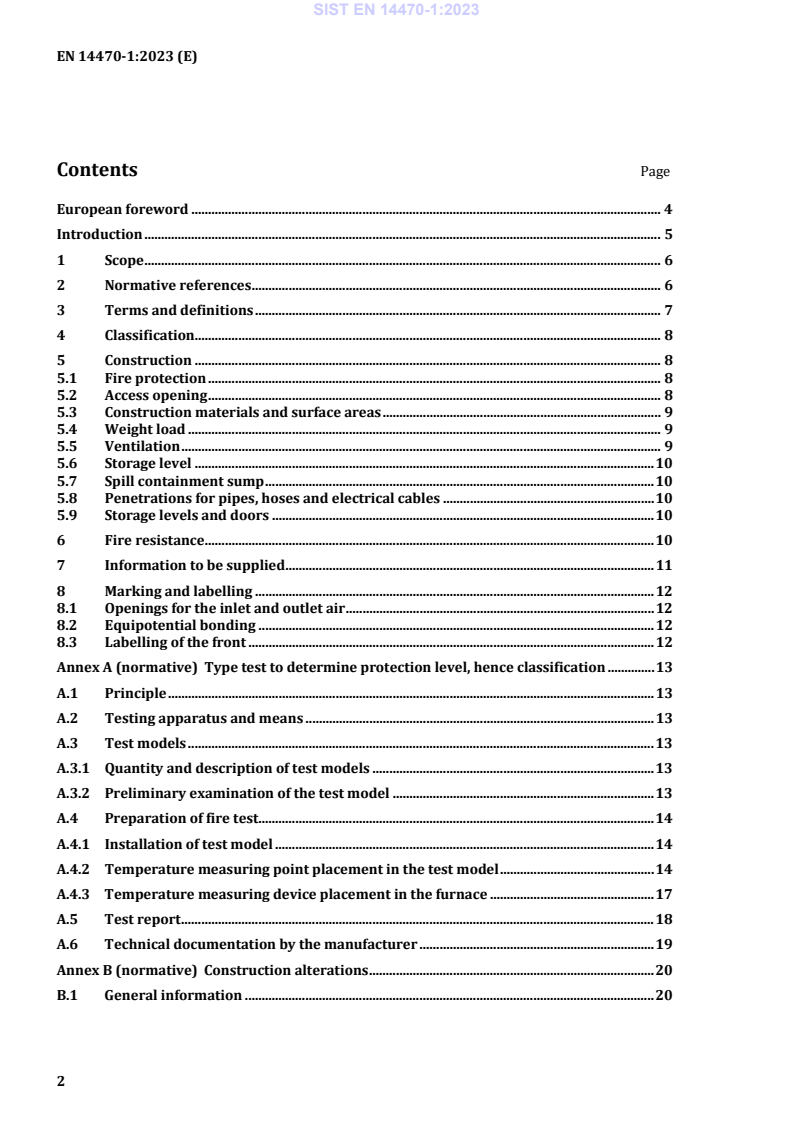
Contents Page
European foreword . 4
Introduction . 5
1 Scope . 6
2 Normative references . 6
3 Terms and definitions . 7
4 Classification. 8
5 Construction . 8
5.1 Fire protection . 8
5.2 Access opening . 8
5.3 Construction materials and surface areas . 9
5.4 Weight load . 9
5.5 Ventilation . 9
5.6 Storage level . 10
5.7 Spill containment sump . 10
5.8 Penetrations for pipes, hoses and electrical cables . 10
5.9 Storage levels and doors . 10
6 Fire resistance . 10
7 Information to be supplied . 11
8 Marking and labelling . 12
8.1 Openings for the inlet and outlet air . 12
8.2 Equipotential bonding . 12
8.3 Labelling of the front . 12
Annex A (normative) Type test to determine protection level, hence classification . 13
A.1 Principle . 13
A.2 Testing apparatus and means . 13
A.3 Test models . 13
A.3.1 Quantity and description of test models . 13
A.3.2 Preliminary examination of the test model . 13
A.4 Preparation of fire test. 14
A.4.1 Installation of test model . 14
A.4.2 Temperature measuring point placement in the test model . 14
A.4.3 Temperature measuring device placement in the furnace . 17
A.5 Test report . 18
A.6 Technical documentation by the manufacturer . 19
Annex B (normative) Construction alterations . 20
B.1 General information . 20
B.2 Construction modifications that shall be assessed . 20
B.2.1 Subsequent change of outer dimensions . 20
B.2.2 Subsequent change of access openings . 20
B.2.3 Subsequent variation and extension of interior equipment. 20
B.2.4 Changes in components and materials . 21
B.2.5 Additional penetrations . 21
B.2.6 Additional superimposed load . 24
B.3 Test report – Construction alterations . 24
Annex C (normative) Mechanical and aerotechnical tests . 25
C.1 General information . 25
C.2 Mechanical tests . 25
C.3 Aerotechnical tests . 25
C.4 Test report – Mechanical and aerotechnical tests . 26
Bibliography . 27
European foreword
This document (EN 14470-1:2023) has been prepared by Technical Committee CEN/TC 332 “Laboratory
equipment”, the secretariat of which is held by DIN.
This European Standard shall be given the status of a national standard, either by publication of an
identical text or by endorsement, at the latest by January 2024, and conflicting national standards shall
be withdrawn at the latest by January 2024.
Attention is drawn to the possibility that some of the elements of this document may be the subject of
patent rights. CEN shall not be held responsible for identifying any or all such patent rights.
This document supersedes EN 14470-1:2004.
The main changes compared to the previous edition are listed below:
3 3
a) Extension of the scope from an internal volume of not more than 1 m to not more than 2 m ;
b) Clause 3 “Terms and definitions” extended and clarified;
c) Deletion of the classification “Type 15”;
d) Clarifications in Clause 5 “Construction” by e.g. including the description for materials and surfaces,
weight loads and the addition of openings for pipes, hoses and electrical cables;
e) Extension of Clause 7 “Information to be supplied”;
f) Extension of Clause 8 “Marking and labelling”;
g) Revision of the figures for temperature sensors in Annex A;
h) Annex B extended and clarified by including a small fire test;
i) Adding new Annex C “Mechanical and aerotechnical testing”.
Any feedback and questions on this document should be directed to the users’ national standards body.
A complete listing of these bodies can be found on the CEN website.
According to the CEN-CENELEC Internal Regulations, the national standards organisations of the
following countries are bound to implement this European Standard: Austria, Belgium, Bulgaria, Croatia,
Cyprus, Czech Republic, Denmark, Estonia, Finland, France, Germany, Greece, Hungary, Iceland, Ireland,
Italy, Latvia, Lithuania, Luxembourg, Malta, Netherlands, Norway, Poland, Portugal, Republic of North
Macedonia, Romania, Serbia, Slovakia, Slovenia, Spain, Sweden, Switzerland, Türkiye and the United
Kingdom.
Introduction
This document describes the design and testing criteria for fire safety storage cabinets (also referred to
as “cabinets” in this document) to be used in rooms to store flammable liquids in closed containers at
normal room temperatures.
Primarily, this document covers the three major safety requirements for storage of flammable liquids,
which are:
a) minimizing the fire risk associated with the storage of flammable substances and protection of the
fire safety storage cabinet’s content in the event of fire for a known (tested) minimum length of time
(fire rating);
b) minimizing the amount of vapour released into the working environment;
c) retention of accidental spillage within the fire safety storage cabinet.
Testing of the fire safety storage cabinet (see a) above) under fire conditions is a normative part of this
document and the procedures and interpretation of the tests are described in detail.
The fire test (see a) above) provides three categories of fire protection ratings. In practice the degree of
fire protection/rating allows the user to select, depending on individual circumstances, a fire safety
storage cabinet which will allow sufficient time for personnel to leave, and fire fighters to enter the room
before it is likely to that the flammables stored turn a possible minor/extinguishable fire into an
uncontrollable one. The methods of achieving b) and c) above are sufficiently flexible to allow for
local/national needs.
Caution should be exercised when determining the appropriate cabinet fire rating when flammables
having auto-ignition temperatures below 200 °C and/or having high vapour pressures at room
temperature are involved. When such flammable materials are being stored, expert advice should be
sought. Reference is made to national regulations concerning flammable liquids.
1 Scope
This document is a product specification, giving performance requirements for fire safety storage
cabinets to be used for the storage of flammable liquids. It is applicable to cabinets with a total internal
volume of not greater than 2 m , which can be free standing, restrained to a wall or mounted on plinth or
castors.
This document does not apply to brick enclosures or walk-in storage rooms.
This document does not apply to any support frame or mechanism other than the base which is integral
to the fire safety storage cabinet.
Requirements are given in respect of the construction of the fire safety storage cabinet and its capacity
to resist fire conditions on the outside. A classification of fire safety storage cabinets is given, according
to the level of fire resistance offered, and a type test is included, see Annex A.
The tests described in this document are type tests.
This document does not discriminate between different flammable liquids, which can have considerably
different physical properties.
Attention is drawn to national regulations, which can apply with regard to the storage of flammable
liquids.
2 Normative references
The following documents are referred to in the text in such a way that some or all of their content
constitutes requirements of this document. For dated references, only the edition cited applies. For
undated references, the latest edition of the referenced document (including any amendments) applies.
EN 1363-1:2020, Fire resistance tests - Part 1: General requirements
EN 13165, Thermal insulation products for buildings - Factory made rigid polyurethane foam (PU) products
- Specification
EN 13501-1:2018, Fire classification of construction products and building elements - Part 1: Classification
using data from reaction to fire tests
EN 16121, Non-domestic storage furniture - Requirements for safety, strength, durability and stability
EN 16122, Domestic and non-domestic storage furniture - Test methods for the determination of strength,
durability and stability
EN ISO 5167-1, Measurement of fluid flow by means of pressure differential devices inserted in circular
cross-section conduits running full - Part 1: General principles and requirements (ISO 5167-1)
EN ISO 7010, Graphical symbols - Safety colours and safety signs - Registered safety signs (ISO 7010)
3 Terms and definitions
For the purposes of this document, the following terms and definitions apply.
ISO and IEC maintain terminology databases for use in standardization at the following addresses:
• IEC Electropedia: available at https://www.electropedia.org/
• ISO Online browsing platform: available at https://www.iso.org/obp
3.1
type
specimen of a design manufactured with the characteristics intended for series production
3.2
type test
conformity testing on the basis of one or more specimens of product representative of the production
3.3
penetration
passage of a media line (3.13) through any orifice of the fire safety storage
cabinet
3.4
access opening
opening through which user access to a fire safety storage cabinet interior
is intended
3.5
door
component of the fire safety storage cabinet, which closes the access opening
Note 1 to entry: Example of a door would be a wing door, pull-out element with front part or cover.
3.6
usable space
designated area inside the fire safety storage cabinet that can be used for
the storage of flammable liquids
3.7
bottom of the cabinet
lower fire integrity construction element of the fire safety storage cabinet
3.8
storage level
fitting element carrying the goods to be stored
3.9
spill containment sump
area intended to collect leakages and spilled liquids
3.10
superimposed load
load on top of the fire safety storage cabinet
3.11
weight load
total gross fire safety storage cabinet weight including the maximum load and the optional superimposed
load as specified by the manufacturer
3.12
small fire test
comparative fire test where only a part of the penetrated wall, ceiling or bottom is tested
3.13
media line
cable, hose or pipe to distribute services such as gases, liquids, electricity and IT
3.14
EX zone
area where explosive atmosphere can occur
4 Classification
A fire safety storage cabinet shall be classified as one of the types given in Table 1.
Table 1 — Fire safety storage cabinet type classification
Type Time taken for
internal
temperature T to
rise by 180 K
min
30 ≥ 30
60 ≥ 60
90 ≥ 90
5 Construction
5.1 Fire protection
In the case of a fire, the fire safety storage cabinet shall ensure that, for at least 30 min, the contents of
the cabinet do not contribute any additional risks or spread of fire.
5.2 Access opening
5.2.1 In case of fire, the access opening shall be closed off by the door/s automatically and completely.
The closing time of fully opened doors, from the time of door release, shall not exceed 20 s.
Tests shall be performed according to C.2 c) and e).
If a hold-open feature is included, the access opening shall be closed off fully in the event of a temperature
+0
of ( ) °C being reached in the vicinity of the access opening of the cabinet. The temperature release
−10
sensor for this shall be positioned in freely circulating air of the access opening, so that it can heat up
rapidly.
5.2.2 The temperature release component of the closing device shall conform to the temperature range
specified in 5.2.1. This shall be confirmed in the manufacturer's declaration.
5.2.3 If the closing of the doors is actuated or triggered by an external power source, the mechanism
shall be working even if the external power source fails.
5.2.4 Moving components of the closing mechanism shall not reach into the usable space of the cabinet.
5.2.5 Doors and their surroundings shall be designed such that the static force shall not exceed 100 N
between the main closing edge and the counter closing edge to prevent injuries.
5.2.6 It shall be possible to operate each door single-handedly.
5.2.7 If the doors are lockable, the locking device shall not compromise the self-closing performance as
required in 5.2.1.
5.2.8 The functioning of the closing mechanism shall be tested according to C.2.
5.3 Construction materials and surface areas
Coatings and/or decors inside the fire safety storage cabinet, which may be used to improve the
durability/impact-resistance, shall be classified at least as class E according to EN 13501-1:2018. The
surface areas of the cabinet interior shall be resistant to the flammable liquids that can correctly be stored
inside the cabinet.
NOTE Where the surface coating or material of hinges for doors or hardware for drawers reduces the
conductivity between the cabinet body and the doors or drawers, and a risk is identified by the user’s risk
assessment, it is advisable to take appropriate measures to establish a conductive connection between such
components.
5.4 Weight load
The fire safety storage cabinet including supporting elements, e.g. castors, plinths, shall be constructed in
such a way that it is capable of carrying the total cabinet weight including additional load given by the
manufacture without any damaging distortion at the testing temperature according to Annex A.
5.5 Ventilation
5.5.1 Fire safety storage cabinets shall be equipped with openings for inlet and outlet air, enabling the
connection of the cabinet to an extract air system. The openings for the inlet and outlet air shall be
positioned to each other in such a way that a uniform ventilation of the entire cabinet interior is
maintained. These openings should close in the event of fire. Tests shall be performed according to C.3.
NOTE Attention is drawn to national regulations regarding the connection of fire safety storage cabinets to
extract air systems.
5.5.2 In a fire safety storage cabinet connected to a ventilation system, with the doors closed, air
exchange at a rate of at least 10 times the volumetric capacity of the empty cabinet per hour shall take
place. The differential pressure at the connection point to the ventilation system shall not exceed 150 Pa
compared to the ambient pressure. The low pressure, which the ventilation system causes inside the
cabinet, shall not significantly compromise the opening of the doors. The ventilation shall be effective
immediately above the bottom tray of the cabinet. Tests shall be performed according to C.3.
−1
NOTE An air exchange rate of greater than 10 h can be necessary for other reasons and is not covered by this
document.
5.6 Storage level
The storage levels and their fastenings shall be of non-absorbent material and shall carry the load
specified in the user information (see Clause 7). The storage levels shall not hinder the automatic closure
of the doors. This shall be tested by a functional test. Pull-out storage levels shall not cause the cabinet to
topple, not even when it is fully loaded. Tests shall be performed according to C.2 a) and b).
NOTE For better ventilation, perforated storage levels or gratings as storage levels can be useful.
The highest storage level shall be not higher than 1,75 m from the floor.
5.7 Spill containment sump
The spill containment sump shall have a minimum capacity of 10 % of the volume of all the containers
stored in the cabinet, or at least 110 % of the volume of the largest single container, whichever is the
greater. All spillages or condensation up to this volume shall be retained.
In multi-level cabinets, the lowest spill containment sump shall be below the lowest storage level. In the
case where the spill containment sump constitutes at the same time the lowest storage level, it shall be
designed such that it meets the requirements regarding the minimum capacity of collection even when
this storage level is fully loaded.
The sump shall perform its function at 220 °C during the entire time of its type classification according to
Table 1. This shall be confirmed by the manufacturer’s declaration. Tests shall be performed according
to C.2 d).
Attention should be paid to national regulation, as these may request higher collection capacities than
mentioned above, e.g. for environmental protection reasons.
5.8 Penetrations for pipes, hoses and electrical cables
Pipes, hoses and electrical cables, if installed, shall only be lead through predefined penetrations parts
which shall be indicated in the manufacturer’s specifications. The pipes, hoses and electrical cables shall
not compromise the requirements for fire resistance established in the type test according to Annex A
(see Clause 6).
Unused penetrations shall be sealed according to the manufacturer’s specifications.
The materials of the pipes, tubes and electrical cables shall comply with the requirements specified in the
additional small fire test according to Annex B and shall be given in the user information (see Clause 7).
5.9 Storage levels and doors
Storage levels, doors and pull-out elements shall be in accordance with EN 16121 and EN 16122.
Mechanical tests shall be performed in accordance with C.2.
6 Fire resistance
The fire resistance capability of the fire safety storage cabinet shall be determined by a type test. This test
shall be performed by heating the cabinet in a furnace according to the time-temperature curve described
in EN 1363-1:2020, 5.1.1, and measuring the temperature increase inside the cabinet. The cabinet shall
then be classified in accordance with Table 1, corresponding to the time for which the interior
temperature does not rise by more than 180 K at any point of measuring, starting at a temperature of
(25 ± 15) °C according to ambient temperatures specified in EN 1363-1:2020, 5.6. The test is explained
in detail in Annex A.
Annex B specifies the requirements of the type test of cabinets with construction alterations compared
to a model already tested.
7 Information to be supplied
The fire safety storage cabinet shall be supplied with a user manual/operating instructions for the
cabinet, which include at least the following:
a) intended use;
b) dimensions and weight of the empty cabinet;
c) detailed ventilation information (place and position, air flow volume rate and differential pressure
and air exchange rate recommended by the manufacturer);
d) setup recommendations;
e) the
...