

EN 12350-13:2026
(Main)Testing fresh concrete - Part 13: Bleeding test - Static and pressure
- Abstract
This document specifies the procedures for determining the static and pressure bleed of fresh concrete.
The tests are suitable for specimens having a declared value of the coarsest fraction of aggregates used in concrete (Dmax) not greater than 40 mm. It can be carried out in the laboratory or on site.
- Status
- Published
- Publication Date
- 25-Aug-2026
- Technical Committee
- CEN/TC 104 - Concrete ( performance, production, placing and compliance criteria )
- Drafting Committee
- CEN/TC 104/SC 1 - Revision of ENV 206
- Current Stage
- 6060 - Definitive text made available (DAV) - Publishing
- Start Date
- 26-Aug-2026
- Due Date
- 02-Mar-2026
- Completion Date
- 26-Aug-2026

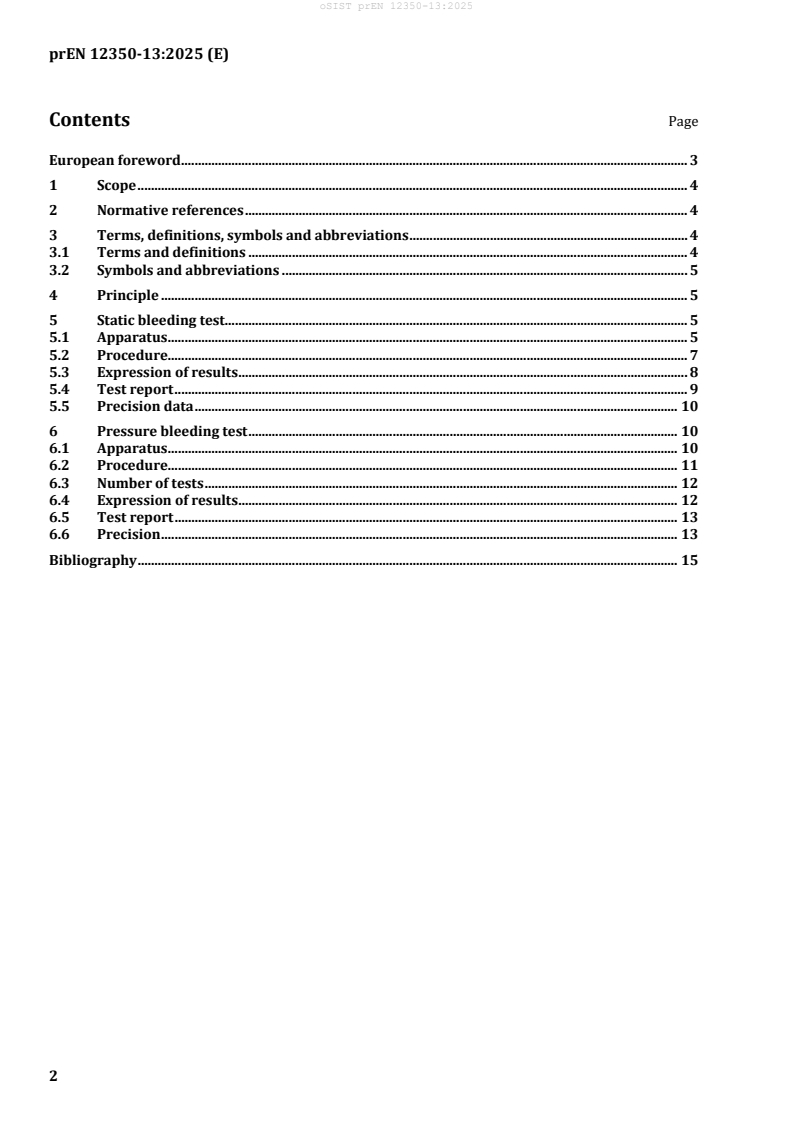
EN 12350-13:2026 is the CEN standard for testing fresh concrete by the static and pressure bleeding methods. It specifies how to measure the water that rises to the surface or is released under pressure, so results can be compared in a controlled way by laboratories, site testing teams and concrete producers. The document applies to specimens with a declared Dmax not greater than 40 mm and can be used in the laboratory or on site.
What does EN 12350-13:2026 specify?
EN 12350-13:2026 specifies the procedures for determining the static bleed and pressure bleed of fresh concrete. It is written for fresh concrete specimens up to Dmax 40 mm and allows testing either in the laboratory or directly on site.
The document is organized into:
- scope
- normative references
- terms, definitions, symbols and abbreviations
- principle
- static bleeding test
- pressure bleeding test
- bibliography
This structure matters in practice because the two test methods use different apparatus, different timing, and different result expressions, so users need to follow the correct clause for the test they are running.
What are the key requirements of EN 12350-13:2026?
Static bleeding test
EN 12350-13:2026 requires the static test to collect water that appears on the surface at set time intervals until bleeding ends. The result is reported as a bleeding rate and, when needed, a total bleed value.
- Clause 5 requires the sample to be taken in accordance with EN 12350-1 and the test to be run with controlled temperature and minimal vibration. In practice, the test conditions can change the amount of bleed, so location and temperature must be recorded.
- Clause 5.2 requires the concrete to be filled, compacted and finished in a defined way, and the compaction method must be reported. This matters because compaction affects the bleed result, and self-compacting concrete is treated differently.
- Clause 5.2.4 sets the water-collection sequence and intervals. The operator must take measurements at defined times and avoid taking paste with the bleed water, otherwise the result will be distorted.
- Clause 5.3 defines the expressions of result. The bleeding rate is taken from the first bleeding phase and the total bleed is calculated from the collected water and specimen volume. This gives a repeatable way to compare mixes.
- Clause 5.4 lists the report items, including consistence, density, mixing time, test start time and deviations. This supports traceability when results are used for quality control or troubleshooting.
Pressure bleeding test
EN 12350-13:2026 also defines a pressure test that measures water released from a concrete sample placed in a special cell under pressure. The procedure is shorter and gives a pressure bleed value that can be compared with static bleed results in mm/m.
- Clause 6.1 requires a filter-press unit in accordance with EN ISO 10414-1 and a manometer with defined accuracy characteristics. In practice, the pressure system must be controlled to keep the loading condition consistent.
- Clause 6.2 requires pressure of 1 bar, maintained for the test period, after the sample is filled and compacted in one layer. For self-compacting concrete, no compaction is applied.
- Clause 6.3 requires two test specimens from the same original sample. If their bleed-water masses differ too much, the test is invalid and a new sample is needed, which helps identify non-uniform concrete.
- Clause 6.4 defines how the individual specimen result and the average pressure bleed are calculated. The result is reported in mm/m, which makes it easier to compare with total bleed from the static method.
- Clause 6.5 requires the report to include both individual specimen results and the average. This is important when the test is used for acceptance checks or investigation of pumpability and segregation behaviour.
What terms does EN 12350-13:2026 define?
- Static bleed - the upward flow of water in fresh concrete after placing, caused by settlement of the solids.
- Bleeding rate - the mass of bleed water collected over a defined period divided by that period.
- Total bleed - the accumulated mass of bleed water collected over the full test duration.
- Pressure bleed - the water released from fresh concrete after placing when pressure is applied in a special cell.
Who uses EN 12350-13:2026?
EN 12350-13:2026 is used by concrete testing laboratories, site technicians, ready-mixed concrete producers, and quality control staff in concrete production and construction. It is relevant when a project needs to measure bleeding behaviour of fresh concrete for mix assessment, delivery checks, site troubleshooting, or comparison between mixes. Buyers and engineers can use it to specify exactly which bleed test method is required.
Which standards are used with EN 12350-13:2026?
- EN 12350-1 - sampling and common apparatus for fresh concrete tests.
- EN 12350-5 - flow table test, used when flow is the consistence measurement.
- EN 12350-6 - density of fresh concrete, used in the bleed calculations.
- EN 12350-8 - slump-flow test for self-compacting concrete.
- EN 12390-2 - making and curing specimens for strength tests, cited for compaction practice.
- EN ISO 10414-1 - the filter-press unit design used for the pressure bleeding test.
- EN 837-1 - pressure gauge accuracy class referenced for the manometer.
- ISO 5725 series - statistical terms and precision concepts used in the precision note.
What does the EN 12350-13:2026 document contain?
- A static bleeding method with apparatus, procedure, result calculation, report content and a note on precision.
- A pressure bleeding method with apparatus, procedure, repeat-test criteria, result calculation, report content and precision data.
- A figure showing an example of the pressure-test apparatus.
- Formulae for bleeding rate, total bleed and pressure bleed, using collected water and specimen density.
- Table 1 with precision data for pressure bleed, plus a bibliography that cites EN 837-3.
Relations
- Effective Date
- 07-Oct-2026
- Effective Date
- 07-Oct-2026
- Refers
EN 12390-2:2019 - Testing hardened concrete - Part 2: Making and curing specimens for strength tests - Effective Date
- 07-Oct-2026
- Effective Date
- 07-Oct-2026
- Effective Date
- 07-Oct-2026
- Effective Date
- 07-Oct-2026
- Effective Date
- 07-Oct-2026
- Effective Date
- 07-Oct-2026
- Effective Date
- 28-Jan-2026
Get Certified
Connect with accredited certification bodies for this standard

DIBt (Deutsches Institut für Bautechnik)
German Institute for Building Technology.
DIN CERTCO
DIN Group product certification.

Aboma Certification B.V.
Specialized in construction, metal, and transport sectors.
Sponsored listings
Frequently Asked Questions
EN 12350-13:2026 is a draft published by the European Committee for Standardization (CEN). Its full title is "Testing fresh concrete - Part 13: Bleeding test - Static and pressure". This standard covers: This document specifies the procedures for determining the static and pressure bleed of fresh concrete. The tests are suitable for specimens having a declared value of the coarsest fraction of aggregates used in concrete (Dmax) not greater than 40 mm. It can be carried out in the laboratory or on site.
This document specifies the procedures for determining the static and pressure bleed of fresh concrete. The tests are suitable for specimens having a declared value of the coarsest fraction of aggregates used in concrete (Dmax) not greater than 40 mm. It can be carried out in the laboratory or on site.
EN 12350-13:2026 is classified under the following ICS (International Classification for Standards) categories: 91.100.30 - Concrete and concrete products. The ICS classification helps identify the subject area and facilitates finding related standards.
EN 12350-13:2026 has the following relationships with other standards: It is inter standard links to EN 12350-6:2019, EN 837-3:1996, EN 12390-2:2019, EN 12350-2:2019, EN 12350-1:2019, EN 12350-8:2019, EN ISO 10414-1:2008, EN 12350-5:2019, EN ISO 12944-5:2019. Understanding these relationships helps ensure you are using the most current and applicable version of the standard.
EN 12350-13:2026 is available in PDF format for immediate download after purchase. The document can be added to your cart and obtained through the secure checkout process. Digital delivery ensures instant access to the complete standard document.
Standards Content (Sample)
SLOVENSKI STANDARD
oSIST prEN 12350-13:2025
01-april-2025
Preizkušanje svežega betona - 13. del: Preizkus krvavitve - Statika in tlak
Testing fresh concrete - Part 13: Bleeding test - Static and pressure
Prüfung von Frischbeton - Teil 13: Prüfung des Blutens - Statisch und Druck
Essais pour béton frais - Partie 13 : Essai de ressuage - Statique et sous pression
Ta slovenski standard je istoveten z: prEN 12350-13
ICS:
91.100.30 Beton in betonski izdelki Concrete and concrete
products
oSIST prEN 12350-13:2025 en,fr,de
2003-01.Slovenski inštitut za standardizacijo. Razmnoževanje celote ali delov tega standarda ni dovoljeno.
oSIST prEN 12350-13:2025
oSIST prEN 12350-13:2025
DRAFT
EUROPEAN STANDARD
prEN 12350-13
NORME EUROPÉENNE
EUROPÄISCHE NORM
February 2025
ICS 91.100.30
English Version
Testing fresh concrete - Part 13: Bleeding test - Static and
pressure
Essais pour béton frais - Partie 13 : Essai de ressuage - Prüfung von Frischbeton - Teil 13: Prüfung des Blutens
Statique et sous pression - Statisch und Druck
This draft European Standard is submitted to CEN members for enquiry. It has been drawn up by the Technical Committee
CEN/TC 104.
If this draft becomes a European Standard, CEN members are bound to comply with the CEN/CENELEC Internal Regulations
which stipulate the conditions for giving this European Standard the status of a national standard without any alteration.
This draft European Standard was established by CEN in three official versions (English, French, German). A version in any other
language made by translation under the responsibility of a CEN member into its own language and notified to the CEN-CENELEC
Management Centre has the same status as the official versions.
CEN members are the national standards bodies of Austria, Belgium, Bulgaria, Croatia, Cyprus, Czech Republic, Denmark, Estonia,
Finland, France, Germany, Greece, Hungary, Iceland, Ireland, Italy, Latvia, Lithuania, Luxembourg, Malta, Netherlands, Norway,
Poland, Portugal, Republic of North Macedonia, Romania, Serbia, Slovakia, Slovenia, Spain, Sweden, Switzerland, Türkiye and
United Kingdom.
Recipients of this draft are invited to submit, with their comments, notification of any relevant patent rights of which they are
aware and to provide supporting documentation.
Warning : This document is not a European Standard. It is distributed for review and comments. It is subject to change without
notice and shall not be referred to as a European Standard.
EUROPEAN COMMITTEE FOR STANDARDIZATION
COMITÉ EUROPÉEN DE NORMALISATION
EUROPÄISCHES KOMITEE FÜR NORMUNG
CEN-CENELEC Management Centre: Rue de la Science 23, B-1040 Brussels
© 2025 CEN All rights of exploitation in any form and by any means reserved Ref. No. prEN 12350-13:2025 E
worldwide for CEN national Members.
oSIST prEN 12350-13:2025
prEN 12350-13:2025 (E)
Contents Page
European foreword . 3
1 Scope . 4
2 Normative references . 4
3 Terms, definitions, symbols and abbreviations . 4
3.1 Terms and definitions . 4
3.2 Symbols and abbreviations . 5
4 Principle . 5
5 Static bleeding test . 5
5.1 Apparatus . 5
5.2 Procedure. 7
5.3 Expression of results . 8
5.4 Test report . 9
5.5 Precision data . 10
6 Pressure bleeding test . 10
6.1 Apparatus . 10
6.2 Procedure. 11
6.3 Number of tests . 12
6.4 Expression of results . 12
6.5 Test report . 13
6.6 Precision . 13
Bibliography . 15
oSIST prEN 12350-13:2025
prEN 12350-13:2025 (E)
European foreword
This document (prEN 12350-13:2025) has been prepared by Technical Committee CEN/TC 104
“Concrete and related products”, the secretariat of which is held by SN.
This document is currently submitted to the CEN Enquiry.
It is based on the French standard XP P 18-468 : Concrete — Testing fresh concrete — Bleed
This document is one of a series on testing concrete.
EN 12350, Testing fresh concrete, consists of the following parts:
— Part 1: Sampling and common apparatus
— Part 2: Slump test
— Part 3: Vebe test
— Part 4: Degree of compactability
— Part 5: Flow table test
— Part 6: Density
— Part 7: Air content – Pressure methods
— Part 8: Self-compacting concrete – Slump-flow test
— Part 9: Self-compacting concrete – V-funnel test
— Part 10: Self-compacting concrete – L-box test
— Part 11: Self-compacting concrete – Sieve segregation test
— Part 12: Self-compacting concrete – J-ring test
— Part 13: Bleeding test – Static and pressure.
oSIST prEN 12350-13:2025
prEN 12350-13:2025 (E)
1 Scope
This document specifies the procedures for determining the static and pressure bleed of fresh concrete.
The tests are suitable for specimens having a declared value of the coarsest fraction of aggregates actually
used in the concrete (D ) not greater than 40 mm. It can be carried out in the laboratory or on site.
max
2 Normative references
The following documents are referred to in the text in such a way that some or all of their content
constitutes requirements of this document. For dated references, only the edition cited applies. For
undated references, the latest edition of the referenced document (including any amendments) applies.
EN 12350-1, Testing fresh concrete — Part 1: Sampling and common apparatus
EN 12350-5, Testing fresh concrete — Part 5: Flow table test
EN 12350-6, Testing fresh concrete — Part 6: Density
EN 12350-8, Testing fresh concrete — Part 8: Self-compacting concrete — Slump-flow test
EN 12390-2, Testing hardened concrete — Part 2: Making and curing specimens for strength tests
EN ISO 10414-1, Petroleum and natural gas industries — Field testing of drilling fluids — Part 1:
Water-based fluids (ISO 10414-1)
3 Terms, definitions, symbols and abbreviations
For the purposes of this document, the following terms and definitions apply.
ISO and IEC maintain terminology databases for use in standardization at the following addresses:
— IEC Electropedia: available at https://www.electropedia.org/
— ISO Online browsing platform: available at https://www.iso.org/obp
3.1 Terms and definitions
3.1.1
static bleed
the upwards flow of water of fresh concrete after placing caused by the settlement of the solid materials
within the mass
3.1.2
bleeding rate
accumulated mass of bleed water during a defined period of time divided by the duration of this period
3.1.3
total bleed
accumulated mass of the bleed water during the duration of the test
3.1.4
pressure bleed
the release of water from fresh concrete after placing caused by the application of a pressure on the
concrete mass placed in a special cell
oSIST prEN 12350-13:2025
prEN 12350-13:2025 (E)
3.2 Symbols and abbreviations
For the purposes of this document, the following common symbols apply.
D density according to EN 12350-6 kg/m3
ρ
volume of the collected water (ml) at time ti
Vi
V volume of the collected water (ml) up to time ti
ci
V total collected water volume (ml)
ctotal
m mass of the container (g)
m mass of the sample and container (g) at the beginning of the test
m mass of the sample and container (g) at the end of the test
B total bleed
T
T starting time of concrete production (1st water-cement contact)
t test starting time
ti time at which a volume of water Vi is collected
V volume of the concrete test specimen (l)
conc
B bleeding rate (ml/min)
R
m mass of the filtration cell (g)
1p
m mass of the sample and filtration of cell (g) at the beginning of the test
2p
m mass of the graduated cylinder (g)
3p
m mass of the graduated cylinder and filtered water (g)
4p
PB pressure bleed of the test specimen (n) at the end of each pressure
n
bleeding test (mm/m)
4 Principle
In the static bleeding test, the water on the surface of the fresh concrete is collected at different time
intervals to determine the bleeding rate, and until the end of bleeding to determine the total bleed of
concrete.
In the pressure bleeding test, the water extracted from a concrete sample subject to a pressure of 1 bar
(0,1 MPa) for a period of 3 min is collected to determine the pressure bleed of the concrete.
This value may allow to estimate the maximum settlement of the concrete.
5 Static bleeding test
5.1 Apparatus
5.1.1 Common apparatus
The apparatus listed below for the execution of this test method shall be in accordance with the
specification given in EN 12350-1 and as specified below.
oSIST prEN 12350-13:2025
prEN 12350-13:2025 (E)
5.1.2 Cylindrical container
Watertight, of sufficient rigidity to retain its shape, made from a non-absorbent material not readily
attacked by cement paste, having a smooth internal face.
The reference container shall have an internal diameter of 255 ± 5 mm and internal height of 280 ± 5mm.
NOTE Where a container having different dimensions is used the test might not produce the same result as
that obtained when using the reference container.
5.1.3 Container cover
Made of the same material as the container or of glass, plexiglass or plastic.
5.1.4 Plastic film
Placed between the top part of the container and the cover to minimize water evaporation from the
concrete.
Any contact between the plastic film and the surface of the concrete shall be avoided.
5.1.5 Shim
Between 30 and 50 mm thick, strong enough not to deform under the weight of the concrete and
container.
5.1.6 Means of compacting the concrete, which may be one of the following
a) internal (poker) vibrator;
b) vibrating table;
c) compacting rod;
d) compacting bar.
5.1.7 Balance or scales
For the determination of the mass of the concrete sample having a maximum instrumental measurement
uncertainty of 0.1 % of the mass.
5.1.8 Balance or scales
For the determination of bleed water mass having a maximum instrumental measurement uncertainty of
0,5 g.
5.1.9 Pipette or similar instrument
Having a capacity of up to 10 ml, graduated to 0,5 ml.
5.1.10 Test tube
Having a capacity of 100 ml.
oSIST prEN 12350-13:2025
prEN 12350-13:2025 (E)
5.1.11 Scoop
5.1.12 Timer or clock
5.1.13 Steel trowel or float
5.1.14 Thermometer
5.2 Procedure
5.2.1 General
The test can be carried out in a laboratory or on site. If carried out on site, the container should be kept
in the shade and placed on a horizontal platform or floor free from vibration.
The sample shall be taken in accordance with EN 12350-1.
5.2.2 Container mass
Weigh the container and record the value (m ) to the nearest g.
5.2.3 Filling and compacting
If the purpose of the test is to give information on the behaviour of the concrete after placing, and if the
filling and compacting of the concrete are carried out in the laboratory, it shall be done at a time after
batching of the concrete reflecting the time of delivery and use on site, but no greater than 2 hours except
where specific consistence retention times had been specified.
Determine the consistence (slump, flow or slump-flow) of the concrete in accordance
...