


EN 115-2:2010
(Main)Safety of escalators and moving walks - Part 2: Rules for the improvement of safety of existing escalators and moving walks
General Information
- Abstract
1.1 This European Standard gives rules for improving the safety of existing escalators and moving walks with the aim of reaching an equivalent level of safety to that of a newly installed escalator and moving walk by the application of today’s state of the art for safety.
NOTE Due to situations such as the existing machine or building designs, it may not be possible in all cases to reach today’s state of the art for safety. Nevertheless the objective is to improve the level of safety wherever possible.
1.2 This standard includes the improvement of safety of existing escalators and moving walks for:
a) users;
b) maintenance and inspection personnel;
c) persons outside the escalator or moving walk (but in its immediate vicinity);
d) authorised persons.
1.3 This standard is not applicable to:
a) safety during transport, installation, repairs and dismantling of escalators and moving walks;
b) spiral escalators;
c) accelerating moving walks.
However, this standard can usefully be taken as a reference basis.
- Status
- Withdrawn
- Publication Date
- 20-Jul-2010
- Withdrawal Date
- 16-Sep-2026
- Technical Committee
- CEN/TC 10 - Passenger, goods and service lifts
- Drafting Committee
- CEN/TC 10/WG 2 - Escalators and passenger conveyors
- Current Stage
- 9960 - Withdrawal effective - Withdrawal
- Start Date
- 28-Apr-2021
- Completion Date
- 17-Sep-2026
- Directive
- Harmonized Standard2006/42/EC - Directive 2006/42/EC of the European Parliament and of the Council of 17 May 2006 on machinery, and amending Directive 95/16/EC (recast)
Not Harmonized98/37/EC - Machinery

Relations
- Splited From
prEN 115 - Safety rules for the construction and installation of escalators and moving walks - Effective Date
- 07-Mar-2023
- Effective Date
- 24-Apr-2019
- Effective Date
- 25-Aug-2026
- Effective Date
- 28-Jan-2026
- Effective Date
- 28-Jan-2026
- Refers
EN 13015:2001+A1:2008 - Maintenance for lifts and escalators - Rules for maintenance instructions - Effective Date
- 28-Jan-2026
- Effective Date
- 28-Jan-2026
- Effective Date
- 28-Jan-2026
- Effective Date
- 28-Jan-2026
- Effective Date
- 28-Jan-2026
- Effective Date
- 28-Jan-2026
- Effective Date
- 22-Dec-2008
Get Certified
Connect with accredited certification bodies for this standard

DIBt (Deutsches Institut für Bautechnik)
German Institute for Building Technology.
DIN CERTCO
DIN Group product certification.

Aboma Certification B.V.
Specialized in construction, metal, and transport sectors.
Sponsored listings
Frequently Asked Questions
EN 115-2:2010 is a standard published by the European Committee for Standardization (CEN). Its full title is "Safety of escalators and moving walks - Part 2: Rules for the improvement of safety of existing escalators and moving walks". This standard covers: 1.1 This European Standard gives rules for improving the safety of existing escalators and moving walks with the aim of reaching an equivalent level of safety to that of a newly installed escalator and moving walk by the application of today’s state of the art for safety. NOTE Due to situations such as the existing machine or building designs, it may not be possible in all cases to reach today’s state of the art for safety. Nevertheless the objective is to improve the level of safety wherever possible. 1.2 This standard includes the improvement of safety of existing escalators and moving walks for: a) users; b) maintenance and inspection personnel; c) persons outside the escalator or moving walk (but in its immediate vicinity); d) authorised persons. 1.3 This standard is not applicable to: a) safety during transport, installation, repairs and dismantling of escalators and moving walks; b) spiral escalators; c) accelerating moving walks. However, this standard can usefully be taken as a reference basis.
1.1 This European Standard gives rules for improving the safety of existing escalators and moving walks with the aim of reaching an equivalent level of safety to that of a newly installed escalator and moving walk by the application of today’s state of the art for safety. NOTE Due to situations such as the existing machine or building designs, it may not be possible in all cases to reach today’s state of the art for safety. Nevertheless the objective is to improve the level of safety wherever possible. 1.2 This standard includes the improvement of safety of existing escalators and moving walks for: a) users; b) maintenance and inspection personnel; c) persons outside the escalator or moving walk (but in its immediate vicinity); d) authorised persons. 1.3 This standard is not applicable to: a) safety during transport, installation, repairs and dismantling of escalators and moving walks; b) spiral escalators; c) accelerating moving walks. However, this standard can usefully be taken as a reference basis.
EN 115-2:2010 is classified under the following ICS (International Classification for Standards) categories: 91.140.90 - Lifts. Escalators. The ICS classification helps identify the subject area and facilitates finding related standards.
EN 115-2:2010 has the following relationships with other standards: It is inter standard links to prEN 115, EN 115-2:2021, ISO 8598:1996, EN 2286:1989, EN ISO 13850:2015, EN 13015:2001+A1:2008, EN 115-1:2008+A1:2010, EN ISO 13857:2008, EN ISO 12100-1:2003, EN ISO 15614-13:2012, EN ISO 17660-1:2006; is excused to prEN 115. Understanding these relationships helps ensure you are using the most current and applicable version of the standard.
EN 115-2:2010 is associated with the following European legislation: EU Directives/Regulations: 2006/42/EC, 98/37/EC; Standardization Mandates: M/079, M/396. When a standard is cited in the Official Journal of the European Union, products manufactured in conformity with it benefit from a presumption of conformity with the essential requirements of the corresponding EU directive or regulation.
EN 115-2:2010 is available in PDF format for immediate download after purchase. The document can be added to your cart and obtained through the secure checkout process. Digital delivery ensures instant access to the complete standard document.
Standards Content (Sample)
2003-01.Slovenski inštitut za standardizacijo. Razmnoževanje celote ali delov tega standarda ni dovoljeno.Sicherheit von Fahrtreppen und Fahrsteigen - Teil 2: Regeln für die Erhöhung der Sicherheit bestehender Fahrtreppen und FahrsteigeSécurite des escaliers mécaniques et trottoirs roulants - Partie 2: Règles pour l'amélioration de la sécurité des escaliers mécaniques et des trottoirs roulants existantsSafety of escalators and moving walks - Part 2: Rules for the improvement of safety of existing escalators and moving walks91.140.90Lifts. EscalatorsICS:Ta slovenski standard je istoveten z:EN 115-2:2010SIST EN 115-2:2010en,fr,de01-oktober-2010SIST EN 115-2:2010SLOVENSKI
STANDARD
EUROPEAN STANDARD NORME EUROPÉENNE EUROPÄISCHE NORM
EN 115-2
July 2010 ICS 91.140.90 English Version
Safety of escalators and moving walks - Part 2: Rules for the improvement of safety of existing escalators and moving walks Sécurité des escaliers mécaniques et trottoirs roulants - Partie 2: Règles pour l'amélioration de la sécurité des escaliers mécaniques et des trottoirs roulants existants
Sicherheit von Fahrtreppen und Fahrsteigen - Teil 2: Regeln für die Erhöhung der Sicherheit bestehender Fahrtreppen und Fahrsteige This European Standard was approved by CEN on 12 June 2010.
CEN members are bound to comply with the CEN/CENELEC Internal Regulations which stipulate the conditions for giving this European Standard the status of a national standard without any alteration. Up-to-date lists and bibliographical references concerning such national standards may be obtained on application to the CEN Management Centre or to any CEN member.
This European Standard exists in three official versions (English, French, German). A version in any other language made by translation under the responsibility of a CEN member into its own language and notified to the CEN Management Centre has the same status as the official versions.
CEN members are the national standards bodies of Austria, Belgium, Bulgaria, Croatia, Cyprus, Czech Republic, Denmark, Estonia, Finland, France, Germany, Greece, Hungary, Iceland, Ireland, Italy, Latvia, Lithuania, Luxembourg, Malta, Netherlands, Norway, Poland, Portugal, Romania, Slovakia, Slovenia, Spain, Sweden, Switzerland and United Kingdom.
EUROPEAN COMMITTEE FOR STANDARDIZATION
COMITÉ EUROPÉEN DE NORMALISATION EUROPÄISCHES KOMITEE FÜR NORMUNG
Management Centre:
Avenue Marnix 17,
B-1000 Brussels © 2010 CEN All rights of exploitation in any form and by any means reserved worldwide for CEN national Members. Ref. No. EN 115-2:2010: ESIST EN 115-2:2010
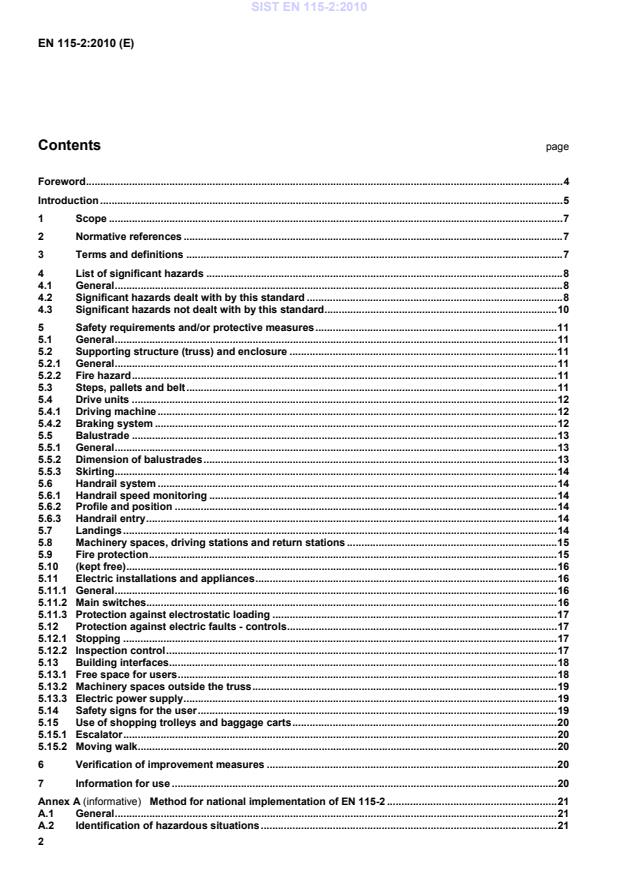
Method for national implementation of EN 115-2 . 21A.1General . 21A.2Identification of hazardous situations . 21SIST EN 115-2:2010
Safety check list for existing escalators and moving walks . 25Bibliography . 31 SIST EN 115-2:2010
New technologies and social expectations have led to today's state of the art for safety. This has led to the situation today of different levels of safety across Europe causing accidents. However, users and authorised persons expect a common acceptable level of safety. Furthermore the life cycle of escalators and moving walks is longer than most other transportation systems and building equipment, which therefore means that the design, performance and safety can fall behind modern technologies. If all existing escalators and moving walks are not upgraded to today's state of the art of safety the number of injuries will increase (especially in areas which can be accessed by the general public, recognizing the change of behaviour and changing attitudes towards safety in general). If escalators or moving walks were installed before 1970 on the base of manufacturer's and national standards or were installed after 1970 but not in accordance with CIRA Recommendation 28, then they should be the subject of a separate risk assessment in addition to the recommendations of this standard to determine whether a safety upgrade or a full replacement is appropriate. Approach of this standard This standard
categorises various hazards and hazardous situations, each of which has been analysed by a risk assessment (see in particular Annex A); is intended to provide corrective actions to progressively and selectively improve, step by step, the safety of all existing escalators and moving walks towards today’s state of the art for safety (see Clause 5); enables each escalator and moving walk to be audited and safety measures to be identified and implemented in a step by step and selective fashion according to the frequency and severity of any single risk (see Table B.2); lists the high, medium and low risks and corrective actions which can be applied in separate steps in order to mitigate the risks (see Table B.2). Use of this standard This standard can be used as a guideline for: a) national authorities to determine its own programme of implementation in a step by step process via a filtering process (see Annex A) in a reasonable and practicable1) way based on the level of risk (e.g. high, medium, low) and social and economic considerations;
1) "Reasonable and practicable” is defined as follows: “In deciding what is reasonably practicable the seriousness of a risk to injury should be weighted against the difficulty and cost of removing or reducing that risk. Where the difficulty and costs are high, and a careful assessment of the risk shows it to be comparatively unimportant, action may not need to be taken. On the other hand where the risk is high, action should be taken at whatever cost.”. SIST EN 115-2:2010
1 Scope 1.1 This European Standard gives rules for improving the safety of existing escalators and moving walks with the aim of reaching an equivalent level of safety to that of a newly installed escalator and moving walk by the application of today’s state of the art for safety. NOTE Due to situations such as the existing machine or building designs, it may not be possible in all cases to reach today’s state of the art for safety. Nevertheless the objective is to improve the level of safety wherever possible. 1.2 This standard includes the improvement of safety of existing escalators and moving walks for: a) users; b) maintenance and inspection personnel; c) persons outside the escalator or moving walk (but in its immediate vicinity); d) authorised persons. 1.3 This standard is not applicable to: a) safety during transport, installation, repairs and dismantling of escalators and moving walks; b) spiral escalators; c) accelerating moving walks. However, this standard can usefully be taken as a reference basis. 2 Normative references The following referenced documents are indispensable for the application of this document. For dated references, only the edition cited applies. For undated references, the latest edition of the referenced document (including any amendments) applies. EN 115-1:2008+A1:2010, Safety of escalators and moving walks — Part 1: Construction and installation EN 13015:2001+A1:2008, Maintenance for lifts and escalators — Rules for maintenance instructions EN 60204-1:2006, Safety of machinery — Electrical equipment of machines — Part 1: General requirements
(IEC 60204-1:2005, modified)
EN ISO 12100-1:2003, Safety of machinery — Basic concepts, general principles for design — Part 1: Basic terminology, methodology (ISO 12100-1:2003) EN ISO 13850, Safety of machinery — Emergency stop — Principles for design (ISO 13850:2006) EN ISO 13857:2008, Safety of machinery — Safety distances to prevent hazard zones being reached by upper and lower limbs (ISO 13857:2008) 3 Terms and definitions For the purposes of this document, the terms and definitions given in EN ISO 12100-1:2003,
EN 115-1:2008+A1:2010 and the following apply. SIST EN 115-2:2010
9 Collision between fixed and moving parts of the step/pallet/belt system M 5.3.6 10 Uncontrolled movement or a failure to stop of the machine resulting from missing second independent main contactor H 5.4.1, 5.4.2.3 11 Excessive speed and unintended reversal of direction M 5.4.2.1, 5.4.2.2, 5.4.2.5
12 Effect of excessive stopping distance L 5.4.2.4 13 Falling due to reduced stopping distance H 5.4.2.6 14 Falling over the balustrade M 5.5.2.1, 5.5.2.2 15 Falling resulting from sliding on the outside of the balustrade L 5.5.2.3 16 Climbing on the outside of the balustrade or falling from the landing H 5.5.2.3, 5.13.1.6 17 Falling due to handrail speed deviation M 5.6.1
18 Crushing of fingers between handrail and balustrade H 5.6.2 19 Drawing-in at handrail entry into the balustrade H/M 5.6.3.1 20 Trapping at handrail entry (between handrail and floor) M 5.6.3.2 21 Trapping between comb and step/pallet H 5.7.2, 5.7.3 22 Trapping of users resulting from sagging of the step/pallet H 5.7.4
23 Miscellaneous equipment in workers' area not related to the installation M 5.8.1 SIST EN 115-2:2010
H 5.8.5 27.2 Inadequate emergency stopping device (working area) L 5.8.5 28 Contact of persons with live parts - Insufficient isolation H 5.11.1.2, 5.13.3 29 Contact of persons with live parts – Isolation failure H 5.11.1.3, 5.11.1.4, 5.13.3 30.1 Unsafe working conditions due to missing main switch H 5.11.2 30.2 Unsafe working conditions due to or inadequate main switch M 5.11.2 31 Electrostatic discharge from moving components L 5.11.3 32.1 Injuries due to missing stop switch for emergency situation
H 5.12.1 32.2 Injuries due to inadequate stop switch for emergency situation M 5.12.1 33 Impact on bodies caused by collision with building structures (wall, roof, criss-cross arrangement)
H 5.13.1.1, 5.13.1.2, 5.13.1.3 34 Crushing due to restricted circulation areas M 5.13.1.4 35 Crushing of persons resulting from traffic congestion on succeeding escalators or moving walks L 5.13.1.5 36 Falling due to inadequate lighting at the landings M 5.13.1.7 37 Missing safety signs M 5.14 38.1 Missing devices resulting in misuse of escalators by transporting other items than persons (e.g. shopping trolleys or baggage carts)
H 5.15.1 38.2 Inadequate devices to prevent use of trolleys or baggage carts on escalators M 5.15.1 39 Crushing due to incompatible trolleys on moving walks L 5.15.2 Key H
high, M
medium, L
low
4.3 Significant hazards not dealt with by this standard Environmental conditions including e.g. earthquake and flooding; electromagnetic interferences; shearing due to sharp edges on machinery; non-conformance with national building codes; fire in the building. SIST EN 115-2:2010
EN 115-1:2008+A1:2010. 5.2 Supporting structure (truss) and enclosure 5.2.1 General All mechanically moving parts of the escalator or moving walk shall be completely enclosed within panels or walls. Exempt from this are the accessible steps, the accessible pallets, the accessible belt and that part of the handrail available for the user. Ventilation apertures in compliance with EN ISO 13857:2008, Table 5 are permitted. Exterior panels which are designed to be opened (e.g. for cleaning purposes), inspection covers and floor plates shall be provided with an electric safety device according to EN 115-1:2008+A1:2010, Table 6 n). For inspection covers and floor plates it shall only be possible to open them by a key or a tool suited for that purpose. If rooms behind inspection covers and floor plates can be entered, it shall be possible to open them from the inside without a key or a tool even when locked. It is permissible to omit an enclosure of the mechanically moving parts if other measures (such as rooms with locked doors accessible to authorised personnel only) make a hazard to the public impossible. 5.2.2 Fire hazard 5.2.2.1 Accumulation of combustible material inside the truss due to the daily environmental pollution can generate a fire hazard. Therefore, the inner part of the escalator/moving walk shall be cleaned regularly.
5.2.2.2 Depending on the maintenance conditions, e.g. access, fire protection systems shall be installed.
5.3 Steps, pallets and belt 5.3.1 Tread surfaces for escalators and moving walks shall provide a secure foothold taking into consideration the operational and environmental conditions. 5.3.2 Demarcation (e.g. groove in the step tread) shall be provided to highlight at the landings the rear edge of the steps. SIST EN 115-2:2010
The vertical displacement shall not exceed 4 mm for steps and pallets and 6 mm for belts. 5.3.4 Clearances for steps with cleated risers and pallets with meshing front and rear edges shall not exceed 6 mm between two consecutive steps or pallets in any usable position measured at the tread surface.
Clearances for steps with plain risers and pallets without meshing shall not exceed 5 mm between two consecutive steps or pallets in any usable position measured at the tread surface.
In the area of the transition curves of moving walks with meshed front edges and rear edges of the pallets, this clearance is permitted to be increased to 8 mm. 5.3.5 A missing step/pallet shall be detected and the escalator/moving walk stopped before the gap (resulting from the missing step/pallet) emerges from the comb. This shall be ensured by a device according to
EN 115-1:2008+A1:2010, Table 6 k), provided at each driving and return station. 5.3.6 The step/pallet chains and the belt shall be tensioned continuously. The escalator/moving walk shall be stopped automatically before the tensioning device moves excessively (see EN 115-1:2008+A1:2010, 5.4.3.3 and Table 6 e) and f)). Springs working in tension are not permitted for the tensioning device. When weights are used for tensioning they shall be safely retained should their suspension break. 5.4 Drive units 5.4.1 Driving machine Stopping the escalator or moving walk by means of the electric safety devices shall be effected as follows: The supply shall be interrupted by two independent contactors, the contacts of which shall be in series in the supply circuit. If, when the escalator or moving walk is stopped, one of the main contacts of one of the contactors has not opened, starting shall be impossible. If a hand winding device is provided it shall be easily accessible and safe to operate. If the hand winding device is removable an electric safety device shall be actuated when or before the hand winding device is put on the machine. Crank handles or perforate hand wheels are not permitted. 5.4.2 Braking system 5.4.2.1 If the design does not prevent excessive speed, escalators and moving walks shall be equipped in such a way that they stop automatically before the speed exceeds a value of 1,2 times the nominal speed. Where speed control devices are used for this purpose they shall have switched off the escalator or moving walk before the speed exceeds a value of 1,2 times the nominal speed and shall be provided with an electrical safety device in accordance with EN 115-1:2008+A1:2010, Table 6 c). 5.4.2.2 Escalators and inclined (α ≥ 6°) moving walks shall be equipped with an electrical safety device in accordance with EN 115-1:2008+A1:2010, Table 6 c) in such a way that they stop automatically by the time the steps and pallets or the belt change from the pre-set direction of travel. 5.4.2.3 The interruption of the electricity supply to an electromechanical brake shall be effected by at least two independent electric devices. They can be those which break the supply to the machine. If after the stop of the escalator or moving walk one of these electric devices has not opened, restarting shall be prevented. 5.4.2.4 A device shall be provided to monitor the lifting of the braking system after starting the escalator/moving walk. 5.4.2.5 Escalators and inclined moving walks shall be equipped with auxiliary brake(s) if a) the connection between the operational brake and the driving sprockets of the steps/pallets or the drum of the belt is not accomplished by shafts, gear wheels, multiplex chains, or more than one single chain, or SIST EN 115-2:2010
The stopping distances for unloaded and horizontally or downward moving loaded moving walks shall be as indicated in Table 3. Table 3 — Stopping distances for moving walks Nominal speed v Stopping distance between 0,50 m/s 0,20 m and 1,00 m 0,65 m/s 0,30 m and 1,30 m 0,75 m/s 0,40 m and 1,50 m 0,90 m/s 0,55 m and 1,70 m
For intermediate speeds the stopping distances shall be interpolated. The stopping distances shall be measured from the time the electric device for stopping is actuated. 5.5 Balustrade 5.5.1 General Balustrades shall be installed on each side of the escalator or moving walk. 5.5.2 Dimension of balustrades 5.5.2.1 In the inclined section the vertical height from step nose or pallet surface or belt surface to top of the handrail shall be not less than 0,90 m and not exceed 1,10 m. 5.5.2.2 The lower inner decking and the interior panel shall have an angle of inclination of at least 25° to the horizontal. This does not apply to the horizontal part of the lower inner decking that directly joins the interior panel. 5.5.2.3 Appropriate measures shall be taken to discourage people from climbing on the outsides of the balustrade if there is a danger of people falling from them. SIST EN 115-2:2010
If this is not reasonably practicable, a movement detection device shall be installed and shall stop the escalator or moving walk in the event of no hand rail movement for a period of 15 s while the step/pallet/belt is running. 5.6.2 Profile and position The handrail profiles and their guides on the balustrades shall be formed or enclosed in such a way that the possibility of pinching or trapping of fingers or hands is reduced. The distance between the handrail profile and guide or cover profiles shall under no circumstances be wider than 8 mm. 5.6.3 Handrail entry 5.6.3.1 At the point of entry of the handrail into the newel a guard shall be installed to prevent the pinching of fingers and hands. An electric safety device in accordance with EN 115-1:2008+A1:2010, Table 6 i) shall be provided. 5.6.3.2 If extended newels are fitted they shall be of the correct profile in accordance with
EN 115-1:2008+A1:2010, 5.6.4.2 or appropriate guarding shall be fitted to prevent trapping. 5.7 Landings 5.7.1 The landing area of escalators and moving walks (i.e. comb plate and floor plate) shall have a surface that provides a secure foothold for a minimum distance of 0,85 m measured from the root of the comb teeth.
Exempt from this are the combs. SIST EN 115-2:2010
A stop switch need not be provided in a machinery space if a main switch according to EN 115-1:2008+A1:2010, 5.11.4 is located therein. 5.9 Fire protection Fire protection and building requirements differ from country to country and so far neither have been harmonised. Therefore, this standard cannot include specific requirements for fire protection and building requirements. SIST EN 115-2:2010
EN 115-1:2008+A1:2010, 5.12.1.2. NOTE Devices according to EN ISO 13850 do not support the functional requirement for stop switches according to EN 115-1:2008+A1:2010, 5.12.2.2.3. For the specific purpose of safety for escalators and moving walks the stop switch for emergency situations is defined different to EN ISO 13850. 5.12.2 Inspection control 5.12.2.1 Escalators or moving walks shall be equipped with inspection controls to permit operation during maintenance or repair or inspection by means of portable and manually operated control devices. 5.12.2.2 For this purpose, one inspection outlet for the connection of the flexible cable of the portable manually operated control device shall be provided at least at each landing, e.g. in the driving station and the return station in the truss. The length of the cable shall be at least 3,0 m. Inspection outlets shall be located in such a way that any point of the escalator or moving walk can be reached with the cable. 5.12.2.3 The
...