

EN 12976-1:2017
(Main)Thermal solar systems and components - Factory made systems - Part 1: General requirements
- Abstract
This European Standard specifies requirements on durability, reliability and safety for Factory Made solar heating systems. The standard also includes provisions for evaluation of conformity to these requirements. Concept of system families is included, as well.
The requirements in this standard apply to Factory Made solar systems as products. The installation of these systems including their integration with roofs or facades is not considered, but requirements are given for the documentation for the installer and the user to be delivered with the system (see also 4.6).
External auxiliary water heating devices that are placed in series with the Factory Made system are not considered to be part of the system. Cold water piping from the cold water grid to the system as well as piping from the system to an external auxiliary heater or to draw-off points is not considered to be part of the system. Piping between components of the Factory Made system is considered to be part of the system. Any integrated heat exchanger or piping for space heating option (see Introduction, last paragraph) is not considered to be part of the system.
- Status
- Withdrawn
- Publication Date
- 24-Jan-2017
- Withdrawal Date
- 06-Oct-2026
- Technical Committee
- CEN/TC 312 - Thermal solar systems and components
- Drafting Committee
- CEN/TC 312/WG 2 - Factory made systems
- Current Stage
- 9960 - Withdrawal effective - Withdrawal
- Start Date
- 08-Dec-2021
- Completion Date
- 07-Oct-2026



Relations
- Effective Date
- 01-Feb-2017
- Effective Date
- 18-Oct-2017
- Effective Date
- 08-Sep-2026
- Effective Date
- 08-Sep-2026
- Effective Date
- 08-Sep-2026
- Effective Date
- 08-Sep-2026
- Effective Date
- 08-Sep-2026
- Effective Date
- 08-Sep-2026
- Effective Date
- 08-Sep-2026
- Effective Date
- 08-Sep-2026
- Effective Date
- 08-Sep-2026
- Effective Date
- 08-Sep-2026
- Effective Date
- 25-Aug-2026
- Effective Date
- 18-Aug-2026
- Effective Date
- 18-Aug-2026
Get Certified
Connect with accredited certification bodies for this standard

DNV
DNV is an independent assurance and risk management provider.

Lloyd's Register
Lloyd's Register is a global professional services organisation specialising in engineering and technology.
DNV Energy Systems
Energy and renewable energy certification.
Sponsored listings
Frequently Asked Questions
EN 12976-1:2017 is a standard published by the European Committee for Standardization (CEN). Its full title is "Thermal solar systems and components - Factory made systems - Part 1: General requirements". This standard covers: This European Standard specifies requirements on durability, reliability and safety for Factory Made solar heating systems. The standard also includes provisions for evaluation of conformity to these requirements. Concept of system families is included, as well. The requirements in this standard apply to Factory Made solar systems as products. The installation of these systems including their integration with roofs or facades is not considered, but requirements are given for the documentation for the installer and the user to be delivered with the system (see also 4.6). External auxiliary water heating devices that are placed in series with the Factory Made system are not considered to be part of the system. Cold water piping from the cold water grid to the system as well as piping from the system to an external auxiliary heater or to draw-off points is not considered to be part of the system. Piping between components of the Factory Made system is considered to be part of the system. Any integrated heat exchanger or piping for space heating option (see Introduction, last paragraph) is not considered to be part of the system.
This European Standard specifies requirements on durability, reliability and safety for Factory Made solar heating systems. The standard also includes provisions for evaluation of conformity to these requirements. Concept of system families is included, as well. The requirements in this standard apply to Factory Made solar systems as products. The installation of these systems including their integration with roofs or facades is not considered, but requirements are given for the documentation for the installer and the user to be delivered with the system (see also 4.6). External auxiliary water heating devices that are placed in series with the Factory Made system are not considered to be part of the system. Cold water piping from the cold water grid to the system as well as piping from the system to an external auxiliary heater or to draw-off points is not considered to be part of the system. Piping between components of the Factory Made system is considered to be part of the system. Any integrated heat exchanger or piping for space heating option (see Introduction, last paragraph) is not considered to be part of the system.
EN 12976-1:2017 is classified under the following ICS (International Classification for Standards) categories: 27.160 - Solar energy engineering. The ICS classification helps identify the subject area and facilitates finding related standards.
EN 12976-1:2017 has the following relationships with other standards: It is inter standard links to EN 12976-1:2006, EN 12976-1:2021, EN IEC 60335-2-110:2026, EN IEC 60335-2-82:2026, EN IEC 60335-2-82:2026/A11:2026, EN IEC 60335-2-111:2026, EN IEC 60335-2-110:2026/A11:2026, EN IEC 60335-2-101:2026/A11:2026, EN IEC 60335-2-62:2026/A11:2026, EN IEC 60335-2-62:2026, EN IEC 60335-2-101:2026, EN IEC 60335-2-111:2026/A11:2026, ISO 9459-5:2007, EN IEC 60335-2-66:2026, EN IEC 60335-2-66:2026/A11:2026. Understanding these relationships helps ensure you are using the most current and applicable version of the standard.
EN 12976-1:2017 is associated with the following European legislation: EU Directives/Regulations: 811/2013, 812/2013, 813/2013, 814/2013; Standardization Mandates: M/534, M/535. When a standard is cited in the Official Journal of the European Union, products manufactured in conformity with it benefit from a presumption of conformity with the essential requirements of the corresponding EU directive or regulation.
EN 12976-1:2017 is available in PDF format for immediate download after purchase. The document can be added to your cart and obtained through the secure checkout process. Digital delivery ensures instant access to the complete standard document.
Standards Content (Sample)
2003-01.Slovenski inštitut za standardizacijo. Razmnoževanje celote ali delov tega standarda ni dovoljeno.Thermische Solaranlagen und ihre Bauteile - Vorgefertigte Anlagen - Teil 1: Allgemeine AnforderungenInstallations solaires thermiques et leurs composants - Installations préfabriquées en usine - Partie 1: Exigences généralesThermal solar systems and components - Factory made systems - Part 1: General requirements27.160Solar energy engineeringICS:Ta slovenski standard je istoveten z:EN 12976-1:2017SIST EN 12976-1:2017en,fr,de01-april-2017SIST EN 12976-1:2017SLOVENSKI
STANDARDSIST EN 12976-1:20061DGRPHãþD
EUROPEAN STANDARD NORME EUROPÉENNE EUROPÄISCHE NORM
EN 12976-1
January
t r s y ICS
t yä s x r Supersedes EN
s t { y xæ sã t r r xEnglish Version
Thermal solar systems and components æ Factory made systems æ Part
sã General requirements Installations solaires thermiques et leurs composants æInstallations préfabriquées en usine æ Partie
s ã Exigences générales
Thermische Solaranlagen und ihre Bauteile æ Vorgefertigte Anlagen æ Teil
sã Allgemeine Anforderungen This European Standard was approved by CEN on
s w April
t r s xä
egulations which stipulate the conditions for giving this European Standard the status of a national standard without any alterationä Upætoædate lists and bibliographical references concerning such national standards may be obtained on application to the CENæCENELEC Management Centre or to any CEN memberä
translation under the responsibility of a CEN member into its own language and notified to the CENæCENELEC Management Centre has the same status as the official versionsä
CEN members are the national standards bodies of Austriaá Belgiumá Bulgariaá Croatiaá Cyprusá Czech Republicá Denmarká Estoniaá Finlandá Former Yugoslav Republic of Macedoniaá Franceá Germanyá Greeceá Hungaryá Icelandá Irelandá Italyá Latviaá Lithuaniaá Luxembourgá Maltaá Netherlandsá Norwayá Polandá Portugalá Romaniaá Serbiaá Slovakiaá Sloveniaá Spainá Swedená Switzerlandá Turkey and United Kingdomä
EUROPEAN COMMITTEE FOR STANDARDIZATION COMITÉ EUROPÉEN DE NORMALISATION EUROPÄISCHES KOMITEE FÜR NORMUNG
CEN-CENELEC Management Centre:
Avenue Marnix 17,
B-1000 Brussels
t r s y CEN All rights of exploitation in any form and by any means reserved worldwide for CEN national Membersä Refä Noä EN
s t { y xæ sã t r s y ESIST EN 12976-1:2017
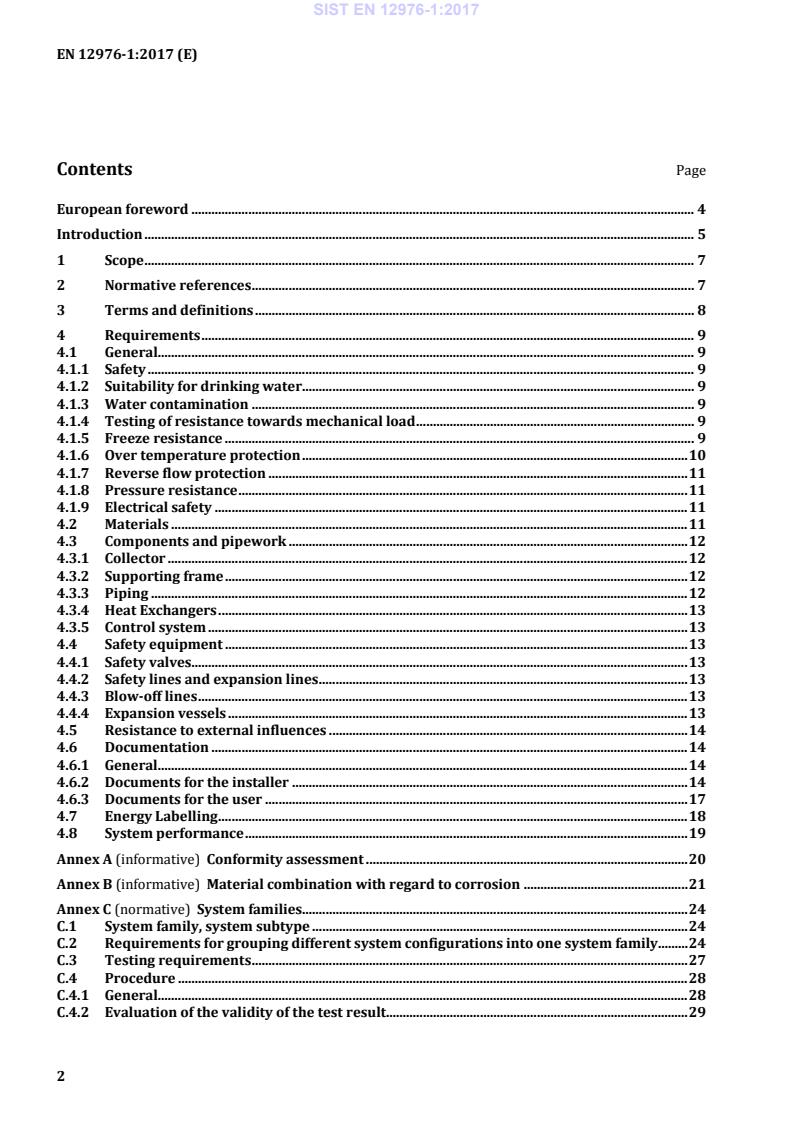
Conformity assessment . 20 Annex B (informative)
Material combination with regard to corrosion . 21 Annex C (normative)
System families. 24 C.1 System family, system subtype . 24 C.2 Requirements for grouping different system configurations into one system family. 24 C.3 Testing requirements . 27 C.4 Procedure . 28 C.4.1 General. 28 C.4.2 Evaluation of the validity of the test result. 29 SIST EN 12976-1:2017
Tables Table 1 — Division for factory made and custom built solar heating systems . 6 Table A.1 — Guidelines for repetition of tests in case that components have been changed . 20 Table B.1 — Material/fluid combination for closed systems . 21 Table B.2 — Material/fluid combination for closed systems . 22 Table B.3 — Material combinations for open systems (related to internal surfaces) . 23 Table B.4 — Material combinations for open systems (related to internal surfaces) . 23
Figures Figure C.1 — Principle of method II (DST) . 29
NOTE Forced circulation systems can be classified either as Factory Made or as Custom Built, depending on the market approach chosen by the final supplier. Both Factory Made and Custom Built systems are performance tested under the same set of reference conditions as specified in EN 12976–2:2017, Annex B, and in EN 12977–2:2012, Annex A. In practice, the installation conditions may differ from these reference conditions. A Factory Made system for domestic hot water preparation may have an option for space heating, however this option should not be used or considered during testing as a Factory Made system. SIST EN 12976-1:2017
In EN 12976–2:2017, Annex E, a test method based on EN 62305–3 is given for solar domestic water heating systems. d) If a support frame that is normally mounted outdoors is part of the system, the maximum values of sk (snow load) and qp (peak velocity pressure) according to EN 1991-1-3, EN 1991-1-4 and a statement that the system may only be installed in locations with lower values of sk and qp, should be provided. Both the permissible and the maximum positive and negative pressure (wind and snow load) for both the collector and supporting frame should be declared. Recommendations for the calculation of design loads: 1) The calculation should be done by a Structural Engineer or a specialist with equivalent skill; 2) The calculation should be done in accordance with the relevant Eurocodes and National Annexes; 3) Self-weight shall be calculated in accordance with EN 1991-1-1 / NA; 4) Minimum imposed roof loads shall be calculated in accordance with the snow load map featured in EN 1991-1-3:2003, Annex C; and 5) Wind loads shall be calculated in accordance with EN 1991-1-4 / NA; e) Method for pipework connections: 1) design and Sizing of Solar Thermal System (collectors, pumps, store tanks, etc.) 2) internal space and access requirements (cylinder, pumps, controls, store, safety vessels, etc.); f) Types and sizes of the safety and security devices and their draining: the assembly instruction shall demand that any pressure relief valves from which steam can escape during normal or stagnation conditions shall be mounted, in such a way that no injuries, harm or damage can be caused by the escape of steam. When the system has a provision to drain an amount of drinking water as a protection against overheating, the hot water drain shall be constructed in such a way that no damage is done to the system or any other materials in the building by the drained hot water; g) The necessary control and safety devices including the wiring diagram, including the need for: 1) assembly instructions for each system design and configuration; 2) solar pipework layout (shortest distances, fall, supports, fixing intervals, penetrations, contact, protection from high temperature, etc.); 3) if required. a thermostatic mixing valve which limits the draw-off temperature to 60 °C, according to 4.1.5.2 and is in accordance with EN 15092; 4) adequate means for preventing backflow from all circuits to drinking main supplies; h) Reviewing, filling and starting up of the system; i) Commissioning of the system: 1) operational/functioning details of solar thermal system; SIST EN 12976-1:2017
...