

EN 12977-3:2018
(Main)Thermal solar systems and components - Custom built systems - Part 3: Performance test methods for solar water heater stores
- Abstract
This European Standard specifies test methods for the performance characterization of stores which are intended for use in small custom built systems as specified in EN 12977-1.
Stores tested according to this document are commonly used in solar hot water systems. However, the thermal performance of all other thermal stores with water as a storage medium can also be assessed according to the test methods specified in this document.
The document applies to stores with a nominal volume between 50 l and 3 000 l.
This document does not apply to combistores. Performance test methods for solar combistores are specified in EN 12977-4.
- Status
- Published
- Publication Date
- 03-Apr-2018
- Withdrawal Date
- 30-Oct-2018
- Technical Committee
- CEN/TC 312 - Thermal solar systems and components
- Current Stage
- 9093 - Decision to confirm - Review Enquiry
- Start Date
- 24-Oct-2024
- Completion Date
- 07-Oct-2026



Overview
EN 12977-3:2018 - published by CEN - defines performance test methods for solar water heater stores used in small custom-built thermal solar systems. The standard covers laboratory test procedures to characterize the thermal behaviour of stores (water as the storage medium) with a nominal volume between 50 l and 3 000 l. It delivers the parameters required to simulate store performance in custom systems and to compare store designs on meaningful, repeatable criteria.
Key topics and requirements
- Scope and applicability: Applies to stores commonly used in solar hot water systems; does not apply to combistores (see EN 12977-4 for combistores).
- Store classification: Groups stores by features relevant to testing and modelling.
- Laboratory testing requirements: Defines requirements for the test stand, measured quantities, sensor and connection arrangements, mounting and instrumentation.
- Test sequences and data processing: Specifies standard test sequences, data acquisition and processing procedures to derive store parameters (thermal capacity, heat loss behaviour, stratification characteristics, heat exchanger performance).
- Combined testing: Describes combining store tests with whole-system tests (ISO 9459-5) when required.
- Scaling and parameter identification: Procedures for up‑ and down‑scaling to determine parameters for stores of different sizes.
- Verification and benchmarks: Annexes provide benchmark tests, verification procedures, model requirements and numerical model guidance to ensure consistent parameter identification.
- Ecodesign and energy labelling: Informative annexes link the test results to EU ecodesign and energy labelling requirements (implementation guidance present in Annex F and ZA/ZB/ZC).
Practical applications
- Product development: Use test results to optimise store geometry, insulation and heat exchanger sizing.
- Performance simulation: Obtain the complete set of parameters needed for accurate thermal simulations of custom built solar hot water systems.
- Testing & certification: Provide repeatable, comparable performance data for laboratory testing, conformity assessment and third‑party certification.
- System design & specification: Enable system designers and installers to select or size stores based on validated performance metrics (e.g., stratification quality, standing losses).
- Regulatory compliance: Support manufacturers in demonstrating compliance with EU ecodesign and energy labelling rules.
Who should use this standard
- Manufacturers of solar thermal stores and components
- Test laboratories and research institutes
- System designers, HVAC engineers and installers
- Certification bodies and conformity assessors
- Policymakers and product compliance teams
Related standards
- EN 12977-1 (general requirements for custom built systems)
- EN 12977-2 (test methods for heaters and combisystems)
- EN 12977-4 (performance tests for combistores)
- EN 12897 (alternative method for thermal capacity and heat loss)
- ISO 9459-5 (whole-system performance testing and simulation)
Keywords: EN 12977-3:2018, thermal solar systems, solar water heater stores, performance test methods, solar hot water systems, store testing, stratification, ecodesign, energy labelling.
Relations
- Effective Date
- 08-Jun-2022
- Effective Date
- 25-Aug-2026
- Effective Date
- 28-Jan-2026
- Effective Date
- 28-Jan-2026
- Effective Date
- 28-Jan-2026
- Effective Date
- 28-Jan-2026
- Effective Date
- 28-Jan-2026
- Effective Date
- 28-Jan-2026
- Effective Date
- 28-Jan-2026
- Effective Date
- 28-Jan-2026
- Effective Date
- 28-Jan-2026
- Effective Date
- 28-Jan-2026
Get Certified
Connect with accredited certification bodies for this standard

DNV
DNV is an independent assurance and risk management provider.

Lloyd's Register
Lloyd's Register is a global professional services organisation specialising in engineering and technology.

DIBt (Deutsches Institut für Bautechnik)
German Institute for Building Technology.
Sponsored listings
Frequently Asked Questions
EN 12977-3:2018 is a standard published by the European Committee for Standardization (CEN). Its full title is "Thermal solar systems and components - Custom built systems - Part 3: Performance test methods for solar water heater stores". This standard covers: This European Standard specifies test methods for the performance characterization of stores which are intended for use in small custom built systems as specified in EN 12977-1. Stores tested according to this document are commonly used in solar hot water systems. However, the thermal performance of all other thermal stores with water as a storage medium can also be assessed according to the test methods specified in this document. The document applies to stores with a nominal volume between 50 l and 3 000 l. This document does not apply to combistores. Performance test methods for solar combistores are specified in EN 12977-4.
This European Standard specifies test methods for the performance characterization of stores which are intended for use in small custom built systems as specified in EN 12977-1. Stores tested according to this document are commonly used in solar hot water systems. However, the thermal performance of all other thermal stores with water as a storage medium can also be assessed according to the test methods specified in this document. The document applies to stores with a nominal volume between 50 l and 3 000 l. This document does not apply to combistores. Performance test methods for solar combistores are specified in EN 12977-4.
EN 12977-3:2018 is classified under the following ICS (International Classification for Standards) categories: 27.160 - Solar energy engineering; 91.140.10 - Central heating systems; 91.140.65 - Water heating equipment. The ICS classification helps identify the subject area and facilitates finding related standards.
EN 12977-3:2018 has the following relationships with other standards: It is inter standard links to EN 12977-3:2012, ISO 9459-5:2007, EN 12897:2016+A1:2020, EN ISO 9488:1999, EN 12828:2012+A1:2014, EN ISO 17294-2:2016, EN 12976-1:2017, CEN/TR 16798-16:2017, EN 12977-1:2012, EN 12977-2:2018, EN 12976-1:2021, EN 12977-4:2018. Understanding these relationships helps ensure you are using the most current and applicable version of the standard.
EN 12977-3:2018 is associated with the following European legislation: EU Directives/Regulations: 811/2013, 812/2013, 814/2013; Standardization Mandates: M/495, M/534, M/535. When a standard is cited in the Official Journal of the European Union, products manufactured in conformity with it benefit from a presumption of conformity with the essential requirements of the corresponding EU directive or regulation.
EN 12977-3:2018 is available in PDF format for immediate download after purchase. The document can be added to your cart and obtained through the secure checkout process. Digital delivery ensures instant access to the complete standard document.
Standards Content (Sample)
2003-01.Slovenski inštitut za standardizacijo. Razmnoževanje celote ali delov tega standarda ni dovoljeno.PThermische Solaranlagen und ihre Bauteile - Kundenspezifisch gefertigte Anlagen - Teil 3: Leistungsprüfung von Warmwasserspeichern für SolaranlagenInstallations solaires thermiques et leurs composants - Installations assemblées à façon - Partie 3 : Méthodes d'essai des performances des dispositifs de stockage des installations de chauffage solaire de l'eauThermal solar systems and components - Custom built systems - Part 3: Performance test methods for solar water heater stores91.140.65Oprema za ogrevanje vodeWater heating equipment91.140.10Sistemi centralnega ogrevanjaCentral heating systems27.160Solar energy engineeringICS:Ta slovenski standard je istoveten z:EN 12977-3:2018SIST EN 12977-3:2018en,fr,de01-september-2018SIST EN 12977-3:2018SLOVENSKI
STANDARDSIST EN 12977-3:20121DGRPHãþD
EUROPEAN STANDARD NORME EUROPÉENNE EUROPÄISCHE NORM
EN 12977-3
April
t r s z ICS
t yä s x râ
{ sä s v rä s râ
{ sä s v rä x w Supersedes EN
s t { y yæ uã t r s tEnglish Version
Thermal solar systems and components æ Custom built systems æ Part
uã Performance test methods for solar water heater stores Installations solaires thermiques et leurs composants æInstallations assemblées à façon æ Partie
u ã Méthodes d 5essai des performances des dispositifs de stockage des installations de chauffage solaire de l 5eau
Thermische Solaranlagen und ihre Bauteile æ Kundenspezifisch gefertigte Anlagen æ Teil
uã Leistungsprüfung von Warmwasserspeichern für Solaranlagen This European Standard was approved by CEN on
t { October
t r s yä
egulations which stipulate the conditions for giving this European Standard the status of a national standard without any alterationä Upætoædate lists and bibliographical references concerning such national standards may be obtained on application to the CENæCENELEC Management Centre or to any CEN memberä
translation under the responsibility of a CEN member into its own language and notified to the CENæCENELEC Management Centre has the same status as the official versionsä
CEN members are the national standards bodies of Austriaá Belgiumá Bulgariaá Croatiaá Cyprusá Czech Republicá Denmarká Estoniaá Finlandá Former Yugoslav Republic of Macedoniaá Franceá Germanyá Greeceá Hungaryá Icelandá Irelandá Italyá Latviaá Lithuaniaá Luxembourgá Maltaá Netherlandsá Norwayá Polandá Portugalá Romaniaá Serbiaá Slovakiaá Sloveniaá Spainá Swedená Switzerlandá Turkey and United Kingdomä
EUROPEAN COMMITTEE FOR STANDARDIZATION COMITÉ EUROPÉEN DE NORMALISATION EUROPÄISCHES KOMITEE FÜR NORMUNG
CEN-CENELEC Management Centre:
Rue de la Science 23,
B-1040 Brussels
t r s z CEN All rights of exploitation in any form and by any means reserved worldwide for CEN national Membersä Refä Noä EN
s t { y yæ uã t r s z ESIST EN 12977-3:2018
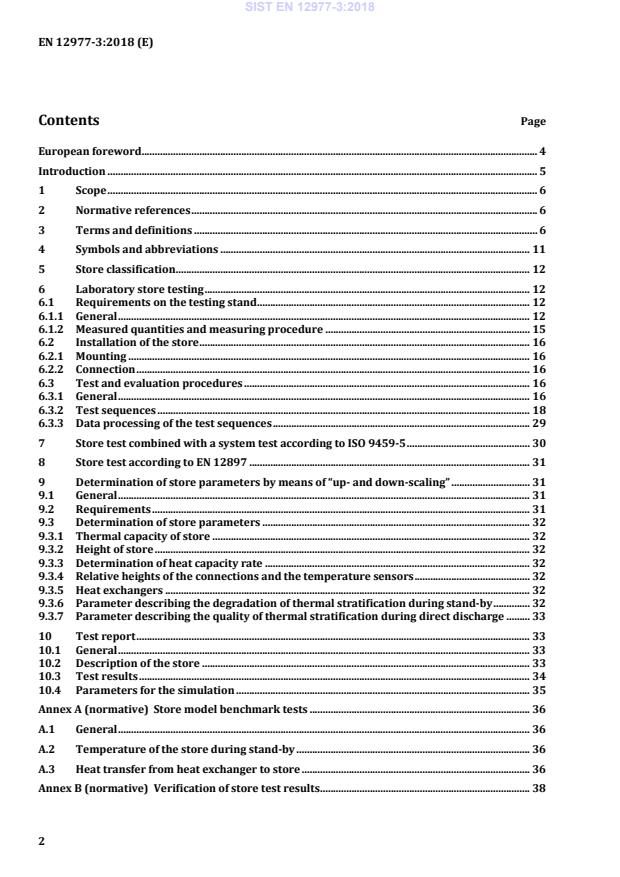
Store model benchmark tests . 36 A.1 General . 36 A.2 Temperature of the store during stand-by . 36 A.3 Heat transfer from heat exchanger to store . 36 Annex B (normative)
Verification of store test results . 38 SIST EN 12977-3:2018
Benchmarks for the parameter identification . 47 Annex D (informative)
Requirements for the numerical store model . 48 D.1 General . 48 D.2 Assumptions . 48 D.3 Calculation of energy balance . 48 Annex E (informative)
Determination of hot water comfort . 50 Annex F (informative)
Implementation for Ecodesign and Energy Labelling . 51 F.1 Standing loss . 51 F.2 Nominal store volume . 51 F.3 Volume of the non-solar heat storage . 51 Annex ZA (informative)
Relationship between this European Standard and the energy labelling requirements of Commission Delegated Regulation (EC) No 811/2013 aimed to be covered . 52 Annex ZB (informative)
Relationship between this European Standard and the energy labelling requirements of Commission Delegated Regulation (EC) No 812/2013 aimed to be covered . 53 Annex ZC (informative)
Relationship between this European Standard and the ecodesign requirements of Commission Regulation (EC) No 814/2013 aimed to be covered . 54 Bibliography . 55 SIST EN 12977-3:2018
density, in kg/m3 5 Store classification Hot water stores are classified by distinction between different charge and discharge modes. Five groups are defined as shown in Table 1. Table 1 — Classification of the stores Group Charge mode Discharge mode 1 direct direct 2 indirect direct 3 direct indirect 4 indirect indirect 5 stores that cannot be assigned to groups 1 to 4 NOTE All stores can have one or more additional electrical auxiliary heating elements. 6 Laboratory store testing 6.1 Requirements on the testing stand 6.1.1 General The hot water store shall be tested separately from the whole solar system on a store-testing stand. The testing stand configuration shall be determined by the classification of hot water stores as described in Clause 5. An example of a representative hydraulic testing stand configuration is shown in Figure 1 and Figure 2. The circuits are intended to simulate the charge and discharge circuit of the solar system and to provide fluid flow with a constant or well-controlled temperature. The full test stand consists of one charge and one discharge circuit. NOTE 1 If the store consists of more than one charge or discharge devices (e.g. two heat exchangers), then these are tested separately. The testing stand shall be located in an air-conditioned room where the room temperature of 20 °C should not vary more than ± 2 K during the test. Both circuits shall fulfil the following requirements: — the flow rate shall be adjustable and stable within ± 5 %; — the working temperature range shall be between 10 °C and 90 °C; NOTE 2 A typical heating power of the charge circuit is in the range of 15 kW. — the minimum cooling power in the discharge circuit shall be at least 25 kW at a fluid temperature of 20 °C; SIST EN 12977-3:2018
Key FF flow meter HX heat exchanger OP overheating protection P pump ST store (belonging to test facility) SV solenoid valve TT temperature sensor TIC temperature indicator and controller V valve Figure 1 — Charge circuit of the store-testing stand The heating medium water in the charge circuit (see Figure 1) is pumped through the cooler (HX101) and the temperature controlled heaters (TIC106) by the pump (P101). A buffer tank (ST101) is used to balance the remaining control deviations. By means of the bypass (V107) the flow through the store can be controlled, it also ensures a continuously high flow through the heating section and therefore good control characteristics. With the solenoid valve (SV101), the heating medium can bypass the store to prepare a sudden increase of the inlet temperature into the store. The temperature sensors are placed near the inlet (TT101) and outlet (TT102) connections of the store; the connection to the store is established through insulated flexible pipes. The charge circuit can be operated closed, under pressure (design pressure 2,5 bar, membrane pressure expansion tank and pressure relief valve (V109)) as well as open (valve (V108) open) with the store SIST EN 12977-3:2018
Key FF flow meter HX heat exchanger P pump SV solenoid valve TT temperature sensor TIC temperature indicator and controller V valve Figure 2 — Discharge circuit of the store-testing stand SIST EN 12977-3:2018
group 1
group 2
group 3
group 4 6.3.2.2.2 6.3.2.2.3 6.3.2.2.4 6.3.2.2.5 Determination of the thermal stratification during discharge with a 'high' flow rate Test S 6.3.2.3 Determination of the stand-by heat loss capacity rate of the entire store Test L:
group 1
group 2
group 3
group 4 6.3.2.4.2 6.3.2.4.3 6.3.2.4.4 6.3.2.4.5 Determination of the heat transfer capacity rate and the position of the auxiliary heat exchanger(s) Test NiA for stores with auxiliary heat exchanger(s) 6.3.2.5 Determination of the position(s) and length(s) of the electrical heating source(s) Test EiA for stores with electrical heating source(s) 6.3.2.6 Determination of the degradation of thermal stratification during stand-by Test NiA and Test NiB for stores of groups 1 and 3 Test NiA and Test NiB for stores of groups 2 and 4 Test EiA and Test EiB for stores with electrical auxiliary heating sources only 6.3.2.7.2 6.3.2.5 6.3.2.7.3 6.3.2.6 6.3.2.7.4 The exact vertical positions of the upper connections of the heat exchangers above which the store is charged in a mixed way, h
...