

CR 13839:2000
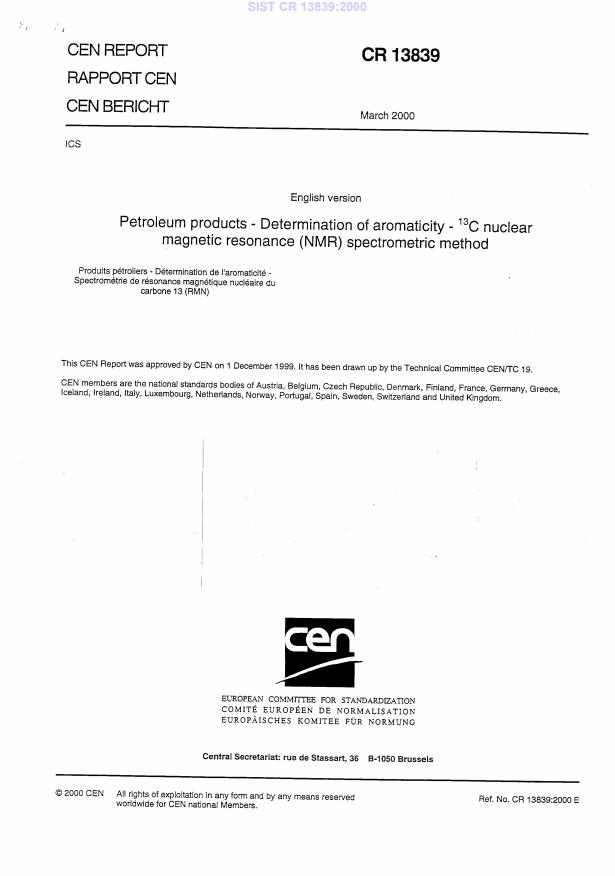
(Main)Petroleum products - Determination of aromaticity - 13C nuclear magnetic resonance (NMR) spectrometric method
- Abstract
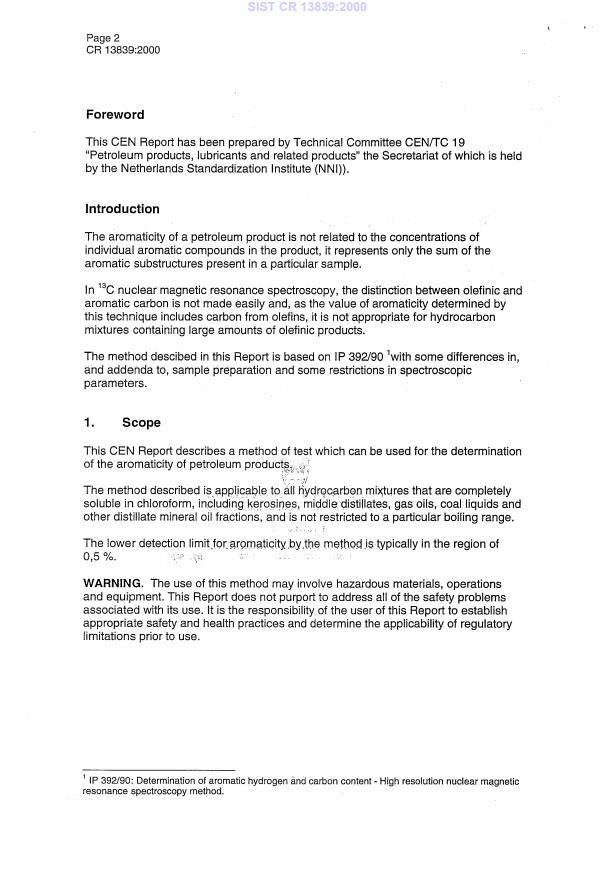
This CEN Report describes a method of test which can be used for the determination of the aromaticity of petroleum products. The method described is applicable to all hydrocarbon mixtures that are completely soluble in chloroform, including kerosines, middle distillates, gas oils, coal liquids and other distillate mineral oil fractions, and is not restricted to a particular boiling range. The lower detection limit for aromaticity by the method is typically in the region of 0,5 %.
- Status
- Withdrawn
- Publication Date
- 21-Mar-2000
- Withdrawal Date
- 06-Oct-2026
- Technical Committee
- CEN/TC 19 - Petroleum products, lubricants and related products
- Drafting Committee
- CEN/TC 19/WG 27 - Elemental analysis of petroleum and related products
- Current Stage
- 9960 - Withdrawal effective - Withdrawal
- Start Date
- 14-Dec-2021
- Completion Date
- 07-Oct-2026

Relations
- Effective Date
- 24-Jun-2026
- Effective Date
- 28-Jan-2026
- Effective Date
- 28-Jan-2026
- Effective Date
- 28-Jan-2026
- Effective Date
- 28-Jan-2026
Get Certified
Connect with accredited certification bodies for this standard

Element Materials Technology
Materials testing and product certification.

ABS Group Brazil
ABS Group certification services in Brazil.

ABS Quality Evaluations Inc.
American Bureau of Shipping quality certification.
Sponsored listings
Frequently Asked Questions
CR 13839:2000 is a standard published by the European Committee for Standardization (CEN). Its full title is "Petroleum products - Determination of aromaticity - 13C nuclear magnetic resonance (NMR) spectrometric method". This standard covers: This CEN Report describes a method of test which can be used for the determination of the aromaticity of petroleum products. The method described is applicable to all hydrocarbon mixtures that are completely soluble in chloroform, including kerosines, middle distillates, gas oils, coal liquids and other distillate mineral oil fractions, and is not restricted to a particular boiling range. The lower detection limit for aromaticity by the method is typically in the region of 0,5 %.
This CEN Report describes a method of test which can be used for the determination of the aromaticity of petroleum products. The method described is applicable to all hydrocarbon mixtures that are completely soluble in chloroform, including kerosines, middle distillates, gas oils, coal liquids and other distillate mineral oil fractions, and is not restricted to a particular boiling range. The lower detection limit for aromaticity by the method is typically in the region of 0,5 %.
CR 13839:2000 is classified under the following ICS (International Classification for Standards) categories: 75.080 - Petroleum products in general; 75.100 - Lubricants, industrial oils and related products. The ICS classification helps identify the subject area and facilitates finding related standards.
CR 13839:2000 has the following relationships with other standards: It is inter standard links to EN ISO 4259-2:2026, EN ISO 3696:1995, EN ISO 3171:1999, EN ISO 3170:2025, EN ISO 4259-2:2017. Understanding these relationships helps ensure you are using the most current and applicable version of the standard.
CR 13839:2000 is available in PDF format for immediate download after purchase. The document can be added to your cart and obtained through the secure checkout process. Digital delivery ensures instant access to the complete standard document.
Standards Content (Sample)
2003-01.Slovenski inštitut za standardizacijo. Razmnoževanje celote ali delov tega standarda ni dovoljeno.Petroleum products - Determination of aromaticity - 13C nuclear magnetic resonance (NMR) spectrometric method75.080Naftni proizvodi na splošnoPetroleum products in generalICS:Ta slo
...