


EN 15058:2006
(Main)Stationary source emissions - Determination of the mass concentration of carbon monoxide (CO) - Reference method: Non-dispersive infrared spectrometry
General Information
- Abstract
This European Standard specifies the Standard Reference Method (SRM) for sampling, and determining car-bon monoxide content in ducts and stacks emitting to atmosphere. It describes the Non Dispersive Infra-Red (NDIR) analytical technique, including the sampling system and sample gas conditioning system, to determine CO in flue gases. This European Standard is the reference method for periodic monitoring and for calibration or control of Automatic Measuring Systems (AMS) permanently installed on a stack, for regulatory purposes or other purposes. To be used as the SRM, it is necessary to demonstrate that the performance characteristics of the method are lower than the performance criteria defined in this European standard and that the overall uncertainty of the method is less than ± 6 % relative at the daily Emission Limit Value (ELV).
NOTE When the NDIR method is used as an AMS, refer to EN 14181 and other relevant standards provided by CEN TC 264.
It is necessary for anybody who would like to use an Alternative Method instead of this Standard Reference Method to work out the demonstration of the equivalence according to the Technical Specification TS 14793, providing that his capability to carry out this demonstration is officially recognised by his national accreditation body or law.
This Standard Reference Method has been evaluated during field tests on waste incineration, co-incineration installations and large combustion plants. It has been validated for CO concentrations with sampling periods of 30 min in the range of 0 mg/m3 to 400 mg/m3 for large combustion plants and 0 mg/m3 – 740 mg/m3 for waste and co-incineration. For waste incineration plants, Council Directive 2000/76/EC lays down emission values which are expressed in mg/m3, on dry basis at a specified value of O2 and at reference conditions of 273 K and 101,3 kPa.
- Status
- Withdrawn
- Publication Date
- 16-May-2006
- Withdrawal Date
- 22-Sep-2026
- Technical Committee
- CEN/TC 264 - Air quality
- Current Stage
- 9960 - Withdrawal effective - Withdrawal
- Start Date
- 11-Jan-2017
- Completion Date
- 23-Sep-2026
- Directive
- Not Harmonized89/369/EEC - Prevention of air pollution from new municipal waste incineration plants
Not Harmonized89/429/EEC - Reduction of air pollution from existing municipal waste incineration plants
Not Harmonized94/67/EC - Incineration of hazardous waste

Relations
- Effective Date
- 18-Jan-2017
- Effective Date
- 25-Aug-2026
- Effective Date
- 25-Aug-2026
- Effective Date
- 28-Jan-2026
- Effective Date
- 28-Jan-2026
- Effective Date
- 28-Jan-2026
- Effective Date
- 28-Jan-2026
- Referred By
EN 13000:2010 - Cranes - Mobile cranes - Effective Date
- 28-Jan-2026
- Effective Date
- 28-Jan-2026
- Effective Date
- 28-Jan-2026
- Effective Date
- 28-Jan-2026
- Effective Date
- 28-Jan-2026
Get Certified
Connect with accredited certification bodies for this standard

CIS Institut d.o.o.
Personal Protective Equipment (PPE) certification body. Notified Body NB-2890 for EU Regulation 2016/425 PPE.

Kiwa BDA Testing
Building and construction product certification.
Kmetijski inštitut Slovenije
Agricultural Institute of Slovenia. Soil testing, plant health, agricultural product analysis.
Sponsored listings
Frequently Asked Questions
EN 15058:2006 is a standard published by the European Committee for Standardization (CEN). Its full title is "Stationary source emissions - Determination of the mass concentration of carbon monoxide (CO) - Reference method: Non-dispersive infrared spectrometry". This standard covers: This European Standard specifies the Standard Reference Method (SRM) for sampling, and determining car-bon monoxide content in ducts and stacks emitting to atmosphere. It describes the Non Dispersive Infra-Red (NDIR) analytical technique, including the sampling system and sample gas conditioning system, to determine CO in flue gases. This European Standard is the reference method for periodic monitoring and for calibration or control of Automatic Measuring Systems (AMS) permanently installed on a stack, for regulatory purposes or other purposes. To be used as the SRM, it is necessary to demonstrate that the performance characteristics of the method are lower than the performance criteria defined in this European standard and that the overall uncertainty of the method is less than ± 6 % relative at the daily Emission Limit Value (ELV). NOTE When the NDIR method is used as an AMS, refer to EN 14181 and other relevant standards provided by CEN TC 264. It is necessary for anybody who would like to use an Alternative Method instead of this Standard Reference Method to work out the demonstration of the equivalence according to the Technical Specification TS 14793, providing that his capability to carry out this demonstration is officially recognised by his national accreditation body or law. This Standard Reference Method has been evaluated during field tests on waste incineration, co-incineration installations and large combustion plants. It has been validated for CO concentrations with sampling periods of 30 min in the range of 0 mg/m3 to 400 mg/m3 for large combustion plants and 0 mg/m3 – 740 mg/m3 for waste and co-incineration. For waste incineration plants, Council Directive 2000/76/EC lays down emission values which are expressed in mg/m3, on dry basis at a specified value of O2 and at reference conditions of 273 K and 101,3 kPa.
This European Standard specifies the Standard Reference Method (SRM) for sampling, and determining car-bon monoxide content in ducts and stacks emitting to atmosphere. It describes the Non Dispersive Infra-Red (NDIR) analytical technique, including the sampling system and sample gas conditioning system, to determine CO in flue gases. This European Standard is the reference method for periodic monitoring and for calibration or control of Automatic Measuring Systems (AMS) permanently installed on a stack, for regulatory purposes or other purposes. To be used as the SRM, it is necessary to demonstrate that the performance characteristics of the method are lower than the performance criteria defined in this European standard and that the overall uncertainty of the method is less than ± 6 % relative at the daily Emission Limit Value (ELV). NOTE When the NDIR method is used as an AMS, refer to EN 14181 and other relevant standards provided by CEN TC 264. It is necessary for anybody who would like to use an Alternative Method instead of this Standard Reference Method to work out the demonstration of the equivalence according to the Technical Specification TS 14793, providing that his capability to carry out this demonstration is officially recognised by his national accreditation body or law. This Standard Reference Method has been evaluated during field tests on waste incineration, co-incineration installations and large combustion plants. It has been validated for CO concentrations with sampling periods of 30 min in the range of 0 mg/m3 to 400 mg/m3 for large combustion plants and 0 mg/m3 – 740 mg/m3 for waste and co-incineration. For waste incineration plants, Council Directive 2000/76/EC lays down emission values which are expressed in mg/m3, on dry basis at a specified value of O2 and at reference conditions of 273 K and 101,3 kPa.
EN 15058:2006 is classified under the following ICS (International Classification for Standards) categories: 13.040.40 - Stationary source emissions. The ICS classification helps identify the subject area and facilitates finding related standards.
EN 15058:2006 has the following relationships with other standards: It is inter standard links to EN 15058:2017, ISO 5725-6:1994, ISO 5725-2:1994, ENV 14237:2002, EN ISO 14956:2002, EN 14793:2017, ENV 13005:1999, EN 13000:2010, EN 13000:2010+A1:2014, EN 14439:2006+A2:2009, EN 13852-1:2025, EN 12644-2:2000+A1:2008. Understanding these relationships helps ensure you are using the most current and applicable version of the standard.
EN 15058:2006 is associated with the following European legislation: EU Directives/Regulations: 89/369/EEC, 89/429/EEC, 94/67/EC; Standardization Mandates: M/276. When a standard is cited in the Official Journal of the European Union, products manufactured in conformity with it benefit from a presumption of conformity with the essential requirements of the corresponding EU directive or regulation.
EN 15058:2006 is available in PDF format for immediate download after purchase. The document can be added to your cart and obtained through the secure checkout process. Digital delivery ensures instant access to the complete standard document.
Standards Content (Sample)
2003-01.Slovenski inštitut za standardizacijo. Razmnoževanje celote ali delov tega standarda ni dovoljeno.NRYHJDWURPHWULMDEmissionen aus stationären Quellen - Bestimmung der Massenkonzentration von Kohlenmonoxid (CO) - Referenzverfahren:
Nicht-dispersive InfrarotspektrometrieEmissions de sources fixes - Détermination de la concentration massique en monoxyde de carbone (CO) - Méthode de référence : spectrométrie infrarouge non dispersiveStationary source emissions - Determination of the mass concentration of carbon monoxide (CO) - Reference method: Non-dispersive infrared spectrometry13.040.40Stationary source emissionsICS:Ta slovenski standard je istoveten z:EN 15058:2006SIST EN 15058:2006en,fr,de01-julij-2006SIST EN 15058:2006SLOVENSKI
STANDARD
EUROPEAN STANDARDNORME EUROPÉENNEEUROPÄISCHE NORMEN 15058May 2006ICS 13.040.40 English VersionStationary source emissions - Determination of the massconcentration of carbon monoxide (CO) - Reference method:Non-dispersive infrared spectrometryEmissions de sources fixes - Détermination de laconcentration massique en monoxyde de carbone (CO) -Méthode de référence : spectrométrie infrarouge nondispersiveEmissionen aus stationären Quellen - Bestimmung derMassenkonzentration von Kohlenmonoxid (CO) -Referenzverfahren:
Nicht-dispersive InfrarotspektrometrieThis European Standard was approved by CEN on 20 April 2006.CEN members are bound to comply with the CEN/CENELEC Internal Regulations which stipulate the conditions for giving this EuropeanStandard the status of a national standard without any alteration. Up-to-date lists and bibliographical references concerning such nationalstandards may be obtained on application to the Central Secretariat or to any CEN member.This European Standard exists in three official versions (English, French, German). A version in any other language made by translationunder the responsibility of a CEN member into its own language and notified to the Central Secretariat has the same status as the officialversions.CEN members are the national standards bodies of Austria, Belgium, Cyprus, Czech Republic, Denmark, Estonia, Finland, France,Germany, Greece, Hungary, Iceland, Ireland, Italy, Latvia, Lithuania, Luxembourg, Malta, Netherlands, Norway, Poland, Portugal, Romania,Slovakia, Slovenia, Spain, Sweden, Switzerland and United Kingdom.EUROPEAN COMMITTEE FOR STANDARDIZATIONCOMITÉ EUROPÉEN DE NORMALISATIONEUROPÄISCHES KOMITEE FÜR NORMUNGManagement Centre: rue de Stassart, 36
B-1050 Brussels© 2006 CENAll rights of exploitation in any form and by any means reservedworldwide for CEN national Members.Ref. No. EN 15058:2006: ESIST EN 15058:2006
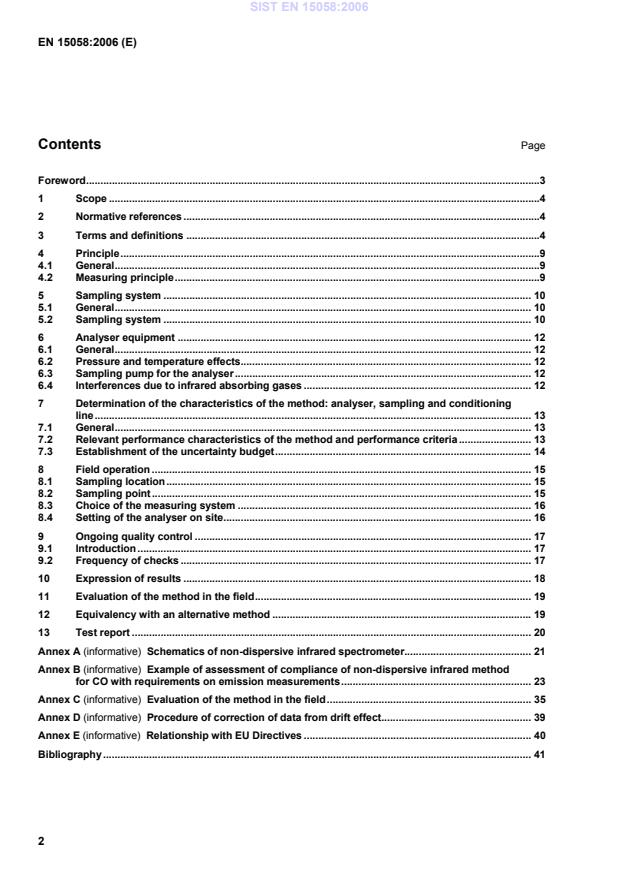
Schematics of non-dispersive infrared spectrometer.21 Annex B (informative)
Example of assessment of compliance of non-dispersive infrared method for CO with requirements on emission measurements.23 Annex C (informative)
Evaluation of the method in the field.35 Annex D (informative)
Procedure of correction of data from drift effect.39 Annex E (informative)
Relationship with EU Directives.40 Bibliography.41
measuring cell that the sample gas enters. There may be a reference cell in some designs;
infrared detector; amplifier and signal processing system to give an electrical output proportional to the CO concentration. The standard of construction and vibration/corrosion resistance shall be suited to industrial environments and to the composition of the flue gas. In Annex A schematic diagrams are given of two types of non-dispersive infrared analysers. 6.2 Pressure and temperature effects The output signal of the analyser is proportional to the density of CO (number of CO molecules) present in the absorption cell and depends on the absolute pressure and temperature in the absorption cell. The effects of variations of pressure and temperature in the absorption cell should be taken into account by the manufac-turer. 6.3 Sampling pump for the analyser The sampling pump can be separate or part of the analyser. In any case, it shall be capable of operating within the specified flow requirements of the manufacturer of the analyser and pressure conditions required for the NDIR absorption cell. 6.4 Interferences due to infrared absorbing gases 6.4.1 General As various gases absorb infrared radiation, interference from these gases can occur when their infrared ab-sorption bands coincide or overlap the CO infrared absorption bands. The degree of interference varies among individual NDIR analysers. In general, gas correlation spectrophotometers are less sensitive to the influence of interferents. 6.4.2 Water vapour The primary interferent is water vapour. However water vapour interference should be minimised by using sampling and conditioning configuration 1 or 2. SIST EN 15058:2006
Detection limit X
≤ ± 2,0 % of the range
Lack of fit X
≤ ± 2,0 % of the range X Zero drift X
≤ ± 2,0 % of the range/24 h X Span drift X
≤ ± 2,0 % of the range/24 h X Sensitivity to atmospheric pressure X
≤ ± 3,0 % of the range/ 2 kPa X Sensitivity to sample volume flow of sample pressure X
a
X Sensitivity to ambient tem-perature
X
≤ ± 3,0 %of the range/10 K
X Sensitivity to electric voltage X
≤ ± 2,0 % of the range/10 V X Interferentsb X
Total ≤ ± 4,0 % of the range X Losses and leakage in the sampling line and condition-ing system
X ≤ ± 2,0 % of the measured value X Standard deviation of re-peatability in laboratory at zero X
≤ ± 1,0 % of the range Xc Standard deviation of re-peatability in laboratory at span level X
≤ ± 2,0 % of the range Xc a The tested volume flow range or pressure is defined in the manufacturer's recommendations. b Interferents that shall be tested are at least those given in Table 2. The sums of contributions to uncertainty producing positive and negative effects are calculated separately. The maximum of their absolute value shall be compared with the performance criterion. c Only one of these values shall be included in the calculation : the first possibility is to choose the repeatability standard deviation got from laboratory tests corresponding to the closest concentration to the actual concentration in stack, or the higher (relative) standard devia-tion of repeatability independently of the concentration measured in stack. 7.3 Establishment of the uncertainty budget An uncertainty budget shall be established to determine if the analyser and its associated sampling system fulfils the requirements for a maximum allowable overall uncertainty. The overall uncertainty for this method used as a reference shall be lower than 6 % at the daily emission limit value. This overall uncertainty is calculated on dry basis and before correction to the O2 reference concentra-tion. SIST EN 15058:2006
57 mg/m3 H2O 1 % volumea a This corresponds to a maximum concentration which is obtained by the sampling procedure described in 5.1. An example of the evaluation of an uncertainty budget is given in Annex B. 8 Field operation 8.1 Sampling location The sampling location is chosen to ensure that the gas concentrations measured are representative of the average conditions in the gas duct. In addition, the sampling location shall be chosen with regard to safety of the personnel, accessibility and availability of electrical power. 8.2 Sampling point It is necessary to ensure that the gas concentrations measured are representative of the average conditions inside the waste gas duct. In most cases, a single sampling point situated in the middle of the duct shall be selected. For larger ducts, this point can be situated closer to the sampling port but not too close to avoid any disturbance of the flow or concentration due to influences from the sampling port. SIST EN 15058:2006
Every campaign if neededa
Regular maintenance of several parts of the monitor
As required by manufacturer As required Lack of fit At least every year and after repair of the analyser As required and when lack of fit > ± 2 % of the range a The particle filter shall be changed periodically depending on the dust loading at the sampling site. During this filter change the filter housing shall be cleaned. Overloading of the particle filter may increase the pressure drop in the sampling line. 10 Expression of results The readings from the analyser are converted to concentrations using the appropriate calibration graph and the results are expressed in milligrams per cubic metre, or parts per million by volume, on dry basis at 273 K and 101,3 kPa. For carbon monoxide (CO) the conversion factors at 273 K and 101,3 kPa are: 1 mg CO/m3 = 0,8 ppm (V/V) CO. 1 ppm (V/V) CO = 1,25 mg CO/m3. When results are given on wet basis, the concentrations on dry basis are calculated according to the fol-lowing equation, where "H2O" is the water vapour content determined according to [3]: w2dOH 100100 CC−= (1) Where Cd is the concentration of the measurand on dry basis; Cw is the measured concentration of the measurand on wet basis; H2O is the water vapour content measured in gas, in percentage/volume. Concentrations are generally expressed at a reference concentration of O2 defined in the European directives: 11 % for incineration of waste in waste incinerators; 10 % for co-incineration of waste in cement kilns; 3 % for combustion of gas or liquid fuels; 6 % for combustion of solid fuels; 15 % for gas turbines. SIST EN 15058:2006
...