

EN 474-1:2006+A4:2013
(Main + Amendment)Earth-moving machinery - Safety - Part 1: General requirements
- Abstract
This %European Standard& specifies the general safety requirements for earth-moving machinery ) described in EN ISO 6165:2006, except rollers and horizontal directional drill.
NOTE 1 Rollers are covered by EN 500.
NOTE 2 Horizontal directional drills are covered by EN 791.
This %European Standard& also applies to derivative machinery (see 3.1.2) designed primarily for use with equipment to loosen, pick-up, move, transport, distribute and grade earth and rock.
This %European Standard& gives the common safety requirements for earth-moving machinery families and is intended to be used in conjunction with one of the EN 474 parts 2 to 12. These machine specific parts (EN 474-2 to -12) do not repeat the requirements from !EN 474-1:2006+A1:2009", but add or replace the requirements for the family in question.
NOTE 3 The requirements specified in this part of the standard are common to two or more families of earth- moving machinery.
'This part gives specific requirements for demolition machinery.(
Specific requirements in EN 474 parts 2 to 12 take precedence over the respective requirements of
!EN 474-1:2006+A1:2009".
For multipurpose machinery the parts of the standard that cover the specific functions and applications have to be used e.g. a compact loader also used as a trencher shall use the relevant requirements of EN 474 parts 1, 3 and 10.
The standard also covers general requirements for attachments intended to be used with earth moving machine families covered in the scope.
!Except for part 12 this European Standard does not deal" with the electrical hazards related to the main circuits and drives of machinery when the principal source of energy is electrical.
!This European Standard does not deal with towing of trailers."
This European Standard deals with all significant hazards, hazardous situations and events relevant to earth-moving machinery, when used as intended and under conditions of misuse which are reasonably foreseeable by the manufacturer (see Clause 4). This European Standard specifies the appropriate technical measures to eliminate or reduce risks arising from the significant hazards, hazardous situations and events during commissioning, operation and maintenance of earth-moving machinery.
This European Standard is not applicable to earth moving machines, which are manufactured before the date of publication of this European Standard by CEN.
- Status
- Withdrawn
- Publication Date
- 24-Sep-2013
- Withdrawal Date
- 06-Oct-2026
- Technical Committee
- CEN/TC 151 - Construction equipment and building material machines - Safety
- Drafting Committee
- CEN/TC 151/WG 1 - Earth-moving machinery - Safety
- Current Stage
- 9960 - Withdrawal effective - Withdrawal
- Start Date
- 24-Jan-2018
- Completion Date
- 07-Oct-2026
- Directive
- 2006/42/EC - Directive 2006/42/EC of the European Parliament and of the Council of 17 May 2006 on machinery, and amending Directive 95/16/EC (recast)OJ Ref: C, C 348 OJ Date: 28-Nov-2013

Relations
- Effective Date
- 08-Jun-2022
- Effective Date
- 20-Sep-2017
- Effective Date
- 11-Dec-2013
- Effective Date
- 25-Aug-2026
- Effective Date
- 25-Aug-2026
- Effective Date
- 25-Aug-2026
- Effective Date
- 25-Aug-2026
- Effective Date
- 25-Aug-2026
- Effective Date
- 25-Aug-2026
- Effective Date
- 25-Aug-2026
- Effective Date
- 25-Aug-2026
- Effective Date
- 25-Aug-2026
- Effective Date
- 25-Aug-2026
- Effective Date
- 25-Aug-2026
- Effective Date
- 25-Aug-2026
Frequently Asked Questions
EN 474-1:2006+A4:2013 is a standard published by the European Committee for Standardization (CEN). Its full title is "Earth-moving machinery - Safety - Part 1: General requirements". This standard covers: This %European Standard& specifies the general safety requirements for earth-moving machinery ) described in EN ISO 6165:2006, except rollers and horizontal directional drill. NOTE 1 Rollers are covered by EN 500. NOTE 2 Horizontal directional drills are covered by EN 791. This %European Standard& also applies to derivative machinery (see 3.1.2) designed primarily for use with equipment to loosen, pick-up, move, transport, distribute and grade earth and rock. This %European Standard& gives the common safety requirements for earth-moving machinery families and is intended to be used in conjunction with one of the EN 474 parts 2 to 12. These machine specific parts (EN 474-2 to -12) do not repeat the requirements from !EN 474-1:2006+A1:2009", but add or replace the requirements for the family in question. NOTE 3 The requirements specified in this part of the standard are common to two or more families of earth- moving machinery. 'This part gives specific requirements for demolition machinery.( Specific requirements in EN 474 parts 2 to 12 take precedence over the respective requirements of !EN 474-1:2006+A1:2009". For multipurpose machinery the parts of the standard that cover the specific functions and applications have to be used e.g. a compact loader also used as a trencher shall use the relevant requirements of EN 474 parts 1, 3 and 10. The standard also covers general requirements for attachments intended to be used with earth moving machine families covered in the scope. !Except for part 12 this European Standard does not deal" with the electrical hazards related to the main circuits and drives of machinery when the principal source of energy is electrical. !This European Standard does not deal with towing of trailers." This European Standard deals with all significant hazards, hazardous situations and events relevant to earth-moving machinery, when used as intended and under conditions of misuse which are reasonably foreseeable by the manufacturer (see Clause 4). This European Standard specifies the appropriate technical measures to eliminate or reduce risks arising from the significant hazards, hazardous situations and events during commissioning, operation and maintenance of earth-moving machinery. This European Standard is not applicable to earth moving machines, which are manufactured before the date of publication of this European Standard by CEN.
This %European Standard& specifies the general safety requirements for earth-moving machinery ) described in EN ISO 6165:2006, except rollers and horizontal directional drill. NOTE 1 Rollers are covered by EN 500. NOTE 2 Horizontal directional drills are covered by EN 791. This %European Standard& also applies to derivative machinery (see 3.1.2) designed primarily for use with equipment to loosen, pick-up, move, transport, distribute and grade earth and rock. This %European Standard& gives the common safety requirements for earth-moving machinery families and is intended to be used in conjunction with one of the EN 474 parts 2 to 12. These machine specific parts (EN 474-2 to -12) do not repeat the requirements from !EN 474-1:2006+A1:2009", but add or replace the requirements for the family in question. NOTE 3 The requirements specified in this part of the standard are common to two or more families of earth- moving machinery. 'This part gives specific requirements for demolition machinery.( Specific requirements in EN 474 parts 2 to 12 take precedence over the respective requirements of !EN 474-1:2006+A1:2009". For multipurpose machinery the parts of the standard that cover the specific functions and applications have to be used e.g. a compact loader also used as a trencher shall use the relevant requirements of EN 474 parts 1, 3 and 10. The standard also covers general requirements for attachments intended to be used with earth moving machine families covered in the scope. !Except for part 12 this European Standard does not deal" with the electrical hazards related to the main circuits and drives of machinery when the principal source of energy is electrical. !This European Standard does not deal with towing of trailers." This European Standard deals with all significant hazards, hazardous situations and events relevant to earth-moving machinery, when used as intended and under conditions of misuse which are reasonably foreseeable by the manufacturer (see Clause 4). This European Standard specifies the appropriate technical measures to eliminate or reduce risks arising from the significant hazards, hazardous situations and events during commissioning, operation and maintenance of earth-moving machinery. This European Standard is not applicable to earth moving machines, which are manufactured before the date of publication of this European Standard by CEN.
EN 474-1:2006+A4:2013 is classified under the following ICS (International Classification for Standards) categories: 53.100 - Earth-moving machinery. The ICS classification helps identify the subject area and facilitates finding related standards.
EN 474-1:2006+A4:2013 has the following relationships with other standards: It is inter standard links to CEN/TS 13778:2004, EN 474-1:2006+A5:2018, EN 474-1:2006+A3:2013, ISO 9533:1989, ISO 13333:1994, ISO 14396:2002, ISO 15998:2008, ISO 3864-2:2004, ISO 4250-3:2006, ISO 15817:2005, ISO 3795:1989, ISO 6405-1:2004, ISO 14401-2:2004, ISO 10264:1990, ISO 14401-1:2004. Understanding these relationships helps ensure you are using the most current and applicable version of the standard.
EN 474-1:2006+A4:2013 is associated with the following European legislation: EU Directives/Regulations: 2006/42/EC; Standardization Mandates: M/396. When a standard is cited in the Official Journal of the European Union, products manufactured in conformity with it benefit from a presumption of conformity with the essential requirements of the corresponding EU directive or regulation.
EN 474-1:2006+A4:2013 is available in PDF format for immediate download after purchase. The document can be added to your cart and obtained through the secure checkout process. Digital delivery ensures instant access to the complete standard document.
Standards Content (Sample)
2003-01.Slovenski inštitut za standardizacijo. Razmnoževanje celote ali delov tega standarda ni dovoljeno.Stroji za zemeljska dela - Varnost - 1. del: Splošne zahteveErdbaumaschinen - Sicherheit - Teil 1: Allgemeine AnforderungenEngins de terrassement - Sécurité - Partie 1: Prescriptions généralesEarth-moving machinery - Safety - Part 1: General requirements53.100Stroji za zemeljska delaEarth-moving machineryICS:Ta slovenski standard je istoveten z:EN 474-1:2006+A4:2013SIST EN 474-1:2007+A4:2014en,fr,de01-februar-2014SIST EN 474-1:2007+A4:2014SLOVENSKI
STANDARDSIST-TS CEN/TS 13778:20041DGRPHãþD
EUROPEAN STANDARD NORME EUROPÉENNE EUROPÄISCHE NORM
EN 474-1:2006+A4
September 2013 ICS 53.100 Supersedes EN 474-1:2006+A3:2013, CEN/TS 13778:2004 English Version
Earth-moving machinery - Safety - Part 1: General requirements
Engins de terrassement - Sécurité - Partie 1: Prescriptions générales
Erdbaumaschinen - Sicherheit - Teil 1: Allgemeine Anforderungen This European Standard was approved by CEN on 17 April 2006 and includes Amendment 1 approved by CEN on 4 January 2009, Amendment 3 approved by CEN on 6 January 2013 and Amendment 4 approved by CEN on 10 August 2013.
CEN members are bound to comply with the CEN/CENELEC Internal Regulations which stipulate the conditions for giving this European Standard the status of a national standard without any alteration. Up-to-date lists and bibliographical references concerning such national standards may be obtained on application to the CEN-CENELEC Management Centre or to any CEN member.
This European Standard exists in three official versions (English, French, German). A version in any other language made by translation under the responsibility of a CEN member into its own language and notified to the CEN-CENELEC Management Centre has the same status as the official versions.
CEN members are the national standards bodies of Austria, Belgium, Bulgaria, Croatia, Cyprus, Czech Republic, Denmark, Estonia, Finland, Former Yugoslav Republic of Macedonia, France, Germany, Greece, Hungary, Iceland, Ireland, Italy, Latvia, Lithuania, Luxembourg, Malta, Netherlands, Norway, Poland, Portugal, Romania, Slovakia, Slovenia, Spain, Sweden, Switzerland, Turkey and United Kingdom.
EUROPEAN COMMITTEE FOR STANDARDIZATION
COMITÉ EUROPÉEN DE NORMALISATION
EUROPÄISCHES KOMITEE FÜR NORMUNG
Management Centre:
Avenue Marnix 17,
B-1000 Brussels © 2013 CEN All rights of exploitation in any form and by any means reserved worldwide for CEN national Members. Ref. No. EN 474-1:2006+A4:2013: E SIST EN 474-1:2007+A4:2014
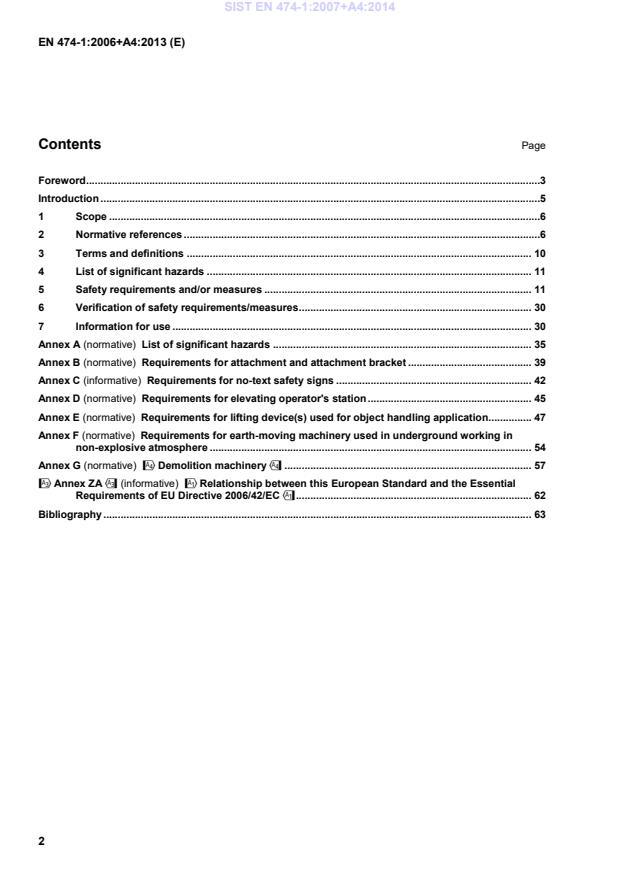
List of significant hazards . 35 Annex B (normative)
Requirements for attachment and attachment bracket . 39 Annex C (informative)
Requirements for no-text safety signs . 42 Annex D (normative)
Requirements for elevating operator's station . 45 Annex E (normative)
Requirements for lifting device(s) used for object handling application. 47 Annex F (normative)
Requirements for earth-moving machinery used in underground working in non-explosive atmosphere . 54 Annex G (normative)
'Demolition machinery( . 57 %Annex ZA& (informative)
!Relationship between this European Standard and the Essential Requirements of EU Directive 2006/42/EC" . 62 Bibliography . 63
!EN 474-1:2006+A1:2009". For multipurpose machinery the parts of the standard that cover the specific functions and applications have to be used e.g. a compact loader also used as a trencher shall use the relevant requirements of EN 474 parts 1, 3 and 10. The standard also covers general requirements for attachments intended to be used with earth moving machine families covered in the scope. !Except for part 12 this European Standard does not deal" with the electrical hazards related to the main circuits and drives of machinery when the principal source of energy is electrical. !This European Standard does not deal with towing of trailers." This European Standard deals with all significant hazards, hazardous situations and events relevant to earth-moving machinery, when used as intended and under conditions of misuse which are reasonably foreseeable by the manufacturer (see Clause 4). This European Standard specifies the appropriate technical measures to eliminate or reduce risks arising from the significant hazards, hazardous situations and events during commissioning, operation and maintenance of earth-moving machinery. This European Standard is not applicable to earth moving machines, which are manufactured before the date of publication of this European Standard by CEN. 2 Normative references %The following documents, in whole or in part, are normatively referenced in this document and are indispensable for its application. For dated references, only the edition cited applies. For undated references, the latest edition of the referenced document (including any amendments) applies.&
1) For travelling on public roads the national traffic regulations apply until harmonised requirements are available. (A CEN-standard is under preparation.) SIST EN 474-1:2007+A4:2014
ISO 3795:1989, Road vehicles, and tractors and machinery for agriculture and forestry — Determination of burning behaviour of interior materials ISO 3864-1:2002, Graphical symbols — Safety colours and safety signs — Part 1: Design principles for safety signs in work places and public areas ISO 3864-2:2004, Graphical symbols — Safety colours and safety signs — Part 2: Design principles for product safety labels !ISO 4250-3:2006", Earth-mover tyres and rims — Part 3: Rims ISO 5006:2006, Earth-moving machinery — Operator's field of view — Test method and performance criteria ISO 6011:2003, Earth-moving machinery — Visual display of machine operation ISO 6014:1986, Earth-moving machinery — Determination of ground speed ISO 6016:1998, Earth-moving machinery — Methods of measuring the masses of whole machines, their equipment and components !ISO 6395:2008, Earth-moving machinery — Determination of sound power level — Dynamic test conditions" !ISO 6396:2008", Earth-moving machinery — Determination of emission sound pressure level at operator's position — Dynamic test conditions ISO 6405-1:2004, Earth-moving machinery — Symbols for operator controls and other displays — Part 1: Common symbols ISO 6405-2:1993, Earth-moving machinery — Symbols for operator controls and other displays — Part 2: Specific symbols for machines, equipment and accessories SIST EN 474-1:2007+A4:2014
!EN 474-3:2006+A1:2009" and !EN 474-4:2006+A1:2009". The term "rated lift capacity" is defined in
ISO 10567:1992 and used in !EN 474-5:2006+A3:2013". Both terms are equivalent. '3.6 demolition machine machine based on earth moving machinery (see EN ISO 6165) and including equipment and attachment (working tool – e.g. processor or breaker) specifically designed to demolish, cut, loosen, separate, pick up, transport and distribute component parts of buildings, civil engineering structures 3.7 processor attachment with tooth, teeth and/or cutting edges, used for demolition or deconstruction 3.8 hydraulic hammer or breaker equipment which uses the hydraulic power source of the carrier machine to accelerate a piston (sometimes gas-assisted), which then hits a tool Note 1 to entry: The stress wave generated by kinetic action flows through the tool into the material, which causes the material to break. Hydraulic hammers need a supply of pressurised oil to function. The complete carrier/hammer unit is controlled by an operator, usually seated in the cabin of the carrier. 3.9 high reach equipment multi piece rigid or telescopic equipment with the primary function of operating specialised attachments for the demolition of structures at heights that cannot be reached by standard backhoe equipment 3.10 base machine machine with a cab or canopy and operator protective structures if required, without equipment or attachments but possessing the necessary mountings for such equipment and attachments [SOURCE: ISO 6016:2008, 3.1.1]( 4 List of significant hazards See Annex A. NOTE Annex A (normative) contains all the significant hazards, hazardous situations and events, as far as they are dealt with in this European Standard, identified by risk assessment as common to two or more machinery families and which require action to eliminate or reduce the risk. 5 Safety requirements and/or measures 5.1 General Earth-moving machinery shall comply with the safety requirements and/or protective measures of this European Standard, as far as not modified by requirements of the relevant specific part of the standard series. In addition, the machine shall be designed according to the principles of EN ISO 12100-1:2003 and EN ISO 12100-2:2003 for hazards relevant but not significant which are not dealt with by this European Standard. SIST EN 474-1:2007+A4:2014
Figure 1 — Minimum clearance of lower limbs at access to the operator's station on machines with articulated steering 5.2.3 Access system on crawler machines with step(s) Access step(s) integrated in the track frame shall meet the requirements as stated below (see also Figure 2).
A step of an access system can be retracted under an angle of ≤ 15°, if at least the basic dimension of riser height dimension B, and the tread depth F1 according to Figure 1 and Table 1 of EN ISO 2867:2006 is met, measured from the outer edges of the track shoes. In such a case, taken into account the limited view during egress, the step width shall be at least as wide as the minimum in accordance with Table 1 of EN ISO 2867:2006. SIST EN 474-1:2007+A4:2014
Key B ≤ 400 mm F1 ≥ 130 mm Q maximum retraction of a step Figure 2 — Dimensions access step 5.3 Operator's station 5.3.1 General requirements 5.3.1.1 Machinery equipment !The driving position of ride-on drivers shall be designed and constructed in such a way that a driver's cab may be fitted, provided this does not increase the risk and there is room for it." Machines with an operating mass less than 1 500 kg are not required to have a cab. Machines with an operating mass greater than or equal to 1 500 kg shall be equipped with a cab, unless the foreseeable adverse weather conditions allow all-year operation without a cab (negotiated between manufacturer and user). Machines shall be equipped with a cab and a contamination protective system if the machine is intended for use in unhealthy environments, e.g. contaminated areas (negotiated between manufacturer and user). See 5.14.1. If a hazard due to projection of splinters exists, e.g. operation with a hydraulic- or demolition-hammer, an adequate protection such as bullet proof glass, mesh guard or an equivalent protection is required. 5.3.1.2 Minimum space The minimum space available to the operator shall be as defined in !EN ISO 3411:2007" (except as amended in 5.3.2.5). SIST EN 474-1:2007+A4:2014
The minimum dimensions given in Table 1 are also required for machines having a front or rear window which are located (in an opened position) above the operator's seat. 5.3.2.6 Heating and ventilation system If a heating system is fitted it shall either: a) comply with !ISO/DIS 10263-4:2007", or b) have the capability of increasing the temperature of the air inside the cab and maintain a temperature of + 18°C at expected ambient temperature the machine is intended for. The minimum capacity of the heating system shall have a ∆T of 25°C (∆T of 25 K) within 30 min. The test shall run starting with the engine at working temperature as specified by the manufacturer. Measurement of the system capacity shall be made at three points. The three points shall be located in a vertical plane through the SIP and parallel to the longitudinal axis of the machine as follows (see Figure 3): 1) at filament position centre-point as defined in ISO 5006:2006; 2) at the SIP as defined in EN ISO 5353:1998; 3) 100 mm above floor plate and 600 mm in front of SIP. SIST EN 474-1:2007+A4:2014
Figure 3 — Location of measuring points c) Alternatively, the heating capacity can be determined by calculation. The ventilation system shall be capable of providing the cab with filtered fresh air at the minimum of 43 m3/h. The filter shall be tested according to !ISO/DIS 10263-2:2007". NOTE The filter element selection depends on the intended operating environment conditions. 5.3.2.7 Defrosting system Machine with a cab shall provide facilities to defrost the front and rear window(s), for example by means of a heating system or a particular defrosting device. NOTE A testing method of windscreen defrosting system is described in !ISO/DIS 10263-5:2007". 5.3.2.8 Pressurisation system Where a cab is provided with a pressurisation system, it shall be tested according to
!ISO/DIS 10263-3:2007" and shall provide an interior relative pressure of at least 50 Pa. 5.3.2.9 Doors and windows Doors, windows and flaps shall be securely held in their functional positions; measures shall be taken for preventing inadvertent opening. Doors shall be retained at their intended operating position(s) by a positive engagement device. A primary opening designed to be held securely open as an intended operating position, shall be releasable from the operator's station. Windows shall be made of safety glass or other material which provides similar safety performance (see e.g. ECE R43). Roof windows do not need additional mechanical safeguarding. The front and rear window(s) shall be fitted with motorised windscreen wiper(s) and washer(s). The tank of the window washer(s) shall be easily accessible. SIST EN 474-1:2007+A4:2014
stops). " 'In the case of hydraulically assisted variable gauge undercarriage, the controls shall be located in the operator's station.( 5.5.2 !Starting/stopping system" !The starting/stopping system of earth-moving machinery shall be provided with a starting/stopping device (e.g. key) and shall comply with ISO 10264:1990 or have a similar protection against unauthorized use. Earth-moving machines shall be so designed that hazardous movement of the machine or its working equipment and/or attachment shall not be possible without action on the controls whilst starting/stopping the engine. If the visibility from the operator's station to the rear by direct or indirect view cannot be achieved in accordance with 5.8.1, the machine shall be equipped with an acoustic and/or visual warning signal activated automatically when the reversing command is given, combined with a delay in starting the reverse movement, leaving sufficient time for an exposed person to leave the danger zone. NOTE When drafting this text it was not possible to define clear criteria for the necessary delay time as it depends on different parameters. In the idea of the drafters a delay of 3 s (that may be achieved completely or in part in the reaction time of the machine) will in general be appropriate. " 5.5.3 Inadvertent activation !Controls, which can cause a hazard due to inadvertent activation, shall be so arranged or deactivated or guarded as to minimise the risk, when the operator gets into or out of the operator's station." The deactivation device shall either be self-acting or acting by compulsory actuation of the relevant device. 5.5.4 Pedals Pedals shall have an appropriate size, shape and be adequately spaced. The pedals shall have a slip-resistant surface and be easy to clean. If the pedals of an earth-moving machine have the same function (clutch, brake, and accelerator) as on a motor vehicle, they shall be arranged in the same manner to avoid the risk of confusion. 5.5.5 Emergency attachment lowering If the engine is stopped it shall be possible to: a) lower the equipment/attachment to the ground/frame; b) see the equipment/attachment lowering from the operator actuating position of the lowering control; c) release the residual pressure in each hydraulic and pneumatic circuit, which can cause a risk. SIST EN 474-1:2007+A4:2014
ISO 14401-2:2004. 5.8.2 Lighting, signalling and marking lights, and reflex-reflector devices Work lights and reflex-reflector devices shall be provided and shall comply with ISO 12509:2004. Lighting, signalling and marking lights, if provided, shall comply with the appropriate clauses of ISO 12509:2004. 5.9 Warning devices and safety signs Earth-moving machinery shall be equipped with: an audible warning dev
...