

EN 474-13:2022
(Main)Earth-moving machinery - Safety - Part 13: Requirements for rollers
- Abstract
This document together with EN 474 1:2022 deals with all significant hazards, hazardous situations and events relevant to rollers when used as intended and under the conditions of misuse which are reasonably foreseeable by the manufacturer (see Annex A) associated with the whole lifetime of the machine as described in EN ISO 12100:2010, 5.4.
The requirements of this document are complementary to the common requirements formulated in EN 474 1:2022. This document does not repeat the requirements of EN 474 1:2022 but supplements or modifies the requirements for rollers.
This document does not provide requirements for main electrical circuits and drives of machinery when the primary source of energy is an external electrical supply.
The following significant and relevant hazards are not covered in this document:
— Laser;
— Lightning.
This document does not provide performance requirements for safety related functions of control system(s).
This document does not deal with towing of trailers.
This part of EN 474:2022 is not applicable for seated ride-on operated rollers with a drum width less than nominal 0,8 m.
This document is not applicable to rollers which are manufactured before the date of publication of this document by CEN.
- Status
- Published
- Publication Date
- 29-Mar-2022
- Technical Committee
- CEN/TC 151 - Construction equipment and building material machines - Safety
- Drafting Committee
- CEN/TC 151/WG 1 - Earth-moving machinery - Safety
- Current Stage
- 6060 - Definitive text made available (DAV) - Publishing
- Start Date
- 30-Mar-2022
- Due Date
- 26-May-2019
- Completion Date
- 30-Mar-2022
- Directive
- 2006/42/EC - Directive 2006/42/EC of the European Parliament and of the Council of 17 May 2006 on machinery, and amending Directive 95/16/EC (recast)OJ Ref: OJ L 194 OJ Date: 02-Aug-2023

Overview
EN 474-13:2022 - Earth-moving machinery: Safety - Part 13: Requirements for rollers is a CEN type‑C standard that supplements the general requirements in EN 474-1:2022 with roller‑specific safety rules. It addresses significant hazards, hazardous situations and events for rollers (static and vibrating, pedestrian‑controlled, towed and ride‑on types) throughout the machine’s lifetime, in line with EN ISO 12100 risk‑assessment principles. The standard excludes some topics (e.g., laser, lightning), main electrical circuits when primary energy is external electrical supply, towing of trailers and does not apply to rollers manufactured before its publication or to seated ride‑on rollers with drum width < 0.8 m.
Key topics and technical requirements
- Scope & applicability: Defines roller types (single‑drum, tandem, pneumatic‑tyre, combined, pedestrian‑controlled, towed) and limits (weight, drum width exclusions).
- Operator’s station: Minimum spatial and protective requirements (e.g., offset seat minimum internal distance of 295 mm) and cab/canopy provisions depending on operating mass.
- Controls & indicators: Requirements for travel, steering, braking and vibration controls, including provisions for pedestrian and remote control machines (Annex B).
- Brake systems: Safety and verification requirements for travelling brakes and parking systems.
- Visibility & ergonomics: Field-of-view, operator comfort zones and seat placement to reduce blind spots.
- Noise & vibration: Test codes and measurement methods - hand‑arm vibration (Annex C) and noise test codes for vibratory and non‑vibrating rollers (Annexes D & E).
- Protective measures: Guards, rollover and falling‑object protection, fuel/DEF/urea and hydraulic tank safety.
- Maintenance & verification: Instructions for safe maintenance, verification of safety measures and conformity testing.
- Information for use: Machine safety labels, operator manuals and documentation requirements.
- Normative and informative annexes: List of significant hazards (Annex A), illustrations (Annex F) and relationship to Machinery Directive 2006/42/EC (Annex ZA).
Practical applications and users
- Who uses it: Machine manufacturers, design engineers, safety managers, test laboratories, conformity assessors, maintenance teams, procurement officers and regulatory bodies.
- How it’s used:
- Integrate roller‑specific safety into product design and CE marking processes.
- Prepare operator manuals, safety labeling and maintenance procedures.
- Design and verify braking, operator protection, noise and vibration controls.
- Support risk assessments and compliance with EU Machinery Directive requirements.
Related standards
- EN 474-1:2022 (General requirements) - complementary and mandatory where not superseded.
- Normative references included: EN ISO 12100:2010, ISO 3164, ISO 11201, ISO 6165, ISO 5006, among others cited in EN 474-13:2022.
EN 474-13:2022 is essential for anyone responsible for the safe design, manufacture, testing or purchase of earth‑moving rollers and for ensuring regulatory compliance and operator protection.
Relations
- Effective Date
- 07-Sep-2022
- Effective Date
- 18-Mar-2026
- Effective Date
- 18-Mar-2026
- Effective Date
- 18-Mar-2026
- Refers
ISO 15817:2012 - Earth-moving machinery — Safety requirements for remote operator control systems - Effective Date
- 09-Feb-2026
- Effective Date
- 09-Feb-2026
- Effective Date
- 28-Jan-2026
- Effective Date
- 28-Jan-2026
- Effective Date
- 28-Jan-2026
- Effective Date
- 28-Jan-2026
- Effective Date
- 28-Jan-2026
- Effective Date
- 28-Jan-2026
- Effective Date
- 28-Jan-2026
- Effective Date
- 28-Jan-2026
- Effective Date
- 28-Jan-2026
Frequently Asked Questions
EN 474-13:2022 is a standard published by the European Committee for Standardization (CEN). Its full title is "Earth-moving machinery - Safety - Part 13: Requirements for rollers". This standard covers: This document together with EN 474 1:2022 deals with all significant hazards, hazardous situations and events relevant to rollers when used as intended and under the conditions of misuse which are reasonably foreseeable by the manufacturer (see Annex A) associated with the whole lifetime of the machine as described in EN ISO 12100:2010, 5.4. The requirements of this document are complementary to the common requirements formulated in EN 474 1:2022. This document does not repeat the requirements of EN 474 1:2022 but supplements or modifies the requirements for rollers. This document does not provide requirements for main electrical circuits and drives of machinery when the primary source of energy is an external electrical supply. The following significant and relevant hazards are not covered in this document: — Laser; — Lightning. This document does not provide performance requirements for safety related functions of control system(s). This document does not deal with towing of trailers. This part of EN 474:2022 is not applicable for seated ride-on operated rollers with a drum width less than nominal 0,8 m. This document is not applicable to rollers which are manufactured before the date of publication of this document by CEN.
This document together with EN 474 1:2022 deals with all significant hazards, hazardous situations and events relevant to rollers when used as intended and under the conditions of misuse which are reasonably foreseeable by the manufacturer (see Annex A) associated with the whole lifetime of the machine as described in EN ISO 12100:2010, 5.4. The requirements of this document are complementary to the common requirements formulated in EN 474 1:2022. This document does not repeat the requirements of EN 474 1:2022 but supplements or modifies the requirements for rollers. This document does not provide requirements for main electrical circuits and drives of machinery when the primary source of energy is an external electrical supply. The following significant and relevant hazards are not covered in this document: — Laser; — Lightning. This document does not provide performance requirements for safety related functions of control system(s). This document does not deal with towing of trailers. This part of EN 474:2022 is not applicable for seated ride-on operated rollers with a drum width less than nominal 0,8 m. This document is not applicable to rollers which are manufactured before the date of publication of this document by CEN.
EN 474-13:2022 is classified under the following ICS (International Classification for Standards) categories: 53.100 - Earth-moving machinery. The ICS classification helps identify the subject area and facilitates finding related standards.
EN 474-13:2022 has the following relationships with other standards: It is inter standard links to EN 500-4:2011, ISO 5353:1995, ISO 10570:2004, ISO 5805:1997, ISO 15817:2012, ISO 5006:2017, prEN 419111-2, EN ISO 11201:2010, EN 474-1:2022, EN ISO 20643:2008, EN ISO 6682:2008, EN 13279-1:2005, EN ISO 6165:2012, EN ISO 3744:2010, EN ISO 3164:2013. Understanding these relationships helps ensure you are using the most current and applicable version of the standard.
EN 474-13:2022 is associated with the following European legislation: EU Directives/Regulations: 2006/42/EC; Standardization Mandates: M/396. When a standard is cited in the Official Journal of the European Union, products manufactured in conformity with it benefit from a presumption of conformity with the essential requirements of the corresponding EU directive or regulation.
EN 474-13:2022 is available in PDF format for immediate download after purchase. The document can be added to your cart and obtained through the secure checkout process. Digital delivery ensures instant access to the complete standard document.
Standards Content (Sample)
SLOVENSKI STANDARD
01-maj-2022
Stroji za zemeljska dela - Varnost - 13. del: Zahteve za valjarje
Earth-moving machinery - Safety - Part 13: Requirements for rollers
Erdbaumaschinen - Sicherheit - Teil 13: Anforderungen für Walzen
Engins de terrassement - Sécurité - Partie 13 : Prescriptions applicables aux
compacteurs
Ta slovenski standard je istoveten z: EN 474-13:2022
ICS:
53.100 Stroji za zemeljska dela Earth-moving machinery
2003-01.Slovenski inštitut za standardizacijo. Razmnoževanje celote ali delov tega standarda ni dovoljeno.
EN 474-13
EUROPEAN STANDARD
NORME EUROPÉENNE
March 2022
EUROPÄISCHE NORM
ICS 53.100
English Version
Earth-moving machinery - Safety - Part 13: Requirements
for rollers
Engins de terrassement - Sécurité - Partie 13 : Erdbaumaschinen - Sicherheit - Teil 13: Anforderungen
Prescriptions applicables aux compacteurs für Walzen
This European Standard was approved by CEN on 14 February 2022.
CEN members are bound to comply with the CEN/CENELEC Internal Regulations which stipulate the conditions for giving this
European Standard the status of a national standard without any alteration. Up-to-date lists and bibliographical references
concerning such national standards may be obtained on application to the CEN-CENELEC Management Centre or to any CEN
member.
This European Standard exists in three official versions (English, French, German). A version in any other language made by
translation under the responsibility of a CEN member into its own language and notified to the CEN-CENELEC Management
Centre has the same status as the official versions.
CEN members are the national standards bodies of Austria, Belgium, Bulgaria, Croatia, Cyprus, Czech Republic, Denmark, Estonia,
Finland, France, Germany, Greece, Hungary, Iceland, Ireland, Italy, Latvia, Lithuania, Luxembourg, Malta, Netherlands, Norway,
Poland, Portugal, Republic of North Macedonia, Romania, Serbia, Slovakia, Slovenia, Spain, Sweden, Switzerland, Turkey and
United Kingdom.
EUROPEAN COMMITTEE FOR STANDARDIZATION
COMITÉ EUROPÉEN DE NORMALISATION
EUROPÄISCHES KOMITEE FÜR NORMUNG
CEN-CENELEC Management Centre: Rue de la Science 23, B-1040 Brussels
© 2022 CEN All rights of exploitation in any form and by any means reserved Ref. No. EN 474-13:2022 E
worldwide for CEN national Members.
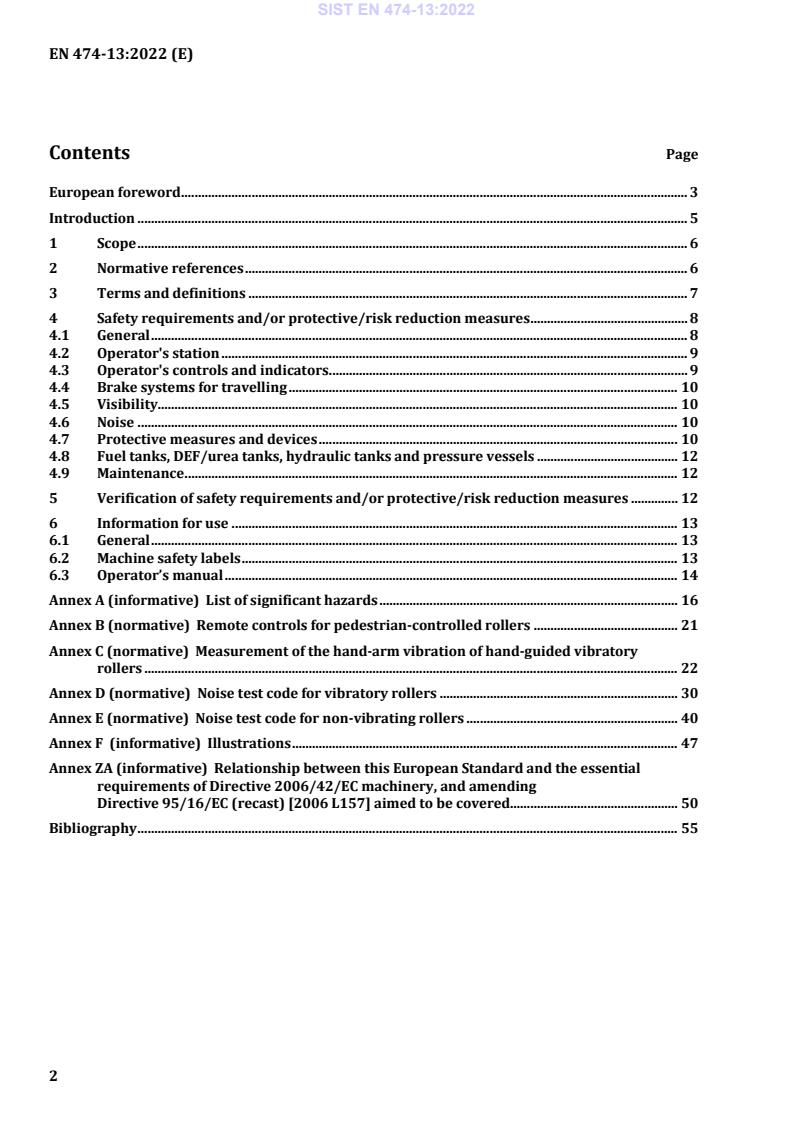
Contents Page
European foreword . 3
Introduction . 5
1 Scope . 6
2 Normative references . 6
3 Terms and definitions . 7
4 Safety requirements and/or protective/risk reduction measures . 8
4.1 General . 8
4.2 Operator's station . 9
4.3 Operator's controls and indicators . 9
4.4 Brake systems for travelling . 10
4.5 Visibility. 10
4.6 Noise . 10
4.7 Protective measures and devices . 10
4.8 Fuel tanks, DEF/urea tanks, hydraulic tanks and pressure vessels . 12
4.9 Maintenance . 12
5 Verification of safety requirements and/or protective/risk reduction measures . 12
6 Information for use . 13
6.1 General . 13
6.2 Machine safety labels . 13
6.3 Operator’s manual . 14
Annex A (informative) List of significant hazards . 16
Annex B (normative) Remote controls for pedestrian-controlled rollers . 21
Annex C (normative) Measurement of the hand-arm vibration of hand-guided vibratory
rollers . 22
Annex D (normative) Noise test code for vibratory rollers . 30
Annex E (normative) Noise test code for non-vibrating rollers . 40
Annex F (informative) Illustrations . 47
Annex ZA (informative) Relationship between this European Standard and the essential
requirements of Directive 2006/42/EC machinery, and amending
Directive 95/16/EC (recast) [2006 L157] aimed to be covered. 50
Bibliography . 55
European foreword
This document (EN 474-13:2022) has been prepared by Technical Committee CEN/TC 151 “Construction
equipment and building material machines - Safety”, the secretariat of which is held by DIN.
This European Standard shall be given the status of a national standard, either by publication of an
identical text or by endorsement, at the latest by September 2022, and conflicting national standards shall
be withdrawn at the latest by March 2024.
Attention is drawn to the possibility that some of the elements of this document may be the subject of
patent rights. CEN shall not be held responsible for identifying any or all such patent rights.
This document partially supersedes EN 500-4:2011.
This document has been prepared under a standardization request given to CEN by the European
Commission and the European Free Trade Association, and supports essential requirements of
EU Directive(s).
For relationship with EU Directive(s), see informative Annex ZA, which is an integral part of this
document.
For bibliographic references, see EN 474-1:2022.
EN 474 “Earth-moving machinery — Safety” comprises the following parts:
— Part 1: General requirements
— Part 2: Requirements for tractor-dozers
— Part 3: Requirements for loaders
— Part 4: Requirements for backhoe-loaders
— Part 5: Requirements for hydraulic excavators
— Part 6: Requirements for dumpers
— Part 7: Requirements for scrapers
— Part 8: Requirements for graders
— Part 9: Requirements for pipelayers
— Part 10: Requirements for trenchers
— Part 11: Requirements for earth and landfill compactors
— Part 12: Requirements for cable excavators
— Part 13: Requirements for rollers
Any feedback and questions on this document should be directed to the users’ national standards body.
A complete listing of these bodies can be found on the CEN website.
This document supersedes EN 500-4 together with prEN ISO 20500-4. Stage at time of publication of this
document: prEN ISO 20500-4:2022.
According to the CEN-CENELEC Internal Regulations, the national standards organisations of the
following countries are bound to implement this European Standard: Austria, Belgium, Bulgaria, Croatia,
Cyprus, Czech Republic, Denmark, Estonia, Finland, France, Germany, Greece, Hungary, Iceland, Ireland,
Italy, Latvia, Lithuania, Luxembourg, Malta, Netherlands, Norway, Poland, Portugal, Republic of North
Macedonia, Romania, Serbia, Slovakia, Slovenia, Spain, Sweden, Switzerland, Turkey and the United
Kingdom.
Introduction
This document is a type-C standard as stated in EN ISO 12100.
This document is of relevance, in particular, for the following stakeholder groups representing the market
players with regard to machinery safety:
— machine manufacturers (small, medium and large enterprises);
— health and safety bodies (regulators, accident prevention organizations, market surveillance, etc.).
Others can be affected by the level of machinery safety achieved with the means of the document by the
above-mentioned stakeholder groups:
— machine users/employers (small, medium and large enterprises);
— machine users/employees (e.g. trade unions, organizations for people with special needs);
— service providers, e.g. for maintenance (small, medium and large enterprises);
— consumers (in case of machinery intended for use by consumers).
The above-mentioned stakeholder groups have been given the possibility to participate in the drafting
process of this document.
The machinery concerned and the extent to which hazards, hazardous situations or hazardous events are
covered are indicated in the scope of this document.
When requirements of this type-C standard are different from those which are stated in type-A or type-B
standards, the requirements of this type-C standard take precedence over the requirements of the other
standards for machines that have been designed and built according to the requirements of this type-C
standard.
1 Scope
This document together with EN 474-1:2022 deals with all significant hazards, hazardous situations and
events relevant to rollers when used as intended and under the conditions of misuse which are
reasonably foreseeable by the manufacturer (see Annex A) associated with the whole lifetime of the
machine as described in EN ISO 12100:2010, 5.4.
The requirements of this document are complementary to the common requirements formulated in
EN 474-1:2022. This document does not repeat the requirements of EN 474-1:2022 but supplements or
modifies the requirements for rollers.
This document does not provide requirements for main electrical circuits and drives of machinery when
the primary source of energy is an external electrical supply.
The following significant and relevant hazards are not covered in this document:
— Laser;
— Lightning.
This document does not provide performance requirements for safety related functions of control
system(s).
This document does not deal with towing of trailers.
This part of EN 474:2022 is not applicable for seated ride-on operated rollers with a drum width less than
nominal 0,8 m.
This document is not applicable to rollers which are manufactured before the date of publication of this
document by CEN.
2 Normative references
The following documents are referred to in the text in such a way that some or all of their content
constitutes requirements of this document. For dated references, only the edition cited applies. For
undated references, the latest edition of the referenced document (including any amendments) applies.
EN 474-1:2022, Earth-moving machinery — Safety — Part 1: General requirements
EN ISO 3164:2013, Earth-moving machinery — Laboratory evaluations of protective structures —
Specifications for deflection-limiting volume (ISO 3164:2013)
EN ISO 3744:2010, Acoustics — Determination of sound power levels and sound energy levels of noise
sources using sound pressure — Engineering methods for an essentially free field over a reflecting plane
(ISO 3744:2010)
EN ISO 6165:2012, Earth-moving machinery — Basic types — Identification and terms and definitions
(ISO 6165:2012)
EN ISO 6682:2008, Earth-moving machinery — Zones of comfort and reach for controls (ISO 6682:1986,
including Amd 1:1989)
EN ISO 12100:2010, Safety of machinery — General principles for design — Risk assessment and risk
reduction (ISO 12100:2010)
EN ISO 11201:2010, Acoustics — Noise emitted by machinery and equipment — Determination of
emission sound pressure levels at a work station and at other specified positions in an essentially free field
over a reflecting plane with negligible environmental corrections (ISO 11201:2010)
EN ISO 13850:2015, Safety of machinery — Emergency stop function — Principles for design
(ISO 13850:2015)
EN ISO 20643:2008, Mechanical vibration — Hand-held and hand-guided machinery — Principles for
evaluation of vibration emission (ISO 20643:2005)
ISO 5006:2017, Earth-moving machinery — Operator’s field of view — Test method and performance
criteria
ISO 5353:1995, Earth-moving machinery, and tractors and machinery for agriculture and forestry - Seat
index point
ISO 5805:1997, Mechanical vibration and shock — Human exposure — Vocabulary
ISO 10570:2004, Earth-moving machinery — Articulated frame lock — Performance requirements
ISO 15817:2012, Earth-moving machinery — Safety requirements for remote operator control systems
3 Terms and definitions
For the purposes of this document, the terms and definitions given in EN 474-1:2022, EN ISO 6165:2012,
EN ISO 12100:2010 and the following apply.
ISO and IEC maintain terminological databases for use in standardization at the following addresses:
— IEC Electropedia: available at https://www.electropedia.org/
— ISO Online browsing platform: available at https://www.iso.org/obp
3.1
roller
self-propelled or towed machine having a compaction device, consisting of one or more metallic
cylindrical bodies (drums) or rubber tyres, which compacts material such as crushed rock, earth, asphalt
or gravel through a rolling and/or vibrating action of the compaction device
[SOURCE: EN ISO 6165:2012, 4.10]
Note 1 to entry: The wheel bodies (metallic cylinders) can be rubber-coated or fitted with pads.
3.1.1
non-vibrating (static) roller
roller that performs compaction by its static weight
3.1.2
vibrating roller
roller that have a vibrating and/or oscillating mechanism in at least one drum
3.1.2.1
single-drum roller
self-propelled roller with one vibrating metallic cylindrical body (drum) and two rubber tyres
3.1.2.2
tandem roller
self-propelled roller with one metallic cylindrical body (drum) in the front and one in the rear
Note 1 to entry: They can be either static or vibrating and they can be split.
3.1.2.3
combined roller
self-propelled roller with one or more metallic cylindrical body (drum) and more than two rubber tyres
3.1.2.4
three-wheel roller
self-propelled roller with one metallic body (drum) in the front (or rear) and two in the rear (or front)
Note 1 to entry: The drums can be split.
3.1.2.5
pneumatic-tyre roller
self-propelled roller with three or more tyres in the front and the rear
3.1.3
pedestrian-controlled roller
self-propelled compact roller (4 500 kg or less) with one or more metallic cylindrical bodies (drums) or
rubber tyres in which the operating facilities for travelling, steering, braking and vibrating are disposed
in such a way that the intended operation of the machine has to be undertaken by an attending operator
or by remote control
Note 1 to entry: A pedestrian-controlled roller is considered to be non-riding machine in the sense of
EN 474-1:2022, 3.13.
3.1.4
towed roller
roller with one or more metallic cylindrical bodies (drums) or rubber tyres which do not possess an
independent drive system and where the operator's station is located at the towing unit
3.2
operating mass
OM
mass of the base machine, with equipment and empty attachment in the most usual configuration as
specified by the manufacturer, and with the operator (75 kg), full fuel tank and all fluid systems (i.e.
hydraulic oil, transmission oil, engine oil, engine coolant) at the levels specified by the manufacturer and,
when applicable, with sprinkler water tank(s) half full
Note 1 to entry: The mass of an operator is not included for non-riding machines.
Note 2 to entry: Ballast mass at delivery can be included if specified by the manufacturer.
[SOURCE: ISO 6016:2008, 3.2.1]
3.3
operator’s place
area as defined by the manufacturer on rollers other than ride-on, from which an operator controls the
travel and work functions of the roller
4 Safety requirements and/or protective/risk reduction measures
4.1 General
4.1.1 Context
Rollers shall comply with the safety requirements and/or protective/risk reduction measures of this
clause. In addition, the machines shall be designed according to the principles of EN ISO 12100:2010 for
relevant but not significant hazards which are not dealt with by this document.
4.1.2 Specific relation to EN 474-1
Rollers shall comply with the requirements of EN 474-1:2022, as far as not modified or replaced by the
requirements of this part.
4.2 Operator's station
4.2.1 General requirements
EN 474-1:2022, 4.3 shall apply with the following modification:
If the operator's position is offset from the space envelope width centreline, then the internal distance
from the seat centreline to the side of the enclosure shall not be less than 295 mm.
EN 474-1:2022, 4.3.1.1, first paragraph shall be replaced by:
The operator’s station of seated ride-on rollers shall be fitted with a cab. This requirement does not apply
to rollers with an operating mass < 6 000 kg; or rollers with an operating mass ≥ 6 000 kg
and < 12 000 kg where either an operator’s cab or a canopy shall be fitted.
EN 474-1:2022, 4.3.1.2 shall apply with the following addition:
EN 474-1:2022, 4.3.1.3, 4.3.1.4 and 4.3.1.5 do also apply to the operator’s place.
4.2.2 Roll-over protective structures (ROPS)
EN 474-1:2022, 4.3.3 shall apply with the following addition:
For ROPS test, the position of the DLV (see EN ISO 3164:2013, 5.2) for machines which have multiple seat
locations and therefore multiple SIPs (see ISO 5353:1995, 5.3.3), the SIP used by the operator in working
mode in the most lateral position (as defined by the manufacturer) shall be used.
4.2.3 Falling-object protective structures (FOPS)
EN 474-1:2022, 4.3.4 applies only for single drum rollers > 6 000 kg. For single drum rollers > 6 000 kg
EN ISO 3449:2008, Level I applies.
4.3 Operator's controls and indicators
4.3.1 General
EN 474-1:2022, 4.5 applies with the additions/modifications in 4.3.2, 4.3.3, 4.3.4.
4.3.2 Emergency stop
EN 474-1:2022, 4.5.2 shall apply with the following addition:
Rollers, except non-remote pedestrian-controlled rollers, shall be fitted with an emergency stop within
the zone of comfort as specified in EN ISO 6682:2008.
It shall stop the movement of the machine. The emergency stop shall be in accordance with
EN ISO 13850:2015 and meet at least the requirements of stop category 1.
NOTE For non-remote pedestrian controlled rollers, the requirements are described in 4.7.1.3.
4.3.3 Controls for towed machines
For towed-rollers, it shall be possible to at least control the on-off operation of the vibration from the
operator's station on the towing unit.
4.3.4 Remote control
EN 474-1:2022, 4.5.7 shall apply to rollers.
EN 474-1:2022, 4.5.7 shall apply for pedestrian-controlled rollers with the modifications/additions in
Annex B.
4.3.5 Controls of ride-on machinery accessible from ground level
EN 474-1:2022, 4.5.9 applies with the following addition:
Ride-on operated machines shall prevent uncontrolled travelling of the machine if the operator is not on
the operator's station.
NOTE This requirement can be achieved by technical means like seat switches, sensors on the armrest, etc. in
conjunction with a time delay.
The delay time before stopping shall be less than the time to reach the hazardous area from operator’s
station.
4.4 Brake systems for travelling
EN 474-1:2022, 4.7 shall apply.
For ride-on machines, EN 474-1:2022, 4.7.1 applies with the following addition:
If a hydrostatic drive is provided, it shall be interrupted when activating the secondary brake.
4.5 Visibility
EN 474-1:2022, 4.8 shall apply with the following addition:
ISO 5006:2017 shall be applied with the following clarification:
For rollers, which can be ballasted and where the operational weight may exceed one of the thresholds
of ISO 5006:2017, Table 2 concerning the height of the test-object, the height of the test object shall be
1,2 m for the rectangular boundary (RB).
4.6 Noise
EN 474-1:2022, 4.13 and 6.3.2 shall apply with the following modifications:
— the noise emission of vibratory rollers shall be determined according to Annex D;
— the noise emission of non-vibratory rollers shall be determined according to Annex E.
NOTE A main source of noise for rollers is also the compaction process.
4.7 Protective measures and devices
4.7.1 Pedestrian-controlled rollers
4.7.1.1 General
EN 474-1:2022, 4.14 shall apply with the additions/modifications stated in 4.7.1.2, 4.7.1.3 and 4.7.2.
4.7.1.2 Handle bar
To prevent dangerous vertical swinging of the steering element (handle bar) of the single-drum
pedestrian-controlled rollers, movement of the handle shall be not less than 0,2 m and not more than
1,4 m above the ground (see Figure 1).
Dimensions in millimetres
Figure 1 — Vertical swinging of single-drum walk-behind rollers
4.7.1.3 Protection against crushing
Pedestrian-controlled rollers shall be provided with a device against crushing which is designed to
prevent the operator from being trapped between the machine and an obstacle.
If this device is of mechanical type (see Figure 2), e.g. force actuated protective device, it shall be so
designed to stop the machine in a distance that is less than the total operating range of the device and its
effective operating force shall not exceed 230 N.
NOTE 1 Further guidance on protective devices can be found in EN ISO 13855:2010.
NOTE 2 This device can be of a mechanical type as shown in Figure 2 or provide its function by other means (e.g.
laser scanner, ultrasonic, radar, transponder system). See B.2, first paragraph.
Dimensions in millimetres
a) b)
Key
1 stopping device
a) rollers with handle bar
b) remote controlled rollers
Figure 2 — Position of the protective device on non-riding rollers
4.7.2 Articulated machines
EN 474-1:2022, 4.14.2.3 applies with the following modification:
Rollers with pivot articulated components shall be equipped with an integral, rigid locking device to
prevent pivoting during maintenance and/or transport. The locking device shall meet the requirements
of ISO 10570:2004, but with a safety factor of 1,5 instead of 2 as indicated in ISO 10570:2004, 4.4, second
paragraph.
4.8 Fuel tanks, DEF/urea tanks, hydraulic tanks and pressure vessels
EN 474-1:2022, 4.19 applies with the following exemption:
The requirements for fluid level indicators in EN 474-1:2022, 4.19.1 are not applicable for fuel tanks of
rollers with an operating mass ≤ 2 000 kg.
4.9 Maintenance
EN 474-1:2022, 4.22.2, 3rd paragraph does not apply to compact rollers with an operating
mass ≤ 4 500 kg.
5 Verification of safety requirements and/or protective/risk reduction
measures
Safety requirements and/or protective/risk reduction measures of Clause 4 of this document shall be
verified according to Table 1.
Table 1 sets out verification methods which shall be applied for each safety requirement in this document.
Where X(s) is indicated in the table, the corresponding verification method(s) shall be applied.
Table 1 shall be read in conjunction with the corresponding clauses.
Table 1 includes the following verification methods:
a) calculation: to establish that the requirements of this document have been met;
b) visual verification: to establish that something is present (e.g. a guard, a marking, a document);
c) measurement: to show that the required numerical values have been met (e.g. geometric dimensions,
safety distances, resistance of insulation of the electric circuits, results of physical tests);
d) functional tests: to show that the adequate signals intended to be forwarded to the main control
system of the complete machine are available and comply with the requirements and with the
technical documentation;
e) special verification: by reference to a standard which is mentioned in the corresponding clause.
Table 1 — Verification of safety requirements and/or protective/risk reduction measures
4.1 General X
4.2.1 Operator's station, General requirements X X
4.2.2 Roll-over protective structure (ROPS) X
4.2.3 Falling object protective structure (FOPS) X
4.3.2 Emergency stop X
4.3.3 Controls for towed machines X
4.3.4 Remote control X X X
4.3.5 Controls of ride-on machinery accessible from X
ground level
4.4 Brake systems for travelling X
4.5 Visibility X
4.6 Noise X
4.7.1.2 Handle bar X
4.7.1.3 Protection against crushing X X
4.7.2 Articulated machines X
6 Information for use
6.1 General
Information for use shall be provided in accordance with EN ISO 12100:2010, 6.4.
6.2 Machine safety labels
EN 474-1:2022, 6.2 applies with the following addition:
Clause number
a) Calculation
b) Visual verification
c) Measurement
d) Functional test
e) Special verification
For ride-on rollers with a drum width less than nominal 1 m a warning decal (see Figure 3) shall be
affixed visible from the operator’s station.
Figure 3 — Warning decal
6.3 Operator’s manual
6.3.1 General
EN 474-1:2022, 6.3 shall apply with the following addition:
— stopping device for non-riding and remote-controlled rollers;
— safety precaution for starting and stopping non-riding rollers;
— instructions for the proper use including cleaning and maintenance of the water sprinkler system;
— additional information concerning the stability of the machine (permissible slope, etc.);
— for rollers with a drum width less than nominal 1 m the tipping angle and the applicable
circumstances on the job-site which have a negative impact on the stability (e.g. height of kerbstone,
dynamic influence);
— for rollers with a drum width less than nominal 1 m additional risk arises while driving close to edges
(e.g. edges of kerbstones, bank, trenches, pothole) by exceeding the edge;
— for remote/pedestrian controlled rollers a description of the operator’s place; additional information
for remote controls:
— data on performance and operating limits;
— instructions on actuation;
— a description of the actuation equipment;
— the instruction handbook shall contain information regarding the assigned operator's location,
and it shall specify if the actuation of controls from the operator's place/station which is on the
opposite side does not correspond with the intended/expected direction of the roller movement;
— instructions concerning safe operation (changing the battery, cleaning, reflections, encoding,
etc.);
— instructions on action in the event of the occurrence of faults;
— the minimum distance between machine and operator shall be 2 m.
6.3.2 Information concerning hand-arm and whole-body vibration emission
EN 474-1:2022, 6.3.3 shall apply with the following addition:
For pedestrian-controlled (hand-guided) rollers, the hand-arm vibration shall be determined according
to Annex C.
Annex A
(informative)
List of significant hazards
This annex contains in Table A.1 all the hazards, hazardous situations and events identified by risk
assessment as significant for earth rollers as defined in the scope of this document and which require
action to eliminate or reduce the risk.
Table A.1 — List of significant hazards
Hazard Relevant clauses of
this document
Hazards, hazardous situations and hazardous events
Mechanical hazards
Due to machine parts or workpieces, e.g. 4.1
by potential energy (falling objects, height from the ground, gravity)
by kinetic energy (acceleration, deceleration, moving/rotating elements) 4.1, 4.7
— mechanical strength (break-up) 4.1, 4.2.7, 4.8
by stored energy, e.g.: 4.1, 4.8
— elastic elements (springs)
Crushing hazard 4.1, 4.2.2, 4.2.7, 4.3.2, 4.3,
4.7, 6.2
Shearing hazard 4.1, 4.7
Cutting or severing hazard 4.1, 4.2.2, 4.7
Entanglement 4.1, 4.7
Drawing-in or trapping hazard 4.1, 4.7
Impact hazard 4.1, 4.3.2
Stabbing or puncture hazard 4.1, 4.7
Friction or abrasion hazard 4.1, 4.3.2
Injection 4.1
Slipping, tripping and falling 4.1
Instability 4.1, 4.2.2, 6.2, 6.3
Electrical hazards
Touching live parts 4.1
Electromagnetic phenomena 4.1
Short-circuit 4.1
Hazard Relevant clauses of
this document
Overload 4.1
Thermal hazards
Burns, scalds 4.1, 4.7, 4.8
Radiation of heat sources 4.1, 4.7
Noise hazards
Permanent hearing loss, tinnitus 4.1, 4.6, Annex D, Annex E
As a consequence of an interference with speech communication or with 4.1, 4.6
acoustic signals.
Physiological impairment (e.g. loss of balance, loss of awareness) 4.1
Vibration hazards
Vibrations transmitted to the operator when sitting during operation 4.1, 6.3.2
Portable hand-held and/or hand-guided machinery (e.g. vascular disorder, 4.1, 6.3.2, Annex C
neurological disorder)
In conjunction with a rigid position (e.g. trauma of the spine, osteo-articular 4.1
disorder, low-back morbidity)
Radiation hazards
Radio frequency electromagnetic radiation 4.1
Laser Not covered
Material/ substance hazards
Hazards from contact with/or inhalation of harmful fluids, gases, mists, 4.1, 4.8
fumes and dusts
Fire 4.1, 4.8
Explosion 4.1
Ergonomic hazards
Unhealthy postures or excessive effort 4.1, 4.2.1, 4.5, 4.8, 4.9
Inadequate consideration of anatomy 4.1, 4.3, 6.3, 4.5, 4.8, 4.9
Insufficient means for evacuation/emergency exit 4.1
Inadequate local lighting 4.1
Inadequate design or location of visual display units 4.1, 4.5
Design, location or identification of control devices 4.1, 4.4
Flicker, dazzling, shadow, stroboscopic effect 4.1, 4.5
Human error during operation 4.1
Hazards associated with the environment in which the machine is used
Hazard Relevant clauses of
this document
Lightning Not covered
Pollution 4.1
Snow, water, wind, temperature 4.1
Exhaust gas/ lack of oxygen at workplace 4.1
Dust and fog 4.1
Unexpected start up, unexpected overrun/overspeed (or similar
malfunction)
Failure/disorder of the control system and control circuits 4.1, 4.3, 4,4
Restoration of energy supply after an interruption 4.1
Software error Not covered
Failure of the power supply 4.1, 4.3, 4.4
Hazards due to:
— assembly and installation
— setting
— cleaning
— fault-finding
— maintenance
Maintenance 4.1
Insufficient means of access during use, setting and maintenance 4.1, 4.8
Hazards due to portable machinery — hand-held and/or hand-guided
machinery
Instability 4.1
Accidental starting/or continued operation 4.1
Hazards relating to travelling function
Movement when starting the engine 4.1
Movement without a driver at the driving position 4.1
Movement without all parts in a safe position 4.1
Excessive speed of pedestrian controlled machinery 4.1
Insufficient ability of machinery to be slowed down, stopped and 4.1, 4.3, 4.4
immobilised
Hazards linked to work position (including driving station) on the
machine
Fall of persons during access to (or at/from) the drive/work position(s) 4.1
Fire (flammability of the cab, lack of extinguishing means) 4.1
Hazard Relevant clauses of
this document
Mechanical hazards at the work position: 4.1, 4.2.2, 4.2.3, 4.7
contact with the wheels; rollover and overturning; fall of objects, penetration
by objects; slipping during access; contact of persons with machine parts or
tools (pedestrian controlled machines
Insufficient visibility from the drive/work position(s) 4.1, 4.5
Inadequate seating 4.1
Hazards due to the control system
Inadequate location of manual controls 4.1, 4.3, 4.4
Inadequate design of manual controls and their mode of operation 4.1, 4.4
Hazards due to the power source and to the transmission of power
Engine and batteries 4.1
Transmission of power between machines Not covered
Couplings and towings 4.1
From/to third persons
Unauthorised start-up/use 4.1
Drift of a part away from its stopping position 4.1
Lack or inadequacy of visual or acoustic warning means 4.1, 4.5, 6.2
Insufficient instructions for the driver/operator (operation manual, 4.1, 4.5, 6.2
signs, warnings, and markings)
Additional hazards, hazardous situations and hazardous events due to 4.1
lifting
Mechanical hazards caused by load falls, collisions, machine tipping
Lack of stability 4.2.2, 6.2, 6.3
Uncontrolled loading, overloading, overturning moments exceeded 4.1
Unexpected/unintended movement of loads 4.1
Inadequate holding devices/accessories 4.1
Access of persons to load support 4.1
From insufficient mechanical strength of parts 4.1
From inadequate selection of chain, ropes, lifting and accessories and their 4.1
inadequate integration into the machine
Abnormal conditions of assembly/use/maintenance 4.1
Hazards linked to driver/operator position
Insufficient visibility from driver position 4.1, 4.5
Hazard Relevant clauses of
this document
Supplementary, for machinery intended for underground work
Mechanical hazards and hazardous events due to:
Fire and explosion 4.1
Emission of dust, gases, etc. Not covered
Supplementary, for machinery presenting particular hazards due to the
lifting of persons
Mechanical hazards due to
inadequate mechanical strength, failing of loading control 4.1
inadequate working coefficients
Failing of controls in person carrier (function, priority) 4.1
Overspeed of person carrier 4.1
Falling of persons from person carrier 4.1
Annex B
(normative)
Remote controls for pedestrian-controlled rollers
B.1 General
ISO 15817:2012 applies with the following additions for wireless remote controls.
B.2 Safety requirements and measures
All travel movements shall be switched off automatically by the receiver if the distance between the
transmitter hold by the operator and the machine is less than 2 m.
All travel movements shall be switched off automatically by the control system if the machine is leaving
the work- and travel area (maximum distance between transmitter and machine less than 50 m).
If there is an insufficient state of charge concerning the battery of the transmitter, this state should be
indicated (e.g. acoustically or optically) before the function of the equipment is affected in any way (e.g.
alteration of the transmission of control commands).
Transmitters and receivers shall be assigned to each other.
ISO 15817:2012, 4.4.2.4 is considered to be fulfilled by a lockable storage place on the roller for the
remote control box.
ISO 15817:2012, 4.5.3 applies with the following modification: An emergency stop on the machine is not
required.
No movements shall be caused on connection of transmitter or receiver to a power source.
The alignment of the remote control shall not exceed horizontally ± 30°.
NOTE It is intended that this measure limits the possibility of a command being unintentionally issued due to
reflecting walls or obstacles.
B.3 Components and equipment
It shall be possible to operate the controls while wearing protective gloves.
If programming is used in the process of transmitting commands in conjunction with the remote controls,
it shall only be possible to alter the programme with a special tool.
The description of type shall clearly indicate the relationship between transmitter and receiver.
The following message shall be legibly and durably shown on the transmitter (either by text or by an
appropriate pictogram):
“Check the operational functionality of the remote control system prior to use.”
Annex C
(normative)
Measurement of the hand-arm vibration of hand-guided vibratory rollers
C.1 General
In this annex, specifications are laid down for machines as a supplement to EN ISO 20643:2008 for hand-
guided vibratory rollers. Those specifications serve to determine the characteristic vibration amplitudes
under practical conditions. The machines are characterized by their possessing a module for producing
vibration, so as to cause compacting of the under-surface.
This annex contains the same conditions for operation and arrangement for all hand-guided vibratory
machines as they apply to the determination of sound power level for those hand-guided vibratory rollers
as described in Annex C.
C.2 Terminology
The terms and definitions given in ISO 5805:1997 shall apply.
C.3 Quantities to be measured
C.3.1 R.m.s. value of the weighted acceleration
The quantities to be measured are the r.m.s. values of the weighted vibration accelerations a , , a ,
xhw i yhw i
and a , of the i = 1 to 3 measurements of a test run in accordance with EN ISO 20643:2008. Those are
zhw i
formed according to
3 33
1 1 1
a = a ; a = a ;=a a (C.1)
xhw yhw zhw
∑ ∑∑
xhw,i yhw,i zhw,i
3 3 3
i=l i=l i=l
for each coordinate into the result of the test run. Since in the case of the machines under investigation,
the vibration accelerations in the x-, y- and z-coordinates often produce values of the same magnitude,
the acceleration sum of the test run is also formed according to
2 2 2
a = aa++ a (C.2)
xhw yhw zhw
vhw
C.3.2 Frequency analysis
If required, frequency analyses from the acceleration time signals can be determined for one
measurement direction (x-axis) or for all directions of measurement. The analyses shall not be weighted
with the hand-arm filter.
C.3.3 Time records
If required, the variations of the signals with time can be recorded for one measurement direction (x-axis)
or for all three measurement directions.
C.3.4 Other quantities to be measured
a) Speed of engine (see Table C.1);
b) Measurement duration t (see C.6.5, 7th paragraph and Figure C.3).
M
C.4 Measuring equipment
C.4.1 Requirements for the acceleration transducers
Shall be according to EN ISO 20643:2008, 7.2.1.
In another variant, the total mass of the three acceleration transducers (or of the triaxial transducer)
should be less than 60 g. The mass of the coupling device for the acceleration transducers should be kept
as low as possible (maximum 60 g).
C.4.2 Fastening of the acceleration transducers
Measurement is carried out in three directions of measurement with three single or one triaxial
acceleration transducer(s). The three acceleration transducers are fastened to a coupling device on the
drawbar (according to Figures C.1 a) and C.1 b)). The coupling device shall be adapted to the diameter of
the respective drawbar. The three acceleration transducers (or one triaxial transducer) are attached
(screwed or glued) to the coupling device.
The axes of the acceleration transducers shall be directed in accordance with C.5.1.
If the drawbar has a resilient cover in the region to which the coupling device is to be attached (see
Figure C.2), then care shall be taken during the measurements. The resilient cover can form a “spring-
mass system” together with the coupling device and the acceleration transducer(s), resulting in natural
vibration. In addition, the results of measurement are difficult to reproduce. It is therefore advisable to
remove the resilient cover for the measurements.
In the test report, it shall be recorded whether a vibration-damping cover was present and whether this
was removed for the measurements.
C.4.3 Frequency weighting filter
Frequency weighting filter shall be according to EN ISO 20643:2008, 7.3.
C.4.4 R.m.s. detector
R.m.s.detector shall be according to EN ISO 20643:2008, 6.3.
C.4.5 Calibration
Calibration shall be according to EN ISO 20643:2008, 7.6.
C.5 Measurement direction and measurement location
C.5.1 Measurement direction
The directions of measurement are given in Figure C.1. The coupling device shall be directed, depending
on the size of the operator, in such a manner that the z-axis runs parallel to the ground during the
measurements.
Key
1 engine 6 acceleration transducer a) aluminium clamp to be adjusted to the
guidance pole tube
2 z-axis 7 aluminium clamp
3 x-axis 8 steel clamp b) steel clamp with soldered block
carrying the acceleration transducer
4 y-axis 9 steel block approximately
10 mm × 10 mm × 10 mm soldered
5 pole tube
Figure C.1 — Directions of measurement and examples for attachment of the acceleration
transducer
C.5.2 Measurement location
Depending on the design of the drawbar, the coupling device shall be arranged according to Figure C.2.
Key
1 coupling device
2 drawbar
Figure C.2 — Arrangement of the coupling device on the drawbar
C.6 Specification of working procedure
C.6.1 Operator
The operator shall be skilled in handling and operating the machine.
C.6.2 Other quantities to be determined (forces)
The acceleration values measured at the drawbars can be influenced by the operati
...