

EN 15689:2009
(Main)Railway applications - Track - Switches and crossings - Crossing components made of cast austenitic manganese steel
- Abstract
The scope of this European Standard is:
- to establish material requirements for cast austenitic manganese steel for fixed crossings and cradles for crossings with moveable parts designed to be welded or bolted to rails;
- to formulate codes of practice for inspection, testing of un-machined and machined heat-treated castings;
- to list the methods by which crossings should be identified and traced;
- to define limits of weld rectification by the supplier;
- special requirements for pre-hardened crossings.
Geometrical aspects, as machining tolerances and inspection of finished crossings are covered in EN 13232-6 and EN 13232-7 and therefore not in this European Standard.
This European Standard specifies the minimum requirements for cast manganese crossing components. Special applications (for instance tram systems) can require different demands in certain paragraphs and need to be agreed between customer and supplier.
- Status
- Published
- Publication Date
- 24-Nov-2009
- Technical Committee
- CEN/TC 256 - Railway applications
- Current Stage
- 9092 - Decision on results of review/2YR ENQ - revise - Review Enquiry
- Start Date
- 01-Jul-2025
- Completion Date
- 07-Oct-2026



Overview
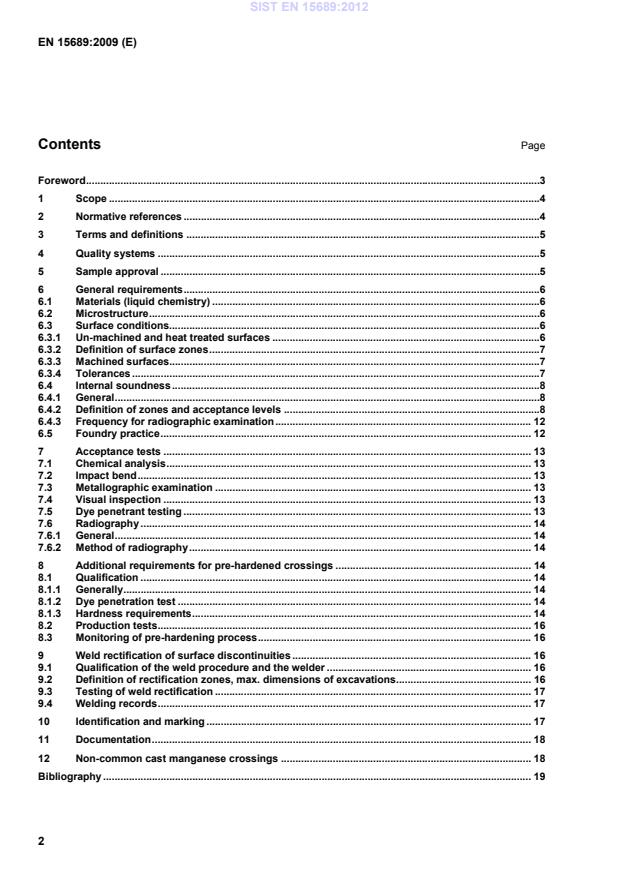
EN 15689:2009 (CEN) defines material, inspection and testing requirements for crossing components made of cast austenitic manganese steel used in railway switches and crossings. The standard sets minimum requirements for fixed crossings and cradles for moveable crossings that are designed to be welded or bolted to rails. It focuses on material chemistry, microstructure, foundry practice, non‑destructive testing and traceability - not on finished geometry, which is covered by EN 13232‑6 and EN 13232‑7.
Key topics
- Material chemistry: Specifies liquid steel composition ranges (example: carbon ~0.95–1.30 %, manganese ~11.5–14.0 %, silicon ≤0.65 %, phosphorus and sulphur limits and maximum levels for other elements). Manganese must be significantly higher than carbon to ensure austenitic structure.
- Microstructure: Castings must be austenitic and free of detrimental carbide precipitation; verification by metallography or mechanical testing is required.
- Surface and machining: Defines surface finish comparators for un‑machined, heat‑treated surfaces and maximum roughness values for machined areas (e.g., wheel contact Ra values). Machined tolerances are referenced to ISO 8062 and EN 13232 parts.
- Internal soundness & radiography: Zones for radiographic inspection (nose, wheel transfer area, leg ends, changes of section) are defined; sample frequency and acceptance procedure are specified (e.g., radiography on 1 in 50 castings of each pattern).
- Acceptance tests: Chemical analysis, impact bend, metallography, visual inspection, dye‑penetrant testing and radiography are required for sample approval and production control.
- Weld rectification & pre‑hardened crossings: Limits on weld excavation/repairs, qualification of welding procedure and welder, plus special requirements and monitoring for pre‑hardened contact areas.
- Quality systems, sample approval & traceability: Supplier quality certification, prototype/sample approval for new patterns and marking/identification methods are specified. Use of chaplets is restricted unless agreed with the customer.
Applications
EN 15689 is intended for:
- Foundries and suppliers producing cast manganese crossing components for mainline switches and crossings.
- Railway infrastructure owners, track engineers and procurement teams specifying material and inspection requirements.
- NDT personnel and quality managers implementing radiographic and surface inspection regimes.
- Welding engineers and manufacturers performing repair/weld rectification on cast crossings.
Practical value: ensures consistent mechanical performance and in‑service durability of crossing components through controlled chemistry, heat treatment, inspection and traceability - reducing risk of in‑track failures and simplifying supplier/customer acceptance.
Related standards
- EN 13232‑6 and EN 13232‑7 (geometrical and dimensional requirements for crossings)
- EN 1370 / EN 1371 (foundry inspection and penetrant testing)
- EN 444, EN 462‑3 (radiography principles and image quality)
- EN 10204, ISO 8062 (inspection documentation and dimensional tolerances)
Keywords: EN 15689, cast austenitic manganese steel, railway crossings, switches and crossings, radiography, NDT, foundry practice, welding rectification, EN 13232.
Relations
- Effective Date
- 02-Sep-2026
- Effective Date
- 25-Aug-2026
- Effective Date
- 28-Jan-2026
- Effective Date
- 28-Jan-2026
- Effective Date
- 28-Jan-2026
- Effective Date
- 28-Jan-2026
- Effective Date
- 28-Jan-2026
- Refers
EN 12801:2000 - Footwear - Test methods for insoles, lining and insocks - Perspiration resistance - Effective Date
- 28-Jan-2026
- Effective Date
- 28-Jan-2026
- Effective Date
- 28-Jan-2026
- Effective Date
- 28-Jan-2026
- Effective Date
- 28-Jan-2026
- Effective Date
- 28-Jan-2026
- Effective Date
- 28-Jan-2026
- Effective Date
- 28-Jan-2026
Get Certified
Connect with accredited certification bodies for this standard

Zavod za gradbeništvo Slovenije (ZAG) - Inšpekcija
ZAG inspection body for construction products, structures, and materials.
Sponsored listings
Frequently Asked Questions
EN 15689:2009 is a standard published by the European Committee for Standardization (CEN). Its full title is "Railway applications - Track - Switches and crossings - Crossing components made of cast austenitic manganese steel". This standard covers: The scope of this European Standard is: - to establish material requirements for cast austenitic manganese steel for fixed crossings and cradles for crossings with moveable parts designed to be welded or bolted to rails; - to formulate codes of practice for inspection, testing of un-machined and machined heat-treated castings; - to list the methods by which crossings should be identified and traced; - to define limits of weld rectification by the supplier; - special requirements for pre-hardened crossings. Geometrical aspects, as machining tolerances and inspection of finished crossings are covered in EN 13232-6 and EN 13232-7 and therefore not in this European Standard. This European Standard specifies the minimum requirements for cast manganese crossing components. Special applications (for instance tram systems) can require different demands in certain paragraphs and need to be agreed between customer and supplier.
The scope of this European Standard is: - to establish material requirements for cast austenitic manganese steel for fixed crossings and cradles for crossings with moveable parts designed to be welded or bolted to rails; - to formulate codes of practice for inspection, testing of un-machined and machined heat-treated castings; - to list the methods by which crossings should be identified and traced; - to define limits of weld rectification by the supplier; - special requirements for pre-hardened crossings. Geometrical aspects, as machining tolerances and inspection of finished crossings are covered in EN 13232-6 and EN 13232-7 and therefore not in this European Standard. This European Standard specifies the minimum requirements for cast manganese crossing components. Special applications (for instance tram systems) can require different demands in certain paragraphs and need to be agreed between customer and supplier.
EN 15689:2009 is classified under the following ICS (International Classification for Standards) categories: 93.100 - Construction of railways. The ICS classification helps identify the subject area and facilitates finding related standards.
EN 15689:2009 has the following relationships with other standards: It is inter standard links to EN 1370:2026, ISO 8062:1994, EN 10204:2004, EN 462-3:1996, EN 1371-1:2011, EN 444:1994, EN 13232-6:2005, EN 12801:2000, EN 13232-7:2006, EN ISO 11970:2025, EN 13232-1:2003, EN 473:2008, EN 1370:2011, EN ISO 3452-1:2021, EN 13232-7:2023. Understanding these relationships helps ensure you are using the most current and applicable version of the standard.
EN 15689:2009 is associated with the following European legislation: EU Directives/Regulations: 2001/16/EC, 2008/57/EC, 93/38/EEC, 96/48/EC; Standardization Mandates: M/024, M/275, M/334. When a standard is cited in the Official Journal of the European Union, products manufactured in conformity with it benefit from a presumption of conformity with the essential requirements of the corresponding EU directive or regulation.
EN 15689:2009 is available in PDF format for immediate download after purchase. The document can be added to your cart and obtained through the secure checkout process. Digital delivery ensures instant access to the complete standard document.
Standards Content (Sample)
2003-01.Slovenski inštitut za standardizacijo. Razmnoževanje celote ali delov tega standarda ni dovoljeno.Bahnanwendungen - Oberbau - Weichen und Kreuzungen - Gegossener austenitischer Manganstahl für HerzstückbauteileApplications ferroviaires - Voie - Appareils de voie - Coeurs ou composants de coeur en acier moulé au manganèseRailway applications - Track - Switches and crossings - Crossing components made of cast austenitic manganese steel93.100Gradnja železnicConstruction of railwaysICS:Ta slovenski standard je istoveten z:EN 15689:2009SIST EN 15689:2012en,fr,de01-september-2012SIST EN 15689:2012SLOVENSKI
STANDARD
EUROPEAN STANDARD NORME EUROPÉENNE EUROPÄISCHE NORM
EN 15689
November 2009 ICS 93.100 English Version
Railway applications - Track - Switches and crossings - Crossing components made of cast austenitic manganese steel
Applications ferroviaires - Voie - Appareils de voie -Coeurs ou composants de coeur en acier moulé au manganèse
Bahnanwendungen - Oberbau - Weichen und Kreuzungen -Gegossener austenitischer Manganstahl für Herzstückbauteile This European Standard was approved by CEN on 10 October 2009.
CEN members are bound to comply with the CEN/CENELEC Internal Regulations which stipulate the conditions for giving this European Standard the status of a national standard without any alteration. Up-to-date lists and bibliographical references concerning such national standards may be obtained on application to the CEN Management Centre or to any CEN member.
This European Standard exists in three official versions (English, French, German). A version in any other language made by translation under the responsibility of a CEN member into its own language and notified to the CEN Management Centre has the same status as the official versions.
CEN members are the national standards bodies of Austria, Belgium, Bulgaria, Cyprus, Czech Republic, Denmark, Estonia, Finland, France, Germany, Greece, Hungary, Iceland, Ireland, Italy, Latvia, Lithuania, Luxembourg, Malta, Netherlands, Norway, Poland, Portugal, Romania, Slovakia, Slovenia, Spain, Sweden, Switzerland and United Kingdom.
EUROPEAN COMMITTEE FOR STANDARDIZATION
COMITÉ EUROPÉEN DE NORMALISATION EUROPÄISCHES KOMITEE FÜR NORMUNG
Management Centre:
Avenue Marnix 17,
B-1000 Brussels © 2009 CEN All rights of exploitation in any form and by any means reserved worldwide for CEN national Members. Ref. No. EN 15689:2009: ESIST EN 15689:2012
...