

EN 473:2008
(Main)Non-destructive testing - Qualification and certification of NDT personnel - General principles
- Abstract
This European Standard establishes principles for the qualification and certification of personnel who perform industrial non-destructive testing (NDT). The term ‘industrial’ implies the exclusion of applications in the field of medicine.
The system described in this European Standard can also apply to other NDT methods, or to new techniques within an established NDT method, provided a comprehensive scheme of certification exists and the method or technique is covered by European, international or national standards, or the new NDT method or technique has been demonstrated as effective through a formal qualification carried out in accordance with CEN/TR 14748.
NOTE 1 Wherever gender specific words such as "his", "her", "he" or "she" appear in this standard, the other gender is also applicable.
When certification of NDT personnel is defined in product standards, regulations, codes or specifications, it is recommended to certify the personnel in accordance with this European Standard.
NOTE 2 The methodology for “Approval” of NDT personnel is not specified in Directive 97/23/EC and it was agreed that guidance was required in order to ensure a consistent approach to the application of the Directive and the implementation of Working Group Pressure guideline 6/13 by Recognised Third Party Organisations (RTPO). As a result a Code of Practice was developed as Technical Report CEN/TR 15589 [3].
The certification covers proficiency in one or more of the following methods:
a) acoustic emission testing;
b) eddy current testing;
c) leak testing (hydraulic pressure tests excluded);
d) magnetic particle testing;
e) penetrant testing;
f) radiographic testing;
g) ultrasonic testing;
h) visual testing (direct unaided visual tests and visual tests carried out during the application of another NDT method are excluded).
- Status
- Withdrawn
- Publication Date
- 10-Jun-2008
- Withdrawal Date
- 14-Jun-2012
- Technical Committee
- CEN/TC 138 - Non-destructive testing
- Drafting Committee
- CEN/TC 138 - Non-destructive testing
- Current Stage
- 9960 - Withdrawal effective - Withdrawal
- Start Date
- 15-Jun-2012
- Completion Date
- 15-Jun-2012
97/23/EC - Pressure equipmentOJ Ref: C, C 81 OJ Date: 04-Apr-2009

Relations
- Effective Date
- 22-Dec-2008
- Effective Date
- 22-Dec-2008
- Effective Date
- 27-Jun-2012
- Effective Date
- 28-Jan-2026
- Effective Date
- 28-Jan-2026
- Effective Date
- 28-Jan-2026
- Referred By
EN 16090:2011 - Copper and copper alloys - Estimation of average grain size by ultrasound - Effective Date
- 28-Jan-2026
- Effective Date
- 28-Jan-2026
- Effective Date
- 28-Jan-2026
- Effective Date
- 28-Jan-2026
- Effective Date
- 28-Jan-2026
Get Certified
Connect with accredited certification bodies for this standard

IMP NDT d.o.o.
Non-destructive testing services. Radiography, ultrasonic, magnetic particle, penetrant, visual inspection.
Inštitut za kovinske materiale in tehnologije
Institute of Metals and Technology. Materials testing, metallurgical analysis, NDT.
Q Techna d.o.o.
NDT and quality assurance specialist. 30+ years experience. NDT personnel certification per ISO 9712, nuclear and thermal power plant inspections, QA/
Sponsored listings
Frequently Asked Questions
EN 473:2008 is a standard published by the European Committee for Standardization (CEN). Its full title is "Non-destructive testing - Qualification and certification of NDT personnel - General principles". This standard covers: This European Standard establishes principles for the qualification and certification of personnel who perform industrial non-destructive testing (NDT). The term ‘industrial’ implies the exclusion of applications in the field of medicine. The system described in this European Standard can also apply to other NDT methods, or to new techniques within an established NDT method, provided a comprehensive scheme of certification exists and the method or technique is covered by European, international or national standards, or the new NDT method or technique has been demonstrated as effective through a formal qualification carried out in accordance with CEN/TR 14748. NOTE 1 Wherever gender specific words such as "his", "her", "he" or "she" appear in this standard, the other gender is also applicable. When certification of NDT personnel is defined in product standards, regulations, codes or specifications, it is recommended to certify the personnel in accordance with this European Standard. NOTE 2 The methodology for “Approval” of NDT personnel is not specified in Directive 97/23/EC and it was agreed that guidance was required in order to ensure a consistent approach to the application of the Directive and the implementation of Working Group Pressure guideline 6/13 by Recognised Third Party Organisations (RTPO). As a result a Code of Practice was developed as Technical Report CEN/TR 15589 [3]. The certification covers proficiency in one or more of the following methods: a) acoustic emission testing; b) eddy current testing; c) leak testing (hydraulic pressure tests excluded); d) magnetic particle testing; e) penetrant testing; f) radiographic testing; g) ultrasonic testing; h) visual testing (direct unaided visual tests and visual tests carried out during the application of another NDT method are excluded).
This European Standard establishes principles for the qualification and certification of personnel who perform industrial non-destructive testing (NDT). The term ‘industrial’ implies the exclusion of applications in the field of medicine. The system described in this European Standard can also apply to other NDT methods, or to new techniques within an established NDT method, provided a comprehensive scheme of certification exists and the method or technique is covered by European, international or national standards, or the new NDT method or technique has been demonstrated as effective through a formal qualification carried out in accordance with CEN/TR 14748. NOTE 1 Wherever gender specific words such as "his", "her", "he" or "she" appear in this standard, the other gender is also applicable. When certification of NDT personnel is defined in product standards, regulations, codes or specifications, it is recommended to certify the personnel in accordance with this European Standard. NOTE 2 The methodology for “Approval” of NDT personnel is not specified in Directive 97/23/EC and it was agreed that guidance was required in order to ensure a consistent approach to the application of the Directive and the implementation of Working Group Pressure guideline 6/13 by Recognised Third Party Organisations (RTPO). As a result a Code of Practice was developed as Technical Report CEN/TR 15589 [3]. The certification covers proficiency in one or more of the following methods: a) acoustic emission testing; b) eddy current testing; c) leak testing (hydraulic pressure tests excluded); d) magnetic particle testing; e) penetrant testing; f) radiographic testing; g) ultrasonic testing; h) visual testing (direct unaided visual tests and visual tests carried out during the application of another NDT method are excluded).
EN 473:2008 is classified under the following ICS (International Classification for Standards) categories: 19.100 - Non-destructive testing. The ICS classification helps identify the subject area and facilitates finding related standards.
EN 473:2008 has the following relationships with other standards: It is inter standard links to EN 473:2000/A1:2005, EN 473:2000, EN ISO 9712:2012, CEN/TR 13445-101:2015, EN 12542:2010, EN 12952-6:2011, EN 16090:2011, CEN/TR 16332:2012, EN 13110:2012, EN 15689:2009, EN 14638-3:2010. Understanding these relationships helps ensure you are using the most current and applicable version of the standard.
EN 473:2008 is associated with the following European legislation: EU Directives/Regulations: 2008/68/EC, 87/404/EEC, 97/23/EC; Standardization Mandates: M/071, M/BC/CEN/89/2. When a standard is cited in the Official Journal of the European Union, products manufactured in conformity with it benefit from a presumption of conformity with the essential requirements of the corresponding EU directive or regulation.
EN 473:2008 is available in PDF format for immediate download after purchase. The document can be added to your cart and obtained through the secure checkout process. Digital delivery ensures instant access to the complete standard document.
Standards Content (Sample)
2003-01.Slovenski inštitut za standardizacijo. Razmnoževanje celote ali delov tega standarda ni dovoljeno.Zerstörungsfreie Prüfung - Qualifizierung und Zertifizierung von Personal der zerstörungsfreien Prüfung - Allgemeine GrundlagenEssais non destructifs - Qualification et certification du personnel END - Principes générauxNon destructive testing - Qualification and certification of NDT personnel - General principles19.100Neporušitveno preskušanjeNon-destructive testing03.100.30Vodenje ljudiManagement of human resourcesICS:Ta slovenski standard je istoveten z:EN 473:2008SIST EN 473:2008en,fr,de01-oktober-2008SIST EN 473:2008SLOVENSKI
STANDARDSIST EN 473:2001/A1:2006SIST EN 473:20011DGRPHãþD
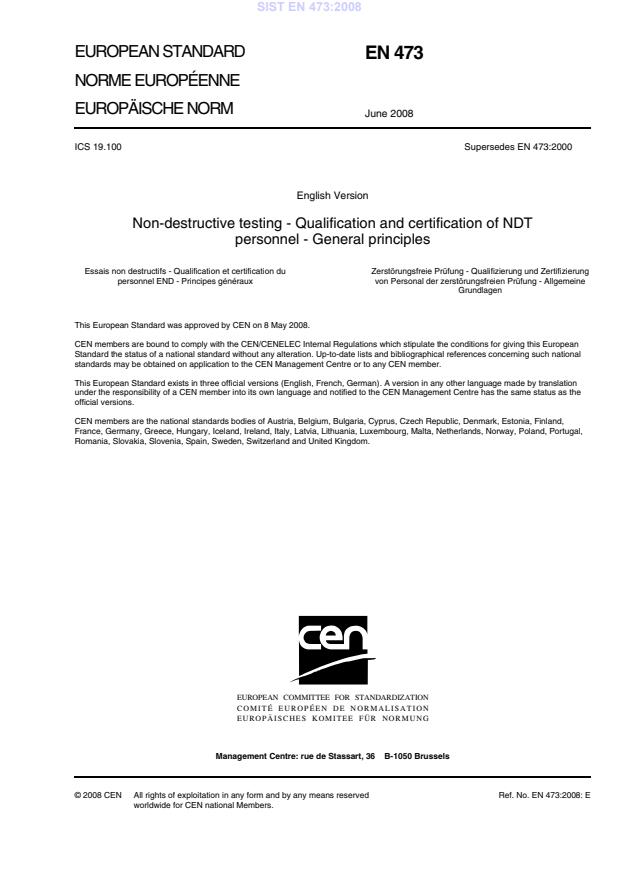
EUROPEAN STANDARDNORME EUROPÉENNEEUROPÄISCHE NORMEN 473June 2008ICS 19.100Supersedes EN 473:2000
English VersionNon-destructive testing - Qualification and certification of NDTpersonnel - General principlesEssais non destructifs - Qualification et certification dupersonnel END - Principes générauxZerstörungsfreie Prüfung - Qualifizierung und Zertifizierungvon Personal der zerstörungsfreien Prüfung - AllgemeineGrundlagenThis European Standard was approved by CEN on 8 May 2008.CEN members are bound to comply with the CEN/CENELEC Internal Regulations which stipulate the conditions for giving this EuropeanStandard the status of a national standard without any alteration. Up-to-date lists and bibliographical references concerning such nationalstandards may be obtained on application to the CEN Management Centre or to any CEN member.This European Standard exists in three official versions (English, French, German). A version in any other language made by translationunder the responsibility of a CEN member into its own language and notified to the CEN Management Centre has the same status as theofficial versions.CEN members are the national standards bodies of Austria, Belgium, Bulgaria, Cyprus, Czech Republic, Denmark, Estonia, Finland,France, Germany, Greece, Hungary, Iceland, Ireland, Italy, Latvia, Lithuania, Luxembourg, Malta, Netherlands, Norway, Poland, Portugal,Romania, Slovakia, Slovenia, Spain, Sweden, Switzerland and United Kingdom.EUROPEAN COMMITTEE FOR STANDARDIZATIONCOMITÉ EUROPÉEN DE NORMALISATIONEUROPÄISCHES KOMITEE FÜR NORMUNGManagement Centre: rue de Stassart, 36
B-1050 Brussels© 2008 CENAll rights of exploitation in any form and by any means reservedworldwide for CEN national Members.Ref. No. EN 473:2008: ESIST EN 473:2008
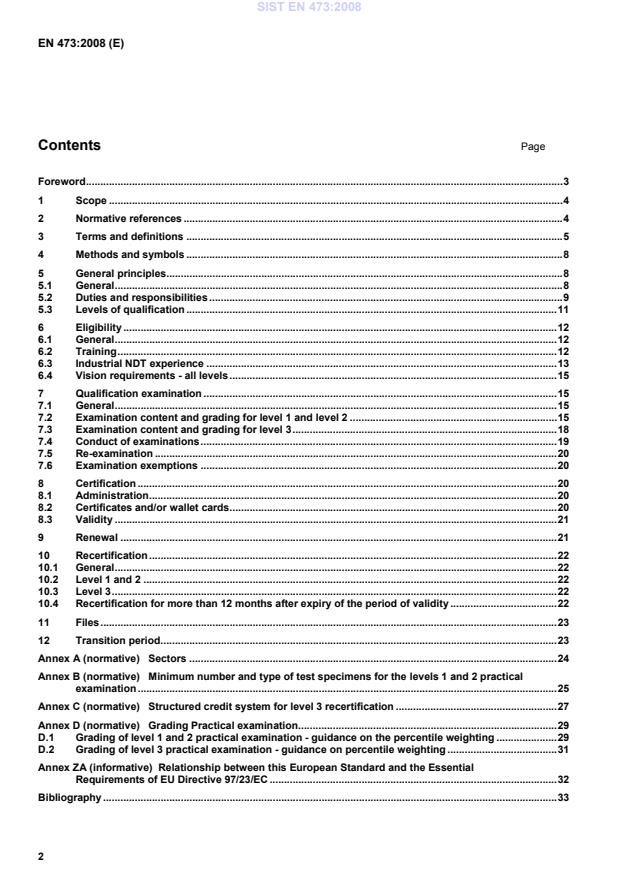
Sectors.24 Annex B (normative)
Minimum number and type of test specimens for the levels 1 and 2 practical examination.25 Annex C (normative)
Structured credit system for level 3 recertification.27 Annex D (normative)
Grading Practical examination.29 D.1 Grading of level 1 and 2 practical examination - guidance on the percentile weighting.29 D.2 Grading of level 3 practical examination - guidance on percentile weighting.31 Annex ZA (informative)
Relationship between this European Standard and the Essential Requirements of EU Directive 97/23/EC.32 Bibliography.33
For relationship with EU Directive(s), see informative Annex ZA, which is an integral part of this standard.
According to the CEN/CENELEC Internal Regulations, the national standards organizations of the following countries are bound to implement this European Standard: Austria, Belgium, Bulgaria, Cyprus, Czech Republic, Denmark, Estonia, Finland, France, Germany, Greece, Hungary, Iceland, Ireland, Italy, Latvia, Lithuania, Luxembourg, Malta, Netherlands, Norway, Poland, Portugal, Romania, Slovakia, Slovenia, Spain, Sweden, Switzerland and the United Kingdom.
2 Normative references The following referenced documents are indispensable for the application of this document. For dated references, only the edition cited applies. For undated references, the latest edition of the referenced document (including any amendments) applies. CEN/TR 14748:2004, Non-destructive testing – Methodology for qualification of non-destructive tests
CEN/TS 15053:2005, Non-destructive testing – Recommendations for discontinuities-types in test specimens for examination EN ISO/IEC 17024:2003, Conformity assessment – General requirements for bodies operating certification of persons (ISO/IEC 17024:2003)
3.2 basic examination written examination, at level 3, which demonstrates the candidate’s knowledge of the materials science and process technology and types of discontinuities, the qualification and certification system according to this European Standard, and the basic principles of NDT methods as required for level 2
NOTE For an explanation of the three levels of qualification, see Subclause 5.3.
3.3 candidate individual seeking qualification and certification who gains experience under the supervision of suitably qualified personnel
3.4 certificate document issued by the certification body under the provisions of this European Standard, indicating that the named person has demonstrated the competence(s) defined on the certificate
3.5 certification procedure used by the certification body to confirm that the qualification requirements for a method, level and sector have been fulfilled, leading to the issuing of a certificate
3.6 certification body body that administers procedures for certification according to the requirements of this European Standard and which fulfils the requirements of EN ISO/IEC 17024
3.7 employer organization for which the candidate works on a regular basis; an employer can also be a candidate at the same time
3.8 examination centre centre approved by the certification body where qualification examinations will be carried out
3.9 examiner person certified to level 3 in the method and product or industrial sector for which he is authorized by the certification body to conduct, supervise and grade the qualification examination
3.10 general examination written examination, at level 1 or 2, concerned with the principles of an NDT method
3.12 invigilator person authorized by the certification body to supervise examinations
3.13 job-specific training training, provided by the employer (or his agent) to the certificate holder in those aspects of non-destructive testing specific to the employer’s products, NDT equipment, NDT procedures, and applicable codes, standards, specifications and procedures, leading to the award of operating authorizations
3.14 main-method examination written examination, at level 3, which demonstrates the candidate’s general and specific knowledge, and the ability to write NDT procedures for the NDT method as applied in the industrial or product sector(s) for which certification is sought
3.15 multiple-choice examination question wording of a question giving rise to four potential replies, only one of which is correct, the remaining three being incorrect or incomplete
3.16 NDT instruction written description of the precise steps to be followed in testing to an established standard, code, specification or NDT procedure
3.17 NDT method discipline applying a physical principle in non-destructive testing
EXAMPLE Ultrasonic testing.
3.18 NDT procedure written description of all essential parameters and precautions to be applied when non-destructively testing products in accordance with standard(s), code(s) or specification(s)
3.19 NDT technique specific way of utilizing an NDT method
EXAMPLE Immersion ultrasonic testing.
3.20 NDT training process of instruction in theory and practice in the NDT method in which certification is sought, which takes the form of training courses to a syllabus approved by the certification body
3.21 operating authorization written statement issued by the employer, based upon the scope of certification, authorizing the individual to carry out defined tasks
NOTE Such authorization can be dependent on the provision of job-specific training.
3.22 practical examination assessment of practical skills, in which the candidate demonstrates familiarity with, and the ability to perform, SIST EN 473:2008
3.23 qualification demonstration of physical attributes, knowledge, skill, training and experience required to properly perform NDT tasks
3.24 qualification examination examination, administered by the certification body or the authorized qualifying body, which assesses the general, specific and practical knowledge and the skill of the candidate
3.25 qualified supervision supervision of candidates gaining experience by NDT personnel certified to this European Standard or by non-certified personnel who, in the opinion of the certification body, possess the knowledge, skill, training and experience required to properly perform such supervision
3.26 sector particular section of industry or technology where specialized NDT practices are used, requiring specific product-related knowledge, skill, equipment or training
NOTE A sector can be interpreted to mean a product (welded products, castings) or an industry (aerospace, in-service testing). See Annex A.
3.27 significant interruption absence or change of activity which prevents the certified individual from practising the duties corresponding to the level in the method and the sector(s) within the certified scope, for either a continuous period in excess of one year or two or more periods for a total time exceeding two years
NOTE Legal holidays or periods of sickness or courses of less than thirty days are not taken into account when calculating the interruption.
3.28 specific examination written examination, at level 1 or 2, concerned with testing techniques applied in a particular sector(s), including knowledge of the product(s) tested and of codes, standards, specifications, procedures and acceptance criteria
3.29 specification document stating requirements 3.30 specimen sample used in practical examinations, possibly including radiographs and data sets, which is representative of products typically tested in the applicable sector
NOTE It can include more than one area or volume to be tested.
3.31 specimen master report model answer, indicating the optimum result for a practical examination given a defined set of conditions (equipment type, settings, technique, specimen, etc.) against which the candidate’s test report will be graded SIST EN 473:2008
3.32 supervision act of directing the application of NDT performed by other NDT personnel, which includes the control of actions involved in the preparation of the test, performance of the test and reporting of the results
3.33 validation act of demonstrating that a verified procedure will work in practice and fulfil its intended function, normally achieved by actual witnessing, demonstration, field or laboratory tests or selected trials 4 Methods and symbols
For the purposes of this European Standard, the following symbols are used to identify the NDT methods.
Table 1 – Methods and symbols NDT Method Symbol Acoustic emission testing AT Eddy current testing ET Leak testing LT Magnetic particle testing MT Penetrant testing PT Radiographic testing RT Ultrasonic testing UT Visual testing VT 5 General principles 5.1 General The certification system, which shall be controlled and administered by a certification body (with the assistance, where necessary, of authorized qualifying bodies), includes all procedures necessary to demonstrate the qualification of an individual to carry out tasks in a specific NDT method and product or industrial sector, leading to certification of competence. 5.1.1 The certification body shall fulfil the requirements of EN ISO/IEC 17024. 5.1.2 Where established, the authorised qualifying body shall: a) work under the control of the certification body; b) have the resources needed to administer examinations at examination centres, including the calibration and control of equipment; c) prepare and supervise examinations under the responsibility of an examiner authorised by the certification body; d) be independent of any single predominant interest; e) apply a documented quality management system approved by the certification body; f) have the resources and expertise necessary to establish examination centres; g) ensure that test specimens are not in use for training purposes. SIST EN 473:2008
5.1.3 The examination centre shall: a) work under the control of the certification body or authorised qualifying body; b) apply a documented quality procedure approved by the certification body; c) have the resources needed to administer examinations, including the calibration and control of equipment; d) prepare and conduct examinations under responsibility of an examiner authorised by the certification body; e) ensure that test specimens are not in use for training purposes. 5.2 Duties and responsibilities 5.2.1 Certification body The certification body: a) shall initiate, promote, maintain and administer the certification scheme according to EN ISO/IEC 17024 and this European Standard; b) may delegate, under its direct responsibility, the detailed administration of qualification to authorised qualifying bodies, to which it should issue specifications and/or quality procedures covering facilities, personnel, calibration and control of NDT equipment, examination materials, specimens, conduct of examinations, examination grading, records, etc; c) shall approve properly staffed and equipped examination centres which it shall monitor on a periodic basis; d) shall establish an appropriate system for the maintenance of records, which shall be retained for at least one certification cycle (10 years); e) shall be responsible for the issue of all certificates; f) shall be responsible for the definition of sectors (see Annex A); g) shall ensure that test specimens are not in use for training purposes; h) shall monitor, in accordance with a documented procedure, all delegated functions; i) shall require all candidates and certificate holders to give a signed undertaking to abide by a code of ethics which it shall develop for the purpose and publish. 5.2.2 Authorised qualifying bodies 5.2.2.1 Where established, authorised qualifying bodies shall: a) work under the control of and, where applicable, apply the specifications issued by the certification body; b) work within a documented quality management system approved by the certification body; c) have the resources needed to prepare, supervise and administer examinations under the responsibility of an examiner authorised by the certification body at examination centres established for the purpose; d) maintain appropriate qualification and examination records according to the requirements of the certification body.
d) maintain appropriate qualification and examination records according to the requirements of the certification body. 5.2.4 Employer 5.2.4.1 The employer shall introduce the candidate to the certification body or the authorised qualifying body and document the validity of the personal information provided, including the declaration of education, training and experience required for the eligibility of the candidate, but shall not be directly involved in the qualification examination. 5.2.4.2 With regard to certificated persons, the employer shall be responsible for: a) providing job-specific training, if necessary; b) issuing the written operating authorisation; c) verifying annually the NDT employee’s visual acuity in accordance with 6.4, and d) verifying continuity in the application of the NDT method without significant interruption. It is recommended that these responsibilities be described in a documented procedure.
5.2.4.3 A self employed individual shall assume all responsibilities ascribed to the employer. 5.2.5 Candidate Candidates, either employed or unemployed shall: a) provide documentary evidence of satisfactory completion of a course of training approved by the Certification Body; b) provide verifiable documentary evidence that the required experience has been gained under qualified supervision; c) provide documentary evidence of vision satisfying the requirements of 6.4; d) undertake to abide by a code of ethics published by the certification body for candidates and certificates holders. SIST EN 473:2008
5.3.1.2 Level 1 certificated personnel shall not be responsible for the choice of test method or technique to be used, nor for the assessment of test results.
5.3.2 Level 2 An individual certificated to level 2 has demonstrated competence to perform non-destructive testing according to established or recognised procedures. Within the scope of the competence defined on the certificate, level 2 personnel may be authorised by the employer to: a) select the NDT technique for the testing method to be used; b) define the limitations of application of the testing method; c) translate NDT standards and specifications into NDT instructions; d) set up and verify equipment settings; e) perform and supervise tests; f) interpret and evaluate results according to applicable standards, codes or specifications; g) prepare written NDT instructions; h) carry out and supervise all tasks at or below level 2; i) provide guidance for personnel at or below level 2, and j) organise and report the results of non-destructive tests. SIST EN 473:2008
f) provide guidance for NDT personnel at all levels.
5.3.3.2 Level 3 personnel have demonstrated: a) the competence to evaluate and interpret results in terms of existing standards, codes and specifications; b) sufficient practical knowledge of applicable materials, fabrication and product technology to select NDT methods, establish NDT techniques, and assist in establishing acceptance criteria where none are otherwise available; and c) a general familiarity with other NDT methods. 6 Eligibility
6.1 General The candidate shall fulfil the minimum requirements of vision and training prior to the qualification examination and shall fulfil the minimum requirements for industrial experience prior to certification. 6.2 Training The candidate shall provide documentary evidence that he has satisfactorily completed a course of training, in the method and level for which the certification is sought, which is in accordance with the syllabus content of CEN ISO/TR 25107 [1]. For candidates seeking certification in more than one method (e.g. VT, MT, PT) or already certificated and seeking further certification, when the training syllabus duplicates certain aspects (e.g. product technology) the certification body can accept reduction of the total number of training hours for these methods (e.g. VT, PT, MT) in line with the training syllabuses CEN ISO/TR 25107 [1]. It is recommended that the NDT personnel training organisations follow the guidelines given in CEN ISO/TR 25108 [2]. The minimum duration of training undertaken by the candidate for certification shall be as defined in Table 2 for the applicable NDT method.
This duration is based upon candidates possessing adequate mathematical skills and prior knowledge of materials and processes. Training hours include both practical and theory courses. SIST EN 473:2008
Table 2 - Minimum training requirements
6.3 Industrial NDT experience 6.3.1 General In the event that a part of the experience is sought following successful examination, the results of the examination shall remain valid for two years. Documentary evidence of experience shall be confirmed by the employer and submitted to the certification body or authorised qualifying body. 6.3.2 Level 1 and level 2 The minimum period of experience to be gained in the appropriate sector prior to examination may be defined by certification body (a fraction or percentage of the total requirement of Table 3). The appropriate sector is the sector where the candidate is seeking certification.
NDT Method Level 1 (hours) b e g Level 2 (hours) a b e g Level 3 (hours) e g AT 64 64 48 ET 40 40 40 A - Basic knowledge 8 8 8 B - Pressure method 16 24 24 c, d LT C - Tracer gas method 16 32 32 c, d MT 16 24 32 PT 16 24 24 RT 72 80 f 72 c, d UT 64 80 72 c, d
VT 16 24 24 Basic knowledge (direct access to level 3) - - 80 a Direct access to level 2 examination requires the total hours shown for level 1 and level 2. b Training duration may be reduced by up to 50 % when the certification sought is limited: - in application (e.g. automated ET, MT, UT of bar, tube and rod, or normal beam ultrasonic thickness and lamination testing of rolled steel plate); - in technique (e.g. RT using only Radioscopy); - for RT and UT, level 1, in only one product sector. c Training duration may be reduced by up to 50 % when the candidate is a certified level 2 in the method. d Up to 50 % of the required training duration may be acquired by practical training agreed by the certification body. e A reduction of up to 50 % in the total required number of training hours may be accepted by the Certification Body for candidates who have graduated from technical college or university, or have completed at least two years of engineering or science study at college or university. f When certification is restricted to the film interpretation and to only one product sector, a minimum training requirement of 56 h applies for direct access. Footnote a is not applicable. g Maximum reduction may be 50 %.
AT 3 9 18 ET 3 9 18 Total experience 3 9 18 Partial experience for pressure method only 3 9 18 LT Partial experience for tracer gas method only 3 9 18 MT 1 3 12 PT 1 3 12 RT 3 9 18 UT 3 9 18 VT 1 3 12 a Work experience in months is based on a nominal 40 hours/week or the legal week of work. When an individual is working in excess of 40 hours per week, he may be credited with experience based on the total hours, but he shall be required to produce evidence of this experience. b For level 2 certification, the intent of this European Standard is that work experience consists of time as a level 1. If the individual is being qualified directly to level 2, with no time at level 1, the experience shall consist of the sum of the times required for level 1 and level 2. c Experience duration may be reduced by up to 50 % but shall not be less than one month when the certification sought is limited in application (e.g. automated testing). d Credit for work experience may be gained simultaneously in two or more of the NDT methods covered by this European Standard, with the reduction of total required experience as follows: - two testing methods - reduction of total required time by 25 %; - three testing methods - reduction of total required time by 33 %; - four or more testing methods - reduction of total required
time by 50 %. In all cases the candidate shall be required to show that for each of the testing methods for which he seeks certification, he has at least half of the time required in Table 3. e Up to 50 % of the practical experience time may be achieved by an appropriate practical course, the duration of which may be weighted by a maximum factor of five (5). This procedure shall not be used in conjunction with that described in c. The course shall be concentrated on practical solutions of frequently occurring testing problems, and the programme shall be approved by the certification body or the authorised qualifying body. f Maximum reduction may be 50 % g For level 3 certification, the intent of this European Standard is that work experience consists of time as a level 2. If the individual is being qualified directly to level 3, with no time at level 2, the experience shall consist of the sum of the times required for level 2 and level 3. No reduction in the period of experience specified above shall be allowed. h These values assume that candidates have successfully completed a technical school or at least two years of engineering or science study at an accredited college or university. In the event that this is not the case, the duration has to be multiplied by a factor of 2.
6.3.3 Level 3 Level 3 responsibilities require knowledge beyond the technical scope of any specific NDT method. This broad knowledge may be acquired through a variety of combinations of education, training and experience. Table 3 (see footnote h) details minimum experience related to formal education.
7.2 Examination content and grading for level 1 and level 2 The written tests of the "general" and "specific" examinations are assessed by comparing the replies given by the candidate against answer keys approved by the certification body. Each correct reply scores 1 point and the mark attributed to the test is equal to the sum of points obtained. For the final calculation, the mark of each test is expressed as a percentage. 7.2.1 General examination 7.2.1.1 The general examination shall include only questions selected in an unpredictable way from the Certification Body's or authorised qualifying body’s collection of basic knowledge questions valid at the date of examination. The candidate shall be required, as a minimum, to give answers to the number of multiple choice questions shown in Table 4. 7.2.1.2 The time allowed to the candidates for completion of each examination shall be based upon the number and difficulty of the questions. The average time allowed shall be no less than one minute nor longer than two minutes per multiple choice question. 7.2.1.3 Where not otherwise addressed by national regulations, there shall be an additional examination on radiation safety for the radiographic test method. 7.2.1.4 Examinations on the radiographic test method may include either X- or gamma-radiation, or both, depending upon the procedure of the Certification Body.
NDT method
Number of questions AT, ET, RT, UT 40
LT, MT, PT, VT 30
7.2.2 Specific examination 7.2.2.1 The specific examination shall include only questions selected from the certification body's or authorised qualifying body’s current collection of specific questions related to the sector(s) concerned. 7.2.2.2 The time allowed to the candidates for completion of each examination shall be based upon the number and difficulty of the questions. The average time allowed for multiple choice questions shall be no longer than three minutes per question. The average time allowed for individual answers shall be determined by the certification body. 7.2.2.3 During the specific examination, the candidate shall be required to give answers to at least 20 multiple-choice questions, including questions involving calculations, written procedures and questions on codes, standards and specifications. 7.2.2.4 If the specific examination covers two or more sectors, the minimum number of questions shall be at least 30, evenly spread between the sectors concerned. 7.2.3 Practical examination 7.2.3.1 The practical examination shall involve applying the test to prescribed test specimens, recording (and, for level 2 candidates, interpreting) the resulting information to the degree required, and reporting the results in the required format. Specimens used for training purposes shall not be used for examination. 7.2.3.2 Each test specimen shall be uniquely identified and have a master report which includes all of the equipment settings used to detect specified discontinuities contained within the specimen. The master report shall be compiled based upon at least two independent tests, and shall be validated by an authorised level 3 certificate holder for use in grading examinations. The independent test reports from which the master report is compiled shall be retained as records. 7.2.3.3 Test specimens shall contain discontinuities characteristic of those which occur during manufacturing or in service. They may be natural, artificial or implanted. For RT, the test specimen need not contain discontinuities since these will be exhibited in the radiographs for interpretation. Each test specimen introduced following the publication of this European Standard shall contain one or more discontinuities defined in CEN/TS 15053. 7.2.3.4 The requirements for the number of specimens to be tested in the levels 1 and 2 practical examinations are given in Annex B. 7.2.3.5 The level 1 candidate shall follow the NDT instruction(s) provided by the examiner. 7.2.3.6 The level 2 candidate shall select the applicable NDT technique and determine the operating conditions related to a given code, standard, or specification. SIST EN 473:2008
20 % 10 % 2 The application of NDT to the test specimen. This consists of the following parts: a) for level 2, selection of the techniques and determination of the operating conditions; b) the preparation (surface condition) and visual examination of the test piece; c) the setting up of the apparatus; d) the performance of the test; and e) the operations after the test.
35 % 20 % 3 The detection and reporting of the discontinuities and, for level 2, their characterisation (position, orientation, dimensions and type) and evaluation.
45 % 55 % 4 For level 2, the written instruction for level 1.
-- 15 %
7.2.4.4 To be eligible for certification the candidate shall obtain a minimum grade of 70 % in each part of the examination (general
...