


EN 13814-1:2019
(Main)Safety of amusement rides and amusement devices - Part 1: Design and manufacture
Safety of amusement rides and amusement devices - Part 1: Design and manufacture
This document specifies the minimum requirements necessary to ensure the safe design, calculation, manufacture, and installation of mobile, temporary or permanently installed machinery and structures which are intended for use by persons as a leisure activity, e.g. roundabouts, swings, boats, ferris wheels, roller coasters, chutes, booths, side shows, and structures for artistic aerial displays. The above items are hereafter called amusement devices, which are intended to be installed both repeatedly without degradation or loss of integrity, and temporarily or permanently in fairgrounds and amusement parks or any other locations. Grandstands, construction site installations, scaffolding, removable agricultural structures, simple coin operated children's amusement devices, carrying up to three children, and recreational devices like waterslides or summer toboggan runs, playground equipment, rope courses, climbing wall, inflatable, trampolines, swimming pool equipment (this list is not exhaustive) are not covered by this document.
For all the equipment not covered by the requirements of EN 13814-1, the relevant standards apply.
Nevertheless this document can be used in the design of any similar structural or passenger carrying amusement device not explicitly mentioned herein.
In terms of workers’ health and safety, national regulations apply.
This document is applicable to manufacturing and major modification of amusement devices and rides for designs after the effective date of publication.
Sicherheit von Fahrgeschäften und Vergnügungseinrichtungen - Teil 1: Konstruktion, Bemessung und Herstellung
Dieses Dokument legt grundlegende Anforderungen fest, um die Sicherheit bezüglich Entwurf, Berechnung, Herstellung und Aufstellung von mobilen, vorübergehend oder dauerhaft installierten Vergnügungsanlagen, die für den Gebrauch durch Personen als Freizeitbeschäftigung vorgesehen sind, wie z. B. Karusselle, Schaukeln, Boote, Riesenräder, Achterbahnen, Rutschen, Buden, Schaugeschäfte und Aufbauten für artistische Vorstellungen, sicherzustellen. Im Folgenden Vergnügungsanlagen, Fahrgeschäfte oder Fliegende Bauten genannt, sind diese sowohl zu einem wiederholten Aufbau ohne Substanzverlust als auch vorübergehend oder dauerhaft auf Veranstaltungsplätzen, in Vergnügungsparks oder anderen Örtlichkeiten vorgesehen. Feste Tribünen, Bau und andere Gerüste sowie entfernbare landwirtschaftliche Konstruktionen und einfache münz¬betriebene Vergnügungsanlagen für Kinder, die bis zu drei Kinder tragen sowie Sport und Freizeitanlagen, wie Wasserrutschen oder Sommerrodelbahnen, Spielplatzgeräte, Seilgärten, Kletterwände, Hüpfburgen, Trampoline, Schwimmbadgeräte (diese Liste ist nicht vollständig) sind nicht Gegenstand dieses Dokumentes.
Für alle Einrichtungen, die nicht von den Anforderungen nach EN 13814 1 behandelt werden, gelten die entsprechenden Normen.
Dieses Dokument kann auch für den Entwurf ähnlicher Bauten oder fahrgastbefördernder Vergnügungsanlagen verwendet werden, selbst wenn diese hier nicht explizit erwähnt sind.
Für Belange des Arbeits und Gesundheitsschutzes gelten nationale Vorschriften.
Dieses Dokument gilt für die Herstellung und für größere Modifikationen von Vergnügungsanlagen und Fahrgeschäften, deren Entwurf nach dem Zeitpunkt der Veröffentlichung dieses Dokumentes datiert.
Sécurité des manèges et des dispositifs de divertissement - Partie 1 : Conception et fabrication
Le présent document spécifie les exigences minimales nécessaires pour garantir la conception, les calculs, la fabrication et l’installation en toute sécurité de machines et structures mobiles, temporaires ou installées de manière permanente qui sont destinées à être utilisées par des personnes comme activités de loisirs, par exemple les manèges circulaires, les balançoires, les embarcations, les grandes roues, les montagnes russes, les toboggans, les baraques, les attractions en baraque et les structures pour démonstrations aériennes artistiques. Les dispositifs énumérés ci-dessus, appelés ci-après « dispositifs de divertissement », sont destinés à être installés de manière répétitive sans dégradation ni perte d’intégrité, que ce soit temporairement ou définitivement, dans des fêtes foraines, des parcs d’attraction ou d’autres emplacements. Les tribunes, les installations des chantiers de construction, les échafaudages et les structures agricoles amovibles, les dispositifs de divertissement pour enfants actionnés par un simple jeton ne transportant pas plus de trois enfants, ainsi que les dispositifs de divertissement comme les toboggans aquatiques ou les pistes de luge d’été, les équipements pour aires de jeux, les parcours accrobranches, les murs d’escalade, les équipements gonflables, les trampolines, les équipements de piscine (cette liste n’est pas exhaustive) ne sont pas couverts par le présent document.
Pour tous les équipements non couverts par les exigences de l’EN 13814 1, les normes pertinentes s’appliquent.
Néanmoins, le présent document peut être utilisé pour la conception de tout dispositif de divertissement structural ou de transport de passagers similaire non mentionné explicitement dans le présent document.
En matière de santé et de sécurité des ouvriers, les réglementations nationales s’appliquent.
Le présent document s’applique à la fabrication et à la modification majeure de manèges et dispositifs de divertissement pour des conceptions après la date effective de publication.
Varnost naprav in opreme v zabaviščnih parkih - 1. del: Načrtovanje in izdelava
Ta dokument določa minimalne zahteve, ki so nujne za zagotavljanje varnega načrtovanja, izračunavanja, izdelovanja in nameščanja mobilnih, začasnih ali stalno nameščenih strojev in konstrukcij, ki so namenjene za prostočasne dejavnosti ljudi, na primer vrtiljaki, gugalnice, ladje, razgledna kolesa, vlakci, žlebovi, tribune, membrane ali tekstilne strukture, kabine, odri, stranski odri in konstrukcije za umetniške zračne predstave. Zgoraj omenjene konstrukcije so v nadaljevanju imenovane oprema v zabaviščnih parkih, ki je namenjena tako za večkratno nameščanje brez degradacije ali zmanjšane neokrnjenosti kot tudi za začasno ali stalno nameščanje v zabaviščih in zabaviščnih parkih ali na kateri koli drugi lokaciji. Fiksna stojišča, gradbiščne konstrukcije, odri, odstranljive kmetijske konstrukcije in preproste naprave na kovance v zabaviščnih parkih, ki so namenjene za največ tri otroke, niso zajeti v tem dokumentu.
Kljub temu se lahko ta dokument uporabi pri načrtovanju katere koli podobne konstrukcije ali nosilne naprave, ki tu ni izrecno omenjena.
Ta dokument ne obravnava obstoječih nacionalnih pravil o varnosti delavcev.
Ta dokument se uporablja za izdelavo ter večje spremembe naprav in opreme v zabaviščnih parkih, ki je izdelana po načrtih po objavi tega standarda.
Ta standard se ne uporablja za izdelavo že obstoječih načrtov, pripravljenih v skladu s standardom EN 13814:2004, za obdobje 5 let po izdaji tega standarda.
Standard prEN 13814-3:2016 vsebuje zahteve za nadzor med načrtovanjem, izdelavo, delovanjem in uporabo.
General Information
- Status
- Withdrawn
- Publication Date
- 28-May-2019
- Withdrawal Date
- 13-Apr-2025
- Technical Committee
- CEN/TC 152 - Fairground and amusement park machinery and structures - Safety
- Drafting Committee
- CEN/TC 152/WG 1 - Rides
- Current Stage
- 9060 - Closure of 2 Year Review Enquiry - Review Enquiry
- Start Date
- 02-Dec-2024
- Completion Date
- 02-Dec-2024
Relations
- Effective Date
- 08-Jun-2022
- Effective Date
- 22-May-2024
- Effective Date
- 31-Aug-2022
Overview
EN 13814-1:2019 - Safety of amusement rides and amusement devices, Part 1: Design and manufacture - defines minimum safety requirements for the safe design, calculation, manufacture and installation of mobile, temporary or permanently installed amusement machinery and structures. It covers common attractions such as roundabouts, swings, boats, ferris wheels, roller coasters, chutes, booths, side shows and structures for artistic aerial displays. The standard applies to new designs and major modifications after its publication date. Items explicitly excluded (and covered by other standards) include grandstands, scaffolding, simple coin‑operated children’s devices for up to three children, waterslides, summer toboggan runs, playground equipment, rope courses, climbing walls, inflatables, trampolines and swimming‑pool equipment.
Key topics and technical requirements
EN 13814-1:2019 focuses on practical engineering and safety controls across the product lifecycle. Key areas include:
- Design documentation and risk assessment - requirements for design files, operation descriptions and documented design risk assessments.
- Materials selection - guidance on steels, aluminium, timber, composites, concrete, and fasteners appropriate for passenger‑carrying amusement devices.
- Design loads and load combinations - defines permanent, variable and seismic actions and applicable coefficients for structural calculations.
- Structural analysis and verification - principles for static and dynamic analysis, strength verification, fatigue and bolt design, and special rules for rail‑guided or track‑bound devices.
- Stability and ground anchorage - checking overturning, sliding, lifting and anchor design/testing for temporary and permanent installations.
- Mechanical, hydraulic and electrical systems - functional safety expectations for control systems, hydraulics/pneumatics and Annex A on electrical equipment and protection.
- Manufacture, quality assurance and supply - manufacturer responsibilities, quality plans, production controls, safety precautions and required manuals/drawings.
- Documentation and traceability - requirements for an amusement device log, official technical dossier and identification/marking.
Practical applications - who uses this standard
EN 13814-1:2019 is used by:
- Designers and structural, mechanical and electrical engineers developing amusement devices.
- Manufacturers and fabricators implementing quality plans and production controls to meet safety requirements.
- Installation teams and contractors responsible for anchorage, erection and commissioning.
- Park operators, safety managers and maintenance teams using the device log, manuals and technical dossiers.
- Regulators, notified bodies and inspectors assessing conformity and safety during manufacture, installation and major modification.
Related standards and compliance notes
- For equipment and features explicitly excluded from this document, consult the relevant national or international standards that apply.
- To apply EN 13814-1:2019 in practice, obtain the full standard from the national standards body and integrate it with applicable national health & safety regulations and conformity assessment procedures.
Keywords: EN 13814-1:2019, safety of amusement rides, design and manufacture standard, amusement device safety requirements, structural analysis, risk assessment, amusement park equipment.

Frequently Asked Questions
EN 13814-1:2019 is a standard published by the European Committee for Standardization (CEN). Its full title is "Safety of amusement rides and amusement devices - Part 1: Design and manufacture". This standard covers: This document specifies the minimum requirements necessary to ensure the safe design, calculation, manufacture, and installation of mobile, temporary or permanently installed machinery and structures which are intended for use by persons as a leisure activity, e.g. roundabouts, swings, boats, ferris wheels, roller coasters, chutes, booths, side shows, and structures for artistic aerial displays. The above items are hereafter called amusement devices, which are intended to be installed both repeatedly without degradation or loss of integrity, and temporarily or permanently in fairgrounds and amusement parks or any other locations. Grandstands, construction site installations, scaffolding, removable agricultural structures, simple coin operated children's amusement devices, carrying up to three children, and recreational devices like waterslides or summer toboggan runs, playground equipment, rope courses, climbing wall, inflatable, trampolines, swimming pool equipment (this list is not exhaustive) are not covered by this document. For all the equipment not covered by the requirements of EN 13814-1, the relevant standards apply. Nevertheless this document can be used in the design of any similar structural or passenger carrying amusement device not explicitly mentioned herein. In terms of workers’ health and safety, national regulations apply. This document is applicable to manufacturing and major modification of amusement devices and rides for designs after the effective date of publication.
This document specifies the minimum requirements necessary to ensure the safe design, calculation, manufacture, and installation of mobile, temporary or permanently installed machinery and structures which are intended for use by persons as a leisure activity, e.g. roundabouts, swings, boats, ferris wheels, roller coasters, chutes, booths, side shows, and structures for artistic aerial displays. The above items are hereafter called amusement devices, which are intended to be installed both repeatedly without degradation or loss of integrity, and temporarily or permanently in fairgrounds and amusement parks or any other locations. Grandstands, construction site installations, scaffolding, removable agricultural structures, simple coin operated children's amusement devices, carrying up to three children, and recreational devices like waterslides or summer toboggan runs, playground equipment, rope courses, climbing wall, inflatable, trampolines, swimming pool equipment (this list is not exhaustive) are not covered by this document. For all the equipment not covered by the requirements of EN 13814-1, the relevant standards apply. Nevertheless this document can be used in the design of any similar structural or passenger carrying amusement device not explicitly mentioned herein. In terms of workers’ health and safety, national regulations apply. This document is applicable to manufacturing and major modification of amusement devices and rides for designs after the effective date of publication.
EN 13814-1:2019 is classified under the following ICS (International Classification for Standards) categories: 91.040.99 - Other buildings; 97.200.40 - Playgrounds; 97.200.99 - Other equipment for entertainment. The ICS classification helps identify the subject area and facilitates finding related standards.
EN 13814-1:2019 has the following relationships with other standards: It is inter standard links to EN 13814:2004, EN 13814-1:2019+A1:2024, EN 13814-1:2019/prA1. Understanding these relationships helps ensure you are using the most current and applicable version of the standard.
You can purchase EN 13814-1:2019 directly from iTeh Standards. The document is available in PDF format and is delivered instantly after payment. Add the standard to your cart and complete the secure checkout process. iTeh Standards is an authorized distributor of CEN standards.
Standards Content (Sample)
SLOVENSKI STANDARD
01-september-2019
Nadomešča:
SIST EN 13814:2005
Varnost naprav in opreme v zabaviščnih parkih - 1. del: Načrtovanje in izdelava
Safety of amusement rides and amusement devices - Part 1: Design and manufacture
Sicherheit von Fahrgeschäften und Vergnügungseinrichtungen - Teil 1: Konstruktion,
Bemessung und Herstellung
Sécurité des manèges et des dispositifs de divertissement - Partie 1: Conception et
fabrication
Ta slovenski standard je istoveten z: EN 13814-1:2019
ICS:
97.200.40 Igrišča Playgrounds
2003-01.Slovenski inštitut za standardizacijo. Razmnoževanje celote ali delov tega standarda ni dovoljeno.
EN 13814-1
EUROPEAN STANDARD
NORME EUROPÉENNE
May 2019
EUROPÄISCHE NORM
ICS 97.200.40 Supersedes EN 13814:2004
English Version
Safety of amusement rides and amusement devices - Part
1: Design and manufacture
Sécurité des manèges et des dispositifs de Sicherheit von Fahrgeschäften und
divertissement - Partie 1: Conception et fabrication Vergnügungseinrichtungen - Teil 1: Konstruktion,
Bemessung und Herstellung
This European Standard was approved by CEN on 13 May 2018.
CEN members are bound to comply with the CEN/CENELEC Internal Regulations which stipulate the conditions for giving this
European Standard the status of a national standard without any alteration. Up-to-date lists and bibliographical references
concerning such national standards may be obtained on application to the CEN-CENELEC Management Centre or to any CEN
member.
This European Standard exists in three official versions (English, French, German). A version in any other language made by
translation under the responsibility of a CEN member into its own language and notified to the CEN-CENELEC Management
Centre has the same status as the official versions.
CEN members are the national standards bodies of Austria, Belgium, Bulgaria, Croatia, Cyprus, Czech Republic, Denmark, Estonia,
Finland, Former Yugoslav Republic of Macedonia, France, Germany, Greece, Hungary, Iceland, Ireland, Italy, Latvia, Lithuania,
Luxembourg, Malta, Netherlands, Norway, Poland, Portugal, Romania, Serbia, Slovakia, Slovenia, Spain, Sweden, Switzerland,
Turkey and United Kingdom.
EUROPEAN COMMITTEE FOR STANDARDIZATION
COMITÉ EUROPÉEN DE NORMALISATION
EUROPÄISCHES KOMITEE FÜR NORMUNG
CEN-CENELEC Management Centre: Rue de la Science 23, B-1040 Brussels
© 2019 CEN All rights of exploitation in any form and by any means reserved Ref. No. EN 13814-1:2019 E
worldwide for CEN national Members.
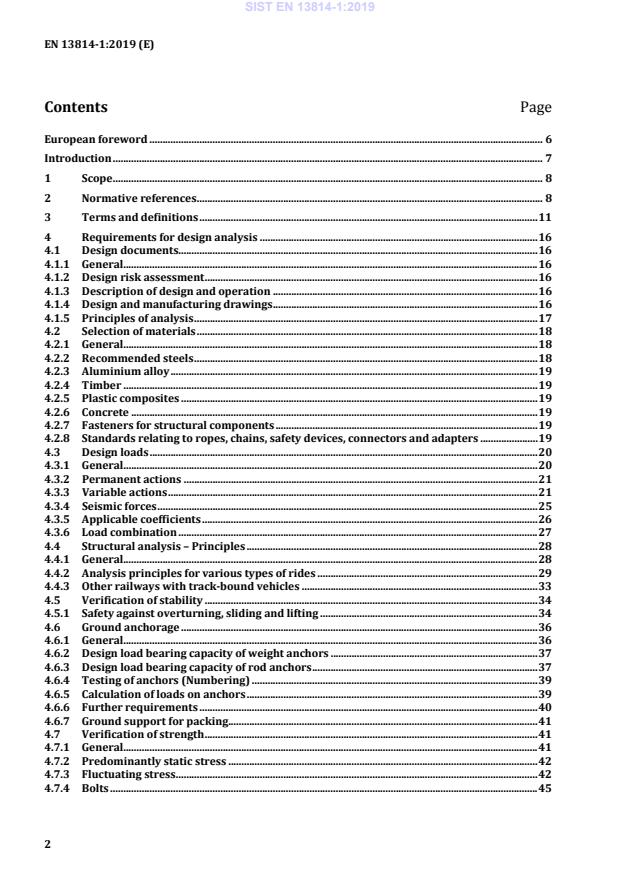
Contents Page
European foreword . 6
Introduction . 7
1 Scope . 8
2 Normative references . 8
3 Terms and definitions . 11
4 Requirements for design analysis . 16
4.1 Design documents. 16
4.1.1 General. 16
4.1.2 Design risk assessment . 16
4.1.3 Description of design and operation . 16
4.1.4 Design and manufacturing drawings . 16
4.1.5 Principles of analysis . 17
4.2 Selection of materials . 18
4.2.1 General. 18
4.2.2 Recommended steels . 18
4.2.3 Aluminium alloy . 19
4.2.4 Timber . 19
4.2.5 Plastic composites . 19
4.2.6 Concrete . 19
4.2.7 Fasteners for structural components . 19
4.2.8 Standards relating to ropes, chains, safety devices, connectors and adapters . 19
4.3 Design loads . 20
4.3.1 General. 20
4.3.2 Permanent actions . 21
4.3.3 Variable actions . 21
4.3.4 Seismic forces . 25
4.3.5 Applicable coefficients . 26
4.3.6 Load combination . 27
4.4 Structural analysis – Principles . 28
4.4.1 General. 28
4.4.2 Analysis principles for various types of rides . 29
4.4.3 Other railways with track-bound vehicles . 33
4.5 Verification of stability . 34
4.5.1 Safety against overturning, sliding and lifting . 34
4.6 Ground anchorage . 36
4.6.1 General. 36
4.6.2 Design load bearing capacity of weight anchors . 37
4.6.3 Design load bearing capacity of rod anchors . 37
4.6.4 Testing of anchors (Numbering) . 39
4.6.5 Calculation of loads on anchors . 39
4.6.6 Further requirements . 40
4.6.7 Ground support for packing . 41
4.7 Verification of strength . 41
4.7.1 General. 41
4.7.2 Predominantly static stress . 42
4.7.3 Fluctuating stress . 42
4.7.4 Bolts . 45
4.7.5 Ropes, chains, safety devices, connectors and adapters . 47
4.8 Structural design and construction . 49
4.8.1 Arrangement, accessibility. 49
4.8.2 Locking and safety devices for fasteners . 49
4.8.3 Joints intended for regular dismantling . 49
4.8.4 Designing of components subject to fluctuating loads . 50
4.8.5 Supports . 50
4.8.6 Central masts . 50
4.8.7 Prevention of corrosion and rot . 50
5 Requirements for design and manufacture of rides and structures . 50
5.1 Risk reduction by prevailing design and safety measures . 50
5.1.1 General . 50
5.1.2 Risk assessment . 51
5.1.3 Risk reduction for platforms, ramps, floors, stairs and walkways . 52
5.1.4 Risk reduction by the use of barriers, fencing and guarding . 56
5.1.5 Guarding of machinery parts. 60
5.1.6 Risk reduction in the case of access and egress . 60
5.1.7 Risk reduction for passengers units . 62
5.1.8 Requirements by special provisions . 74
5.2 Supplementary safety requirements for various types of amusement device . 75
5.2.1 Amusement rides with vertical axis . 75
5.2.2 Amusement rides with horizontal axis . 77
5.2.3 Rail-guided channel or track-bound amusement devices . 79
5.2.4 Dodgem cars/Bumper cars . 81
5.2.5 Speedways/Go-karts . 86
5.2.6 Mini-motorbikes for children . 86
5.2.7 Boat rides . 87
5.2.8 Flume rides . 88
5.2.9 Helter skelters, slides, etc . 89
5.2.10 Side shows, booths, win-a-prize and sales stands, mazes, halls of mirrors, fun houses,
labyrinths, hammers, ring the bell and similar . 90
5.2.11 Shooting stands and trailers, shooting devices . 92
5.3 Mechanical systems . 94
5.3.1 Hydraulic and pneumatic devices . 94
5.3.2 Lifting and elevating units being integral part of a ride . 96
5.4 Manufacture and supply . 99
5.4.1 Manufacturer . 99
5.4.2 Quality assurance — Quality plan . 100
5.4.3 Manufacturing process . 101
5.4.4 Safety precautions to be taken by the manufacturer . 103
5.4.5 Electrical installations . 103
5.5 Supply . 103
5.5.1 Manuals . 103
5.5.2 Special information . 105
5.5.3 Drawings and diagrams . 105
5.6 Design documentation . 105
5.6.1 General . 105
5.6.2 Description of installation and technical specification/information . 106
5.7 Amusement Device Log . 106
5.7.1 General . 106
5.8 Official technical dossier . 108
5.8.1 General . 108
5.8.2 Content . 108
5.8.3 Identification marking . 109
Annex A (normative) Electrical equipment and control systems . 110
A.1 Electrical equipment. 110
A.1.1 General. 110
A.1.2 Protection against electric shocks . 110
A.1.3 Protection against lightning. 111
A.1.4 Lighting . 111
A.1.5 Generators . 112
A.1.6 Heaters and light fittings . 112
A.1.7 Communication system . 112
A.2 Control Systems . 112
A.2.1 General. 112
A.2.2 Safety-related control functions . 113
A.2.3 Safety-related parameters . 114
A.2.4 Passenger restraints . 115
A.2.5 Fall Prevention . 116
A.2.6 Inhibiting of safety functions . 117
A.2.7 Operating modes . 118
A.2.8 Collision prevention safety function . 120
Annex B (informative) Control systems - Best practices . 122
B.1 Security . 122
B.2 Example block zone logic . 122
B.3 Requirements for the positioning of sensors and stopping devices . 122
Annex C (informative) Guidance on design of passenger containment . 124
Annex D (informative) Amusement Device Log for an amusement device . 129
Annex E (informative) List of main hazards, hazardous situations and events for spectators
and passengers during the operation and use of amusement rides . 150
Annex F (informative) Guest behaviour . 154
F.1 Scope . 154
F.2 Terms and definitions . 154
F.2.1 General. 154
F.2.2 Boarding passengers . 154
F.2.3 Riding passengers . 154
F.2.4 Exiting passengers . 154
F.2.5 Waiting passenger . 154
F.2.6 Behaviour . 154
F.2.7 Foreseeable behaviour . 154
F.2.8 Parent or Supervision Companion . 155
F.2.9 Child . 155
F.2.10 Information to public . 155
F.2.11 Parents or Supervision Companions accompanying children . 155
F.3 Classification of age and basic capabilities . 155
F.4 Human factors . 157
F.5 General Strategy of Risk mitigation in Guest Behaviour . 157
F.5.1 General . 157
F.5.2 Adults . 157
F.5.3 Refusal of access . 158
F.5.4 Normal Behaviour . 158
F.5.5 Unacceptable behaviour . 158
Annex G (informative) Limited accessibility to amusement devices . 159
Annex H (informative) Safety envelope for passengers . 161
H.1 Design Criteria . 161
H.2 Anthropometric Basis . 161
H.3 Methods for Defining Safety Envelope Boundaries . 161
H.3.1 Documentation . 161
H.3.2 Prerequisites . 162
H.3.3 Safety envelopes . 162
H.3.4 Hazards and related safety envelope class . 162
Annex I (informative) Acceleration effects on passengers . 164
I.1 Medical tolerance – General . 164
I.2 Rides . 165
I.2.1 General . 165
I.2.2 General Definitions and Limitations. 165
I.2.3 Acceleration in X-Direction . 165
I.2.4 Acceleration in Y-Direction . 166
I.2.5 Acceleration in Z-direction (parallel to Spine) . 167
I.2.6 Combinations . 168
I.3 Reversals . 169
I.3.1 Reversals in X and Y . 169
I.3.2 Transitions in Z . 170
I.4 Example obtaining admissible accelerations . 172
Bibliography . 174
European foreword
This document (EN 13814-1:2019) has been prepared by Technical Committee CEN/TC 152
“Fairground and amusement park machinery and structures - Safety”, the secretariat of which is held by
UNI.
This European Standard shall be given the status of a national standard, either by publication of an
identical text or by endorsement, at the latest by November 2019, and conflicting national standards
shall be withdrawn at the latest by May 2022.
Attention is drawn to the possibility that some of the elements of this document may be the subject of
patent rights. CEN shall not be held responsible for identifying any or all such patent rights.
This document, together with its second and third parts, supersedes EN 13814:2004.
EN 13814 consists of the following parts, under the general title Safety of amusement rides and
amusement devices:
— Part 1: Design and manufacture;
— Part 2: Operation, maintenance and use;
— Part 3: Requirements for inspection during design, manufacture, operation and use.
According to the CEN-CENELEC Internal Regulations, the national standards organisations of the
following countries are bound to implement this European Standard: Austria, Belgium, Bulgaria,
Croatia, Cyprus, Czech Republic, Denmark, Estonia, Finland, Former Yugoslav Republic of Macedonia,
France, Germany, Greece, Hungary, Iceland, Ireland, Italy, Latvia, Lithuania, Luxembourg, Malta,
Netherlands, Norway, Poland, Portugal, Romania, Serbia, Slovakia, Slovenia, Spain, Sweden, Switzerland,
Turkey and the United Kingdom.
Introduction
The object of this document is to define safety rules related to structures and machinery, which are
either an integral part of, or constitute the amusement device itself. The safety rules are intended to
safeguard persons against the risk of accidents caused by deficiencies in design, manufacture and
operation of such structures and machinery.
Annex A (normative) provides guidance on electrical equipment and control systems
Annex B (informative) provides control systems – best practices
Annex C (informative) provides guidance of passenger containment
Annex D (informative) shows a typical layout of a device log for an amusement device
Annex E (informative) lists hazards pertaining to amusement rides
Annex F (informative) provides guidance on guest behaviour
Annex G (informative) provides guidance on the limited accessibility to amusement devices
Annex H (informative) provides guidance on the safety envelope for passengers
Annex I (informative) explains acceleration effects on passengers
1 Scope
This document specifies the minimum requirements necessary to ensure the safe design, calculation,
manufacture, and installation of mobile, temporary or permanently installed machinery and structures
which are intended for use by persons as a leisure activity, e.g. roundabouts, swings, boats, ferris
wheels, roller coasters, chutes, booths, side shows, and structures for artistic aerial displays. The above
items are hereafter called amusement devices, which are intended to be installed both repeatedly
without degradation or loss of integrity, and temporarily or permanently in fairgrounds and
amusement parks or any other locations. Grandstands, construction site installations, scaffolding,
removable agricultural structures, simple coin operated children's amusement devices, carrying up to
three children, and recreational devices like waterslides or summer toboggan runs, playground
equipment, rope courses, climbing wall, inflatable, trampolines, swimming pool equipment (this list is
not exhaustive) are not covered by this document.
For all the equipment not covered by the requirements of EN 13814-1, the relevant standards apply.
Nevertheless this document can be used in the design of any similar structural or passenger carrying
amusement device not explicitly mentioned herein.
In terms of workers’ health and safety, national regulations apply.
This document is applicable to manufacturing and major modification of amusement devices and rides
for designs after the effective date of publication.
2 Normative references
The following documents are referred to in the text in such a way that some or all of their content
constitutes requirements of this document. For dated references, only the edition cited applies. For
undated references, the latest edition of the referenced document (including any amendments) applies.
EN 349, Safety of machinery — Minimum gaps to avoid crushing of parts of the human body
EN 818 (all parts), Short link chain for lifting purposes — Safety
EN 1090-2:2018, Execution of steel structures and aluminium structures — Part 2: Technical
requirements for steel structures
EN 1090-3:2008, Execution of steel structures and aluminium structures — Part 3: Technical
requirements for aluminium structures
EN 1176 (all parts), Playground equipment and surfacing
EN 1991-1-4, Eurocode 1: Actions on structures - Part 1-4: General actions - Wind actions
EN 1993-1-1, Eurocode 3: Design of steel structures - Part 1-1: General rules and rules for buildings
EN 1993-1-8, Eurocode 3: Design of steel structures - Part 1-8: Design of joints
EN 1993-1-9, Eurocode 3: Design of steel structures - Part 1-9: Fatigue
EN 1999-1-1, Eurocode 9: Design of aluminium structures — Part 1-1: General structural rules
EN 10204, Metallic products - Types of inspection documents
EN 12195-2, Load restraint assemblies on road vehicles - Safety - Part 2: Web lashing made from man-
made fibres
EN 13796-1, Safety requirements for cableway installations designed to carry persons - Carriers - Part 1:
Grips, carrier trucks, on-board brakes, cabins, chairs, carriages, maintenance carriers, tow-hangers
EN 13814-2:2019, Safety of amusement rides and amusement devices — Part 2: Operation, maintenance
and use
EN 13814-3:2019, Safety of amusement rides and amusement devices — Part 3: Requirements for
inspection during design, manufacture, operation and use
EN 14399 (all parts), High-strength structural bolting assemblies for preloading
EN 50172, Emergency escape lighting systems
EN 60204-1:2006, Safety of machinery — Electrical equipment of machines — Part 1: General
requirements (IEC 60204-1:2006)
EN 60204-32, Safety of machinery - Electrical equipment of machines - Part 32: Requirements for hoisting
machines (IEC 60204-32)
HD 60364-4-41, Low-voltage electrical installations — Part 4-41: Protection for safety — Protection
against electric shock (IEC 60364-4-41)
HD 60364-5-54, Low-voltage electrical installations - Part 5-54: Selection and erection of electrical
equipment - Earthing arrangements and protective conductors (IEC 60364-5-54)
HD 60364-7-740, Electrical installations of buildings - Part 7-740: Requirements for special installations
or locations - Temporary electrical installations for structures, amusement devices and booths at
fairgrounds, amusement parks and circuses (IEC 60364-7-740)
EN 61558-1, Safety of power transformers, power supplies, reactors and similar products - Part 1: General
requirements and tests (IEC 61558-1)
EN 61800-5-2, Adjustable speed electrical power drive systems — Part 5-2: Safety requirements —
Functional (IEC 61800-5-2)
EN 62061, Safety of machinery - Functional safety of safety-related electrical, electronic and
programmable electronic control systems (IEC 62061)
EN 62305 (all parts), Protection against lightning (IEC 62305, all parts)
EN ISO 898-1, Mechanical properties of fasteners made of carbon steel and alloy steel - Part 1: Bolts,
screws and studs with specified property classes - Coarse thread and fine pitch thread (ISO 898-1)
EN ISO 3834-2, Quality requirements for fusion welding of metallic materials - Part 2: Comprehensive
quality requirements (ISO 3834-2)
EN ISO 3834-3, Quality requirements for fusion welding of metallic materials - Part 3: Standard quality
requirements (ISO 3834-3)
EN ISO 3834-4, Quality requirements for fusion welding of metallic materials - Part 4: Elementary quality
requirements (ISO 3834-4)
EN ISO 4014, Hexagon head bolts - Product grades A and B (ISO 4014)
EN ISO 4016, Hexagon head bolts - Product grade C (ISO 4016)
EN ISO 4017, Fasteners - Hexagon head screws - Product grades A and B (ISO 4017)
EN ISO 4018, Hexagon head screws - Product grade C (ISO 4018)
EN ISO 4032, Hexagon regular nuts (style 1) - Product grades A and B (ISO 4032)
EN ISO 4034, Hexagon regular nuts (style 1) - Product grade C (ISO 4034)
EN ISO 4413, Hydraulic fluid power - General rules and safety requirements for systems and their
components (ISO 4413)
EN ISO 4414, Pneumatic fluid power - General rules and safety requirements for systems and their
components (ISO 4414)
EN ISO 5817:2014, Welding - Fusion-welded joints in steel, nickel, titanium and their alloys (beam welding
excluded) - Quality levels for imperfections (ISO 5817:2014)
EN ISO 9606-1, Qualification testing of welders - Fusion welding - Part 1: Steels (ISO 9606-1)
EN ISO 9606-2, Qualification test of welders - Fusion welding - Part 2: Aluminium and aluminium alloys
(ISO 9606-2)
EN ISO 9692-1, Welding and allied processes - Types of joint preparation - Part 1: Manual metal arc
welding, gas-shielded metal arc welding, gas welding, TIG welding and beam welding of steels (ISO 9692-
1)
EN ISO 9692-2, Welding and allied processes - Joint preparation - Part 2: Submerged arc welding of steels
(ISO 9692-2)
EN ISO 9692-3, Welding and allied processes - Types of joint preparation - Part 3: Metal inert gas welding
and tungsten inert gas welding of aluminium and its alloys (ISO 9692-3)
EN ISO 9712:2012, Non-destructive testing - Qualification and certification of NDT personnel (ISO
9712:2012)
EN ISO 10042:2018, Welding - Arc-welded joints in aluminium and its alloys - Quality levels for
imperfections (ISO 10042:2018)
EN ISO 12100:2010, Safety of machinery - General principles for design - Risk assessment and risk
reduction (ISO 12100:2010)
EN ISO 13849 (all parts), Safety of machinery — Safety-related parts of control systems (ISO 13849)
EN ISO 13857, Safety of machinery - Safety distances to prevent hazard zones being reached by upper and
lower limbs (ISO 13857)
EN ISO 14119, Safety of machinery - Interlocking devices associated with guards - Principles for design
and selection (ISO 14119)
EN ISO 14120, Safety of machinery - Guards - General requirements for the design and construction of
fixed and movable guards (ISO 14120)
EN ISO 14731, Welding coordination - Tasks and responsibilities (ISO 14731)
EN ISO 14732, Welding personnel - Qualification testing of welding operators and weld setters for
mechanized and automatic welding of metallic materials (ISO 14732)
EN ISO 17635, Non-destructive testing of welds - General rules for metallic materials (ISO 17635)
ISO 10474, Steel and steel products — Inspection documents
ISO 14118, Safety of machinery — Prevention of unexpected start-up
3 Terms and definitions
For the purposes of this document, the following terms and definitions apply.
ISO and IEC maintain terminological databases for use in standardization at the following addresses:
• IEC Electropedia: available at http://www.electropedia.org/
• ISO Online browsing platform: available at http://www.iso.org/obp
3.1
amusement device
arrangement of equipment that produces the desired effect of amusement or entertainment when the
passenger (3.28) moves through it or on it primarily by his or her own action, or any other system that
is not covered by the term amusement ride (3.2)
3.2
amusement ride
equipment that is designed to entertain the passengers (3.28) during motion including the consequence
of biomechanical effect
Note 1 to entry: In this standard, the word amusement device is used to refer to an amusement device (3.1) or
amusement ride (3.2).
3.3
attendant
trained person appointed to work under the supervision of an operator (3.27), to assist in the operation
of an amusement device (3.1) available for use by the public
3.4
barrier
device intended to prevent the user from falling and from passing beneath a barrier can also be used as
a fence
3.5
closed restraint
closed restraint position in which the restraint (3.37) is intended to remain during the operation of the
device in order to restrain the passenger (3.28)
3.6
competent person
person who can demonstrate that he has acquired through training, qualifications or experience, or a
combination of these, the knowledge and skills enabling that person to perform a specified task
3.7
controller
ride controller
person or organisation having overall control of an amusement device (3.1). This may be either an
individual or corporate body owning an amusement device (3.1) or the concessionaire or lessee who has
been granted control of the amusement device, by the owner, for a specified period
3.8
design review
document detailing the review of all the applicable design documents, to determine the suitability for
use of an amusement device
3.9
design risk assessment
DRA
document, produced by the designer (3.10) as a tool for safe design, within the agreed scope of supply
3.10
designer
engineer
persons or bodies that are responsible for the design of an amusement device (or modifications
thereof), including, but not limited to establishing and describing the configuration of the amusement
device, conducting appropriate risk assessment(s), establishing strength (including fatigue strength),
designing and specifying electrical/electronic control systems, defining the acceptable quality level for
production, defining inspection criteria and including the publication of the necessary documentation
3.11
amusement device log
book and/or electronic data file containing all the necessary information about the use and history of
any amusement device
3.12
fail safe
characteristic of a system, component or device the failure of which maintains a safe state
3.13
fence
structure designed to restrict or prevent movement across a boundary without change of elevation
3.14
gate
section of fence (3.13) or barrier (3.4) that may be opened to provide access or egress
3.15
guardrail
rail intended to prevent a user from falling
3.16
guest
persons that may interact with an amusement device
3.17
handrail
rail intended to assist the user to balance
----
...
기사 제목: EN 13814-1:2019 - 유료 놀이기구 및 유료 놀이기구 - 파트 1 : 설계와 제조의 안전 기사 내용 : 이 문서는 휴가 활동으로 사용되는 사람들을 위한 이동식, 일시적 또는 영구적으로 설치된 기계 및 구조물의 안전한 설계, 계산, 제조 및 설치를 보장하기 위해 필요한 최소 요구 사항을 명시합니다. 놀이기구(놀이기구라고도 함)라고 불리는 위의 항목은 메리고, 그네, 보트, 대관령, 롤러 코스터, 고지 앞, 부스, 사이드 쇼 등의 예로 사용됩니다. 이러한 기기는 부패나 무결성의 상실 없이 반복적으로 설치되거나 임시 또는 영구적으로 놀이동산 및 유원지 등의 장소에 설치되도록 의도되었습니다. 본 문서는 대규모 설치물, 건설 현장 설치물, 비앙구 설치물, 함께 할 수 있는 세 아동을 태우는 간단한 자동식 아동 놀이기구 및 워터 슬라이드 또는 서리 썰매코스, 놀이기구, 로프 코스, 클라이밍 월, 부양물, 트럼폴린, 수영장 장비(이 목록은 전체적이지 않음)는 본 문서에 해당하지 않습니다. EN 13814-1의 요구 사항에 해당하지 않는 모든 장비에는 관련 표준이 적용됩니다. 그러나 본 문서는 명시적으로 언급되지 않은 비슷한 구조물이나 승객을 태우는 놀이기구의 설계에도 사용할 수 있습니다. 노동자의 건강과 안전에 대해서는 국가 규정이 적용됩니다. 본 문서는 발표일 이후의 설계와 제조에 관한 유료 놀이기구 및 놀이기구의 주요 변경에 적용됩니다.
The article discusses EN 13814-1:2019, a document that sets out minimum requirements for the safe design, calculation, manufacture, and installation of amusement rides and devices. This includes roundabouts, swings, ferris wheels, roller coasters, and more. The document covers both mobile and permanently installed machines and structures. However, it does not apply to certain items such as grandstands, construction site installations, and playground equipment. For all equipment not covered by EN 13814-1, relevant standards still apply. The document can be used as a guide for designing similar amusement devices not explicitly mentioned. It is important to note that national regulations regarding workers' health and safety should also be followed. This document applies to the manufacturing and major modification of amusement devices and rides designed after its publication date.
記事のタイトル:EN 13814-1:2019 - 遊園地施設および遊園地機器の安全 - 第1部:設計および製造 記事の内容:この文書は、レジャー活動として人々に利用される移動式、一時的または常設された機械や構造物の安全な設計、計算、製造、および取り付けに必要な最低限の要件を規定しています。この文書は、回転木馬、ブランコ、ボート、観覧車、ジェットコースター、シュート、ブース、サイドショーなどの遊園地機器を指し、これらは再度設置されたり、品質を損なうことなく繰り返し使用されることを意図しています。また、遊園地やテーマパークなどの一時的または常設の場所にも設置されます。ただし、グランドスタンド、建設現場の設置物、足場、取り外し可能な農業施設、最大3人の子供を乗せることができる簡単なコインオペレーションの子供用遊具、ウォータースライドやサマートボブガン、遊び場の設備、ロープコース、クライミングウォール、インフレータブルトランポリン、プールの設備など、このリストは網羅的ではありませんが、この文書の対象外です。 EN 13814-1の要件に該当しないすべての機器には、関連する規格が適用されます。 ただし、明示的に記載されていない類似の構造物や乗客を運ぶ遊園地機器の設計においても、この文書を参考にすることができます。 労働者の健康と安全に関しては、国の規制が適用されます。 この文書は、発行日以降の遊園地機器および遊園地の計画と大幅な変更に適用されます。
Questions, Comments and Discussion
Ask us and Technical Secretary will try to provide an answer. You can facilitate discussion about the standard in here.
Loading comments...