

EN 13814-1:2019+A1:2024
(Main + Amendment)Safety of amusement rides and amusement devices - Part 1: Design and manufacture
- Abstract
This document specifies the minimum requirements necessary to ensure the safe design, calculation, manufacture, and installation of mobile, temporary or permanently installed machinery and structures which are intended for use by persons as a leisure activity, e.g. roundabouts, swings, boats, ferris wheels, roller coasters, chutes, booths, side shows, and structures for artistic aerial displays. The above items are hereafter called amusement devices, which are intended to be installed both repeatedly without degradation or loss of integrity, and temporarily or permanently in fairgrounds and amusement parks or any other locations. Grandstands, construction site installations, scaffolding, removable agricultural structures, simple coin operated children's amusement devices, carrying up to three children, and recreational devices like waterslides or summer toboggan runs, playground equipment, rope courses, climbing wall, inflatable, trampolines, swimming pool equipment (this list is not exhaustive) are not covered by this document.
For all the equipment not covered by the requirements of EN 13814 1, the relevant standards apply.
Nevertheless this document can be used in the design of any similar structural or passenger carrying amusement device not explicitly mentioned herein.
In terms of workers’ health and safety, national regulations apply.
This document is applicable to manufacturing and major modification of amusement devices and rides for designs after the effective date of publication.
- Status
- Published
- Publication Date
- 23-Jul-2024
- Technical Committee
- CEN/TC 152 - Fairground and amusement park machinery and structures - Safety
- Drafting Committee
- CEN/TC 152/WG 1 - Rides
- Current Stage
- 6060 - Definitive text made available (DAV) - Publishing
- Start Date
- 24-Jul-2024
- Due Date
- 29-Nov-2024
- Completion Date
- 24-Jul-2024

Overview - EN 13814-1:2019+A1:2024 (Design & Manufacture)
EN 13814-1:2019+A1:2024 is the CEN European standard for the safety of amusement rides and amusement devices - Part 1: Design and manufacture. It sets minimum requirements for safe design, calculation, manufacture and installation of mobile, temporary or permanently installed amusement machinery and structures intended for use by persons (e.g., roundabouts, swings, ferris wheels, roller coasters, chutes, booths and aerial display structures). The standard applies to designs published after the effective date and includes Amendment A1 (2024). Certain items (playgrounds, simple coin-operated children’s devices, waterslides, grandstands, scaffolding, etc.) are explicitly excluded; for those, relevant standards apply. National workplace health & safety regulations remain applicable.
Key topics and technical requirements
EN 13814-1 covers a broad set of technical and safety topics crucial to ride design and manufacture:
- Design documentation & risk assessment - requirements for technical drawings, design risk assessments and descriptions of design and operation.
- Material selection - guidance for steels, aluminium alloys, timber, composites, concrete and fasteners.
- Design loads & load combinations - permanent and variable actions, seismic considerations and applicable coefficients.
- Structural analysis & verification - principles for static and dynamic analysis, strength and stability (overturning, sliding, lifting).
- Ground anchorage & foundations - design, calculation and testing of anchors and ground support.
- Fatigue, joint and bolt design - verification for fluctuating stresses, bolted connections and components subject to cyclic loading.
- Corrosion protection & constructability - design for durability, accessibility, removable joints and routine dismantling.
- Risk reduction measures - platforms, barriers, guarding, passenger units and special provisions for different ride types (vertical, horizontal, rail-guided, dodgems, flume rides, etc.).
- Mechanical, hydraulic, pneumatic and electrical systems - integration and safety of control systems (Annex A covers electrical equipment and control systems).
- Manufacture, QA and supply - manufacturer responsibilities, quality plans, manufacturing processes, manuals, technical dossiers and the Amusement Device Log.
Practical applications
- Use this standard to design and certify new amusement rides or to evaluate major modifications.
- Apply it during concept design, structural analysis, procurement of components, factory acceptance and handover to operators.
- Essential for producing the official technical dossier, operator manuals and the Amusement Device Log required for safe operation and inspection regimes.
Who should use this standard
- Ride designers and structural/mechanical engineers
- Manufacturers and fabricators of amusement devices
- Amusement park owners, installers and ride operators
- Notified bodies, conformity assessors and safety inspectors
- Asset managers preparing technical dossiers and logs
Related standards and notes
- EN 13814-1 is part of the EN 13814 series; consult the full series and other sector-specific standards for items excluded from this Part (playgrounds, waterslides, etc.).
- Follow national occupational health and safety regulations in addition to EN 13814-1 for worker safety and installation practices.
Keywords: EN 13814-1, safety of amusement rides, design and manufacture, amusement devices standard, CEN, ride design, structural analysis, risk assessment.
Relations
- Effective Date
- 22-May-2024
- Merged From
EN 13814-1:2019 - Safety of amusement rides and amusement devices - Part 1: Design and manufacture - Effective Date
- 22-May-2024
- Effective Date
- 25-Mar-2026
- Effective Date
- 09-Feb-2026
- Effective Date
- 09-Feb-2026
- Effective Date
- 09-Feb-2026
- Effective Date
- 09-Feb-2026
- Effective Date
- 09-Feb-2026
- Effective Date
- 09-Feb-2026
- Effective Date
- 09-Feb-2026
- Effective Date
- 09-Feb-2026
- Effective Date
- 09-Feb-2026
- Effective Date
- 09-Feb-2026
- Effective Date
- 09-Feb-2026
- Effective Date
- 09-Feb-2026
Frequently Asked Questions
EN 13814-1:2019+A1:2024 is a standard published by the European Committee for Standardization (CEN). Its full title is "Safety of amusement rides and amusement devices - Part 1: Design and manufacture". This standard covers: This document specifies the minimum requirements necessary to ensure the safe design, calculation, manufacture, and installation of mobile, temporary or permanently installed machinery and structures which are intended for use by persons as a leisure activity, e.g. roundabouts, swings, boats, ferris wheels, roller coasters, chutes, booths, side shows, and structures for artistic aerial displays. The above items are hereafter called amusement devices, which are intended to be installed both repeatedly without degradation or loss of integrity, and temporarily or permanently in fairgrounds and amusement parks or any other locations. Grandstands, construction site installations, scaffolding, removable agricultural structures, simple coin operated children's amusement devices, carrying up to three children, and recreational devices like waterslides or summer toboggan runs, playground equipment, rope courses, climbing wall, inflatable, trampolines, swimming pool equipment (this list is not exhaustive) are not covered by this document. For all the equipment not covered by the requirements of EN 13814 1, the relevant standards apply. Nevertheless this document can be used in the design of any similar structural or passenger carrying amusement device not explicitly mentioned herein. In terms of workers’ health and safety, national regulations apply. This document is applicable to manufacturing and major modification of amusement devices and rides for designs after the effective date of publication.
This document specifies the minimum requirements necessary to ensure the safe design, calculation, manufacture, and installation of mobile, temporary or permanently installed machinery and structures which are intended for use by persons as a leisure activity, e.g. roundabouts, swings, boats, ferris wheels, roller coasters, chutes, booths, side shows, and structures for artistic aerial displays. The above items are hereafter called amusement devices, which are intended to be installed both repeatedly without degradation or loss of integrity, and temporarily or permanently in fairgrounds and amusement parks or any other locations. Grandstands, construction site installations, scaffolding, removable agricultural structures, simple coin operated children's amusement devices, carrying up to three children, and recreational devices like waterslides or summer toboggan runs, playground equipment, rope courses, climbing wall, inflatable, trampolines, swimming pool equipment (this list is not exhaustive) are not covered by this document. For all the equipment not covered by the requirements of EN 13814 1, the relevant standards apply. Nevertheless this document can be used in the design of any similar structural or passenger carrying amusement device not explicitly mentioned herein. In terms of workers’ health and safety, national regulations apply. This document is applicable to manufacturing and major modification of amusement devices and rides for designs after the effective date of publication.
EN 13814-1:2019+A1:2024 is classified under the following ICS (International Classification for Standards) categories: 97.200.40 - Playgrounds. The ICS classification helps identify the subject area and facilitates finding related standards.
EN 13814-1:2019+A1:2024 has the following relationships with other standards: It is inter standard links to EN 13814-1:2019/prA1, EN 13814-1:2019, EN 1991-1-4:2026, EN 50172:2024, EN IEC 60204-32:2025, HD 60364-4-41:2017, EN IEC 62305-1:2024, EN 60204-1:2006, EN IEC 62305-4:2024, ISO 14118:2017, HD 60364-5-54:2011, HD 60364-7-740:2006, EN 61800-5-2:2017, ISO 10474:2013, EN IEC 62305-3:2024. Understanding these relationships helps ensure you are using the most current and applicable version of the standard.
EN 13814-1:2019+A1:2024 is available in PDF format for immediate download after purchase. The document can be added to your cart and obtained through the secure checkout process. Digital delivery ensures instant access to the complete standard document.
Standards Content (Sample)
SLOVENSKI STANDARD
01-september-2024
Varnost naprav in opreme v zabaviščnih parkih - 1. del: Načrtovanje in izdelava
(vključno z dopolnilom A1)
Safety of amusement rides and amusement devices - Part 1: Design and manufacture
Sicherheit von Fahrgeschäften und Vergnügungseinrichtungen - Teil 1: Konstruktion,
Bemessung und Herstellung
Sécurité des manèges et des dispositifs de divertissement - Partie 1 : Conception et
fabrication
Ta slovenski standard je istoveten z: EN 13814-1:2019+A1:2024
ICS:
97.200.40 Igrišča Playgrounds
2003-01.Slovenski inštitut za standardizacijo. Razmnoževanje celote ali delov tega standarda ni dovoljeno.
EN 13814-1:2019+A1
EUROPEAN STANDARD
NORME EUROPÉENNE
July 2024
EUROPÄISCHE NORM
ICS 97.200.40 Supersedes EN 13814-1:2019
English Version
Safety of amusement rides and amusement devices - Part
1: Design and manufacture
Sécurité des manèges et des dispositifs de Sicherheit von Fahrgeschäften und
divertissement - Partie 1 : Conception et fabrication Vergnügungseinrichtungen - Teil 1: Konstruktion,
Bemessung und Herstellung
This European Standard was approved by CEN on 13 May 2018 and includes Amendment 1 approved by CEN on 7 June 2024.
CEN members are bound to comply with the CEN/CENELEC Internal Regulations which stipulate the conditions for giving this
European Standard the status of a national standard without any alteration. Up-to-date lists and bibliographical references
concerning such national standards may be obtained on application to the CEN-CENELEC Management Centre or to any CEN
member.
This European Standard exists in three official versions (English, French, German). A version in any other language made by
translation under the responsibility of a CEN member into its own language and notified to the CEN-CENELEC Management
Centre has the same status as the official versions.
CEN members are the national standards bodies of Austria, Belgium, Bulgaria, Croatia, Cyprus, Czech Republic, Denmark, Estonia,
Finland, France, Germany, Greece, Hungary, Iceland, Ireland, Italy, Latvia, Lithuania, Luxembourg, Malta, Netherlands, Norway,
Poland, Portugal, Republic of North Macedonia, Romania, Serbia, Slovakia, Slovenia, Spain, Sweden, Switzerland, Türkiye and
United Kingdom.
EUROPEAN COMMITTEE FOR STANDARDIZATION
COMITÉ EUROPÉEN DE NORMALISATION
EUROPÄISCHES KOMITEE FÜR NORMUNG
CEN-CENELEC Management Centre: Rue de la Science 23, B-1040 Brussels
© 2024 CEN All rights of exploitation in any form and by any means reserved Ref. No. EN 13814-1:2019+A1:2024 E
worldwide for CEN national Members.
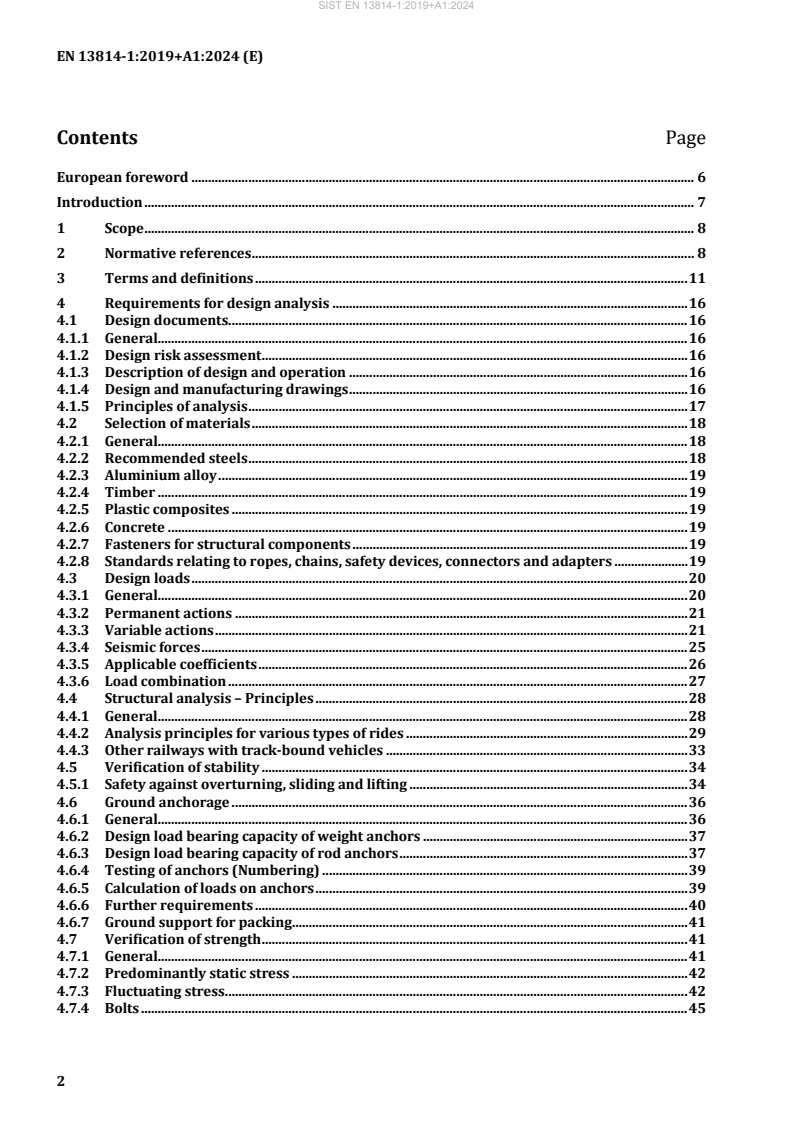
Contents Page
European foreword . 6
Introduction . 7
1 Scope . 8
2 Normative references . 8
3 Terms and definitions . 11
4 Requirements for design analysis . 16
4.1 Design documents. 16
4.1.1 General. 16
4.1.2 Design risk assessment . 16
4.1.3 Description of design and operation . 16
4.1.4 Design and manufacturing drawings . 16
4.1.5 Principles of analysis . 17
4.2 Selection of materials . 18
4.2.1 General. 18
4.2.2 Recommended steels . 18
4.2.3 Aluminium alloy . 19
4.2.4 Timber . 19
4.2.5 Plastic composites . 19
4.2.6 Concrete . 19
4.2.7 Fasteners for structural components . 19
4.2.8 Standards relating to ropes, chains, safety devices, connectors and adapters . 19
4.3 Design loads . 20
4.3.1 General. 20
4.3.2 Permanent actions . 21
4.3.3 Variable actions . 21
4.3.4 Seismic forces . 25
4.3.5 Applicable coefficients . 26
4.3.6 Load combination . 27
4.4 Structural analysis – Principles . 28
4.4.1 General. 28
4.4.2 Analysis principles for various types of rides . 29
4.4.3 Other railways with track-bound vehicles . 33
4.5 Verification of stability . 34
4.5.1 Safety against overturning, sliding and lifting . 34
4.6 Ground anchorage . 36
4.6.1 General. 36
4.6.2 Design load bearing capacity of weight anchors . 37
4.6.3 Design load bearing capacity of rod anchors . 37
4.6.4 Testing of anchors (Numbering) . 39
4.6.5 Calculation of loads on anchors . 39
4.6.6 Further requirements . 40
4.6.7 Ground support for packing . 41
4.7 Verification of strength . 41
4.7.1 General. 41
4.7.2 Predominantly static stress . 42
4.7.3 Fluctuating stress . 42
4.7.4 Bolts . 45
4.7.5 Ropes, chains, safety devices, connectors and adapters . 47
4.8 Structural design and construction . 49
4.8.1 Arrangement, accessibility. 49
4.8.2 Locking and safety devices for fasteners . 49
4.8.3 Joints intended for regular dismantling . 49
4.8.4 Designing of components subject to fluctuating loads . 50
4.8.5 Supports . 50
4.8.6 Central masts . 50
4.8.7 Prevention of corrosion and rot . 50
5 Requirements for design and manufacture of rides and structures . 50
5.1 Risk reduction by prevailing design and safety measures . 50
5.1.1 General . 50
5.1.2 Risk assessment . 51
5.1.3 Risk reduction for platforms, ramps, floors, stairs and walkways . 52
5.1.4 Risk reduction by the use of barriers, fencing and guarding . 56
5.1.5 Guarding of machinery parts. 60
5.1.6 Risk reduction in the case of access and egress . 60
5.1.7 Risk reduction for passengers units . 62
5.1.8 Requirements by special provisions . 75
5.2 Supplementary safety requirements for various types of amusement device . 76
5.2.1 Amusement rides with vertical axis . 76
5.2.2 Amusement rides with horizontal axis . 78
5.2.3 Rail-guided channel or track-bound amusement devices . 80
5.2.4 Dodgem cars/Bumper cars . 82
5.2.5 Speedways/Go-karts . 87
5.2.6 Mini-motorbikes for children . 87
5.2.7 Boat rides . 88
5.2.8 Flume rides . 89
5.2.9 Helter skelters, slides, etc . 90
5.2.10 Side shows, booths, win-a-prize and sales stands, mazes, halls of mirrors, fun houses,
labyrinths, hammers, ring the bell and similar . 91
5.2.11 Shooting stands and trailers, shooting devices . 93
5.3 Mechanical systems . 95
5.3.1 Hydraulic and pneumatic devices . 95
5.3.2 Lifting and elevating units being integral part of a ride . 97
5.4 Manufacture and supply . 100
5.4.1 Manufacturer . 100
5.4.2 Quality assurance — Quality plan . 100
5.4.3 Manufacturing process . 102
5.4.4 Safety precautions to be taken by the manufacturer . 103
5.4.5 Electrical installations . 104
5.5 Supply . 104
5.5.1 Manuals . 104
5.5.2 Special information . 105
5.5.3 Drawings and diagrams . 106
5.6 Design documentation . 106
5.6.1 General . 106
5.6.2 Description of installation and technical specification/information . 107
5.7 Amusement Device Log . 107
5.7.1 General . 107
5.8 Official technical dossier . 109
5.8.1 General . 109
5.8.2 Content . 109
5.8.3 Identification marking . 109
Annex A (normative) Electrical equipment and control systems . 111
A.1 Electrical equipment. 111
A.1.1 General. 111
A.1.2 Protection against electric shocks . 111
A.1.3 Protection against lightning. 112
A.1.4 Lighting . 112
A.1.5 Generators . 113
A.1.6 Heaters and light fittings . 113
A.1.7 Communication !means" . 113
A.2 Control Systems . 113
A.2.1 General. 113
A.2.2 Safety-related control functions . 114
A.2.3 Safety-related parameters . 115
A.2.4 Passenger restraints . 116
A.2.5 Fall Prevention . 117
A.2.6 Inhibiting of safety functions . 118
A.2.7 Operating modes . 119
A.2.8 Collision prevention safety function . 121
Annex B (informative) Control systems - Best practices . 123
B.1 Security . 123
B.2 Example block zone logic . 123
B.3 Requirements for the positioning of sensors and stopping devices . 123
Annex C (informative) Guidance on design of passenger containment . 125
Annex D (informative) Amusement Device Log for an amusement device . 130
Annex E (informative) List of main hazards, hazardous situations and events for spectators
and passengers during the operation and use of amusement rides . 151
Annex F (informative) Guest behaviour . 155
F.1 Scope . 155
F.2 Terms and definitions . 155
F.2.1 General. 155
F.2.2 Boarding passengers . 155
F.2.3 Riding passengers . 155
F.2.4 Exiting passengers . 155
F.2.5 Waiting passenger . 155
F.2.6 Behaviour . 155
F.2.7 Foreseeable behaviour . 155
F.2.8 Parent or Supervision Companion . 156
F.2.9 Child . 156
F.2.10 Information to public . 156
F.2.11 Parents or Supervision Companions accompanying children . 156
F.3 Classification of age and basic capabilities . 156
F.4 Human factors . 158
F.5 General Strategy of Risk mitigation in Guest Behaviour . 158
F.5.1 General . 158
F.5.2 Adults . 158
F.5.3 Refusal of access . 159
F.5.4 Normal Behaviour . 159
F.5.5 Unacceptable behaviour . 159
Annex G (informative) Limited accessibility to amusement devices . 160
Annex H (informative) Safety envelope for passengers . 162
H.1 Design Criteria . 162
H.2 Anthropometric Basis . 162
H.3 Methods for Defining Safety Envelope Boundaries . 162
H.3.1 Documentation . 162
H.3.2 Prerequisites . 163
H.3.3 Safety envelopes . 163
H.3.4 Hazards and related safety envelope class . 163
Annex I (informative) Acceleration effects on passengers . 165
I.1 Medical tolerance – General . 165
I.2 Rides . 166
I.2.1 General . 166
I.2.2 General Definitions and Limitations. 166
I.2.3 Acceleration in X-Direction . 166
I.2.4 Acceleration in Y-Direction . 168
I.2.5 Acceleration in Z-direction (parallel to Spine) . 169
I.2.6 Combinations . 170
I.3 Reversals . 171
I.3.1 Reversals in X and Y . 171
I.3.2 Transitions in Z . 172
I.4 Example obtaining admissible accelerations . 174
Bibliography . 176
European foreword
This document (EN 13814-1:2019+A1:2024) has been prepared by Technical Committee CEN/TC 152
“Fairground and amusement park machinery and structures - Safety”, the secretariat of which is held by
UNI.
This European Standard shall be given the status of a national standard, either by publication of an
identical text or by endorsement, at the latest by January 2025, and conflicting national standards shall
be withdrawn at the latest by July 2027.
Attention is drawn to the possibility that some of the elements of this document may be the subject of
patent rights. CEN shall not be held responsible for identifying any or all such patent rights.
This document includes Amendment 1 approved by CEN on 7 June 2024.
This document !supersedes EN 13814-1:2019".
The start and finish of text introduced or altered by amendment is indicated in the text by tags !".
EN 13814 consists of the following parts, under the general title Safety of amusement rides and
amusement devices:
— Part 1: Design and manufacture;
— Part 2: Operation, maintenance and use;
— Part 3: Requirements for inspection during design, manufacture, operation and use.
According to the CEN-CENELEC Internal Regulations, the national standards organisations of the
following countries are bound to implement this European Standard: Austria, Belgium, Bulgaria,
Croatia, Cyprus, Czech Republic, Denmark, Estonia, Finland, Former Yugoslav Republic of Macedonia,
France, Germany, Greece, Hungary, Iceland, Ireland, Italy, Latvia, Lithuania, Luxembourg, Malta,
Netherlands, Norway, Poland, Portugal, Romania, Serbia, Slovakia, Slovenia, Spain, Sweden, Switzerland,
Turkey and the United Kingdom.
Introduction
The object of this document is to define safety rules related to structures and machinery, which are
either an integral part of, or constitute the amusement device itself. The safety rules are intended to
safeguard persons against the risk of accidents caused by deficiencies in design, manufacture and
operation of such structures and machinery.
Annex A (normative) provides guidance on electrical equipment and control systems
Annex B (informative) provides control systems – best practices
Annex C (informative) provides guidance of passenger containment
Annex D (informative) shows a typical layout of a device log for an amusement device
Annex E (informative) lists hazards pertaining to amusement rides
Annex F (informative) provides guidance on guest behaviour
Annex G (informative) provides guidance on the limited accessibility to amusement devices
Annex H (informative) provides guidance on the safety envelope for passengers
Annex I (informative) explains acceleration effects on passengers
1 Scope
This document specifies the minimum requirements necessary to ensure the safe design, calculation,
manufacture, and installation of mobile, temporary or permanently installed machinery and structures
which are intended for use by persons as a leisure activity, e.g. roundabouts, swings, boats, ferris
wheels, roller coasters, chutes, booths, side shows, and structures for artistic aerial displays. The above
items are hereafter called amusement devices, which are intended to be installed both repeatedly
without degradation or loss of integrity, and temporarily or permanently in fairgrounds and
amusement parks or any other locations. Grandstands, construction site installations, scaffolding,
removable agricultural structures, simple coin operated children's amusement devices, carrying up to
three children, and recreational devices like waterslides or summer toboggan runs, playground
equipment, rope courses, climbing wall, inflatable, trampolines, swimming pool equipment (this list is
not exhaustive) are not covered by this document.
For all the equipment not covered by the requirements of EN 13814-1, the relevant standards apply.
Nevertheless this document can be used in the design of any similar structural or passenger carrying
amusement device not explicitly mentioned herein.
In terms of workers’ health and safety, national regulations apply.
This document is applicable to manufacturing and major modification of amusement devices and rides
for designs after the effective date of publication.
2 Normative references
The following documents are referred to in the text in such a way that some or all of their content
constitutes requirements of this document. For dated references, only the edition cited applies. For
undated references, the latest edition of the referenced document (including any amendments) applies.
EN 349, Safety of machinery — Minimum gaps to avoid crushing of parts of the human body
EN 818 (all parts), Short link chain for lifting purposes — Safety
EN 1090-2:2018, Execution of steel structures and aluminium structures — Part 2: Technical
requirements for steel structures
EN 1090-3:2008, Execution of steel structures and aluminium structures — Part 3: Technical
requirements for aluminium structures
EN 1176 (all parts), Playground equipment and surfacing
EN 1991-1-4, Eurocode 1: Actions on structures - Part 1-4: General actions - Wind actions
EN 1993-1-1, Eurocode 3: Design of steel structures - Part 1-1: General rules and rules for buildings
EN 1993-1-8, Eurocode 3: Design of steel structures - Part 1-8: Design of joints
EN 1993-1-9, Eurocode 3: Design of steel structures - Part 1-9: Fatigue
EN 1999-1-1, Eurocode 9: Design of aluminium structures — Part 1-1: General structural rules
EN 10204, Metallic products - Types of inspection documents
EN 12195-2, Load restraint assemblies on road vehicles - Safety - Part 2: Web lashing made from man-
made fibres
EN 13796-1, Safety requirements for cableway installations designed to carry persons - Carriers - Part 1:
Grips, carrier trucks, on-board brakes, cabins, chairs, carriages, maintenance carriers, tow-hangers
EN 13814-2:2019, Safety of amusement rides and amusement devices — Part 2: Operation, maintenance
and use
EN 13814-3:2019, Safety of amusement rides and amusement devices — Part 3: Requirements for
inspection during design, manufacture, operation and use
EN 14399 (all parts), High-strength structural bolting assemblies for preloading
EN 50172, Emergency escape lighting systems
EN 60204-1:2006, Safety of machinery — Electrical equipment of machines — Part 1: General
requirements (IEC 60204-1:2006)
EN 60204-32, Safety of machinery - Electrical equipment of machines - Part 32: Requirements for hoisting
machines (IEC 60204-32)
HD 60364-4-41, Low-voltage electrical installations — Part 4-41: Protection for safety — Protection
against electric shock (IEC 60364-4-41)
HD 60364-5-54, Low-voltage electrical installations - Part 5-54: Selection and erection of electrical
equipment - Earthing arrangements and protective conductors (IEC 60364-5-54)
HD 60364-7-740, Electrical installations of buildings - Part 7-740: Requirements for special installations
or locations - Temporary electrical installations for structures, amusement devices and booths at
fairgrounds, amusement parks and circuses (IEC 60364-7-740)
EN 61558-1, Safety of power transformers, power supplies, reactors and similar products - Part 1: General
requirements and tests (IEC 61558-1)
EN 61800-5-2, Adjustable speed electrical power drive systems — Part 5-2: Safety requirements —
Functional (IEC 61800-5-2)
EN 62061, Safety of machinery - Functional safety of safety-related electrical, electronic and
programmable electronic control systems (IEC 62061)
EN 62305 (all parts), Protection against lightning (IEC 62305, all parts)
EN ISO 898-1, Mechanical properties of fasteners made of carbon steel and alloy steel - Part 1: Bolts,
screws and studs with specified property classes - Coarse thread and fine pitch thread (ISO 898-1)
EN ISO 3834-2, Quality requirements for fusion welding of metallic materials - Part 2: Comprehensive
quality requirements (ISO 3834-2)
EN ISO 3834-3, Quality requirements for fusion welding of metallic materials - Part 3: Standard quality
requirements (ISO 3834-3)
EN ISO 3834-4, Quality requirements for fusion welding of metallic materials - Part 4: Elementary quality
requirements (ISO 3834-4)
EN ISO 4014, Hexagon head bolts - Product grades A and B (ISO 4014)
EN ISO 4016, Hexagon head bolts - Product grade C (ISO 4016)
EN ISO 4017, Fasteners - Hexagon head screws - Product grades A and B (ISO 4017)
EN ISO 4018, Hexagon head screws - Product grade C (ISO 4018)
EN ISO 4032, Hexagon regular nuts (style 1) - Product grades A and B (ISO 4032)
EN ISO 4034, Hexagon regular nuts (style 1) - Product grade C (ISO 4034)
EN ISO 4413, Hydraulic fluid power - General rules and safety requirements for systems and their
components (ISO 4413)
EN ISO 4414, Pneumatic fluid power - General rules and safety requirements for systems and their
components (ISO 4414)
EN ISO 5817:2014, Welding - Fusion-welded joints in steel, nickel, titanium and their alloys (beam welding
excluded) - Quality levels for imperfections (ISO 5817:2014)
EN ISO 9606-1, Qualification testing of welders - Fusion welding - Part 1: Steels (ISO 9606-1)
EN ISO 9606-2, Qualification test of welders - Fusion welding - Part 2: Aluminium and aluminium alloys
(ISO 9606-2)
EN ISO 9692-1, Welding and allied processes - Types of joint preparation - Part 1: Manual metal arc
welding, gas-shielded metal arc welding, gas welding, TIG welding and beam welding of steels (ISO 9692-
1)
EN ISO 9692-2, Welding and allied processes - Joint preparation - Part 2: Submerged arc welding of steels
(ISO 9692-2)
EN ISO 9692-3, Welding and allied processes - Types of joint preparation - Part 3: Metal inert gas welding
and tungsten inert gas welding of aluminium and its alloys (ISO 9692-3)
EN ISO 9712:2012, Non-destructive testing - Qualification and certification of NDT personnel (ISO
9712:2012)
EN ISO 10042:2018, Welding - Arc-welded joints in aluminium and its alloys - Quality levels for
imperfections (ISO 10042:2018)
EN ISO 12100:2010, Safety of machinery - General principles for design - Risk assessment and risk
reduction (ISO 12100:2010)
EN ISO 13849 (all parts), Safety of machinery — Safety-related parts of control systems (ISO 13849)
EN ISO 13857, Safety of machinery - Safety distances to prevent hazard zones being reached by upper and
lower limbs (ISO 13857)
EN ISO 14119, Safety of machinery - Interlocking devices associated with guards - Principles for design
and selection (ISO 14119)
EN ISO 14120, Safety of machinery - Guards - General requirements for the design and construction of
fixed and movable guards (ISO 14120)
EN ISO 14731, Welding coordination - Tasks and responsibilities (ISO 14731)
EN ISO 14732, Welding personnel - Qualification testing of welding operators and weld setters for
mechanized and automatic welding of metallic materials (ISO 14732)
EN ISO 17635, Non-destructive testing of welds - General rules for metallic materials (ISO 17635)
ISO 10474, Steel and steel products — Inspection documents
ISO 14118, Safety of machinery — Prevention of unexpected start-up
3 Terms and definitions
For the purposes of this document, the following terms and definitions apply.
ISO and IEC maintain terminological databases for use in standardization at the following addresses:
• IEC Electropedia: available at http://www.electropedia.org/
• ISO Online browsing platform: available at http://www.iso.org/obp
3.1
amusement device
arrangement of equipment that produces the desired effect of amusement or entertainment when the
passenger (3.28) moves through it or on it primarily by his or her own action, or any other system that
is not covered by the term amusement ride (3.2)
3.2
amusement ride
equipment that is designed to entertain the passengers (3.28) during motion including the consequence
of biomechanical effect
Note 1 to entry: In this standard, the word amusement device is used to refer to an amusement device (3.1) or
amusement ride (3.2).
3.3
attendant
trained person appointed to work under the supervision of an operator (3.27), to assist in the operation
of an amusement device (3.1) available for use by the public
3.4
barrier
device intended to prevent the user from falling and from passing beneath a barrier can also be used as
a fence
3.5
closed restraint
closed restraint position in which the restraint (3.37) is intended to remain during the operation of the
device in order to restrain the passenger (3.28)
3.6
competent person
person who can demonstrate that he has acquired through training, qualifications or experience, or a
combination of these, the knowledge and skills enabling that person to perform a specified task
3.7
controller
ride controller
person or organisation having overall control of an amusement device (3.1). This may be either an
individual or corporate body owning an amusement device (3.1) or the concessionaire or lessee who has
been granted control of the amusement device, by the owner, for a specified period
3.8
design review
document detailing the review of all the applicable design documents, to determine the suitability for
use of an amusement device
3.9
design risk assessment
DRA
document, produced by the designer (3.10) as a tool for safe design, within the agreed scope of supply
3.10
designer
engineer
persons or bodies that are responsible for the design of an amusement device (or modifications
thereof), including, but not limited to establishing and describing the configuration of the amusement
device, conducting appropriate risk assessment(s), establishing strength (including fatigue strength),
designing and specifying electrical/electronic control systems, defining the acceptable quality level for
production, defining inspection criteria and including the publication of the necessary documentation
3.11
amusement device log
book and/or electronic data file containing all the necessary information about the use and history of
any amusement device
3.12
fail safe
characteristic of a system, component or device the failure of which maintains a safe state
3.13
fence
structure desi
...