

CEN/TR 18042:2024
(Main)Safety of amusement rides and amusement devices - Replies to requests for interpretation of EN 13814:2019 and its parts
- Abstract
The purpose of this CEN Technical Report is to provide replies to requests for interpretations of all parts to EN 13814:2019.
- Status
- Published
- Publication Date
- 02-Apr-2024
- Technical Committee
- CEN/TC 152 - Fairground and amusement park machinery and structures - Safety
- Drafting Committee
- CEN/TC 152/WG 1 - Rides
- Current Stage
- 6060 - Definitive text made available (DAV) - Publishing
- Start Date
- 03-Apr-2024
- Due Date
- 20-Mar-2024
- Completion Date
- 03-Apr-2024

Overview
CEN/TR 18042:2024 is a CEN Technical Report that provides official replies to requests for interpretation of EN 13814:2019 - the European standard for the safety of amusement rides and amusement devices. Approved by CEN in March 2024, this TR compiles clarifications across all parts of EN 13814:2019 to ensure consistent application of safety, design and manufacture requirements throughout Europe.
Key topics and technical requirements
This Technical Report addresses interpretation requests mapped to EN 13814:2019 sections. Major technical topics include:
- Design and manufacture: clarifications on scope, principles of design analysis and documentation requirements.
- Structural analysis and loads: interpretation of permanent, imposed and wind loads in operating and non‑operating states; bracing and restraint loads; rotating device calculation conditions.
- Verification of strength and fatigue: guidance on number of load cycles, fatigue assessment and verification principles.
- Fasteners and connections: questions about bolts, pre‑stressing forces and tightening torques referencing EN 14399 and EN ISO fastener standards.
- Ropes, chains and connectors: interpretation for suspension systems, fluctuating loads and safety devices.
- Passenger containment and restraints: classification and requirements for restraint devices, secondary restraints, safety envelopes and minimum safety distances.
- Mechanical and safety components: brakes, anti‑rollback devices, safety‑related parts and machinery components.
- Risk assessment and documentation: use of Design Risk Assessment (DRA), Operation and Use Risk Assessment (OURA) and the Amusement Device Log.
- Operational safety: access/egress, area separation systems, fences/barriers, and personnel requirements.
Practical applications
This Technical Report is a practical reference to:
- Interpret ambiguous or complex clauses in EN 13814:2019
- Support conformity assessment, certification and design verification
- Inform design decisions for new or modified rides and amusement devices
- Provide authoritative guidance for inspection, testing and maintenance activities
- Aid regulatory bodies and event organisers in harmonised enforcement of safety requirements
Who should use this standard
- Amusement ride designers and manufacturers
- Structural and mechanical engineers
- Inspection bodies, notified bodies and conformity assessors
- Regulators, safety authorities and park/operators
- Testing laboratories, maintenance teams and risk assessors
Related standards
- EN 13814:2019 - Safety of amusement rides and amusement devices (main standard)
- Referenced fastener standards such as EN 14399, EN ISO 4014 / EN ISO 4017 (as cited within interpretation replies)
This CEN Technical Report helps ensure consistent interpretation and application of EN 13814:2019, improving safety, regulatory compliance and interoperability across the amusement ride sector.
Frequently Asked Questions
CEN/TR 18042:2024 is a technical report published by the European Committee for Standardization (CEN). Its full title is "Safety of amusement rides and amusement devices - Replies to requests for interpretation of EN 13814:2019 and its parts". This standard covers: The purpose of this CEN Technical Report is to provide replies to requests for interpretations of all parts to EN 13814:2019.
The purpose of this CEN Technical Report is to provide replies to requests for interpretations of all parts to EN 13814:2019.
CEN/TR 18042:2024 is classified under the following ICS (International Classification for Standards) categories: 97.200.40 - Playgrounds. The ICS classification helps identify the subject area and facilitates finding related standards.
CEN/TR 18042:2024 is available in PDF format for immediate download after purchase. The document can be added to your cart and obtained through the secure checkout process. Digital delivery ensures instant access to the complete standard document.
Standards Content (Sample)
SLOVENSKI STANDARD
01-junij-2024
Varnost zabaviščnih vozil in naprav za zabavo - Odgovori na zahteve za razlago
standarda EN 13814:2019 in njegovih delov
Safety of amusement rides and amusement devices - Replies to requests for
interpretation of EN 13814:2019 and its parts
Sicherheit von Fahrgeschäften und Vergnügungsanlagen - Antworten zu Anfragen zu EN
13814:2019 und dessen Teile
Ta slovenski standard je istoveten z: CEN/TR 18042:2024
ICS:
97.200.40 Igrišča Playgrounds
2003-01.Slovenski inštitut za standardizacijo. Razmnoževanje celote ali delov tega standarda ni dovoljeno.
CEN/TR 18042
TECHNICAL REPORT
RAPPORT TECHNIQUE
April 2024
TECHNISCHER REPORT
ICS 97.200.40
English Version
Safety of amusement rides and amusement devices -
Replies to requests for interpretation of EN 13814:2019
and its parts
Sicherheit von Fahrgeschäften und
Vergnügungsanlagen - Antworten zu Anfragen zu EN
13814:2019 und dessen Teile
This Technical Report was approved by CEN on 23 March 2024. It has been drawn up by the Technical Committee CEN/TC 152.
CEN members are the national standards bodies of Austria, Belgium, Bulgaria, Croatia, Cyprus, Czech Republic, Denmark, Estonia,
Finland, France, Germany, Greece, Hungary, Iceland, Ireland, Italy, Latvia, Lithuania, Luxembourg, Malta, Netherlands, Norway,
Poland, Portugal, Republic of North Macedonia, Romania, Serbia, Slovakia, Slovenia, Spain, Sweden, Switzerland, Türkiye and
United Kingdom.
EUROPEAN COMMITTEE FOR STANDARDIZATION
COMITÉ EUROPÉEN DE NORMALISATION
EUROPÄISCHES KOMITEE FÜR NORMUNG
CEN-CENELEC Management Centre: Rue de la Science 23, B-1040 Brussels
© 2024 CEN All rights of exploitation in any form and by any means reserved Ref. No. CEN/TR 18042:2024 E
worldwide for CEN national Members.
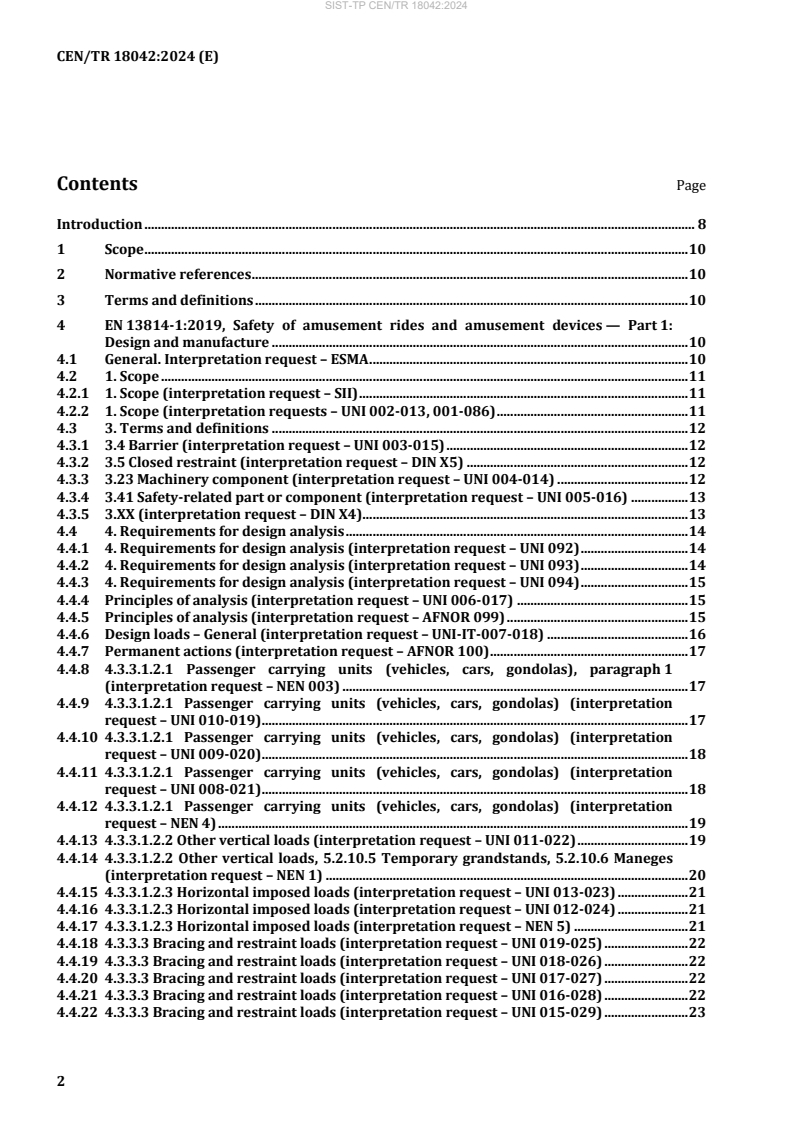
Contents Page
Introduction . 8
1 Scope . 10
2 Normative references . 10
3 Terms and definitions . 10
4 EN 13814-1:2019, Safety of amusement rides and amusement devices — Part 1:
Design and manufacture . 10
4.1 General. Interpretation request – ESMA . 10
4.2 1. Scope . 11
4.2.1 1. Scope (interpretation request – SII) . 11
4.2.2 1. Scope (interpretation requests – UNI 002-013, 001-086) . 11
4.3 3. Terms and definitions . 12
4.3.1 3.4 Barrier (interpretation request – UNI 003-015) . 12
4.3.2 3.5 Closed restraint (interpretation request – DIN X5) . 12
4.3.3 3.23 Machinery component (interpretation request – UNI 004-014) . 12
4.3.4 3.41 Safety-related part or component (interpretation request – UNI 005-016) . 13
4.3.5 3.XX (interpretation request – DIN X4) . 13
4.4 4. Requirements for design analysis . 14
4.4.1 4. Requirements for design analysis (interpretation request – UNI 092) . 14
4.4.2 4. Requirements for design analysis (interpretation request – UNI 093) . 14
4.4.3 4. Requirements for design analysis (interpretation request – UNI 094) . 15
4.4.4 Principles of analysis (interpretation request – UNI 006-017) . 15
4.4.5 Principles of analysis (interpretation request – AFNOR 099) . 15
4.4.6 Design loads – General (interpretation request – UNI-IT-007-018) . 16
4.4.7 Permanent actions (interpretation request – AFNOR 100) . 17
4.4.8 4.3.3.1.2.1 Passenger carrying units (vehicles, cars, gondolas), paragraph 1
(interpretation request – NEN 003) . 17
4.4.9 4.3.3.1.2.1 Passenger carrying units (vehicles, cars, gondolas) (interpretation
request – UNI 010-019) . 17
4.4.10 4.3.3.1.2.1 Passenger carrying units (vehicles, cars, gondolas) (interpretation
request – UNI 009-020) . 18
4.4.11 4.3.3.1.2.1 Passenger carrying units (vehicles, cars, gondolas) (interpretation
request – UNI 008-021) . 18
4.4.12 4.3.3.1.2.1 Passenger carrying units (vehicles, cars, gondolas) (interpretation
request – NEN 4) . 19
4.4.13 4.3.3.1.2.2 Other vertical loads (interpretation request – UNI 011-022) . 19
4.4.14 4.3.3.1.2.2 Other vertical loads, 5.2.10.5 Temporary grandstands, 5.2.10.6 Maneges
(interpretation request – NEN 1) . 20
4.4.15 4.3.3.1.2.3 Horizontal imposed loads (interpretation request – UNI 013-023) . 21
4.4.16 4.3.3.1.2.3 Horizontal imposed loads (interpretation request – UNI 012-024) . 21
4.4.17 4.3.3.1.2.3 Horizontal imposed loads (interpretation request – NEN 5) . 21
4.4.18 4.3.3.3 Bracing and restraint loads (interpretation request – UNI 019-025) . 22
4.4.19 4.3.3.3 Bracing and restraint loads (interpretation request – UNI 018-026) . 22
4.4.20 4.3.3.3 Bracing and restraint loads (interpretation request – UNI 017-027) . 22
4.4.21 4.3.3.3 Bracing and restraint loads (interpretation request – UNI 016-028) . 22
4.4.22 4.3.3.3 Bracing and restraint loads (interpretation request – UNI 015-029) . 23
4.4.23 4.3.3.3 Bracing and restraint loads (interpretation request – UNI 014-030) . 23
4.4.24 4.3.3.4.3 Wind loads in operating state (in service) (interpretation request –
UNI 020-031) . 23
4.4.25 4.3.6.2 Fundamental combinations (interpretation request – AFNOR 101) . 23
4.4.26 4.3.6.3 Accidental combination (interpretation request – UNI 021-032) . 24
4.4.27 Structural analysis – Principles. General (interpretation request – UNI 022-033) . 24
4.4.28 Structural analysis – Principles. General (interpretation request – AFNOR 102) . 25
4.4.29 4.4.2.1 Conditions for calculating rotating type amusement devices (interpretation
request – NEN 004) . 25
4.4.30 4.4.2.1 Conditions for calculating rotating type amusement devices (interpretation
request – UNI 023-034) . 26
4.4.31 4.4.2.4.4 Brakes (interpretation request – UNI 025-035) . 26
4.4.32 4.4.2.4.4 Brakes (interpretation request – UNI 024-036) . 26
4.4.33 4.4.2.4.5 Anti-rollback devices (interpretation request – NEN 2) . 27
4.4.34 Verification of strength. General (interpretation request – AFNOR 103) . 27
4.4.35 4.7.3.1.4 Number of load cycles (interpretation request – UNI 030-037) . 27
4.4.36 4.7.3.1.4 Number of load cycles (interpretation request – UNI 029-038) . 28
4.4.37 4.7.3.1.4 Number of load cycles (interpretation request – UNI 028-039) . 28
4.4.38 4.7.3.1.4 Number of load cycles (interpretation request – UNI 027-040) . 28
4.4.39 4.7.3.1.4 Number of load cycles (interpretation request – UNI 026-041) . 29
4.4.40 Bolts (interpretation request – UNI 032-042). 30
4.4.41 Bolts (interpretation request – UNI 112) . 30
4.4.42 Bolts, Table 6 — Pre-stressing forces and tightening torques for bolts EN 14399-4/
EN 14399-6/ EN ISO 4014/ EN ISO 4017 (interpretation request – UNI 031-043) . 31
4.4.43 Bolts, Table 6 — Pre-stressing forces and tightening torques for bolts EN 14399-4/
EN 14399-6/ EN ISO 4014/ EN ISO 4017 (interpretation request – AFNOR 104) . 31
4.4.44 Bolts, Table 6 — Pre-stressing forces and tightening torques for bolts EN 14399-4/
EN 14399-6/ EN ISO 4014/ EN ISO 4017 (interpretation request – AFNOR 105) . 32
4.4.45 Ropes, chains, safety devices, connectors and adapters (interpretation request –
AFNOR 106) . 32
4.4.46 4.7.5.1.2 Ropes and chains under fluctuating loads (suspension of passenger
carrying devices e.g. chairs, gondolas) (interpretation request – UNI 034-044) . 32
4.4.47 4.7.5.1.2 Ropes and chains under fluctuating loads (suspension of passenger
carrying devices e.g. chairs, gondolas) (interpretation request – UNI 033-045) . 33
4.4.48 4.7.5.2 Passenger safety locking devices (interpretation request – UNI 035-046) . 33
4.5 Requirements for design and manufacture of rides and structures . 34
4.5.1 5.1.2.2 Design Risk Assessment (DRA), 5.1.2.3 Operation and Use Risk Assessment
(OURA), 5.7 Amusement Device Log (interpretation request – SN 010) . 34
4.5.2 5.1.2.2 Design Risk Assessment (DRA), 5.1.2.3 Operation and Use Risk Assessment
(OURA), 5.5 Supply (interpretation request – SN 011) . 34
4.5.3 5.1.2.2 Design Risk Assessment (DRA), 5.1.2.3 Operation and Use Risk Assessment
(OURA) (interpretation request – SN 012) . 35
4.5.4 5.1.3.3 Stairs (interpretation request – UNI 036-047) . 35
4.5.5 Risk reduction by the use of barriers, fencing and guarding (interpretation request –
DIN X9) . 35
4.5.6 5.1.4.1.1 Protection against falls from one level to another barriers, fencing and
guarding. General (interpretation request – UNI 037-048) . 37
4.5.7 5.1.4.2.2 Area separating systems (interpretation request – UNI 038-005) . 38
4.5.8 5.1.4.2.2 Area separating systems (interpretation request – UNI 039-049) . 38
4.5.9 5.1.4.3.1 Fences and Barriers. General (interpretation request – UNI 040-050) . 39
4.5.10 5.1.6.1.1 Access to and egress from passengers' units. General (interpretation
request – UNI 112) . 39
4.5.11 5.1.6.1.1 Access to and egress from passengers' units. General (interpretation
request – UNI 113) . 40
4.5.12 5.1.6.1.1 Access to and egress from passengers' units. General (interpretation
request – NEN 6) . 41
4.5.13 5.1.7.1.3 Minimum dimensions of Safety Envelope (interpretation request –
UNI 042-051) . 42
4.5.14 5.1.7.1.3 Minimum dimensions of Safety Envelope (interpretation request –
UNI 043-052) . 44
4.5.15 5.1.7.1.3 Minimum dimensions of Safety Envelope (interpretation request –
UNI 041-053) . 44
4.5.16 5.1.7.1.4 Minimum safety distances between passenger containments
(interpretation request – UNI 044-054) . 46
4.5.17 5.1.7.2 Restraint devices limiting passenger movement (interpretation request –
AFNOR 107) . 47
4.5.18 5.1.7.2.2 Passenger restraints (interpretation request – UNI 046-055) . 47
4.5.19 5.1.7.2.2 Passenger restraints (interpretation request – UNI 045-056) . 48
4.5.20 5.1.7.2.3 Classification of passenger restraint devices (interpretation request –
DIN X1) . 48
4.5.21 5.1.7.2.3 Classification of passenger restraint devices (interpretation request –
DIN X2) . 49
4.5.22 5.1.7.2.3 Classification of passenger restraint devices (interpretation request –
DIN X6) . 49
4.5.23 5.1.7.2.3 Classification of passenger restraint devices (interpretation request –
DIN X7) . 50
4.5.24 5.1.7.2.3 Classification of passenger restraint devices (interpretation request –
DIN X8) . 52
4.5.25 5.1.7.2.4 Secondary restraint device for class 5 restraints (see 5.1.7.2.3, class 5 no. 9)
(interpretation request – UNI 047-057) . 52
4.5.26 5.1.8.1 Criteria relative to passenger characteristics (interpretation request –
UNI 048-058) . 54
4.5.27 5.2 Supplementary safety requirements for various types of amusement device
(interpretation request – UNI 090) . 54
4.5.28 5.2.2.3 Passenger units (interpretation request – UNI 049-059) . 54
4.5.29 5.2.2.5 Miscellaneous (interpretation request – UNI 050-009) . 55
4.5.30 5.2.4.1 Dodgem cars/Bumper cars. General (interpretation request – UNI ably) . 56
4.5.31 5.2.4.1 Dodgem cars/Bumper cars – General (interpretation request – AFNOR 108) . 57
4.5.32 5.2.4.5 Electromechanical requirements for dodgem cars (interpretation request –
UNI 053-061) . 57
4.5.33 5.2.4.5 Electromechanical requirements for dodgem cars (interpretation request –
UNI 052-062) . 58
4.5.34 5.2.7.2 Area separation system and access and egress (interpretation request –
UNI 054-063) . 58
4.5.35 5.2.8.1 Area separation system and access and egress (interpretation request –
UNI 055-064) . 59
4.5.36 5.2.8.3 Restraints (interpretation request – UNI 056-065) . 60
4.5.37 5.2.9.5 Miscellaneous (interpretation request – UNI 057-066) . 60
4.5.38 5.3.1.3 Travelling limits (interpretation request – UNI 058-067) . 61
4.5.39 5.3.2.11 Pneumatic drives (interpretation request – UNI 059-068) . 61
4.5.40 5.4.1.2 Requirements for the personnel (interpretation request – UNI 061-007) . 62
4.5.41 5.4.1.2 Requirements for the personnel (interpretation request – UNI 060-008) . 62
4.5.42 5.4.3.4 Steel welding (interpretation request – UNI 062-006) . 62
4.5.43 Manuals (interpretation request – UNI 063-069) . 63
4.5.44 Content (interpretation request – SN 083) . 63
4.6 Annex A (normative) Electrical equipment and control systems . 63
4.6.1 A.1.2.1 Protection against electric shocks. General (interpretation request –
UNI 064-070) . 63
4.6.2 A.1.2.3 Earthing systems (interpretation request – UNI 065-071) . 64
4.6.3 A.1.3 Protection against lightning (interpretation request – UNI 066-072) . 65
4.6.4 A.1.4.1 Lighting. General (interpretation request – UNI 067-073) . 65
4.6.5 A.1.7 Communication system (interpretation request – UNI 068-074) . 66
4.6.6 A.2.1.2 RCS particular requirements (interpretation request – UNI 069-075) . 66
4.6.7 A.2.2.4 Stop functions (interpretation request – UNI 070-076) . 67
4.6.8 A.2.4.2 Safety integrity requirements (interpretation request – UNI 071-077) . 67
4.6.9 A.2.4.2 Safety integrity requirements (interpretation request – DIN X3) . 67
4.6.10 A.2.5.1 Fall Prevention. General (interpretation request – UNI 072-078) . 68
4.6.11 A.2.5.2 Safety integrity requirements (interpretation request – UNI 074-079) . 68
4.6.12 A.2.5.2 Safety integrity requirements (interpretation request – UNI 073-080) . 69
4.6.13 A.2.7 Operating modes (interpretation request – UNI 075-081) . 69
4.6.14 A.2.8.4 System Validation (interpretation request – UNI 075-081) . 69
4.7 Annex C (informative) Guidance on design of passenger containment (interpretation
request – UNI 077-084) . 70
4.8 Annex D (informative) Amusement Device Log for an amusement device
(interpretation request – UNI 078-085) . 71
4.9 Annex F (informative) Guest behaviour . 72
4.9.1 F.2.8 Parent or Supervision Companion (interpretation request – UNI 079-087) . 72
4.10 Annex H (informative) Safety envelope for passengers . 72
4.10.1 H.1 Design Criteria (interpretation request – UNI 080-088) . 72
4.10.2 H.3.3.2 Safety envelope by this standard (Type 1) (interpretation request –
UNI 081-089) . 72
4.10.3 H.3.4 Safety envelope by this standard (Type 1) (interpretation request –
UNI 082-090) . 73
4.10.4 Table H.2 — Hazards and related safety envelope class (interpretation request –
UNI 083-091) . 73
4.11 Annex I (informative) Acceleration effects on passengers . 73
4.11.1 I.2.2.1 Limitations/excluded influences (interpretation request – NEN 7) . 73
4.11.2 I.2.2.1 Limitations/excluded influences (interpretation request – NEN 8) . 74
4.11.3 I.2.3 Acceleration in X-Direction (interpretation request – NEN 9) . 74
4.11.4 I.2.3 Acceleration in X-Direction (interpretation request – AFNOR 110) . 75
4.11.5 I.2.3 Acceleration in X-Direction (interpretation request – NEN 10). 77
4.11.6 I.2.3 Acceleration in X-Direction (interpretation request – NEN 11). 77
4.11.7 I.2.3 Acceleration in X-Direction (interpretation request – NEN 12). 78
4.11.8 I.2.5 Acceleration in Z-direction (parallel to Spine) (interpretation request –
DIN X10) . 78
4.11.9 I.2.5 Acceleration in Z-direction (parallel to Spine) (interpretation request – NEN 13) . 79
4.11.10 I.2.6 Combinations (interpretation request – NEN 14). 79
4.11.11 I.2.6 Combinations (interpretation request – NEN 15). 80
4.11.12 I.2.6 Combinations (interpretation request – NEN 16). 80
4.11.13 I.2.6 Combinations (interpretation request – NEN 17). 81
4.11.14 I.3.1 Reversals in X and Y (interpretation request – NEN 18) . 82
4.11.15 I.3.2 Transitions in Z (interpretation request – NEN 19) . 82
4.11.16 I.3.2 Transitions in Z (interpretation request – NEN 20) . 84
4.11.17 I.4 Example obtaining admissible accelerations (interpretation request –
NEN 21) . 85
EN 13814-2:2019, Safety of amusement rides and amusement devices – Part 2: Operation,
maintenance and use . 85
4.12 European forward (interpretation request – UNI 084-093) . 85
4.13 4. Operation, maintenance and use of amusement rides and amusement devices . 86
4.13.1 4.2 Standard documentation (interpretation request – SN 083) . 86
4.13.2 Selection and training of staff (interpretation request – UNI 085-094) . 86
4.13.3 4.3.8.3 Repair (interpretation request – SN 092) . 87
4.14 6. Independent inspection . 87
4.14.1 Reports (interpretation request – NEN 22) . 87
4.15 Annex B (informative): Provisions prior to use . 87
4.15.1 B.7 Testing (interpretation request – UNI 086-095) . 87
4.15.2 Table B.1 — Maximum examination intervals for amusement devices and structures
(interpretation request – UNI 111) . 88
4.15.3 B.10.4 Netherlands (interpretation request – NEN 23). 88
EN 13814-3:2019, Safety of amusement rides and amusement devices – Part 3:
Requirements for inspection during design, manufacture, operation and use . 88
4.16 European forward (interpretation request – UNI 087-096) . 88
4.17 4. Requirements . 89
4.17.1 General (interpretation request – UNI 088-097) . 89
4.17.2 4.1.3.2 Inspection requirements (interpretation request – UNI 089-098) . 89
4.17.3 4.1.3.3 Initial inspection and testing (interpretation request – NEN 24) . 89
Bibliography . 90
European foreword
This document (CEN/TR 18042:2024) has been prepared by Technical Committee CEN/TC 152
“Fairground and amusement park machinery and structures - Safety”, the secretariat of which is held by
UNI.
Attention is drawn to the possibility that some of the elements of this document may be the subject of
patent rights. CEN shall not be held responsible for identifying any or all such patent rights.
Any feedback and questions on this document should be directed to the users’ national standards body.
A complete listing of these bodies can be found on the CEN website.
Introduction
Interpretations and no-action decisions
This document contains replies to requests for interpretations concerning the understanding of clauses
in EN 13814:2019 and its parts. The replies concern those requests that have resulted in an
interpretation or a decision that no action is required as the standard is sufficiently clear.
An interpretation does not have the same status as the text of the standard. However, following an
interpretation gives assurance that the relevant clause of the standard has been correctly applied. An
interpretation is a clarification of the meaning of the standard.
Disclaimer
The interpretations have been derived by expert groups of CEN/TC 152/WG 1 and have been circulated
to National Standards Bodies for approval. The information contained herein does not reflect the full
formal approval by CEN or CEN member bodies. It should be noted that the interpretations are neither
part of any standard nor have been referenced in the Official Journal of the European Union.
Requests for interpretations may be submitted by a CEN member body through its national committee
or by a CEN/TC 152 liaison (but not directly by an individual or a company) – in accordance with the
interpretation protocols agreed by CEN/TC 152/WG 1. The requests are then channelled to the
CEN/TC 152/WG 1 interpretation panel, which will then deal with the request.
A request for an interpretation may lead to:
a) an interpretation of the standard with no action to the standard (no revision and no amendment)
This should reflect a reasonable interpretation of how the standard should be used, taking into
account:
— the wording of the standard;
— the rationale of the standard;
— the history of the standard.
This is also applicable when it is agreed that the standard appropriately specifies how amusement
rides and amusement devices shall be assessed.
b) a proposal for an amendment of the standard
This is applicable when it is agreed that the standard is deficient in some way.
NOTE Interpretation and no-action decisions are published in EN 13814-1:2019/prA1:2023, which will be
updated on a regular basis
Proposals for amendments will be progressed as new work item proposals in accordance with
CEN rules.
c) a future revision
This is applicable when the standard is not clear and a suitable amendment cannot be found to fully
clarify the question. It is also a case when an opportunity was identified to further add to the
content. Further work is needed on existing requirements or new requirements may need to be
drafted.
Proposals for a revision will be progressed as a new work item proposal in accordance with CEN
rules.
Answers to requests for interpretations
Since requests for interpretations are submitted through a CEN member body, it is assumed that the
member body will keep itself informed about decisions concerning the request and its progress and will
itself inform the originator of the request as appropriate.
The information requests from the following countries have been included in this document:
AFNOR – France, ASI – Austria, DIN – Germany, DS – Denmark, ESMA – United Arab Emirates, NEN – the
Netherlands, SFS – Finland, SII – Israel, SIS – Sweden, SN – Norway, SNV – Switzerland, TSI – Turkey,
UNI – Italy.
1 Scope
The purpose of this document is to provide replies to requests for interpretations of all parts to
EN 13814:2019.
2 Normative references
There are no normative references in this document.
3 Terms and definitions
No terms and definitions are listed in this document.
ISO and IEC maintain terminological databases for use in standardization at the following addresses:
— IEC Electropedia: available at https://www.electropedia.org/
— ISO Online browsing platform: available at https://www.iso.org/obp
4 EN 13814-1:2019, Safety of amusement rides and amusement devices —
Part 1: Design and manufacture
4.1 General. Interpretation request – ESMA
Question
I am contacting you following a visit to your website and reading about EN 13814.
We are in the Leisure Karting industry and we often face national administrations referring to
EN 13814 when it comes to certification and applicable norms to our activities when we claim
EN 16230-1 and EN 16230-2 is better adapted.
However, the answer I always get is the same and is: We don’t know about EN 16230-1 and −2, we
always worked with EN 13814, why should be apply one instead of the other? Is there a clear line of
where one applies versus the other?
Initially, my understanding was that EN 13814 was only applying to mobile temporary rides but it also
looks like it applies to permanently installed rides. In our industry, we only refer to permanent venues
dedicated to Karting (or sometimes part of multi entertainment venues) and we can’t figure out how to
justify application of 1 norm versus the other.
Could you help with this?
Reply
No action/Clarification
EN 13814 is applicable only to “go karts” installation which are part of amusement parks and
fairgrounds:
“5.2.5 Speedways/Go-karts
5.2.5.1 General
These requirements are specific to amusement parks and fairground go-karts.”
4.2 1. Scope
4.2.1 1. Scope (interpretation request – SII)
Question
SII expert committee is adopting the EN 13814: May 19 standards with national modifications.
In the scope of EN 13814-1, the rides that are not covered by the standard are specified, and then it is
mentioned that “for all the equipment not covered by the requirements of EN 13814-1, the relevant
standards apply”.
However, the next line of the scope states that the standard can be used in the design of any similar
device not explicitly mentioned.
Our question is what standard applies in the case of such similar device if it is covered by a relevant
standard. Does the relevant standard apply, does this standard apply, or both? Or was this line intended
only for devices without relevant standards?
Furthermore, it would be helpful to learn whether the rides that are not included in the scope do have
relevant standards that apply.
Reply
No action/Clarification
If applicable standards exist for particular equipment, they should be applied. EN 13814 can be applied
in the absence of any applicable standards.
4.2.2 1. Scope (interpretation requests – UNI 002-013, 001-086)
Question
“This document is applicable to manufacturing and major modification of amusement devices and rides
for designs after the effective date of publication”.
How it shall be interpreted, that it’s applicable only to new Design developed after the date of
publication of EN 13814:2019?
What about the ride manufactured in compliance with existing design but built after the date of
publication of EN 13814-1:2019?
Reply
No action/Clarification
From November 2019 till May 2022 the versions EN 13814:2004 and EN 13814:2019 were valid.
The current version in force is 2019.
National regulation bodies and/or contractual agreement may decide which version they accept.
4.3 3. Terms and definitions
4.3.1 3.4 Barrier (interpretation request – UNI 003-015)
Question
What is it in practice the difference between 3.4 Barrier and 3.15 Guardrail?
Reply
Clarification
A guardrail does not prevent a person for passing beneath it, whereas a barrier does.
Revision
Discuss the definitions of Barrier/Guardrail/Fence.
4.3.2 3.5 Closed restraint (interpretation request – DIN X5)
Question
The term “closed restraint” should be rephrased because of distinction to “minimum closed restraint
position” and also due to the missing information of the body-fitted requirement.
Explain what closed restraint in relation to restraint position means.
Suggestion for new revision:
Change the term 3.5 body-fitted restraint position: the restraint position in which the restraint (3.37) is
closed tight to the individual body of the passenger and intended to remain during the operation of the
device in order to restrain the passenger (3.28).
Reply
Revision
An improvement for the definition of “closed restraint” will be proposed for the next revision.
4.3.3 3.23 Machinery component (interpretation request – UNI 004-014)
Question
“machinery component
component which form part of an assembly in which at least one component moves (excluding
vibration and deformation)”
Is it the complete definition or are there other requirements?
Reply
No action/Clarification
At this stage this is the complete definition.
4.3.4 3.41 Safety-related part or component (interpretation request – UNI 005-016)
Question
“safety-related part or component
part or component of an amusement device (3.1) on which the safety of the passengers (3.28) is
dependent as identified in the design risk assessment (3.9) and/or the operation and use risk
assessment (3.26)
Seems that take in consideration passenger safety only.
What about public, spectators and operators (including attendants and staff)?
Reply
This is true.
Revision
For discussion during next revision.
4.3.5 3.XX (interpretation request – DIN X4)
Question
The term “minimum closed restraint position” should be defined in Clause 3.
Plain Speak: The “minimum closed restraint position” of a restraint is a dedicated restraint position
which limits the acceptable corpulence of a rider.
Add the term: 3.xx minimum closed restraint position: The restraint position in relation to the seat
which defines together with the seat the range of acceptable application of the restraint system.
NOTE 1 to 3.xx: The monitoring of the minimum closed restraint position limits the acceptable
corpulence of a rider and ensures the area of locking has been reached. If a tight to the body closed
restraint would not reach the minimum closed position the passenger would not be allowed to ride.
NOTE 2 to 3.xx: Regardless of the minimum closed restraint position safe retention of the passenger
requires in any case the restraint is reaching the body-fitted restraint position (3.5).
Reply
Clarification
A commonly used term in the industry is “minimum closed restraint position”. This position is defined
as the position of the restraint with the respect to the seat which is considered as a minimum closed
position in order to guarantee the acceptable range of body dimensions. Any technical monitoring of
restraint position is related to the “minimum closed restraint position” (see Table 12 and Table A.2) and
as such there is no guarantee that the restraint is fully restraining the passenger (tight to the body). The
responsibility of checking that the restraint is tight to the passengers’ body remains with the attendant
(3.3) A.2.5.2.
Revision
For discussion during next revision.
4.4 4. Requirements for design analysis
4.4.1 4. Requirements for design analysis (interpretation request – UNI 092)
Question
With reference to EN 1993-1-1, Eurocode 3: Design of steel structures — Part 1-1: General rules and
rules for buildings, as mentioned in the chapter “Clause 2 Normative references” of EN 13814-1:2019,
related to the following condition in paragraph “Subclause 1.1.2 Purpose and field of application of
Part 1-1 of Eurocode 3” where it is mentioned that “EN 1993-1-1 provides general design rules for steel
structures with thickness of the material t > = 3 mm. It also provides additional provisions for the
structural design of steel buildings.”.
Does it mean that there mustn’t be structural elements duly calculated and verified with thicknesses
less than 3 mm?
In addition, the object specifies the term “buildings”, but it is clear that a tourist train is not a building:
so, are there margins of applicability of the aforementioned regulation? The decision and discretion are
delegated to the builder/structural engineer of the product or to whom?
Reply
No action/Clarification
Elements below 3 mm which are not covered by Eurocode, can be treated as machinery components
and calculated accordingly.
4.4.2 4. Requirements for design analysis (interpretation request – UNI 093)
Question
With reference to EN 1993-1-8, Eurocode 3: Design of steel structures — Part 1-8: Design of joints, in
the paragraph “Clause 4 Welded connections – Subclause 4.1 General” it says that “(1) The indications
of this section apply to weldable structural steels conforming to EN 1993-1-1 and to material
thicknesses of 4 mm and higher” and also “For welding on thinner material thicknesses it is
recommended to refer to EN 1993 part 1.3, while for welding in hollow structural sections with a
thickness of 2,5 mm and higher, the indications are provided in Clause 7 of this standard.”.
In addition, in the paragraph “Clause 7 Connections of hollow sections – Subclause 7.1 General –
Subclause 7.1.1 Purpose” of the same standard, it is reported that “(5) It is recommended that the
nominal wall thickness of hollow sections is not less than 2,5 mm.”.
So, which is the interpretation of all these restrictions? In our opinion, there is a clear contrast with
what declared in the scope of the EN 1993-1-1, isn’t it?
Reply
No action/Clarification
Elements below 3 mm which are not covered by Eurocode, can be treated as machinery components
and designed accordingly.
4.4.3 4. Requirements for design analysis (interpretation request – UNI 094)
Question
With reference to EN 1993-1-3, Eurocode 3 — Design of steel structures — Part 1-3: General rules —
Supplementary rules for cold-formed members and sheeting:
Why this regulation cannot fall within the scope of application of EN 13814-1:2019 (due to existing and
already approved uses in the amusement ride sector)?
Reply
Clarification
This standard can be used for static loading conditions. Any dynamic loading conditions (more than
10 000 load cycles in total or if the stress is below the endurance limit) need to be evaluated by other
means.
Revision
Add EN 1993-1-3 t
...