

EN 458:2025
(Main)Hearing protectors - Recommendations for selection, use, care and maintenance - Guidance document
- Abstract
This document gives recommendations for the selection, use, care and maintenance of hearing protectors.
- Status
- Published
- Publication Date
- 23-Dec-2025
- Technical Committee
- CEN/TC 159 - Hearing protectors
- Current Stage
- 6060 - Definitive text made available (DAV) - Publishing
- Start Date
- 24-Dec-2025
- Due Date
- 14-Nov-2025
- Completion Date
- 24-Dec-2025

Overview
The draft European Standard prEN 458:2025 titled Hearing protectors - Recommendations for selection, use, care and maintenance - Guidance document provides comprehensive guidance to employers, safety advisors, supervisors, and users on the effective use of hearing protectors. Developed by the CEN Technical Committee CEN/TC 159, this standard updates and supersedes EN 458:2016 and outlines best practices for choosing, fitting, and maintaining hearing protection devices in various noise environments.
Hearing protectors are classified as Category III Personal Protective Equipment (PPE) under EU Regulation (EU) 2016/425, as they protect against high-risk noise hazards causing irreversible hearing damage. This standard focuses on maximizing protection through correct selection and use while considering user comfort, communication needs, and sustainability.
Key Benefits:
- Ensures protective hearing devices meet safety and performance requirements.
- Guides correct fitting and care to maintain effective noise attenuation.
- Supports sustainable practice from sourcing to disposal.
- Promotes safety compliance in workplaces with hazardous noise exposure.
Key Topics
- Selection Principles: Guidance on choosing hearing protectors based on noise attenuation, environmental factors, compatibility with other PPE, and medical or ergonomic considerations.
- Types of Hearing Protectors: Overview of earmuffs, earplugs, and devices with safety-related or entertainment audio input, highlighting advantages and limitations.
- Usage Guidelines: Instructions for correct fitting, speech intelligibility, and continuous use during exposure periods to achieve optimal protection.
- Care and Maintenance: Recommendations for cleaning, hygiene, inspection, storage, and replacement to prolong protector lifespan and reliability.
- Residual Noise Calculation: Methods for estimating noise levels effective to the ear when selecting hearing protectors, using various national regulation criteria.
- Sustainability: Advice on sustainable sourcing, manufacturing, training, usage, and disposal practices in line with environmental goals.
- Individual Fit Testing: Encouragement of individual measurement techniques to ensure hearing protectors deliver expected levels of attenuation to users.
- Communication and Compatibility: Addressing use alongside other safety equipment and maintaining ability to perceive important sounds such as speech or warnings.
Applications
This standard applies to workplaces where employees face noise risks potentially harmful to hearing health, including:
- Industrial and Manufacturing Sites: Where machinery generates noise above regulatory limits requiring effective hearing protection.
- Construction and Engineering Projects: Environments with high transient or continuous noise levels demanding reliable PPE solutions.
- Entertainment and Leisure Activities: Settings necessitating specialized audio-enhanced hearing protectors for communication and safety.
- Occupational Health Programs: Frameworks incorporating noise hazard identification, risk assessment, and hearing conservation.
- Safety Training and Supervision: Developing instructional programs for correct use, fitting, and maintenance of hearing protectors.
- Product Development and Quality Assurance: Manufacturers designing hearing protection that complies with EN 352 series and meets user needs.
Related Standards
- EN 352 Series: Specifies safety requirements for hearing protectors, including earmuffs (EN 352-6), entertainment audio earmuffs (EN 352-8), earplugs with audio input (EN 352-9), and entertainment audio earplugs (EN 352-10).
- EN ISO 9612: Methods for measuring occupational noise exposure levels to which hearing protectors must respond.
- EN 61672-1: Standards for sound level meters and frequency-weighted levels referenced in noise exposure assessments.
- EU Regulation (EU) 2016/425: Legal framework governing the classification and certification of personal protective equipment, including hearing protectors.
By adhering to prEN 458:2025, organizations can ensure effective hearing protection strategies that safeguard worker health, comply with European directives, and promote responsible PPE practices. Proper selection, use, care, and maintenance of hearing protectors are vital in minimizing noise-induced hearing loss and fostering safe occupational environments.
Relations
- Effective Date
- 18-Jan-2023
- Effective Date
- 28-Jan-2026
- Effective Date
- 28-Jan-2026
- Effective Date
- 28-Jan-2026
- Effective Date
- 28-Jan-2026
- Effective Date
- 28-Jan-2026
- Effective Date
- 28-Jan-2026
- Effective Date
- 28-Jan-2026
- Effective Date
- 28-Jan-2026
- Effective Date
- 28-Jan-2026
- Effective Date
- 28-Jan-2026
- Effective Date
- 28-Jan-2026
Get Certified
Connect with accredited certification bodies for this standard

CIS Institut d.o.o.
Personal Protective Equipment (PPE) certification body. Notified Body NB-2890 for EU Regulation 2016/425 PPE.

Kiwa BDA Testing
Building and construction product certification.
Kmetijski inštitut Slovenije
Agricultural Institute of Slovenia. Soil testing, plant health, agricultural product analysis.
Sponsored listings
Frequently Asked Questions
EN 458:2025 is a standard published by the European Committee for Standardization (CEN). Its full title is "Hearing protectors - Recommendations for selection, use, care and maintenance - Guidance document". This standard covers: This document gives recommendations for the selection, use, care and maintenance of hearing protectors.
This document gives recommendations for the selection, use, care and maintenance of hearing protectors.
EN 458:2025 is classified under the following ICS (International Classification for Standards) categories: 13.340.20 - Head protective equipment. The ICS classification helps identify the subject area and facilitates finding related standards.
EN 458:2025 has the following relationships with other standards: It is inter standard links to EN 458:2016, EN 352-8:2020+A1:2024, EN 352-10:2020+A1:2024, EN 352-9:2020+A1:2024, EN 352-6:2020+A1:2024, EN ISO 3691-6:2021, EN 17558:2023, EN ISO 3691-3:2016, EN 1459-1:2025, EN ISO 3691-2:2023, EN 16307-3:2023, EN 16307-1:2020. Understanding these relationships helps ensure you are using the most current and applicable version of the standard.
EN 458:2025 is associated with the following European legislation: EU Directives/Regulations: 2016/425. When a standard is cited in the Official Journal of the European Union, products manufactured in conformity with it benefit from a presumption of conformity with the essential requirements of the corresponding EU directive or regulation.
EN 458:2025 is available in PDF format for immediate download after purchase. The document can be added to your cart and obtained through the secure checkout process. Digital delivery ensures instant access to the complete standard document.
Standards Content (Sample)
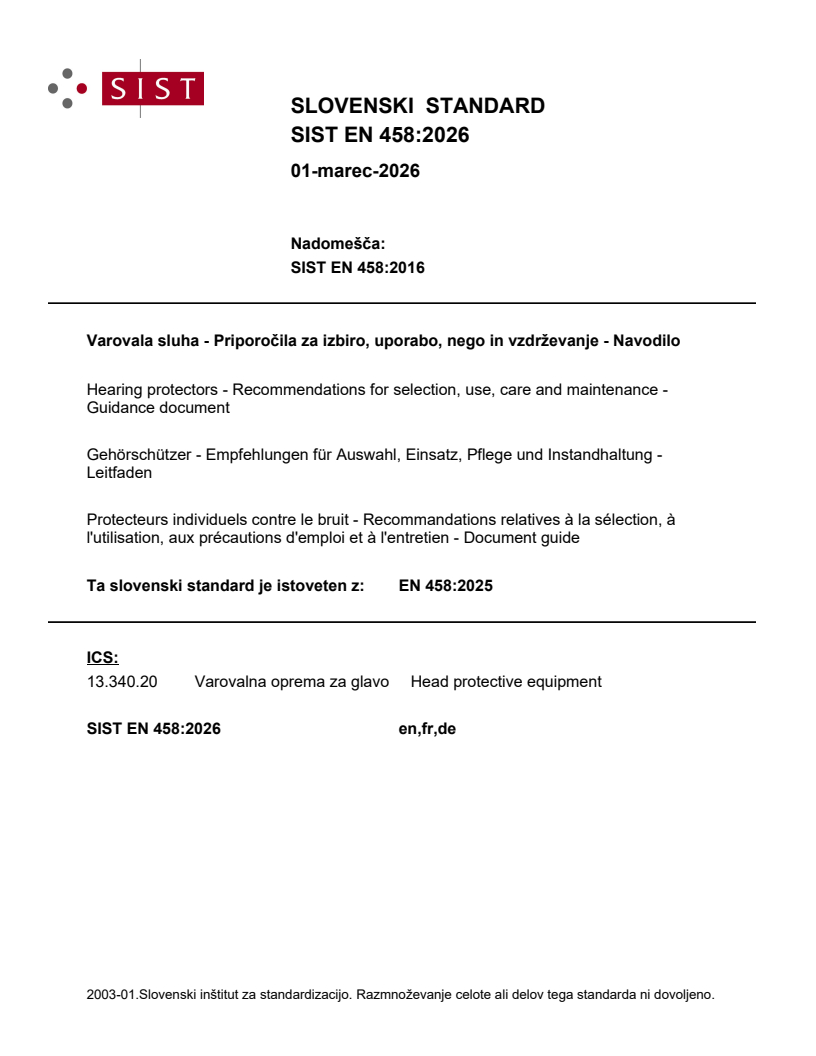
SLOVENSKI STANDARD
01-marec-2026
Nadomešča:
SIST EN 458:2016
Varovala sluha - Priporočila za izbiro, uporabo, nego in vzdrževanje - Navodilo
Hearing protectors - Recommendations for selection, use, care and maintenance -
Guidance document
Gehörschützer - Empfehlungen für Auswahl, Einsatz, Pflege und Instandhaltung -
Leitfaden
Protecteurs individuels contre le bruit - Recommandations relatives à la sélection, à
l'utilisation, aux précautions d'emploi et à l'entretien - Document guide
Ta slovenski standard je istoveten z: EN 458:2025
ICS:
13.340.20 Varovalna oprema za glavo Head protective equipment
2003-01.Slovenski inštitut za standardizacijo. Razmnoževanje celote ali delov tega standarda ni dovoljeno.
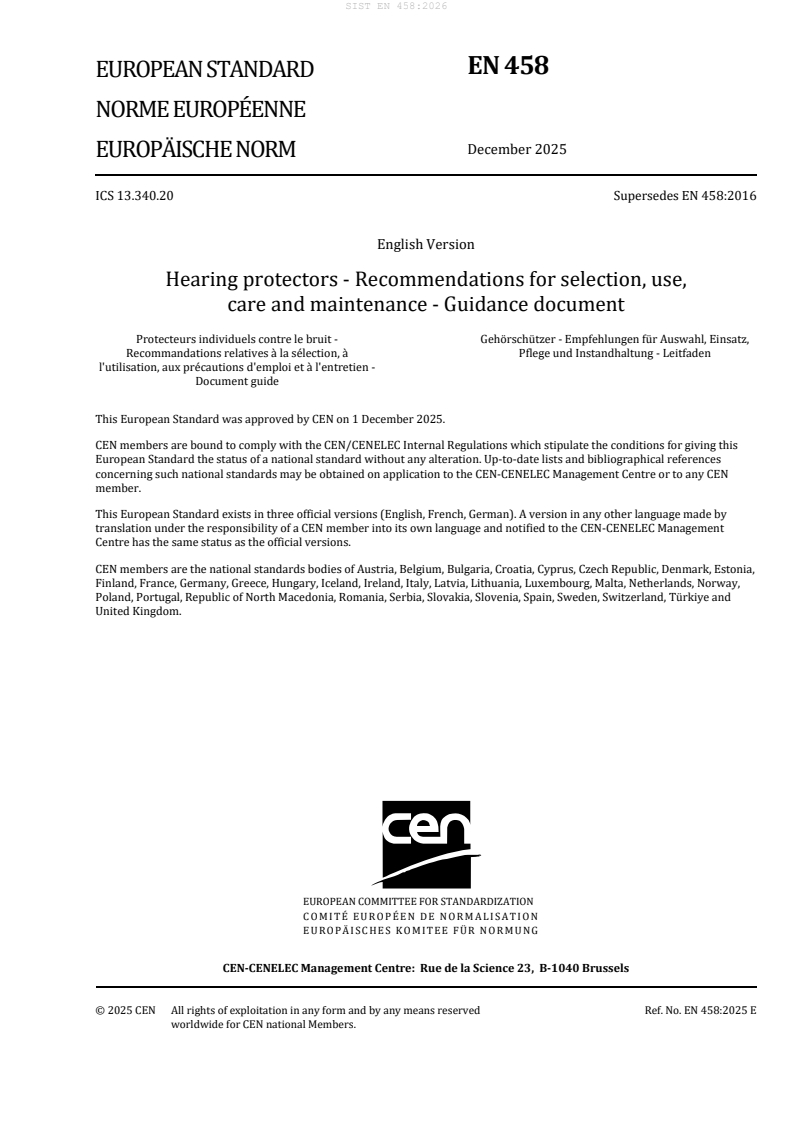
EN 458
EUROPEAN STANDARD
NORME EUROPÉENNE
December 2025
EUROPÄISCHE NORM
ICS 13.340.20 Supersedes EN 458:2016
English Version
Hearing protectors - Recommendations for selection, use,
care and maintenance - Guidance document
Protecteurs individuels contre le bruit - Gehörschützer - Empfehlungen für Auswahl, Einsatz,
Recommandations relatives à la sélection, à Pflege und Instandhaltung - Leitfaden
l'utilisation, aux précautions d'emploi et à l'entretien -
Document guide
This European Standard was approved by CEN on 1 December 2025.
CEN members are bound to comply with the CEN/CENELEC Internal Regulations which stipulate the conditions for giving this
European Standard the status of a national standard without any alteration. Up-to-date lists and bibliographical references
concerning such national standards may be obtained on application to the CEN-CENELEC Management Centre or to any CEN
member.
This European Standard exists in three official versions (English, French, German). A version in any other language made by
translation under the responsibility of a CEN member into its own language and notified to the CEN-CENELEC Management
Centre has the same status as the official versions.
CEN members are the national standards bodies of Austria, Belgium, Bulgaria, Croatia, Cyprus, Czech Republic, Denmark, Estonia,
Finland, France, Germany, Greece, Hungary, Iceland, Ireland, Italy, Latvia, Lithuania, Luxembourg, Malta, Netherlands, Norway,
Poland, Portugal, Republic of North Macedonia, Romania, Serbia, Slovakia, Slovenia, Spain, Sweden, Switzerland, Türkiye and
United Kingdom.
EUROPEAN COMMITTEE FOR STANDARDIZATION
COMITÉ EUROPÉEN DE NORMALISATION
EUROPÄISCHES KOMITEE FÜR NORMUNG
CEN-CENELEC Management Centre: Rue de la Science 23, B-1040 Brussels
© 2025 CEN All rights of exploitation in any form and by any means reserved Ref. No. EN 458:2025 E
worldwide for CEN national Members.
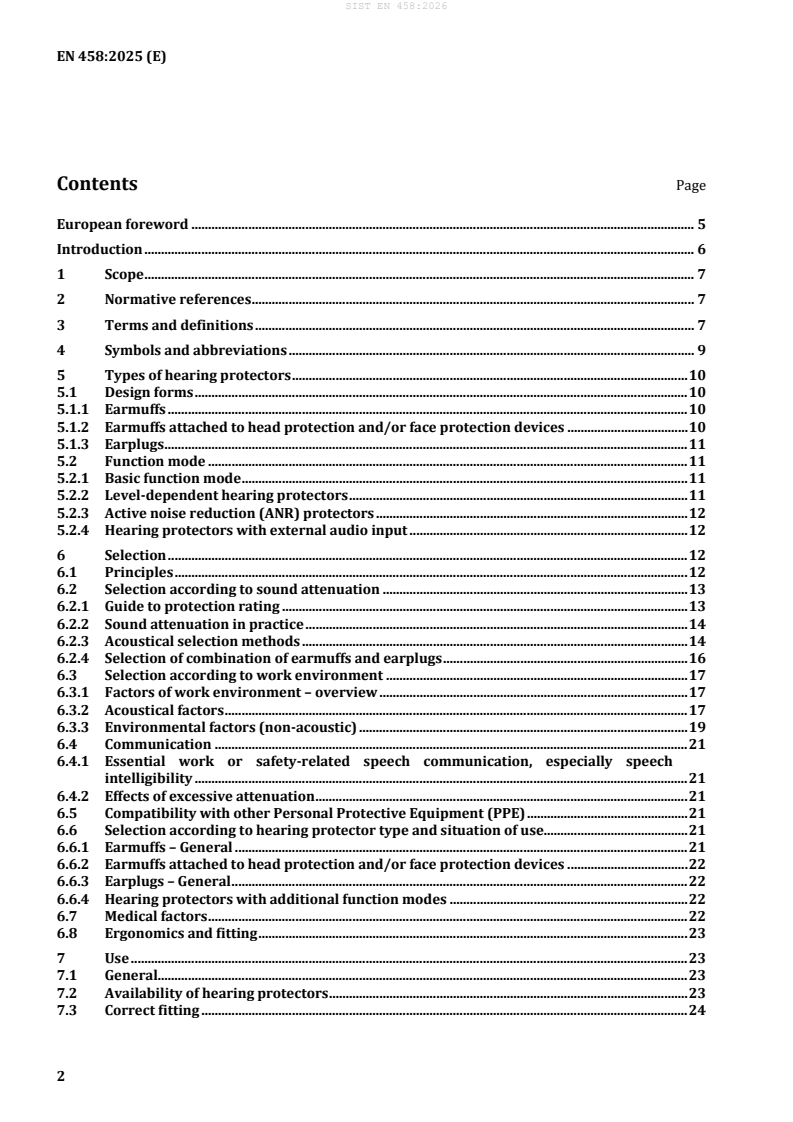
Contents Page
European foreword . 5
Introduction . 6
1 Scope . 7
2 Normative references . 7
3 Terms and definitions . 7
4 Symbols and abbreviations . 9
5 Types of hearing protectors . 10
5.1 Design forms . 10
5.1.1 Earmuffs . 10
5.1.2 Earmuffs attached to head protection and/or face protection devices . 10
5.1.3 Earplugs . 11
5.2 Function mode . 11
5.2.1 Basic function mode . 11
5.2.2 Level-dependent hearing protectors . 11
5.2.3 Active noise reduction (ANR) protectors . 12
5.2.4 Hearing protectors with external audio input . 12
6 Selection . 12
6.1 Principles . 12
6.2 Selection according to sound attenuation . 13
6.2.1 Guide to protection rating . 13
6.2.2 Sound attenuation in practice . 14
6.2.3 Acoustical selection methods . 14
6.2.4 Selection of combination of earmuffs and earplugs . 16
6.3 Selection according to work environment . 17
6.3.1 Factors of work environment – overview . 17
6.3.2 Acoustical factors . 17
6.3.3 Environmental factors (non-acoustic) . 19
6.4 Communication . 21
6.4.1 Essential work or safety-related speech communication, especially speech
intelligibility . 21
6.4.2 Effects of excessive attenuation . 21
6.5 Compatibility with other Personal Protective Equipment (PPE) . 21
6.6 Selection according to hearing protector type and situation of use. 21
6.6.1 Earmuffs – General . 21
6.6.2 Earmuffs attached to head protection and/or face protection devices . 22
6.6.3 Earplugs – General . 22
6.6.4 Hearing protectors with additional function modes . 22
6.7 Medical factors . 22
6.8 Ergonomics and fitting . 23
7 Use . 23
7.1 General. 23
7.2 Availability of hearing protectors . 23
7.3 Correct fitting . 24
7.3.1 General . 24
7.3.2 Earmuffs . 24
7.3.3 Earplugs . 25
7.4 Simultaneous use of hearing protectors with other PPE . 25
7.4.1 General . 25
7.4.2 Protective clothing . 25
7.4.3 Spectacles . 25
7.4.4 Goggles . 25
7.4.5 Face shields . 26
7.4.6 Hoods . 26
7.4.7 Head protection . 26
7.4.8 Respiratory protection devices . 26
7.5 Speech intelligibility and signal audibility . 26
7.6 Instruction and training . 26
7.6.1 General . 26
7.6.2 Information . 26
7.6.3 Special instructions for use including training . 27
7.7 Period of use . 27
7.8 Leisure activities . 28
8 Care and maintenance . 28
8.1 General . 28
8.2 Hygiene and cleaning . 29
8.3 Inspection and replacement . 29
8.4 Storage . 29
8.5 Disposal . 29
9 Sustainability . 29
Annex A (informative) Methods for estimating the level effective to the ear when selecting
a hearing protector based on the national regulation level L' . 30
NR
A.1 General . 30
A.2 Octave band method . 33
A.3 HML method . 34
A.4 HML check method . 35
A.5 SNR method . 37
Annex B (informative) Method for estimating the level effective to the ear when selecting a
hearing protector based on the national peak regulation level L' . 38
NR,peak
B.1 General . 38
B.2 Method . 38
Annex C (informative) Selection method for sound-restoration level-dependent hearing
protectors intended for all types of noise environment using HML-criterion values . 40
C.1 General . 40
C.2 Method 1: HML method . 40
C.3 Method 2A: HML check method – Measurement check . 41
C.4 Method 2B: HML check method – Listening method . 41
Annex D (informative) Calculation method for hearing protectors with audio input . 42
D.1 General . 42
D.2 Method . 42
Annex E (informative) Improving field performance and special instructions for use . 44
E.1 Improving field performance . 44
E.2 Instructions for use . 45
Annex F (informative) Further guidance on individual fit testing methods . 48
F.1 General information . 48
F.2 Available individual fit testing methods . 48
Annex G (informative) Noise types . 50
Annex H (informative) Sustainability . 53
H.1 General. 53
H.2 Manufacturer evaluation (sourcing) . 53
H.3 Product attributes (sourcing and safety) . 54
H.4 Instruction and training (supervision) . 54
H.5 Cleaning, maintenance and disposal (correct use) . 55
H.6 Transportation, distribution and storage (safety and sourcing) . 55
Annex I (informative) Significant technical changes between this document and the
previous edition EN 458:2016. 56
Bibliography . 58
European foreword
This document (EN 458:2025) has been prepared by Technical Committee CEN/TC 159 “Hearing
protectors” the secretariat of which is held by DIN.
This European Standard shall be given the status of a national standard, either by publication of an
identical text or by endorsement, at the latest by June 2026, and conflicting national standards shall be
withdrawn at the latest by June 2026.
Attention is drawn to the possibility that some of the elements of this document may be the subject of
patent rights. CEN shall not be held responsible for identifying any or all such patent rights.
This document supersedes EN 458:2016.
The main changes compared to the previous edition are listed in Annex I, Table I.1.
Any feedback and questions on this document should be directed to the users’ national standards body.
A complete listing of these bodies can be found on the CEN website.
According to the CEN-CENELEC Internal Regulations, the national standards organisations of the
following countries are bound to implement this European Standard: Austria, Belgium, Bulgaria,
Croatia, Cyprus, Czech Republic, Denmark, Estonia, Finland, France, Germany, Greece, Hungary, Iceland,
Ireland, Italy, Latvia, Lithuania, Luxembourg, Malta, Netherlands, Norway, Poland, Portugal, Republic of
North Macedonia, Romania, Serbia, Slovakia, Slovenia, Spain, Sweden, Switzerland, Türkiye and the
United Kingdom.
Introduction
This document is intended to guide employers, supervisors and safety advisors. Additionally, this
document gives information to all who need to use hearing protectors.
Hearing protectors are intended to protect against the risk of harmful noise and are elevated into the
highest risk Category III under the Personal Protective Equipment Regulation (EU) 2016/425, which
can cause irreversible health effects or can be potentially life threatening. They are intended to reduce
the harmful effects that sound and noise can have on the hearing of an individual. Requirements for
hearing protection products are given in the EN 352 series.
Guidance is provided on how to best select, use and maintain hearing protectors and check for
compatibility for other equipment (e.g. Personal Protective Equipment (PPE), communication devices
and hearing aids). Calculation procedures to estimate the residual noise exposure level, when a certain
hearing protector is used, are also provided.
National bodies can develop their own local application documents based on this document.
Hearing protectors are generally available in two main forms: earmuffs and earplugs. Both forms are
available with additional features and functions. All have their advantages and disadvantages in terms
of attenuation, comfort, ease of use, communication facilities and cost.
In hearing conservation programmes noise hazard areas are identified and the personal noise exposure
is assessed. Before a suitable hearing protector is considered, priority should be given to reducing noise
at source and/or reducing the exposure time.
If the use of a hearing protector is found necessary or advisable, choosing optimum devices is a complex
task. The most important aspects for hearing protector performance include sufficient attenuation and
usage during the entire exposure period.
It is often desirable to retain the ability to hear speech and warning signals. If the hearing protector is a
passive device only, the hearing protector should not provide excessive attenuation (over-protection),
which can create a feeling of isolation and difficulties with perception of important sounds. In
particular, this needs attention at moderate noise levels.
Hearing protectors are supplied with attenuation data in various formats. The attenuation is expressed
in decibels and has been derived from laboratory tests. It is important to note that these data have been
achieved under controlled laboratory conditions using trained test subjects. Under real working
conditions, the attenuation achieved by the user can be lower than that generated by the laboratory
testing.
The performance of hearing protectors is subject to natural variability in the anatomy amongst users.
Correct fitting, training, regular inspection and user motivation are important to obtain the desired
protection. Due to the natural variability, it is not possible to calculate the exact attenuation that a
certain hearing protector will give for an individual. If a more accurate prediction is required, an
individual fit test is strongly recommended. At high noise level exposures it is advisable to seek expert
advice. In some cases dual protection, i.e. the use of an earmuff and an earplug combination, can be
required.
For hearing protectors to be effective they should be used at all times when the user is in a potentially
hazardous noise environment. When selecting hearing protectors, attention should be given to factors
influencing comfort and user preference.
This document also provides advice on how to consider sustainability.
1 Scope
This document gives recommendations for the selection, use, care and maintenance of hearing
protectors.
2 Normative references
The following documents are referred to in the text in such a way that some or all of their content
constitutes requirements of this document. For dated references, only the edition cited applies. For
undated references, the latest edition of the referenced document (including any amendments) applies.
EN 352-6, Hearing protectors — Safety requirements — Part 6: Earmuffs with safety-related audio input
EN 352-8, Hearing protectors — Safety requirements — Part 8: Entertainment audio earmuffs
EN 352-9, Hearing protectors — Safety requirements — Part 9: Earplugs with safety-related audio input
EN 352-10, Hearing protectors — Safety requirements — Part 10: Entertainment audio earplugs
3 Terms and definitions
For the purposes of this document, the following terms and definitions apply.
ISO and IEC maintain terminology databases for use in standardization at the following addresses:
— ISO Online browsing platform: available at https://www.iso.org/obp/
— IEC Electropedia: available at https://www.electropedia.org/
3.1
daily noise exposure level
L
EX,8h
A-weighted noise exposure level normalized to a nominal 8 h working day according to EN ISO 9612
3.2
peak sound pressure level
Lp,Cpeak
C-weighted instantaneous peak sound pressure level according to EN ISO 9612
3.3
national regulation level
L'
NR
daily noise exposure level (L ) effective to the ear according to national regulations
EX,8h
Note 1 to entry: National laws or regulations determine the levels of exposure at which hearing protectors are
provided or used.
3.4
national peak regulation level
L'NR,peak
peak pressure level L effective to the ear according to national regulations
p,Cpeak
Note 1 to entry: National laws or regulations determine the levels of exposure at which hearing protectors are
provided or used.
3.5
effective attenuation
measure of protection afforded by the hearing protector for the user
3.6
A-weighted sound pressure level
Lp,A
sound pressure level with frequency weighting A according to EN 61672-1
3.7
A-weighted sound pressure level effective to the ear
L'
p,A
A-weighted diffuse-field related sound pressure level under the hearing protector for the external
sound pressure level L
p,A
3.8
C-weighted sound pressure level
Lp,C
sound pressure level with frequency weighting C according to EN 61672-1
3.9
A-weighted equivalent sound pressure level effective to the ear
L'p,A,eqT
A-weighted diffuse-field related equivalent sound pressure level under the hearing protector for the
external equivalent sound pressure level for time period T, L
p,A,eqT
Note 1 to entry: For simplicity of notation, the subscript T is omitted throughout the following text.
3.10
daily noise exposure level effective to the ear
L'EX,8h
A-weighted diffuse-field related equivalent sound pressure level under the hearing protector for the
external daily noise exposure level LEX,8h
3.11
peak sound pressure level effective to the ear
L'
p,Cpeak
C-weighted peak sound pressure level under the hearing protector for the external sound pressure
level Lp,Cpeak
3.12
flat frequency response
attenuation which is constant (or nearly constant) over the frequency range between 125 Hz and
8 000 Hz
Note 1 to entry: The slope of the linear regression of mean attenuation values from 125 Hz up to 4 000 Hz fulfils
the criterion proposed by Liedtke [25] with a value lower than 3,6 dB, or very approximately H – L < 9 dB. See A.1
for explanation of “H” and “L”.
3.13
fit testing
procedure for checking that a specific hearing protector is suitable for use by a
specific individual by assessing the physical fit, seal, sound attenuation or other properties of the
hearing protector
[SOURCE: EN 17479:2021, 3.1]
3.14
personal attenuation rating
PAR
individual attenuation given as a single value in dB that a user obtains for the fit of the hearing
protector that was tested
Note 1 to entry: The PAR can be either the combined left-right (binaural) or separate left-right ear value.
Note 2 to entry: The calculation procedure is not standardized and is specified by the manufacturer for a specific
fit testing method.
[SOURCE: EN 17479:2021, 3.4]
4 Symbols and abbreviations
For the purposes of this document, the following symbols and abbreviations apply.
f centre frequency of the octave band in Hz
Lp,eq equivalent sound pressure level
L sound pressure level for a single octave band
p,oct
L equivalent sound pressure level for a single octave band
p,oct,eq
PNR predicted noise level reduction according to EN ISO 4869-2
APV assumed protection value APV according to EN ISO 4869-2
f f84
H high-frequency attenuation value
M middle-frequency attenuation value
L low-frequency attenuation value
SNR Single Number Rating
rms root mean square
LEX,8h daily noise exposure level
L C-weighted peak sound pressure level
p,Cpeak
L' national regulation level
NR
L' national peak regulation level
NR,peak
L A-weighted sound pressure level
p,A
L' A-weighted sound pressure level effective to the ear
p,A
Lp,C C-weighted sound pressure level
Lp,A,eqT A-weighted equivalent sound pressure level
Lp,C,eqT C-weighted equivalent sound pressure level
L'p,A,eqT A-weighted equivalent sound pressure level effective to the ear
NOTE For simplification of notation, the subscript T is omitted throughout the following text.
L' daily noise exposure level effective to the ear
EX,8h
L' peak sound pressure level effective to the ear
p,Cpeak
L maximum value of the sound pressure level with time-weighting F (fast) and frequency
C,Fmax
weighting C
L maximum value of the sound pressure level with time-weighting F (fast) and frequency
A,Fmax
weighting A
Af frequency weighting A in dB for octave band centre frequency ƒ
Lcrit criterion level
Lmax maximum input signal level to the protector audio input
Ucrit criterion voltage
U maximum rms voltage input to the protector audio input
max
K constant for corresponding national regulation level
n maximum number of hours for use of audio input
PPE personal protective equipment
ANR active noise reduction
REAT real ear attenuation at threshold
dm modified sound attenuation value
5 Types of hearing protectors
5.1 Design forms
5.1.1 Earmuffs
Earmuffs consist of cups which fit over the ears and are sealed to the head with soft cushions, usually
filled with foam and/or liquid. The cups are usually lined with sound absorptive material. They are
connected by a tensioning band (head band), usually made of metal and/or plastic. When the earmuff is
used behind-the-head or under-the-chin and has a mass in excess of 150 g, a flexible head strap is fitted
to each cup or to the head band close to the cups to support the earmuff. Some earmuffs have one cup
intended only for the left ear and the other only for the right ear. Earmuffs can be available in ‘medium
size range’, ‘small size range’ and ‘large size range’ types. ‘Medium size range' earmuffs will fit the
majority of users. ‘Small size range' or ‘large size range' earmuffs are designed to fit users for whom
‘medium size range' earmuffs are not suitable.
Earmuffs are available with head bands, neck bands, chin bands and universal bands. Earmuffs with
neck bands and chin bands permit the simultaneous using of a safety helmet. Universal bands can be
used over-the-head, behind-the-head or under-the-chin.
Requirements for earmuffs are specified in EN 352-1.
5.1.2 Earmuffs attached to head protection and/or face protection devices
Earmuffs attached to head protection and/or face protection devices (also called mounted earmuffs)
consist of individual cups attached to arms that are mounted to a safety helmet or other equipment
serving as carrier for the hearing protector, such as the rigid head top of a powered and supplied air
respirator system. The arms are adjustable so that the cups can be positioned over the ears.
Requirements for earmuffs attached to head protection and/or face protection devices are specified in
EN 352-3.
5.1.3 Earplugs
5.1.3.1 General
Earplugs are hearing protectors that are designed to be inserted into the ear canal or to cover the ear
canal entrance. They are sometimes provided with an interconnecting cord (corded earplugs), rigid
band or finger grips. Earplugs can be either disposable (intended for single use) or reusable (intended
for repeated use). All types of earplugs except custom moulded earplugs can be available in a range of
sizes.
Requirements for earplugs are specified in EN 352-2.
5.1.3.2 Pre-shaped earplugs
Pre-shaped earplugs can readily be inserted into the ear canal without prior shaping. Pre-shaped
earplugs are available in a variety of materials.
5.1.3.3 User-formable earplugs
User-formable earplugs are made from compressible or malleable materials that the user forms before
insertion. Compressible earplugs are designed to expand to form the seal within the ear canal after
insertion.
5.1.3.4 Banded earplugs
Banded earplugs are pre-shaped earplugs attached to a band which presses them into the ear canal or
against the entrance of the ear canal. Some are intended to be used in more than one position, e.g. with
the band under-the-chin.
5.1.3.5 Custom moulded earplugs
Custom moulded earplugs are individually moulded to fit the shape of the user’s ear canals typically
using an impression or a scan of the concha and the ear canal of the user. They can be manufactured in a
range of materials and with different acoustic filters to offer a range of attenuation.
5.2 Function mode
5.2.1 Basic function mode
All hearing protectors have the characteristics of reducing noise by their design and type of material
used, to absorb and/or reflect sound. Devices that have only this function are called passive devices.
They constitute the basis for all other additional function modes as described in 5.2.2 to 5.2.4.
5.2.2 Level-dependent hearing protectors
5.2.2.1 General
Level-dependent hearing protectors are designed to provide different attenuation as the external sound
level changes. Their main purpose is to protect against impulsive or intermittent hazardous noise while
allowing situational awareness.
5.2.2.2 Passive level-dependent hearing protectors
Passive level-dependent hearing protectors use the acoustic properties of carefully designed air ducts
to give different attenuation depending on the noise level. These types of hearing protectors are
designed to be effective against very high level single-impulse noises, such as firearms, rather than the
continuous noise or repetitive impulses found in most industrial situations.
5.2.2.3 Sound-restoration level-dependent hearing protectors
Sound-restoration level-dependent hearing protectors incorporate an electronic sound reproduction
system. At low sound pressure levels, the sound detected by an external microphone is relayed to a
loudspeaker inside the earmuff or earplug. As the external sound pressure level increases, the
electronics reduce the gain and control the level of reproduced sound inside the hearing protector.
Requirements for level-dependent hearing protectors are specified in EN 352-4 (for earmuffs) and
EN 352-7 (for earplugs), e.g. minimum criterion levels.
There are two types of sound-restoration level-dependent hearing protectors: products only intended
for use in impulsive type noise situations and products for all types of noise environment (continuous,
fluctuating and intermittent noise including impulsive noise, see Annex G).
5.2.3 Active noise reduction (ANR) protectors
Active noise reduction protectors are hearing protectors which incorporate an electronic sound
cancelling system to achieve additional noise attenuation where passive hearing protectors can be less
effective. ANR is particularly effective for continuous noise at low frequencies (50 Hz to 500 Hz) (see
Annex G).
Requirements for active noise reduction earmuffs are specified in EN 352-5.
5.2.4 Hearing protectors with external audio input
5.2.4.1 General
These devices use a wired or wireless system through which communication signals, alarms, messages
or audio entertainment can be relayed. Some products incorporate a system to limit the sound pressure
level.
5.2.4.2 Hearing protector with entertainment audio input
These devices can incorporate a radio receiver set or music player for entertainment or allow audio
input from external devices. The entertainment audio input is limited to 82 dB(A).
Requirements for entertainment audio hearing protectors are specified in EN 352-8 (for earmuffs) and
EN 352-10 (for earplugs).
5.2.4.3 Hearing protector with safety-related audio input
These devices include wired or wireless input and/or built-in two-way radio and can be used for work-
related or safety-related communication. As the information to be received might be crucial for safety,
the product standards impose no limitation on the reproduced sound pressure level at the ear.
Requirements for hearing protectors with safety-related audio input (for work or safety-related
communication) are specified in EN 352-6 (for earmuffs) and EN 352-9 (for earplugs).
6 Selection
6.1 Principles
Personal hearing protection should be selected so that, when used correctly and for the entire duration
of exposure, it will eliminate or minimize the risk to hearing.
As there are many different hearing protectors intended for use in a wide range of noise environments
it is important to choose a suitable type. The product shall be checked for regulatory conformance.
Consideration should be given to the factors listed in a) to h). The list is neither exclusive nor
exhaustive:
a) sound attenuation, see 6.2;
b) work environment, see 6.3;
c) essential work or safety-related communication, especially speech intelligibility, see 6.4;
d) compatibility with other personal protective equipment (PPE), such as helmets, spectacles, etc., see
6.5;
e) the interaction between the user and the situation of use, see 6.6;
f) medical factors, see 6.7;
g) user comfort and ergonomic requirements, see 6.8;
h) sustainability aspects of the products, see Clause 9.
The selection procedure should be reviewed at regular intervals to ensure that an effective attenuation
is maintained. When considering all factors in the selection process the most important outcome is that
the hearing protector will be used during the whole time of noise exposure.
6.2 Selection according to sound attenuation
6.2.1 Guide to protection rating
Hearing protectors should be chosen according to the sound attenuation they will provide. Methods to
predict the sound attenuation of hearing protectors are given in 6.2.3.
NOTE 1 It is generally accepted that the risk of hearing damage associated with occupational noise exposure is
low where the daily noise exposure level (LEX,8h) is below 80 dB, and insignificant where LEX,8h is below 75 dB.
NOTE 2 National regulations or other guidelines can stipulate selection criteria for personal hearing protection
and place limits on sound exposure. Such relevant criteria and limits are often taken into account in deciding what
level of sound attenuation is required.
In general, a hearing protector which provides an effective sound level at the ear (L' ) of between
p,A,eq
70 dB and 80 dB is considered suitable. If the chosen hearing protector provides excessive attenuation,
users are at risk of failing to recognize warning signals and understand essential communications. Users
can also feel isolated from their working environment. The perception of isolation increases as the
sound level effective to the ear decreases.
Workers can be exposed to different noise environments during the working day. It can be possible to
select a single hearing protector which is adequate for all situations likely to be encountered, or in some
situations, to select more than one type of hearing protector.
EXAMPLE 1 A worker’s only significant noise exposure is to an Lp,A,eq of 98 dB, for a total of 30 min per day. His
L is 86 dB. His employer wishes to minimize the risk to the worker’s hearing, and so aims to provide a hearing
EX,8h
protector that provides an effective sound pressure level at the ear of below 80 dB, ideally between 75 dB and
70 dB during the noise exposure. Using the HML check method, the employer selects a protector that provides a
sound attenuation of M = 26 dB.
EXAMPLE 2 A worker spends the majority of her working day (a total of 6 h) in an environment with an L of
p,A,eq
94 dB. Her L is around 93 dB. Her employer wishes to reduce the effective L' to at least below 80 dB, and to
EX,8h EX,8h
minimize the risk to the worker’s hearing. The employer rejects a protector that provides a sound attenuation of
M = 32 dB, as this would reduce the effective sound pressure level at the ear to 62 dB and so risk excessive
attenuation. Using the HML check method, the employer selects a protector that provides a sound attenuation of
M = 22 dB.
6.2.2 Sound attenuation in practice
The attenuation afforded by a hearing protector when used under normal working conditions can differ
from that indicated on the device packaging or in the user information. This can be due to factors
including incorrect selection of type and/or size, use (see Clause 7), misuse and poor maintenance. For
remarks on improving field performance see Annex E.
These differences can be overcome by appropriate information, instruction and on-going training in the
use of the product. There are tools, referred to as “fit testing systems” that allow individual tests to be
carried out to verify the correct fit. Further information and guidance on these systems can be found in
7.3 and more extensively in EN 17479.
In the absence of fit testing, some countries have published specific guidance on de-rating the published
data in an attempt to address the issue of attenuation in practice. Refer to national guidance for further
information.
NOTE Sound attenuation in practice can be referred to as real-world attenuation or field attenuation.
6.2.3 Acoustical selection methods
6.2.3.1 Overview of applicable methods
The applicability of methods for estimating the sound pressure level effective to the ear for different
types of hearing protector is summarized in Table 1. If the risk assessment indicates that the national
peak regulation level is likely to be exceeded, refer also to the last column of Table 1.
Table 1 — Applicability of acoustical selection methods to different types of hearing protector
Type of hearing protector Selection based only on L'NR Selection also based on L'NR,peak
Passive Annex A Annex B
Passive level dependent Annex A Annex B
a
Sound restoration level dependent Annex C Annex B
b a
ANR Annex A Annex B
a
Audio input Annex A and Annex D Annex B
c c
Dual hearing protection Annex A Annex B
a
using the passive attenuation data
b
using the total (passive and active) attenuation data
c
using the passive attenuation data for the combination
6.2.3.2 Methods for estimating the level effective to the ear when selecting a hearing protector
based on the national regulation level L'NR
This approach is suitable for continuous, fluctuating and intermittent noise.
When selecting a suitable hearing protector, consideration should be given to the characteristics of the
noise and the attenuation data of potentially suitable hearing prote
...