

EN 352-2:2020+A1:2024
(Main + Amendment)Hearing protectors - General requirements - Part 2: Earplugs
- Abstract
This document specifies requirements on construction, design, performance, marking and user information for earplugs.
In particular, it specifies requirements regarding the sound attenuation of the earplugs, measured in accordance with EN ISO 4869-1:2018.
This document applies to earplugs designed for users who are able to follow supplied instructions and understand the related risks, can fit the earplugs correctly and can give feedback on the performance.
Ergonomic aspects are addressed by taking into account, within the requirements, the interaction between the user, the device and where possible the working environment in which the device is likely to be used (see Annex ZA and EN 458).
- Status
- Published
- Publication Date
- 11-Jun-2024
- Technical Committee
- CEN/TC 159 - Hearing protectors
- Current Stage
- 9060 - Closure of 2 Year Review Enquiry - Review Enquiry
- Start Date
- 04-Jun-2026
- Completion Date
- 04-Jun-2026
- Directive
- 2016/425 - Regulation (EU) 2016/425 of the European Parliament and of the Council of 9 March 2016 on personal protective equipment and repealing Council Directive 89/686/EECOJ Ref: 2025/895, OJ, OJ L, OJ L, 2025/895 OJ Date: 16-May-2025

Overview
EN 352-2:2020+A1:2024 - published by CEN - is the European standard that sets general requirements for earplugs as personal hearing protectors. It covers construction, design, performance, marking and user information for aural, semi-aural, disposable, re‑usable, custom‑moulded and banded earplugs. The standard requires declaration and measurement of sound attenuation in accordance with EN ISO 4869-1:2018 and addresses ergonomic interaction between the user, the device and the working environment. Amendment A1 (2024) adds/updates requirements primarily for banded earplugs.
Key topics and technical requirements
- Sound attenuation: Measured per EN ISO 4869-1:2018; manufacturers must declare attenuation values and meet specified minimum attenuation requirements to support correct product selection.
- Performance testing: Physical and acoustic test methods referenced (e.g., EN 13819-1:2020+A1:2024 for physical tests and EN 13819-2:2020 for acoustic test methods).
- Sizing and adjustability:
- Nominal diameter or range must be reported for aural earplugs (except custom‑moulded and semi‑aural types).
- Specific adjustability and sizing requirements for banded earplugs (medium/small/large size ranges; over‑the‑head, behind‑the‑head, under‑the‑chin configurations).
- Materials and construction: Requirements for materials and robustness (drop resistance, low‑temperature resistance as applicable), cleaning and ignitability.
- Marking and user information:
- Mandatory marking and packaging information.
- Clear instructions for fitting, care, limitations and warnings. Applies to users able to follow instructions and give feedback on fit/performance.
- Ergonomics: Consideration of user-device-environment interactions and reference to selection/use guidance (EN 458).
Practical applications
- Ensures earplugs sold in Europe meet consistent safety, performance and labelling criteria.
- Used by manufacturers to design, test and declare compliant earplugs.
- Used by procurement teams, safety officers and PPE specialists to select earplugs appropriate for workplace noise exposures.
- Supports compliance with EU Regulation 2016/425 for personal protective equipment (see Annex ZA).
Who would use this standard
- Earplug and hearing protector manufacturers
- Product designers and R&D teams
- Certification bodies and test laboratories
- Occupational health & safety professionals and PPE procurement managers
Related standards
- EN ISO 4869-1:2018 (attenuation measurement)
- EN ISO 4869-2:2018 (estimation of effective A‑weighted sound levels)
- EN 13819-1 / EN 13819-2 (test methods)
- EN 458 (selection, use, care and maintenance of hearing protection)
Keywords: EN 352-2, earplugs, hearing protectors, sound attenuation, EN ISO 4869-1, banded earplugs, PPE, CEN, marking, user information.
Relations
- Effective Date
- 17-Apr-2024
- Effective Date
- 17-Apr-2024
- Effective Date
- 28-Jan-2026
- Effective Date
- 28-Jan-2026
- Effective Date
- 28-Jan-2026
- Effective Date
- 28-Jan-2026
- Effective Date
- 28-Jan-2026
- Effective Date
- 28-Jan-2026
Get Certified
Connect with accredited certification bodies for this standard

CIS Institut d.o.o.
Personal Protective Equipment (PPE) certification body. Notified Body NB-2890 for EU Regulation 2016/425 PPE.

Kiwa BDA Testing
Building and construction product certification.
Kmetijski inštitut Slovenije
Agricultural Institute of Slovenia. Soil testing, plant health, agricultural product analysis.
Sponsored listings
Frequently Asked Questions
EN 352-2:2020+A1:2024 is a standard published by the European Committee for Standardization (CEN). Its full title is "Hearing protectors - General requirements - Part 2: Earplugs". This standard covers: This document specifies requirements on construction, design, performance, marking and user information for earplugs. In particular, it specifies requirements regarding the sound attenuation of the earplugs, measured in accordance with EN ISO 4869-1:2018. This document applies to earplugs designed for users who are able to follow supplied instructions and understand the related risks, can fit the earplugs correctly and can give feedback on the performance. Ergonomic aspects are addressed by taking into account, within the requirements, the interaction between the user, the device and where possible the working environment in which the device is likely to be used (see Annex ZA and EN 458).
This document specifies requirements on construction, design, performance, marking and user information for earplugs. In particular, it specifies requirements regarding the sound attenuation of the earplugs, measured in accordance with EN ISO 4869-1:2018. This document applies to earplugs designed for users who are able to follow supplied instructions and understand the related risks, can fit the earplugs correctly and can give feedback on the performance. Ergonomic aspects are addressed by taking into account, within the requirements, the interaction between the user, the device and where possible the working environment in which the device is likely to be used (see Annex ZA and EN 458).
EN 352-2:2020+A1:2024 is classified under the following ICS (International Classification for Standards) categories: 13.340.20 - Head protective equipment. The ICS classification helps identify the subject area and facilitates finding related standards.
EN 352-2:2020+A1:2024 has the following relationships with other standards: It is inter standard links to EN 352-2:2020/FprA1, EN 352-2:2020, EN 13819-1:2020+A1:2024, EN 13819-2:2020, EN ISO 4869-2:2018, EN 458:2004, EN 458:2016, EN 17558:2023. Understanding these relationships helps ensure you are using the most current and applicable version of the standard.
EN 352-2:2020+A1:2024 is associated with the following European legislation: EU Directives/Regulations: 2016/425; Standardization Mandates: M/571, M/571 AMD 1. When a standard is cited in the Official Journal of the European Union, products manufactured in conformity with it benefit from a presumption of conformity with the essential requirements of the corresponding EU directive or regulation.
EN 352-2:2020+A1:2024 is available in PDF format for immediate download after purchase. The document can be added to your cart and obtained through the secure checkout process. Digital delivery ensures instant access to the complete standard document.
Standards Content (Sample)
SLOVENSKI STANDARD
01-november-2024
Varovala sluha - Splošne zahteve - 2. del: Ušesni čepi (vključno z dopolnilom A1)
Hearing protectors - General requirements - Part 2: Earplugs
Gehörschützer - Allgemeine Anforderungen - Teil 2: Gehörschutzstöpsel
Protecteurs individuels contre le bruit - Exigences générales - Partie 2 : Bouchons
d'oreille
Ta slovenski standard je istoveten z: EN 352-2:2020+A1:2024
ICS:
13.340.20 Varovalna oprema za glavo Head protective equipment
2003-01.Slovenski inštitut za standardizacijo. Razmnoževanje celote ali delov tega standarda ni dovoljeno.
EN 352-2:2020+A1
EUROPEAN STANDARD
NORME EUROPÉENNE
June 2024
EUROPÄISCHE NORM
ICS 13.340.20 Supersedes EN 352-2:2020
English Version
Hearing protectors - General requirements - Part 2:
Earplugs
Protecteurs individuels contre le bruit - Exigences Gehörschützer - Allgemeine Anforderungen - Teil 2:
générales - Partie 2 : Bouchons d'oreille Gehörschutzstöpsel
This European Standard was approved by CEN on 24 February 2020 and includes Amendment 1 approved by CEN on 5 May
2024.
CEN members are bound to comply with the CEN/CENELEC Internal Regulations which stipulate the conditions for giving this
European Standard the status of a national standard without any alteration. Up-to-date lists and bibliographical references
concerning such national standards may be obtained on application to the CEN-CENELEC Management Centre or to any CEN
member.
This European Standard exists in three official versions (English, French, German). A version in any other language made by
translation under the responsibility of a CEN member into its own language and notified to the CEN-CENELEC Management
Centre has the same status as the official versions.
CEN members are the national standards bodies of Austria, Belgium, Bulgaria, Croatia, Cyprus, Czech Republic, Denmark, Estonia,
Finland, France, Germany, Greece, Hungary, Iceland, Ireland, Italy, Latvia, Lithuania, Luxembourg, Malta, Netherlands, Norway,
Poland, Portugal, Republic of North Macedonia, Romania, Serbia, Slovakia, Slovenia, Spain, Sweden, Switzerland, Türkiye and
United Kingdom.
EUROPEAN COMMITTEE FOR STANDARDIZATION
COMITÉ EUROPÉEN DE NORMALISATION
EUROPÄISCHES KOMITEE FÜR NORMUNG
CEN-CENELEC Management Centre: Rue de la Science 23, B-1040 Brussels
© 2024 CEN All rights of exploitation in any form and by any means reserved Ref. No. EN 352-2:2020+A1:2024 E
worldwide for CEN national Members.
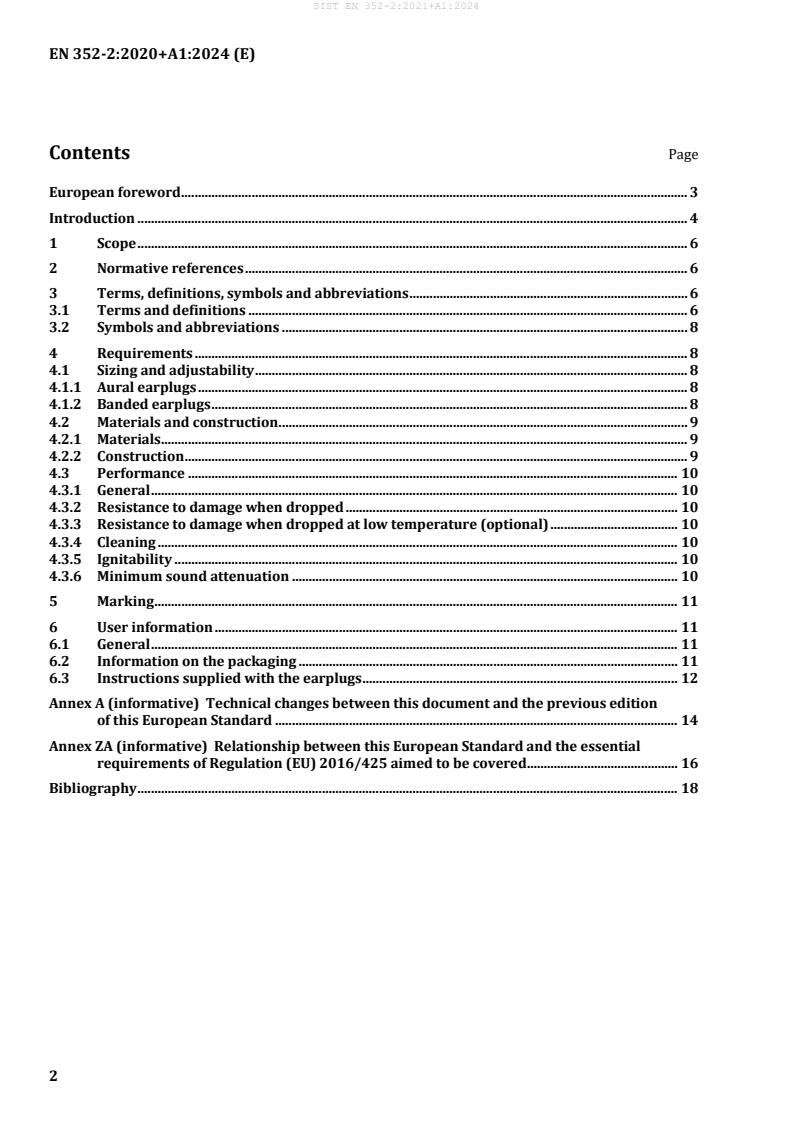
Contents Page
European foreword . 3
Introduction . 4
1 Scope . 6
2 Normative references . 6
3 Terms, definitions, symbols and abbreviations . 6
3.1 Terms and definitions . 6
3.2 Symbols and abbreviations . 8
4 Requirements . 8
4.1 Sizing and adjustability . 8
4.1.1 Aural earplugs . 8
4.1.2 Banded earplugs . 8
4.2 Materials and construction . 9
4.2.1 Materials . 9
4.2.2 Construction . 9
4.3 Performance . 10
4.3.1 General . 10
4.3.2 Resistance to damage when dropped . 10
4.3.3 Resistance to damage when dropped at low temperature (optional) . 10
4.3.4 Cleaning . 10
4.3.5 Ignitability . 10
4.3.6 Minimum sound attenuation . 10
5 Marking . 11
6 User information . 11
6.1 General . 11
6.2 Information on the packaging . 11
6.3 Instructions supplied with the earplugs . 12
Annex A (informative) Technical changes between this document and the previous edition
of this European Standard . 14
Annex ZA (informative) Relationship between this European Standard and the essential
requirements of Regulation (EU) 2016/425 aimed to be covered . 16
Bibliography . 18
European foreword
This document (EN 352-2:2020+A1:2024) has been prepared by Technical Committee CEN/TC 159
“Hearing protectors”, the secretariat of which is held by DIN.
This European Standard shall be given the status of a national standard, either by publication of an
identical text or by endorsement, at the latest by December 2024, and conflicting national standards
shall be withdrawn at the latest by December 2024.
Attention is drawn to the possibility that some of the elements of this document may be the subject of
patent rights. CEN shall not be held responsible for identifying any or all such patent rights.
This document supersedes !EN 352-2:2020".
This document includes Amendment 1 approved by CEN on 5 May 2024.
The start and finish of text introduced or altered by amendment is indicated in the text by tags !".
The technical changes between this document and the previous edition of this European Standard are
listed in Annex A.
!The content of the changes added with Amendment A1 to EN 352-2:2020 refers only to banded
earplugs."
This document has been prepared under a standardization request given to CEN by the European
Commission and the European Free Trade Association, and supports essential requirements of
EU Regulation(s).
For relationship with EU Regulation(s), see informative Annex ZA, which is an integral part of this
document.
!Any feedback and questions on this document should be directed to the users’ national standards
body. A complete listing of these bodies can be found on the CEN website."
According to the CEN-CENELEC Internal Regulations, the national standards organisations of the
following countries are bound to implement this European Standard: Austria, Belgium, Bulgaria,
Croatia, Cyprus, Czech Republic, Denmark, Estonia, Finland, France, Germany, Greece, Hungary, Iceland,
Ireland, Italy, Latvia, Lithuania, Luxembourg, Malta, Netherlands, Norway, Poland, Portugal, Republic of
North Macedonia, Romania, Serbia, Slovakia, Slovenia, Spain, Sweden, Switzerland, Türkiye and the
United Kingdom.
Introduction
This document sets requirements for personal hearing protection devices in relation to Regulation
(EU) 2016/425 on personal protective equipment.
The particular requirement in relation to the ability of hearing protectors to reduce noise below limit
levels is addressed in the standard by requiring the sound attenuation of the hearing protectors,
measured in accordance with EN ISO 4869-1, to be not less than a specified minimum. Further, by
requiring that the measured sound attenuation be declared, the selection of suitable hearing protectors
for individual circumstances can be undertaken according to established practice.
EN 352-2 is part of a family of standards describing product requirements for hearing protectors:
— EN 352-1, Hearing protectors — General requirements — Part 1: Earmuffs
— EN 352-2, Hearing protectors — General requirements — Part 2: Earplugs
— EN 352-3, Hearing protectors — General requirements — Part 3: Earmuffs attached to head
protection and/or face protection devices
— EN 352-4, Hearing protectors — Safety requirements — Part 4: Level-dependent earmuffs
— EN 352-5, Hearing protectors — Safety requirements — Part 5: Active noise reduction earmuffs
— EN 352-6, Hearing protectors — Safety requirements — Part 6: Earmuffs with safety-related audio
input
— EN 352-7, Hearing protectors — Safety requirements — Part 7: Level-dependent earplugs
— EN 352-8, Hearing protectors — Safety requirements — Part 8: Entertainment audio earmuffs
— EN 352-9, Hearing protectors — Safety requirements — Part 9: Earplugs with safety-related audio
input
— EN 352-10, Hearing protectors — Safety requirements — Part 10: Entertainment audio earplugs
Test methods for these requirements for all types of hearing protectors are described in the following
standards:
— EN 13819-1, Hearing protectors — Testing — Part 1: Physical test methods
— EN 13819-2, Hearing protectors — Testing — Part 2: Acoustic test methods
— EN 13819-3, Hearing protectors — Testing — Part 3: Supplementary acoustic test methods
An associated standard EN 458 covers selection, use, care and maintenance of hearing protection.
The parts of EN 352, other than parts 1, 2 and 3, cover the performance of functions additional to
passive hearing protection. Hearing protectors which incorporate one or more of these functions are
subject to the requirements and tests of each of the relevant parts of EN 352-4 to −10, in addition to
that of parts 1, 2 or 3, as appropriate.
The requirements of this document are concerned primarily with the physical and acoustic
performance of the earplugs. It covers disposable, re-usable, custom moulded and banded earplugs.
In order to assist users to select the correct size(s) of earplugs, a nominal diameter, or range of
diameters, of the earplugs is required to be declared (except for custom moulded and semi-aural
earplugs).
In the case of banded earplugs, the standard specifies sizing requirements which enable the majority of
the user population to be fitted satisfactorily by “medium size range” earplugs. Individuals with other
sizes can be accommodated by “small size range” or “large size range” earplugs, which are required to
be accompanied by information regarding the range of sizes which they are designed to fit.
The standard also calls for the values of sound attenuation provided by the earplugs (measured in
accordance with EN ISO 4869-1) in order to assist users in selecting the most appropriate model of
earplugs for their needs. Minimum values of sound attenuation are also specified.
1 Scope
This document specifies requirements on construction, design, performance, marking and user
information for earplugs.
In particular, it specifies requirements regarding the sound attenuation of the earplugs, measured in
accordance with EN ISO 4869-1:2018.
This document applies to earplugs designed for users who are able to follow supplied instructions and
understand the related risks, can fit the earplugs correctly and can give feedback on the performance.
Ergonomic aspects are addressed by taking into account, within the requirements, the interaction
between the user, the device and where possible the working environment in which the device is likely
to be used (see Annex ZA and EN 458).
2 Normative references
The following documents are referred to in the text in such a way that some or all of their content
constitutes requirements of this document. For dated references, only the edition cited applies. For
undated references, the latest edition of the referenced document (including any amendments) applies.
!EN 13819-1:2020+A1:2024, Hearing protectors — Testing — Part 1: Physical test methods"
EN 13819-2:2020, Hearing protectors — Testing — Part 2: Acoustic test methods
EN ISO 4869-2:2018, Acoustics — Hearing protectors — Part 2: Estimation of effective A-weighted sound
pressure levels when hearing protectors are worn (ISO 4869-2:2018)
3 Terms, definitions, symbols and abbreviations
3.1 Terms and definitions
For the purposes of this document, the following terms and definitions apply.
ISO and IEC maintain terminological databases for use in standardization at the following addresses:
— IEC Electropedia: available at https://www.electropedia.org/
— ISO Online browsing platform: available at https://www.iso.org/obp
3.1.1
passive hearing protection
hearing protection that provides attenuation of external sounds not by means of electronics
Note 1 to entry: All hearing protectors have the characteristics of reducing noise by their design and type of
material used. Devices that have only this function are called passive hearing protection.
[SOURCE: EN 352-1:2020, 3.1.1]
3.1.2
earplug
hearing protector worn in each of the outer ear canals (aural) or in the concha, at the entrance of each
of the outer ear canals (semi-aural)
Note 1 to entry: Earplugs can be formable, requiring a degree of manipulation prior to fitting, or pre-formed,
which require no manipulation prior to fitting.
Note 2 to entry: Earplugs can sometimes be attached to an interconnecting cord.
3.1.3
headband
band, usually made of plastics, designed to enable the earplugs to be held within (aural) or
against (semi-aural) the entrance to the outer ear canals by exerting force against the earplug elements
!Note 1 to entry: The headband position can be either over the head, behind the head or under the chin."
3.1.4
disposable earplug
earplug intended for one fitting only
3.1.5
re-usable earplug
earplug intended for more than one fitting
3.1.6
custom moulded earplug
earplug made using an impression of the individual concha and the outer ear canal of the user
Note 1 to entry: These are usually of the re-usable type.
3.1.7
banded earplugs
eartips linked by a headband designed to be used in at least one position
Note 1 to entry: Eartips can be aural or semi-aural; disposable or re-usable.
Note 2 to entry: Banded earplugs belong to the group of re-usable earplugs (see 3.1.5).
3.1.7.1
over-the-head !banded earplug"
earplug designed to be worn with the headband passing over the top of the head
3.1.7.2
behind-the-head !banded earplug"
earplug designed to be worn with the headband passing behind the head
3.1.7.3
under-the-chin !banded earplug"
earplug designed to be worn with the headband passing under the chin
3.1.7.4
universal !banded earplug"
earplug designed to be worn as over-the-head, behind-the-head and under-the-chin earplugs
3.1.8
sound attenuation
for a given test signal the mean difference, in decibels, between the threshold of hearing with and
without the hearing protector in place
Note 1 to entry: Measured in accordance with EN ISO 4869-1:2018 for a panel of test subjects.
[SOURCE: EN ISO 4869-1:2018, 3.8, modified — The words “for a given test signal” have been moved to
beginning of definition, the words “mean”, “in decibels” have been added, the words “for a test subject”
have been deleted and Note 1 to entry has been added.]
3.2 Symbols and abbreviations
For the purposes of this document, the following symbols and abbreviations apply.
H High-frequency attenuation value
M Medium-frequency attenuation value
L Low-frequency attenuation value
APV Assumed Protection Value for frequency f and a protection performance of 98 %
f98
SNR Single Number Rating
PPE Personal Protective Equipment
4 Requirements
4.1 Sizing and adjustability
4.1.1 Aural earplugs
The nominal diameter or, if appropriate, the range of nominal diameters of the earplugs, shall be tested
in accordance with !EN 13819-1:2020+A1:2024", 5.2 and reported.
C
...