

CEN/TS 18355:2026
(Main)Railway applications - Acoustics - Unattended and automated measurements of noise emitted by railbound vehicles in operation
- Abstract
This document specifies long-term measurement methods to obtain trackside noise emission values of multiple trains passing by, automated and unattended, of all kinds of vehicles operating on rails in regular operation, taking into consideration the specific environmental, track and vehicle conditions.
It specifies conditions the measurement setup, data analysis and data processing methods.
The results are datasets of pass-by sound pressure levels or third octave spectra for different sites, train types, units (vehicles) which can be used for different reporting objectives and data analysis. The following are described within the document:
- comparison of results from different scenarios, e.g. to evaluate the noise reduction of innovative techniques or acoustically relevant modifications to the track structure on a particular track section;
- trend analysis;
- averaging procedures, e.g. for determination of acoustic parameters for source term calculations as given in EN 17936 or sites with other infrastructure related sources (such as bridges, crossings, switching, impact noise, curving noise).
This document is not applicable to:
- type testing;
- attended measurements;
- parked or stationary vehicles;
- shunting yards;
- positions beyond 25 m from the track;
- obstructed positions such as behind barriers or around dwellings.
NOTE The procedures specified in this normative document are of survey grade (grade 2) as defined in EN ISO 12001.
- Status
- Published
- Publication Date
- 10-Nov-2026
- Technical Committee
- CEN/TC 256 - Railway applications
- Drafting Committee
- CEN/TC 256/WG 3 - Noise emission
- Current Stage
- 6060 - Definitive text made available (DAV) - Publishing
- Start Date
- 11-Nov-2026
- Due Date
- 30-Jun-2026
- Completion Date
- 11-Nov-2026

CEN/TS 18355:2026 is a CEN Technical Specification for railway acoustics. It defines unattended and automated long-term measurement (LTM) methods for trackside noise emitted by railbound vehicles in regular operation, with the results expressed as pass-by sound pressure levels or third-octave spectra.
The document is written for people who need comparable rail noise data from real service conditions - for example for monitoring, scenario comparison, trend analysis, or averaging data for source-term work.
What does CEN/TS 18355:2026 specify?
CEN/TS 18355:2026 specifies how to set up, run, process and report long-term measurements of railway noise from multiple train pass-bys. It covers environmental, track and vehicle conditions so that the measured datasets can be used consistently across sites and reporting objectives.
The document is organized into clauses on scope, normative references, terms and definitions, instrumentation and calibration, identification of the LTM setup, the measurement conditions, measured quantities and procedures, data processing, quality, and the LTM report.
| Annex | What it covers |
|---|---|
| Annex A | Examples for quantifying measurement uncertainty for LTM results |
| Annex B | Estimation of the influence of reflective objects near the track axis |
CEN/TS 18355:2026 is not intended for type testing, attended measurements, parked or stationary vehicles, shunting yards, positions beyond 25 m from the track, or obstructed positions such as behind barriers or around dwellings. The procedures are survey grade (grade 2) as defined in EN ISO 12001, so the standard is aimed at monitoring and comparison rather than laboratory-style vehicle approval.
What are the key requirements of CEN/TS 18355:2026?
CEN/TS 18355:2026 is built around a controlled measurement setup, valid pass-by records, and clear rules for data acceptance and reporting. The practical effect is that the user must measure not only noise, but also the site, train and operational conditions that can change the result.
Instrumentation and calibration
CEN/TS 18355:2026 requires class 1 noise measurement instrumentation, class 1 microphones when a separate sound level meter is not used, class 1 one-third octave filters when spectral analysis is needed, and a class 1 sound calibrator. The microphone system is expected to support continuous outdoor operation and free-field measurement.
The microphone unit is calibrated before the measurement campaign, and the measurement chain is adjusted to the calibration certificate. Intermediate testing is required during the campaign, including manual calibration checks and supplementary tests, so that drift, signal faults or invalid data can be detected early.
Site selection and measurement conditions
CEN/TS 18355:2026 requires a site where free sound propagation is preserved between the track and the microphones. The surrounding area must be free of people, paths, tall vegetation, water, tarmac, concrete or large reflective objects that could alter the measured pass-by sound.
Background sound pressure level has to be low enough that train noise dominates the record. The standard gives a 10 dB separation as the basic condition and recommends 15 dB when greater accuracy is needed. This matters because background noise directly affects whether a pass-by can be accepted as valid.
Track and vehicle conditions
CEN/TS 18355:2026 requires the track section to be acoustically consistent over the measurement length, with geometry, superstructure, roughness and dynamic properties assessed and recorded. It recommends straight track sections, appropriate curvature limits for “straight” conditions, and a track with ballast bed and concrete sleepers for standard comparisons.
The track surface shall be free from visible defects such as corrugation, rail burns, pits, loose sleepers and audible weld impacts. Rail roughness and track decay rates have to be assessed periodically. Vehicle conditions at LTM sites are taken as they are in regular operation, which means the method is intended for field monitoring, not for controlling vehicle state as in type testing.
Measurement cross-sections and recorded quantities
CEN/TS 18355:2026 recommends a microphone position 7.5 m from the track centreline and 1.2 m above the upper rail surface, with variants for double-track sites. The choice of cross-section depends on the application area and the reporting objective.
For each pass-by, the standard requires acoustic and non-acoustic quantities such as sound pressure level history, timestamps, pass-by duration, direction, speed, axle count, meteorological data and, where relevant, track occupation or simultaneous train detection. These measurements are what make later validation and grouping possible.
Data processing and validity
CEN/TS 18355:2026 requires data to be stored in a synchronized structure so that acoustic and non-acoustic quantities can be merged and checked together. Calculated quantities are produced only from valid data, and the reasons for excluding data must be documented.
The standard defines handling for incomplete data, erroneous data, distortion, disturbing sound sources, adverse weather, simultaneous trains, low-speed pass-bys, acceleration or braking, and track maintenance effects. It also sets out normalization and processing for quantities such as pass-by levels, unit-related levels, TEL and SEL, including normalization to 80 km/h and APL where applicable.
Quality and reporting
CEN/TS 18355:2026 sets practical tolerances for measurement distances, spread between redundant microphones, and uncertainty evaluation. The report has to state the application area, the measurement site, equipment, calibration, environmental conditions, track conditions, measurement positions, measured quantities, calculated quantities, validity checks and uncertainties.
This is important in practice because the report is not just a results summary - it is the record that shows why the values can be compared, averaged or trended over time.
What terms does CEN/TS 18355:2026 define?
- train - A self-propelled rail vehicle or a self-propelled group of physically coupled rail vehicles.
- train category - A grouping of trains by traffic type, such as long-distance passenger, local passenger, freight or other rail traffic.
- train type - A distinction within a train category based on technical differences between trains.
- long-term measurement (LTM) - An automated, unattended method for obtaining trackside noise emission values from multiple train pass-bys over a longer period.
- LTM site - A railway location where long-term measurements and related data are collected, including at least one measurement cross-section.
- measurement cross-section - An imaginary vertical plane through the microphone position, orthogonal to the track centreline, used as the reference for pass-by measurements.
- measurement data set - The complete set of acoustic and non-acoustic quantities for one train pass-by, including data needed for validity checks.
- reported quantity - The value produced after data analysis, such as a calculated quantity, an average, or a trend result.
Who uses CEN/TS 18355:2026?
CEN/TS 18355:2026 is used by railway operators, infrastructure managers, acoustics engineers, laboratories, consultants and noise-monitoring teams. It supports people who need to measure rail noise in regular service, compare different track or vehicle scenarios, track changes over time, or derive source terms for environmental noise calculations.
It is also relevant to maintenance and asset teams because it records the track and vehicle conditions that affect sound emission, such as roughness, dynamic properties, wheel condition, maintenance events and weather. Buyers and quality managers can use it to judge whether a monitoring setup and its report are structured well enough for comparison and follow-up work.
Which standards are used with CEN/TS 18355:2026?
CEN/TS 18355:2026 refers to several standards and one technical report that supply the measurement tools, definitions or related methods it relies on:
- EN 15461 - used for assessing the dynamic properties of track sections.
- EN 15610 - used for measuring rail and wheel roughness related to rolling noise generation.
- EN IEC 60268-4:2018 - provides microphone requirements.
- EN 61672-1:2013 - provides specifications for sound level meters.
- EN 61672-3 - provides periodic tests for sound level meters.
- EN IEC 60942:2018 - provides requirements for sound calibrators.
- EN 61260-1:2014 - provides octave-band and fractional-octave-band filter specifications.
- CEN/TR 16891 - provides a method for combined roughness, track decay rates and transfer functions.
What does the CEN/TS 18355:2026 document contain?
CEN/TS 18355:2026 contains detailed requirements for measurement instrumentation, calibration, site setup, environmental conditions, track conditions, vehicle conditions, pass-by timing, data transfer, data processing, data validity, quality checks and reporting. It also includes process guidance for selecting the LTM application area: comparison of scenarios, trend analysis, or averaging procedures.
The document includes tables for application-area requirements, measured quantities, processing outputs and reporting content. It also includes examples for uncertainty evaluation in Annex A and a simplified estimation of reflection effects near the track axis in Annex B.
A reader using the standard for field work will find procedures for recording pass-by curves, identifying valid events, dealing with disturbed or incomplete data, and producing comparable outputs from different sites or time periods. That makes it useful both for day-to-day monitoring and for structured technical reporting.
Get Certified
Connect with accredited certification bodies for this standard

IRIS Certification (UNIFE)
International Railway Industry Standard certification.

TÜV SÜD Rail GmbH
TÜV SÜD railway certification services.

BSMI (Bureau of Standards, Metrology and Inspection)
Taiwan's standards and inspection authority.
Sponsored listings
Frequently Asked Questions
CEN/TS 18355:2026 is a technical specification published by the European Committee for Standardization (CEN). Its full title is "Railway applications - Acoustics - Unattended and automated measurements of noise emitted by railbound vehicles in operation". This standard covers: This document specifies long-term measurement methods to obtain trackside noise emission values of multiple trains passing by, automated and unattended, of all kinds of vehicles operating on rails in regular operation, taking into consideration the specific environmental, track and vehicle conditions. It specifies conditions the measurement setup, data analysis and data processing methods. The results are datasets of pass-by sound pressure levels or third octave spectra for different sites, train types, units (vehicles) which can be used for different reporting objectives and data analysis. The following are described within the document: - comparison of results from different scenarios, e.g. to evaluate the noise reduction of innovative techniques or acoustically relevant modifications to the track structure on a particular track section; - trend analysis; - averaging procedures, e.g. for determination of acoustic parameters for source term calculations as given in EN 17936 or sites with other infrastructure related sources (such as bridges, crossings, switching, impact noise, curving noise). This document is not applicable to: - type testing; - attended measurements; - parked or stationary vehicles; - shunting yards; - positions beyond 25 m from the track; - obstructed positions such as behind barriers or around dwellings. NOTE The procedures specified in this normative document are of survey grade (grade 2) as defined in EN ISO 12001.
This document specifies long-term measurement methods to obtain trackside noise emission values of multiple trains passing by, automated and unattended, of all kinds of vehicles operating on rails in regular operation, taking into consideration the specific environmental, track and vehicle conditions. It specifies conditions the measurement setup, data analysis and data processing methods. The results are datasets of pass-by sound pressure levels or third octave spectra for different sites, train types, units (vehicles) which can be used for different reporting objectives and data analysis. The following are described within the document: - comparison of results from different scenarios, e.g. to evaluate the noise reduction of innovative techniques or acoustically relevant modifications to the track structure on a particular track section; - trend analysis; - averaging procedures, e.g. for determination of acoustic parameters for source term calculations as given in EN 17936 or sites with other infrastructure related sources (such as bridges, crossings, switching, impact noise, curving noise). This document is not applicable to: - type testing; - attended measurements; - parked or stationary vehicles; - shunting yards; - positions beyond 25 m from the track; - obstructed positions such as behind barriers or around dwellings. NOTE The procedures specified in this normative document are of survey grade (grade 2) as defined in EN ISO 12001.
CEN/TS 18355:2026 is classified under the following ICS (International Classification for Standards) categories: 17.140.30 - Noise emitted by means of transport; 45.060.01 - Railway rolling stock in general. The ICS classification helps identify the subject area and facilitates finding related standards.
CEN/TS 18355:2026 is available in PDF format for immediate download after purchase. The document can be added to your cart and obtained through the secure checkout process. Digital delivery ensures instant access to the complete standard document.
Standards Content (Sample)
SLOVENSKI STANDARD
01-januar-2027
Železniške naprave - Akustika - Avtomatske meritve hrupa, ki ga povzročajo
železniška vozila med vožnjo
Railway applications - Acoustics - Unattended and automated measurements of noise
emitted by railbound vehicles in operation
Bahnanwendungen - Akustik - Unbeaufsichtigte und automatisierte Messungen der
Geräuschemission von spurgebundenen Fahrzeugen im Betrieb
Applications ferroviaires - Acoustique - Mesures non supervisées et automatisées du
bruit émis en service par les véhicules circulant sur rail
Ta slovenski standard je istoveten z: CEN/TS 18355:2026
ICS:
17.140.30 Emisija hrupa transportnih Noise emitted by means of
sredstev transport
45.060.01 Železniška vozila na splošno Railway rolling stock in
general
2003-01.Slovenski inštitut za standardizacijo. Razmnoževanje celote ali delov tega standarda ni dovoljeno.
CEN/TS 18355
TECHNICAL SPECIFICATION
SPÉCIFICATION TECHNIQUE
November 2026
TECHNISCHE SPEZIFIKATION
ICS 45.060.01; 17.140.30
English Version
Railway applications - Acoustics - Unattended and
automated measurements of noise emitted by railbound
vehicles in operation
Applications ferroviaires - Acoustique - Mesures non Bahnanwendungen - Akustik - Unbeaufsichtigte und
supervisées et automatisées du bruit émis en service automatisierte Messungen der Geräuschemission von
par les véhicules circulant sur rail spurgebundenen Fahrzeugen im Betrieb
This Technical Specification (CEN/TS) was approved by CEN on 28 September 2026 for provisional application.
The period of validity of this CEN/TS is limited initially to three years. After two years the members of CEN will be requested to
submit their comments, particularly on the question whether the CEN/TS can be converted into a European Standard.
CEN members are required to announce the existence of this CEN/TS in the same way as for an EN and to make the CEN/TS
available promptly at national level in an appropriate form. It is permissible to keep conflicting national standards in force (in
parallel to the CEN/TS) until the final decision about the possible conversion of the CEN/TS into an EN is reached.
CEN members are the national standards bodies of Austria, Belgium, Bulgaria, Croatia, Cyprus, Czech Republic, Denmark, Estonia,
Finland, France, Germany, Greece, Hungary, Iceland, Ireland, Italy, Latvia, Lithuania, Luxembourg, Malta, Netherlands, Norway,
Poland, Portugal, Republic of North Macedonia, Romania, Serbia, Slovakia, Slovenia, Spain, Sweden, Switzerland, Türkiye and
United Kingdom.
EUROPEAN COMMITTEE FOR STANDARDIZATION
COMITÉ EUROPÉEN DE NORMALISATION
EUROPÄISCHES KOMITEE FÜR NORMUNG
CEN-CENELEC Management Centre: Rue de la Science 23, B-1040 Brussels
© 2026 CEN All rights of exploitation in any form and by any means reserved Ref. No. CEN/TS 18355:2026 E
worldwide for CEN national Members.
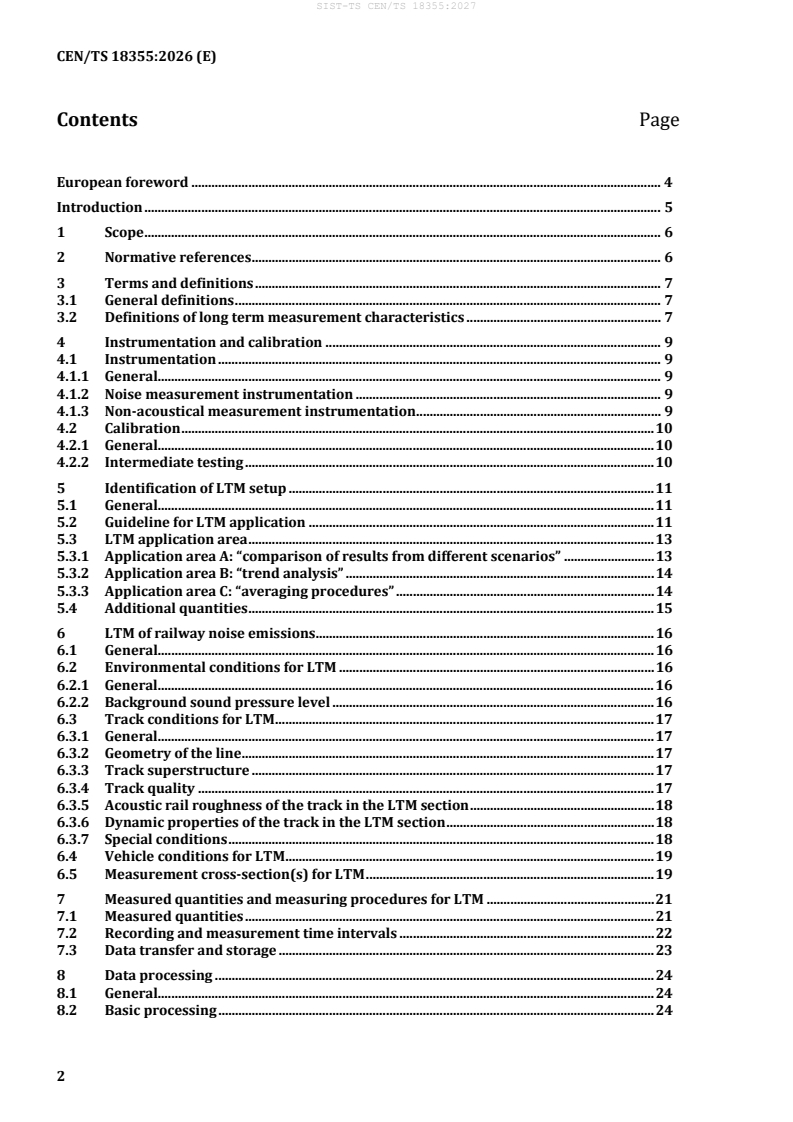
Contents Page
European foreword . 4
Introduction . 5
1 Scope . 6
2 Normative references . 6
3 Terms and definitions . 7
3.1 General definitions . 7
3.2 Definitions of long term measurement characteristics . 7
4 Instrumentation and calibration . 9
4.1 Instrumentation . 9
4.1.1 General. 9
4.1.2 Noise measurement instrumentation . 9
4.1.3 Non-acoustical measurement instrumentation . 9
4.2 Calibration . 10
4.2.1 General. 10
4.2.2 Intermediate testing . 10
5 Identification of LTM setup . 11
5.1 General. 11
5.2 Guideline for LTM application . 11
5.3 LTM application area . 13
5.3.1 Application area A: “comparison of results from different scenarios” . 13
5.3.2 Application area B: “trend analysis” . 14
5.3.3 Application area C: “averaging procedures” . 14
5.4 Additional quantities . 15
6 LTM of railway noise emissions . 16
6.1 General. 16
6.2 Environmental conditions for LTM . 16
6.2.1 General. 16
6.2.2 Background sound pressure level . 16
6.3 Track conditions for LTM . 17
6.3.1 General. 17
6.3.2 Geometry of the line . 17
6.3.3 Track superstructure . 17
6.3.4 Track quality . 17
6.3.5 Acoustic rail roughness of the track in the LTM section . 18
6.3.6 Dynamic properties of the track in the LTM section . 18
6.3.7 Special conditions . 18
6.4 Vehicle conditions for LTM . 19
6.5 Measurement cross-section(s) for LTM . 19
7 Measured quantities and measuring procedures for LTM . 21
7.1 Measured quantities . 21
7.2 Recording and measurement time intervals . 22
7.3 Data transfer and storage . 23
8 Data processing . 24
8.1 General. 24
8.2 Basic processing . 24
8.3 Additional processing . 25
8.4 Validity of data . 25
8.4.1 General . 25
8.4.2 Incomplete data by data loss or error messages . 26
8.4.3 Erroneous data . 26
8.4.4 Impaired and/or influenced data . 26
8.5 Data analysis . 27
9 Quality of LTM . 28
9.1 Deviations from the requirements . 28
9.2 Measurement tolerances . 28
9.3 Measurement spread. 28
9.4 Measurement uncertainties . 28
10 LTM report . 29
10.1 General . 29
10.2 Content of the test report. 29
Annex A (informative) Quantification examples of measurement uncertainties according to
ISO/IEC Guide 98-3:2008 . 32
A.1 General . 32
A.2 Examples of possible input quantities and their uncertainties . 32
A.3 Example for determination of the measurement uncertainty for pass-by level L
pAeq,Tp
................................................................................................................................................................... 33
Annex B (informative) Estimation of influence of reflective objects near track axis . 34
Bibliography . 36
European foreword
This document (CEN/TS 18355:2026) has been prepared by Technical Committee CEN/TC 256 “Railway
applications”, the secretariat of which is held by DIN.
Attention is drawn to the possibility that some of the elements of this document may be the subject of
patent rights. CEN shall not be held responsible for identifying any or all such patent rights.
Any feedback and questions on this document should be directed to the users’ national standards body.
A complete listing of these bodies can be found on the CEN website.
According to the CEN/CENELEC Internal Regulations, the national standards organisations of the
following countries are bound to announce this Technical Specification: Austria, Belgium, Bulgaria,
Croatia, Cyprus, Czech Republic, Denmark, Estonia, Finland, France, Germany, Greece, Hungary, Iceland,
Ireland, Italy, Latvia, Lithuania, Luxembourg, Malta, Netherlands, Norway, Poland, Portugal, Republic of
North Macedonia, Romania, Serbia, Slovakia, Slovenia, Spain, Sweden, Switzerland, Türkiye and the
United Kingdom.
Introduction
Railway exterior noise is encountered both along open track and in and around depots, stops, stations
and other stop locations. It includes a number of different physical sources such as rolling noise, impact
noise, traction noise, aerodynamic noise, curving noise, braking noise, horn noise and noise from
auxiliary equipment and other components. The noise for any given train type strongly depends on the
rolling stock design, operating conditions and the track type and condition.
Rolling noise is one of the main sources which contains a significant and sometimes dominant noise
contribution from the track. This document is intended to characterize and specify the Long-Term
Measurement (LTM) of noise emission of pass-by of trains in operation.
Such LTMs can be of interest for various reasons like e.g. maintenance of trains in service, deriving source
terms for noise calculation schemes or monitoring the noise effect of retrofitting of wagons. In other
words, LTM can be used to describe and evaluate the noise emissions caused by scheduled rail traffic.
1 Scope
This document specifies long-term measurement methods to obtain trackside noise emission values of
multiple trains passing by, automated and unattended, of all kinds of vehicles operating on rails in regular
operation, taking into consideration the specific environmental, track and vehicle conditions.
It specifies the conditions of the measurement setup, data analysis and data processing methods.
The results are data sets of pass-by sound pressure levels or third octave spectra for different train, unit,
running on different sites which can be used for different reporting objectives and data analysis. The
following are described within the document:
— comparison of results from different scenarios, e.g. to evaluate the noise reduction of innovative
techniques or acoustically relevant modifications to the track structure on a particular track section;
— trend analysis;
— averaging procedures, e.g. for determination of acoustic parameters for source term calculations as
given in EN 17936 or sites with other infrastructure related sources (such as bridges, crossings,
switching, impact noise, curving noise).
This document is not applicable to:
— type testing;
— attended measurements;
— parked or stationary vehicles;
— shunting yards;
— positions beyond 25 m from the track;
— obstructed positions such as behind barriers or around dwellings.
NOTE The procedures specified in this normative document are of survey grade (grade 2) as defined in
EN ISO 12001.
2 Normative references
The following documents are referred to in the text in such a way that some or all of their content
constitutes requirements of this document. For dated references, only the edition cited applies. For
undated references, the latest edition of the referenced document (including any amendments) applies.
EN 15461, Railway applications — Noise emission — Characterisation of the dynamic properties of track
sections for pass by noise measurements
EN 15610, Railway applications — Acoustics — Rail and wheel roughness measurement related to rolling
noise generation
EN IEC 60268-4:2018, Sound system equipment - Part 4: Microphones
EN 61672-1:2013, Electroacoustics - Sound level meters - Part 1: Specifications
EN 61672-3, Electroacoustics - Sound level meters - Part 3: Periodic tests
EN IEC 60942:2018, Electroacoustics - Sound calibrators
EN 61260-1:2014, Electroacoustics - Octave-band and fractional-octave-band filters - Part 1: Specifications
CEN/TR 16891, Railway applications - Acoustics - Measurement method for combined roughness, track
decay rates and transfer functions
3 Terms and definitions
For the purposes of this document, the terms and definitions given in EN 17343 and the following apply.
ISO and IEC maintain terminology databases for use in standardization at the following addresses:
— ISO Online browsing platform: available at https://www.iso.org/obp/
— IEC Electropedia: available at https://www.electropedia.org/
3.1 General definitions
3.1.1
train
self-propelled rail vehicle or a self-propelled group of physically coupled rail vehicles
EXAMPLE 1: locomotive(s) coupled with trailers.
EXAMPLE 2: one multiple unit, or several multiple units coupled together.
[SOURCE: EN 17343:2023, 3.1.7.9. modified – Example 3 to entry has been deleted]
3.1.2
train category
distinction of trains related to traffic type
EXAMPLE: If no train categories are specified, the following classification is preferred:
— long-distance passenger rail transport;
— local passenger (public) rail transport;
— rail freight transport;
— other rail traffic.
3.1.3
train type
distinction of individual trains within a train category due to technical differentiation criteria
3.2 Definitions of long term measurement characteristics
3.2.1
long-term measurement (LTM)
measurement methods to obtain trackside noise emission values of multiple trains passing by for a longer
time, automated and unattended
Note 1 to entry: The time duration depends on the reporting objectives. For additional information see Clause 5
Note 2 to entry: Long-term measurement of railway sound emissions is fundamental for railway noise monitoring
3.2.2
LTM site
place at a railway line where long-term measurement of railway sound emissions and its accompanying
data are measured. It includes at least one measurement cross-section and can contain more
measurement cross-section if there are more tracks at the LTM site
3.2.3
measurement cross-section
measurement methods to obtain trackside noise emission values of multiple trains passing by for an
imaginary vertical plane proceeding from the measurement position of the microphone orthogonal to the
centre-line of track
3.2.4
LTM application area
purpose of monitoring of railway sound emissions which requires different reporting objectives and data
analysis
EXAMPLE comparison of results from different scenarios; trend analysis; averaging procedures.
3.2.5
measurement data set
contains all measured quantities of one single train pass-by, both acoustically and non-acoustically
measured quantities, needed to determine the reported quantities, including data for validity checks
3.2.6
measured quantity
quantity to be determined by measurement systems at a train pass-by
EXAMPLE sound level measurements, axle detection, rail temperature, RFID (Radio Frequency Identification,
commonly used for the automated identification of objects) detection of vehicles, etc.
3.2.7
calculated quantity
quantity of single pass-bys which are calculated from measured quantities
EXAMPLE pass-by level of a train LpA,Train by calculation of measured LpA(t) for Tp.
3.2.8
reported quantity
quantity provided as a result of data analysis
Note 1 to entry: reported quantities depend on the LTM application area
EXAMPLE: calculated quantities; averages of calculated quantities; result of trend analysis
4 Instrumentation and calibration
4.1 Instrumentation
4.1.1 General
The LTM site equipment should be protected against power failure in order to minimize any loss of
measurement values.
4.1.2 Noise measurement instrumentation
The entire system for noise measurement shall comply with the requirements of EN 61672-1:2013
specifications for class 1 measuring equipment.
Where measurement equipment other than type-approved sound level meter is used, microphones shall
comply with the requirements of EN IEC 60268-4:2018 specifications for class 1 measuring equipment.
NOTE Multichannel acquisition systems are generally used to record data.
The complete microphone system consists of a microphone, preamplifier, rain protection, wind screen,
microphone holder, bird repeller and shall be suitable for continuous outdoor operation. Microphones
with free field characteristics shall be used.
Where one-third octave frequency band analysis is required, the filters shall meet the requirements of
class 1, according to EN 61260-1:2014.
When verifying the electroacoustical performance parameters, the characteristics specified in
EN 61672-3 shall be tested and reported.
The sound calibrator shall meet the requirements of class 1 according to EN IEC 60942:2018.
The conformity of the calibrator with the requirements of EN IEC 60942 shall have been verified within
one year of the test date.
4.1.3 Non-acoustical measurement instrumentation
Non-acoustical measurement instrumentation shall include at least systems for:
— time acquisition;
— axle detection;
— speed detection;
— driving direction detection;
— track detection (occupation) if double or multi-track layout at measurement site;
— recording meteorological / environmental conditions.
Vehicle identification can be done by measurement instrumentation at the site or by other appropriate
systems like railway operating systems.
The pass-by time T shall be determined with a tolerance ΔT ≤ 0,05 s.
p p
The accuracy of speed detection shall comply with:
— ± 3 km/h for speeds up to 100 km/h;
— ± 3 % of the measured value for speeds over 100 km/h.
The measurement of meteorological conditions shall be done in the near surrounding of the noise
measurement site and be representative for the site.
The instrumentation for meteorological conditions shall acquire the following measurement quantities:
— temperature (air and rail) [°C];
— relative humidity [%];
— wind speed [m/s];
— wind direction [° from North];
— precipitation [mm/h];
— atmospheric pressure [Pa].
If necessary, snow covering of track shall be determined.
NOTE Snow fall and snow covering (e.g. of track) has high influence on noise measurement.
Meteorological data shall be acquired between 10 s and 60 s before or after the train pass-by and stored
in a manner that it can be associated with the train pass-by sound measurement.
Additional meteorological data can help to evaluate the quality of the pass-bys measurement, e.g. amount
3 2
of rain within last 1 h [mm], quantities of rainfall [m /(s*m )].
4.2 Calibration
4.2.1 General
The calibration of the microphone unit (microphone and preamplifier) is conducted before the beginning
of the measurements in a laboratory. The calibration includes the test of the frequency response at one
or more frequencies over the frequency range of interest; the usual frequency range is
from 31,5 Hz to 10 kHz.
Once the microphone unit has been calibrated, the measurement chain has to be adjusted according to
the calibration certificate.
In the case when calibration intervals of the microphone are expired then the measurement data series
shall be marked as ‘not valid’ and be documented in an appropriate way. This marking ends when the
microphone is replaced by another calibrated unit.
4.2.2 Intermediate testing
Intermediate tests shall be performed between the specified calibration intervals to check the validity of
the measurement chain.
The intermediate tests include manually performed acoustical and supplementary tests.
The manual acoustical test contains a verification of the measured value of sound pressure level by means
of a sound calibrator. The maximum deviation of the measured sound pressure level from the reference
value of the calibrator shall not be more than ± 1,1 dB.
The manual acoustical test shall be performed at least once a year on each acoustic measurement
microphone; shorter intervals (e.g. every three months) are recommended.
Supplementary tests can be implemented as automatic signal data tests, or by testing the signal quality
e.g. by means of redundant measurements.
Redundant measurements are implemented by a second measurement cross-section where one
microphone is used as main or measuring microphone and the other as redundant microphone for
verification. The measurement values of the main or measuring microphone is marked as ‘valid’ if the
equivalent pass-by level L measured during the test at the redundant microphone does not differ by
pAeq,Tp
more than ± 1,5 dB.
Automatic signal data tests are implemented by feeding a known electric signal for testing the function
of the sound level meters and acoustical system (e.g. incorporated sound sources in the microphone unit
(the signal at the microphone output shall correspond to a sound pressure level of at least 80 dB); CIC
calibration (charge injection calibration); electrostatic calibration; other equivalent procedures). This
automatic test shall be performed in times without rail traffic, otherwise both the automated test and the
rail traffic noise measurements shall be marked as ‘not valid’. All test data shall be stored. The maximum
deviation of the measured sound pressure level from the reference value of the calibrator shall not be
more than ± 1,1 dB.
Supplementary tests shall be performed at least once a day. In the case of intermediate testing results in
invalid microphone values, the data obtained after the last performed valid test shall be marked as
‘potentially incorrect’ and be documented in an appropriate way. An adjustment is not permitted.
5 Identification of LTM setup
5.1 General
The identification of the application area is important for the identification of measured quantities
needed, calculated quantities to be analysed, and at the end the demand for certain reported quantities.
It is possible to apply multiple application areas simultaneously.
The measurement shall involve the continuous identification of individual rail traffic noise events. The
measurement data have to be recorded. Accompanying parameters to be measured will determine the
inclusion, re-calculation or exclusion of the measured data set for further processing to get the reported
quantities.
In general, there are three main types of application area for LTM:
— comparison of results from different scenarios;
— trend analysis;
— averaging procedures.
The characteristics of these types are elaborated in 5.3.
5.2 Guideline for LTM application
The process defined in Table 1 helps to identify the desired application area(s) / case(s) for LTM and lists
the steps to implement the measurement campaign up to reporting.
Table 1 — Flow diagram of process to determine LTM application area, with relevant section
numbers indicated
see
outcome (sub)clause
stage 0 Identify and clarify need of LTM: > what is the reason for LTM ? > which is the
objective in terms of ‚reported quantities‘ needed for the LTM-Report?
reason and objective for LTM, reported quantities
stage 1 Declare / specify application case
predefined application case: new application case: identify
as given in one of the three parameters (acoustic; additional), which
application areas described have to be presented in the Report
in 5.3 („reported quantities“)
parameter set of application case identified [5.2.]
application area identified [5.3.]
stage 2 Identify and list sound measurement quantities depending on
stage 1
list of identified sound measurement quantities [5.2.]
list of sound measurement quantities given in 5.3 [5.3.]
stage 3 Identify and list additional measurement quantities necessary for
a. quality control
list of additional quantities
b. application case specific (non-acoustic measurement quantities which are
mandatory / optional, but necessary if needed for application case)
list of additional measurement quantities [5.4, (5.3)]
stage 4 Identify the duration of measurement campaign * [5, 9]
in combination
duration of measurement campaign with stage 0
stage 5 Identify site parameters (application case specific, like track geometry) and find
[6]
suitable site
in combination
measurement site selected including description with stage 6&7
stage 6 Identify measurement equipment including power supply at the site
list of measurement equipment [4, 7, 8]
stage 7 Identify data flow and data architecture
data processing chart including data architecture [8, 9]
stage 8 Installation (of sensors, data collector, data storage / database) and setup, including
initial quality check of system
site installed and initial system check [4]
stage 9 Measurements (includes also maintenance and quality control of equipment)
measured quantities and results of quality control [4, 9]
Analysis of measured quantities, including (application case specific) calculations to
stage 10
determine values of reported quantities - data processing including validation
calculated quantities [8, 9]
stage 11 Reporting
LTM - Report [10]
Key
planning outcome
installation outcome
measurement and processing outcome
analysis and reporting outcome
NOTE (*) Depending on application case, e.g. evolution in time; minimum number of trains; enough
environmental conditions considered which are acoustical relevant. Usually the duration of “long term” is
depending on the number of trains during regular traffic at a dedicated LTM-site.
5.3 LTM application area
5.3.1 Application area A: “comparison of results from different scenarios”
Application area A represents the ‘comparison of results from different scenarios’ to determine the effects
on noise emissions. Usually comparisons are done between different types of track (components) or
vehicle (components). These can be subdivided in ‘before’ and ‘after’ the modification was applied, or by
‘reference’ section without modification and ‘test’ section with modification (only for track components!).
For these cases it is important to leave all other components and/or parameters the same to minimize
the uncertainty of measurement of the differences between scenarios. When the application area is
developed, it has to be identified which additional measured quantities might be of acoustical relevance.
The requirement for application area A ‘comparison of results from different scenarios’ is listed in
Table 2:
Table 2 — requirement for application area A
pass-by measurement
of sites with same Remarks
(track) parameters
SPL L (t) x sound pressure level curve
pAeq
T x T for train, corresponding Figure 4
rec rec
T x T for train, corresponding Figure 4
p p
T o T for vehicle, corresponding Figure 4
unit unit
speed of train (of axle) including speed
Speed x
difference max-min
vertical / horizontal if needed e.g. for
acceleration at rail o measurement of source terms corresponding
EN 17936
e.g. by train operation data; detection of axle
train (type) detection o
pattern
e.g. by train operation data; detection of axle
vehicle (type) detection o
pattern; RFID
environmental
x see 6.2, for each train pass-by
conditions
track conditions x see 6.3
vehicle conditions o if necessary, e.g. wheel profile, roundness
measurement positions x see 6.5
third octave band
o if necessary
(frequency)
NOTE
x obligatory
o optional, but obligatory if required in scenario
NOTE Examples for application area A are provided in UIC 75717 “Track noise measurement guidelines” or in
I-LENA (Initiative Lärmschutz-Erprobung neu und anwendungsorientiert).
5.3.2 Application area B: “trend analysis”
The application area ‘trend analysis’ aims at the observation of changes in the noise emission over time,
e.g. for certain groups of trains / vehicles or single trains / vehicles. Depending on the objective of interest
additional data are needed, e.g. individual vehicle identification by RFID. Train types can be determined
by measurement (e.g. axle pattern analysis) or by additional external data (e.g. operational data) which
shall be merged with the measured data and stored for further data processing.
The requirement for application area B ‘trend analysis’ is listed in Table 3:
Table 3 — requirement for application area B
pass-by measurement
of sites with same remarks
(track) parameters
SPL L (t) x sound pressure level curve
pAeq
Trec x Trec for train, corresponding Figure 4
T x T for train, corresponding Figure 4
p p
T o T for vehicle, corresponding Figure 4
unit unit
speed of train (of axle) including speed difference
Speed x
max-min
vertical / horizontal if needed e.g. for
acceleration at rail o measurement of source terms corresponding
EN 17936
e.g. by train operation data; detection of axle
train (type) detection o
pattern
e.g. by train operation data; detection of axle
vehicle (type) detection o
pattern; RFID
environmental
x see 6.2, for each train pass-by
conditions
track conditions x see 6.3
vehicle conditions o if necessary, e.g. wheel profile, roundness
measurement positions x see 6.5
third octave band
o if necessary
(frequency)
NOTE
x obligatory
o optional, but obligatory if required in scenario
5.3.3 Application area C: “averaging procedures”
The application area ‘averaging procedures’ aims to generate average noise emission values for a chosen
group of trains and vehicles. Applications are e.g. determination of acoustic parameters for source term
calculations, getting acoustic characteristics of a dedicated place in the railway network (e.g. at straight
line, at curve, at bridge, etc). In general, the more train pass-bys are measured, the more the accuracy of
the average increases.
The requirement for application area C ‘averaging procedures’ is listed in Table 4:
Table 4 — requirement for application area C
pass-by measurement
of sites with same Remarks
(track) parameters
SPL L (t) x sound pressure level curve
pAeq
T x T for train, corresponding Figure 4
rec rec
T x T for train, corresponding Figure 4
p p
Tunit o Tunit for vehicle, corresponding Figure 4
speed of train (of axle) including speed
Speed x
difference max-min
vertical / horizontal if needed e.g. for
acceleration at rail o measurement of source terms corresponding
EN 17936
e.g. by train operation data; detection of axle
train (type) detection x
pattern
e.g. by train operation data; detection of axle
vehicle (type) detection o
pattern; RFID
environmental
x see 6.2, for each train pass-by
conditions
track conditions x see 6.3
vehicle conditions o if necessary, e.g. wheel profile, roundness
measurement positions x see 6.5
third octave band
o if necessary
(frequency)
NOTE
x obligatory
o optional, but obligatory if required in scenario
NOTE Example for application area C is given by EN 17936 “Measurement of source terms for environmental
noise calculations”.
5.4 Additional quantities
Depending on the specific application case, additional (measured) quantities for each pass-by of a train
need to be determined by on-site measurements/detection systems, like e.g.:
— loading conditions;
— wheel conditions, e.g. wheel profile monitoring; wheel roundness monitoring.
6 LTM of railway noise emissions
6.1 General
LTM of Railway Noise Emissions is dedicated to regular train operation. Depending on the application
area for the LTM reporting objectives, the conditions which are influencing the measurements and which
need to be measured and/or controlled, can vary.
The noise emitted during the pass-by of a railway vehicle depends upon numerous parameters like track-
and vehicle conditions, environmental conditions and the measurement cross-section(s).
6.2 Environmental conditions for LTM
6.2.1 General
For the selection of a LTM site the following environmental conditions needs to be taken into account.
In the triangular area between the track and the microphone(s), extending along the track to a distance
twice the microphone distance to either side, the test site shall ensure free sound propagation. To achieve
this result:
— the level of the ground surface over this area shall be within 0 m to −2 m, relative to the top of rail;
NOTE 1 The level of the ground and the nature of the ground surface can affect the spectral content of the
measured sound. For more information see EN 17936:2024, Annex B.
— this area shall be free of sound absorbing matter such as tall vegetation or free of sound-reflecting
surfaces such as water, tarmac or concrete;
— no person shall be present in this area, also no (public) path or way or street passes the measurement
site between the microphone(s) and the track.
Additionally, an area around the microphones having a radius which is at least three times the
measurement distance shall be free of large reflecting objects like barriers, hills, rocks, bridges or
buildings.
In the case of large buildings, tunnels and bridges a distance of at least 200 m is recommended. If the
distance is less than 200 m, an evaluation shall safeguard that there is no relevant influence on the sound
measurement of the pass by.
A description of the site including relevant cross-sections drawing shall be recorded and included in the
report.
NOTE 2 An estimation of the influences of reflective object near to track axis are given in Annex B.
6.2.2 Background sound pressure level
It is recommended to check the background sound pressure level before the decision for a certain location
for long-term measurements. Care shall be taken to ensure that usual or typical noise from other sources
(e.g. other vehicles or industrial plants) does not influence the measurements significantly.
The expected background levels shall be at least 10 dB below the lowest pass-by level of trains to be
measured at the site. This will result in relation to uncertainty of up to 0,5 dB(A) for 10 dB below the
L . If the application area requires to be more accurate (see Clause 5), then background noise levels
pAeq,Tp
of at least 15 dB below the L are recommended; for this case an uncertainty of up to 0,1 dB may be
pAeq,Tp
expected. For frequency analysis this difference shall be at least 10 dB in each frequency band of interest.
6.3 Track conditions for LTM
6.3.1 General
The noise emission contains contributions from the rolling stock and the track. Therefore, noise emission
values are only comparable between sites where the track parameters are controlled to make them
equivalent in terms of acoustic performance.
These parameters are distinguished between parameters necessary for identification and selection of the
LTM-site (e.g. geometry of the line), and such parameters to be measured when the LTM site is in
operation (e.g. the acoustic roughness of the rail surface and the vertical and lateral dynamic responses
of the track).
The track at the LTM site shall have a consistent superstructure over a minimum length of twice the
microphone distance to either side. This includes geometry of the line, track quality, acoustic rail
roughness and track decay rates as described hereafter.
For further information about the track influence see Annex C of EN ISO 3095:2025.
6.3.2 Geometry of the line
The LTM-site shall be situated in a straight track section with the exception of specific application areas
measuring in curves. A track is considered as a straight track if the radius of curvature r of the track shall
be:
— r ≥ 1 000 m for train speed v ≤ 70 km/h;
— r ≥ 3 000 m for train speed 70 < v ≤ 120 km/h;
— r ≥ 5 000 m for train speeds v > 120 km/h.
The level gradient at the track shall be 5:1000 at the most.
Deviations from these values result in less comparability of sites but can be necessary depending on the
application area for LTM (see Clause 5).
NOTE Data taken from EN ISO 3095:2025.
6.3.3 Track superstructure
The recommended superstructure for LTM is a track with ballast bed and concrete sleepers without any
type of elements which covers or shields the rail or track, with the exception of specific application areas
measuring such sound affecting measures.
NOTE Measurement results made on other track designs are only comparable with measurements made on
similar track design.
The ballast shall be loose i.e. not bound together by glue and not blocked by debris.
Deviations from these values result in less comparability of sites but can be necessary depending on the
application area for LTM (e.g. determining the acoustic effectiveness of rail/track measures).
6.3.4 Track quality
The track at the LTM site shall be laid without rail joints and be free of visible surface defects such as
corrugations, rail burns or pits and spikes (caused by the compression of external material between
wheel and rail). No audible impact noise due to welds or loose sleepers shall be present.
If such defects occur during LTM site operation and are relevant for the results, these are recommended
to be eliminated by track maintenance works. These measurement data sets from the detection until the
finished maintenance works shall be marked as ‘not valid’ and to document this in a propriate way.
Track maintenance measures shall be recorded (kind of measure, date), in particular if these influences
the acoustic performance
...