

EN 12865:2001
(Main)Hygrothermal performance of building components and building elements - Determination of the resistance of external wall systems to driving rain under pulsating air pressure
- Abstract
This standard specifies a general method for assessing the driving rain resistance of wall systems through determining the water tightness of wall systems under pulsating air pressure.
- Status
- Published
- Publication Date
- 20-Mar-2001
- Withdrawal Date
- 29-Sep-2001
- Technical Committee
- CEN/TC 89 - Thermal performance of buildings and building components
- Drafting Committee
- CEN/TC 89/WG 10 - Moisture
- Current Stage
- 9093 - Decision to confirm - Review Enquiry
- Start Date
- 09-Jul-2024
- Completion Date
- 07-Oct-2026



Overview
EN 12865:2001 (CEN) defines a laboratory test method to assess the hygrothermal performance of building components by determining the resistance of external wall systems to driving rain under pulsating air pressure. The standard specifies how to measure the water tightness of wall systems or parts of wall systems when sprayed with water and subjected to alternating (pulsating) air pressure differences that simulate wind-driven rain.
Key Topics and Technical Requirements
- Test principle: continuous water spraying on the external face while a pulsating air pressure difference is applied in stepped increments until water penetration occurs.
- Apparatus essentials:
- Test chamber with an adjustable opening for the specimen.
- Controlled differential air pressure system with control uncertainty of ±5% and pulse generator for rapid pressure changes.
- Water spraying system providing a continuous surface film (driving rain 1.5 l/(m²·min) and run‑off water ≈1.2 l/(m·min) - see Annex A for nozzle arrangements).
- Instruments to measure supplied water (±10%) and differential pressure (±5%).
- Pulse profile: each pulse typically comprises rising (3 ±1 s), maximum (5 ±1 s), falling (2 ±1 s) and zero (5 ±1 s) stages - total pulse ~15 ±2 s.
- Specimen requirements:
- Representative construction and joints; where no specific product specification exists, minimum specimen size is 1,200 mm wide × 2,400 mm high.
- Conditioning and mounting to prevent frame-induced false results.
- Procedures:
- Procedure A - qualitative short-term testing.
- Procedure B - quantitative testing, enabling measurement of water absorption by mass.
- Test conditions and reporting:
- Laboratory temperature (23 ±5) °C.
- Results expressed as the limit of water tightness in pascals (e.g., 300A or 300B). Water absorption may be reported in kg/m².
- Typical pressure step resolution is 150 Pa; overall expected error in pulsating pressure < ±8%.
Applications and Users
- Manufacturers of cladding, façades, rainscreen systems and external wall components use EN 12865 for product development, quality control and performance claims.
- Test laboratories and certification bodies apply the method to verify water tightness and support compliance with product specifications.
- Architects, façade engineers and specifiers use results to select appropriate systems for exposure to wind-driven rain and to inform detailing and mitigation strategies (ventilation, overhangs, drainage).
- Useful for R&D, comparative performance testing and inclusion in product technical documentation.
Related Standards
- EN 12865 is part of the CEN/TC 89 suite addressing thermal and moisture-related test methods for building components. Users should consider complementary EN standards covering air permeability, thermal performance and durability when specifying façade performance.
Keywords: EN 12865:2001, driving rain resistance, hygrothermal performance, pulsating air pressure, water tightness, external wall systems, CEN, driving rain test.
Relations
- Effective Date
- 28-Jan-2026
- Effective Date
- 28-Jan-2026
- Effective Date
- 28-Jan-2026
- Effective Date
- 28-Jan-2026
- Effective Date
- 28-Jan-2026
Get Certified
Connect with accredited certification bodies for this standard

DIBt (Deutsches Institut für Bautechnik)
German Institute for Building Technology.
DIN CERTCO
DIN Group product certification.

Aboma Certification B.V.
Specialized in construction, metal, and transport sectors.
Sponsored listings
Frequently Asked Questions
EN 12865:2001 is a standard published by the European Committee for Standardization (CEN). Its full title is "Hygrothermal performance of building components and building elements - Determination of the resistance of external wall systems to driving rain under pulsating air pressure". This standard covers: This standard specifies a general method for assessing the driving rain resistance of wall systems through determining the water tightness of wall systems under pulsating air pressure.
This standard specifies a general method for assessing the driving rain resistance of wall systems through determining the water tightness of wall systems under pulsating air pressure.
EN 12865:2001 is classified under the following ICS (International Classification for Standards) categories: 91.120.30 - Waterproofing. The ICS classification helps identify the subject area and facilitates finding related standards.
EN 12865:2001 has the following relationships with other standards: It is inter standard links to EN 16855-2:2018, EN 14509:2006, EN 16309:2014+A1:2014, EN 14509:2013, EN 16309:2014. Understanding these relationships helps ensure you are using the most current and applicable version of the standard.
EN 12865:2001 is associated with the following European legislation: EU Directives/Regulations: 305/2011, 89/106/EEC; Standardization Mandates: M/BC/CEN/91/4. When a standard is cited in the Official Journal of the European Union, products manufactured in conformity with it benefit from a presumption of conformity with the essential requirements of the corresponding EU directive or regulation.
EN 12865:2001 is available in PDF format for immediate download after purchase. The document can be added to your cart and obtained through the secure checkout process. Digital delivery ensures instant access to the complete standard document.
Standards Content (Sample)
2003-01.Slovenski inštitut za standardizacijo. Razmnoževanje celote ali delov tega standarda ni dovoljeno.]UDNDWärme- und feuchteschutztechnisches Verhaltens von Bauteilen - Bestimmung des Widerstandes des Außenwandsystems gegen Schlagregen bei pulsierendem LuftdruckPerformance hygrothermique des composants et parois de bâtiments - Détermination de la résistance a la pluie battante des systemes de murs extérieurs sous pression d'air pulsatoireHygrothermal performance of building components and building elements - Determination of the resistance of external wall systems to driving rain under pulsating air pressure91.120.30WaterproofingICS:Ta slovenski standard je istoveten z:EN 12865:2001SIST EN 12865:2002en01-marec-2002SIST EN 12865:2002SLOVENSKI
STANDARD
EUROPEAN STANDARDNORME EUROPÉENNEEUROPÄISCHE NORMEN 12865March 2001ICS 91.120.30English versionHygrothermal performance of building components and buildingelements - Determination of the resistance of external wallsystems to driving rain under pulsating air pressurePerformance hygrothermique des composants et parois debâtiments - Détermination de la résistance à la pluiebattante des systèmes de murs extérieurs sous pressiond'air pulsatoireWärme- und feuchteschutztechnisches Verhaltens vonBauteilen - Bestimmung des Widerstandes desAußenwandsystems gegen Schlagregen bei pulsierendemLuftdruckThis European Standard was approved by CEN on 29 December 2000.CEN members are bound to comply with the CEN/CENELEC Internal Regulations which stipulate the conditions for giving this EuropeanStandard the status of a national standard without any alteration. Up-to-date lists and bibliographical references concerning such nationalstandards may be obtained on application to the Management Centre or to any CEN member.This European Standard exists in three official versions (English, French, German). A version in any other language made by translationunder the responsibility of a CEN member into its own language and notified to the Management Centre has the same status as the officialversions.CEN members are the national standards bodies of Austria, Belgium, Czech Republic, Denmark, Finland, France, Germany, Greece,Iceland, Ireland, Italy, Luxembourg, Netherlands, Norway, Portugal, Spain, Sweden, Switzerland and United Kingdom.EUROPEAN COMMITTEE FOR STANDARDIZATIONCOMITÉ EUROPÉEN DE NORMALISATIONEUROPÄISCHES KOMITEE FÜR NORMUNGManagement Centre: rue de Stassart, 36
B-1050 Brussels© 2001 CENAll rights of exploitation in any form and by any means reservedworldwide for CEN national Members.Ref. No. EN 12865:2001 ESIST EN 12865:2002
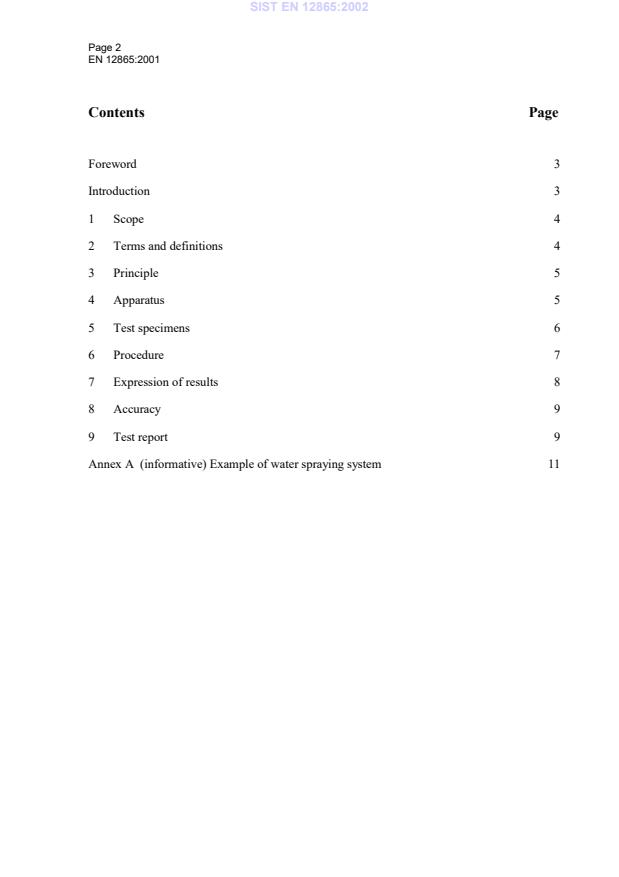
Page 2EN 12865:2001ContentsPageForeword3Introduction31Scope42Terms and definitions43Principle54Apparatus55Test specimens66Procedure77Expression of results88Accuracy99Test report9Annex A
(informative) Example of water spraying system11SIST EN 12865:2002
Page 3EN 12865:2001ForewordThis European Standard has been prepared by Technical Committee CEN/TC 89 "Thermalperformance of buildings and building components", the secretariat of which is held by SIS.This European Standard shall be given the status of a national standard, either by publicationof an identical text or by endorsement, at the latest by September 2001, and conflictingnational standards shall be withdrawn at the latest by September 2001.According to the CEN/CENELEC Internal Regulations, the national standards organizationsof the following countries are bound to implement this European Standard: Austria, Belgium,Czech Republic, Denmark, Finland, France, Germany, Greece, Iceland, Ireland, Italy,Luxembourg, Netherlands, Norway, Portugal, Spain, Sweden, Switzerland and the UnitedKingdom.This standard is one of a series of standards which specify test methods for the thermal andmoisture related properties of buildings, building components, building products and buildingmaterials.Annex A is informative.IntroductionDriving rain is often the cause of building damage due to the penetration of wind driven raininto or through external wall elements. The amount of driving rain impinging on a local partof an external wall surface depends on the rainfall and wind speed occurring simultaneously,the exposure of the building and the architectural / structural details of the surface. Nationalstandards define areas with different classes of driving rain severity which may be used todetermine the protection needed against driving rain.Protection can be achieved by measures such as:a)
architectural / structural design to reduce the amount of driving rain (e.g. roofoverhangs);b)
ventilated or unventilated air space behind cladding (any water penetrating thecladding flows down on the internal face of the cladding and is drained out at specifiedopenings; an air flow in a ventilated air space due to stack effects accelerates thedrying);c)
rendering on external wall surfaces with appropriate properties to absorb or repel thewater during driving rain and allow drying during the following drying period;d)
proper detailing to prevent water ingress around openings;e)
providing a defined water tightness of the wall element including existing joints so asto limit water penetration to an acceptable level.This standard specifies a test method to determine the resistance of wall elements to drivingrain, thus mainly covering measure e).SIST EN 12865:2002
Page 4EN 12865:2001The specified test conditions, with pulsating air pressure difference, simulate in a simplifiedway the dynamic nature of rain and wind pressure against a wall.Test methods for the determination of the resistance to driving rain under static air pressuremay lead to different results.This standard is intended to be used by product specifications, except where specific productshave properties which make application of this standard difficult.1ScopeThis standard specifies a general method for assessing the driving rain resistance of wallsystems by determining the water tightness of wall systems or part of wall systems underpulsating air pressure.2Terms and definitionsFor the purposes of this standard, the following terms and definitions apply.2.1driving rain resistanceability of the test specimen to resist water penetration under the conditions of the test2.2water penetrationwater continuously or repeatedly reaching the inside surface of the test specimen or parts ofthe specimen not designed to be wetted or where the water is not drained out2.3pulsating air pressure differenceair pressure difference across the specimen alternating periodically between zero and aspecified higher level2.4limit of water tightnessmaximum pulsating air pressure difference, in Pa, for which water penetration does not occurduring the test2.5water absorptionmass of absorbed water per area, in kg/m²SIST EN 12865:2002
Page 5EN 12865:20013PrincipleA test specimen is fitted into the driving rain test apparatus, the external surface of the testspecimen is sprayed continuously with water at a specified rate while the pulsating airpressure difference is increased in specified steps. The time of water penetration, if any, themaximum air pressure difference applied and the location of any penetrations are noted.4ApparatusThe driving rain test apparatus shall include:a) chamber with an adjustable opening to which the test specimen is fitted;b) means of providing a controlled differential air pressure across the test specimen with acontrol uncertainty of ± 5 %;NOTE 1
The control should be able to keep the pulsating pressure difference within theabove mentioned accuracy even when the air permeability varies during the test due tothe water film on the surface and the water absorbed by the test specimen.c) device able to apply rapid controlled changes of the differential air pressure operatingbetween defined limits (see clause 6.2 and Figure 1 for the sequence of a typical pressurepulse);d) spraying system applying a continuous film of water all over the surface of the testspecimen;The applied amount of water consists of two parts:- run-off water, 1,2
l/(m·min), evenly distributed at the top of the test specimen;- driving rain, 1,5
l/(m2 ·min), evenly distributed over the external surface of the testspecimen.NOTE 2
A spraying device, usually calibrated in litres per minute, which complies withthis requirement is shown in annex A.The distribution of driving rain can be controlled using driv
...