

EN 14509:2006
(Main)Self-supporting double skin metal faced insulating panels - Factory made products - Specifications
- Abstract
This European Standard specifies requirements for factory made, self-supporting, double skin metal faced insulating sandwich panels, which are intended for discontinuous laying in the following applications:
a) roofs and roof cladding;
b) external walls and wall cladding;
c) walls (including partitions) and ceilings within the building envelope.
The insulating core materials covered by this European Standard are rigid polyurethane, expanded polystyrene, extruded polystyrene foam, phenolic foam, cellular glass and mineral wool.
NOTE Polyurethane (PUR) includes polyisocyanurate (PIR).
Panels with edge details that utilize different materials from the main insulating core are included in this European Standard.
Panels used in cold store applications are included in this European Standard. Panels, put on the market as a component of a cold storage room, building and/or building envelope kit, will be covered by a future ETA-Guideline “Cold storage premises kits”.
This European Standard does not cover the following:
i. sandwich panels with a declared thermal conductivity for the insulating core greater than 0,06 W/m×K at
10 °C;
ii. products consisting of two or more clearly defined layers of different insulating core materials (multi-layered);
iii. panels with perforated facing(s);
iv. curved panels.
- Status
- Withdrawn
- Publication Date
- 14-Nov-2006
- Withdrawal Date
- 15-Oct-2013
- Current Stage
- 9960 - Withdrawal effective - Withdrawal
- Start Date
- 16-Oct-2013
- Completion Date
- 16-Oct-2013
89/106/EEC - Construction productsOJ Ref: C, C 321 OJ Date: 16-Dec-2008

Relations
- Effective Date
- 23-Oct-2013
- Effective Date
- 17-Sep-2026
- Effective Date
- 25-Aug-2026
- Refers
EN 1991-3:2026 - Eurocode 1 - Actions on structures - Part 3: Actions induced by cranes and machines - Effective Date
- 25-Mar-2026
- Effective Date
- 25-Mar-2026
- Effective Date
- 25-Mar-2026
- Effective Date
- 25-Mar-2026
- Effective Date
- 25-Mar-2026
- Effective Date
- 04-Feb-2026
- Effective Date
- 28-Jan-2026
- Effective Date
- 28-Jan-2026
- Effective Date
- 28-Jan-2026
- Effective Date
- 28-Jan-2026
- Effective Date
- 28-Jan-2026
- Effective Date
- 28-Jan-2026
Get Certified
Connect with accredited certification bodies for this standard

DIBt (Deutsches Institut für Bautechnik)
German Institute for Building Technology.
DIN CERTCO
DIN Group product certification.

Aboma Certification B.V.
Specialized in construction, metal, and transport sectors.
Sponsored listings
Frequently Asked Questions
EN 14509:2006 is a standard published by the European Committee for Standardization (CEN). Its full title is "Self-supporting double skin metal faced insulating panels - Factory made products - Specifications". This standard covers: This European Standard specifies requirements for factory made, self-supporting, double skin metal faced insulating sandwich panels, which are intended for discontinuous laying in the following applications: a) roofs and roof cladding; b) external walls and wall cladding; c) walls (including partitions) and ceilings within the building envelope. The insulating core materials covered by this European Standard are rigid polyurethane, expanded polystyrene, extruded polystyrene foam, phenolic foam, cellular glass and mineral wool. NOTE Polyurethane (PUR) includes polyisocyanurate (PIR). Panels with edge details that utilize different materials from the main insulating core are included in this European Standard. Panels used in cold store applications are included in this European Standard. Panels, put on the market as a component of a cold storage room, building and/or building envelope kit, will be covered by a future ETA-Guideline “Cold storage premises kits”. This European Standard does not cover the following: i. sandwich panels with a declared thermal conductivity for the insulating core greater than 0,06 W/m×K at 10 °C; ii. products consisting of two or more clearly defined layers of different insulating core materials (multi-layered); iii. panels with perforated facing(s); iv. curved panels.
This European Standard specifies requirements for factory made, self-supporting, double skin metal faced insulating sandwich panels, which are intended for discontinuous laying in the following applications: a) roofs and roof cladding; b) external walls and wall cladding; c) walls (including partitions) and ceilings within the building envelope. The insulating core materials covered by this European Standard are rigid polyurethane, expanded polystyrene, extruded polystyrene foam, phenolic foam, cellular glass and mineral wool. NOTE Polyurethane (PUR) includes polyisocyanurate (PIR). Panels with edge details that utilize different materials from the main insulating core are included in this European Standard. Panels used in cold store applications are included in this European Standard. Panels, put on the market as a component of a cold storage room, building and/or building envelope kit, will be covered by a future ETA-Guideline “Cold storage premises kits”. This European Standard does not cover the following: i. sandwich panels with a declared thermal conductivity for the insulating core greater than 0,06 W/m×K at 10 °C; ii. products consisting of two or more clearly defined layers of different insulating core materials (multi-layered); iii. panels with perforated facing(s); iv. curved panels.
EN 14509:2006 is classified under the following ICS (International Classification for Standards) categories: 91.100.60 - Thermal and sound insulating materials. The ICS classification helps identify the subject area and facilitates finding related standards.
EN 14509:2006 has the following relationships with other standards: It is inter standard links to EN 14509:2013, EN ISO 9001:2026, ISO 12491:1997, EN 1991-3:2026, EN 1991-4:2026, EN 1991-1-8:2026, EN 1991-1-6:2026, EN 1991-1-4:2026, EN ISO 11925-2:2026, EN 1365-2:2014, EN ISO 11925-2:2020, EN 1991-3:2006, EN 1991-1-4:2005/A1:2010, EN 13501-5:2016, EN 10346:2015. Understanding these relationships helps ensure you are using the most current and applicable version of the standard.
EN 14509:2006 is associated with the following European legislation: EU Directives/Regulations: 305/2011, 89/106/EEC; Standardization Mandates: M/121, M/122. When a standard is cited in the Official Journal of the European Union, products manufactured in conformity with it benefit from a presumption of conformity with the essential requirements of the corresponding EU directive or regulation.
EN 14509:2006 is available in PDF format for immediate download after purchase. The document can be added to your cart and obtained through the secure checkout process. Digital delivery ensures instant access to the complete standard document.
Standards Content (Sample)
2003-01.Slovenski inštitut za standardizacijo. Razmnoževanje celote ali delov tega standarda ni dovoljeno.Self-supporting double skin metal faced insulating panels - Factory made products - SpecificationsPanneaux sandwiches autoportants, isolants, double peau a parements métalliques - Produits manufacturés - SpécificationsSelbsttragende Sandwich-Elemente mit beidseitigen Metalldeckschichten - Werkmäßig hergestellte Produkte - SpezifikationenTa slovenski standard je istoveten z:EN 14509:2006SIST EN 14509:2007en,fr,de91.100.60Thermal and sound insulating materialsICS:SLOVENSKI
STANDARDSIST EN 14509:200701-marec-2007
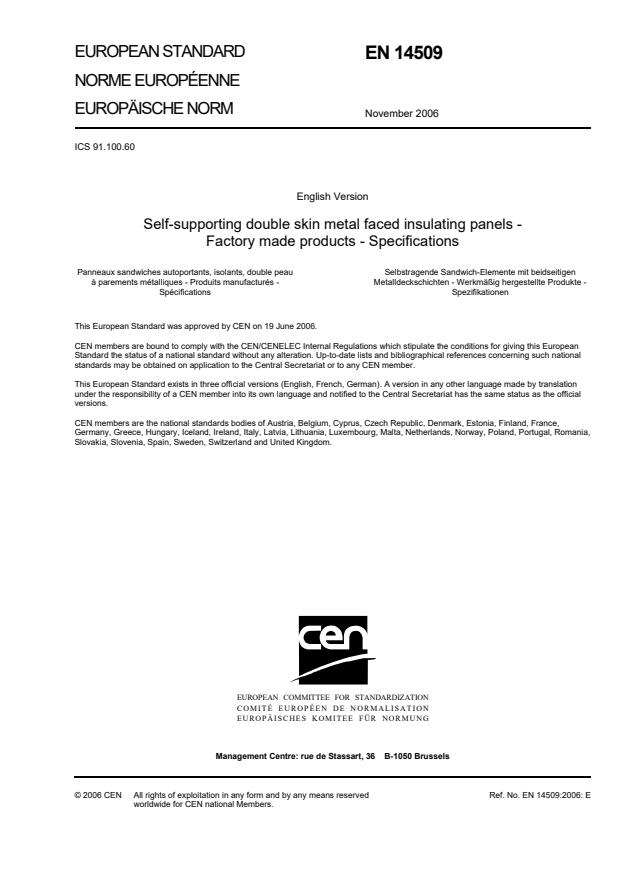
EUROPEAN STANDARDNORME EUROPÉENNEEUROPÄISCHE NORMEN 14509November 2006ICS 91.100.60 English VersionSelf-supporting double skin metal faced insulating panels -Factory made products - SpecificationsPanneaux sandwiches autoportants, isolants, double peauà parements métalliques - Produits manufacturés -SpécificationsSelbstragende Sandwich-Elemente mit beidseitigenMetalldeckschichten - Werkmäßig hergestellte Produkte -SpezifikationenThis European Standard was approved by CEN on 19 June 2006.CEN members are bound to comply with the CEN/CENELEC Internal Regulations which stipulate the conditions for giving this EuropeanStandard the status of a national standard without any alteration. Up-to-date lists and bibliographical references concerning such nationalstandards may be obtained on application to the Central Secretariat or to any CEN member.This European Standard exists in three official versions (English, French, German). A version in any other language made by translationunder the responsibility of a CEN member into its own language and notified to the Central Secretariat has the same status as the officialversions.CEN members are the national standards bodies of Austria, Belgium, Cyprus, Czech Republic, Denmark, Estonia, Finland, France,Germany, Greece, Hungary, Iceland, Ireland, Italy, Latvia, Lithuania, Luxembourg, Malta, Netherlands, Norway, Poland, Portugal, Romania,Slovakia, Slovenia, Spain, Sweden, Switzerland and United Kingdom.EUROPEAN COMMITTEE FOR STANDARDIZATIONCOMITÉ EUROPÉEN DE NORMALISATIONEUROPÄISCHES KOMITEE FÜR NORMUNGManagement Centre: rue de Stassart, 36
B-1050 Brussels© 2006 CENAll rights of exploitation in any form and by any means reservedworldwide for CEN national Members.Ref. No. EN 14509:2006: E
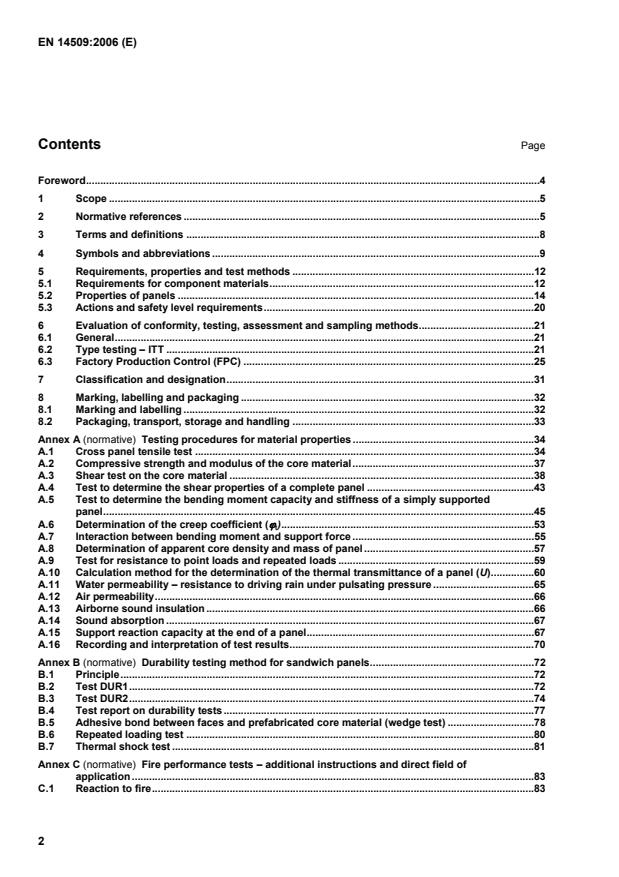
Testing procedures for material properties.34 A.1 Cross panel tensile test.34 A.2 Compressive strength and modulus of the core material.37 A.3 Shear test on the core material.38 A.4 Test to determine the shear properties of a complete panel.43 A.5 Test to determine the bending moment capacity and stiffness of a simply supported panel.45 A.6 Determination of the creep coefficient (ϕϕϕϕt).53 A.7 Interaction between bending moment and support force.55 A.8 Determination of apparent core density and mass of panel.57 A.9 Test for resistance to point loads and repeated loads.59 A.10 Calculation method for the determination of the thermal transmittance of a panel (U).60 A.11 Water permeability – resistance to driving rain under pulsating pressure.65 A.12 Air permeability.66 A.13 Airborne sound insulation.66 A.14 Sound absorption.67 A.15 Support reaction capacity at the end of a panel.67 A.16 Recording and interpretation of test results.70 Annex B (normative)
Durability testing method for sandwich panels.72 B.1 Principle.72 B.2 Test DUR1.72 B.3 Test DUR2.74 B.4 Test report on durability tests.77 B.5 Adhesive bond between faces and prefabricated core material (wedge test).78 B.6 Repeated loading test.80 B.7 Thermal shock test.81 Annex C (normative)
Fire performance tests – additional instructions and direct field of application.83 C.1 Reaction to fire.83
Dimensional tolerances.96 D.1 General.96 D.2 Dimensional tolerances.96 Annex E (normative)
Design procedures.106 E.1 Definitions and symbols.106 E.2 General.108 E.3 Actions.109 E.4 Resistance.110 E.5 Combination rules.113 E.6 Combination coefficients and safety factors.116 E.7 Calculation of the effects of actions.118 Annex ZA (informative)
Clauses of this European Standard addressing the provisions of the EU Construction Products Directive.127 ZA.1 Scope and relevant characteristics.127 ZA.2 Procedures for the attestation of conformity of sandwich panels.129 ZA.3 CE Marking and labelling.134 Bibliography.147
10 °C; ii. products consisting of two or more clearly defined layers of different insulating core materials (multi-layered); iii. panels with perforated facing(s); iv. curved panels. 2 Normative references The following referenced documents are indispensable for the application of this document. For dated references, only the edition cited applies. For undated references, the latest edition of the referenced document (including any amendments) applies. EN 485-2, Aluminium and aluminium alloys — Sheet, strip and plate — Part 2: Mechanical properties EN 485-4, Aluminium and aluminium alloys — Sheet, strip and plate — Part 4: Tolerances on shape and dimensions for cold-rolled products EN 502, Roofing products from metal sheet — Specification for fully supported roofing products of stainless steel sheet EN 508-1, Roofing products from metal sheet — Specification for self-supporting products of steel, aluminium or stainless steel sheet — Part 1: Steel EN 826, Thermal insulating products for building applications — Determination of compression behaviour EN 1172, Copper and copper alloys — Sheet and strip for building purposes
thermal conductivity, Design (design value) ϕ creep coefficient θ parameter (Table E.10.1 design equations)
coefficient, density Subscripts C core D declared value (RD) F face, action (γF) G self-weight, degree M material (γM) Q variable action S sandwich part of the cross-section adj adjusted b bending, elastic extension c compression, core, carrier (C.4.3.2), clip (fjoint,c) d design e external, additional thickness of main profiles (ûe) eff effective f load, facing (fi) i internal (fi) i, j index k characteristic value lin linear m material n nominal nc without clip (fjoint,nc) obs observed (e.g. result) q uniform load s support (Ls = support width), stiffeners, surface (Rs1) t tension, time tol tolerance (normal or special) tr traffic (Ctr) u ultimate (Fu)
cellular glass CWFT classified without further testing EPS expanded polystyrene FPC factory production control ITT
initial type test MW
mineral wool NPD no performance determined PCS gross calorific potential PUR rigid polyurethane foam (the abbreviation PUR includes polyisocyanurate foam (PIR)) PF
phenolic foam XPS extruded polystyrene foam 5 Requirements, properties and test methods 5.1 Requirements for component materials 5.1.1 General The product shall be manufactured with materials and components conforming to 5.1.2 to 5.1.4. 5.1.2 Metal facings 5.1.2.1 Steel faces Steel faces (other than stainless steel) shall have a minimum yield strength of 220 N/mm2 and shall conform to the requirements of the appropriate standard given in Table 1.
The minimum nominal metallic coating masses shall be as specified in EN 508-1. If the metal face is bonded over its whole area to a rigid foam core with a closed cell structure, the reverse side metallic coating mass shall be a minimum of 50 g/m2.
Organic protective coatings shall be selected according to their durability in the application environment. Organic coated steel sheets shall conform to the requirements of EN 10169-1, EN 10169-2 and EN 10169-3. Multi-layer coatings shall conform to EN 508-1. The panel manufacturer shall state the metal grade, thickness and tolerance system of each face. Tolerances on thickness shall be according to “special” or “normal” tolerances as described in the relevant standards. The thickness of steel facing sheets shall be determined in accordance with EN 10143. NOTE Not all steels in Table 1 are suitable for sandwich panels in all the intended end uses. 5.1.2.2 Stainless steel faces Stainless steel facings shall have a minimum yield strength of 220 N/mm2. The chemical composition of stainless steel faces and their physical properties shall conform to EN 10088-1. The panel manufacturer shall state the metal grade, thickness and tolerance system of each face. Tolerances on thickness shall be according to “special” or “normal” tolerances as described in the relevant standards. The thickness of steel facing sheets shall be determined in accordance with EN ISO 9445. NOTE Not all steels in EN 10088-1 are suitable for sandwich panels in all the intended end uses. The coating properties of terne coated stainless steel shall conform to EN 502. The nominal coating mass shall be the total mass including both sides and shall be at least 40 g/m2. 5.1.2.3 Aluminium faces Aluminium facings shall have a minimum design value of the stress at the 0,2%-strainlimit (for simplification called “yield strength“) of 140 N/mm2. The chemical composition, temper and mechanical properties of aluminium shall conform to EN 485-2 or EN 1396. Organic coated aluminium sheets shall conform to the requirements of EN 1396. The panel manufacturer shall state the metal grade, thickness and tolerance system of each face. Tolerances on thickness shall be according to “special” or “normal” tolerances as described in the relevant standards. The thickness of aluminium facing sheets shall be determined in accordance with EN 485-4 or EN 1396. NOTE Not all aluminium alloys covered by EN 485-2 or EN 1396 are suitable for sandwich panels in all the intended end uses. 5.1.2.4 Copper faces Copper facings shall have a minimum design value of the stress at the 0,2%-strainlimit (for simplification called “yield strength“) of 180 N/mm2. The chemical composition, temper, mechanical properties and thickness tolerances of copper faces shall conform to EN 1172.
EN 13165:2001 including Amendments A1 and A2:2004 and combinations of these agents , but excluding CO2 blown foams Other blowing agents shall be tested to DUR1 Polyurethane (PUR), – adhesive bond DUR1 No test required for panels manufactured using the blowing agents covered within
EN 13165:2001 including Amendments A1 and A2:2004 and combinations of these agents, but excluding CO2 blown foams. Other blowing agents shall be tested to DUR1 including the wedge test (B.5) The wedge test (B.5) shall be carried out Phenolic (PF) DUR1 and repeated loading B.6 PF panels with an adhesive bond shall be tested to DUR1 including the wedge test (B.5) Cellular glass (CG) DUR1, thermal shock B.7 and repeated loading B.6 Including the wedge test (B.5)
1 Reference to be brought in line with correct Decision number or removed before publication.
± 2 mm D > 100 mm
± 2 % D.2.1 Deviation from flatness (according to the length of measurement L) For L = 200 mm – Deviation from flatness 0,6 mm For L = 400 mm – Deviation from flatness 1,0 mm For L > 700 mm – Deviation from flatness 1,5 mm D.2.2 Depth of metal profile (ribs) (mm) 5 < h ≤ 50 mm ± 1 mm 50 < h ≤ 100 mm ± 2,5 mm D.2.3 Depth of stiffeners and light profiling ds ≤ 1 mm ± 30 % of ds 1 mm < ds ≤ 3 mm ± 0,3 mm 3 mm < ds ≤ 5 mm ± 10 % of ds D.2.4 Length of the panel L ≤ 3 m ± 5 mm L > 3 m ± 10 mm D.2.5 Cover width of the panel w ± 2 mm D.2.6 Deviation from squareness 0,006 × w (nominal cover width) D.2.7 Deviation from straightness (on length) 1 mm per metre, maximum 5 mm D.2.8 Bowing 2 mm per metre length, maximum 10 mm
8,5 mm per metre width for flat profiles – h ≤ 10 mm 10 mm per metre width for profiles – h > 10 mm D.2.9 Pitch of the profile (p) If h ≤ 50 mm p: ± 2 mm If h > 50 mm p: ± 3 mm D.2.10 Width of the ribs (b1) and width of the valleys (b2) For b1 ± 1 mm
For b2 ± 2 mm D.2.11 a
For calculation of the thickness of panels with profiled facings, see Figure D.1.
5.2.6 Water permeability Where required, the water permeability (resistance to driving rain) of a complete assembly of sandwich panels shall be assessed, i.e. the assembly that is to be installed in a building, including the product and its coatings, factory applied seals, standard joints, site applied seals, representative flashings, and a method of fixing as appropriate to the test. The resistance classification of a sandwich panel assembly to driving rain under pulsating air pressure shall be determined according to A.11. The test method shall be used for both external wall and roof applications. Sandwich panels covered by this European Standard are metal faced. When correctly manufactured and if satisfying an appropriate visual inspection they may be deemed to be impermeable to water. The water tightness of the assembly is a function of its installation. Water permeability is only relevant to the joints and fixings.
...