

CWA 17896:2022
(Main)Test method for the evaluation of the adhesive properties of fibre reinforced polymer composite joints
- Abstract
This document provides a test method for the determination of the adhesive properties in joints of continuous fibre reinforced polymer matrix composite structures using the Lap Strap specimen.
The evaluation includes the optional concurrent use of the non-destructive technique of the Electrical Resistance Change Method (ERCM) and/or Acoustic Emission (AE) for the monitoring of the debonding of the lap from the strap optionally. The ERCM NDE technique has a limited application only on carbon fibre composites due to the inherent electrical conductivity of the carbon fibres.
This test applies to composites manufactured with continuous carbon fibres (woven or unidirectional) and thermoset or thermoplastic matrices, with quasi-isotropic lamination. This methodology can be used on repairable or self-healing composites in order to estimate the repair or healing efficiency respectively.
Safety aspects about manufacturing and mechanical testing of the composites are excluded.
- Status
- Published
- Publication Date
- 07-Jun-2022
- Current Stage
- 9093 - Decision to confirm - Review Enquiry
- Start Date
- 12-Aug-2026
- Completion Date
- 07-Oct-2026

Overview
CWA 17896:2022 (CEN) defines a laboratory test method for evaluating the adhesive properties of joints in continuous fibre reinforced polymer composite structures using the Lap Strap specimen. The method is intended to reproduce the damage mechanisms seen in skin–stringer “run-out” and stiffened composite panels while minimising material usage and test complexity. Optional on-line non‑destructive evaluation (NDE) techniques - Electrical Resistance Change Method (ERCM) and Acoustic Emission (AE) - can be used concurrently to monitor debonding. ERCM is applicable only to carbon fibre composites because of their electrical conductivity.
Key topics and technical requirements
- Specimen geometry and sizing
- Lap: 100 × 20 mm; Strap: 200 × 20 mm; Endtab: 50 × 20 mm.
- Thickness of lap and strap: 2–5 mm; variation between parts ≤ 0.1 mm.
- Measure width/thickness to nearest 0.05 mm and report averages.
- Laminate configuration
- Continuous carbon fibre (woven or unidirectional), quasi‑isotropic, balanced and symmetric.
- Typical layup examples given for unidirectional tape and woven fabric.
- Sample size and statistics
- Minimum five specimens per condition; follow statistical guidance (ASTM E122 referenced) for significant data.
- Manufacture and conditioning
- Compatible with thermoset or thermoplastic matrices; panels produced by common composite processes (vacuum bag, autoclave, RTM, etc.). Void content and fibre volume fraction reporting per referenced ASTM methods.
- Mechanical test outputs
- Determine maximum strength, stiffness, strain, knockdown effect, and repair efficiency for repairable or self‑healing composites.
- NDE monitoring
- Optional AE and ERCM for on-line monitoring of debond initiation and propagation. ERCM limited to carbon composites.
Applications
- Evaluating adhesive joint behaviour in aerospace, aeronautics, automotive, wind energy, and naval composite structures.
- Simulating stringer run‑out and skin–stringer debonding with a material- and time‑efficient specimen.
- Quantifying repair or self‑healing efficiency and assessing the knockdown effect introduced by embedded repair/healing systems.
- Useful for R&D, qualification testing, failure analysis and comparative material selection.
Who should use this standard
- Composite materials engineers, test laboratories, R&D teams, manufacturers of carbon fibre composites, and quality assurance personnel involved in joint qualification, repair validation and structural integrity assessment.
Related standards
- CWA 17896:2022 contains no normative references but cites statistical and materials test guidance (e.g., ASTM E122, ASTM D2734, ASTM D3171) and ISO/IEC terminological resources. Users should consult relevant CEN, ISO and ASTM composite testing standards for complementary procedures and safety requirements.
Get Certified
Connect with accredited certification bodies for this standard

DIN CERTCO
DIN Group product certification.

Smithers Quality Assessments
US management systems and product certification.
Sponsored listings
Frequently Asked Questions
CWA 17896:2022 is a technical report published by the European Committee for Standardization (CEN). Its full title is "Test method for the evaluation of the adhesive properties of fibre reinforced polymer composite joints". This standard covers: This document provides a test method for the determination of the adhesive properties in joints of continuous fibre reinforced polymer matrix composite structures using the Lap Strap specimen. The evaluation includes the optional concurrent use of the non-destructive technique of the Electrical Resistance Change Method (ERCM) and/or Acoustic Emission (AE) for the monitoring of the debonding of the lap from the strap optionally. The ERCM NDE technique has a limited application only on carbon fibre composites due to the inherent electrical conductivity of the carbon fibres. This test applies to composites manufactured with continuous carbon fibres (woven or unidirectional) and thermoset or thermoplastic matrices, with quasi-isotropic lamination. This methodology can be used on repairable or self-healing composites in order to estimate the repair or healing efficiency respectively. Safety aspects about manufacturing and mechanical testing of the composites are excluded.
This document provides a test method for the determination of the adhesive properties in joints of continuous fibre reinforced polymer matrix composite structures using the Lap Strap specimen. The evaluation includes the optional concurrent use of the non-destructive technique of the Electrical Resistance Change Method (ERCM) and/or Acoustic Emission (AE) for the monitoring of the debonding of the lap from the strap optionally. The ERCM NDE technique has a limited application only on carbon fibre composites due to the inherent electrical conductivity of the carbon fibres. This test applies to composites manufactured with continuous carbon fibres (woven or unidirectional) and thermoset or thermoplastic matrices, with quasi-isotropic lamination. This methodology can be used on repairable or self-healing composites in order to estimate the repair or healing efficiency respectively. Safety aspects about manufacturing and mechanical testing of the composites are excluded.
CWA 17896:2022 is classified under the following ICS (International Classification for Standards) categories: 83.120 - Reinforced plastics; 83.180 - Adhesives. The ICS classification helps identify the subject area and facilitates finding related standards.
CWA 17896:2022 is available in PDF format for immediate download after purchase. The document can be added to your cart and obtained through the secure checkout process. Digital delivery ensures instant access to the complete standard document.
Standards Content (Sample)
SLOVENSKI STANDARD
01-september-2022
Preskusna metoda za ovrednotenje adhezijskih lastnosti kompozitnih spojev iz
polimerov, ojačenih z vlakni
Test method for the evaluation of the adhesive properties of fibre reinforced polymer
composite joints
Prüfverfahren zur Bewertung der Hafteigenschaften von faserverstärkten
Polymerverbundverbindungen
Ta slovenski standard je istoveten z: CWA 17896:2022
ICS:
83.120 Ojačani polimeri Reinforced plastics
83.180 Lepila Adhesives
2003-01.Slovenski inštitut za standardizacijo. Razmnoževanje celote ali delov tega standarda ni dovoljeno.
CEN
CWA 17896
WORKSHOP
June 2022
AGREEMENT
ICS 83.120; 83.180
English version
Test method for the evaluation of the adhesive properties
of fibre reinforced polymer composite joints
This CEN Workshop Agreement has been drafted and approved by a Workshop of representatives of interested parties, the
constitution of which is indicated in the foreword of this Workshop Agreement.
The formal process followed by the Workshop in the development of this Workshop Agreement has been endorsed by the
National Members of CEN but neither the National Members of CEN nor the CEN-CENELEC Management Centre can be held
accountable for the technical content of this CEN Workshop Agreement or possible conflicts with standards or legislation.
This CEN Workshop Agreement can in no way be held as being an official standard developed by CEN and its Members.
This CEN Workshop Agreement is publicly available as a reference document from the CEN Members National Standard Bodies.
CEN members are the national standards bodies of Austria, Belgium, Bulgaria, Croatia, Cyprus, Czech Republic, Denmark, Estonia, Finland, France,
Germany, Greece, Hungary, Iceland, Ireland, Italy, Latvia, Lithuania, Luxembourg, Malta, Netherlands, Norway, Poland, Portugal, Republic of North
Macedonia, Romania, Serbia, Slovakia, Slovenia, Spain, Sweden, Switzerland, Turkey and United Kingdom.
EUROPEAN COMMITTEE FOR STANDARDIZATION
COMITÉ EUROPÉEN DE NORMALISATION
EUROPÄISCHES KOMITEE FÜR NORMUNG
CEN-CENELEC Management Centre: Rue de la Science 23, B-1040 Brussels
© 2022 CEN All rights of exploitation in any form and by any means reserved worldwide for CEN national Members.
Ref. No.:CWA 17896:2022 E
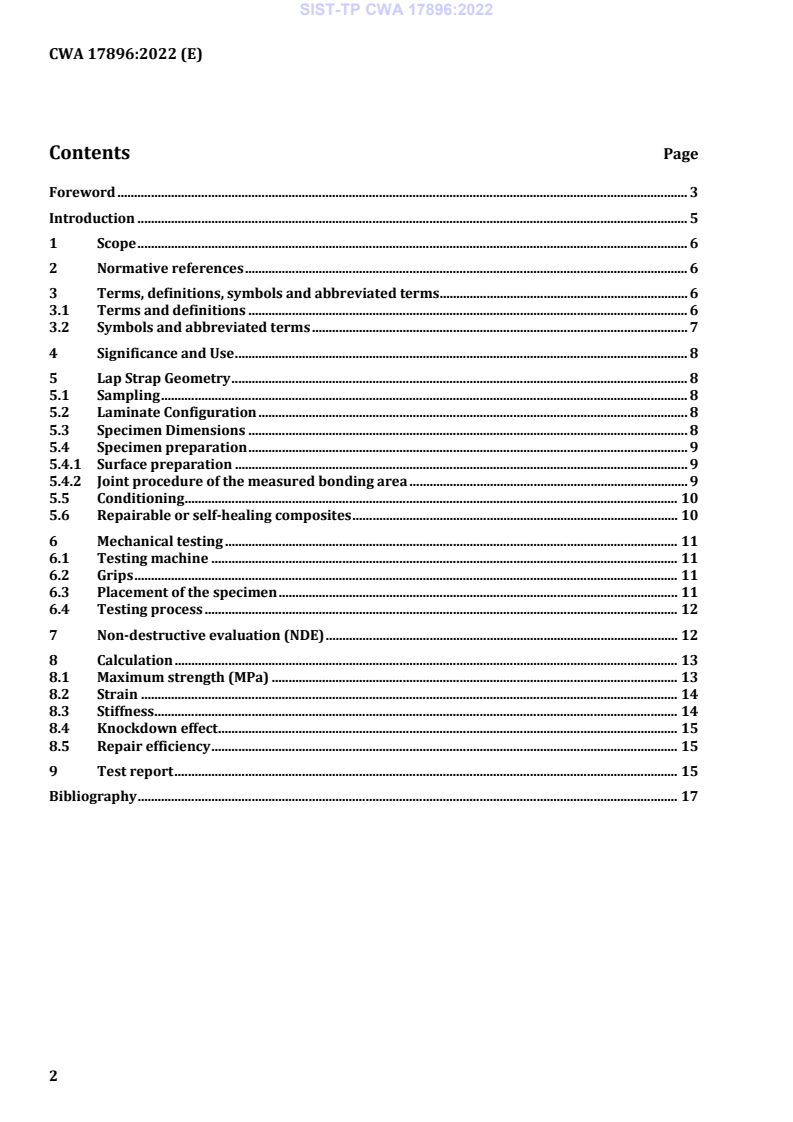
Contents Page
Foreword . 3
Introduction . 5
1 Scope . 6
2 Normative references . 6
3 Terms, definitions, symbols and abbreviated terms . 6
3.1 Terms and definitions . 6
3.2 Symbols and abbreviated terms . 7
4 Significance and Use . 8
5 Lap Strap Geometry . 8
5.1 Sampling . 8
5.2 Laminate Configuration . 8
5.3 Specimen Dimensions . 8
5.4 Specimen preparation . 9
5.4.1 Surface preparation . 9
5.4.2 Joint procedure of the measured bonding area . 9
5.5 Conditioning . 10
5.6 Repairable or self-healing composites . 10
6 Mechanical testing . 11
6.1 Testing machine . 11
6.2 Grips . 11
6.3 Placement of the specimen . 11
6.4 Testing process . 12
7 Non-destructive evaluation (NDE) . 12
8 Calculation . 13
8.1 Maximum strength (MPa) . 13
8.2 Strain . 14
8.3 Stiffness . 14
8.4 Knockdown effect . 15
8.5 Repair efficiency . 15
9 Test report . 15
Bibliography . 17
Foreword
This CEN Workshop Agreement (CWA 17896:2022)has been developed in accordance with the CEN-
CENELEC Guide 29 “CEN/CENELEC Workshop Agreements – A rapid prototyping to standardization” and
with the relevant provisions of CEN/CENELEC Internal Regulations - Part 2. It was approved by a
Workshop of representatives of interested parties on 2022-04-06, the constitution of which was
supported by CEN following the public call for participation made on 2021-07-26. However, this CEN
Workshop Agreement does not necessarily include all relevant stakeholders.
The final text of this CEN Workshop Agreement was provided to CEN for publication on 2022-05-20.
Results incorporated in this CWA received funding from the European Union’s Horizon 2020 research
and innovation programme under grant agreement No 769274 (AIRPOXY project).
The following organizations and individuals developed and approved this CEN Workshop Agreement:
• Nerea Markaide – Chairperson, FUNDACIÓN CIDETEC (Spain)
• Esther Bermejo – Secretary, UNE (Spain)
• Alkiviadis Paipetis – CWA Leader, University of Ioannina (Greece)
• Georgios Foteinidis, University of Ioannina (Greece)
• Kyriaki Tsirka, University of Ioannina (Greece)
• Maria Kosarli, University of Ioannina (Greece)
• Nektaria-Marianthi Barkoula, University of Ioannina (Greece)
• Conor Kelly, ÉireComposites Teoroanta (Ireland)
• Alain Leroy, COEXPAIR S.A. (Belgium)
• Juan Pedro Berro Ramirez, Altair Engineering France (France)
• Alaitz Ruiz de Luzuriaga, FUNDACIÓN CIDETEC (Spain)
• Stefan Weidmann, Leibniz-Institut für Verbundwekstoffe GmbH-IVW (Germany)
• Stephan Becker, Leibniz-Institut für Verbundwekstoffe GmbH-IVW (Germany)
• Mª Eugenia Rodríguez, FUNDACIÓ EURECAT (Spain)
• Vincent Gayraud, FUNDACIÓ EURECAT (Spain)
• Diego Calderón, IDEC – Ingeniería y Desarrollos en Composites, S.L. (Spain)
• Rakel Gonzalez, IDEC – Ingeniería y Desarrollos en Composites, S.L. (Spain)
• Guillaume Messin, IPC-Centre Technique Industriel de la Plasturgie et des Composites (France)
• Mathieu Lions, IPC-Centre Technique Industriel de la Plasturgie et des Composites (France)
• Rafael Luterbacher, GMA Group (Germany)
• Dimitrios Bekas, MEGA PLAST Industrial-Exporting S.A. (Greece)
• Markus Wolfahrt, Polymer Competence Center Leoben (Austria)
• Robert Perrin, DGA Aeronautical Systems (France)
• Pierre Barbier, Hexcel Composites (France)
• Daniel Ng, ASD-STAN Aerospace
Attention is drawn to the possibility that some elements of this document may be subject to patent rights.
CEN-CENELEC policy on patent rights is described in CEN-CENELEC Guide 8 “Guidelines for
Implementation of the Common IPR Policy on Patent”. CEN shall not be held responsible for identifying
any or all such patent rights.
Although the Workshop parties have made every effort to ensure the reliability and accuracy of technical
and non-technical descriptions, the Workshop is not able to guarantee, explicitly or implicitly, the
correctness of this document. Anyone who applies this CEN Workshop Agreement shall be aware that
neither the Workshop, nor CEN, can be held liable for damages or losses of any kind whatsoever. The use
of this CEN Workshop Agreement does not relieve users of their responsibility for their own actions, and
they apply this document at their own risk. The CEN Workshop Agreement should not be construed as
legal advice authoritatively endorsed by CEN/CENELEC.
Introduction
Advanced fibre reinforced polymer composites, due to their lightweight, are used in aeronautics,
aerospace, automotive, and naval activities (e.g., aircraft fuselage, wind turbines, gears, chassis, etc.).
Skin-stiffened or “stringer run-outs” structures are used mostly in aerospace and are very sensitive to
local damages. Usually, the stringer tends to debond from the skin, and then the delamination may further
propagate in the skin. The mechanical characterization of these specimens is both time-consuming and
material intensive.
This document describes a modified test method used in a European project to characterize delamination
at the tip of the flange and to understand ‘stringer run-out’ experienced in the manufacture of composite
large panel, typically greater than 0,5 m in any in-plane direction. The method employed a simplified joint
configuration via a lap-strap geometry. The results of the work showed that the simplified lap-strap
specimens showed the same damage mechanisms as the stringer run-out.
Firstly, the lap debonds from the strap and then the delamination may further propagate interplay in the
strap. It should be mentioned that failure in the lap -strap geometry is manifested in a mixed-mode. At
the early stages of the test, the adhesive layer between lap and strap fails in mode II, followed by mode I
failure at higher stress levels. This test method could also be used to evaluate the healing or repair
efficiency at self-healing or repairable composites or their knockdown effect (see 5.6).
Non-destructive Evaluation (NDE) techniques, for example Acoustic Emission, can be optionally applied
to the Lap Strap specimen with the mechanical testing. NDE techniques include Electrical Resistance
Change Method (ERCM) and Acoustic Emission (AE). These techniques could provide information about
the failure of the geometry and, additionally, information about the damage that was induced before
failure. They are strongly suggested in cases of poor mechanical properties of the adhesive.
1 Scope
This document provides a test method for the determination of the adhesive properties in joints of
continuous fibre reinforced polymer matrix composite structures using the Lap Strap specimen.
The evaluation includes the optional concurrent use of the non-destructive technique of the Electrical
Resistance Change Method (ERCM) and/or Acoustic Emission (AE) for the monitoring of the debonding
of the lap from the strap optionally. The ERCM NDE technique has a limited application only on carbon
fibre composites due to the inherent electrical conductivity of the carbon fibres.
This test applies to composites manufactured with continuous carbon fibres (woven or unidirectional)
and thermoset or thermoplastic matrices, with quasi-isotropic lamination. This methodology can be used
on repairable or self-healing composites in order to estimate the repair or healing efficiency respectively.
Safety aspects about manufacturing and mechanical testing of the composites are excluded.
2 Normative references
There are no normative references in this document.
3 Terms, definitions, symbols and abbreviated terms
3.1 Terms and definitions
For the purposes of this document, the following terms, definitions, symbols and abbreviated terms apply.
ISO and IEC maintain terminological databases for use in standardization at the following addresses:
— IEC Electropedia: available at http://www.electropedia.org/
— ISO Online browsing platform: available at http://www.iso.org/obp
3.1.1
non-destructive evaluation
NDE
process or procedure for determining the quality or characteristics of a material, part or assembly
without permanently altering the subject or its properties
[SOURCE: ISO 21648:2008, 2.1.29]
3.1.2
on-line monitoring
any inspection activity carried out concurrent with the mechanical testing
3.1.3
knockdown effect
the change of the initial mechanical properties of a composite material after the incorporation of a self-
healing or a self-repairing system
3.1.4
balanced laminate
continuous fibre-reinforced laminate that each +θ° (angle) lamina is balanced by a -θ° (angle) lamina in
regard to a reference axis
3.1.5
symmetric laminate
continuous fibre-reinforced laminate that each ply above the mid-plane is identically the same in terms
of position and orientation with one below the mid-plane
3.2 Symbols and abbreviated terms
AE Acoustic Emission
b measured specimen width
Ε apparent stiffness
ERCM Electrical Resistance Change Method
max
value of the load at the drop-off point
F
g measured grip-to-grip distance
h measured lap thickness
l extension
NDE Non-Destructive Evaluation
R Initial value of the resistance
ΔR The final value of the resistance minus the initial value of the resistance
ε lap strap strain
θ° angle
Initial
lap strap strength from a initial composite
σ
max
Modified
lap strap strength from a modified composite
σ
max
max lap strap strength at the drop off point
σ
Reference
lap strap strength from a reference composite
σ
max
Repaired
lap strap strength from a repaired composite
σ
max
4 Significance and Use
The most common failure mode of stiffened composite panels is the debonding between the skin and the
stringer. The proposed test method provides the mechanical strength of the lap strap specimen that
simulates the mechanical and failure behaviour of a stiffened panel and reduces cons
...