

EN 14891:2012
(Main)Liquid-applied water impermeable products for use beneath ceramic tiling bonded with adhesives - Requirements, test methods, evaluation of conformity, classification and designation
- Abstract
This European Standard applies to all liquid-applied water impermeable products, based on polymer modified cementitious mortars, dispersions and reaction resin coatings, used beneath ceramic tiling, for external tile installations on walls and floors and in swimming pools.
This European Standard gives the terminology concerning the products and specifies the test methods and the values of performance requirements for liquid-applied water impermeable products associated with tile adhesives.
This European Standard specifies the evaluation of conformity and the classification and designation of liquid-applied water impermeable products beneath ceramic tiling.
This European Standard does not contain recommendations for the design and installation of ceramic tiles and grouts in combination with water impermeable products.
NOTE 1 Liquid-applied water impermeable products may also be used beneath other types of tiles (natural and agglomerated stones, etc.), where they do not adversely affect these materials.
NOTE 2 The user of this European Standard should be familiar with normal laboratory practice. This European Standard does not purport to address all the safety problems associated with its use. It is the responsibility of the user to establish appropriate health and safety practices and to ensure compliance with any European and national regulatory conditions.
- Status
- Withdrawn
- Publication Date
- 24-Apr-2012
- Withdrawal Date
- 06-Oct-2026
- Technical Committee
- CEN/TC 67 - Ceramic tiles
- Drafting Committee
- CEN/TC 67/WG 3 - Adhesives and grouts for tiles
- Current Stage
- 9960 - Withdrawal effective - Withdrawal
- Start Date
- 15-Feb-2017
- Completion Date
- 07-Oct-2026
- Directive
- 305/2011 - Regulation (eu) No 305/2011 of the European Parliament and of the Council of 9 march 2011 laying down harmonised conditions for the marketing of construction products and repealing council directive 89/106/eecOJ Ref: C, C 259 OJ Date: 08-Aug-2014
89/106/EEC - Construction productsOJ Ref: C, C 59 OJ Date: 28-Feb-2013

Relations
- Effective Date
- 08-Jun-2022
- Effective Date
- 02-May-2012
- Effective Date
- 02-May-2012
- Effective Date
- 02-May-2012
- Effective Date
- 22-Feb-2017
- Effective Date
- 28-Jan-2026
- Effective Date
- 28-Jan-2026
- Effective Date
- 28-Jan-2026
- Effective Date
- 28-Jan-2026
- Effective Date
- 28-Jan-2026
- Effective Date
- 28-Jan-2026
- Effective Date
- 28-Jan-2026
- Refers
EN 12390-2:2019 - Testing hardened concrete - Part 2: Making and curing specimens for strength tests - Effective Date
- 28-Jan-2026
- Effective Date
- 28-Jan-2026
- Effective Date
- 28-Jan-2026
Get Certified
Connect with accredited certification bodies for this standard

DIBt (Deutsches Institut für Bautechnik)
German Institute for Building Technology.
DIN CERTCO
DIN Group product certification.

Aboma Certification B.V.
Specialized in construction, metal, and transport sectors.
Sponsored listings
Frequently Asked Questions
EN 14891:2012 is a standard published by the European Committee for Standardization (CEN). Its full title is "Liquid-applied water impermeable products for use beneath ceramic tiling bonded with adhesives - Requirements, test methods, evaluation of conformity, classification and designation". This standard covers: This European Standard applies to all liquid-applied water impermeable products, based on polymer modified cementitious mortars, dispersions and reaction resin coatings, used beneath ceramic tiling, for external tile installations on walls and floors and in swimming pools. This European Standard gives the terminology concerning the products and specifies the test methods and the values of performance requirements for liquid-applied water impermeable products associated with tile adhesives. This European Standard specifies the evaluation of conformity and the classification and designation of liquid-applied water impermeable products beneath ceramic tiling. This European Standard does not contain recommendations for the design and installation of ceramic tiles and grouts in combination with water impermeable products. NOTE 1 Liquid-applied water impermeable products may also be used beneath other types of tiles (natural and agglomerated stones, etc.), where they do not adversely affect these materials. NOTE 2 The user of this European Standard should be familiar with normal laboratory practice. This European Standard does not purport to address all the safety problems associated with its use. It is the responsibility of the user to establish appropriate health and safety practices and to ensure compliance with any European and national regulatory conditions.
This European Standard applies to all liquid-applied water impermeable products, based on polymer modified cementitious mortars, dispersions and reaction resin coatings, used beneath ceramic tiling, for external tile installations on walls and floors and in swimming pools. This European Standard gives the terminology concerning the products and specifies the test methods and the values of performance requirements for liquid-applied water impermeable products associated with tile adhesives. This European Standard specifies the evaluation of conformity and the classification and designation of liquid-applied water impermeable products beneath ceramic tiling. This European Standard does not contain recommendations for the design and installation of ceramic tiles and grouts in combination with water impermeable products. NOTE 1 Liquid-applied water impermeable products may also be used beneath other types of tiles (natural and agglomerated stones, etc.), where they do not adversely affect these materials. NOTE 2 The user of this European Standard should be familiar with normal laboratory practice. This European Standard does not purport to address all the safety problems associated with its use. It is the responsibility of the user to establish appropriate health and safety practices and to ensure compliance with any European and national regulatory conditions.
EN 14891:2012 is classified under the following ICS (International Classification for Standards) categories: 91.100.25 - Terracotta building products; 91.100.50 - Binders. Sealing materials. The ICS classification helps identify the subject area and facilitates finding related standards.
EN 14891:2012 has the following relationships with other standards: It is inter standard links to EN 14891:2007/AC:2009, EN 14891:2007/AC:2009, EN 14891:2007/AC:2008, EN 14891:2007, EN 14891:2017, EN 196-1:2005, EN 12004-2:2017, EN 1067:2005, EN ISO 15605:2004, EN 197-1:2011, EN 480-1:2006+A1:2011, EN 14411:2006, EN 12390-2:2019, EN 1008:2002, EN 12620:2002+A1:2008. Understanding these relationships helps ensure you are using the most current and applicable version of the standard.
EN 14891:2012 is associated with the following European legislation: EU Directives/Regulations: 305/2011, 89/106/EEC; Standardization Mandates: M/102. When a standard is cited in the Official Journal of the European Union, products manufactured in conformity with it benefit from a presumption of conformity with the essential requirements of the corresponding EU directive or regulation.
EN 14891:2012 is available in PDF format for immediate download after purchase. The document can be added to your cart and obtained through the secure checkout process. Digital delivery ensures instant access to the complete standard document.
Standards Content (Sample)
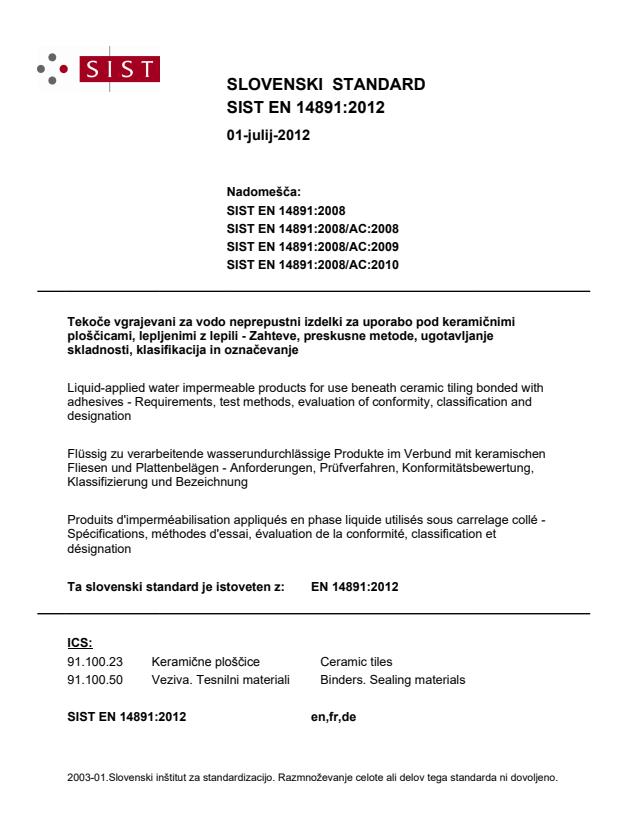
2003-01.Slovenski inštitut za standardizacijo. Razmnoževanje celote ali delov tega standarda ni dovoljeno.PLþQLPLDYOMDQMHFlüssig zu verarbeitende wasserundurchlässige Produkte im Verbund mit keramischen Fliesen und Plattenbelägen - Anforderungen, Prüfverfahren, Konformitätsbewertung, Klassifizierung und BezeichnungProduits d'imperméabilisation appliqués en phase liquide utilisés sous carrelage collé - Spécifications, méthodes d'essai, évaluation de la conformité, classification et désignationLiquid-applied water impermeable products for use beneath ceramic tiling bonded with adhesives - Requirements, test methods, evaluation of conformity, classification and designation91.100.50Veziva. Tesnilni materialiBinders. Sealing materials91.100.23Ceramic tilesICS:Ta slovenski standard je istoveten z:EN 14891:2012SIST EN 14891:2012en,fr,de01-julij-2012SIST EN 14891:2012SLOVENSKI
STANDARDSIST EN 14891:2008/AC:2009SIST EN 14891:2008/AC:2010SIST EN 14891:2008SIST EN 14891:2008/AC:20081DGRPHãþD
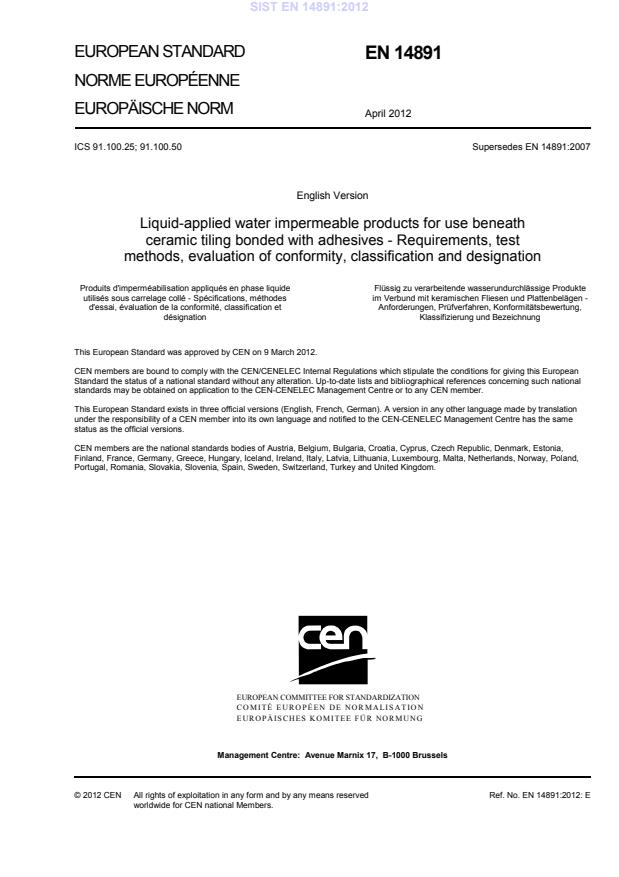
EUROPEAN STANDARD NORME EUROPÉENNE EUROPÄISCHE NORM
EN 14891
April 2012 ICS 91.100.25; 91.100.50 Supersedes EN 14891:2007English Version
Liquid-applied water impermeable products for use beneath ceramic tiling bonded with adhesives - Requirements, test methods, evaluation of conformity, classification and designation Produits d'imperméabilisation appliqués en phase liquide utilisés sous carrelage collé - Spécifications, méthodes d'essai, évaluation de la conformité, classification et désignation
Flüssig zu verarbeitende wasserundurchlässige Produkte im Verbund mit keramischen Fliesen und Plattenbelägen - Anforderungen, Prüfverfahren, Konformitätsbewertung, Klassifizierung und Bezeichnung This European Standard was approved by CEN on 9 March 2012.
CEN members are bound to comply with the CEN/CENELEC Internal Regulations which stipulate the conditions for giving this European Standard the status of a national standard without any alteration. Up-to-date lists and bibliographical references concerning such national standards may be obtained on application to the CEN-CENELEC Management Centre or to any CEN member.
This European Standard exists in three official versions (English, French, German). A version in any other language made by translation under the responsibility of a CEN member into its own language and notified to the CEN-CENELEC Management Centre has the same status as the official versions.
CEN members are the national standards bodies of Austria, Belgium, Bulgaria, Croatia, Cyprus, Czech Republic, Denmark, Estonia, Finland, France, Germany, Greece, Hungary, Iceland, Ireland, Italy, Latvia, Lithuania, Luxembourg, Malta, Netherlands, Norway, Poland, Portugal, Romania, Slovakia, Slovenia, Spain, Sweden, Switzerland, Turkey and United Kingdom.
EUROPEAN COMMITTEE FOR STANDARDIZATION
COMITÉ EUROPÉEN DE NORMALISATION EUROPÄISCHES KOMITEE FÜR NORMUNG
Management Centre:
Avenue Marnix 17,
B-1000 Brussels © 2012 CEN All rights of exploitation in any form and by any means reserved worldwide for CEN national Members. Ref. No. EN 14891:2012: ESIST EN 14891:2012
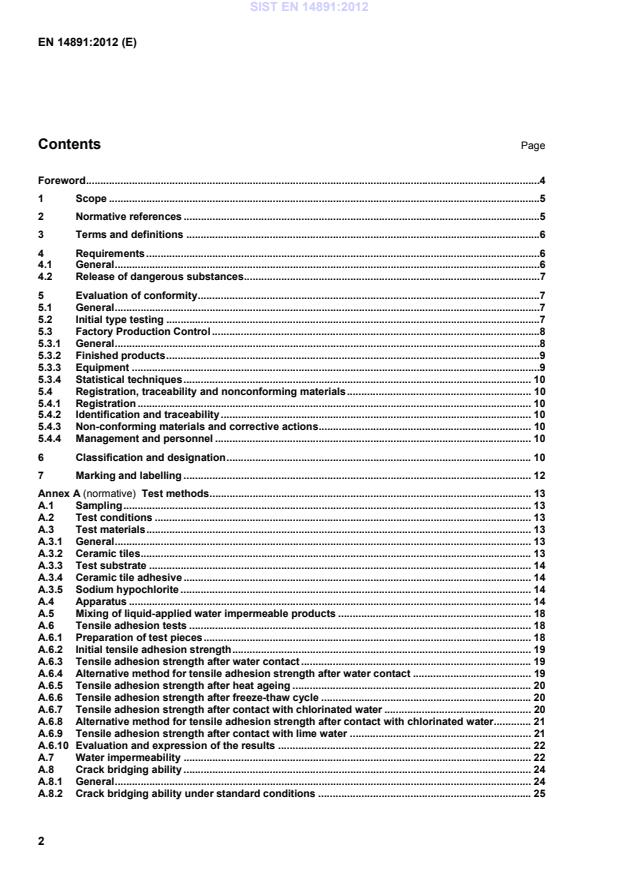
Test methods . 13A.1 Sampling . 13A.2 Test conditions . 13A.3 Test materials . 13A.3.1 General . 13A.3.2 Ceramic tiles . 13A.3.3 Test substrate . 14A.3.4 Ceramic tile adhesive . 14A.3.5 Sodium hypochlorite . 14A.4 Apparatus . 14A.5 Mixing of liquid-applied water impermeable products . 18A.6 Tensile adhesion tests . 18A.6.1 Preparation of test pieces . 18A.6.2 Initial tensile adhesion strength . 19A.6.3 Tensile adhesion strength after water contact . 19A.6.4 Alternative method for tensile adhesion strength after water contact . 19A.6.5 Tensile adhesion strength after heat ageing . 20A.6.6 Tensile adhesion strength after freeze-thaw cycle . 20A.6.7 Tensile adhesion strength after contact with chlorinated water . 20A.6.8 Alternative method for tensile adhesion strength after contact with chlorinated water . 21A.6.9 Tensile adhesion strength after contact with lime water . 21A.6.10 Evaluation and expression of the results . 22A.7 Water impermeability . 22A.8 Crack bridging ability . 24A.8.1 General . 24A.8.2 Crack bridging ability under standard conditions . 25SIST EN 14891:2012
Relationship between this European Standard and the Essential Requirements of EU Directive (89/106/EEC EU Construction Products Directive) . 27ZA.1 General . 27ZA.2 Procedure(s) for attestation of conformity of liquid applied water impermeable products . 29ZA.2.1 System of attestation of conformity . 29ZA.2.2 EC Declaration of conformity . 29ZA.3
CE marking and labelling. 30Bibliography . 33 SIST EN 14891:2012
CM mixture of hydraulic binding agents, aggregates and organic additives that has only to be mixed with water or liquid admixture just before use 3.3 dispersion liquid-applied water impermeable product
DM mixture of organic binding agent(s) in the form of an aqueous polymer dispersion, organic additives and mineral fillers Note 1 to entry: The mixture is ready for use. 3.4 reaction resin liquid-applied water impermeable product
RM mixture of synthetic resin, mineral fillers and organic additives in which hardening occurs by chemical reaction Note 1 to entry: They are available in one or more component forms. 3.5 crack bridging ability ability of the hardened waterproofing material to withstand propagation of the cracks without deterioration 3.6 primer liquid coating applied to the surface, prior to the application of a liquid product, to improve adhesion and durability of the bond 3.7 fundamental characteristics characteristics that a liquid-applied water impermeable product always needs to have 3.8 optional characteristics characteristics for specific service conditions where enhanced levels of performance are required or which provide further information about its general performance 4 Requirements 4.1 General The liquid-applied water impermeable products shall comply with the characteristics specified in Table 1, section 1 a. Table 1, section 1 b gives the additional characteristics that might be required for special service conditions. SIST EN 14891:2012
4.2 Release of dangerous substances Materials used in products shall not release any dangerous substances in excess of the maximum permitted levels specified in a relevant European Standard for the material of permited in the national regulations of the member state of destination. 5 Evaluation of conformity 5.1 General
The compliance of liquid-applied water impermeable products with the requirements of this standard and with the declared values (including classes) shall be demonstrated by: Initial Type Testing (ITT); Factory Production Control (FTP) by the manufacturer, including product assessment. 5.2 Initial type testing On first evaluation of a product to the requirements of this European Standard, or before the beginning of sale of a new product, appropriate initial type testing shall be carried out to confirm that the characteristics of the product meet the requirements of this European Standard. Tests which have previously been performed in accordance with the provisions of this European Standard (same product, same characteristic, test method, SIST EN 14891:2012
5.3.1.2 Raw materials The acceptance criteria and control procedures for incoming materials shall be defined by the manufacturer, to ensure that these are not used until it has been verified that they conform to the required specifications. SIST EN 14891:2012
A means «at six month interval»; (A) means «at six month interval, if relevant for the product».
For the purpose of the Factory Production Control alternative tests to those given in Table 2 may be used, provided that a correlation of the results between both tests, for the product in question, is established. The use of alternative tests shall be recorded, maintained and be made available on request. 5.3.3 Equipment All the measuring instruments used for production or testing shall be identified, calibrated and kept in good order, in accordance with documented procedures and instructions. The manufacturer shall establish an appropriate plan detailing the procedures and frequency of these checks and shall maintain the registrations. Test equipment shall be calibrated to traceable standards. SIST EN 14891:2012
cementitious liquid-applied water impermeable products; DM
dispersion liquid-applied water impermeable products; RM
reaction resin liquid-applied water impermeable products. For each type it is possible to have different classes, related to the different optional characteristics given in
Table 1, section 1b. These classes are designated by the following abbreviations: SIST EN 14891:2012
Normal cementitious liquid-applied water impermeable product DM
Normal dispersion liquid-applied water impermeable product RM
Normal reaction resin liquid-applied water impermeable product CM O1 Cementitious liquid-applied water impermeable product with improved crack bridging ability at low temperature (-5°C) CM O2 Cementitious liquid-applied water impermeable product with improved crack bridging ability at low temperature (-20°C) DM O1 Dispersion liquid-applied water impermeable product with improved crack bridging ability at low temperature (-5°C) DM O2 Dispersion liquid-applied water impermeable product with improved crack bridging ability at low temperature (-20°C) RM O1 Reaction resin liquid-applied water impermeable product with improved crack bridging ability at low temperature (-5°C) RM O2 Reaction resin liquid-applied water impermeable product with improved crack bridging ability at low temperature (-20°C) CM P Cementitious liquid-applied water impermeable product resistant to contact with chlorinated water DM P Dispersion liquid-applied water impermeable product resistant to contact with chlorinated water RM P Reaction resin liquid-applied water impermeable product resistant to contact with chlorinated water CM O1P Cementitious liquid-applied water impermeable product with improved crack bridging ability at low temperature (-5°C) and resistant to contact with chlorinated water CM O2P Cementitious liquid-applied water impermeable product with improved crack bridging ability at low temperature (-20°C) and resistant to contact with chlorinated water DM O1P Dispersion liquid-applied water impermeable product with improved crack bridging ability at low temperature (-5°C) and resistant to contact with chlorinated water DM O2P Dispersion liquid-applied water impermeable product with improved crack bridging ability at low temperature (-20°C) and resistant to contact with chlorinated water RM O1P Reaction resin liquid-applied water impermeable product with improved crack bridging ability at low temperature (-5°C) and resistant to contact with chlorinated water RM O2P Reaction resin liquid-applied water impermeable product with improved crack bridging ability at low temperature (-20°C) and resistant to contact with chlorinated water
Test methods A.1 Sampling Take a sample of at least 2 kg of the product to be tested in accordance with EN ISO 15605 and EN 1067. A.2 Test conditions Standard conditions shall be (23 ± 2) °C and (50 ± 5) % Relative Humidity and the speed of air in the working area less than 0,2 m/s. When the test specimens have to be conditioned according to the test method, the tolerances in the time of conditioning for all test specimens shall be as follows:
Conditioning
Tolerance
24 h
±
0,5
h
7 days
±
h
14 days
±
h
21 days
±
h
28 days
± 12
h A.3 Test materials A.3.1 General Condition all test materials for at least 24 h under standard conditions. The materials to be tested shall be within their shelf life. A.3.2 Ceramic tiles The tiles shall be clean and dry. The tiles used for this method shall be of: type V1: fully vitrified tile complying with EN 14411:2006, with a water absorption ≤ 0,5 % by mass, unglazed and with a plain adhering surface, with facial dimensions of (50 ± 1) mm × (50 ± 1) mm. SIST EN 14891:2012
...