

EN ISO 10239:2008
(Main)Small craft - Liquefied petroleum gas (LPG) systems (ISO 10239:2008)
- Abstract
ISO 10239:2008 covers permanently installed liquefied petroleum gas (LPG) systems and LPG burning appliances on small craft of hull length up to 24 m, except for systems used on LPG-fuelled propulsion engines or LPG-driven generators.
ISO 10239:2008 does not cover appliances with directly attached gas cylinders, such as portable self-contained camping stoves and portable gas lamps.
- Status
- Withdrawn
- Publication Date
- 14-Feb-2008
- Withdrawal Date
- 06-Oct-2026
- Technical Committee
- CEN/SS T01 - Shipbuilding and maritime structures
- Drafting Committee
- CEN/SS T01 - Shipbuilding and maritime structures
- Current Stage
- 9960 - Withdrawal effective - Withdrawal
- Start Date
- 03-Dec-2014
- Completion Date
- 07-Oct-2026
94/25/EC - Recreational craftOJ Ref: C, C 109 OJ Date: 30-Apr-2008


Relations
- Effective Date
- 22-Dec-2008
- Effective Date
- 22-Dec-2008
- Effective Date
- 26-Nov-2011
- Effective Date
- 25-Aug-2026
- Effective Date
- 25-Aug-2026
- Effective Date
- 25-Aug-2026
- Effective Date
- 25-Aug-2026
- Effective Date
- 25-Aug-2026
- Effective Date
- 28-Jan-2026
- Effective Date
- 28-Jan-2026
- Effective Date
- 28-Jan-2026
- Effective Date
- 28-Jan-2026
- Effective Date
- 12-Feb-2026
Get Certified
Connect with accredited certification bodies for this standard

DNV
DNV is an independent assurance and risk management provider.

Lloyd's Register
Lloyd's Register is a global professional services organisation specialising in engineering and technology.

FSC International
Forest Stewardship Council certification.
Sponsored listings
Frequently Asked Questions
EN ISO 10239:2008 is a standard published by the European Committee for Standardization (CEN). Its full title is "Small craft - Liquefied petroleum gas (LPG) systems (ISO 10239:2008)". This standard covers: ISO 10239:2008 covers permanently installed liquefied petroleum gas (LPG) systems and LPG burning appliances on small craft of hull length up to 24 m, except for systems used on LPG-fuelled propulsion engines or LPG-driven generators. ISO 10239:2008 does not cover appliances with directly attached gas cylinders, such as portable self-contained camping stoves and portable gas lamps.
ISO 10239:2008 covers permanently installed liquefied petroleum gas (LPG) systems and LPG burning appliances on small craft of hull length up to 24 m, except for systems used on LPG-fuelled propulsion engines or LPG-driven generators. ISO 10239:2008 does not cover appliances with directly attached gas cylinders, such as portable self-contained camping stoves and portable gas lamps.
EN ISO 10239:2008 is classified under the following ICS (International Classification for Standards) categories: 47.080 - Small craft. The ICS classification helps identify the subject area and facilitates finding related standards.
EN ISO 10239:2008 has the following relationships with other standards: It is inter standard links to EN ISO 10239:2000/AC:2002, EN ISO 10239:2000, EN ISO 10239:2014, ISO 10240:2004, ISO 13297:2000, ISO 9094-1:2003, ISO 10133:2000, ISO 8846:1990, EN 1756-2:2004+A1:2009, EN 13238:2010, EN 13523-11:2011, EN 2858-3:1994, ISO 10239:2008. Understanding these relationships helps ensure you are using the most current and applicable version of the standard.
EN ISO 10239:2008 is associated with the following European legislation: EU Directives/Regulations: 2003/44/EC, 94/25/EC; Standardization Mandates: M/075. When a standard is cited in the Official Journal of the European Union, products manufactured in conformity with it benefit from a presumption of conformity with the essential requirements of the corresponding EU directive or regulation.
EN ISO 10239:2008 is available in PDF format for immediate download after purchase. The document can be added to your cart and obtained through the secure checkout process. Digital delivery ensures instant access to the complete standard document.
Standards Content (Sample)
2003-01.Slovenski inštitut za standardizacijo. Razmnoževanje celote ali delov tega standarda ni dovoljeno.Small craft - Liquefied petroleum gas (LPG) systems (ISO 10239:2008)Petits navires - Installations alimentées en gaz de pétrole liquéfiés (GPL) (ISO 10239:2008)Kleine Wasserfahrzeuge - Flüssiggasanlagen (ISO 10239:2008)Ta slovenski standard je istoveten z:EN ISO 10239:2008SIST EN ISO 10239:2008en47.080ICS:SIST EN ISO 10239:2001/AC:2004SIST EN ISO 10239:20011DGRPHãþDSLOVENSKI
STANDARDSIST EN ISO 10239:200801-april-2008
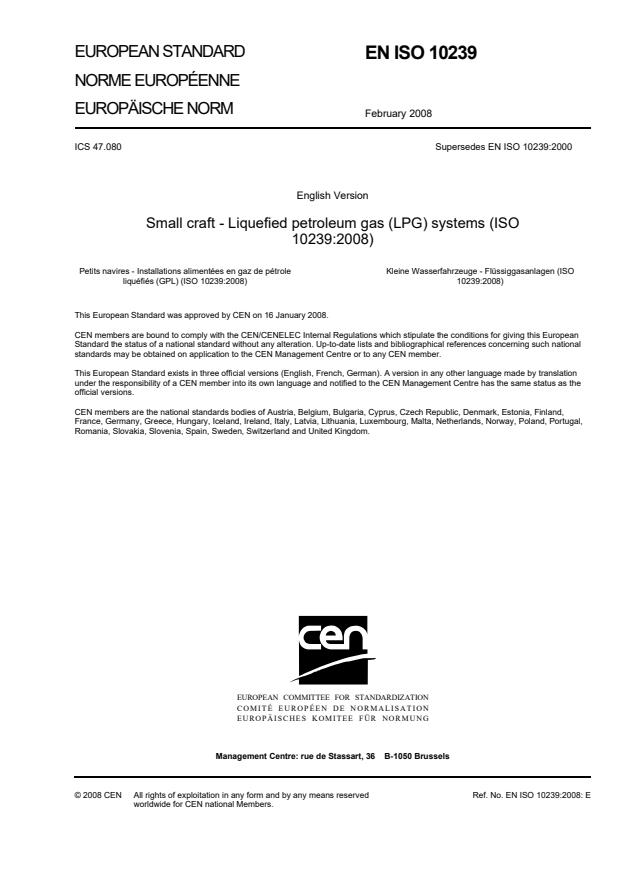
EUROPEAN STANDARDNORME EUROPÉENNEEUROPÄISCHE NORMEN ISO 10239February 2008ICS 47.080Supersedes EN ISO 10239:2000
English VersionSmall craft - Liquefied petroleum gas (LPG) systems (ISO10239:2008)Petits navires - Installations alimentées en gaz de pétroleliquéfiés (GPL) (ISO 10239:2008)Kleine Wasserfahrzeuge - Flüssiggasanlagen (ISO10239:2008)This European Standard was approved by CEN on 16 January 2008.CEN members are bound to comply with the CEN/CENELEC Internal Regulations which stipulate the conditions for giving this EuropeanStandard the status of a national standard without any alteration. Up-to-date lists and bibliographical references concerning such nationalstandards may be obtained on application to the CEN Management Centre or to any CEN member.This European Standard exists in three official versions (English, French, German). A version in any other language made by translationunder the responsibility of a CEN member into its own language and notified to the CEN Management Centre has the same status as theofficial versions.CEN members are the national standards bodies of Austria, Belgium, Bulgaria, Cyprus, Czech Republic, Denmark, Estonia, Finland,France, Germany, Greece, Hungary, Iceland, Ireland, Italy, Latvia, Lithuania, Luxembourg, Malta, Netherlands, Norway, Poland, Portugal,Romania, Slovakia, Slovenia, Spain, Sweden, Switzerland and United Kingdom.EUROPEAN COMMITTEE FOR STANDARDIZATIONCOMITÉ EUROPÉEN DE NORMALISATIONEUROPÄISCHES KOMITEE FÜR NORMUNGManagement Centre: rue de Stassart, 36
B-1050 Brussels© 2008 CENAll rights of exploitation in any form and by any means reservedworldwide for CEN national Members.Ref. No. EN ISO 10239:2008: E
Relationship between this International Standard and the Essential Requirements of EU Directive 94/25/EC, as amended by Directive 2003/44/EC.4
Relationship between this International Standard and the Essential Requirements of EU Directive 94/25/EC, as amended by Directive 2003/44/EC
This International Standard has been prepared under a mandate given to CEN by the European Commission and the European Free Trade Association to provide one means of conforming to Essential Requirements of the New Approach Directive 94/25/EC as amended by Directive 2003/44/EC.
Once this standard is cited in the Official Journal of the European Communities under that Directive and has been implemented as a national standard in at least one Member State, compliance with the normative clauses of this standard given in Table ZA.1 confers, within the limits of the scope of this standard, a presumption of conformity with the relevant Essential Requirements of that Directive and associated EFTA regulations.
Table ZA.1 — Correspondence between this International Standard and Directive 94/25/EC as amended by Directive 2003/44/EC
Clauses/sub-clausesof this European Standard
Corresponding annexes/paragraphs of Directive 94/25/EC as amended by Directive 2003/44/EC Comments 4.2 Annex 1A 5.5 Gas system.
Gas systems for domestic use shall be ‘vapour-withdrawal’ type
4, 5, 6, 7, 8, 11 Designed and installed to avoid leaks and risk of explosion
10, Annex C.4 Capable of being tested for leaks The use of a pressure gauge in the high pressure side of the system will not detect cylinder valve ‘let by’ which, if suspected, should be tested for separately. 6.1.1, 6.2.1, 6.2.4, 6.3.1, 6.4.2, 6.5.8, 7.1
Materials and components shall be suitable for the specific gas used
4.1, 5.6, 5.7, 6.2.1, 6.4, 6.5.1, 6.5.4, 6.5.5, 6.5.7, 7.1
Materials and components to withstand marine environment
7.3
Flame failure device on all burners
6.6 Each appliance to have separate branch of distribution system and each appliance to have separate closing system
8 Adequate ventilation to prevent hazards from leaks
7.4, 7.6, 9, 13, Annex B Adequate ventilation to prevent hazards from products of combustion
8.2, 8.3 An enclosure shall contain all gas cylinders permanently installed. The enclosure shall be:
(i) separated from living quarters
(ii) accessible only from the outside
(iii) ventilated only to outside
10 Gas systems shall be tested after installation
6.5.3, 7.7, 7.9, 11 Annex 1A 5.6.1 Fire protection.
Installation shall take account of risk of fire from open flame devices,
12 (Annex C) Annex 1A 2.5 Owner’s manual
WARNING — Other requirements and other EU Directives may be applicable to the products falling within the scope of this standard.
Reference numberISO 10239:2008(E)© ISO 2008
INTERNATIONAL STANDARD ISO10239Second edition2008-02-15Small craft — Liquefied petroleum gas (LPG) systems Petits navires — Installations alimentées en gaz de pétrole liquéfiés (GPL)
ISO 10239:2008(E) PDF disclaimer This PDF file may contain embedded typefaces. In accordance with Adobe's licensing policy, this file may be printed or viewed but shall not be edited unless the typefaces which are embedded are licensed to and installed on the computer performing the editing. In downloading this file, parties accept therein the responsibility of not infringing Adobe's licensing policy. The ISO Central Secretariat accepts no liability in this area. Adobe is a trademark of Adobe Systems Incorporated. Details of the software products used to create this PDF file can be found in the General Info relative to the file; the PDF-creation parameters were optimized for printing. Every care has been taken to ensure that the file is suitable for use by ISO member bodies. In the unlikely event that a problem relating to it is found, please inform the Central Secretariat at the address given below.
©
ISO 2008 All rights reserved. Unless otherwise specified, no part of this publication may be reproduced or utilized in any form or by any means, electronic or mechanical, including photocopying and microfilm, without permission in writing from either ISO at the address below or ISO's member body in the country of the requester. ISO copyright office Case postale 56 • CH-1211 Geneva 20 Tel.
+ 41 22 749 01 11 Fax
+ 41 22 749 09 47 E-mail
copyright@iso.org Web
www.iso.org Published in Switzerland
ii © ISO 2008 – All rights reserved
ISO 10239:2008(E) © ISO 2008 – All rights reserved iiiContents Page Foreword.iv 1 Scope.1 2 Normative references.1 3 Terms and definitions.1 4 General provisions.3 5 Pressure reduction system.4 6 LPG supply line system.4 6.1 General.4 6.2 Piping.5 6.3 Hoses and hose lines.5 6.4 Materials.5 6.5 Installation.6 6.6 Shut-off valves.6 7 Appliances.7 8 Location and installation of LPG cylinders.7 9 Ventilation.8 10 LPG installation system tests.8 11 Electrical devices for ignition sources.9 12 Owners manual.9 13 Ducts and flues for air intake and combustion product discharge.9 Annex A (informative)
Design guidelines for pressure drop due to pipe resistance.10 Annex B (normative)
Ventilation.11 Annex C (normative)
Instructions to be included with the owner's manual.12 Bibliography.14
ISO 10239:2008(E) iv © ISO 2008 – All rights reserved Foreword ISO (the International Organization for Standardization) is a worldwide federation of national standards bodies (ISO member bodies). The work of preparing International Standards is normally carried out through ISO technical committees. Each member body interested in a subject for which a technical committee has been established has the right to be represented on that committee. International organizations, governmental and non-governmental, in liaison with ISO, also take part in the work. ISO collaborates closely with the International Electrotechnical Commission (IEC) on all matters of electrotechnical standardization. International Standards are drafted in accordance with the rules given in the ISO/IEC Directives, Part 2. The main task of technical committees is to prepare International Standards. Draft International Standards adopted by the technical committees are circulated to the member bodies for voting. Publication as an International Standard requires approval by at least 75 % of the member bodies casting a vote. Attention is drawn to the possibility that some of the elements of this document may be the subject of patent rights. ISO shall not be held responsible for identifying any or all such patent rights. ISO 10239 was prepared by Technical Committee ISO/TC 188, Small craft. This second edition cancels and replaces the first edition (ISO 10239:2000), which has been technically revised. It also incorporates the Technical Corrigendum ISO 10239:2000/Cor.1:2001.
INTERNATIONAL STANDARD ISO 10239:2008(E) © ISO 2008 – All rights reserved 1Small craft — Liquefied petroleum gas (LPG) systems 1 Scope This International Standard covers permanently installed liquefied petroleum gas (LPG) systems and LPG burning appliances on small craft of hull length up to 24 m, except for systems used on LPG-fuelled propulsion engines or LPG-driven generators. This International Standard does not cover appliances with directly attached gas cylinders, such as portable self-contained camping stoves and portable gas lamps. NOTE 1 This International Standard is not intended to regulate technical requirements for LPG cylinders, which are subject to national regulations. NOTE 2 New designs, materials and methods of assembly giving at least equivalent results can be considered to be complying with the requirements of this International Standard when approved by a relevant body. 2 Normative references The following referenced documents are indispensable for the application of this document. For dated references, only the edition cited applies. For undated references, the latest edition of the referenced document (including any amendments) applies. ISO 2928, Rubber hoses and hose assemblies for liquefied petroleum gas (LPG) in the liquid or gaseous phase and natural gas up to 25 bar (2,5 MPa) — Specification ISO 8846, Small craft — Electrical devices — Protection against ignition of surrounding flammable gases ISO 9094-1, Small craft — Fire protection — Part 1: Craft with a hull length of up to and including 15 m ISO 10133, Small craft — Electrical systems — Extra-low-voltage d.c. installations ISO 10240, Small craft — Owner's manual ISO 13297, Small craft — Electrical systems — Alternating current installations 3 Terms and definitions For the purposes of this document, the following terms and definitions apply. 3.1 liquefied petroleum gas LPG mixture of light hydrocarbons, gaseous under conditions of normal temperature and pressure, and maintained in the liquid state by increase of pressure or lowering of temperature NOTE 1 The principal components are propane, propene, butanes or butenes. NOTE 2 LPG can be obtained as commercial butane, commercial propane or a mixture of the two.
ISO 10239:2008(E) 2 © ISO 2008 – All rights reserved 3.2 cylinder housing ventilated enclosure intended solely for storage of one or more LPG cylinders, pressure regulators and safety devices, and located on the exterior of the craft, where leakage would flow overboard 3.3 cylinder locker vapour tight enclosure with an overboard drain intended solely for storage of one or more LPG cylinders in a cockpit or recessed into the craft NOTE See 8.3. 3.4 room sealed appliance appliance having a combustion system in which incoming combustion air and outgoing products of combustion pass through sealed ductwork connected to the enclosed combustion chamber 3.5 LPG system
system consisting of an arrangement of cylinder(s), safety device(s), pressure regulator(s), connection(s), valve(s), piping, tubing, hose, fitting(s) and devices intended to store, supply, monitor or control the flow of fuel gas up to and including the appliance NOTE The cylinders are replacement items and may not be supplied with the LPG system in the craft. 3.6 accessible capable of being reached for inspection, removal or maintenance without removal of a permanent part of the craft structure, with or without the use of tools 3.7 readily accessible capable of being reached quickly and safely for maintenance or effective use under emergency conditions without the use of tools 3.8 unattended appliance appliance intended to function without the constant attention of an operator and which may cycle on and off automatically NOTE Examples of unattended appliances are water heaters, refrigerators and cabin heaters. Stoves, ovens and gas lamps are not considered to be unattended appliances. 3.9 high pressure side part of the LPG supply line directly exposed to pressure at the inlet of a pressure regulator in a liquefied petroleum gas system NOTE 1 Vapour pressure propane at 20 °C = 0,7 MPa1). NOTE 2 Vapour pressure butane at 20 °C = 0,175 MPa. 3.10 low pressure side part of the LPG supply line exposed to the regulated pressure of the gas regulator
1) 0,1 MPa = 1 bar.
ISO 10239:2008(E) © ISO 2008 – All rights reserved 33.11 pressure regulation system system incorporating one or more regulators to reduce the high pressure of the system to the required nominal pressure of the appliances 3.12 piping pipeline of rigid metallic construction 3.13 hose pipeline of flexible material 3.14 shut-off valve device to isolate an appliance from the gas supply 3.15 main shut-off valve device to isolate the entire LPG system from the high pressure side 3.16 permanent label indelibly marked label secured in place 3.17 flame supervision device device that has a sensing element, activated by presence or absence of a flame, that causes the inlet of the LPG supply to a burner to be opened or closed NOTE See EN 125. 3.18 nominal pressure nominal inlet pressure of the LPG appliances 4 General provisions 4.1 An LPG system and all its components shall be capable of withstanding storage at −30 °C to +60 °C. 4.2 LPG systems shall be of the vapour withdrawal type, i.e. fuel released only under gas phase conditions. 4.3 All LPG appliances installed on the craft shall be designed for use at the same working pressure. 4.4 Each system shall be fitted with a pressure gauge. The gauge shall read the cylinder pressure side of the pressure regulator. The gauge scale shall have a pressure range from 0 kPa to a minimum of 1 200 kPa and a maximum of 1 400 kPa. NOTE The purpose of the gauge is to provide a convenient, simple means to test the system for leakage before each use of the appliances. The gauge does not provide an indication of liquid LPG remaining in the cylinder, only its vapour pressure, which is a constant at any given temperature.
ISO 10239:2008(E) 4 © ISO 2008 – All rights reserved 4.5 A sign shall be fixed in the vicinity of the cylinder shut off valve, listing the leak test procedure using the pressure gauge, as described below. ⎯ With appliance valves closed, open the cylinder valve. ⎯ Close cylinder valve. Allow indicated gauge pressure to stabilize. ⎯ Observe pressure on gauge for 3 min. ⎯ If pressure remains constant, no leak is present. If pressure falls, a leak exists. Do not use LPG system until leak is repaired. 5 Pressure reduction system 5.1 Each LPG system shall be equipped with, or have provision for the installation of, a pressure regulation system (see 3.11). This system shall be designed to provide a fixed nominal pressure suitable for the consuming appliances, but not more than 0,005 MPa. A label indicating the working pressure of the LPG appliances installed shall be affixed in the vicinity of the LPG cylinder installation. 5.2 The LPG pressure reduction system shall have an overpressure device to prevent uncontrolled pressure increase in the low pressure side to a value below 0,015 MPa. Any gas discharge of the device shall be inside the cylinder locker or housing, or shall be separately vented outside the craft. The device may be a pressure relief governor, a pressure relief valve or an automatic safety shut off valve. 5.3 The nominal pressure shall be indicated on the pressure regulator. 5.4 Pressure regulators with external manual output pressure adjustment shall not be fitted. 5.5 The pressure regulator shall be located within the cylinder locker or housing. 5.6 If not rigidly connected to, and supported by, the cylinder connection, the pressure regulator shall be separately secured within the cylinder locker or cylinder housing to protect it from damage and exposure to dirt and water, and be mounted above the cylinder valve so that the attaching connection to the cylinder valve has a continuous rise to the regulator. 5.7 Pressure regulators shall be made of corrosion-resistant metallic material or have an effective coating, such as paint or plastic, against external corrosion. Fasteners used shall be of corrosion-resistant material or have a corrosion-resistant plating or coating. NOTE Pressure reduction systems in accordance with EN 12864:2001, Annex M, or in accordance with EN 13786 meet the requirements. 6 LPG supply line system 6.1 General 6.1.1 The LPG supply line system shall be either a solid piping system in accordance with 6.2, except for short hose connection to gimballed stoves, or continuous hose in accordance with 6.3. 6.1.2 Hoses shall be used to connect gimballed stoves to their LPG supply, and to connect supply piping to the pressure regulator. The hose and its connections from supply piping to the pressure regulator shall be within the cylinder locker or cylinder housing. 6.1.3 Piping and hose shall be sized so that pressure drop due to pipe resistance does not reduce the nominal pressure at any appliance below that required by the appliance manufacturer when all appliances are operating simultaneously. See Annex A.
ISO 10239:2008(E) © ISO 2008 – All rights reserved 56.2 Piping 6.2.1 Only solid drawn copper or drawn stainless steel piping, which are galvanically compatible, shall be used for rigid supply lines. Wall thickness for piping shall be greater than 0,8 mm for piping up to 12 mm outside diameter and a minimum of 1,5 mm for an outside diameter greater than 12 mm. 6.2.2 There shall be no joints or fittings in piping passing through engine compartments. 6.2.3 Metallic LPG supply piping routed through
...