


EN 1591-2:2008
(Main)Flanges and their joints - Design rules for gasketed circular flange connections - Part 2: Gasket parameters
General Information
- Abstract
This European Standard details generic gasket parameters for use in EN 1591 1 during preliminary calculations during which the type of gasket to be used in an application is to be decided. Once the gasket type has been decided the parameters for gaskets of that type from the different potential commercial suppliers should be used in further calculations as within a gasket type there will be differences depending upon the supplier.
WARNING - For the final calculations using the method given in EN 1591 1 the reader is directed to obtain gasket parameters for the selected type from the intended gasket supplier.
- Status
- Withdrawn
- Publication Date
- 10-Jun-2008
- Withdrawal Date
- 16-Sep-2026
- Technical Committee
- CEN/TC 74 - Flanges and their joints
- Drafting Committee
- CEN/TC 74/WG 8 - Gaskets
- Current Stage
- 9960 - Withdrawal effective - Withdrawal
- Start Date
- 04-Mar-2020
- Completion Date
- 17-Sep-2026
- Directive
- Not Harmonized97/23/EC - Pressure equipment

Relations
- Effective Date
- 22-Dec-2008
- Effective Date
- 10-Mar-2020
- Effective Date
- 28-Jan-2026
- Effective Date
- 28-Jan-2026
- Effective Date
- 28-Jan-2026
- Effective Date
- 28-Jan-2026
Get Certified
Connect with accredited certification bodies for this standard

Institut za varilstvo d.o.o. (Welding Institute)
Slovenia's leading welding institute since 1952. ISO 3834, EN 1090, pressure equipment certification, NDT personnel, welder qualification. Only IIW Au
Sponsored listings
Frequently Asked Questions
EN 1591-2:2008 is a standard published by the European Committee for Standardization (CEN). Its full title is "Flanges and their joints - Design rules for gasketed circular flange connections - Part 2: Gasket parameters". This standard covers: This European Standard details generic gasket parameters for use in EN 1591 1 during preliminary calculations during which the type of gasket to be used in an application is to be decided. Once the gasket type has been decided the parameters for gaskets of that type from the different potential commercial suppliers should be used in further calculations as within a gasket type there will be differences depending upon the supplier. WARNING - For the final calculations using the method given in EN 1591 1 the reader is directed to obtain gasket parameters for the selected type from the intended gasket supplier.
This European Standard details generic gasket parameters for use in EN 1591 1 during preliminary calculations during which the type of gasket to be used in an application is to be decided. Once the gasket type has been decided the parameters for gaskets of that type from the different potential commercial suppliers should be used in further calculations as within a gasket type there will be differences depending upon the supplier. WARNING - For the final calculations using the method given in EN 1591 1 the reader is directed to obtain gasket parameters for the selected type from the intended gasket supplier.
EN 1591-2:2008 is classified under the following ICS (International Classification for Standards) categories: 23.040.60 - Flanges, couplings and joints. The ICS classification helps identify the subject area and facilitates finding related standards.
EN 1591-2:2008 has the following relationships with other standards: It is inter standard links to ENV 1591-2:2001, CEN/TR 1591-2:2020, EN 1591-1:2001, EN 13555:2004, EN 13480-3:2012, EN 13480-2:2017. Understanding these relationships helps ensure you are using the most current and applicable version of the standard.
EN 1591-2:2008 is associated with the following European legislation: EU Directives/Regulations: 97/23/EC; Standardization Mandates: M/071. When a standard is cited in the Official Journal of the European Union, products manufactured in conformity with it benefit from a presumption of conformity with the essential requirements of the corresponding EU directive or regulation.
EN 1591-2:2008 is available in PDF format for immediate download after purchase. The document can be added to your cart and obtained through the secure checkout process. Digital delivery ensures instant access to the complete standard document.
Standards Content (Sample)
2003-01.Slovenski inštitut za standardizacijo. Razmnoževanje celote ali delov tega standarda ni dovoljeno.WHVQLOFlansche und ihre Verbindungen - Regeln für die Auslegung von Flanschverbindungen mit runden Flanschen und Dichtung - Teil 2: DichtungskennwerteBrides et leurs assemblages - Regles de calcul des assemblages a brides circulaires avec joint - Partie 2: Parametres de jointFlanges and their joints - Design rules for gasketed circular flange connec-tions - Part 2: Gasket parameters23.040.60Prirobnice, oglavki in spojni elementiFlanges, couplings and jointsICS:Ta slovenski standard je istoveten z:EN 1591-2:2008SIST EN 1591-2:2008en,fr,de01-oktober-2008SIST EN 1591-2:2008SLOVENSKI
STANDARDSIST ENV 1591-2:20021DGRPHãþD
EUROPEAN STANDARDNORME EUROPÉENNEEUROPÄISCHE NORMEN 1591-2June 2008ICS 23.040.60Supersedes ENV 1591-2:2001
English VersionFlanges and their joints - Design rules for gasketed circularflange connections - Part 2: Gasket parametersBrides et leurs assemblages - Règles de calcul desassemblages à brides circulaires avec joint - Partie 2:Paramètres de jointFlansche und ihre Verbindungen - Regeln für dieAuslegung von Flanschverbindungen mit runden Flanschenund Dichtung - Teil 2: DichtungskennwerteThis European Standard was approved by CEN on 8 May 2008.CEN members are bound to comply with the CEN/CENELEC Internal Regulations which stipulate the conditions for giving this EuropeanStandard the status of a national standard without any alteration. Up-to-date lists and bibliographical references concerning such nationalstandards may be obtained on application to the CEN Management Centre or to any CEN member.This European Standard exists in three official versions (English, French, German). A version in any other language made by translationunder the responsibility of a CEN member into its own language and notified to the CEN Management Centre has the same status as theofficial versions.CEN members are the national standards bodies of Austria, Belgium, Bulgaria, Cyprus, Czech Republic, Denmark, Estonia, Finland,France, Germany, Greece, Hungary, Iceland, Ireland, Italy, Latvia, Lithuania, Luxembourg, Malta, Netherlands, Norway, Poland, Portugal,Romania, Slovakia, Slovenia, Spain, Sweden, Switzerland and United Kingdom.EUROPEAN COMMITTEE FOR STANDARDIZATIONCOMITÉ EUROPÉEN DE NORMALISATIONEUROPÄISCHES KOMITEE FÜR NORMUNGManagement Centre: rue de Stassart, 36
B-1050 Brussels© 2008 CENAll rights of exploitation in any form and by any means reservedworldwide for CEN national Members.Ref. No. EN 1591-2:2008: ESIST EN 1591-2:2008
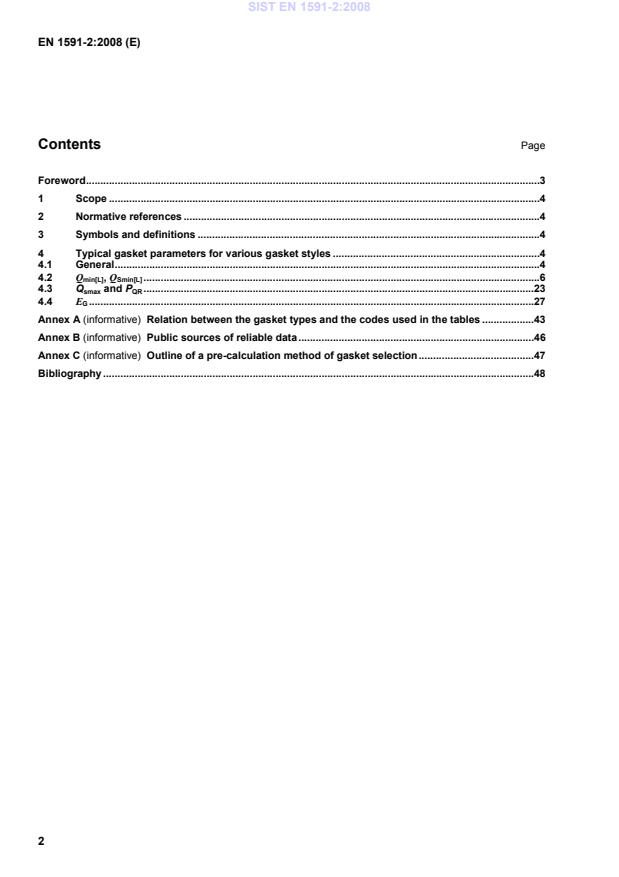
Relation between the gasket types and the codes used in the tables.43 Annex B (informative)
Public sources of reliable data.46 Annex C (informative)
Outline of a pre-calculation method of gasket selection.47 Bibliography.48
tables of values (results of tests) more reliable than those specified in the experimental standard ENV 1591-2:2001. This EN 1591-2 is therefore dedicated to be amended somehow in accordance with the revision in progress carried out by the Joint Working Group on EN 1591-1. According to the CEN/CENELEC Internal Regulations, the national standards organizations of the following countries are bound to implement this European Standard: Austria, Belgium, Bulgaria, Cyprus, Czech Republic, Denmark, Estonia, Finland, France, Germany, Greece, Hungary, Iceland, Ireland, Italy, Latvia, Lithuania, Luxembourg, Malta, Netherlands, Norway, Poland, Portugal, Romania, Slovakia, Slovenia, Spain, Sweden, Switzerland and the United Kingdom.
1) PERL, Pressure Equipment, Reduction of Leak rate: Gasket parameters measurement, RTD Project in the
Framework of the "Competitive & Sustainable Growth" Programme SIST EN 1591-2:2008
2 Normative references The following referenced documents are indispensable for the application of this document. For dated references, only the edition cited applies. For undated references, the latest edition of the referenced document (including any amendments) applies. EN 1591-1:2001, Flanges and their joints — Design rules for gasketed circular flange connections — Part 1: Calculation method EN 13555:2004, Flanges and their joints — Gasket parameters and test procedures relevant to the design rules for gasketed circular flange connections 3 Symbols and definitions For the purposes of this document, the symbols and definitions given in EN 1591-1:2001 and EN 13555:2004 apply. 4 Typical gasket parameters for various gasket styles 4.1 General It shall be noted that the data given in the following tables is only intended to be used in preliminary calculations using EN 1591-1. The data was obtained using the test methods given in EN 13555 during the testing of a selection of a few of the many styles and makes of commercial gasket that are on offer in Europe. For final calculations the user of EN 1591-1 shall contact the gasket supplier of choice and obtain the data for the style and thickness of the gasket intended to be used. A group of end users has derived a pre-calculation method of use of EN 1591-1 that allows gasket selection without any further calculation. This is outlined in Annex C. EN 13555 permits the testing of gaskets sized for either DN40/PN40 or NPS 4 CLASS 300 flanges. All the data values given in this document were obtained from DN40/PN 40 gaskets.
It should
be noted that the rules of EN 13555 regarding QSmax have been adhered to in that where no collapse was found during the QSmax test then the value of QSmax is taken to be that of the surface pressure, Qi , used during the PQR test with the highest surface pressure tabulated. The data in the following sets of tables is presented in three gasket parameter groupings, Qmin[L] and QSmin[L] in the 4.2 set of tables followed by QSmax and PQR in the 4.3 set and then EG in the 4.4 set to allow easy appreciation of how the parameter varies with gasket type. A brief explanation of the parameters in the grouping is given at the start of each set. For more information about the gasket parameters or test methods EN 13555 should be consulted. SIST EN 1591-2:2008
The various parameters that are obtained from gaskets by the tests detailed in EN 13555 are inter-related in complex ways and the guidance given below is in some respects simplistic in view of those inter-relationships. If further guidance is required it is recommended that the favoured suppliers or manufacturers should be consulted as they will be able to provide all the necessary guidance that is required to aid the selection of an optimised solution for any sealing application. QSmin[L] is influenced by QA, the higher the level of QA achieved on assembly the better. QA will be limited by either the maximum bolt load available, the maximum flange loading that can be permitted or the maximum gasket loading, QSmax, that can be withstood. High values of QSmax are desirable. Where a value of QSmax is not tabulated at the temperature and gasket thickness of interest then the value for QSmax at the next higher values should be used. For secure achievement of a given level of tightness, L, the lower the values of Qmin[L] and QSmin[L] the better. Where data is tabulated for more than one helium pressure then interpolation to deduce a value for the pressure of interest is permitted. Where data is not available for the thickness of interest then data for the next higher available thickness should be used. Low values of Qmin[L] and QSmin[L] are desirable. A low difference between the QSmin[L] values for successive values of L is also desirable as this indicates a low sensitivity to off-loading in service. Within a gasket type, high values of PQR are desirable. Where a PQR value is not tabulated at exactly the required level of temperature, stiffness and surface pressure then the value of PQR at the next level above those required should be used. Low values of EG are desirable. Where a value of EG is not tabulated at exactly the required level of temperature, surface pressure and thickness then the value of EG at the next level above those required should be used. The data in the following sets of tables was generated as the test methods of EN 13555 were evolving. As a consequence the data for some tested gaskets does not in all respects comply with the rules subsequently derived and given in EN 13555. An instance of this is given by PQR in the 4.3 set of tables as values are only given for a stiffness of 500 kN/mm whereas the standard calls for PQR values for a range of stiffness to be determined.
The notes at the end of the 4.3 set of tables of QSmax and PQR give important guidance in the use of the data in that set of tables. For relation between the gasket types and the codes used in the tables see Annex A. SIST EN 1591-2:2008
For the Tables 2 to 15 the following marking applies: Qmin[L] or QSmin[L] values for 40 bar without underlining; Qmin[L] or QSmin[L] figures for 10 bar are marked by a dashed line; Qmin[L] or QSmin[L] figures for 80 bar are underlined; Qmin[L] or QSmin[L] figures for 160 bar are double underlined .
4,5 mm
L mg/(sm) Qmin[L] MPa QA MPa 20 40 60 80 100 160
-- QSmin[L] MPa
Material code
101 - - - - - - - - 100 10 30 35 3-3-100-1 - 10 10 10 10 10 10 10 10 10 10 11 10-1 49 37 57 3-3-100-1 - - 10 43 10 11 10 10 10 10 12 10-2 63 62 71 3-3-100-1 - - - 19 25 10 17 10 10 15 10-3 74 80 87 3-3-100-1 - - -
80 28 32 10 19 28 10-4 98 126 1043-3-100-1 - - - -
- 24 71 40 10-5 - - - - - - - - 10-7 - - - - - - - - 10-8 - - - - - - - - 10-9 - - - - - - - -
4,5 mm
L mg/(sm) Qmin[L] MPa QA MPa 20 40 60 80 100 160 320
-- QSmin[L] MPa
Material code
101 - - - - - - - -
100 10 10 10 3-4-104-1 10 10 10 10 10 10 - 10 10 10 10-1 16 32 20 3-4-104-1 - 10 10 10 10 10 - 10 10 10 10-2 25 48 45 3-4-104-1 - 10 10 10 10 10 - 10 10 10 10-3 42
81 83 3-4-104-1 - - 16 18 17 10 - 31 10 15 10-4 81 143 159 3-4-104-1 - - - - 62 35 - 157 26 51 10-5 181 281 3-4-104-1 - - - - - - 83 19810-6 314 3-4-104-1 - - - - - - 298 10-7 - - - - - - - -
10-8 - - - - - - - -
4,5 mm
L mg/(sm) Qmin[L] MPa QA MPa 20 40 60 80 100 160 320
- QSmin[L] MPa
Material code
101 - - - - - - - - - 100 10 - 10 - - - - 10 - - - - 10 10-1 10 10 12 3-5-102-1 10 10 10 10 10 10 10 10 10 10-2 10 19 33 3-5-102-1 10 10 10 10 10 10 10 10 10 10-3 2970 174 3-5-102-1 - - - 10 20 10 14 26 168 10-4 140 231 3-5-102-1 - - - - - 82 88 230 10-5 154 290 3-5-102-1 - - - - - 101 123 288 10-6 167 3-5-102-1 - - - - - - 157 10-7 180 3-5-102-1 - - - - - - 192 10-8 194 3-5-102-1 - - - - - - 258
Qmin[L], QSmin[L] for 40 bar of helium , plus some data for other pressures, at ambient temperature. Code G03,
5,1 mm
L mg/(sm) Qmin[L] MPa QA MPa 60 120 180 240 300 480
-- QSmin[L] MPa
Material code
101 - - - - - - - - 100 - - - - - - - - 10-1 30
58 G03 30 30 30 30 30 30 30 10-2 39
74 G03 - 30 30 30 30 30 30 10-3 52
90 G03 - 30 30 30 30 30 30 10-4 69
105 G03 - 43 30 30 30 30 30 10-5 101 125 G03 - - 30 30 30 30 30 10-6 149 166 G03 - - 97 47 48 35 34 10-7 353 428 G03 - - - - - 132 372 10-8 - - - - - - - -
3,2 mm Code K04,
2,3 mm
L mg/(sm) Qmin[L] MPa QA MPa 20 40 60 80 100 160 320
-- QSmin[L] MPa
Material code
101 - - - - - - - - - 100 - - - - - - - - - 10-1 10 7-01-104-1 10 10 10 10 10 10 10
10 K04 - - - - - - - 10-2 11 7-01-104-1 10 10 10 10 10 10 17
11 K04 10 10 10 10 10 10 - 10-3 17 10 20 7-01-104-1 10 10 10 10 10 10 - 10 24 10
10 22 K04 10 10 10 10 10 10 10 - 10-4 21 75 30 7-01-104-1 - 33 13 17 27 24 - 20 32 10
14 28 K04 - 10 10 10 10 11 10 10 10-5 45 104 40 7-01-104-1 -
18 27 46 36 -
28 37 33
41 35 K04 - 25 10 10 10 20 10
10-6 52 165 95 7-01-104-1 - - 32 36 66 68 - 35 116 74
84 68 K04 - - - 10 10 10 - 10-7 57 295 152 7-01-104-1 - - - 73 86 159 - 95 165 243
100 80 K04 - - - - 44 10 - 10-8 306 7-01-104-1 - - - - - - 305
3,2 mm No sealing data for H02
L mg/(sm) Qmin[L] MPa QA MPa 20 40 60 80 100 160 320
-- QSmin[L] MPa
Material code
101 34 6-4-103-1 - 10 10 10 10 10 10 20 100 55 63 120 6-4-103-1 - - 26 23 21 10 10 20 10-1 96 187 6-4-103-1 - - - - - 56 14 20 10-2 171 287 6-4-103-1 - - - - - - 35 40 10-3 253 6-4-103-1 - - - - - - 133 10-4 - - - - - - - - - 10-5 - - - - - - - - - 10-6 - - - - - - - - - 10-7 - - - - - - - - - 10-8 - - - - - - - - -
4,5 mm Code H01,
4,8 mm
L mg/(sm) Qmin[L] MPa QA MPa 20 40 60 80 100 160 320
-- QSmin[L] MPa
Material code
101 - - - - - - - - - 100 - - - - - - - - - 10-1 -
13 28 5-5-103-1 10 10 10 10 10 10 - 20 10 10 10-2 14 32 73 5-5-103-1 10 10 10 10 10 10 - 32 10 10 10-3 10 H01 10 10 10 10 10 10 -
60 69 5-5-103-1 - - - 33 25 24 22 34 10-4 10 15 H01 10 10 10 10 10 10 -
218 5-5-103-1 - - - - - - 131 10-5 14 23 H01 - 10 10 10 10 10 - 10-6 20 33 H01 - 15 10 10 10 10 10 - 10-7 31 60 H01 - - - 38 32 14 28 - 10-8 50 - - - - - - - 127 - -
Qmin[L], QSmin[L] for 40 bar of helium , plus some data for other pressures, at ambient temperature. Code A01, 2,1 mm L mg/(sm) Qmin[L] MPa QA MPa 20 40 60 80 100 160
-- QSmin[L] MPa
Material code
101 - - - - - - - - 100 - - - - - - - - 10-1 10 A01 10 10 10 10 10 10 10-2 10 30 A01 - 10 10 10 10 10 10-3 38 72 A01 - - - 37 17 10 10-4 83 120 A01 - - - - - 10 38 10-5 123 157 A01 - - - - - 52 150 10-6 - - - - - - - - 10-7 - - - - - - - - 10-8 - - - - - - - -
2,1 mm
L mg/(sm) Qmin[L] MPa QA MPa 20 40 60 80 100 160
-- QSmin[L] MPa
Material code
101 - - - - - - - - 100 10 1-5-101-1 10 10 10 10 10 10 10-1 10
10 E02 10 10 10 10 10 10
10 15 27 1-5-101-1 10 10 10 10 10 10 10 10-2 28 47 E02 - - 11 10 10 10
23 41 60 1-5-101-1 - - 10 10 10 10 10 10-3 62 88 E02 - - - - 36 10
49 84 96 1-5-101-1 - - - - 39 10
12 10-4 94 122 E02 - - - - - 10
93 139 1-5-101-1 - - - - - 16
95 10-5 124 149 E02 - - - - - 33
135 200 1-5-101-1 - - - - - 130
- 10-6 151
- - - - - - - 125
- 10-7 - - - - - - - - 10-8 - - - - - - -
4 mm
L mg/(sm) Qmin[L] MPa QA MPa 20 40 60 80 100 160 320
-- QSmin[L] MPa
Material code
101 -
-
29 2-5-104-1 - - - - - - - 10 - 100 - 10 37 2-5-104-1 - 10 - 10 - 10 - 10 - 10 - 10 10 - 10 10-1 10 33 50 2-5-104-1 10 10 30 10 17 10 14 10 10 10 10
23 10 10 10-2 12 45 62 2-5-104-1 12 16 18 32 14 24 13 23 17 10
43 10 20 10-3 28 53 69 2-5-104-1 - 27 29 46 22 35 20 33 24 32 62 18 30 10-4 47 60 76 2-5-104-1 - - 46 31 50 31 46 34 42 82 32 55 10-5 59 71 101 2-5-104-1 - - - 46 66 43 70 48 59 101 77 97 10-6 71 83 126 2-5-104-1 - - - 64 73 86 73 76 121 123 125 10-7 111 110 138 2-5-104-1 - - - - - 108 149 141 170 154 10-8 138
-
160 2-5-104-1 - - - - - 139 - 160 255 10-9 308 2-5-104-1 - - - - - - 316 10-10 - - - - - - - - -
Qmin[L], QSmin[L] for 40 bar of helium , plus some data for other pressures, at ambient temperature. Code 1-10-102-1,
2 mm Code 1-10-100-1,
2 mm Code G02,
2,0 mm Code D01,
2,0 mm Code A02,
2,0 mm Code K02,
2,0 mm
L mg/(sm) Qmin[L] MPa QA MPa 20 40 60 80 100 160
-- QSmin[L] MPa
Material code
101 - - - - - - - - 100 10
- 1-10-102-1 10 10 10 10 10 10 10 10 - -
10 1-10-100-1 10 10 10 10
10-1 12 12 19 1-10-102-1 10 10 10 10 10 10 10 10 10 - -
10 1-10-100-1 10 10 10 10 10 - -
10 10 G02 10 10 10 10 10 10
10 D01 10 10 10 10 10 10
10 A02 10 10 10 10 10 10 10-2 17 16 26 1-10-102-1 11 10 10 10 10 10 10 10 10 - -
10 12 22 1-10-100-1 10 10 10 10 10 10 10 10 10 - -
11 25 G02 - 10 10 10 10 10
10 25 D01 - 10 10 10 10 10
11 A02 - 10 10 10 10 10 10-3 26 21 33 1-10-102-1 - 10
10 10 10 10 10 10 - -
12 17 30 1-10-100-1 10 10 10 10 10 10 10 10 10 - -
27 52 G02 - - 33 13 10 10
22 30 D01 - 10 10 10 10 10
10 15 A02 10 10 10 10 10 10
10 - K02
-- QSmin[L] MPa
Material code
10-4 38 31 39 1-10-102-1 - 17 10 10 10 10 10 10 - -
17 42 37 1-10-100-1 10
- 10 10 10 10 10 10 - -
58 83 G02 - - - - 27 10
31 36 D01 - 15 10 10 10 10
12 20 A02 14 10 10 10 10 10
13 10 K02 10 10 10 10 10 10 10 10-5 62 41 1-10-102-1 - - 11 43 10 - -
50 - 1-10-100-1 - - 25
- 10
- - -
94 160 G02
-
...