

EN 10027-1:2005
(Main)Designation systems for steels - Part 1: Steel names
- Abstract
1.1 This European Standard specifies rules for designating steels by means of symbolic letters and numbers to express application and principal characteristics, e.g. mechanical, physical, chemical, so as to provide an abbreviated identification of steels.
NOTE In the English language the designations covered by this European Standard are known as "steel names"; in the French language as "designation symbolique"; in the German language as "Kurznamen".
1.2 This European Standard applies to steels specified in European Standards (EN), Technical Specifications (TS), Technical Reports (TR) and CEN member's national standards.
1.3 These rules may be applied to non-standardized steels.
1.4 A system of numerical designation of steels known as steel numbers is specified in EN 10027-2.
- Status
- Withdrawn
- Publication Date
- 09-Aug-2005
- Withdrawal Date
- 06-Oct-2026
- Technical Committee
- ECISS/TC 100 - General issues
- Drafting Committee
- ECISS/TC 100 - General issues
- Current Stage
- 9960 - Withdrawal effective - Withdrawal
- Start Date
- 26-Oct-2016
- Completion Date
- 07-Oct-2026
Buy Documents



Relations
- Effective Date
- 22-Dec-2008
- Effective Date
- 22-Dec-2008
- Effective Date
- 15-Oct-2014
- Effective Date
- 28-Jan-2026
- Effective Date
- 28-Jan-2026
- Effective Date
- 28-Jan-2026
- Referred By
EN 10270-3:2011 - Steel wire for mechanical springs - Part 3: Stainless spring steel wire - Effective Date
- 28-Jan-2026
- Effective Date
- 28-Jan-2026
- Effective Date
- 28-Jan-2026
- Effective Date
- 28-Jan-2026
Buy Documents
Get Certified
Connect with accredited certification bodies for this standard

Element Materials Technology
Materials testing and product certification.

Inštitut za kovinske materiale in tehnologije
Institute of Metals and Technology. Materials testing, metallurgical analysis, NDT.
Sponsored listings
Frequently Asked Questions
EN 10027-1:2005 is a standard published by the European Committee for Standardization (CEN). Its full title is "Designation systems for steels - Part 1: Steel names". This standard covers: 1.1 This European Standard specifies rules for designating steels by means of symbolic letters and numbers to express application and principal characteristics, e.g. mechanical, physical, chemical, so as to provide an abbreviated identification of steels. NOTE In the English language the designations covered by this European Standard are known as "steel names"; in the French language as "designation symbolique"; in the German language as "Kurznamen". 1.2 This European Standard applies to steels specified in European Standards (EN), Technical Specifications (TS), Technical Reports (TR) and CEN member's national standards. 1.3 These rules may be applied to non-standardized steels. 1.4 A system of numerical designation of steels known as steel numbers is specified in EN 10027-2.
1.1 This European Standard specifies rules for designating steels by means of symbolic letters and numbers to express application and principal characteristics, e.g. mechanical, physical, chemical, so as to provide an abbreviated identification of steels. NOTE In the English language the designations covered by this European Standard are known as "steel names"; in the French language as "designation symbolique"; in the German language as "Kurznamen". 1.2 This European Standard applies to steels specified in European Standards (EN), Technical Specifications (TS), Technical Reports (TR) and CEN member's national standards. 1.3 These rules may be applied to non-standardized steels. 1.4 A system of numerical designation of steels known as steel numbers is specified in EN 10027-2.
EN 10027-1:2005 is classified under the following ICS (International Classification for Standards) categories: 77.080.20 - Steels. The ICS classification helps identify the subject area and facilitates finding related standards.
EN 10027-1:2005 has the following relationships with other standards: It is inter standard links to EN 10027-1:1992, CR 10260:1998, EN 10027-1:2016, EN 10027-2:2015, EN 10020:2000, EN 10079:1992, EN 10270-3:2011, EN 10213:2007, EN 10213:2007+A1:2016, EN 10210-1:2006. Understanding these relationships helps ensure you are using the most current and applicable version of the standard.
EN 10027-1:2005 is associated with the following European legislation: Standardization Mandates: M/BC/CEN/86/1. When a standard is cited in the Official Journal of the European Union, products manufactured in conformity with it benefit from a presumption of conformity with the essential requirements of the corresponding EU directive or regulation.
EN 10027-1:2005 is available in PDF format for immediate download after purchase. The document can be added to your cart and obtained through the secure checkout process. Digital delivery ensures instant access to the complete standard document.
Standards Content (Sample)
2003-01.Slovenski inštitut za standardizacijo. Razmnoževanje celote ali delov tega standarda ni dovoljeno.Bezeichnungssysteme für Stähle - Teil 1: KurznamenSystemes de désignation des aciers - Partie 1: Désignation symboliqueDesignation systems for steels - Part 1: Steel names77.080.20JeklaSteels01.040.77Metalurgija (Slovarji)Metallurgy (Vocabularies)ICS:Ta slovenski standard je istoveten z:EN 10027-1:2005SIST EN 10027-1:2005en01-oktober-2005SIST EN 10027-1:2005SLOVENSKI
STANDARDSIST EN 10027-1:1995SIST CR 10260:20001DGRPHãþD
EUROPEAN STANDARD NORME EUROPÉENNE EUROPÄISCHE NORM
EN 10027-1
August 2005 ICS 77.080.20 Supersedes CR 10260:1998, EN 10027-1:1992 English version
Designation systems for steels - Part 1: Steel names
Systèmes de désignation des aciers - Partie 1: Désignation symbolique
Bezeichnungssysteme für Stähle - Teil 1: Kurznamen This European Standard was approved by CEN on 27 June 2005.
CEN members are bound to comply with the CEN/CENELEC Internal Regulations which stipulate the conditions for giving this European Standard the status of a national standard without any alteration. Up-to-date lists and bibliographical references concerning such national standards may be obtained on application to the Central Secretariat or to any CEN member.
This European Standard exists in three official versions (English, French, German). A version in any other language made by translation under the responsibility of a CEN member into its own language and notified to the Central Secretariat has the same status as the official versions.
CEN members are the national standards bodies of Austria, Belgium, Cyprus, Czech Republic, Denmark, Estonia, Finland, France, Germany, Greece, Hungary, Iceland, Ireland, Italy, Latvia, Lithuania, Luxembourg, Malta, Netherlands, Norway, Poland, Portugal, Slovakia, Slovenia, Spain, Sweden, Switzerland and United Kingdom.
EUROPEAN COMMITTEE FOR STANDARDIZATION
COMITÉ EUROPÉEN DE NORMALISATION EUROPÄISCHES KOMITEE FÜR NORMUNG
Management Centre: rue de Stassart, 36
B-1050 Brussels © 2005 CEN All rights of exploitation in any form and by any means reserved worldwide for CEN national Members. Ref. No. EN 10027-1:2005: ESIST EN 10027-1:2005
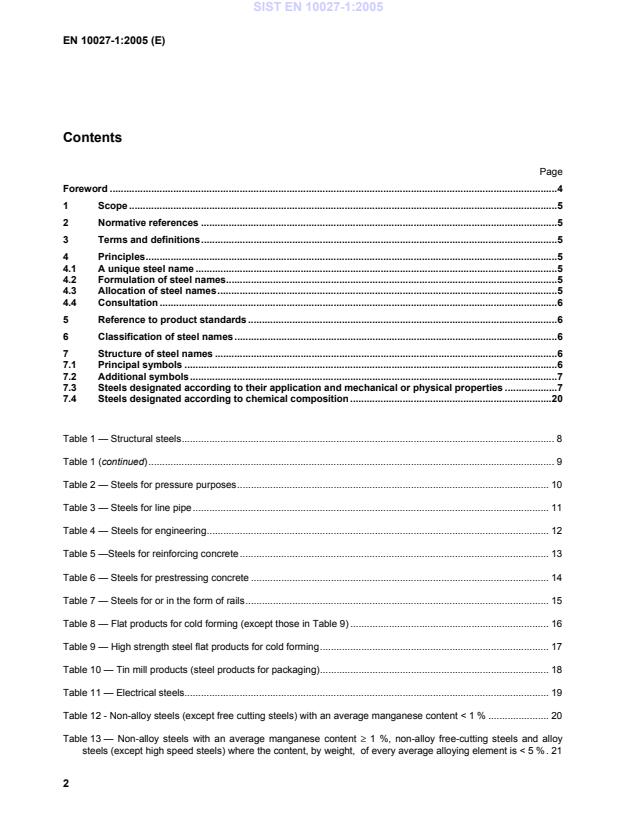
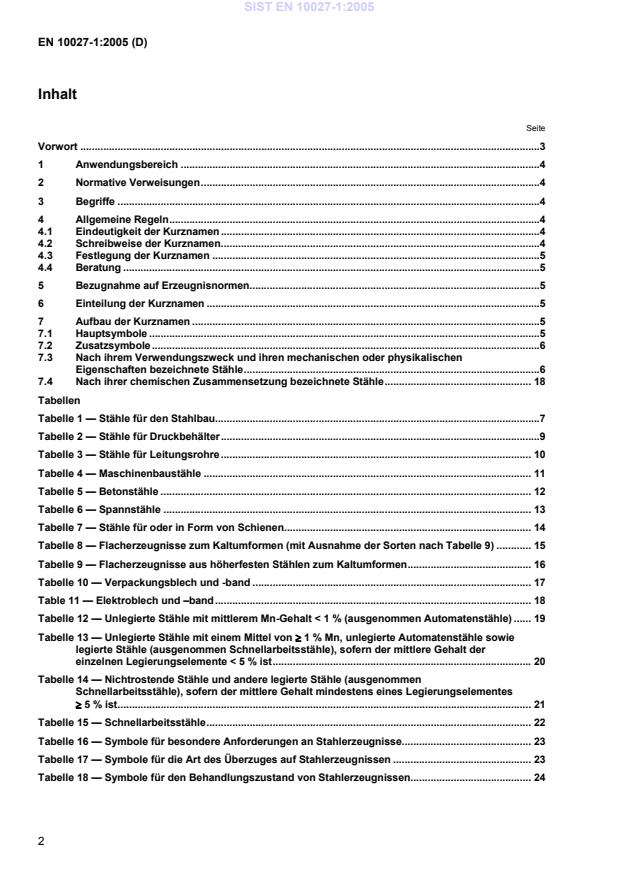
Table 1 — Structural steels.8 Table 1 (continued).9 Table 2 — Steels for pressure purposes.10 Table 3 — Steels for line pipe.11 Table 4 — Steels for engineering.12 Table 5 —Steels for reinforcing concrete.13 Table 6 — Steels for prestressing concrete.14 Table 7 — Steels for or in the form of rails.15 Table 8 — Flat products for cold forming (except those in Table 9).16 Table 9 — High strength steel flat products for cold forming.17 Table 10 — Tin mill products (steel products for packaging).18 Table 11 — Electrical steels.19 Table 12 - Non-alloy steels (except free cutting steels) with an average manganese content < 1 %.20 Table 13 — Non-alloy steels with an average manganese content ≥ 1 %, non-alloy free-cutting steels and alloy steels (except high speed steels) where the content, by weight,
of every average alloying element is < 5 %.21 SIST EN 10027-1:2005
and other alloy steels (except high speed steels) where the average content by weight of at least one alloying element is ≥ 5 %.22 Table 15 — High speed steels.23 Table 16 — Symbols for steel products indicating special requirements.24 Table 17 — Symbols for steel products indicating type of coating.24 Table 18 — Symbols for steel products indicating treatment condition.25
7.2 Additional symbols Additional symbols may be added to the principal symbols and assigned in accordance with 7.3 and 7.4. Additional symbols are divided into two groups, i.e. group 1 and group 2 (see 7.3 and 7.4). If the symbols for
group 1 are inadequate to describe the steel fully, then additional symbols from group 2 may be added.
Symbols of group 2 shall only be used in conjunction with and follow symbols of group 1. Further additional symbols for steel products may follow the additional symbols of group 1 and group 2 and shall be selected in accordance with 7.3 and 7.4 from tables 16, 17 and 18. These symbols shall be separated from preceding symbols by the plus sign (+). NOTE Additional symbols selected from Tables 16, 17 and 18 may be added to steel numbers allocated in accordance with EN 10027-2 and, when used, separated from the steel number by the plus sign (+). 7.3 Steels designated according to their application and mechanical or physical properties The designation of steel according to their application and mechanical or physical properties shall be made in accordance with Table 1 to Table 11. SIST EN 10027-1:2005
Table 1 — Structural steels
Principal symbols Additional symbols for steel Additional symbols for steel products
G S n n n an . +an +an . a
Principal symbols Additional symbols For steel Letter Mechanical property Group 1 b Group 2 c d For steel product Impact property Energy Joules (J) Test tempe-rature 27J 40J 60J oC JR KR LR 20 J0 K0 L0 0 J2 K2 L2 -20 J3 K3 L3 -30 J4 K4 L4 -40 J5 K5 L5 -50 J6 K6 L6 -60 G = steel casting (where necessary) S =structural steel nnn = specified minimum yield strength e in MPa f for the smallest thickness range A =
Precipitation hardening M =
Thermomechanically rolled N =
Normalised or normalised rolled Q =
Quenched and tempered G =
Other characteristics followed, where necessary by 1 or 2 digits C = Special cold forming D = Hot dip coating E = Enamelling F = Forgings H = Hollow section L =
Low temperature M = Thermomechanically rolled N = Normalised or normalised rolled P = Sheet piling Q = Quenched and tempered S = Ship building T = Tubes W = Weather resistant an = Chemical symbol of specified additional elements, e.g. Cu, together, where necessary, with a single digit representing 10 x the average (rounded to 0,1%) of that specified range of the content of that element Tables 16, 17 and 18 a n = numerical characters, a = alpha characters, an = alphanumeric characters. b Symbols A, M, N and Q in Group 1 apply to fine grain steels. c Symbols of Group 2, other than chemical symbols, may be suffixed by one or two digits in order to distinguish between qualities in accordance with the relevant product standard. d If two of the symbols of this Group are needed the chemical symbol shall be the last one. e The term “yield strength” refers to upper or lower yield strength (ReH) or (ReL) or proof strength (Rp), or proof strength total extension (Rt) depending on the requirement specified in the relevant product standard. f 1 MPa = 1 N/mm2. SIST EN 10027-1:2005
EN 10027-1 EN 10025-2 S235JR S355JR S355J0 S355J2 S355K2 S450J0 EN 10025-3 S355N S355NL EN 10025-4 S355M S355ML EN 10025-5 S235J0W S235J2W S355J0WP S355J2WP S355J0W S355J2W S355K2W EN 10025-6 S460Q S460QL S460QL1 EN 10149-2 S355MC EN 10149-3 S355NC EN 10210-1 S355J2H EN 10248-1 S355GP EN 10326 S350GD S350GD+Z
Principal symbols Additional symbols for steel Additional symbols for steel products
G P n n n an . +an + an . a
Principal symbols Additional symbols For steel Letter Mechanical property Group 1 b Group 2 c For steel products G = steel casting (where necessary) P = steels for pressure purposes nnn = specified minimum yield strength d in MPa e for the smallest thickness range B = Gas bottles M = Thermomechanically rolled N = Normalised or normalised rolled Q = Quenched and tempered S = Simple pressure vessels T = Tubes G = Other characteristics followed, where necessary, by 1 or 2 digits H = High temperature L = Low temperature R = Room temperature X = High and low temperature Tables 16, 17 and 18 a n = numerical characters, a = alpha characters, an = alphanumeric characters. b Symbols M, N and Q in group 1 apply to fine grain steels. c Symbols of group 2, other than chemical symbols, may be suffixed by one or two digits in order to distinguish between qualities in accordance with the relevant product standard. d The term “yield strength” refers to upper or lower yield strength (ReH) or (ReL) or proof strength (Rp), or proof strength total extension (Rt) depending on the requirement specified in the relevant product standard. e 1 MPa = 1 N/mm2.
Examples of steel names Standard Steel name according to EN 10027-1 EN 10028-2 P265GH EN 10028-3 P355NH EN 10028-5 P355M P355ML1 EN 10028-6 P355Q P355QH P355QL1 EN 10120 P265NB EN 10207 P265S EN 10213-2 GP240GR GP240GH SIST EN 10027-1:2005
Principal symbols Additional symbols for steel Additional symbols for steel products
L n n n an . +an + an . a
Principal symbols Additional symbols For steel Letter Mechanical property Group 1 b Group 2 For steel products L= steels for line pipe nnn = specified minimum yield strength c in MPa d for the smallest thickness range M = Thermomechanically rolled N = Normalised or normalised rolled Q = Quenched and tempered G = Other characteristics followed, where necessary by 1 or 2 digits a = class requirement followed, where necessary, by one digit Tables 16, 17 and 18 a
...
2003-01.Slovenski inštitut za standardizacijo. Razmnoževanje celote ali delov tega standarda ni dovoljeno.Bezeichnungssysteme für Stähle - Teil 1: KurznamenSystemes de désignation des aciers - Partie 1: Désignation symboliqueDesignation systems for steels - Part 1: Steel names77.080.20JeklaSteels01.040.77Metalurgija (Slovarji)Metallurgy (Vocabularies)ICS:Ta slovenski standard je istoveten z:EN 10027-1:2005SIST EN 10027-1:2005de01-oktober-2005SIST EN 10027-1:2005SLOVENSKI
STANDARDSIST EN 10027-1:1995SIST CR 10260:20001DGRPHãþD
EUROPÄISCHE NORMEUROPEAN STANDARDNORME EUROPÉENNEEN 10027-1August 2005ICS 77.080.20Ersatz für CR 10260:1998, EN 10027-1:1992
Deutsche FassungBezeichnungssysteme für Stähle - Teil 1: KurznamenDesignation systems for steels - Part 1: Steel namesSystèmes de désignation des aciers - Partie 1: DésignationsymboliqueDiese Europäische Norm wurde vom CEN am 27.Juni 2005 angenommen.Die CEN-Mitglieder sind gehalten, die CEN/CENELEC-Geschäftsordnung zu erfüllen, in der die Bedingungen festgelegt sind, unter denendieser Europäischen Norm ohne jede Änderung der Status einer nationalen Norm zu geben ist. Auf dem letzen Stand befindliche Listendieser nationalen Normen mit ihren bibliographischen Angaben sind beim Management-Zentrum oder bei jedem CEN-Mitglied auf Anfrageerhältlich.Diese Europäische Norm besteht in drei offiziellen Fassungen (Deutsch, Englisch, Französisch). Eine Fassung in einer anderen Sprache,die von einem CEN-Mitglied in eigener Verantwortung durch Übersetzung in seine Landessprache gemacht und dem Zentralsekretariatmitgeteilt worden ist, hat den gleichen Status wie die offiziellen Fassungen.CEN-Mitglieder sind die nationalen Normungsinstitute von Belgien, Dänemark, Deutschland, Estland, Finnland, Frankreich, Griechenland,Irland, Island, Italien, Lettland, Litauen, Luxemburg, Malta, den Niederlanden, Norwegen, Österreich, Polen, Portugal, Schweden, derSchweiz, der Slowakei, Slowenien, Spanien, der Tschechischen Republik, Ungarn, dem Vereinigten Königreich und Zypern.EUROPÄISCHES KOMITEE FÜR NORMUNGEUROPEAN COMMITTEE FOR STANDARDIZATIONCOMITÉ EUROPÉEN DE NORMALISATIONManagement-Zentrum: rue de Stassart, 36
B-1050 Brüssel© 2005 CENAlle Rechte der Verwertung, gleich in welcher Form und in welchemVerfahren, sind weltweit den nationalen Mitgliedern von CEN vorbehalten.Ref. Nr. EN 10027-1:2005 DSIST EN 10027-1:2005
Im Englischen werden die nach dieser Europäischen Norm gebildeten Bezeichnungen als "steel names", im Französischen als "désignation symbolique" und im Deutschen als "Kurznamen" bezeichnet. 1.2 Die Regeln nach dieser Europäischen Norm gelten für Stähle, die in Europäischen Normen (EN), Technischen Spezifikationen (TS), Technischen Berichten (TR) und den nationalen Normen der CEN-Mitglieder enthalten sind. 1.3 Diese Regeln dürfen auch zur Bezeichnung nicht genormter Stähle angewendet werden. 1.4 Ein numerisches Bezeichnungssystem für Stähle, bekannt als Werkstoffnummern, ist in EN 10027-2 festgelegt. 2 Normative Verweisungen Die folgenden zitierten Dokumente sind für die Anwendung dieser Europäischen Norm erforderlich. Bei datierten Verweisungen gilt nur die in Bezug genommene Ausgabe. Bei undatierten Verweisungen gilt die letzte Ausgabe des in Bezug genommenen Dokuments (einschließlich Änderungen). EN 10020:2000, Begriffsbestimmung für die Einteilung der Stähle EN 10027-2, Bezeichnungssysteme für Stähle — Teil 2: Nummernsystem EN 10079:1992, Begriffsbestimmungen für Stahlerzeugnisse 3 Begriffe Für die Anwendung dieser Europäischen Norm gelten die Begriffe nach EN 10020:2000 und EN 10079:1992. 4 Allgemeine Regeln 4.1 Eindeutigkeit der Kurznamen Für jeden Stahl darf nur ein Kurzname festgelegt werden. 4.2 Schreibweise der Kurznamen Nach dieser Europäische Norm gebildete Kurznamen müssen Hauptsymbole nach 7.1 enthalten. Der Eindeutigkeit wegen mag es erforderlich sein, diese Hauptsymbole durch Zusatzsymbole für besondere Merkmale des Stahles oder des Stahlerzeugnisses, z.B. für die Eignung zur Verwendung bei hohen oder niedrigen Temperaturen, den Oberflächenzustand, den Behandlungszustand oder die Art der Desoxidation, zu ergänzen. Diese Zusatzsymbole sind in 7.2 wiedergegeben. Soweit nichts anderes in dieser Europäischen Norm festgelegt ist, müssen die zur Bildung der Kurznamen verwendeten Symbole ohne Leerstellen geschrieben werden. SIST EN 10027-1:2005
Eigenschaften bezeichnete Stähle Die Bezeichnung von Stahl nach seiner Verwendung und seinen mechanischen oder physikalischen Eigenschaften muss in Übereinstimmung mit Tabelle 1 bis Tabelle 11 erfolgen.
Hauptsymbole
Zusatzsymbole für Stähle
Zusatzsymbole für Stahlerzeugnisse
G
S
n
n
n
an .
+an +an.
a
Hauptsymbole Zusatzsymbole Für Stahl Buchstabe Mechanische Eigenschaften Gruppe 1b Gruppe 2c,d Für Stahl-erzeugnisse Kerbschlagarbeit
in Joule (J) Prüftem-peratur 27 J 40 J 60 J oC JR KR LR +20 J0 K0 L0 0 J2 K2 L2 -20 J3 K3 L3 -30 J4 K4 L4 -40 J5 K5 L5 -50 J6 K6 L6 -60 G=Stahlguss (wenn erforderlich)
S = Stähle für den Stahlbau nnn = festgelegte Mindeststreckgrenzee in MPaf für den kleinsten Dickenbereich A = Ausscheidungshärtend M = Thermomechanisch
gewalzt N = Normalgeglüht oder
normalisierend gewalzt Q = Vergütet G = Andere Merkmale, wenn
erforderlich mit 1 oder
2 Ziffern C = Mit besonderer Kalt- umformbarkeit D = Für Schmelztauch- überzüge E = Für Emaillierung F = Zum Schmieden H = Hohlprofile L = Für tiefere Temperaturen M = Thermomechanisch
gewalzt N = Normalgeglüht oder
normalisierend gewalzt P = Für Spundbohlen Q = Vergütet S = Für Schiffsbau T = Für Rohre W = Wetterfest an = Chemische Symbole für
vorgeschriebene zusätz-
liche Elemente, z.B. Cu,
falls erforderlich zusam- men mit einer einstelligen
Zahl, die den mit 10 mul-
tiplizierten Mittelwert der
vorgeschriebenen Spanne
des Gehalts (auf 0,1 %
gerundet) des Elementes
angibt Tabellen 16, 17 und 18 a n = Ziffer, a = Buchstabe, an = alphanumerisch. b Symbole A, M, N und Q in Gruppe 1 gelten für Feinkornbaustähle. c Zwecks Unterscheidung zwischen zwei Stahlsorten der betreffenden Erzeugnisnorm können, mit Ausnahme bei den Symbolen für chemische Elemente, an die Zusatzsymbole der Gruppe 2 ein oder zwei Ziffern angehängt werden. d Wenn aus dieser Gruppe zwei Symbole benötigt werden, muss das chemische Symbol an letzter Stelle stehen. e Unter dem Begriff "Streckgrenze" ist je nach den Angaben in der betreffenden Erzeugnisnorm die obere oder untere Streckgrenze (ReH) oder (ReL) oder die Dehngrenze bei nichtproportionaler Dehnung (Rp) oder die Dehngrenze bei gesamter Dehnung (Rt) zu verstehen. f 1 MPa = 1 N/mm2.
Hauptsymbole
Zusatzsymbole für Stähle
Zusatzsymbole für Stahlerzeugnisse
G
P
n
n
n
an .
+an +an.
a
Hauptsymbole Zusatzsymbole Für Stahl Für Stahl- erzeugnisse Buchstabe Mechanische Eigen- schaften Gruppe 1b Gruppe 2c
G = Stahlguss (wenn erforderlich)
P = Druckbe- hälterstähle
nnn = festgelegte Mindeststreckgrenzed in MPae für den klein-sten Dickenbereich B = Gasflaschen
M = Thermomechanisch
gewalzt
N = Normalgeglüht oder nor-
malisierend gewalzt Q = Vergütet S = Einfache Druckbehälter T = Rohre G = Andere Merkmale, wenn
erforderlich mit 1 oder 2
nachfolgenden Ziffern
H = Hochtemperatur L = Tieftemperatur R = Raumtemperatur X = Hoch- und
Tieftemperatur Tabellen 16, 17 und 18 a n = Ziffer, a = Buchstabe, an = alphanumerisch. b Symbole M, N und Q in Gruppe 1 gelten für Feinkornbaustähle. c Zwecks Unterscheidung zwischen zwei Stahlsorten der betreffenden Erzeugnisnorm können, mit Ausnahme bei den
Symbolen für chemische Elemente, an die Zusatzsymbole der Gruppe 2 ein oder zwei Ziffern angehängt werden. d Unter dem Begriff "Streckgrenze" ist je nach den Angaben in der betreffenden Erzeugnisnorm die obere oder untere
Streckgrenze (ReH) oder (ReL) oder die Dehngrenze bei nichtproportionaler Dehnung (Rp) oder die Dehngrenze bei
gesamter Dehnung (Rt) zu verstehen. e 1 MPa = 1 N/mm2.
Beispiele für Kurznamen Norm Kurzname nach EN 10027-1 EN 10028-2 P265GH EN 10028-3 P355NH EN 10028-5 P355M P355ML1 EN 10028-6 P355Q P355QH P355QL1 EN 10120 P265NB EN 10207 P265S EN 10213-2 GP240GR GP240GH SIST EN 10027-1:2005
Hauptsymbole
Zusatzsymbole für Stähle
Zusatzsymbole für Stahlerzeugnisse
L
n
n
n
an .
+an +an.
a
Hauptsymbole Zusatzsymbole Für Stahl Für Stahl- erzeugnisse Buchstabe Mechanische Eigen- schaften Gruppe 1b Gruppe 2c
L = Stähle für Leitungsrohre
nnn = festgelegte Mindeststreckgrenzec in MPad für den klein-sten Dickenbereich M = Thermomechanisch
gewalzt
N = Normalgeglüht oder
normalisierend gewalzt Q = V
...