


EN 10270-3:2011
(Main)Steel wire for mechanical springs - Part 3: Stainless spring steel wire
General Information
- Abstract
1.1 This European Standard applies to the grades of stainless steels listed in Table 1, which are usually used in the cold drawn condition in the form of wire of circular cross-section up to 10,00 mm in diameter, for the production of springs and spring parts that are exposed to corrosive effects and sometimes to slightly increased temperatures (see A.1).
1.2 In addition to the steels listed in Table 1 certain of the steel grades covered by EN 10088-3 e.g. 1.4571, 1.4539, 1.4028 are also used for springs, although to much lesser extent. In these cases the mechanical properties (tensile strength, etc.) should be agreed between purchaser and supplier. Similarly, diameters between 10,00 mm and 15,00 mm may be ordered according to this standard; in this case the parties should agree upon the required mechanical characteristics.
1.3 In addition to this European Standard the general technical delivery requirements of EN 10021 are applicable.
- Status
- Withdrawn
- Publication Date
- 25-Oct-2011
- Withdrawal Date
- 22-Sep-2026
- Technical Committee
- ECISS/TC 106 - Wire rod and wires
- Drafting Committee
- ECISS/TC 106 - Wire rod and wires
- Current Stage
- 9960 - Withdrawal effective - Withdrawal
- Start Date
- 02-Sep-2020
- Completion Date
- 23-Sep-2026


Relations
- Effective Date
- 03-Nov-2011
- Effective Date
- 09-Sep-2020
- Effective Date
- 28-Jan-2026
- Effective Date
- 28-Jan-2026
- Effective Date
- 28-Jan-2026
- Effective Date
- 28-Jan-2026
- Effective Date
- 28-Jan-2026
- Refers
EN 10218-2:2012 - Steel wire and wire products - General - Part 2: Wire dimensions and tolerances - Effective Date
- 28-Jan-2026
- Effective Date
- 28-Jan-2026
- Effective Date
- 28-Jan-2026
- Effective Date
- 28-Jan-2026
- Effective Date
- 28-Jan-2026
- Effective Date
- 28-Jan-2026
- Referred By
EN 14129:2014 - LPG Equipment and accessories - Pressure relief valves for LPG pressure vessels - Effective Date
- 28-Jan-2026
- Effective Date
- 28-Jan-2026
Get Certified
Connect with accredited certification bodies for this standard

Element Materials Technology
Materials testing and product certification.

Inštitut za kovinske materiale in tehnologije
Institute of Metals and Technology. Materials testing, metallurgical analysis, NDT.
Sponsored listings
Frequently Asked Questions
EN 10270-3:2011 is a standard published by the European Committee for Standardization (CEN). Its full title is "Steel wire for mechanical springs - Part 3: Stainless spring steel wire". This standard covers: 1.1 This European Standard applies to the grades of stainless steels listed in Table 1, which are usually used in the cold drawn condition in the form of wire of circular cross-section up to 10,00 mm in diameter, for the production of springs and spring parts that are exposed to corrosive effects and sometimes to slightly increased temperatures (see A.1). 1.2 In addition to the steels listed in Table 1 certain of the steel grades covered by EN 10088-3 e.g. 1.4571, 1.4539, 1.4028 are also used for springs, although to much lesser extent. In these cases the mechanical properties (tensile strength, etc.) should be agreed between purchaser and supplier. Similarly, diameters between 10,00 mm and 15,00 mm may be ordered according to this standard; in this case the parties should agree upon the required mechanical characteristics. 1.3 In addition to this European Standard the general technical delivery requirements of EN 10021 are applicable.
1.1 This European Standard applies to the grades of stainless steels listed in Table 1, which are usually used in the cold drawn condition in the form of wire of circular cross-section up to 10,00 mm in diameter, for the production of springs and spring parts that are exposed to corrosive effects and sometimes to slightly increased temperatures (see A.1). 1.2 In addition to the steels listed in Table 1 certain of the steel grades covered by EN 10088-3 e.g. 1.4571, 1.4539, 1.4028 are also used for springs, although to much lesser extent. In these cases the mechanical properties (tensile strength, etc.) should be agreed between purchaser and supplier. Similarly, diameters between 10,00 mm and 15,00 mm may be ordered according to this standard; in this case the parties should agree upon the required mechanical characteristics. 1.3 In addition to this European Standard the general technical delivery requirements of EN 10021 are applicable.
EN 10270-3:2011 is classified under the following ICS (International Classification for Standards) categories: 77.140.25 - Spring steels; 77.140.65 - Steel wire, wire ropes and link chains. The ICS classification helps identify the subject area and facilitates finding related standards.
EN 10270-3:2011 has the following relationships with other standards: It is inter standard links to EN 10270-3:2001, EN ISO 6931-1:2020, EN ISO 6892-1:2019, EN 10204:2004, EN 10218-1:2012, EN 10021:2006, EN 10027-1:2005, EN 10218-2:2012, EN ISO 14284:2022, EN ISO 377:2017, EN 10088-3:2023, CEN/TR 10261:2023, EN 10027-2:1992, EN 14129:2014, EN 13175:2019. Understanding these relationships helps ensure you are using the most current and applicable version of the standard.
EN 10270-3:2011 is available in PDF format for immediate download after purchase. The document can be added to your cart and obtained through the secure checkout process. Digital delivery ensures instant access to the complete standard document.
Standards Content (Sample)
2003-01.Slovenski inštitut za standardizacijo. Razmnoževanje celote ali delov tega standarda ni dovoljeno.Jeklena žica za vzmeti - 3. del: Nerjavna jeklena žica za vzmetiStahldraht für Federn - Teil 3: Nichtrostender FederstahldrahtFils en acier pour ressorts mécaniques - Partie 3: Fils en acier inoxydableSteel wire for mechanical springs - Part 3: Stainless spring steel wire77.140.65Jeklene žice, jeklene vrvi in verigeSteel wire, wire ropes and link chains77.140.25Vzmetna jeklaSpring steelsICS:Ta slovenski standard je istoveten z:EN 10270-3:2011SIST EN 10270-3:2012en01-januar-2012SIST EN 10270-3:2012SLOVENSKI
STANDARDSIST EN 10270-3:20021DGRPHãþD
EUROPEAN STANDARD NORME EUROPÉENNE EUROPÄISCHE NORM
EN 10270-3
October 2011 ICS 77.140.25; 77.140.65 Supersedes EN 10270-3:2001English Version
Steel wire for mechanical springs - Part 3: Stainless spring steel wire
Fils en acier pour ressorts mécaniques - Partie 3: Fils en acier inoxydable
Stahldraht für Federn - Teil 3: Nichtrostender Federstahldraht This European Standard was approved by CEN on 10 September 2011.
CEN members are bound to comply with the CEN/CENELEC Internal Regulations which stipulate the conditions for giving this European Standard the status of a national standard without any alteration. Up-to-date lists and bibliographical references concerning such national standards may be obtained on application to the CEN-CENELEC Management Centre or to any CEN member.
This European Standard exists in three official versions (English, French, German). A version in any other language made by translation under the responsibility of a CEN member into its own language and notified to the CEN-CENELEC Management Centre has the same status as the official versions.
CEN members are the national standards bodies of Austria, Belgium, Bulgaria, Croatia, Cyprus, Czech Republic, Denmark, Estonia, Finland, France, Germany, Greece, Hungary, Iceland, Ireland, Italy, Latvia, Lithuania, Luxembourg, Malta, Netherlands, Norway, Poland, Portugal, Romania, Slovakia, Slovenia, Spain, Sweden, Switzerland and United Kingdom.
EUROPEAN COMMITTEE FOR STANDARDIZATION
COMITÉ EUROPÉEN DE NORMALISATION EUROPÄISCHES KOMITEE FÜR NORMUNG
Management Centre:
Avenue Marnix 17,
B-1000 Brussels © 2011 CEN All rights of exploitation in any form and by any means reserved worldwide for CEN national Members. Ref. No. EN 10270-3:2011: ESIST EN 10270-3:2012
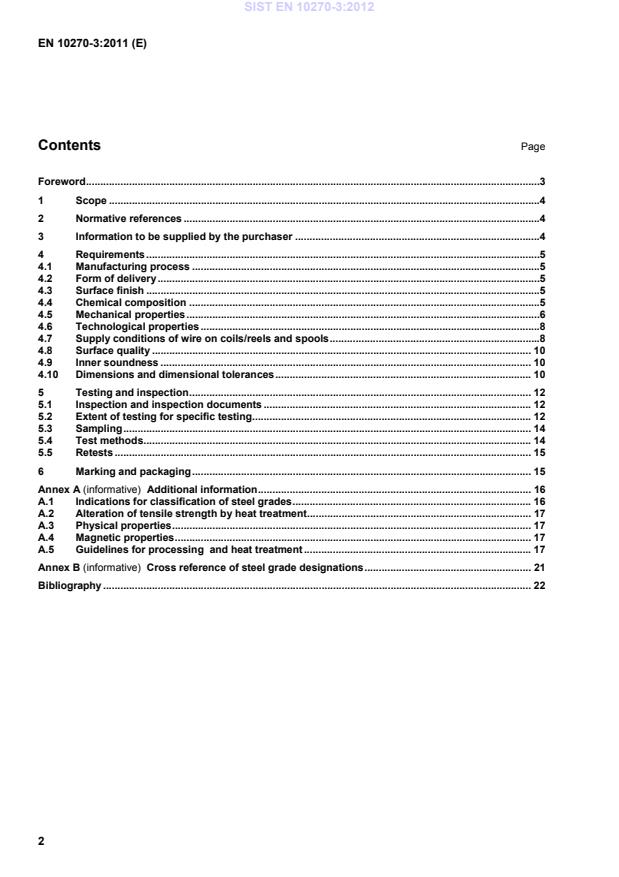
Additional information . 16A.1 Indications for classification of steel grades . 16A.2 Alteration of tensile strength by heat treatment . 17A.3 Physical properties . 17A.4 Magnetic properties . 17A.5 Guidelines for processing
and heat treatment . 17Annex B (informative)
Cross reference of steel grade designations . 21Bibliography . 22 SIST EN 10270-3:2012
4.4.2
The permissible deviation of the product analysis from the values specified in Table 1 shall be in accordance with the provision in EN 10088-3. For a single heat the deviation of an element in the product analysis may be only below the minimum or only above the maximum value of the range specified for the heat analysis, but not both at the same time. SIST EN 10270-3:2012
max. max. max. max.
Name b Number b
X10CrNi18-8 1.4310 0,05 to 0,15 2,00 2,00 0,045 0,015 16,0 to 19,0 ≤ 0,80 6,0 to 9,5 N ≤ 0,11 X5CrNiMo17-12-2 1.4401 c ≤ 0,07 1,00 2,00 0,045 0,015 16,5 to 18,5 2,00 to 2,50 10,0 to 13,0 N ≤ 0,11 X7CrNiAl17-7 1.4568 d ≤ 0,09 0,70 1,00 0,040 0,015 16,0 to 18,0 - 6,5 to 7,8 Al: 0,70 to 1,50 X5CrNi18-10 1.4301 ≤ 0,07 1,00 2,00 0,045 0,015 17,5 to 19,5 - 8,0 to 10,5 N ≤ 0,11 X1NiCrMoCu25-20-5 1.4539 ≤ 0,020 0,70 2,00 0,030 0,010 19,0 to 21,0 4,0 to 5,0 24,0 to 26,0 N ≤ 0,15
Cu: 1,20 to 2,00 X2CrNiMoN22-5-3 1.4462 e ≤ 0,030 1,00 2,00 0,035 0,015 21,0 to 23,0 2, 50 to 3,5 4,5 to 6,5 N: 0,10 to 0,22 a Alternative compositions may be used by agreement. b "Name" and "Number" are derived in accordance with EN 10027-1 and -2 respectively. c Steel 1.4436 may be used to provide increased corrosion resistance compared with 1.4401, with the specification of this part of EN 10270 applicable for steel 1.4401. d For better cold formability the upper limit of nickel content may be increased up to 8,30 %. e Duplex grades.
4.5 Mechanical properties 4.5.1 For the tensile strength in the as drawn condition the data of Table 2 shall apply. SIST EN 10270-3:2012
1.4310
1.4401 1.4568 1.4301 1.4539 1.4462 Nominal diameter mm g Normal tensile strength (NS) - High tensile strength (HS) -
min.
max.
min.
max. Normal tensile strength (NS) min. High tensile strength (HS) min.
max.
min.
max. Normal tensile strength (NS) - High tensile strength (HS) - min. max. min. max. min. max. min. max.
d ≤ 0,20 2 200 2 530 2 350 2 7101 7251 9901 9752 2802 000 2150 2 3001 6001 8402 150 2 480 2 3702 730 0,20 < d ≤ 0,30 2 150 2 480 2 300 2 6501 7001 9601 9502 2501 975 2050 2 2801 5501 7902 100 2 420 2 3702 730 0,30 < d ≤ 0,40 2 100 2 420 2 250 2 5901 6751 9301 9252 2201 925 2050 2 2201 5501 7902 000 2 300 2 3702 730 0,40 < d ≤ 0,50 2 050 2 360 2 200 2 5301 6501 9001 9002 1901 900 1950 2 1901 5001 7502 000 2 300 2 3702 730 0,50 < d ≤ 0,65 2 000 2 300 2 150 2 4801 6251 8701 8502 1301 850 1950 2 1301 4501 6701 900 2 190 2 3702 730 0,65 < d ≤ 0,80 1 950 2 250 2 100 2 4201 6001 8401 8252 1001 800 1850 2 0701 4501 6701 900 2 190 2 2302 570 0,80 < d ≤ 1,00 1 900 2 190 2 050 2 3601 5751 8201 8002 0701 775 1850 2 0501 4001 6101 800 2 070 2 1402 470 1,00 < d ≤ 1,25 1 850 2 130 2 000 2 3001 5501 7901 7502 0201 725 1750 1 9901 3501 5601 800 2 070 2 0902 410 1,25 < d ≤ 1,50 1 800 2 070 1 950 2 2501 5001 7301 7001 9601 675 1750 1 9301 3501 5601 700 1 960 2 0902 410 1,50 < d ≤ 1,75 1 750 2 020 1 900 2 1901 4501 6701 6501 9001 625 1650 1 8701 3001 5001 700 1 960 2 0002 300 1,75 < d ≤ 2,00 1 700 1 960 1 850 2 1301 4001 6101 6001 8401 575 1650 1 8201 3001 5001 700 1 960 2 0002 300 2,00 < d ≤ 2,50 1 650 1 900 1 750 2 0201 3501 5601 5501 7901 525 1550 1 7601 3001 5001 550 1 790 1 9002 190 2,50 < d ≤ 3,00 1 600 1 840 1 700 1 9601 3001 5001 5001 7301 475 1550 1 7001 3001 5001 550 1 790 1 8602 140 3,00 < d ≤ 3,50 1 550 1 790 1 650 1 9001 2501 4401 4501 6701 425 1450 1 6401 3001 5001 550 1 790 – – 3,50 < d ≤ 4,25 1 500 1 730 1 600 1 8401 2251 4101 4001 6101 400 1450 1 6101 2501 4401 450 1 670 – – 4,25 < d ≤ 5,00 1 450 1 670 1 550 1 7901 2001 3801 3501 5601 350 1350 1 5601 2501 4401 450 1 670 – – 5,00 < d ≤ 6,00 1 400 1 610 1 500 1 7301 1501 3301 3001 5001 300 1350 1 5001 2501 4401 350 1 560 – – 6,00 < d ≤ 7,00 1 350 1 560 1 450 1 6701 1251 3001 2501 4401 250 1300 1 4401 2001 3801 350 1 560 – – 7,00 < d ≤ 8,50 1 300 1 500 1 400 1 6101 0751 2401 2501 4401 200 1300 1 3801 1501 330– – – – 8,50 < d ≤ 10,00 1 250 1 440 1 350 1 5601 0501 2101 2501 4401 175 1250 1 360– – – – – – a Tensile strength calculated on actual diameter. b The range of tensile strength values within a production batch of the same heat shall be a maximum of 9 % of the minimum values in this table. c After straightening, it is recognized that the tensile strength may reduce by up to 10 % but the minimum values of this Table have to be fulfilled. d When better formability is required, lower tensile strength values may be agreed upon. e The wire is supplied in the cold drawn condition. The tensile strength in the finished spring may be substantially influenced by a heat treatment; particularly precipitation hardening of grade 1.4568 results in substantially higher tensile strength (see A.5.2 and Table A.3). f 1 MPa = 1 N/mm2. g Larger diameters may be specified in which case the parties shall agree the tensile strength at the time of enquiry and order.NOTE 1 Grade 1.4310 and 1.4462 can be delivered in normal tensile strength (NS) or high tensile strength (HS). NOTE 2 For steel 1.4568 the characteristics of the springs are not only determined by the characteristics of the drawn wire but also by the heat-treatment of the spring (see A.2). Therefore the steel should be of such quality so that by the heat treatment after drawing the mechanical properties are met.
Max. range
(mm) (MPa) d ≤ 1,50 100 1,50 < d ≤ 10,00 70
4.6 Technological properties 4.6.1 Coiling test For evaluation of uniformity of coiling and surface condition the coiling test may be applied to wire with a diameter of 0,50 mm to 1,50 mm. The spring coiled in accordance with 5.4.3 shall show a defect free surface condition without splits or fracture; the coil shall have uniform pitch of the turns and a fair dimensional regularity of its diameter. NOTE Although the usefulness of the coiling test is not generally recognized, it has been retained since it offers the possibility of revealing internal stresses. If doubtful test results are obtained the wire concerned should not be rejected immediately but efforts should be made by the parties concerned to elucidate the cause. 4.6.2 Wrapping test The wrapping test may be applied to wire with a diameter of 0,30 mm to 3,00 mm. The wire shall not show any sign of cracks or surface imperfections when closely wrapped eight turns around a mandrel of a diameter equal to the wire size (see also 5.4.4). 4.6.3 Simple bend test Where requested, the bend test may be applied for wire with a diameter over 3,00 mm. The wire shall withstand the test without any sign of failure. NOTE In s
...