


EN 12245:2002
(Main)Transportable gas cylinders - Fully wrapped composite cylinders
Transportable gas cylinders - Fully wrapped composite cylinders
This European Standard specifies minimum requirements for the materials, design, construction, prototype testing and routine manufacturing inspections of composite gas cylinders with a water capacity up to and including 450 l for compressed, liquefied and dissolved gases.
NOTE For the purposes of this standard, the word "cylinder" includes tubes up to 450 l water capacity
This standard is applicable to cylinders that comprise a liner of metallic material (welded or seamless) or non-metallic material (or a mixture thereof), reinforced by a wound composite consisting of fibres of glass, carbon or aramid (or a mixture thereof) embedded in a matrix.
This standard is also applicable to composite cylinders without liners.
This standard is not applicable to gas cylinders which are partially covered with fibres and commonly called "hoop wrapped" cylinders. For hoop wrapped composite cylinders see EN 12257.
NOTE The specification does not address the design, fitting and performance of removable protective sleeves. Where these are fitted they should be considered separately.
Ortsbewegliche Gasflaschen - Vollumwickelte Flaschen aus Verbundwerkstoffen
Diese Norm enthält Mindestanforderungen an die Werkstoffe, die Gestaltung, Konstruktion, die Bauartprüfungs-, Baureihen- und Abnahmeprüfungen von Flaschen aus Verbundwerkstoffen mit einem Fassungsraum bis zu 450 Liter für verdichtete, verflüssigte und unter Druck gelöste Gase.
ANMERKUNG Für die Anwendung dieser Norm umfasst das Wort "Flasche" auch Großflaschen mit einem Fassungsraum bis zu 450 Litern.
Diese Norm ist auf Flaschen anwendbar, die aus einem Liner mit metallischem Werkstoff (geschweißt oder nahtlos) oder mit nicht-metallischem Werkstoff (oder einer Kombination aus beidem) bestehen, und die mit einem in einer Matrix eingebetteten Wickelverbund aus Glas-, Kohlenstoff-, Aramid- oder sonstigen Faserwerkstoffen verstärkt sind.
Diese Norm gilt auch für Flaschen aus Verbundwerkstoff ohne Liner.
Die vorliegende Norm gilt nicht für Gasflaschen, die teilweise mit Faserwerkstoffen eingehüllt sind und allgemein als "umfangsumwickelte" Flaschen bezeichnet werden, für diese gilt EN 12257.
ANMERKUNG Diese Spezifikationen beinhalten nicht die Gestaltung, Verbindung und Durchführung von abnehmbaren Schutzhüllen. Die Verbindung sollte separat betrachtet werden.
Bouteilles à gaz transportables - Bouteilles entièrement bobinées en matériaux composites
La présente norme spécifie les exigences minimales relatives aux matériaux, à la conception, à la construction, aux essais de qualification de modèle et aux contrôles courants de production, des bouteilles à gaz composites, d'une contenance en eau inférieure ou égale à 450 l, pour gaz comprimés, liquéfiés et dissous.
NOTE Pour les besoins de la présente norme, le mot « bouteille » englobe les tubes d'une contenance en eau inférieure ou égale à 450 l.
La présente norme s'applique aux bouteilles constituées d'un liner métallique (avec ou sans soudure), ou non métallique (ou constitué d'un mélange de ces matériaux), renforcé par un enroulement composite en fibres de verre, de carbone ou d'aramide (ou un mélange de ces matériaux) noyées dans une matrice.
La présente norme s'applique également aux bouteilles à gaz en composite sans liner.
La présente norme ne s'applique pas aux bouteilles à gaz partiellement recouvertes de fibres et couramment appelées "bouteilles frettées". Pour les bouteilles frettées composite, voir l'EN 12257.
NOTE Cette spécification ne traite pas de la conception, du montage et des performances des gaines de protection amovibles. Lorsque celles-ci sont montées, il convient de les considérer séparément.
Premične plinske jeklenke - Popolnoma obvite jeklenke iz kompozitnih mas
General Information
- Status
- Withdrawn
- Publication Date
- 19-Feb-2002
- Withdrawal Date
- 20-Jan-2009
- Technical Committee
- CEN/TC 23 - Transportable gas cylinders
- Drafting Committee
- CEN/TC 23/SC 1/WG 4 - Composite cylinders
- Current Stage
- 9960 - Withdrawal effective - Withdrawal
- Start Date
- 21-Jan-2009
- Completion Date
- 21-Jan-2009
Relations
- Effective Date
- 28-Jan-2009
- Effective Date
- 09-Feb-2026
- Effective Date
- 09-Feb-2026
- Effective Date
- 09-Feb-2026
- Referred By
EN 60974-10:2014 - Arc welding equipment - Part 10: Electromagnetic compatibility (EMC) requirements - Effective Date
- 09-Feb-2026
- Effective Date
- 09-Feb-2026
- Effective Date
- 09-Feb-2026
- Effective Date
- 09-Feb-2026
- Effective Date
- 09-Feb-2026
- Effective Date
- 09-Feb-2026
- Effective Date
- 09-Feb-2026
- Effective Date
- 09-Feb-2026
- Effective Date
- 09-Feb-2026
- Effective Date
- 09-Feb-2026
- Effective Date
- 09-Feb-2026

Get Certified
Connect with accredited certification bodies for this standard

Institut za varilstvo d.o.o. (Welding Institute)
Slovenia's leading welding institute since 1952. ISO 3834, EN 1090, pressure equipment certification, NDT personnel, welder qualification. Only IIW Au
Sponsored listings
Frequently Asked Questions
EN 12245:2002 is a standard published by the European Committee for Standardization (CEN). Its full title is "Transportable gas cylinders - Fully wrapped composite cylinders". This standard covers: This European Standard specifies minimum requirements for the materials, design, construction, prototype testing and routine manufacturing inspections of composite gas cylinders with a water capacity up to and including 450 l for compressed, liquefied and dissolved gases. NOTE For the purposes of this standard, the word "cylinder" includes tubes up to 450 l water capacity This standard is applicable to cylinders that comprise a liner of metallic material (welded or seamless) or non-metallic material (or a mixture thereof), reinforced by a wound composite consisting of fibres of glass, carbon or aramid (or a mixture thereof) embedded in a matrix. This standard is also applicable to composite cylinders without liners. This standard is not applicable to gas cylinders which are partially covered with fibres and commonly called "hoop wrapped" cylinders. For hoop wrapped composite cylinders see EN 12257. NOTE The specification does not address the design, fitting and performance of removable protective sleeves. Where these are fitted they should be considered separately.
This European Standard specifies minimum requirements for the materials, design, construction, prototype testing and routine manufacturing inspections of composite gas cylinders with a water capacity up to and including 450 l for compressed, liquefied and dissolved gases. NOTE For the purposes of this standard, the word "cylinder" includes tubes up to 450 l water capacity This standard is applicable to cylinders that comprise a liner of metallic material (welded or seamless) or non-metallic material (or a mixture thereof), reinforced by a wound composite consisting of fibres of glass, carbon or aramid (or a mixture thereof) embedded in a matrix. This standard is also applicable to composite cylinders without liners. This standard is not applicable to gas cylinders which are partially covered with fibres and commonly called "hoop wrapped" cylinders. For hoop wrapped composite cylinders see EN 12257. NOTE The specification does not address the design, fitting and performance of removable protective sleeves. Where these are fitted they should be considered separately.
EN 12245:2002 is classified under the following ICS (International Classification for Standards) categories: 23.020.30 - Pressure vessels, gas cylinders; 23.020.35 - Gas cylinders. The ICS classification helps identify the subject area and facilitates finding related standards.
EN 12245:2002 has the following relationships with other standards: It is inter standard links to EN 12245:2009, EN 60127-6:2014, EN IEC 61970-302:2018, EN 55016-1-5:2015, EN 60974-10:2014, EN IEC/IEEE 65700-19-03:2018, EN 61215-1-1:2016, EN 61968-6:2016, EN 55014-2:2015, EN IEC 60153-2:2025, EN 60898-2:2021, EN 60770-3:2014, EN IEC 60455-2:2023, EN 61788-21:2015, EN 60143-1:2015. Understanding these relationships helps ensure you are using the most current and applicable version of the standard.
EN 12245:2002 is associated with the following European legislation: EU Directives/Regulations: 94/55/EC, 96/49/EC, 96/86/EC, 96/87/EC, TRRTP121; Standardization Mandates: M/086. When a standard is cited in the Official Journal of the European Union, products manufactured in conformity with it benefit from a presumption of conformity with the essential requirements of the corresponding EU directive or regulation.
EN 12245:2002 is available in PDF format for immediate download after purchase. The document can be added to your cart and obtained through the secure checkout process. Digital delivery ensures instant access to the complete standard document.
Standards Content (Sample)
2003-01.Slovenski inštitut za standardizacijo. Razmnoževanje celote ali delov tega standarda ni dovoljeno.Ortsbewegliche Gasflaschen - Vollumwickelte Flaschen aus VerbundwerkstoffenBouteilles a gaz transportables - Bouteilles entierement bobinées en matériaux compositesTransportable gas cylinders - Fully wrapped composite cylinders23.020.30MHNOHQNHPressure vessels, gas cylindersICS:Ta slovenski standard je istoveten z:EN 12245:2002SIST EN 12245:2002en01-november-2002SIST EN 12245:2002SLOVENSKI
STANDARD
EUROPEAN STANDARDNORME EUROPÉENNEEUROPÄISCHE NORMEN 12245February 2002ICS 23.020.30English versionTransportable gas cylinders - Fully wrapped composite cylindersBouteilles à gaz transportables - Bouteilles entièrementbobinées en matériaux compositesOrtsbewegliche Gasflaschen - Vollumwickelte Flaschenaus VerbundwerkstoffenThis European Standard was approved by CEN on 9 November 2001.CEN members are bound to comply with the CEN/CENELEC Internal Regulations which stipulate the conditions for giving this EuropeanStandard the status of a national standard without any alteration. Up-to-date lists and bibliographical references concerning such nationalstandards may be obtained on application to the Management Centre or to any CEN member.This European Standard exists in three official versions (English, French, German). A version in any other language made by translationunder the responsibility of a CEN member into its own language and notified to the Management Centre has the same status as the officialversions.CEN members are the national standards bodies of Austria, Belgium, Czech Republic, Denmark, Finland, France, Germany, Greece,Iceland, Ireland, Italy, Luxembourg, Malta, Netherlands, Norway, Portugal, Spain, Sweden, Switzerland and United Kingdom.EUROPEAN COMMITTEE FOR STANDARDIZATIONCOMITÉ EUROPÉEN DE NORMALISATIONEUROPÄISCHES KOMITEE FÜR NORMUNGManagement Centre: rue de Stassart, 36
B-1050 Brussels© 2002 CENAll rights of exploitation in any form and by any means reservedworldwide for CEN national Members.Ref. No. EN 12245:2002 ESIST EN 12245:2002
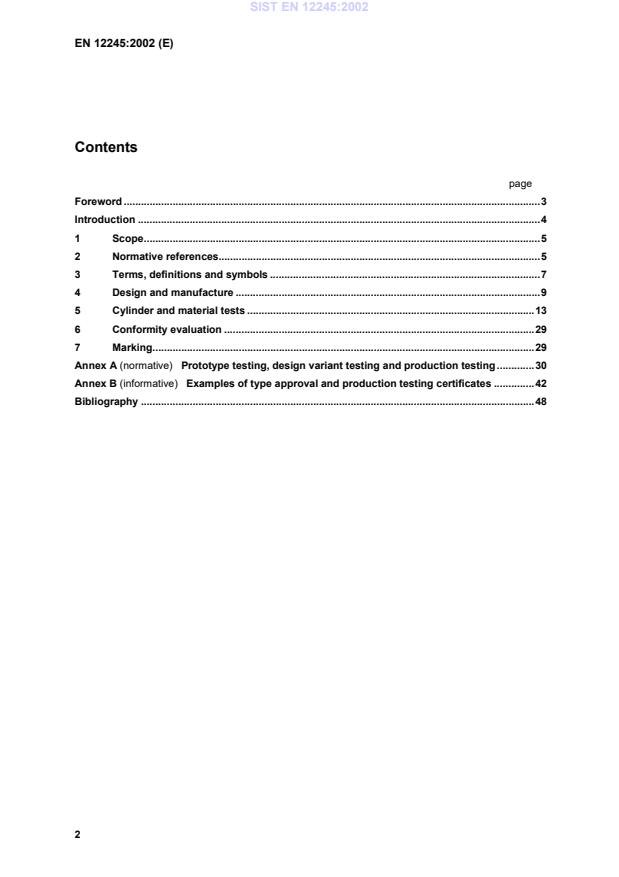
Prototype testing, design variant testing and production testing.30Annex B (informative)
Examples of type approval and production testing certificates.42Bibliography.48SIST EN 12245:2002
1100 MPa.EN 1964-3, Transportable gas cylinders — Specification for the design and construction of refillabletransportable seamless steel gas cylinders of water capacities from 0,5 litres up to and including 150litres — Part 3: Stainless steel cylinders.EN 1975, Transportable gas cylinders — Specification for the design and construction of refillabletransportable seamless aluminium and aluminium alloy gas cylinders of capacity from 0,5 l up to 150 l.EN 12862, Transportable gas cylinders — Refillable transportable welded aluminium alloy gascylinders.SIST EN 12245:2002
1)1 bar = 105 Pa = 0,1 MPa.SIST EN 12245:2002
ultraviolet, or radiation).4.4 Finished cylinder4.4.1 Design drawingsA fully dimensioned drawing of all parts that constitute the finished cylinder shall be supplied. Thedesign drawing shall also include tolerances on all dimensions, including out-of-roundness andstraightness.The drawing shall include the specification of the material(s), the material properties and thereinforcement pattern. The specifications and the reinforcement patterns may be given in a technicalspecification enclosed with the drawing.The details of an exterior coating, if it is an integral part of the design, shall be defined.The test pressure, autofrettage pressure (if applicable) and minimum burst pressure for the designshall be specified. The minimum burst pressure shall be at least 2
test pressure (ph).Any special characteristics or special limitations (e.g. design life, underwater suitability, vacuumsuitability and/or maximum fitting torque restrictions) shall also be stated.4.4.2 Cylinders without linerThe composition of the composite materials and also their properties shall be specified, as follows: tensile strength; tensile modulus; elongation; heat distortion temperature; viscosity.The composite materials shall be compatible with the contained gas as determined by EN ISO 11114-2. The auto-ignition temperature in oxygen gas shall be determined in accordance withEN ISO 11114-3.SIST EN 12245:2002
Additional tests on cylinders without liners: Procedure:Additional tests on the composite materials and adhesives (if applicable) to establish their otherphysical properties shall be carried out in accordance with the following procedures:Tensile strength- ISO 527-1 and ISO 527-2Tensile modulus- ISO 527-1 and ISO 527-2Elongation- ISO 527-1 and ISO 527-2Heat distortion temperature- ISO 3146 for thermoplastics and ISO 75-1 andISO 75-3 for thermoset materials;Auto-ignition temperature in oxygen- prEN ISO 11114-3 (for oxidising gases only)Viscosity- ISO 1628-3 for thermoplastics and ISO 2884-1 orASTM D 2196-86 for thermosetsComposition- Test specification acceptable to the inspection bodyEquivalent tests in accordance with alternative standards or test specifications acceptable tothe inspection body may be applied.Criteria:The mechanical properties shall meet the minimum requirements for the design as specified bythe manufacturer.5.2.2 Test No 2 - Liner material testsProcedure:Tests on the liner material shall be carried out, following the test procedures of the appropriatestandards as follows:a) Seamless steel - as described in EN 1964-1, prEN 1964-2 or EN ISO 11120, as appropriate;SIST EN 12245:2002
test pressure
(pb
2,0 ph); burst initiation shall be in the cylindrical part, and the liner (if any) shall fail into not more thanthree pieces. Damage through impact during the burst test which results in additional fragmentsshall be disregarded. Only pieces of the liner expelled from the body of the cylinder during thetest are to be counted; for cylinders without liners manufactured from two parts joined together, the burst shall not resultin separation at the joint.Parameters to monitor and record: burst pressure; number of pieces; description of failure; pressure/time curve or pressure/volume curve.5.2.6 Test No 6 - Resistance to pressure cycles at test pressure (ph) and ambienttemperature.a) For non-limited life:Procedure:The cycle test shall be carried out using a test rig, which allows pressure to be increased anddecreased at a controlled rate and automatically suspends the test when the cylinder hasfailed, either by leakage or rupture.The test shall be carried out with a non-corrosive liquid subjecting the cylinder to successivereversals at an upper cyclic pressure equal to the hydraulic test pressure (ph). The value of thelower cyclic pressure shall not exceed 10 % of the upper cyclic pressure and shall have anabsolute maximum of 30 bar.The cylinder shall actually experience the maximum and minimum cyclic pressures during thistest.The cycle tests shall be carried out in ambient conditions and the temperature on the outsidesurface of the cylinder shall not exceed 50 °C during the test. The frequency of reversals ofpressure shall not exceed 0,25 Hz (15 cycles per minute).The temperature of the external surface of the cylinder shall be monitored at least twice a day.The number of cycles achieved during the test shall be recorded.After completion of this test the cylinder shall then be destroyed (e.g. by bursting), or madeincapable of holding pressure.SIST EN 12245:2002
is the number of years of design service life and shall be awhole number greater than 10; the test shall continue for a further N cycles, or until failure by leakage whichever is the sooner. Ineither case the cylinder shall be deemed to have passed the test. However should failure duringthis second half of the test be by burst, then the cylinder shall have failed Test No 6.1st part2nd partNumber of cycles0 < -------------------------- > NN < ----------------------- > 2NCriteriaNo leakage/burst = PassNo leakage or burstLeakage = PassPass 1st partBurst = FailFigure 1 — Criteria for Test No 6SIST EN 12245:2002
test pressure (ph) for 45 days without pressure.The pressure shall be recorded at least at the beginning of the test and after 45 days, prior tode-pressurisation.Then, following the 90 day immersion: one of the two cylinders shall be subjected to Test No 5 (see 5.2.5); the other cylinder shall be subjected to Test No 6 (see 5.2.6);After completion of Test No 6 the cylinder shall then be destroyed (e.g. by bursting), or madeincapable of holding pressure.Criteria: for the first cylinder: burst pressure shall be greater than or equal to the manufacturer's minimum specified designburst pressure and 2
test pressure (pb
2,0 ph); for cylinders without liners manufactured from two parts joined together, the burst shall not resultin separation at the joint.SIST EN 12245:2002
test pressure (pb
2,0 ph).Parameters to monitor and record: measurement of the water capacity before and after test; temperature and relative humidity at least twice a day; cylinder pressure at least twice a day; burst pressure.5.2.9 Test No 9 - Drop testProcedure:Two cylinders, each filled with water to 50 % capacity shall be fitted with a plug, flush with theend of the cylinder. Each cylinder shall then be dropped twice in each of the five positionsshown in Figure 2, from a height of 1,2 m on to a steel plate. The protective plate shall be10 mm thick and sufficiently flat so that the difference in level between any two points on thesurface is no more than 2 mm. It shall be replaced regularly and in any event if damaged. Theplate shall rest on flat smooth concrete, composed of cement, sand and gravel, and which is atleast 100 mm thick. The steel plate shall be in full contact with the concrete so that the plate isfully supported by the concrete.SIST EN 12245:2002
test pressure
(pb
2,0 ph); for cylinders without liners manufactured from two parts joined together, the burst shall not resultin separation at the joint; for the second cylinder, criteria shall be as Test No 6 (see 5.2.6).Parameters to monitor and record: visual appearance after each drop - position and dimensions of impact damage; burst pressure; description of failure; parameters specified in Test No 6 (see 5.2.6).SIST EN 12245:2002
ph
and the number of cycles shall be a maximum of 5 000.After completion of Test No 6, the cylinder shall then be destroyed (e.g. by bursting), or madeincapable of holding pressure.Criteria: for the first cylinder, burst pressure shall be greater than or equal to 4/3
test pressure
(pb
4/3ph); for the second cylinder, it shall withstand at least 1 000 pressure cycles to 2/3
ph withoutleakage. If the cylinder fails by leakage after 1 000 cycles it shall be deemed to have passed thetest. However should failure occur during this second part of the test by burst, then the cylindershall have failed Test No 10.Parameters to monitor and record: burst pressure; number of cycles; flaw size; description of failure; parameters as specified in Test No 6.5.2.11 Test No 11 - Extreme temperature cycle testa) Vacuum cycling conditioningFor cylinders with non-load sharing liners (metallic or non-metallic) only, the cylinder shall either besubjected to a vacuum conditioning prior to the extreme temperature cycle test or it shall be clearlymarked in accordance with the requirements of clause 7.SIST EN 12245:2002
equal to 1,67
test pressure (pb
1,67 ph).Parameters to monitor and record: burst pressure; description of failure.5.2.12 Test No 12 - Fire resistance testProcedure:Two cylinders shall undergo this test; one in a horizontal position; one in a vertical position.The cylinders shall be fitted either:a) with a valve with the type of pressure relief device intended for service (e.g. fusible or burst disc);orb) with a valve fitted with bursting disc set to operate at between test pressure (ph) and 1,15 phIf the valve in a) is fitted with a fusible plug this shall operate at a minimum temperature of100 °C.The cylinders shall be pressurized with either air or nitrogen to 2/3
test pressure (ph).SIST EN 12245:2002
...
Questions, Comments and Discussion
Ask us and Technical Secretary will try to provide an answer. You can facilitate discussion about the standard in here.
Loading comments...