

prEN 1948-5
(Main)Stationary source emissions - Determination of the mass concentration of PCDDs/PCDFs and dioxin-like PCBs - Part 5: Long-term sampling of PCDDs/PCDFs/PCBs
- Abstract
This document specifies the long-term sampling of PCDDs/PCDFs/PCBs. There are three different sampling methods, which are based on the three different principles described in EN 1948 1, but partially modified for long-term sampling requirements:
— filter/condenser method;
— dilution method;
— cooled probe method.
Each sampling method is illustrated in detail in Annex D. The sampling methods described in this document are designed for a sampling duration of typically up to four weeks.
Additionally, this document specifies a framework of quality control requirements for any long-term sampling method.
With the methods described, experiences were gained for a concentration range up to 4,0 ng TEQ/m3 at various stationary sources (e.g. waste incinerators, sinter plants, cement kilns).
For complete implementation of the measurement method, the use of EN 1948 2 and EN 1948 3 describing extraction, clean-up, identification, and quantification, respectively, is necessary in order to determine PCDDs/PCDFs. Additionally, EN 1948 4 is necessary for PCBs.
- Status
- Not Published
- Publication Date
- 27-Feb-2028
- Technical Committee
- CEN/TC 264 - Air quality
- Drafting Committee
- CEN/TC 264/WG 1 - Dioxins - emissions
- Current Stage
- 4060 - Closure of enquiry - Enquiry
- Start Date
- 06-Aug-2026
- Due Date
- 02-Feb-2027
- Completion Date
- 06-Aug-2026

Overview
prEN 1948-5 is a European standard developed by CEN focusing on the long-term sampling of polychlorinated dibenzo-p-dioxins (PCDDs), polychlorinated dibenzofurans (PCDFs), and dioxin-like polychlorinated biphenyls (PCBs) from stationary source emissions. This document sets out procedures and minimum requirements for conducting long-duration sampling-typically up to four weeks-to accurately determine average mass concentrations of these persistent organic pollutants in industrial emissions.
This standard supplements earlier parts of EN 1948, which establish reference methods for sampling, extraction, clean-up, identification, and quantification of PCDDs/PCDFs/PCBs. prEN 1948-5 is particularly relevant in monitoring compliance with European industrial emission directives aimed at pollution prevention and control in installations such as waste incinerators, sinter plants, and cement kilns.
Key Topics
Long-Term Sampling Methods
Three modified sampling principles adapted from EN 1948-1 are specified for long-term measurements:- Filter/condenser method
- Dilution method
- Cooled probe method
These are detailed within the standard’s annexes, providing guidance on setup and operation for extended sample collection periods.
Quality Assurance Framework
The standard lays out robust quality control and quality assurance procedures to ensure reliability and repeatability of sampling results. Key elements include:- Certification and validation of sampling systems
- Regular system checks, maintenance, and leak testing
- Validation of installation at each emission source
- Field blank tests and routine performance verifications
Minimum Requirements
Detailed minimum requirements for sampling points, equipment, sampling procedures, and sample handling are specified to ensure representative and comparable results across a range of stationary sources.Reporting and Documentation
prEN 1948-5 describes the requirements for sampling and analytical reports, data recording intervals, and proper documentation of any interruptions or maintenance activities during the sampling campaign.
Applications
Organizations involved in industrial emission monitoring-such as operators of waste incineration plants, cement industry facilities, and metallurgical works-will find prEN 1948-5 essential for:
- Regulatory Compliance: Ensuring adherence to emission limit values (ELVs) and supporting legal requirements under EU Directive 2010/75/EU and its amendments.
- Environmental Protection: Monitoring and managing releases of hazardous compounds such as PCDDs, PCDFs, and PCBs, which are subject to control due to their toxicity and persistence.
- Process Optimization: Gathering data to help optimize combustion or processing conditions, with the aim of minimizing dioxin and PCB formation and emissions.
- Quality Data Generation: Facilitating high-integrity, scientifically robust data to support environmental impact assessments and public reporting.
The ability to conduct long-term sampling allows for a more accurate picture of average emission levels and variability, addressing limitations of short-term or spot sampling, especially for pollutants that have sporadic or process-dependent release patterns.
Related Standards
prEN 1948-5 is part of a suite of standards addressing stationary source emissions, and is directly linked with several related CEN and ISO documents, including:
- EN 1948-1: Sampling of PCDDs/PCDFs
- EN 1948-2: Extraction and clean-up of PCDDs/PCDFs
- EN 1948-3: Identification and quantification of PCDDs/PCDFs
- EN 1948-4: Sampling and analysis of dioxin-like PCBs
- EN 15259: Requirements for measurement sections and sites
- EN ISO 16911-1: Manual reference method for flue gas velocity and flow rate
- EN 15267 (series): Assessment and certification of air quality monitoring equipment
By adhering to prEN 1948-5 in conjunction with these related standards, operators and laboratories can ensure comprehensive, harmonized, and credible long-term emission monitoring of PCDDs/PCDFs/PCBs across the European Union.
Keywords: prEN 1948-5, stationary source emissions, long-term sampling, PCDDs, PCDFs, dioxin-like PCBs, environmental monitoring, EU emission standards, CEN, industrial emissions compliance.
Relations
- Effective Date
- 28-Feb-2024
Get Certified
Connect with accredited certification bodies for this standard

CIS Institut d.o.o.
Personal Protective Equipment (PPE) certification body. Notified Body NB-2890 for EU Regulation 2016/425 PPE.

Kiwa BDA Testing
Building and construction product certification.
Kmetijski inštitut Slovenije
Agricultural Institute of Slovenia. Soil testing, plant health, agricultural product analysis.
Sponsored listings
Frequently Asked Questions
prEN 1948-5 is a draft published by the European Committee for Standardization (CEN). Its full title is "Stationary source emissions - Determination of the mass concentration of PCDDs/PCDFs and dioxin-like PCBs - Part 5: Long-term sampling of PCDDs/PCDFs/PCBs". This standard covers: This document specifies the long-term sampling of PCDDs/PCDFs/PCBs. There are three different sampling methods, which are based on the three different principles described in EN 1948 1, but partially modified for long-term sampling requirements: — filter/condenser method; — dilution method; — cooled probe method. Each sampling method is illustrated in detail in Annex D. The sampling methods described in this document are designed for a sampling duration of typically up to four weeks. Additionally, this document specifies a framework of quality control requirements for any long-term sampling method. With the methods described, experiences were gained for a concentration range up to 4,0 ng TEQ/m3 at various stationary sources (e.g. waste incinerators, sinter plants, cement kilns). For complete implementation of the measurement method, the use of EN 1948 2 and EN 1948 3 describing extraction, clean-up, identification, and quantification, respectively, is necessary in order to determine PCDDs/PCDFs. Additionally, EN 1948 4 is necessary for PCBs.
This document specifies the long-term sampling of PCDDs/PCDFs/PCBs. There are three different sampling methods, which are based on the three different principles described in EN 1948 1, but partially modified for long-term sampling requirements: — filter/condenser method; — dilution method; — cooled probe method. Each sampling method is illustrated in detail in Annex D. The sampling methods described in this document are designed for a sampling duration of typically up to four weeks. Additionally, this document specifies a framework of quality control requirements for any long-term sampling method. With the methods described, experiences were gained for a concentration range up to 4,0 ng TEQ/m3 at various stationary sources (e.g. waste incinerators, sinter plants, cement kilns). For complete implementation of the measurement method, the use of EN 1948 2 and EN 1948 3 describing extraction, clean-up, identification, and quantification, respectively, is necessary in order to determine PCDDs/PCDFs. Additionally, EN 1948 4 is necessary for PCBs.
prEN 1948-5 is classified under the following ICS (International Classification for Standards) categories: 13.040.40 - Stationary source emissions. The ICS classification helps identify the subject area and facilitates finding related standards.
prEN 1948-5 has the following relationships with other standards: It is inter standard links to CEN/TS 1948-5:2015. Understanding these relationships helps ensure you are using the most current and applicable version of the standard.
prEN 1948-5 is associated with the following European legislation: EU Directives/Regulations: 2000/76/EC; Standardization Mandates: M/588. When a standard is cited in the Official Journal of the European Union, products manufactured in conformity with it benefit from a presumption of conformity with the essential requirements of the corresponding EU directive or regulation.
prEN 1948-5 is available in PDF format for immediate download after purchase. The document can be added to your cart and obtained through the secure checkout process. Digital delivery ensures instant access to the complete standard document.
Standards Content (Sample)
SLOVENSKI STANDARD
01-maj-2026
Emisije nepremičnih virov - Določanje masne koncentracije PCDD/PCDF in
dioksinom podobnih PCB - 5. del: Dolgotrajno vzorčenje PCDD/PCDF/PCB
Stationary source emissions - Determination of the mass concentration of
PCDDs/PCDFs and dioxin-like PCBs - Part 5: Long-term sampling of
PCDDs/PCDFs/PCBs
Emissionen aus stationären Quellen - Bestimmung der Massenkonzentration von
PCDD/PCDF und dioxin-ähnlichen PCB - Teil 5: Langzeitprobenahme von
PCDD/PCDF/PCB
Émissions de sources fixes - Détermination de la concentration massique en
PCDD/PCDF et PCB de type dioxine - Partie 5 : Prélèvement à long-terme de
PCDD/PCDF/PCB
Ta slovenski standard je istoveten z: prEN 1948-5
ICS:
13.040.40 Emisije nepremičnih virov Stationary source emissions
2003-01.Slovenski inštitut za standardizacijo. Razmnoževanje celote ali delov tega standarda ni dovoljeno.
DRAFT
EUROPEAN STANDARD
NORME EUROPÉENNE
EUROPÄISCHE NORM
May 2026
ICS 13.040.40 Will supersede CEN/TS 1948-5:2015
English Version
Stationary source emissions - Determination of the mass
concentration of PCDDs/PCDFs and dioxin-like PCBs -
Part 5: Long-term sampling of PCDDs/PCDFs/PCBs
Émissions de sources fixes - Détermination de la Emissionen aus stationären Quellen - Bestimmung der
concentration massique en PCDD/PCDF et PCB de type Massenkonzentration von PCDD/PCDF und dioxin-
dioxine - Partie 5 : Prélèvement à long-terme de ähnlichen PCB - Teil 5: Langzeitprobenahme von
PCDD/PCDF/PCB PCDD/PCDF/PCB
This draft European Standard is submitted to CEN members for enquiry. It has been drawn up by the Technical Committee
CEN/TC 264.
If this draft becomes a European Standard, CEN members are bound to comply with the CEN/CENELEC Internal Regulations
which stipulate the conditions for giving this European Standard the status of a national standard without any alteration.
This draft European Standard was established by CEN in three official versions (English, French, German). A version in any other
language made by translation under the responsibility of a CEN member into its own language and notified to the CEN-CENELEC
Management Centre has the same status as the official versions.
CEN members are the national standards bodies of Austria, Belgium, Bulgaria, Croatia, Cyprus, Czech Republic, Denmark, Estonia,
Finland, France, Germany, Greece, Hungary, Iceland, Ireland, Italy, Latvia, Lithuania, Luxembourg, Malta, Netherlands, Norway,
Poland, Portugal, Republic of North Macedonia, Romania, Serbia, Slovakia, Slovenia, Spain, Sweden, Switzerland, Türkiye and
United Kingdom.
Recipients of this draft are invited to submit, with their comments, notification of any relevant patent rights of which they are
aware and to provide supporting documentation.
Warning : This document is not a European Standard. It is distributed for review and comments. It is subject to change without
notice and shall not be referred to as a European Standard.
EUROPEAN COMMITTEE FOR STANDARDIZATION
COMITÉ EUROPÉEN DE NORMALISATIO N
EUROPÄISCHES KOMITEE FÜR NORMUN G
CEN-CENELEC Management Centre: Rue de la Science 23, B-1040 Brussels
© 2026 CEN All rights of exploitation in any form and by any means reserved Ref. No. prEN 1948-5:2026 E
worldwide for CEN national Members.
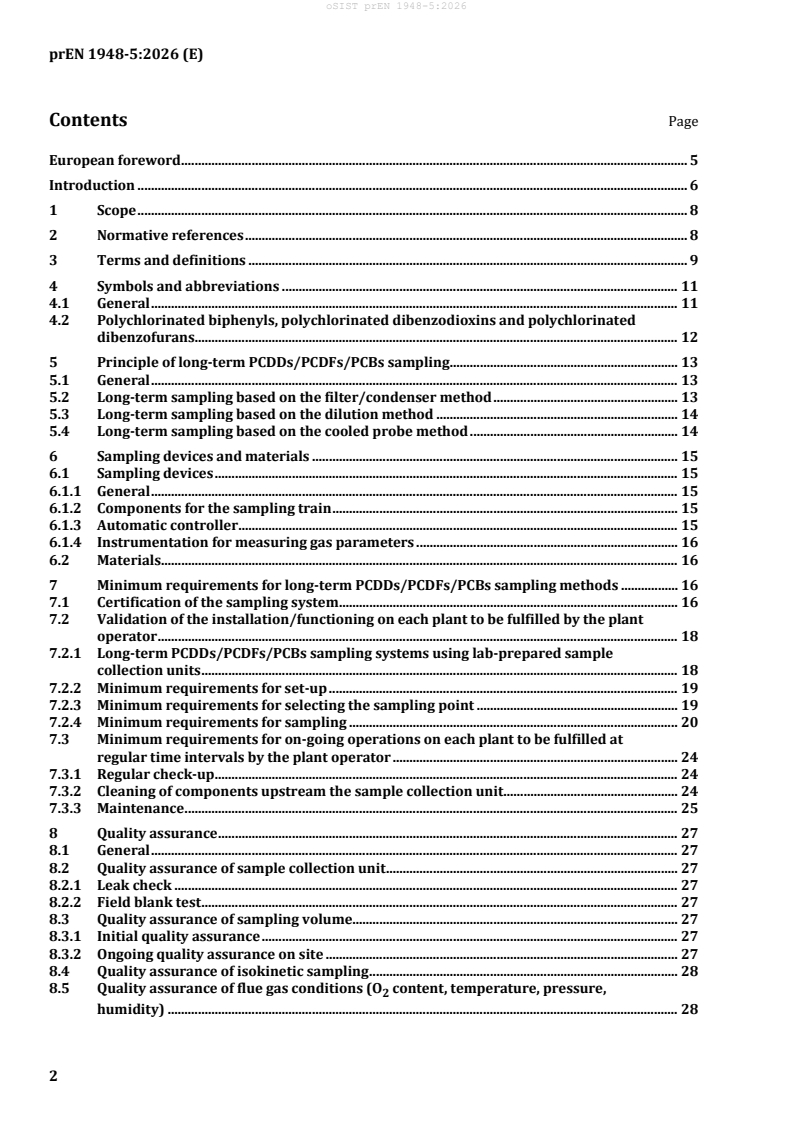
Contents Page
European foreword . 5
Introduction . 6
1 Scope . 8
2 Normative references . 8
3 Terms and definitions . 9
4 Symbols and abbreviations . 11
4.1 General . 11
4.2 Polychlorinated biphenyls, polychlorinated dibenzodioxins and polychlorinated
dibenzofurans. 12
5 Principle of long-term PCDDs/PCDFs/PCBs sampling . 13
5.1 General . 13
5.2 Long-term sampling based on the filter/condenser method . 13
5.3 Long-term sampling based on the dilution method . 14
5.4 Long-term sampling based on the cooled probe method . 14
6 Sampling devices and materials . 15
6.1 Sampling devices . 15
6.1.1 General . 15
6.1.2 Components for the sampling train . 15
6.1.3 Automatic controller . 15
6.1.4 Instrumentation for measuring gas parameters . 16
6.2 Materials . 16
7 Minimum requirements for long-term PCDDs/PCDFs/PCBs sampling methods . 16
7.1 Certification of the sampling system . 16
7.2 Validation of the installation/functioning on each plant to be fulfilled by the plant
operator . 18
7.2.1 Long-term PCDDs/PCDFs/PCBs sampling systems using lab-prepared sample
collection units . 18
7.2.2 Minimum requirements for set-up . 19
7.2.3 Minimum requirements for selecting the sampling point . 19
7.2.4 Minimum requirements for sampling . 20
7.3 Minimum requirements for on-going operations on each plant to be fulfilled at
regular time intervals by the plant operator . 24
7.3.1 Regular check-up . 24
7.3.2 Cleaning of components upstream the sample collection unit . 24
7.3.3 Maintenance . 25
8 Quality assurance . 27
8.1 General . 27
8.2 Quality assurance of sample collection unit . 27
8.2.1 Leak check . 27
8.2.2 Field blank test . 27
8.3 Quality assurance of sampling volume. 27
8.3.1 Initial quality assurance . 27
8.3.2 Ongoing quality assurance on site . 27
8.4 Quality assurance of isokinetic sampling . 28
8.5 Quality assurance of flue gas conditions (O content, temperature, pressure,
humidity) . 28
9 Analytical procedure . 29
9.1 General . 29
9.2 Extraction of the sample . 29
9.3 Clean-up and partitioning of the sample extract . 29
9.4 Identification and quantification . 32
9.5 Calculation of the recovery rates of the extraction standards . 32
9.6 Calculation of results . 32
10 Estimation of uncertainty of the method . 33
10.1 General . 33
10.2 Elements required for the uncertainty determinations . 33
10.2.1 Model formula and parameters . 33
10.2.2 Expanded uncertainty . 35
11 Reporting . 35
11.1 Sampling report, analytical report and field blank report . 35
11.2 Record keeping every half hour . 37
11.3 Interruptions recording . 38
Annex A (normative) Overview of minimum requirements . 39
Annex B (normative) Cleaning procedure . 41
Annex C (normative) Performance criteria and test procedure for certification . 43
C.1 General relation to other standards . 43
C.2 General requirements . 43
C.3 Performance criteria common to all long-term PCDDs/PCDFs/PCBs sampling
systems for laboratory testing . 43
C.4 Performance criteria common to all long-term PCDDs/PCDFs/PCBs sampling
systems for field testing . 44
C.5 Reporting of the long-term sampling system certificates . 45
Annex D (informative) Examples of devices and operation for long-term sampling systems . 47
D.1 Filter/condenser method . 47
D.2 Dilution method . 50
D.3 Cooled probe method . 53
Annex E (informative) Fundamentals of isokinetic sampling . 57
E.1 General . 57
E.2 Error (ɛ) by non-isokinetic sampling depending on particle diameter . 58
E.3 Influence of long-term sampling on achieving isokinetic sampling . 58
E.4 Procedure . 59
E.5 Parameters affecting gas velocity measurement that require regular device
calibration and checking . 61
Annex F (informative) Example for the determination of the representative sampling point . 64
Annex G (informative) Estimation of the uncertainty of measured PCDDs/PCDFs/PCBs of
the long-term sampling system . 68
G.1 General . 68
G.2 Analysis of the measurement process and mathematical modelling . 68
G.3 Application of the law of propagation of uncertainties . 71
G.4 Calculation of type uncertainties. 71
G.5 Calculation of expanded uncertainty . 74
G.6 Example of digital application: measurement of dioxin/furan-concentration . 75
Annex H (informative) Example for calculation of measurement results for standard
conditions . 81
H.1 General . 81
H.2 Dry gas volumetric flow rate at standard conditions . 81
Annex I (normative) Adaption of the maximum deviation in relation to the
PCDDs/PCDFs/PCBs concentration . 83
Annex J (informative) Validation results . 85
J.1 Prerequisite and assumptions . 85
J.2 Results . 86
J.3 Summary . 87
Annex K (informative) Significant changes between this document prEN 1948-5:2026 and
the previous edition CEN/TS 1948-5:2015 in the transfer from TS to EN . 88
Bibliography . 92
European foreword
This document (prEN 1948-5:2026) has been prepared by Technical Committee CEN/TC 264 “Air
quality”, the secretariat of which is held by DIN.
This document is currently submitted to the CEN Enquiry.
This document will supersede CEN/TS 1948-5:2015.
This document has been prepared under a standardization request addressed to CEN by the European
Commission. The Standing Committee of the EFTA States subsequently approves these requests for its
Member States.
An informative Annex K has been added in which the technical changes between this document and
CEN/TS 1948-5:2015 are listed in detail.
Introduction
0.1 Background
EN 1948-1, EN 1948-2, EN 1948-3 and EN 1948-4 describe reference methods for the determination of
PCDDs/PCDFs/PCBs, whereas this document gives requirements for long-term sampling measurements
in connection with the appropriate analytical methods (equivalent method). In contrast to the short-term
sampling methods which refers to monitoring the limit value for compliance with emission limit values
(ELVs) in Directives, such as Industrial Emission Directive (IED) [10], the long-term sampling is intended
to determine the average concentration level during a longer period (see e.g. [12], [13]). EN 1948-5
provides methods for measuring long-term average mass concentrations, but it does not specify its
potential use by the competent authority for demonstrating compliance with long-term ELVs.
Long-term sampling methods are not automatic measurement methods and do not provide continuous
emission monitoring data (real time display).
Application of EN 1948-2 (extraction), EN 1948-3 (analysis) and EN 1948-4 (‘PCBs’) in connection with
this document are necessary for performing long-term sampling of PCDDs/PCDFs/PCBs.
Currently, in some European Union countries, PCDDs/PCDFs/PCBs long-term sampling is an obligatory
measurement for some processes, further countries and processes can or will follow.
In Reference [1] the results of a Type Performance Test for long-term sampling are presented.
0.2 Relationship between this document and the essential requirements of Directive (EU)
2024/1785 amending Directive 2010/75/EU
This document has been prepared under a Standardization Request M/588 / C(2022) 6574 final
“Methods for the measurements of emissions into the air of polychlorinated dibenzo-p-dioxins and furans
(PCDDs/PCDFs) and dioxin-like polychlorinated biphenyls (PCBs), total gaseous mercury and
formaldehyde” given to CEN by the European Commission and the European Free Trade Association, and
supports essential requirements of EU Directives / Regulations Directive (EU) 2024/1785 of the
European Parliament and of the Council of 24 April 2024 amending Directive 2010/75/EU of the
European Parliament and of the Council on industrial emissions (integrated pollution prevention and
control) and Council Directive 1999/31/EC on the landfill of waste.
Essential Requirements of Directive 2010/75/EU
Article 45 Permit conditions
“(2) In addition to the requirements set out in paragraph 1, the permit granted to a waste incineration
plant or waste co-incineration plant using hazardous waste shall include the following…
(b) the minimum and maximum mass flows of those hazardous wastes, their lowest and maximum
calorific values and their maximum contents of polychlorinated biphenyls, pentachlorophenol, chlorine,
fluorine, sulphur, heavy metals and other polluting substances.”
Article 48 Monitoring of emissions
“As soon as appropriate measurement techniques are available within the Union, the Commission shall,
by means of delegated acts in accordance with Article 76 and subject to the conditions laid down in
Articles 77 and 78, set the date from which continuous measurements of emissions into the air of heavy
metals and dioxins and furans are to be carried out.”
Essential Requirements of Directive (EU) 2024/1785
(36) in Article 48, paragraph 1 is replaced by the following:
“Member States shall ensure that monitoring of emissions is carried out in accordance with Parts 6 and
7 of Annex VI. Emissions to air from waste incineration and co-incineration plants shall also be monitored
during other than normal operating conditions. Emissions during start-up and shutdown while no waste
is being incinerated, including emissions of PCDD/F and dioxin-like PCBs, shall be estimated based on
measurement campaigns, carried out at regular intervals, such as every three years, carried out during
planned start-up or shutdown operations. Emissions of PCDD/F and dioxin-like PCBs shall as far as
possible be prevented or minimised.”
Annex VI to Directive 2010/75/EU is amended as follows:
in Part 6, point 1.2 is replaced by the following:
“1.2. Sampling and analysis of all polluting substances including dioxins and furans, as well as the quality
assurance of automated measuring systems and the reference measurement methods to calibrate them,
shall be carried out in accordance with CEN-standards. If CEN standards are not available, ISO, national
or other international standards which ensure the provision of data of an equivalent scientific quality
shall apply. This applies also to the quality assurance system of the laboratory performing the sampling
and analysis. Automated measuring systems shall be subject to control by means of parallel
measurements with the reference methods at least once per year.”
NOTE Other Union legislation might be applicable to the methods falling within the scope of this document.
1 Scope
This document specifies the long-term sampling of PCDDs/PCDFs/PCBs. There are three different
sampling methods, which are based on the three different principles described in EN 1948-1, but partially
modified for long-term sampling requirements:
— filter/condenser method;
— dilution method;
— cooled probe method.
Each sampling method is illustrated in detail in Annex D. The sampling methods described in this
document are designed for a sampling duration of typically up to four weeks.
Additionally, this document specifies a framework of quality control requirements for any long-term
sampling method.
With the methods described, experiences were gained for a concentration range up to 4,0 ng TEQ/m at
various stationary sources (e.g. waste incinerators, sinter plants, cement kilns).
For complete implementation of the measurement method, the use of EN 1948-2 and EN 1948-3
describing extraction, clean-up, identification, and quantification, respectively, is necessary in order to
determine PCDDs/PCDFs. Additionally, EN 1948-4 is necessary for PCBs.
2 Normative references
The following documents are referred to in the text in such a way that some or all of their content
constitutes requirements of this document. For dated references, only the edition cited applies. For
undated references, the latest edition of the referenced document (including any amendments) applies.
EN 1948-1:2006, Stationary source emissions — Determination of the mass concentration of PCDDs/PCDFs
and dioxin-like PCBs — Part 1: Sampling of PCDDs/PCDFs
EN 1948-2:2006, Stationary source emissions — Determination of the mass concentration of PCDDs/PCDFs
and dioxin-like PCBs — Part 2: Extraction and clean-up of PCDDs/PCDFs
EN 1948-3:2006, Stationary source emissions — Determination of the mass concentration of PCDDs/PCDFs
and dioxin-like PCBs — Part 3: Identification and quantification of PCDDs/PCDFs
EN 1948-4:2010+A1:2013, Stationary source emissions — Determination of the mass concentration of
PCDDs/PCDFs and dioxin-like PCBs — Part 4: Sampling and analysis of dioxin-like PCBs
EN 13284-1:2017, Stationary source emissions — Determination of low range mass concentration of dust
— Part 1: Manual gravimetric method
EN 15259:2007, Air quality — Measurement of stationary source emissions — Requirements for
measurement sections and sites and for the measurement objective, plan and report
EN 15267-1, Air quality — Assessment of air quality monitoring equipment — Part 1: General principles of
certification
EN 15267-2, Air quality — Assessment of air quality monitoring equipment — Part 2: Initial assessment of
the manufacturer’s quality management system and post certification surveillance for the manufacturing
process
EN 15267-3:2023, Air quality — Assessment of air quality monitoring equipment — Part 3: Performance
criteria and test procedures for stationary automated measuring systems for continuous monitoring of
emissions from stationary sources
EN ISO 16911-1, Stationary source emissions — Manual and automatic determination of velocity and
volume flow rate in ducts — Part 1: Manual reference method (ISO 16911-1)
3 Terms and definitions
For the purposes of this document, the following terms and definitions apply.
ISO and IEC maintain terminology databases for use in standardization at the following addresses:
• ISO Online browsing platform: available at https://www.iso.org/obp
• IEC Electropedia: available at https://www.electropedia.org/
3.1
sample collection unit
entity, which is covering and holding different media, including e.g. adsorber, absorber and filter, used to
collect the PCDDs/PCDFs/PCBs from the gaseous and particulate phase and it is processed later, after the
end of sampling, at a laboratory
3.2
short-term sampling
sampling for a period of 6 to 8 h according to EN 1948-1
3.3
long-term sampling
sampling, continuously performed for an extended period of time compared to short-term sampling, e.g.
sampling for one month
3.4
long-term sampling system
a system used for long-term sampling
3.5
measurement report
report, including the relevant details of the sampling report and the analytical report, indicating
especially the PCDDs/PCDFs/PCBs concentration
3.6
Field blank report
Report of the field blank test results
3.7
standby
Interruption of the sampling process, due to, e.g. plant shut down, sampling system maintenance or
during the changing of sample collection unit
3.8
standardized gas volume
gas volume, quantified at standard conditions of temperature (273,15 K) and pressure (101,3 kPa) on a
dry basis, and corrected to a reference concentration of oxygen, if needed
3.9
isokinetic sampling
sampling, which is performed such that the velocity (magnitude and direction) of the gas entering the
sampling nozzle is the same as the velocity of the gas in the duct at the sampling point
3.10
sampling standard
one or more C -labelled PCDD/PCDF/PCB, added before sampling
3.11
extraction standard
one or more C -labelled PCDD/PCDF/PCB, added before extraction and used for calculation of results
3.12
recovery standard
one or more C -labelled PCDD/PCDF/PCB, added after completing the clean-up procedure
(EN 1948-2) and before identification and quantification (EN 1948-3), or respectively before analysis
(EN 1948-4), as applicable
3.13
type performance test
test, to be performed by an independent test house in a laboratory and on site, to evaluate the conformity
of the long-term sampling systems, according to the defined performance criteria, corresponding to the
relevant application
3.14
field blank value
concentration value, determined from a sampling collection unit, which was prepared but not used for
sampling
Note 1 to entry: The described measurement procedure is employed to ensure that no significant contamination
has occurred during all steps of the measurement and to check that the operator can achieve a quantification level
adapted to the task.
Note 2 to entry: The field bank value is a calculated value and does not represent a measured concentration.
3.15
accuracy
closeness of agreement between a measured quantity value and a true quantity value of a measurand
[SOURCE: VIM:2012 [3]]
3.16
maintenance interval
maximum allowed time period, within which the performance characteristics will remain in the
predefined range without intervention (e.g. cleaning, calibration or adjustment)
3.17
measurement section
region of the flue gas duct, which includes the measurement plane(s)
[SOURCE: EN 15259:2007, 3.12]
3.18
measurement cross section
plane, normal to the centre line of the duct at the sampling position
Note 1 to entry: Measurement plane is also known as sampling plane
[SOURCE: EN 15259:2007, 3.13]
3.19
availability
fraction of the total sampling time, during which PCDDs/PCDFs/PCBs were collected in the sample
collection unit
3.20
cleaning
general procedure to remove residues, including particulate matter, from parts of the sampling train
which were or will be in contact with the sampled gas
3.21
purging
operation where clean gas is blown at high flow through the complete sampling train or parts of it in the
direction of the stack
Note 1 to entry: Purging is only appropriate when the long-term sampling system is stopped or in stand-by mode.
3.22
backflush
operation to prevent possible contaminations, where clean gas is blown at low flow through the complete
sampling train or parts of it in the opposite direction of the usual sampling flow
3.23
rinsing
cleaning operation, where parts of the sampling train are cleaned using solvents
3.24
thermal desorption
non-invasive cleaning operation, where PCDDs/PCDFs/PCBs, which are immobilised by adsorption in
probes and/or sampling lines, are transferred to mobile phase using thermal energy
3.25
substitute
value, which is used to replace a parameter value, in case the parameter value is not available for any
reason
Note 1 to entry: A substitute is employed to enable sampling, when sampling cannot be performed without the
parameter value.
4 Symbols and abbreviations
For the purposes of this document the following abbreviations apply.
4.1 General
Terms as phrases are described for use in singular form. An ‘s’ following the phrase defines the plural
form.
ELV emission limit value (singular)
I-TEF international toxic equivalent factor (for a detailed description see EN 1948-1)
(singular)
I-TEQ international toxic equivalent obtained by weighting the mass determined with the
corresponding I-TEF (for a detailed description see EN 1948-1) (singular)
LOQ lower limit of quantification (singular)
LOD limit of detection
PU foam polyurethane foam used as adsorbent
TEF toxic equivalent, used for WHO-TEF or I-TEF, depending on the relevant use
TEQ toxic equivalent, used for WHO-TEQ or I-TEQ, depending on the relevant use
ULOQ upper limit of quantification (singular)
WHO-TEF toxic equivalent factor proposed by World Health Organization (WHO) (for a detailed
description see EN 1948-1)
WHO-TEQ toxic equivalent obtained by multiplying the mass determined with the corresponding
WHO-TEF (for a detailed description see EN 1948-1)
PTFE Polytetrafluoroethylene
SI International System of Units
4.2 Polychlorinated biphenyls, polychlorinated dibenzodioxins and polychlorinated
dibenzofurans
Terms as phrases are described for use in singular form. An ‘s’ following the phrase defines the plural
form.
HpCDD heptachlorodibenzo-p-dioxin
HpCDF heptachlorodibenzofuran
HxCDD hexachlorodibenzo-p-dioxin
HxCDF hexachlorodibenzofuran
OCDD octachlorodibenzo-p-dioxin
OCDF octachlorodibenzofuran
PCDD/PCDF polychlorinated dibenzo-p-dioxin and/or polychlorinated dibenzofuran
PCDDs/PCDFs polychlorinated dibenzo-p-dioxins and/or polychlorinated
dibenzofurans
PCDD/PCDF/PCB polychlorinated dibenzo-p-dioxin and/or polychlorinated dibenzofuran
and/or polychlorinated biphenyl
PCDDs/PCDFs/PCBs polychlorinated dibenzo-p-dioxins and/or polychlorinated
dibenzofurans and/or polychlorinated biphenyls
PCB polychlorinated biphenyl
PeCDD pentachlorodibenzo-p-dioxin
PeCDF pentachlorodibenzofuran
TCDD tetrachlorodibenzo-p-dioxin
TCDF tetrachlorodibenzofuran
5 Principle of long-term PCDDs/PCDFs/PCBs sampling
5.1 General
The long-term sampling of PCDDs/PCDFs/PCBs is the continuous isokinetic sampling of
PCDDs/PCDFs/PCBs from a flue gas duct for an extended time period, usually from 24 h up to several
weeks. The sample gas flow rate is automatically controlled in the long term sampling system. The
PCDDs/PCDFs/PCBs, whether adsorbed on particles or present in the gas phase, are both collected in the
sample collection unit of the long-term sampling system. Dependent on the sampling system, the sample
collection unit can consist of different compartments, e.g. filters, a condensate flask unit, solid or liquid
adsorbents. The long-term sampling systems are based on the following sampling methods, described in
EN 1948-1:
— filter/condenser method;
— dilution method;
— cooled probe method.
Schematic representations of the sampling methods according to EN 1948-1 including the modifications
for long-term sampling are given in Figure 1, Figure 2, and Figure 3.
The sample collection unit is spiked with a sampling standard so as to determine the sampling recovery
rate of the congeners. The sample gas is brought to a temperature specific to the sampling system. The
gaseous and particulate PCDDs/PCDFs/PCBs of the sample gas stream are trapped in the sample
collection unit at that temperature.
The minimum requirements of the long-term sampling procedure that need to be fulfilled are described
in this document. An overview of the minimum requirements that shall be met for the long-term sampling
procedure are given in Annex A. Examples of devices and operation of long-term sampling systems are
listed in Annex D. The described systems meet the minimum requirements of Clause 7 and Annex A of
this document but differ in their approach.
After sampling, the sample collection unit shall be sent to the analytical laboratory for the sample
analysis. The necessary safety precautions, e.g. for transport, shall be fulfilled. The data needed for
calculations and reporting shall be provided to the responsible reporting entity (e.g. laboratory, service
provider, etc.).
WARNING Attention is drawn to the existence of national safety regulations. The PCDDs/PCDFs/PCBs
belong to the most toxic chemicals. In addition, working at the sampling site can include exposure to a
range of hazards such as poisonous/asphyxiating flue gases and working at heights. Appropriate
measures shall be taken to minimize exposure to such hazards. Care shall be taken when transporting
samples to avoid their breakage both to prevent contamination and to avoid sample losses.
5.2 Long-term sampling based on the filter/condenser method
Long-term sampling systems based on the filter/condenser method filter the dust at a temperature above
the flue gas dew point, but at a maximum of 125 °C and cool down the sample gas to a temperature of
about 20 °C before it enters the adsorber as described in EN 1948-1. A higher temperature can be used,
if it is demonstrated that the minimum requirements for adsorption efficiency are fulfilled (see 7.1, e)
and f) and 7.2.1, d) of this document). The PCDDs/PCDFs/PCBs passing the filter are collected on a
suitable adsorption medium. The complete sample collection unit comprises a filter and the cartridge
with the adsorbent. The condensate is filtered through the adsorption cartridge and discarded via the
condensate flask unit.
NOTE During validation studies and/or practical applications for more than 15 years higher adsorber
temperature of up to 55 °C has been proven successfully for the filter/condenser method as the recovery rates of
the sampling standards fulfilled the requirements.
Figure 1 — Scheme of long-term sampling system based on filter/condenser method
5.3 Long-term sampling based on the dilution method
Long-term sampling systems based on the dilution method extract the gas from the stack and dilutes the
gas with cleaned air to a temperature of approximately 40 °C, as described in EN 1948-1, before filtering
the dust and adsorption of the gaseous PCDDs/PCDFs/PCBs in a sample collection unit. A higher
temperature can be used, if it is demonstrated that the minimum requirements for adsorption efficiency
are fulfilled (see 7.1, e) and f) and 7.2.1, d) of this document). The respective systems supply dilution air
to the sampling flow, to prevent condensation in the gas stream.
NOTE During validation studies and/or practical applications for more than 20 years higher adsorber
temperature up to 55 °C has been proven successfully for the dilution method as the recovery rates of the sampling
standards fulfilled the requirements.
Figure 2 — Scheme of long-term sampling system based on dilution method
5.4 Long-term sampling based on the cooled probe method
Long-term sampling systems based on the cooled probe method extract the sample from the gas stream
continuously through a probe, which is cooled to below 20 °C, as mentioned in EN 1948-1. The wet
sample is drawn through a sample collection unit, which consists of a filter and a suitable adsorption
medium. A higher temperature can be used if it is demonstrated that the minimum requirements for
adsorption efficiency are fulfilled (see 7.1, e) and f) and 7.2.1, d) of this document). The condensate is
filtered through an adsorption cartridge and discarded via a condensate flask unit.
NOTE During validation studies and/or practical applications for more than 20 years higher adsorber
temperature up to 55 °C has been proven successfully for the cooled probe method as the recovery rates of the
sampling standards fulfilled the requirements.
Figure 3 — Scheme of long-term sampling system based on cooled probe method
6 Sampling devices and materials
6.1 Sampling devices
6.1.1 General
The sampling devices consist, in general, of the following components:
a) sampling train;
b) automatic controller;
c) instrumentation for measuring gas parameters;
d) storage system for sampling and measurement data.
6.1.2 Components for the sampling train
a) nozzle with a defined shape;
b) probes (cooled or heated);
c) flue gas velocity measurement device: e.g. Pitot tube or zero-pressure probe;
d) condenser, if part of the method;
e) temperature-controlled filter;
f) insulated and temperature-controlled sample collection unit;
g) volume measurement device;
h) pump to suck in the sample gas.
6.1.3 Automatic controller
The automatic controller should be protected against inadvertent and unauthorized access or adjustment
and shall have the following automatic functions:
a) maintenance of the isokinetic sampling condition;
b) leak check at the start and end of the sampling (or it can be performed manually as an option);
c) system restart after power loss;
d) automatic start and stop functions that correspond to the operational state of the plant. These start
and stop functions remain under the manual control of plant operators. In general, the automatic
controller’s functions shall be well-defined, so that the controller has the capability to respond to
relevant external control signals, e.g. from the oxygen measurement instrument.
6.1.4 Instrumentation for measuring gas parameters
Dependent on the type of plant and long-term sampling systems, there are different gas parameter values
and concentrations that are needed.
a) flue gas velocity, if necessary (e.g. taken from the plant’s data system).
b) temperature of the flue gas, if necessary (e.g. taken from the plant’s data system).
c) flue gas composition, if necessary (e.g. taken from the plant’s data system).
d) O measurement instrument (e.g. taken from the plant’s data system).
e) humidity measurement instrument (e.g. taken from the plant’s data system).
6.2 Materials
a) All parts of the system in contact with the sample gas (nozzle, probe, tubes, filter holder, filter casing,
condenser, bubbler, sample collection unit, etc.) shall be made from non-PCDDs/PCDFs/PCBs-
adsorbing or reacting materials, such as titanium, quartz or glass.
b) Sealings that are in direct contact with the sample gas shall be made from or covered by PTFE.
Furthermore, filter supporting parts made from PTFE can be used, if validated to be suitable for the
application.
c) Particle filters shall be made from quartz or glass fibre and shall meet the minimum requirements
(see 7.1, e)).
® 1
d) Solid adsorbents, e.g. styrene-divinylbenzene resin copolymer (e.g. XAD-2 ), PU foam or other
suitable solid adsorbents shall satisfy the minimum requirements stated in 7.1, e). See
EN 1948-2:2006, Annex A for examples on material specifications.
7 Minimum requirements for long-term PCDDs/PCDFs/PCBs sampling methods
7.1 Certification of the sampling system
The minimum requirements and method validation criteria shall be fulfilled by the manufacturer of the
long-term sampling system, and they shall be documented and checked during the Type Performance
Test which is part of the
...